May 31, 2005
The Best Revenge
Artichokes
"Are you going to eat that?"
I grew up eating artichokes, and when friends came to dinner, I’d invariably be asked that question. Artichokes, strange looking green things, are an extremely tasty, though perhaps unusual, vegetable. Their armor-like appearance or their prickly-tipped leaves may be intimidating, but they are easy to prepare and fun to eat.
When you eat an artichoke you are actually eating the bud of a warmth-loving, three-to-five-foot-tall thistle plant. The artichoke has the distinction of being the only flower that is actually cultivated to be eaten. We eat the base, or heart, which is an outgrowth of the stem, and the surrounding protective outer leaves. The part we call the choke is actually a mass of undeveloped, immature flowerets, which, if allowed to develop, would turn a beautiful violet-blue.
The most commonly grown artichoke is the globe variety, but there are others. In French Provence, smaller, purplish, spindle-shaped artichokes are delicate enough to be eaten raw. Italy offers numerous varieties, including extremely small ones that are preserved in oil. The Italians and French, by the way, eat many more artichokes per person than we do here.
Forget the Wine
Artichokes contain a chemical called cynarin, which in many people affects the taste buds by enhancing sweet flavors. It will spoil the taste of wine but curiously, makes plain water seem deliciously sweet. Dave Bridges, the Co-op resident wine expert, had this to say about the pairing of wine and artichokes.
"Artichokes... the troubled vegetable with few friends in the wine world. While we adhere to the adage that there are no rules when it comes to Food and Wine matching, artichokes are one vegetable group that does deserve a bad rap in the culinary realm. By virtue of some funky, very individualistic flavors, characteristics, and chemistry, the spectrum of agreeable or complimentary wines are slim. We've found that, in a pinch, some California Sauvignon Blancs work in addition to some of New Zealand’s finer Sauvignon Blanc.
The real ace in the hole is to be found in the Loire Valley of France. Sancerre, that wonderful Sauvignon Blanc-based wine of this region, can hold up to the astringent greeny flavors of the artichoke. Indeed, a good Pouilly Fume, Sancerre, or other Loire Sauvignon Blanc embodies many of these same flavors!
So, if in need, look to the Loire for that match to the artichoke!"
History
Native to the Mediterranean region, the artichoke is a descendant of the cardoon, the uncultivated form. Artichokes probably were first popular in Italy, although not with everyone. Goethe remarked scornfully in his book Travels Through Italy that in that country "peasants eat thistles." Pliny the Elder claimed that artichokes were "the most monstrous production of the earth; even animals avoid them."
Yet, once you get the hang of trimming and cooking them, eating artichokes may become a habit, as it did for Catherine de’ Medici, wife of Henry II. She is credited with bringing the artichoke to France from her native Tuscany.
Unfortunately for her, during the Renaissance it was considered the height of impropriety for a young woman to eat a vegetable claimed to be an aphrodisiac. She gained notoriety due to her scandalous fondness for them.
In the New World, early plantings were made by French settlers in Louisiana and by the Spaniards on the coast of California. Virtually all artichokes grown in the US today come from a California town south of San Francisco called Castorville, the self-proclaimed "Artichoke Center of the World."
Choosing
"In Italy, where the artichoke is known as carciofo, old women at the market stalls usually rub two together before they make their selection for their shopping bags. If the artichokes make a proper little squeak on contact, they are deemed fresh. If they are muto (silent), the ladies simply pass them by." —Bert Greene (Greene on Greens)
Take a tip from the little old Italian ladies, and choose artichokes which feel full, compact, and heavy for their size, with an even green color. Avoid those that are shriveled or have a loose leaf formation. Sometimes fall-and winter-grown artichokes will have a slight mottling on the leaves where they have been nipped by cooler temperatures, but this will not affect the quality. Store unwashed artichokes in a plastic bag in the refrigerator if you must; they are best if used soon after purchase.
Preparing
To prepare whole artichokes for poaching, pull off the lower, outer petals. Trim the stem to form a flat base so that the artichokes will stand upright. Cut off one-fourth to one-third of the artichoke leaves straight across the top. Rub the cut surfaces right away with lemon juice to prevent browning. Stand the artichokes on their flat bases in a non-aluminum pot with about 2 inches of water. If desired, you can flavor the water with lemon juice and seasonings. Cover, and gently simmer the artichokes for 20 to 30 minutes. Drain.
Eating
The traditional way to eat a whole artichoke is with your hands. Remove the outer leaves one at a time, dip them into a sauce or flavored butter, and draw the wider portion of the leaf through the teeth to scrape the fleshy part into your mouth. Discard the leaves onto a spare plate. (You’ll be amazed at how quickly the "discard pile" grows.) Once all the leaves have been eaten, you’ll come to the lighter colored, pinkish cone of inner leaves, which hides the fuzzy choke. Gently twist the cone of leaves to remove it. With the tip of a teaspoon, scrape off the fuzzy part to reveal the heart. If you look closely at the hollowed, firm surface you’ll see the pebbly pattern left behind marking where each individual flower petal was anchored. Now you’ve reached the prize — the rich, succulent, artichoke heart, or flower base. It is the sweetest part of the artichoke plant, and is entirely edible. Cut it into bite-size pieces and enjoy the wonderful flavor. I'll give you some artichoke hearts and spinach dip recipes next, but if you aren't savoring artichokes and hollandaise, you are missing the main menu. Steam them for ten minutes and serve the leaves with a decent hollandaise. If you can't make a decent meal out of oysters on the half shell (6 for me, a couple dozen for you larger folk) and an artichoke, by God, you have not been paying attention. Life is for the living and if you aren't eating the good stuff, why on earth are you alive?
Life is too short to eat bad food or drink bad wine. The best of both are easily at hand. Drink deep and scarf up those oysters
Cooking Skills
The Ultimate Sour Cream Chocolate Cake
CAKE:
2 c. flour
2 c. sugar
1 c. water
3/4 c. sour cream
1/4 c. shortening
1 1/4 tsp. salt
1 tsp. vanilla
1/2 tsp. baking powder
2 eggs
4 oz. unsweetened chocolate, melted
FROSTING:
1/3 c. butter
3 oz. unsweetened chocolate, melted
3 c. confectioners sugar
1/2 c. sour cream
2 tsp. vanilla
CAKE: Preheat oven to 350 degrees. Grease and flour a 13 x 9 inch oblong pan. Measure all cake ingredients into large mixing bowl. Mix 1/2 minute on low speed, scraping bowl constantly. Beat 3 minutes at high speed, scraping bowl occasionally. Pour into pan and bake 40 to 45 minutes.
FROSTING: Mix butter and chocolate thoroughly. Blend in sugar. Stir in sour cream and vanilla. Beat until smooth.
Notes from the cook: don't overbeat the cake batter, you'll get tunnels instead of a fine crumb. Quit stirring as soon as the dry ingredients are combined. It's fine if the batter is a little lumpy.
Got a birthday in your future or a fourth of July party? This one is a winner. The frosting is to die for (unless you are one of those Ben and Jerry's cookie dough batter people. That cake will never get baked.) This is chocolate intensity. It is so good that it ought to be illegal.
No EEG
Bush's Passive Appeasement
By Steve Andreasen, Steve Andreasen was director for defense policy and arms control on the National Security Council during the Clinton administration.
No one can accuse the Bush administration of making an active effort to appease North Korea or Iran. In fact, the administration has gone to great lengths to avoid even the appearance of "giving in" to Pyongyang or Tehran, refusing to engage in direct negotiations regarding their nuclear programs. Without negotiations, the reasoning appears to be, there can be no concessions, no agreement and no appeasement.Or can there be? The administration seems to have forgotten the part about meeting the aggressor head-on. Indeed, the administration's approach might be called passive appeasement — and the absence of energetic diplomacy or credible military threat may be just as injurious to U.S. interests as an active agreement recognizing renegade nations as nuclear powers.
Take North Korea. In 1994, the Clinton administration made it clear that Pyongyang would not be allowed to reprocess fuel rods from its nuclear reactor to produce plutonium for weapons. A "red line" was drawn, not to be crossed, on pain of military force. That catalyzed the 1994 Agreed Framework, which froze North Korea's reactor, fuel rods and reprocessing capabilities in place.
During the latter half of the 1990s, it turns out, Pyongyang violated the accord and began a secret program to produce enriched uranium for nuclear arms — a clear violation of the framework, which was crafted to ensure a nuclear-free Korean peninsula. When the U.S. got wind of it and confronted North Korea in October 2002, North Korea kicked out international inspectors and went back to producing plutonium for arms. The Bush administration's response to this provocation? On the military side, North Korea shrewdly timed its actions to coincide with the administration's decision to put Iraq on the front burner. With the U.S. deploying roughly 300,000 troops, six carrier battle groups and 15 air wings to deal with Iraq, the administration has had few sabers available to rattle in Asia.
As for the U.S. diplomatic response, it might best be described as asleep at the wheel. The Bush administration rejected North Korea's demand for bilateral negotiations, agreeing only to six-party talks (Russia, China, Japan and South Korea in addition to the U.S. and North Korea). In the absence of meaningful U.S. incentives, it's an approach that has gotten nowhere.
I'd go further and call Bush's "foreign policy" brain-dead. In fact, besides invading Iraq, his foreign policy isn't detectable. His failure to engage China on monetary policy is costing us big-time in trade deficits. The man is clueless and has only yes-men around him in his second term cabinet.
Forbidding the Conversation
No Room For Dissent?
By E. J. Dionne Jr.
Tuesday, May 31, 2005; Page A17
Not long after, word came that the Rev. Tom Reese had been forced to resign as the editor of America magazine, the Jesuit weekly, at the end of a process begun under then-Cardinal Ratzinger. It seems that Reese was too willing to invite Catholics to his pages who did not agree with the totality of the Vatican's views. Not, mind you, that he didn't give top billing to the official view. Cardinal Ratzinger himself once wrote for Reese's magazine. But Father Tom, a moderate by temperament, was a bit too willing to broaden the community of discourse.Liberal Catholics -- and many moderates, too -- were aghast. "For those who had hoped that the pastoral challenges of his new office might broaden Benedict's sympathies, this is a time of indignation, disappointment and increased apprehension," the editors of Commonweal, a lay Catholic magazine (with which I've had a long association), wrote. "If the moderate views expressed in America, views widely shared by the vast majority of lay Catholics, are judged suspect by the [Congregation for the Doctrine of the Faith], how is the average Catholic to assess his or her own relationship to the church?"
Fay Vincent, the former baseball commissioner, made his own assessment. A couple of weeks ago he resigned from the board of trustees at the Jesuit-run Fairfield University and refused to accept an honorary degree from Sacred Heart University to protest what happened to Reese. "I'm really worried that some Catholic organizations, especially universities, are at some risk," Vincent told a local newspaper, according to the Associated Press. "How can you call yourself a university without free debate?"
Now there's a case to be made that those who don't like what's happening always have the option of, well, crossing the street to another church, or another magazine. The Rev. Richard John Neuhaus, once a liberal Lutheran pastor and now a conservative Catholic priest, makes a forceful case for clear boundaries. Writing in the Boston Globe, Neuhaus argued that because America is "a Catholic magazine in the service of the church and its mission," it has a special obligation to uphold orthodoxy as defined by the pope. That's especially true, he said, on "publicly controversial questions such as the moral understanding of homosexuality, same-sex marriage and the exploitation of embryonic stem cells."
"On such questions, the church has clearly defined positions," Neuhaus wrote. "The practice of America suggested to some the magazine's neutrality or hostility to the church's teaching. Not surprisingly, they asked of the magazine, 'Whose side are you on?' " That last question is a good one, relevant to all traditions and not just to Catholics. I answer it differently from Neuhaus not only because I failed to see hostility toward the church in Reese's magazine, but also because I think we see tradition differently.
The Catholics Reese's magazine spoke to, and often for, are loyal to their tradition but also understand, as the philosopher Michael Walzer has put it, that "traditions are sites for arguments." Traditions stay alive by nurturing a spirit that is at once loving and critical. If every question is kept open, there are no answers. But if too many questions are closed, the answers the tradition offers become steadily less compelling, less fresh and less persuasive.
"Tradition is the living faith of the dead," wrote the great religious historian Jaroslav Pelikan. "Traditionalism is the dead faith of the living." Father Reese stands for a living faith serene enough to argue with itself. I worry that's why he was asked to leave his post.
Exactly, E.J. And that is the reason I decided to "cross the street."
Human Sale
AP: Gitmo Detainees Say They Were Sold
By MICHELLE FAUL
Associated Press Writer
The U.S. Rewards for Justice program pays only for information that leads to the capture of suspected terrorists identified by name, said Steve Pike, a State Department spokesman. Some $57 million has been paid under the program, according to its Web site. It offers rewards up to $25 million for information leading to the capture of al-Qaida leader Osama bin Laden and Jordanian militant Abu Musab al-Zarqawi.But a wide variety of detainees at the U.S. lockup at Guantanamo Bay, Cuba, alleged they were sold into capture. Their names and other identifying information were blacked out in the transcripts from the tribunals, which were held to determine whether prisoners were correctly classified as enemy combatants.
One detainee who said he was an Afghan refugee in Pakistan accused the country's intelligence service of trumping up evidence against him to get bounty money from the U.S.
"When I was in jail, they said I needed to pay them money and if I didn't pay them, they'd make up wrong accusations about me and sell me to the Americans and I'd definitely go to Cuba," he told the tribunal. "After that I was held for two months and 20 days in their detention, so they could make wrong accusations about me and my (censored), so they could sell us to you."
Another prisoner said he was on his way to Germany in 2001 when he was captured and sold for "a briefcase full of money" then flown to Afghanistan before being sent to Guantanamo.
"It's obvious. They knew Americans were looking for Arabs, so they captured Arabs and sold them - just like someone catches a fish and sells it," he said. The detainee said he was seized by "mafia" operatives somewhere in Europe and sold to Americans because he was in the wrong place at the wrong time - an Arab in a foreign country.
A detainee who said he was a Saudi businessman claimed, "The Pakistani police sold me for money to the Americans."
"This was part of a roundup of all foreigners and Arabs in that area," of Pakistan near the Afghan border, he said, telling the tribunal he went to Pakistan in November 2001 to help Afghan refugees.
The military-appointed representative for one detainee - who said he was a Taliban fighter - said the prisoner told him he and his fellow fighters "were tricked into surrendering to Rashid Dostum's forces. Their agreement was that they would give up their arms and return home. But Dostum's forces sold them for money to the U.S."
Several detainees who appeared to be ethnic Chinese Muslims - known as Uighurs - described being betrayed by Pakistani tribesmen along with about 100 Arabs.
I don't know what the Geneva Conventions have to say about this, but it is a policy ripe for abuse. Old hatreds and rivalries and ethnic strife are going to have people standing in line to get paid to turn in old enemies. This is stupid and unproductive, and says a great deal about how truly clueless Bushco is about prosecuting the so-called Global War on Terror.
Flatline
Working people, watch your wallets
May 29, 2005
BY WILLIAM O'ROURKE
The public is catching on to the deal being doled out to workers generally. It isn't management but the workers at United who end up paying for all the tumult in the airline industry. It's not their fault that United overexpanded during the 1990s stock market bubble; not their fault that low-cost, bottom-feeder airlines can use the physical infrastructure created by the legacy airlines and pay none of the costs, but reap the benefits. It's not their fault that United didn't make a good bet on the oil futures market, like Southwest Airlines did. And United's workers weren't responsible for 9/11 and its effects on air travel.Progressive economists have offered a number of solutions for the plight of legacy airlines like United. There could be a $1 or $2 surcharge on airline tickets to restore the underfunded pension plans. A tax solution, generated from the Abandoned Mine Land Fund, was reluctantly brokered in 1992 by Elizabeth Dole, when she was the first President Bush's secretary of labor, to help fund a mine workers retirees' health plan.
In 1919, legacy railroads created the industrywide Railroad Retirement plan. Similarly, it is foolish to see United as a single company in trouble. Its troubles come from industrywide practices, and the solution is industry wide, too: All airline workers could be put into an airline retirement fund similar to the railroad fund.
Of course, all such solutions are anathema to the current Bush administration. It's another case where the son differs from the father. It's sink or swim out there -- for workers, but not for bosses. The buck -- or lack of bucks -- is passed down to employees. They shoulder most of the burden.
Recent reports make that clear. In April, the Wall Street Journal pointed out that ''The U.S. Labor Department says that hourly wages for private-sector workers who aren't bosses rose 2.6 percent to nearly $16 an hour between March 2004 and March 2005, which is short of the 3.1 percent increase in consumer prices over that period." In other words, wages aren't even keeping up with inflation.
Regardless, workers still are blamed. In Chicago, there are the perennial complaints about the wages paid to union workers at McCormick Place and continuing dire predictions of what those costs will do to convention business. What goes unsaid by those complaining -- but not undone by businesses everywhere -- is that other people would work for lower pay -- and undocumented workers would work for even less, practically for free. It's the same kind of worldwide economic policy the president of Mexico, Vicente Fox, espouses: the preeminence of cheap labor above all.
But, as the Wall Street Journal noted, ''Not everyone's wages are sinking.'' For United workers, the sinking will go on after they retire, given the caps on payments the PBGC will make to pensioners if it takes over United's plan. The Bush administration is all for caps -- when they limit what is paid out, not when they are raised to take in more revenue, as in the case of the easiest possible Social Security fix. Indeed, one reason for the 75-year shortfall forecast for Social Security is that wages for most people haven't gone up at the rate Social Security actuaries had predicted. What goes around, comes around.
How are you doing? I haven't had a raise in ten years.
Believing Badly
via teacherken, who always reads the BoGlo, even when I forget to:
By James Carroll | May 31, 2005
MUCH AS Democrats and liberals hate to admit it, the Bush disaster did not begin with him. That he swatted aside the structures of international law as a mode of responding to Osama bin Laden was prepared for by Washington's habit, begun in the Reagan years, of dismissing international courts, ignoring treaties, and refusing to meet obligations to the United Nations and other transnational bodies.The International Criminal Court, just coming into existence as America's war on terrorism was mobilized, fulfilled the impulse to replace revenge with adjudication. Completing the Nuremberg legacy, this new court would have been the perfect arena in which to make world historic cases against Al Qaeda, Bin Laden, and Saddam Hussein, but George W. Bush, in one of his first acts as president, had ''unsigned" the ICC treaty.
This momentous act of political destruction had been prepared for, though, by Bill Clinton, who, despite signing the treaty, had never argued for it. Both presidents were protective of the US military because the Pentagon regarded itself as a ready target of ICC prosecution, a fear that seemed paranoid until revelations both that American soldiers routinely abused prisoners in Iraq and high Pentagon officials unilaterally rejected norms set by the Geneva Convention. Abu Ghraib and Guantanamo were epiphanies of a new Pentagon lawlessness, but it was rooted in several decades' worth of dismissal of international law.
Ironically, US military initiatives, including the invasion of Iraq, were justified with the language of human rights, as if the promotion of elections and the liberation of females defined the heart of Washington's agenda. This fulfilled a trend that began when liberals and neo-conservatives found common ground in the Clinton-era ideal of ''humanitarian intervention," as if every war in history hadn't been justified by its perpetrator as humanitarian.
The measure of the humanitarian character of interventions, of course, is taken by what happens on the ground in the countries at issue. In Afghanistan and Iraq, new levels of sectarianism, ethnic conflict, warlordism, drug trafficking, and radical Islamism are all evident in the broader context of destroyed infrastructure, widespread malnourishment, obliterated civil society.
Bush administration officials crow that girls in Afghanistan and Iraq can at last attend schools as equals, without acknowledging that, with rare exceptions in heavily protected enclaves in both countries, there are no schools for anyone to attend. The two countries had been human rights nightmares before Bush's wars, but the wars themselves -- destroying cities and villages to save them -- hardly represent improvements in the lives of ordinary people. Even under the best of outcomes -- if, say, civil war can be avoided -- Afghanistan and Iraq will be decades in recovering from America's self-proclaimed good intentions.
Carroll is being very narrow in his vision. American militarism and colonialism have a much longer history, he seems to have forgotten the Phillippines and the War of 1812, begun when we invaded what is now the Canadian province of Ontario.
Where Carroll is correct: Americans have always had expansionist dreams, usually crafted in the language of American goodness and exceptionalism. That's the bullshit language that Bushco is using to excuse the rape (literal and figurative) of Iraq, and Americans may not buy it in the Gallup polls, but are doing little about it as a practical matter.
Fleeing
Bush's Political Capital Spent, Voices in Both Parties Suggest
Poll Numbers Sag as Setbacks Mount at Home and Abroad
By Peter Baker and Jim VandeHei
Washington Post Staff Writers
Tuesday, May 31, 2005; Page A02
Two days after winning reelection last fall, President Bush declared that he had earned plenty of "political capital, and now I intend to spend it." Six months later, according to Republicans and Democrats alike, his bank account has been significantly drained.In the past week alone, the Republican-led House defied his veto threat and passed legislation promoting stem cell research; Senate Democrats blocked confirmation, at least temporarily, of his choice for U.N. ambassador; and a rump group of GOP senators abandoned the president in his battle to win floor votes for all of his judicial nominees.
With his approval ratings in public opinion polls at the lowest level of his presidency, Bush has been stymied so far in his campaign to restructure Social Security. On the international front, violence has surged again in Iraq in recent weeks, dispelling much of the optimism generated by the purple-stained-finger elections back in January, while allies such as Egypt and Uzbekistan have complicated his campaign to spread democracy.The series of setbacks on the domestic front could signal that the president has weakened leverage over his party, a situation that could embolden the opposition, according to analysts and politicians from both sides. Bush faces the potential of a summer of discontent when his capacity to muscle political Washington into following his lead seems to have diminished and few easy victories appear on the horizon.
"He has really burned up whatever mandate he had from that last election," said Leon E. Panetta, who served as White House chief of staff during President Bill Clinton's second term. "You can't slam-dunk issues in Washington. You can't just say, 'This is what I want done' and by mandate get it done. It's a lesson everybody has to learn, and sometimes you learn it the hard way."
Through more than four years in the White House, the signature of Bush's leadership has been that he does not panic in the face of bad poll numbers. Yet many Republicans on Capitol Hill and in the lobbyist corridor of K Street worry about a season of drift and complain that the White House has not listened to their concerns. In recent meetings, House Republicans have discussed putting more pressure on the White House to move beyond Social Security and talk up different issues, such as health care and tax reform, according to Republican officials who asked not to be named to avoid angering Bush's team.
"There is a growing sense of frustration with the president and the White House, quite frankly," said an influential Republican member of Congress. "The term I hear most often is 'tin ear,' " especially when it comes to pushing Social Security so aggressively at a time when the public is worried more about jobs and gasoline prices. "We could not have a worse message at a worse time."
No, Karl Rove is not the current incarnation of Niccolo Machiavelli, he's a marginal figure who may understand Texas, but not the broader American scene. Bush is in trouble and he's taking the GOP with him. Coming into the midterm elections, watch the congressional repubs cut their ties. "RINO" is going to be a real theme in the coming year.
Get Out of Jail Free Card
Robert Scheer:
A Cover-Up as Shameful as Tillman's Death
Once again it has taken grieving relatives to point out that the Bush administration will exploit even a heroic death for its own partisan purposes.
As with the widows of Sept. 11 who demanded that our obfuscating leaders investigate what went wrong on that terrible day, or the wounded Army Pfc. Jessica Lynch, who resisted efforts to make her into some kind of Rambo figure, so relatives of late NFL star Pat Tillman are demanding to know why their celebrated war hero son's death in 2004 was exploited for public relations purposes by the U.S. military and the administration."They blew up their poster boy," Tillman's father, Patrick, a San Jose lawyer, told the Washington Post last week. He joined his former wife to demand accountability for the latest military cover-up to happen on Commander in Chief Bush's watch. High-ranking Army officials, he said, told "outright lies."
"After it happened, all the people in positions of authority went out of their way to script this," Tillman said. "They purposely interfered with the investigation …. I think they thought they could control it, and they realized that their recruiting efforts were going to go to hell in a handbasket if the truth about his death got out."
A devastating series of investigations and Post stories has shown that the Army's command structure was eager to cover up the embarrassing truth: that Pat Tillman, who turned down a $3.6-million contract with the Arizona Cardinals to join the Army Rangers after 9/11, was accidentally killed by his fellow Rangers while on patrol in Afghanistan a year ago.
Last spring, after months of increasingly damaging reports exposing the Abu Ghraib prison scandal and cover-up, the administration found some public relations relief in the sad, patriotic tale of a man who spurned fame and fortune to make "the ultimate sacrifice in the war on terror," in the words of a White House spokesman at the time. A nationally televised memorial service and a Silver Star commendation cemented Tillman's place as the nation's first war hero since the story of Lynch's capture and phony details of her rescue were foisted on the public in 2003.
Now, thanks to the reporting of the Post and the fury of Tillman's parents, we know that the military's top commanders were covering up the truth to protect their image, and that of the Bush administration's costly and deadly "nation-building" exercises in Afghanistan and Iraq.
Although "soldiers on the scene said they were immediately sure Tillman was killed by a barrage of American bullets," according to the Post, and "a new Army report on the death shows that top Army officials, including the theater commander, Gen. John P. Abizaid, were told that Tillman's death was fratricide days before the service," Army officials decided not to inform Tillman's family or the public until weeks after the memorial. And even then, they provided no details and answered no questions, saying only that friendly fire "probably" killed Tillman.
"The fact that he was the ultimate team player and he watched his own men kill him is absolutely heartbreaking and tragic," Tillman's mother, Mary, told the Post. "The fact that they lied about it afterward is disgusting."
The soldiers on the ground said they burned Tillman's bullet-riddled uniform and body armor, the Post reported, because they considered them a biohazard, and because, as one said, "we knew at the time, based on taking the pictures and walking around it, it was a fratricide…. so we weren't thinking about proof or anything."
So, given all this, why has nobody high in the Army chain of command, such as Abizaid, been held accountable for this cover-up?
Did President Bush know about it? If not, why not? After all, this was the most prominent soldier to die since Bush took office four years earlier, a prize recruit for his controversial spate of foreign invasions.
In any case, the White House has refrained from making any public apologies for the cover-up. Indeed, Mary Tillman said she was particularly offended that even after the facts were known, Bush exploited her son's death with a message played before an Arizona Cardinal game last fall before the election.
"Maybe lying's not a big deal anymore," Patrick Tillman said. "Pat's dead, and this isn't going to bring him back. But these guys should have been held up to scrutiny, right up the chain of command, and no one has."
Accountability is an idea which seems to have gone out of favor, unless it applies to thee and me. Or Bill Clinton's blow jobs. Perpetrators of war crimes, like W and Rumsfeld get off scott free.
Payback is Hell
Unceremonious end to Army career
Outspoken general fights demotion
May 29, 2005
By Tom Bowman
WASHINGTON - John Riggs spent 39 years in the Army, earning a Distinguished Flying Cross for bravery during the Vietnam War and working his way up to become a three-star general entrusted with creating a high-tech Army for the 21st century.But on a spring day last year, Riggs was told by senior Army officials that he would be retired at a reduced rank, losing one of his stars because of infractions considered so minor that they were not placed in his official record.
He was given 24 hours to leave the Army. He had no parade in review, no rousing martial music, no speeches or official proclamations praising his decades in uniform, the trappings that normally herald a high-level military retirement.
Instead, Riggs went to a basement room at Fort Myer, Va., and signed some mandatory forms. Then a young sergeant mechanically presented him with a flag and a form letter of thanks from President Bush.
"That's the coldest way in the world to leave," Riggs, 58, said in a drawl that betrays his rural roots in southeast Missouri. "It's like being buried and no one attends your funeral."
So what cost Riggs his star?
His Pentagon superiors said he allowed outside contractors to perform work they were not supposed to do, creating "an adverse command climate."
But some of the general's supporters believe the motivation behind his demotion was politics. Riggs was blunt and outspoken on a number of issues and publicly contradicted Defense Secretary Donald H. Rumsfeld by arguing that the Army was overstretched in Iraq and Afghanistan and needed more troops.
"They all went bat s- - when that happened," recalled retired Army Lt. Gen. Jay M. Garner, a one-time Pentagon adviser who ran reconstruction efforts in Iraq in the spring of 2003. "The military part of [the defense secretary's office] has been politicized. If [officers] disagree, they are ostracized and their reputations are ruined."
Little-used punishment
A senior officer's loss of a star is a punishment seldom used, and then usually for the most serious offenses, such as dereliction of duty or command failures, adultery or misuse of government funds or equipment.
Over the past several decades, generals and admirals faced with far more serious official findings - scandals at the Navy's Tailhook Convention, the Air Force Academy and Abu Ghraib prison, for example - have continued in their careers or retired with no loss of rank.
Les Brownlee, who was then acting Army secretary and who ordered that Riggs be reduced in rank, said he stands by the demotion. "I read the [Army inspector general's] report and made that judgment. I happen to think it was that serious. Maybe I have a higher standard for these things," Brownlee said in an interview. "I still believe it was the right decision."
Rumsfeld's office had no comment for this story, referring all questions to the Army, which issued a statement.
The two contracting infractions "reflected negatively on Lt. Gen. Riggs's overall leadership and revealed an adverse command climate," the Army statement said. "Based on the review of the investigation and Lt. Gen. Riggs's comments, the Acting Secretary of the Army [Brownlee] concluded that Lt. Gen. Riggs did not serve satisfactorily in the grade of lieutentant general."
Garner and 40 other Riggs supporters - including an unusually candid group of retired generals - are trying to help restore his rank.
But even his most ardent supporters concede that his appeal has little chance of succeeding and that an act of Congress might be required.
See Wayne's post below. Vindictiveness is hardly good policy.
The Usual Suspects
U.S. military mistakenly detains Sunni official
By Nancy A. Youssef and Yasser Salihee
Knight Ridder Newspapers
BAGHDAD, Iraq - The U.S. military said Monday that it mistakenly detained a top Sunni political leader, drawing complaints from Iraqi authorities who say such mistakes are undermining efforts to include Sunnis in the nation's political process.Mohsen Abdel Hamid, the secretary-general of the Iraqi Islamic Party, said a group of American soldiers came into his home around 4 a.m., ransacked it and detained him and his eight bodyguards.
Hamid, who leads the largest Sunni political party, said he was interrogated all day before he was released at the U.S. Embassy about 12 hours later. He said he learned that his three sons also had been detained. They also were released.
Iraqi officials have said the new government will not survive - and the insurgency will not be thwarted - unless Sunnis, the nation's largest minority, are included in the political process. Members of the Shiite-dominated National Assembly have reached out to Sunni leaders such as Hamid, who had agreed to participate.
Laith Kubba, a spokesman for Prime Minister Ibrahim al Jaafari, said it was the second time in a week that a Sunni leader has been the target of a raid shortly after engaging in the political process, although he did not elaborate. He said the troops often do not know they are detaining Sunni leaders who are part of the new government.
"This is undermining the political process, and what the government is trying to do in including the Sunnis," Kubba said.
Hamid declined to give details about his interrogation. "I was blindfolded by the American soldiers who interrogated me for all the day long about different things that I can't mention," he said.
The U.S. military said in a statement that after it apprehended and interviewed Hamid, "it was determined that he was detained by mistake and should be released," adding "coalition forces regret any inconvenience and acknowledge Mr. Hamid's cooperation in resolving this matter."
Lt. Col. Steve Boylan, a U.S. military spokesman, said he did not know how the mistake happened or what kind of investigation the soldiers were conducting.
Hamid's arrest fueled public perception that coalition and Iraqi forces do not know how to fight the insurgency. Residents said they round up any Sunnis and call them potential insurgents.
The insurgency is largely Sunni, according to U.S. and Iraqi security officials.
Sunni leaders held a press conference and said they did not understand why such raids were occurring, particularly when Sunnis are embracing the political process and encouraging people to join the Iraqi army and police forces.
"We're surprised by these raids. They seem designed to obstruct all channels for the Sunnis to join the democratic process in Iraq," said Adnan al Dulaimy, a leader of Sunni Endowments, a group that manages mosques.
Hamid opened his home to reporters after his release. A Knight Ridder reporter who went inside saw that every room and even the refrigerator had been ransacked.
Oh great. We're arresting the good guys.
May 30, 2005
Growing Stories
You've moved me to tears this weekend with your stories, told privately for the most part. I hope that you will learn that narrative is what makes an animal human and that your story needs to be told. Narrative is a public art, rather like being human and going to the grocery store. It needs to be shared in order to grow, and that is what a story needs to do. They have a personal root, but that isn't where the branches are.
Come and leaf out.
The Coming Plague
Kossak G2geek writes this (much on my mind this evening) about the coming possible avian influenza epidemic:
Ideally you want to self-quarantine yourself & family/housemates for the first month following detection of the first case in your area.See also Scientific American (March 2005 issue) about this: the best way to stop a pandemic in its tracks is for everyone to stay home (self-quarantine) for the first couple of weeks it's in their area.
What you need to do to prepare isn't much different than what's needed for your local natural disasters (storms, floods, earthquakes, etc.).
Consider also the possibilty that routine breakdowns in utilities and services could take longer than usual to fix, in the event the power company, water/sewer department, and private contractors (plumbers etc.) are short-staffed during the crisis.
For example an otherwise "normal" localized power outage that would ordinarily be fixed same or next day, might take a few days to fix, during which time food stored in your fridge might go bad.
Have two weeks' to a month's worth of food on hand. Include foods that don't need refrigeration and can be cooked under emergency conditions such as over an outdoor bonfire.
Have two weeks' to a month's worth of clean water on hand (same reason: in case there's a plumbing or public water supply problem that can't be fixed in the normal amount of time). You can store water in half-gallon or 2-liter juice or soda bottles that have been washed and rinsed thoroughly. Add a couple of drops of plain chlorine bleach (not scented bleach or bleach/detergent blends) to each container to keep the water sanitary.
Have some cash on hand to meet emergency expenses for two weeks to a month. Get the cash before there is any sign of a flu crisis. If you don't particularly like or trust your bank, move your accounts to a local credit union, preferably one that's small enough that they know their customers by name: do this now, well ahead of the crisis. If you're in tight economic conditions, put aside a little cash every week, whatever you can spare.
Keep your gas tank full. You're going to buy the gas anyway, you may as well get in the habit of filling up when you're at 1/2 or 3/4 of a tank, rather than waiting until you're at 1/4 or less.
Public transit is a potential hazard, if you're riding during peak hours under crowded conditions. See about changing your work hours so you start and leave earlier or later than normal to avoid crowds. Otherwise you might have to consider going to work earlier and coming home later, even if it means wasting time at both ends.
Plan to do re-supply shopping during either the early morning or late night hours when the stores are least crowded. Do a couple of test runs now so you know the hours of your local grocery stores etc. Consider the possibility that some or most stores may reduce their hours if they are short-staffed.
Buy appropriate facemasks now. Assume one mask per day in normal usage, or as per the instructions on the package. What you want are masks that are rated to stop the transmission of germs. You might also want to buy a box of disposable surgical gloves, to wear when in public places.
Germs hang out on surfaces, and H5N1 is known to be highly persistent. The most notorious surfaces for germs are doorknobs, telephone receivers (especially payphones), countertops, desktops, and light switches. Also be concerned with public drinking fountains, vending machines, public bathrooms, anything that the general public handles. Don't get paranoid, just be aware and prudent.
Improve your hand-washing habits starting now. Wash your hands before you go to the toilet as well as after (before, because you don't want germs from your hands getting on/in sensitive areas of your body that aren't exposed to sunlight). Wash your hands before handling food or eating. Wash your hands before touching your face or blowing your nose. Wash your hands after blowing your nose (to prevent spreading germs to others). Wash your hands when you get home from work each day.
Accordingly, buy more soap than normal, keep track of how much you use, and plan to have a month's worth at home.
Also buy a couple of bottles of "Purell" or similar alcohol-based hand sanitizing lotion. Keep a small bottle with you when you're out of the house in case you need to wash your hands but can't otherwise (i.e. public bathroom out of soap).
Also more detergent and bleach than normal. Under some conditions it might be prudent to change from "work clothes" to "at-home clothes" at the end of each day, and have a good scrub or even a shower before putting your "at-home clothes" on.
If you use public laundromats or communal washing machines, consider they may be a risk factor (warm, humid air; other users' infected clothing; etc.). If you can't afford to buy a standard size washing machine, consider a "compact washer," decent ones cost about $250. and can be ordered online. Otherwise, practice at washing your clothes by hand in the sink or tub, and drying them on an outdoor or indoor clothes line, or drying rack (about $25). Note, never hang clothes near a heater: major fire hazard. A small fan can provide enough air circulation to dry clothes overnight indoors.
Depending on your job, look into the option of telecommuting (working from home), and start taking steps to make that happen (e.g. start with one day a week, increase to two, talk to your supervisor about going to full telecommute mode when the flu hits your area.
If you work in retail or otherwise have to deal with the public, insist on your right to wear facemask and surgical gloves. If your workplace is unionized, talk to your union representaties about this issue now, and give them the facts they will need to make the case.
Consider buying one or two courses of Tamiflu for each member of your household. If you plan to do this, do it now, because during a crisis it may not be possible. Get a prescription and buy it from a reputable local pharmacy; do not order via online pharmacies as there are plenty of fake / counterfeit pills going around.
Talk to your friends and family about forming a mutual financial support network in the event that one or more of you has to leave a job for flu safety reasons. Organize this in advance, including the rules that govern how much money each person should keep on hand to contribute if it becomes necessary, what conditions justify someone quitting a job to stay safe, how you'll decide to allocate resources, and so on. Have those discussions well ahead of a crisis, and write down your agreements and have everyone sign the document.
Talk to your city government about its preparedness plans. Talk to your city council member, your local director of public health, and/or other officials as needed. Write to your local officials. Keep a moderate tone when you write.
If you travel by air during the holidays, consider alternatives, and make those plans now. The most prudent thing to do is to hold family gatherings at times other than the usual calendar holidays. Travel during off-peak seasons when planes are not crowded; tickets are also cheaper during those times.
If you have to fly on a crowded plane, wear an appropriate face mask and surgical gloves. When someone coughs or sneezes, germs can travel up to seven rows ahead of them. When you book your tickets, tell the booking agent you're planning to wear a mask, and ask if there are any security issues (i.e. people in face masks in airports). Bring a couple of extra sets of masks and gloves with you in your carry-ons when you fly. When you board the aircraft, politely ask the flight attendant to make a safety announcement to ask people to cover their mouths with a tissue if they have to cough or sneeze. If you're seated next to someone who appears to be ill, ask to be moved further back in the airplane.
That was supposed to be a short list. Hmm. Most of this stuff is basically minor inconvenience, and it could save your life. Just take reasonable steps, and put up with the inconveniences. The risks of wasted time and money in the event this turns out to be a false alarm, are a heck of a lot less than the risk to your life if this is anywhere near as serious as it appears.
This is very, very good advice.
I'm putting together a new wiki with Revere and DemFromCT on Avian Influenza. When docs and epidemiologists start taking this seriously, you might want to, too. We'll be live before the end of the week. Tell your friends and relations, this is material they need to know. Check in often, there will be new news as often as it happens. It is time to start paying attention and your political bent no longer matters. Flu doesn't care who it infects.
Friends, docs and epidemiologists are worrying about this. If you aren't, you are condemning yourself and your loved ones to needless suffering. If you and your family don't remember the Great Flu Pandemic of 1918-19, I suggest you check in here. This is serious, the time to prepare is now.
Taking a chance is taking a chance. I'm not a gambler.
Never-Never Land
America, a Symbol of . . .
By BOB HERBERT
Published: May 30, 2005
Amnesty International noted last week in its annual report on human rights around the world that more than 500 detainees continue to be held "without charge or trial" at Guantánamo. Locking people up without explaining why, and without giving them a chance to prove their innocence, seems a peculiar way to advance the cause of freedom in the world.It's now known that many of the individuals swept up and confined at Guantánamo and elsewhere were innocent. The administration says it has evidence it could use to prove the guilt of detainees currently at Guantánamo, but much of the evidence is secret and therefore cannot be revealed.
This is where the war on terror meets Never-Never Land.
President Bush's close confidante, Karen Hughes, has been chosen to lead a high-profile State Department effort to repair America's image. The Bush crowd apparently thinks this is a perception problem, as opposed to a potentially catastrophic crisis that will not be eased without substantive policy changes.
This is much more than an image problem. The very idea of what it means to be American is at stake. The United States is a country that as a matter of policy (and in the name of freedom) "renders" people to regimes that specialize in the art of torture.
"How," asked Senator Patrick Leahy of Vermont, "can our State Department denounce countries for engaging in torture while the C.I.A. secretly transfers detainees to the very same countries for interrogation?"
Ms. Hughes said in March that she would do her best "to stand for what President Bush called the nonnegotiable demands of human dignity." Someone should tell her that there's not a lot of human dignity in the venues where torture is inflicted.
The U.S. would regain some of its own lost dignity if a truly independent commission were established to thoroughly investigate the interrogation and detention operations associated with the war on terror and the war in Iraq. A real investigation would be traumatic because it would expose behavior most Americans would never want associated with their country. But in the long run it would be extremely beneficial.
William Schulz, executive director of Amnesty International USA, said in an interview last week that it's important to keep in mind how policies formulated at the highest levels of government led inexorably to the abusive treatment of prisoners.
"The critical point is the deliberateness of this policy," he said. "The president gave the green light. The secretary of defense issued the rules. The Justice Department provided the rationale. And the C.I.A. tried to cover it up."
When is this going to break out? We've got the smoking gun.
In Body and Soul
Remember the Wounded
We should recognize and honor all sacrifices for America.
By John Wheeler
Monday, May 30, 2005; Page A21
Thanks to forward surgical teams, in mini-hospitals close to battle, the ratio of wounded to killed is 8 to 1 in Iraq, up from 5 to 1 in Vietnam. Surgeon Atul Gawande wrote in the New England Journal of Medicine about one Iraq case, "Injuries like his were unsurvivable in previous wars. The cost, however, can be high. The airman lost one leg above the knee, the other in a hip disarticulation, his right hand, and part of his face. How he and others like him will be able to live and function remains an open question."Lew's [Puller's] case shows the need for recognition, support and encouragement for these wounded, especially to avert depression, isolation and suicide. Like Lew, many wounded veterans can continue to be very productive, but they can at the same time be afflicted by potentially fatal aftereffects.
Unfortunately, no Memorial Day ceremony or war memorial that I have seen has explicitly honored the wounded. In fact, under House Concurrent Resolution 587 of Feb. 10, 1966, Memorial Day is simply for paying "tribute to those who gave their lives."
This oversight needs correction. We need to honor the wounded as well as those who died. Their numbers are growing, and society needs to both acknowledge their sacrifice and understand their situation. And it needs, through this tribute, to give support and encouragement to the families of the wounded -- families that bear great anguish, time devoted to care and economic loss.
Some wounds are not as visible as others. The Purple Heart excludes post-traumatic stress disorder as well as infections and disease that often become evident after a veteran has left the war zone. The Department of Veterans Affairs has reported, concerning Afghanistan and Iraq, that these new wars "will produce a new generation of veterans at risk for the chronic mental health problems that result, in part, from exposure to the stress, adversity, and trauma of war-zone experiences. . . . [I]t is important to . . . raise the awareness of civilians back home, to prepare loved ones for soldiers' return."
The nation and its government need to give some thought to ways to honor the wounded and to recognize the full range of impairments suffered by those who have served and sacrificed for their country. Topics for discussion could include officially expanding the purpose of Memorial Day, establishing medals for cases excluded from the Purple Heart (severe illness in the war zone or later, and death in battlefield accidents), and mentioning the wounded, veterans who suffer illnesses and their families in war memorials. This is a good day to start.
Because it is home to both Walter Reed Army Medical Center and the Bethesda Naval Medical Hospital, we in my area are probably more aware of the wounded than is the rest of the country. But Wheeler, is correct, official recognition should be extended to the soldiers, Marines, airmen and sailors who have been wounded, whether their wounds are visible or not. We see the invisible wounds in the faces of the homeless in the metro area, who are disproportionately veterans.
Memorial Day 2005
Church Going
by Philip Larkin
Once I am sure there's nothing going on
I step inside, letting the door thud shut.
Another church: matting, seats, and stone,
And little books; sprawlings of flowers, cut
For Sunday, brownish now; some brass and stuff
Up at the holy end; the small neat organ;
And a tense, musty, unignorable silence,
Brewed God knows how long. Hatless, I take off
My cycle-clips in awkward reverence,
Move forward, run my hand around the font.
From where I stand, the roof looks almost new-
Cleaned or restored? Someone would know: I don't.
Mounting the lectern, I peruse a few
Hectoring large-scale verses, and pronounce
"Here endeth" much more loudly than I'd meant.
The echoes snigger briefly. Back at the door
I sign the book, donate an Irish sixpence,
Reflect the place was not worth stopping for.
Yet stop I did: in fact I often do,
And always end much at a loss like this,
Wondering what to look for; wondering, too,
When churches fall completely out of use
What we shall turn them into, if we shall keep
A few cathedrals chronically on show,
Their parchment, plate, and pyx in locked cases,
And let the rest rent-free to rain and sheep.
Shall we avoid them as unlucky places?
Or, after dark, will dubious women come
To make their children touch a particular stone;
Pick simples for a cancer; or on some
Advised night see walking a dead one?
Power of some sort or other will go on
In games, in riddles, seemingly at random;
But superstition, like belief, must die,
And what remains when disbelief has gone?
Grass, weedy pavement, brambles, buttress, sky,
A shape less recognizable each week,
A purpose more obscure. I wonder who
Will be the last, the very last, to seek
This place for what it was; one of the crew
That tap and jot and know what rood-lofts were?
Some ruin-bibber, randy for antique,
Or Christmas-addict, counting on a whiff
Of gown-and-bands and organ-pipes and myrrh?
Or will he be my representative,
Bored, uninformed, knowing the ghostly silt
Dispersed, yet tending to this cross of ground
Through suburb scrub because it held unspilt
So long and equably what since is found
Only in separation -- marriage, and birth,
And death, and thoughts of these -- for whom was built
This special shell? For, though I've no idea
What this accoutred frowsty barn is worth,
It pleases me to stand in silence here;
A serious house on serious earth it is,
In whose blent air all our compulsions meet,
Are recognised, and robed as destinies.
And that much never can be obsolete,
Since someone will forever be surprising
A hunger in himself to be more serious,
And gravitating with it to this ground,
Which, he once heard, was proper to grow wise in,
If only that so many dead lie round.
The Disownership Society, Again
A Bane Amid The Housing Boom: Rising Foreclosures
By Michael Powell
Washington Post Staff Writer
Monday, May 30, 2005; Page A01
PHILADELPHIA -- To walk Thayer Street in northeast Philadelphia is to count, door by door, the economic devastation afflicting a working-class neighborhood. On a single block, 18 of the 42 brick rowhouses have gone into foreclosure in the past three years.
There's Marciela Perez, who fell ill with cancer, lacked health insurance and stopped making mortgage payments. Barrel-chested Richard Hidalgo, who got divorced and could no longer make his monthly nut. And Mike O'Mara, a rawboned and crew-cut truck driver who took on too much debt, lost his job and fell behind on his mortgage.
"Mortgage companies convinced us to refinance, and each time our bill went up," O'Mara said as he surveyed his narrow street from his shaded front porch. "You fall behind and they swoop down on you."
Philadelphia, its suburbs and indeed much of Pennsylvania have experienced a foreclosure epidemic as low-income homeowners take on mortgage debt they cannot afford. In 2000, the Philadelphia sheriff auctioned 300 to 400 foreclosed properties a month; now he handles more than 1,000 a month. Allegheny County, which includes Pittsburgh, had record auctions of foreclosed homes, and officials speak of a "Depression-era" problem. The foreclosures fall particularly hard on black and Latino families.
For some American homeowners, the greatest housing boom in U.S. history has delivered riches. They repeatedly tap their homes for equity and use the cash to purchase granite countertops, a BMW, even a trip to the Super Bowl. But there's a dark side -- a sharp rise in foreclosures that is destroying the single greatest generator of personal wealth for most Americans.
Foreclosure rates rose in 47 states in March, according to Foreclosure.com, an online foreclosure listing service. The rates in Florida, Texas and Colorado are more than twice the national average. Even in New York City and Boston, where real estate markets are white-hot, foreclosures are rising in working-class neighborhoods.
It's the same old brew: increased income instability, no safety net to guard against catastrophic medical expenses, little if any regulation of predatory lenders, and of course a new bankruptcy law to tilt the table even further against ordinary Americans.
The President says he wants to help average Americans build wealth. That's baloney, of course: he simply wants to end Social Security, and private accounts are his excuse. If he really wanted to do that, he'd help protect Americans from losing everything they've got - and then give them a better hand when it comes to sharing in this country's prosperity. The way into the ownership society is by earning enough money so you can own something.
More of the WaPo story behind the cut.
Virginia, Maryland and the District have relatively low foreclosure rates -- analysts say troubled owners in those booming markets can still sell their homes before facing foreclosure.
Should the nation's housing bubbles deflate, as many economists and federal officials expect, the foreclosures could prefigure a national crisis. Americans now shoulder record levels of housing debt -- more than 8 percent of homeowners spend at least half their income on their mortgage.
"We are clearly seeing a spike in foreclosures in a number of our major urban areas," said Julie L. Williams, acting U.S. comptroller of the currency, whose agency regulates the nation's banks. "It can lead to a downward spiral for neighborhoods. If we are not careful, the American dream can quickly turn into the American nightmare."
A recent study in Chicago found that rising foreclosures, and attendant social dislocation, fuel increases in crime rates.
State and federal regulators place much of the blame for the foreclosure problem at the feet of mortgage brokers and bankers, who have crafted ever-riskier ways for Americans with poor credit to buy homes. Interest-only and adjustable-rate mortgages account for 63 percent of new mortgages.
But many policymakers say the rise in foreclosures leads to a larger question: Is the push to boost homeownership -- successive presidential administrations have strongly promoted it -- backfiring? As home prices and personal debt rise to record levels, they note, homeownership has become an albatross for millions of Americans, destroying rather than creating wealth.
Officials at Fannie Mae, the federally chartered mortgage giant designed to expand homeownership, suggest that the solution lies with more counseling and fine-tuning of mortgages for lower-income families. But the Pennsylvania Banking Department is skeptical. It commissioned a study of 14 counties -- urban, suburban and rural -- and found that foreclosures had spiked in each county in the past four years.
"We've had a national agenda that's putting people into homeownership who are not ready for it," said A. William Schenck III, Pennsylvania's secretary of banking and a former bank president. "This is a fact that the nation must deal with unless we want to wreck the credit of a lot of middle-class Americans."
A Rude Awakening
Six years ago, Cynthia Boyd, 42, signed mortgage documents and lived a dream. The food aide at St. Christopher's Hospital for Children had taken ownership of a three-bedroom rowhouse in the Olney neighborhood of Philadelphia.
"This was the first house I'd ever owned," she said. "I didn't think it'd ever happen."
Then Boyd got sick and had family problems. She fell down a mortgage hole. She asked the original mortgage company to cut her a break, but it had already sold her mortgage to another lender. She tried -- unsuccessfully -- to file for bankruptcy in hopes of forestalling foreclosure. Soon her monthly payment doubled because she faced penalties for falling behind. She also owed $10,000 in back payments and attorney fees. Then the sheriff's office added a charge for processing the foreclosure: $4,000.
Boyd felt like curling into a fetal position. "I was fighting so hard to save my house," she said. "I just kept thinking to myself: You're going to lose your house." For now, she is holding on to the house, but just barely.
Stories like this are heard again and again in Philadelphia. "When a lot of homeowners get into trouble, it doesn't take long to turn into big trouble," said John Dodds, director of the Philadelphia Unemployment Project.
At first glance, the high foreclosure rates in Pennsylvania seem paradoxical. The average Pennsylvania homeowner has one of the highest credit scores in the nation, saves more than the average American, and is less likely to be unemployed or divorced.
But the Reinvestment Fund, a Philadelphia-based think tank, analyzed 22,979 foreclosures for the state Banking Department and found a more problematic profile. Those homeowners, most of whom are blacks, Latinos or working-class whites, live close to the economic margin.
They have low incomes and little or no health insurance -- 40 percent of those who sought emergency foreclosure help cited medical costs as the cause of their distress.
"For lots of these folks, homeownership is a dangerous, precarious existence," said Ira Goldstein, policy director for the fund. "Foreclosures can become like a contagion in these neighborhoods."
Few of these homeowners were tutored in home buying, and 70 percent relied on "subprime" mortgage brokers, which specialize in buyers with bad credit and charge interest rates between 8 and 12 percent, far above market interest rates of 6 percent or less.
Said Williams, the acting comptroller of the currency: "We've produced a new class of lenders willing to take on riskier and riskier borrowers at a very high price. Many of the products are nothing more than time bombs."
On average, at-risk Philadelphia homeowners purchased their homes in the mid- to late 1990s and faced a foreclosure filing four years later. Benigno Diaz, 55, was one of them. He cleans floors at the Philadelphia airport every night. A few years ago, he hurt his knee and went on disability -- which paid 60 percent of his annual $28,000 salary. He fell behind on his home loan.
His mortgage company demanded that he make double payments to catch up. He couldn't manage that. Then he found his house was on a foreclosure list. "I'm like, wow, are you kidding me, man?" Diaz said. He never bounced a check, he said -- "I'm just two months behind." He is hanging on for now.
Irv Ackelsburg, a lawyer with Community Legal Services in Philadelphia, sees people like Diaz every week. They come in with folders stuffed with papers and panicked expressions.
"You see these people come in with huge costs and health problems and it breaks your heart," he said. "A lot of time you have to tell them, 'You're going to lose your home.' "
Frozen Out
Class and the American Dream
Published: May 30, 2005
What fools many Americans is the sight of high achievers vaulting from poor or obscure backgrounds to positions of power and wealth. Witness Bill Clinton, who rose from a humble background to the presidency, or Bill Gates, who rose from the upper middle class to become the world's richest person. Witness all the self-made billionaires and corporate titans. But beneath this veneer of super-achievers, recent scholarship shows, many Americans find themselves mired in the same place as their parents, with profound implications for their health and education, as well as other aspects of their lives. Those in the upper middle classes enjoy better health and live longer than those in the middle classes, who live longer and better than those at the bottom. That's partly because money, good jobs and connections help the better-off get the best medical care. Education, supposedly the key to advancement in a meritocratic society, is also heavily dependent on wealth and class. It is thus extremely disheartening to learn that at 250 of the most selective colleges, the proportion of students from upper-income families has actually grown over the past two decades, despite financial aid programs.There is no sure-fire way to mitigate the deep-seated, multifaceted impact of class. Stronger affirmative-action programs to bring low-income students into colleges would surely help. So, too, would stronger anti-poverty and early-education programs. Tax cuts would be better targeted at the middle class and below, not at the wealthy who already have more than enough advantages. The goal should be a truly merit-based society where class finally fades from importance.
Actually, class immobility is much worse than the Times paints it. Despite multiple graduate degrees, I don't live any where near as well as my (undegreed) parents did. Employment is much less certain, pensions are shakier and health insurance is hard to find. Absent winning the lottery, I'll never be able to afford a single family home.
Too Late
Too Few, Yet Too Many
By PAUL KRUGMAN
Published: May 30, 2005
Back in September 2003 a report by the Congressional Budget Office concluded that the size of the U.S. force in Iraq would have to start shrinking rapidly in the spring of 2004 if the Army wanted to "maintain training and readiness levels, limit family separation and involuntary mobilization, and retain high-quality personnel."Let me put that in plainer English: our all-volunteer military is based on an implicit promise that those who serve their country in times of danger will also be able to get on with their lives. Full-time soldiers expect to spend enough time at home base to keep their marriages alive and see their children growing up. Reservists expect to be called up infrequently enough, and for short enough tours of duty, that they can hold on to their civilian jobs.
To keep that promise, the Army has learned that it needs to follow certain rules, such as not deploying more than a third of the full-time forces overseas except during emergencies. The budget office analysis was based on those rules.
But the Bush administration, which was ready neither to look for a way out of Iraq nor to admit that staying there would require a much bigger army, simply threw out the rulebook. Regular soldiers are spending a lot more than a third of their time overseas, and many reservists are finding their civilian lives destroyed by repeated, long-term call-ups.
Two things make the burden of repeated deployments even harder to bear. One is the intensity of the conflict. In Slate, Phillip Carter and Owen West, who adjusted casualty figures to take account of force size and improvements in battlefield medicine (which allow more of the severely wounded to survive), concluded that "infantry duty in Iraq circa 2004 comes out just as intense as infantry duty in Vietnam circa 1966."
The other is the way in which the administration cuts corners when it comes to supporting the troops. From their foot-dragging on armoring Humvees to their apparent policy of denying long-term disability payments to as many of the wounded as possible, officials seem almost pathologically determined to nickel-and-dime those who put their lives on the line for their country.
Now, predictably, the supply of volunteers is drying up.
Most reporting has focused on the problems of recruiting, which has fallen far short of goals over the past few months. Serious as it is, however, the recruiting shortfall could be only a temporary problem. If and when we get out of Iraq - I know, a big if and a big when - it shouldn't be too hard to find enough volunteers to maintain the Army's manpower.
Much more serious, because it would be irreversible, would be a mass exodus of mid-career military professionals. "That's essentially how we broke the professional Army we took into Vietnam," one officer told the National Journal. "At some point, people decided they could no longer weather the back-to-back deployments."
And we're already seeing stories about how young officers, facing the prospect of repeated harrowing tours of duty in a war whose end is hard to imagine, are reconsidering whether they really want to stay in the military.
For a generation Americans have depended on a superb volunteer Army to keep us safe - both from our enemies, and from the prospect of a draft. What will we do once that Army is broken?
Paul, the correct question would be: What do we do now that our army is broken?
Resolution
It took a bit of running around, but data cables have been moved around, the bios has been renewed, various drives tested and so forth and I'm up and running again. It really helps if the keyboard is plugged in....
Due to technical difficulties...
Good morning. Pogge here.
The poltergeist who lives in Melanie's computer has resurfaced. Posting will be light until he can be persuaded to go back into retirement.
I guess you can treat this as an open thread. And if you know any spells to ward off mischief in electronic devices, this would be a good time to share.
May 29, 2005
What Would Iran Do Without Us?
Gulf actions of U.S. prove boon to Iran
With its Iraqi and Afghan enemies gone, the nation is in a position to become the area's major power
By Michael Hill
Baltimore Sun Staff
Originally published May 29, 2005
And the winner is - drum roll, please - Iran!
That's at least one surprising answer to the question of who is coming
out on top in the U.S.-led wars in Iraq and Afghanistan."Everything has gone very well for the Iranians," says Juan Cole, a
professor specializing in Middle Eastern and South Asian history at the
University of Michigan, a view echoed by many others who study the
region."They had two major geopolitical enemies on the
region. One was the Taliban and the other was Saddam Hussein," Cole
says. "So from their point of view, the United States has very
helpfully removed their major problems."And not only has it removed those major problems, it has installed regimes that have strong
traditional alliances with the Iranians," he says.It can certainly be assumed that it was not the intention of the Bush
administration when it embarked on these military adventures to aid a
member of the so-called "axis of evil." Bush put Iran on that axis,
along with Saddam Hussein's Iraq and North Korea.But that's the way it has worked out.
"It's a very odd outcome," says Shibley Telhami, professor for Peace and Development at the University of Maryland, College Park. "I don't think the administration ever thought we would be where we are today."
Where we are is not only were Iran's enemies vanquished by the U.S.-led
forces, but the government now in power in Baghdad has longstanding
ties to Iran, turning those former enemies into potentially strong
allies."Iraq was the major competitor with Iran in the
Persian Gulf," Telhami says. "The intentional strategy of the United
States for decades was to maintain that balance of power, not to allow
one of them to dominate, to use one against the other."What you have now is Iraq really disappearing as a strategic player in the
gulf for the foreseeable future," he says. "It will not be able to
threaten anyone militarily. And that leaves Iran as the sole power in
the gulf, except for the American military presence."Iran certainly does not dismiss that, especially with Washington's
threatening denunciations of Iran's nuclear program. But for now, U.S.
forces are tied down by the insurgency in Iraq and probably not able to
take on any more military adventures.
In retrospect, this is painfully obvious, even to a mathematician like me. I bet plenty of people whose occupational specialty involves understanding Near Eastern affairs found this obvious beforehand, and could have told the Bushies what to expect, if they'd had any interest in listening, which they didn't.
Liberal Courts, My ***!
Injudiciously divided
The fight over judicial nominees spotlights
the importance of the Circuit Courts of Appeals, which much more often
than not have the final say in high-profile cases.
By Gail Gibson
Baltimore Sun National Staff
Originally published May 29, 2005
Even as partisan warfare over the federal judiciary heated up in the
1990s - a prelude of sorts to the brink-of-disaster rhetoric
surrounding last week's Senate deal over a handful of nominees to U.S.
appeals courts - one of the central players, then-Sen. Jesse Helms,
acknowledged the relative obscurity of the fight."You go out on the street in Raleigh, North Carolina, and ask 100
people, 'Do you give a damn who is on the 4th Circuit Court of
Appeals?' They'll say, 'What's that?'" Helms, a Republican, told one of
his home state newspapers in 1999.Their low profile, however, has not kept the nation's 13 federal
appeals courts from landing at the center of the most heated and public
debate in Washington so far this year. And despite the deal on nominees
brokered by Senate moderates to avert a procedural showdown over
filibusters, no one expects the issue to die.One factor is the looming possibility of a Supreme Court vacancy.
But a mix of statistics and politics also have pushed the U.S. Circuit
Courts of Appeals into a greater position of decision-making
prominence, say activists across the spectrum and legal scholars who
closely follow appellate issues.One step below the Supreme Court, they hear appeals on issues from
abortion to gay marriage, property rights and environmental repairs.
And as the nation's highest court has reduced its workload - from
deciding about 130 cases each term two decades ago to fewer than 80
cases now - the Circuit Courts of Appeals, which decide roughly 27,000
cases each year, increasingly have the last word."The Supreme Court is still the ultimate prize," said Elliot M.
Mincberg, legal director and vice president of the People for the
American Way, an advocacy group that has opposed many of President
Bush's judicial picks. "But, given the 80 cases vs. 30,000 cases, the
amount of influence that the appeals courts can have is significant."They also have drawn the spotlight in a number of high-profile
cases, and people have taken notice, said Jay Sekulow, chief counsel
for the American Center for Law and Justice, a conservative advocacy
group that has supported the president's judicial nominees."Every major social issue is being decided now in the courts, not in the legislatures," Sekulow said.
The Atlanta-based 11th U.S. Circuit Court of Appeals was
criticized earlier this spring when it decided not to intervene in the
case of Terri Schiavo, the severely brain damaged Florida woman. The
San Francisco-based 9th Circuit Court prompted a national uproar with
its 2002 ruling that the words "under God" turned the time-honored
Pledge of Allegiance into a "profession of religious belief."The Supreme Court weighed in on both cases - siding with the 11th
Circuit; overturning the 9th Circuit - but the initial impression
proved lasting."Most folks may not know the difference between a federal court
and a tennis court, but they do know that their child cannot say the
Pledge of Allegiance in their classroom, and that upsets them," Wendy
E. Long, general counsel for the Judicial Confirmation Network, a
conservative group that has worked to support Bush's nominees, told
reporters as the Senate fight escalated."The inside-the-Beltway language that is typically used when it
comes to judicial nominations is not necessarily as relevant," Long
said. "But when you're looking at a case, like Terri Schiavo or the
Pledge of Allegiance or Ten Commandants - or even property rights cases
or any of these other cases, the terrorist cases that have come up -
that makes it relevant and very real to the average person out there."While conservative activists complain about liberal "activist"
judges, a headcount of the federal judiciary shows that the majority of
current appeals court judges were appointed by Republican presidents.As of last week, 94 of the 162 active judges on the federal
appeals courts - or 58 percent - were appointed by Republican
presidents. That number bumped up by one Wednesday, with the Senate's
confirmation of Texas judge Priscilla Owen to the New Orleans-based 5th
U.S. Circuit Court of Appeals.When Bush took office, there was a Republican-appointed majority
on eight of the 13 federal appeals courts. At the end of his first
term, there was a GOP-appointed majority on 10 of them.Last week's Senate deal also means the only evenly divided
appellate court, the Cincinnati-based 6th Circuit Court of Appeals -
which has six Democratic and Republican appointees each - is likely to
tip to a Republican-appointed majority, with two nominees for that
court cleared Thursday by the Senate Judiciary Committee.
There's a lot more to the article, so click the link and read the whole thing if you're interested.
According to a graphic in the print version of the article, only 62 federal Appeals Court judges are Democrats, so there are half again as many Republicans as Democrats on the Courts of Appeals. And in a matter of weeks, eleven of the thirteen appeals courts will have GOP majorities. Feel free to mention these facts when someone talks about activist liberal judges.
No matter how much an advantage the wingnuts get, they'll just keep wanting more.
Mole Holes
First Day of Iraqi Push Against Insurgents Leaves 27 Dead
THE ASSOCIATED PRESS
Published: May 29, 2005
Filed at 1:45 p.m. ET
BAGHDAD, Iraq (AP) -- Iraqi forces swept through Baghdad on Sunday, erecting checkpoints and searching vehicles as they launched the largest offensive of its kind since Saddam Hussein's ouster, but insurgents hit back with suicide bombings and ambushes that killed at least 27 people, including a British soldier. Skip to next paragraph The Reach of War Go to Complete CoverageThe first of more than 40,000 soldiers and police, supported by U.S. forces, searched hundreds of vehicles and raided several houses, described as ''terrorist dens'' in Baghdad's Dora neighborhood, arresting several suspects, army Capt. Ihssan Abdel-Hamza said.
Operation Lightning was launched as a direct challenge to the bloody wave of militant attacks that have killed more than 720 people since the April 28 announcement of Iraq's new Shiite-led government, according to an Associated Press count. At least seven militants died in suicide bombings or gunbattles Sunday.
''We set up these checkpoints in order to arrest all those insurgents trying to destroy this country and we will hit them with an iron fist,'' said Iraqi army Sgt. Ali al-Khazali while manning a highway checkpoint in Dora.
But insurgents defied the offensive, launching a series of coordinated attacks in western Baghdad as well as the southern and northern outskirts of the capital.U.S. jet fighters and attack helicopters flew overhead during the clashes.
Look at the underlined sentence above. Know what that means? It means we have no operational security and that the "insurgents" have excellent intel on the joint force. Things continue to roll downhill.
Violence
Disrespecting Women Soldiers
Published: May 29, 2005
On Tuesday, Republican leaders had the Rules Committee block the House from voting on two modest amendments to the military authorization bill that were intended to remove ideological barriers to providing decent care to military women who are victims of sexual assault. One amendment, offered by Representative Michael Michaud, a Maine Democrat, would have ensured that so-called morning-after emergency contraception, which can prevent pregnancy if taken within 120 hours of unprotected sex, was made available to sexual assault victims at military bases. The other, sponsored by Representatives Christopher Shays, Republican of Connecticut, and Debbie Wasserman-Schultz, Democrat of Florida, would have carved out a narrow exception to the ban on federal financing of abortions, for military women who have suffered rape or incest.We understand why G.O.P. leaders wanted to prevent the House from voting on these measures: that would have required Republicans to go on record in favor of ill-treating female service members to placate their influential extreme-right wing.
On Wednesday, House members did vote on a perennial proposal, offered this time by three California Democrats, Representatives Susan Davis, Jane Harman and Loretta Sanchez, to permit American troops overseas and their relatives to obtain abortions at military hospitals and clinics if they pay the bills. Military doctors currently may perform abortions only in cases of rape, incest or when the mother's life is endangered. Even in cases of rape and incest, the women must pay. While women stationed in the United States who seek an abortion can at least go to public or private hospitals or clinics off the grounds of military bases, those options may not be available to many of the more than 100,000 American women living on overseas bases, including in Iraq and Afghanistan.
"We ask women to put their lives at risk for our freedom, so why is it we do not support them when they require safe and legal medical services?" asked Representative Davis. That is the right question. Troubling figures released this month by the Pentagon show that the number of reported cases of sexual assault among service members continues to climb. Regrettably, this did not deter the House from defeating the amendment, 233 to 194.
Beyond doing the right thing for troops healthcare, hey, Congress, how about an investigation of those "climbing rates" of sexual assualts? Since part of what the military does is turn men into brutes, they are going to act like brutes, and we need to protect our female soldiers from them.
Investing Green
Some pension funds to put $1 billion into companies that fight pollution
Bill Varner
Bloomberg News
May. 29, 2005 12:00 AM
NEW YORK - Labor and government pension fund managers overseeing $3 trillion in assets said they will invest $1 billion in companies that are reducing greenhouse gas emissions and will publicly rate the pollution-fighting efforts of the 100 largest oil, electricity, mining and auto companies.The 26 institutional investors announced the plans during a recent United Nations conference that asked Wall Street and the Securities and Exchange Commission to assess and publish risks related to global climate change. They met with about 75 other investors and officials such as former Vice President Al Gore and former U.S. Treasury Secretary Paul O'Neill.
"How can we excuse ourselves on the grounds that we are in business to make money if we damage our own families?" O'Neill said in a speech to the daylong conference. "So we shouldn't be producing greenhouse gases. We are so far away from getting more value out of the energy we consume that there is a huge opportunity."
The fund managers who pledged the $1 billion investment in clean-technology companies include state treasurers from California, Connecticut, Maryland and New York, New York City's comptroller and heads of labor pension funds for the International Association of Machinists and International Brotherhood of Teamsters.
Fund managers and event sponsors declined to identify the pollution-fighting companies considered suitable for investment.
Event sponsors, including the Investor Network on Climate Risk, a group of 43 institutional investors formed since the first U.N conference on climate change in November 2003, said substantial progress has been made since then.
This is progressivism in action for social change. Click on the link to explore their website.
House Cleaning
This NYTimes opinion piece by Edward Ayers is well worth a read. He makes the connection between Iraq and the Reconstruction of the American South following the Civil War in 1867. The comparison is eerie.
The First Occupation
By EDWARD L. AYERS
For more than a hundred years now the United States has been one of the great agents of social transformation in the world. From the Philippines at the turn of the 20th century to Iraq at the beginning of the 21st, this country has sought to remake other nations. The reconstructions of Japan and Germany after World War II stand as the great successes, mixed among other interventions in the Caribbean, Southeast Asia and the Middle East.As Americans try to understand our role in the world, we seldom turn for instruction to our own history of Reconstruction of the South in the 1860's and 1870's. That is partly because the South is hardly a foreign country and partly because ''Gone With the Wind'' and other popular stories have told us that Reconstruction was a horrible mistake, a misguided, hypocritical and deluded effort by zealots to force an unnatural order on a helpless South. Modern historians have exploded that story but agree that Reconstruction failed to deliver on its promises, abandoning African-Americans to poverty, lynching and segregation.
Despite its limitations and failures, however, Reconstruction is worth our attention -- not least because it represented America's first attempt to transform a defeated society through a sustained military occupation. As such, it would foreshadow significant parts of American foreign policy over the next century and a half.
....
Combining every dream of social reconstitution -- prosperity, justice and equality -- was dangerous enough by itself. But Republicans ignored the segregation and disfranchisement of African-Americans that marred their own Northern states, demanding a standard for the South they refused to apply to themselves. White Southerners hammered away relentlessly on this inconsistency of their would-be reconstructors, claiming that it nullified the moral standing of the white North. They held up every isolated instance of Republican bribery or malfeasance as an example of the moral bankruptcy of all Republicans everywhere.Republicans portrayed themselves not only as agents of democracy but also as agents of economic transformation. They would remake the South along Northern lines, with shrewd and farsighted investments in railroads, levees and roads. They bragged that their Yankee business acumen would make the South prosper in a way it had never prospered under the leadership of the lazy and incompetent slaveholder regime. When railroad financing collapsed in the Panic of 1873 and states defaulted on their payments, the Republicans suddenly appeared as bumbling and corrupt incompetents rather than as astute modernizers. By speaking of social progress as the seamless installation of democracy, capitalism and disinterested virtue, the Republicans put every part of their agenda at risk and would pay the price. After the disputed election of 1876, and the back-room deals that followed, the nation settled on an exit strategy.
A hard paradox lies at the heart of all reconstructions: the reconstructor must transform a society in its own image without appearing selfish or self-righteous. An effort at reconstruction, our nation's history shows us, must be implemented not only with determination and might, but also with humility and self-knowledge -- and with an understanding of the experience of defeat that attention to Southern history can give us. Otherwise, America risks appearing as the thing it least wants to be, a carpetbagger nation.
Ayers is implicitly addressing the moral dimension of reconstruction and the fact that we've got plenty of logs in our own eyes that ought to be removed before we try to transform other societies.
Calling a Spade a Spade
Indian call staff quit over abuse on the line
Firms provide counselling to help staff insulted by British customers
Amelia Gentleman, New Delhi
Sunday May 29, 2005
The Observer
Abuse from British and American customers is driving increasing numbers of Indian call centre workers from their jobs, defeated by the strain of handling persistent rudeness.Irate customers was cited as one of the main industry stress factors in a recent survey of call centre staff and some organisations have begun employing psychiatrists and counsellors to help employees to cope.
'I've had people tell me, "Back off, Paki, and don't call me again", said Eugene, 27, whose former employer, Spectrumind, provided an accounts services for BT. 'There was a lot of racist abuse once people detected from our accents that we weren't English. I saw girls reduced to tears by it.'
Pooja Chopra, 29, from Delhi, who spent two years fielding calls for BT Cellnet and America Online, faced similar abuse. 'People would say, "You're a Paki, I don't want to talk to you, pass me to someone who can speak my language".
Workers face a spectrum of rudeness - from sexual harassment to fury at unsolicited sales calls, to open racism. Industry analysts have seen the phenomenon of racist clients grow in recent years, as customers in the UK and the US become increasingly sensitive to the political issue of jobs outsourced to India.
Shyamanuja Das, editor of Global Outsourcing magazine, which published a study on the stress factors triggering call centre resignations, said that hostility from clients was one of the factors which caused workers to quit - 25 per cent of those questioned said client vitriol was a major cause of stress.
'The anger in the West over job losses and fear about offshoring has made this a growing problem. Some people call up with deliberately difficult questions. Most just say things like: "You're from India. You don't know anything. I don't want to speak to you", he said.
Vijay Mukhi, a call centre analyst, said websites have sprung up in the US giving phone numbers of companies which use call centres in India, and listing Hindi swear words to be used to abuse staff. 'When you move jobs away from a country, there's going to be a lot of pent-up frustration which gets let out on Indian workers,' he said.
As staff turnover is a major problem, with some companies battling an annual departure rate of 60-70 per cent, organisations are taking radical steps to help staff to deal with abuse. In recent months some firms have decided to provide psychological support to their workers. Sanjay Salooja's Delhi-based firm, Empower, has 20 trained counsellors who tour the city's largest call centres, providing support to harassed employees.
The Observer is far too polite. This is racism, pure and simple.
Learning Curve
Review May Shift Terror Policies
U.S. Is Expected to Look Beyond Al Qaeda
By Susan B. Glasser
Washington Post Staff Writer
Sunday, May 29, 2005; Page A01
The Bush administration has launched a high-level internal review of its efforts to battle international terrorism, aimed at moving away from a policy that has stressed efforts to capture and kill al Qaeda leaders since Sept. 11, 2001, and toward what a senior official called a broader "strategy against violent extremism."The shift is meant to recognize the transformation of al Qaeda over the past three years into a far more amorphous, diffuse and difficult-to-target organization than the group that struck the United States in 2001. But critics say the policy review comes only after months of delay and lost opportunities while the administration left key counterterrorism jobs unfilled and argued internally over how best to confront the rapid spread of the pro-al Qaeda global Islamic jihad.
President Bush's top adviser on terrorism, Frances Fragos Townsend, said in an interview that the review is needed to take into account the "ripple effect" from years of operations targeting al Qaeda leaders such as Khalid Sheik Mohammed, arrested for planning the Sept. 11 attacks, and his recently detained deputy. "Naturally, the enemy has adapted," she said. "As you capture a Khalid Sheik Mohammed, an Abu Faraj al-Libbi raises up. Nature abhors a vacuum."The review marks the first ambitious effort since the immediate aftermath of the 2001 attacks to take stock of what the administration has called the "global war on terrorism" -- or GWOT -- but is now considering changing to recognize the evolution of its fight. "What we really want now is a strategic approach to defeat violent extremism," said a senior administration official who described the review on the condition of anonymity because it is not finished. "GWOT is catchy, but there may be a better way to describe it, and those are things that ought to be incumbent on us to look at."
In many ways, this is the culmination of a heated debate that has been taking place inside and outside the government about how to target not only the remnants of al Qaeda but also broader support in the Muslim world for radical Islam. Administration officials refused to describe in detail what new policies are under consideration, and several sources familiar with the discussions said some issues remain sticking points, such as how central the ongoing war in Iraq is to the anti-terrorist effort, and how to accommodate State Department desires to normalize a foreign policy that has stressed terrorism to the exclusion of other priorities in recent years.
"There's been a perception, a sense of drift in overall terrorism policy. People have not figured out what we do next, so we just continue to pick 'em off one at a time," said Roger W. Cressey, who served as a counterterrorism official at the National Security Council under Presidents Bill Clinton and George W. Bush. "We haven't gone to a new level to figure out how things have changed since 9/11."
"No question this is the next stage, the phase two," another senior counterterrorism official said. "We are coming to the point of decisions."
Much of the discussion has focused on how to deal with the rise of a new generation of terrorists,
Top government officials are increasingly turning their attention to anticipate what one called "the bleed out" of hundreds or thousands of Iraq-trained jihadists back to their home countries throughout the Middle East and Western Europe. "It's a new piece of a new equation," a former senior Bush administration official said. "If you don't know who they are in Iraq, how are you going to locate them in Istanbul or London?"
Glasser can't say it in a P.1 Post article, but the subtext here is that these people are clueless and have been clueless since assuming office. The Iraq war creates terrorists and never had anything to do with the "global war on terror." Being widely hated in the Muslim world isn't doing a damn thing to reduce terrorism.
Look at that last question. We are well and truly screwed. If someone could point out to me anywhere in which Bushco is actually competent (other than fscking the middle class taxpayer) that would be a service.
Peering into the Mind of the Times
The Death Spiral of the Volunteer Army
Published: May 29, 2005
Army recruitment is now regularly falling short of the necessary targets. Recruiters are having even more trouble persuading people to sign up for Army National Guard and Reserve units. The Marine Corps has been missing its much smaller monthly quotas as well. Unless there is a sharp change later this year, both forces will soon start feeling the pinch as too few trainees are processed to meet both forces' operational needs.Why this is happening is no mystery. Two years of hearing about too few troops on the ground, inadequate armor, extended tours of duty and accelerated rotations back into combat have taken their toll, discouraging potential enlistees and their parents. The citizen-soldiers of the Guard and Reserves have suddenly become full-time warriors. Nor has it helped that when abuse scandals have erupted, the Pentagon has seemed quicker to punish lower-ranking soldiers than top commanders and policy makers. This negative cycle now threatens to feed on itself. Fewer recruits will mean more stress on those now in uniform and more grim reports reaching hometowns across America.
The results can now be seen at every Army and Marine recruiting office. (The Air Force and Navy, which have not been subjected to the same stresses and dangers as the ground forces, are meeting their recruiting quotas.) Missed quotas have translated into intense pressure to lower standards and recruit people who should not be in uniform. Earlier this month the Army required all of its recruiters to go through a one-day review of basic recruiting ethics.
Things might have been different if Mr. Rumsfeld had heeded the judgment of Gen. Eric Shinseki, then the Army chief of staff, in the months before the United States invaded Iraq and planned for a substantially larger occupation force. A larger force might have kept the insurgency smaller and more manageable. It would have been better able to defend itself without resorting to the kind of indiscriminate firepower that kills civilians, destroys homes and inflames Iraqi opinion. Individual combat brigades would not have been under such constant operational stress. But Mr. Rumsfeld rejected General Shinseki's sound advice. The Pentagon now says it gives field commanders as many troops as they ask for. But those commanders are aware of Mr. Rumsfeld's doctrinaire commitment to holding down troop numbers and of the diminished career prospects that could result from challenging him.
The Pentagon now hopes that next month's high school graduations will help it catch up to its recruiting goals. Besides crossing its fingers, the military should open more combat roles to women, end its senseless discrimination against gays and reach out to immigrants with promises of citizenship after completion of service. There should be no thought of reinstating the draft, which would be militarily foolish and politically explosive. But expanding the potential recruiting pool can be only a partial answer. Young people and their parents are reacting rationally to a regrettable and unnecessary transformation in how the United States government treats its ground troops. That is what needs to be changed.
This editorial tells more about how disconnected the NYT is from the lives of ordinary Americans than what's wrong with recruiting. Note to the Times: people aren't signing up for the Army because they don't want to get killed, it is as simple as that.
May 28, 2005
More Frat Prank News from Iraq
Navy SEAL Acquitted of Abusing Iraqi
Saturday May 28, 2005 2:01 AM
By SETH HETTENA
Associated Press Writer
SAN DIEGO (AP) - A military jury acquitted a Navy SEAL lieutenant Friday of beating an Iraqi prisoner who later died. Jurors deliberated about three hours before finding Lt. Andrew K. Ledford not guilty of all charges.
The 32-year-old SEAL had faced up to 11 years in military prison if he had been convicted of assault, dereliction of duty, conduct unbecoming an officer and making false statements.
Ledford, who had stood at attention for the verdict's reading, burst into a huge smile and embraced his attorney upon hearing he was acquitted.
"I think that's what makes this country great is that there is a system in place and it works," he said outside court.
Ledford's family, including his pregnant wife, wiped away tears as several SEALs who had served with him in Iraq applauded.
Navy prosecutors left the courtroom without commenting.
"I hope that someone receives a message from this outcome," Ledford's civilian attorney, Frank Spinner, told reporters. "That we have valiant warriors, brave SEALs, who put their lives on the line and they're human."
Prosecutors said that Ledford failed as a leader on a November 2003 mission after he and his men captured Manadel al-Jamadi, a suspect in the bombing of Red Cross offices in Baghdad that killed 12.
During a brief stop at an Army base, members of Ledford's SEAL platoon testified that they punched, kicked and struck al-Jamadi with muzzles of their rifles. Instead of ordering his men to halt the beating, Ledford accepted a subordinate's offer to "give this turd a knock" and punched the bound prisoner in the arm, Navy prosecutor Lt. Chad Olcott said.
No witness who appeared during the four-day court martial testified that they saw Ledford strike al-Jamadi. The only evidence of the punch came in Ledford's own sworn statement last year to Navy criminal investigators. On the witness stand Thursday, Ledford denied punching the detainee.
Eight SEALs and one sailor who served under Ledford have received administrative punishments for abusing al-Jamadi and other detainees.
Al-Jamadi died shortly after the SEALs turned him over to the CIA while he was being interrogated in Abu Ghraib prison. Spinner said the CIA should fully disclose its role in the case.
Documents obtained by The Associated Press show al-Jamadi died while suspended by his wrists, which were handcuffed behind his back.
The CIA has forwarded its investigation to the Justice Department for possible prosecution. No charges have been filed against anyone at the CIA.
Ledford also had posed for a picture hoisting a can of Red Bull energy drink as he and his men gathered around al-Jamadi in the back of a Humvee, and he testified that he regretted having done so.
"This case represents nothing more than prosecutorial excess as a result of the pictures and abuses that occurred at Abu Ghraib,'" Spinner told the jury during his closing argument.
Through his attorney, Ledford said he plans to continue serving as a SEAL. He has been selected for the rank of lieutenant commander, a promotion that was placed on hold pending the trial's outcome.
I guess the story of this guy being tortured to death must've been in the news already, but I missed the particulars.
Several things occur to me. First is that that was a very painful way to die. The arms aren't meant to turn that way in the shoulder sockets, even without the weight of one's body pulling everything the wrong way.
Second is, I'm wondering if anyone in the CIA, which had custody of al-Jamadi when he was tortured to death, is getting prosecuted for this.
Third is, even if we assume Lt. Ledford didn't actually punch al-Jamadi himself, it sounds like he was right there when the members of his platoon were beating him up, and did nothing to stop it. And he's going to be promoted now?! That's insane.
I used to think the military was an honorable profession. It used to be one, I think. It's come undone.
Lightening the Mood
I found this over at big brass blog:
It seems that an economist was walking along an Arabian beach when he stumbled upon an ancient lamp. He kicked it a little, then he picked it up. First looking around to make sure no one would see him doing something totally stupid, he rubbed the lamp vigorously. Much to his shock, a billowing cloud issued forth from the lamp, and out came a giant genie."Sahib!" bellowed the enormous being of legend and lore. "You have freed me from my prison, so I shall grant you one wish!"
The economist looked a little perturbed and mumbled, "Whatever happened to the traditional three wishes?"
The genie replied, "The central genie wishing bank recently restricted the supply of wishes because of wish inflation, so be happy with the one you're getting; and make it now, before I get upset."
The economist thought for just a brief moment, and then he said, "I wish for an end to all scarcity: an end to scarcity of food and water, an end to scarcity of adequate medical treatment, an end to scarcity of jobs, an end to scarcity of factors of production... an end to all scarcity."
The genie roared, "Are you NUTS?! You're an economist! You should know that scarcity is the entire point of economic reality. It is scarcity that creates prices, and the prices then allocate the goods and services to their most efficient end uses. Scarcity is what causes creatures and societies to try different ways of organizing themselves in their efforts to deal with the relative scarcities of material and emotional wants and needs. Without scarcity, the entire biology of life would be fundamentally altered, perhaps even catastrophically!" The genie folded his arms defiantly and concluded, "No. No, no, no. I have the right to deny the first proposed wish of any master; and since I am duty bound to deny any such wish that would so fundamentally change the order of the universe, I hereby refuse you."
The economist looked a little taken aback at the adamance of his wish granter. He said, "I am truly sorry. I think I understand now that wishes should be for small and personal matters that don't disrupt the wider cosmos." So he thought for another moment, then he said, "I know what I want. Since I'm an economist, I want to make an economic forecast just once in my life that turns out to be exactly right. Yes! That's what I want."
The genie didn't say a word; he merely turned away from his master and walked down to the edge of the beach and stared out at the sun that was setting over the ocean. There in silence he stood for what seemed like an eternity before he let out an almost mournful sigh, turned to the economist, and said, "Okay. End all scarcity it is, then."
Inoculation Against Militararism
Learning to Say No to the Military
By Andrew Tonkovich
My wife and I will teach our son to recognize the military scam, to challenge the pitch, to be skeptical about flag waving, uniforms and ridiculous promises. He'll need to be armed against the recruiters, prepared to exercise intellectual selfdefense. It is a lot to ask of a child, but it may save his life, and the lives of others.I see him in a crowded school auditorium, flags and bunting all around. Then I see my kid raising his hand to challenge the uniformed man on stage who is promising kids glory, college education and popularity, but never mentioning killing and dying.
It's impossible to inoculate a child completely from the horrors of militarism and its misguided ideals of service, its putative duty to kill others and to be killed in the name of national chauvinism, nostalgia or corporate hegemony.
So we will help him. Along with his other life documents and files — vaccination records, the Social Security card issued at his birth, his first "ouchie" notification from preschool, passport, report cards, awards — he'll have a conscientious objector file. Contents so far include photographs of him in his stroller at antiwar marches, standing in solidarity with striking supermarket workers, wearing his peace sign T-shirt, napping in his mother's arms at candlelight vigils, attending teach-ins and rallies, and standing in line with Dad at the Red Cross bloodmobile.
We'll document his participation in peaceful, alternative service to humanity: canned food and clothing drives for our local Catholic Worker, building trails for the Sierra Club, beach cleanups, voter registration. He'll learn to answer the bullies and sadists who have somehow coerced, shamed, flattered and lied our nation into believing patriotic service means murder on behalf of state power. Speaking truth to power, the Quakers call it.
My son may eventually choose otherwise when it comes to military service, but he will know that resistance is an option, and that thinking about one's allegiances is a requirement of citizenship.
Military service is without honor when militarism is being used to conquer and occupy nations which have never threatened us. I do NOT support the troops, they shouldn't be stationed in bases all over the world and shouldn't be fighting in Iraq.
Making a Joke of Human Rights
Amnesty International Report 2005
Hundreds of detainees continued to be held without charge or trial at the US naval base in Guantánamo Bay, Cuba. Thousands of people were detained during US military and security operations in Iraq and Afghanistan and routinely denied access to their families and lawyers.Military investigations were initiated or conducted into allegations of torture and ill-treatment of detainees by US personnel in Abu Ghraib prison in Iraq and into reports of deaths in custody and ill-treatment by US forces elsewhere in Iraq, and in Afghanistan and Guantánamo. Evidence came to light that the US administration had sanctioned interrogation techniques that violated the UN Convention against Torture. Pre-trial military commission hearings opened in Guantánamo but were suspended pending a US court ruling.
In the USA, more than 40 people died after being struck by police tasers, raising concern about the safety of such weapons. The death penalty continued to be imposed and carried out.
International Criminal Court
The US government intensified its efforts to curtail the power of the International Criminal Court (ICC). In December, Congress approved a provision in a government spending bill mandating the withholding of certain economic assistance to governments that refuse to grant immunity for US nationals before the ICC.
Guantánamo Bay
By the end of the year, more than 500 detainees of around 35 nationalities continued to be held without charge or trial at the US naval base in Guantánamo Bay on grounds of possible links to al-Qa’ida or the former Taleban government of Afghanistan. While at least 10 more detainees were transferred to the base from Afghanistan during the year, more than 100 others were transferred to their home countries for continued detention or release. At least three child detainees were among those released, but at least two other people who were under 18 at the time of their detention were believed to remain in Guantánamo by the end of the year. Neither the identities nor the precise numbers of detainees held in Guantánamo were provided by the Department of Defense, fuelling concern that individual detainees could be transferred to and from the base without appearing in official statistics.
In a landmark decision, the US Supreme Court ruled in June that the US federal courts had jurisdiction over the Guantánamo detainees. However, the administration tried to keep any review of the detainees’ cases as far from a judicial process as possible. The Combatant Status Review Tribunal (CSRT), an administrative review body consisting of panels of three military officers, was established to determine whether the detainees were “enemy combatants”. The detainees were not provided with lawyers to assist them in this process and secret evidence could be used against them. Many detainees boycotted the process, which by the end of the year had determined that more than 200 detainees were “enemy combatants” and two were not and could be released. The authorities also announced that all detainees confirmed as “enemy combatants” would have a yearly review of their cases before an Administrative Review Board (ARB) to determine if they should still be held. Again, detainees would not have access to legal counsel or to secret evidence. Both the CSRT and the ARB could draw on evidence extracted under torture or other coercion. In December, the Pentagon announced that it had conducted its first ARB.
The government informed the detainees that they could file habeas corpus petitions in federal court, giving them the address of the District Court in Washington DC. However, it also argued in the same court that the detainees had no basis under constitutional or international law to challenge the lawfulness of their detention. By the end of the year, six months after the Supreme Court ruling, no detainee had had the lawfulness of his detention judicially reviewed.
This is George Bush's idea of freedom and democracy. This infuriates me, and what infuriates me more is that the American public doesn't give a good Goddam about it.
Only an Apple
Honor Thy Teacher
By MATT MILLER
Published: May 28, 2005
Researchers agree that one of the best things government can do to help poor children is raise teacher quality. Yet poor schools today attract the bottom third of the college class. Why? Compare a typical urban district with its affluent suburbs nearby. When the suburbs (1) pay more, (2) have better working conditions and (3) serve easier-to-teach kids who bring fewer problems to school, it's no surprise that the best teachers gravitate to the best suburban schools.This isn't to diminish the many great teachers who work their hearts out for poor kids in trying conditions. But it's these teachers who've told me with passion how mediocre many of their colleagues are. We're essentially relying on missionaries to staff schools in poor neighborhoods. How many more years have to pass before we admit that the missionary "plan" isn't working?
Yet the problem with most pay reforms (like Arnold's) is that they're all stick and no carrot. Or they offer such small bonuses (say, $2,000) that teachers have no reason to rethink their aversion to pay differentials based on anything but seniority.
The answer is to think bigger. Consider this "grand bargain." We'd raise salaries for teachers in poor schools by 50 percent. But this offer would be conditioned on two major reforms. First, the unions would have to abandon their lock-step pay scale so that we could raise the top half of performers (and those in shortage fields like math and science) another 50 percent. Second, the unions would have to make it much easier to fire the worst teachers, who are blighting the lives of countless kids.
In many big districts, salaries start around $40,000 and top out, after 25 years, around $75,000. Under this plan, starting teachers would earn $60,000. The top performing half of teachers (and the shortage specialties) would average $90,000. The best teachers would earn up to $150,000. With the amount they could save, the best teachers of poor children could retire with $1 million in the bank.
A move on this scale would change how teaching is viewed by college students who are deciding how to spend their lives. We'd finally be acknowledging the massive "subsidy" schools lost once women were free to enter other professions after the 1970's. And there are environmental benefits, too; if a young couple thinks they could jointly earn $250,000 as teachers, we may well end up with two fewer lawyers!
This plan to make teaching poor children the most exciting career in America would cost roughly $30 billion a year. It's a 7 percent increase in the nation's K-12 spending, which would buy a 1,000 percent revolution in how teaching is viewed. Union leaders, superintendents and teachers have told me that while there are details to sort out, something like this could work. It could transform the teacher corps and its professional culture over the next decade.
If we declared both teachers and nurses critical for "homeland security" (which they are) and compensated them like we meant it, shortages in both fields would be over in a heartbeat. The reality is that neither children nor the sick matter at all in our culture. Healthcare and excellent educations are only for the wealthy.
A Little Gardening Music
The herbs are in and I still have room for another pass, maybe some of those "grape tomatoes." Any suggestions? The herb bed gets about a half day of full sun. I've got mint, basil, rosemary, dill, chives, the usual suspects.
What are you growing this year?
The Sorry Truth
Read the whole thing:
The so-called “controversializing” of troublesome mainstream journalists was aided and abetted by the fact that many senior news executives and publishers were either openly or quietly sympathetic to the neocons’ hard-line foreign policy agenda. That was even the case in news companies regarded as “liberal” – such as the New York Times, where executive editor Abe Rosenthal shared many neocon positions, or at Newsweek, where top editor Maynard Parker also aligned himself with the neocons.In the 1980s, reporters who dug up hard stories that challenged the Reagan administration’s messaging found themselves under intense pressure, both externally from well-funded conservative attack groups and behind their backs from senior editors. Any false step – if it offended the Reagan-Bush White House – could prove fatal for a career.
The New York Times’ Central America correspondent Raymond Bonner was perhaps the highest profile journalist pushed out of a job because his reporting angered the neoconservatives, but he was far from alone. The Reagan administration even organized special “public diplomacy” teams to lobby bureau chiefs about ousting reporters who were deemed insufficiently supportive of government policies.
The Bushies actually get reporters fired for telling the truth, and they aren't smart enough to have figured this out on their own, they learned it from the Reaganistas. If you think you are still living in a democracy, you haven't been paying attention.
Trouble in River City
Many Buyers Opt for Risky Mortgages
High Rate of Interest-Only Loans a Concern in Virginia
By Kirstin Downey
Washington Post Staff Writer
Saturday, May 28, 2005; Page A01
More than a third of the mortgages written in the Washington area this year are a risky new kind of loan that lets borrowers pay back only the interest, delaying for years repayment of any loan principal. Economists warn that the new loans are essentially a gamble that home prices will continue to rise at a brisk pace, allowing the borrower to either sell the home at a profit or refinance before the principal payments come due.The loans are attractive because their initial monthly payments are tantalizingly low -- about $1,367 a month for a $320,000 mortgage, compared with about $1,842 a month for a traditional 30-year, fixed-rate loan. If home prices fall, though, borrowers could lose big.
"It's a game of musical chairs," said Allen J. Fishbein, director of housing and credit policy at the Consumer Federation of America. "Somebody is going to have the chair pulled out from under them when they find prices have leveled out and they try to sell, only to find they can't sell for what they paid for it."
About 54 percent of home buyers in the District purchased their homes using interest-only loans so far this year, according to LoanPerformance, a San Francisco-based company that tracks loan originations nationwide. About one-third of buyers in Maryland and Virginia are buying with interest-only loans.
Just five years ago, only about 2 percent of home-purchase loans in the Washington area involved interest-only terms.
So, which gets us first, the collapse of the housing bubble or bird flu? This is not an academic question.
Karl Rove Stumbles
Editorial:
The Senate in Blinders
Published: May 28, 2005
John Bolton's nomination to be United States ambassador to the United Nations was put on hold Thursday when Senate Republicans failed to force a vote over Democratic objections. The delay is not exactly a classic filibuster, but a protest against the Bush administration's failure to turn over documents that the Senate Foreign Relations Committee asked for as part of its review of the nomination.Mr. Bolton was an awful choice for the job before the Senate went away for vacation. He will be an awful choice when the Senate returns. It's unfortunate that this incorrigibly secretive White House is once again stonewalling legitimate requests for documents. But the senators are not exactly working with a shortage of information. They can listen to recordings in which Mr. Bolton expresses contempt for the U. N. They have heard former associates deplore his inability to work well with others, and paint a portrait, as Senator George Voinovich has said, of a "poster child of what someone in the diplomatic corps should not be." The chief of staff for former Secretary of State Colin Powell testified that Mr. Bolton was regarded as so unreliable he was forbidden to make speeches unless they were personally approved by Deputy Secretary of State Richard Armitage.
The senators have also heard compelling reports about Mr. Bolton's habit of pressuring intelligence officers to make their reports fit his own preconceptions about global reality. That includes testimony by former deputy C.I.A. director John McLaughlin that Mr. Bolton had tried to get a top C.I.A. analyst who disagreed with him transferred. It was, Mr. McLaughlin said, the only time in his 32 years in the C.I.A. that he had seen such strong-arming by a policy maker.
Lawmakers who have managed to take in all that information and still believe that Mr. Bolton deserves to represent the country at the U. N. have simply decided to close their eyes and press the lever. Additional evidence of his unsuitability probably isn't going to help.
It is depressing to see how many normally independent Republicans have already put on the blinders. Senator Voinovich, an Ohio Republican, has been waging a gallant and lonely battle to convince other members of his party that they are not obliged to support a desperately unsuitable candidate just because President Bush wants him.
No matter how many times I read the Constitution, I cannot find anywhere a clause which says that the Senate has to ratify every stupid choice the Executive makes.
Methinks that the "separation of powers" offers the choice for one branch to over-ride the idiocy of another. And that would be a good thing.
Everybody within ten miles of 23rd and C street knows that John Bolton is a monstrously inept choice for the UN and that his nomination is a sort of "back of the hand" swipe at everyone from Colin Powell to the State Department career folk. This is a huge "fuck you" to all the people who served in the first Bush administration, and a way of saying "I never needed any of you." The smug frat boy is just begging for retaliation. Thumbing your nose at the State Department is rarely wise.
Bad News From China
Just how bad this news may be is still not clear. But there is just no way that it's other than bad.
The news report of its genesis seems to have surfaced at the CIDRAP website on Wednesday.
Emphasis mine.
Some 519 birds of at least five migratory species have died in the H5N1 avian influenza outbreak in China's Qinghai province, according to data the Chinese government provided the World Organization for Animal Health (OIE).
The May 21 report, available on the OIE Web site, indicates a broader outbreak than has been described in media reports, which have attributed only the deaths of 178 bar-headed geese to H5N1. Other affected bird species are the great black-headed gull, the brown-headed gull, the ruddy shelduck, and the great cormorant.
Note that these were migratory birds, not barnyard fowl. That means that their flyways are also at risk.
The geographic location and extent of Qinghai Province? The People's Daily is good enough to inform us. But Holy Saint Peter! That's a loooong way from Indochina.
Here is a copy of the OIE announcement.
Emphasis mine.
Highly pathogenic avian influenza in the People's Republic of China
virus type H5N1 in wild birds(Date of previous outbreak of highly pathogenic avian influenza in the People's Republic of China reported to the OIE: June 2004 [in poultry]).
Information received on 21 May 2005 from Mr Jia Youling, Director General, Veterinary Bureau, Ministry of Agriculture, Beijing:
Report date: 21 May 2005.
Nature of diagnosis: clinical and laboratory.
Date of initial detection of animal health incident: 4 May 2005.
Estimated date of primary infection: 15 April 2005.
Date of laboratory tests: 18 May 2005.
Location of the outbreak: Niannaisuoma village, Quanji town, Gangcha county, Qinqhai province (in the central part of the country). The place is an important rendezvous of migratory birds on one of their Asia-Europe routes.
Description of affected population: migratory birds found dead, including bar-headed goose (Anser indicus), great black-headed gull (Larus ichthyaetus), brown-headed gull (Larus brunnicephalus), ruddy shelduck (Tadorna ferruginea) and great cormorant (Phalacrocorax carbo).
Total number of birds found dead: 519.
Laboratory where diagnosis was made: National Avian Influenza Reference Laboratory (Harbin Veterinary Research Institute, Chinese Academy of Agricutural Sciences).
Oh, joy. Great joy and gladness.
Furthermore, the incident is a month and a half old, and laboratory tests constitute the evidentiary data. So we cannot hope that this is merely a rumor. This is clinically verified fact.
Meanwhile, back at the ranch, the government of the PRC was insisting that this so far seems to be an isolated case.
"We have surveyed more than 2 million fowls in the whole province, and didn't detect any contagion (of the deadly H5N1 avian influenza virus) among them," Dang Chenyan, director of the Qinghai provincial animal epidemic prevention headquarters, said yesterday.
Nor has the disease spread to humans, he said.
Riiiight. These are migratory birds. So how on earth can the PRC know whether this is isolated or not? The flyways involved extend way past its borders. On both ends. How big are these flyways? Have a look. Sweet. This involves India and Russia, at a minimum.
It gets better.
The province is well on its way to finishing the vaccination of its domestic poultry flock after the ministry confirmed last Saturday that the deaths of migratory birds in Gangcha County on May 4 were caused by bird flu, Dang said.
I'll let Revere, at Effect Measure, comment on the vaccination technique used over there.
We note that China also practices vaccination, which allows birds to be infected but not sicken. Vaccinated birds shed significantly less virus but may still be infectious. So the notion that the problem was isolated and is over with is not very credible. I'm trying to say it nicely.
It gets even better. Henry Niman cites a Chinese language news source, brought to this English language forum through the magic of babelfish.
On May 25, 2005 the Xining news, after before this reported the Qinghai birds and beasts flu causes 121 person of deaths tragedies, China official has strictly blocked the news, but partially died the family member or to obtain the related internal news.
As a result of the epidemic disease area news blockade, caused many to have relative's recently one after another to arrive Xining in the epidemic disease area work family member, and to dead possible place centralism. Because official unblocking, before this once unified places, after but the death news rapid proliferation, the family members are monitored the housing, the foreign relation received the strict limit, to May 25, related with the family member completely severs.
Comforting news. 121 dead people. What did they die of? And if it was disease, then how did they contract it?
Emphasis mine.
According to the insider stated that, at present may understand is this birds and beasts flu certainly is not pure H5N1, but is H5N1 ties the synthesis with other infectious virus the new infection virus, but in the symptom only has the small difference with H5N1, has the ambush in particular under the high temperature, manifests suddenly the time to be quicker, but has the infection.
Oh. My. God.
And today, Reuters informs us that the migratory bird kill is twice what was previously reported.
BEIJING (Reuters) - A strain of bird flu deadly to humans has killed more than 1,000 migratory birds in northwest China, an agriculture ministry official said on Friday, more than five times the number of birds initially reported dead.
Earlier this week, China sealed off nature reserves and rushed more than 3 million doses of bird flu vaccine to far-flung Qinghai province after migratory birds were found dead from the H5N1 strain.
The reference to "news blackouts" may, however, have a halfway reasonable explanation. But only halfway.
The Chinese government has taken measures to prevent domestic birds and human beings from being infected by avian flu virus carried by wild birds, China's national chief veterinary officer said Friday.
At a press conference of the Information Office of the State Council, Jia Youling, director general of the Veterinary Bureau of the Ministry of Agriculture, said that the affected Niannaisuma Village of Quanji Township of Gangca County, Qinghai Province, has been sealed off right after death of some migratory birds was found. He said there had been no precedent in the world to prevent and control avian influenza among migratory birds, and China's measures are all aimed at preventing the virus from spreading to domestic animals and human beings.
Up to May 26, more than 1,000 migratory birds including bar-headed geese and great black-headed gulls were killed by bird flu virus in northwest China's Qinghai Province. No tourists and irrelevant persons had been allowed to get into the habitats of migratory birds and the infected areas since the outbreak, he said.
Revere said it. This incident is not a purely Chinese problem. Because if this really is an airborne strain, and it infects some poor devil who hops aboard an international jetliner, it will be all over the world within a very short time. My brass is on a month, two months tops.
I know perfectly well that China and its people and its sovereignty have been grotesquely abused in decades and centuries past. But the government of the PRC is going to have to get over it. Fast. Because when you're dealing with something which looks perfectly capable of stacking up hundreds of millions, if not billions, of corpses, and can girdle the world in mere months, THERE IS NO ROOM FOR ANYONE TO BE PRICKLY ABOUT SOVEREIGNTY.
Hear that, Mr. "Go it alone" President?
May 27, 2005
Holiday Open Thread
You might have noticed that there is no federal holiday in April, which made it a very long month. I'm going to be here for the long weekend, and welcoming Charles Roten back to guest posting. I'm planning to stroll the Farmer's Market tomorrow morning, pick up some artisanal bread, fresh butter, cut flowers and herb plants for the herb garden, which still isn't in yet (compulsive blogging has really cut into my gardening time.) The fresh pasta makers will be there as well, so I'll get some fresh fettucine for a dish of alfredo tomorrow night. Here is how to make it something less than a heart attack on a plate:
For 2
10 oz fresh pasta, 8 oz dried
Boiling Salted Water
While the water is heating, combine in a food processor
1/2 cup cottage cheese
6 oz wedge of Parmaggiano-Reggiano cheese cut in small pieces
3 tablespoons evaporated skim milk
4 tablespoons unsalted butter
1/4 teaspoon nutmeg
(optional but fun: a couple of cloves of peeled garlic; a handful of cleaned and dried italian flatleaf parsley; baby spinach leaves; a couple of teaspoons of pesto)
Process until the butter is combined, the sauce will be lumpy. Don't use lowfat cottage cheese, it doesn't emulsify properly and you will get stringy protein.
Pour the sauce into your serving dish and place in a very slow oven, 180 degrees, you want to heat the sauce, not cook it.
When the pasta is al dente, drain it carefully but don't rinse. Shake off as much of the water as you can without cooling the pasta any more than you have to. Immediately place the pasta on the sauce and toss. The heat of the pasta will finish the sauce. Yes, this is the way they make it at Alfredo's in Rome.
Top with good button mushrooms, halved, and sauteed lightly in olive oil, drained on paper towels and dressed with a spritz of lemon juice, and chopped flatleaf italian parsley.
To serve as a main course, precede with a good minestrone soup. As a first course, fettucine alfredo is natural pairing with veal or any game dish. For dessert, offer ripe d'anjou pears with coins of bel paese cheese.
Pair with a Pinot Grigio and plenty of mineral water.
If you were a guest at my table tonight this is what I'd feed you, so go make it for your family.
Calling it What it Is
A confrontration ends, but will issue remain?
Palm Beach Post Editorial
Wednesday, May 25, 2005
There would have been no looming confrontation in the Senate if President Bush had chosen better nominees for federal appeals court vacancies. There should be no illusion that, despite Monday night's truce, the confrontation is over.Senate Majority Leader Bill Frist, R-Tenn., the newly minted demagogue on this issue, clearly isn't agreeing that the so-called "nuclear option" — ending judicial filibusters — won't remain an option. Senate Minority Leader Harry Reid, D-Nev., clearly isn't agreeing that his party won't filibuster a nominee, though the compromise agreement allows filibusters only in "extraordinary" circumstances. And President Bush shows no sign of acknowledging that some of his nominees aren't worth risking all-out conflict in the Senate.
Unfortunately, the deal ends filibusters on two of the worst nominees among the seven in question. Janice Rogers Brown, a justice on the California Supreme Court, has dismissed age discrimination and otherwise indicated in her writings that the country would function best with a regulatory climate similar to 1937 — when there was almost no government check on business. She probably will be confirmed for a seat on the appeals court for the District of Columbia that handles major challenges to federal laws. Priscilla Owen, a justice on the Texas Supreme Court, once drew a rebuke for judicial activism — something the president claims to dislike — from a colleague named Alberto Gonzales, who is Mr. Bush's attorney general. In that case, though, it was anti-abortion judicial activism, for which the president will make an exception. Justice Owen soon will be confirmed for the 5th U.S. Circuit Court of Appeals.
At last, a paper calls it like it is: Bush should nominate better people. That's the real problem behind this conflict.
The Coming Pandemic
The world has been swept by devastating flu pandemics in the past, including the Hong Kong flu, which killed a million people in 1968. When health authorities engage in doomsday talk, the public wants specific information as to what to do, and it wants it immediately.However, WHO officials have a problem. If they act too soon, it could provoke panic and needlessly damage various economies. If they don't move fast enough and the virus begins to spread from one person to another, then whatever researchers do may be too little, too late.
This strain of avian influenza has been blamed for more than 50 deaths in Southeast Asia, most in Vietnam. Although it first struck people handling poultry, changes and mutations in the virus have put researchers on guard.
The ultimate nightmare would be a pandemic on the scale of the Spanish flu virus, which killed 50 million people at the end of World War I, including 500,000 in America.
At least WHO is warning the international community. In this country, the federal Centers for Disease Control and Prevention and the National Institutes of Health are reviewing the issue and hopefully are making plans for every possibility.
Meanwhile, the rest of us need to hope that scientists come up with better information to protect the public, and that if an outbreak occurs, it will be contained.
The Toledo Blade has a reputation for award-winning reporting, but this editorial is just plain silly. Had they bothered to actually read this week's issue of Nature they would realize that we are completely defenseless, for all intents and purposes. We know that from the spread of SARS two years ago. Avian flu is asymptomatic for the first 24 hours after infection and there is no way to keep it off of airplanes. This is a silly ed which demonstrates a complete lack of understanding of communicable diseases.
We are looking at mass death on a scale not seen since 1918 (or worse), economic and civic unrest, and the Blade thinks all we need is more information?
The Last Man to Die for a Mistake
LOCAL COMMENT: Bush owes explanation on Iraq war
May 27, 2005
BY SUSAN WRIGHT
Bush claimed in March 2002 that Hussein "is a dangerous man who possesses the world's most dangerous weapons." Vice President Dick Cheney stated on Aug. 26, 2002: "There is no doubt that Saddam Hussein now has weapons of mass destruction. ... There is no doubt that he is amassing them to use against our friends, against our allies, and against us." And the president declared shortly before Congress voted on the war resolution in October 2002, "Facing clear evidence of peril, we cannot wait for the final proof -- the smoking gun -- that could come in the form of a mushroom cloud."But when the Defense Department's billion-dollar investigation scoured Iraq for weapons of mass destruction for 15 months and came up empty-handed last October, the president and his men switched the reason for the war from Iraq's WMDs as imminent threat to the importance of removing Hussein. Bush then claimed that U.S. and allied intelligence on Iraq's weapons was wrong. But he insisted that going to war was the right course anyway -- that "the world is better off" without Hussein. It was a suspiciously abrupt turn in rationale.
What did the president and his men really know about Iraq's lack of WMDs? The memo, published May 1 in the Sunday Times of London, represents unusually hard evidence: It is a British government record, marked "Secret and strictly personal -- UK eyes only. ... No further copies should be made," of a meeting of Blair with his senior ministers and advisers to discuss the president's desire "to remove Saddam, through military action, justified by a conjunction of terrorism and WMD."
"Secret -- UK eyes only" means circulation was strictly limited to the prime minister and his highest confidantes. It's worth paying full attention to what such people say when think they are sharing secrets.
Crucial information in this meeting came from the report of the head of British intelligence, Sir Richard Dearlove, on talks with former CIA director, George Tenet, in Washington on July 22, 2002. Dearlove describes a decision already taken by the Bush administration to find a way to justify a war: "Military action was now seen as inevitable. Bush wanted to remove Saddam."
There was just one problem, of which this group of high-level British politicians and civil servants was clearly aware. Foreign Minister Jack Straw said of the push for military action: "The case was thin. Saddam was not threatening his neighbors, and his WMD capability was less than that of Libya, North Korea or Iran."
Evidently Tenet had said nothing to persuade Dearlove or Straw that Saddam presented a major threat. Dearlove observed: "The intelligence and facts were being fixed around the policy."
It was just a month after the meeting between the top British and American spies that Cheney claimed Hussein was "amassing weapons of mass destruction." And that was just the beginning. Congress and the American people were systematically deceived. The only way to persuade the American people to go to war, and to let their sons and daughters undergo the full onslaught of war, was to conjure up an imminent threat. And this is what they produced, mushroom clouds, lethal chemicals, anthrax and all.
So far, the president's aides have made sure that none of the war protestors' claims would stick to their man. But as the toll of death and injury continues to mount in Iraq, this new evidence that the "case was thin" for war may prove more difficult to evade.
U.S. Rep. John Conyers, D-Mich., and 88 House Democrats have written to the president requesting an explanation. They should have the full support of all Americans. We need to know exactly why this president led the nation into this tragic and disastrous war.
And where were you, Freep, on the run up to the war? Hmm? Beating the drum like CNN?
Missing the Point, V.5.0
Assault On the Media
By E. J. Dionne Jr.
Friday, May 27, 2005; Page A27
Let's be clear: Newsweek originally reported that an internal military investigation had "confirmed" infractions alleged in "internal FBI e-mails." The documents made public Wednesday include only an allegation from a prisoner about the flushing of the Koran, and the Pentagon insisted that the same prisoner, reinterviewed on May 14, couldn't corroborate his earlier claim.But it's also clear, to be charitable, that not all was well in Guantanamo. That's why the administration and its apologists -- more about that word in a moment -- went bonkers over the Newsweek story.
The war on Newsweek shifted attention away from how the Guantanamo prisoners have been treated, how that treatment has affected the battle against terrorism and what American policies should be. Newsweek-bashing also furthered a long-term and so far successful campaign by the administration and the conservative movement to dismiss all negative reports about their side as the product of some entity they call "the liberal media."
At this point, it is customary to offer a disclaimer to the effect that my column runs in The Post, is syndicated by The Washington Post Writers Group and that The Washington Post Co. owns Newsweek. I resisted writing about this subject precisely because I do not want anyone to confuse my own views with Newsweek's or The Post's.
I write about it now because of the new reports and because I fear that too many people in traditional journalism are becoming dangerously defensive in the face of a brilliantly conceived conservative attack on the independent media.
Conservative academics have long attacked "postmodernist" philosophies for questioning whether "truth" exists at all and claiming that what we take as "truths" are merely "narratives" woven around some ideological predisposition. Today's conservative activists have become the new postmodernists. They shift attention away from the truth or falsity of specific facts and allegations -- and move the discussion to the motives of the journalists and media organizations putting them forward. Just a modest number of failures can be used to discredit an entire enterprise.
Of course journalists make mistakes, sometimes stupid ones. Dan Rather should not have used those wacky documents in reporting on President Bush's Air National Guard service. Newsweek has been admirably self-critical about what it sees as its own mistakes on the Guantanamo story. Anonymous sources are overused. Why quote a nameless conservative saying a particular columnist is "an idiot liberal" when many loyal right-wingers could be found to say the same thing even more colorfully on the record? If the current controversies lead to better journalism, three cheers.
But this particular anti-press campaign is not about Journalism 101. It is about Power 101. It is a sophisticated effort to demolish the idea of a press independent of political parties by way of discouraging scrutiny of conservative politicians in power. By using bad documents, Dan Rather helped Bush, not John Kerry, because Rather gave Bush's skilled lieutenants the chance to use the CBS mistake to close off an entire line of inquiry about the president. In the case of Guantanamo, the administration, for a while, cast its actions as less important than Newsweek's.
Back when the press was investigating Bill Clinton, conservatives were eager to believe every negative report about the incumbent. Some even pushed totally false claims, including the loony allegation that Clinton aide Vince Foster was somehow murdered by Clinton's apparatchiks when, in fact, Foster committed suicide. Every journalist who went after Clinton was "courageous." Anyone who opposed his impeachment or questioned even false allegations was "an apologist."
We now know that the conservatives' admiration for a crusading and investigative press carried an expiration date of Jan. 20, 2001.
When the press fails, it should be called on the carpet. But when the press confronts a politically motivated campaign of intimidation, its obligation is to resist -- and to keep reporting.
Um, E.J., you might want to mention that the ICRC reported the Koran infractions a year ago. But that would mean doing real reporting. Or just reading the "A" section of your own damn paper.
Balance of Power, People's Edition
The people, we great unwashed, are paying attention and have a thing or two to say. This is in today's Letters to the Editor in the Miami Herald:
PERSPECTIVES ON FILIBUSTER COMPROMISE
Senate Majority Leader Bill Frist lost a lot in the decision on Senate voting practices. He has been cited as saying that he will still bring up the ''nuclear option'' and move to close debate whenever he sees fit, appealing to overrule the procedure to admit a potential filibuster.But he won't get the votes for that if the ''fearless 14'' senators decide that a particular debate is an ''exceptional circumstance.'' With any luck, they will stay together and keep future Supreme Court nominees from avoiding the threat of filibuster completely. The country needs that safeguard against one-party rule.
I object strongly to the opposition saying that ''people of faith'' are all on their side. What do they think the rest of us are? People of no faith? That's a heresy against the religion of a great many devout people.
DOROTHY L. SEROTTA, Miami Beach
Indeed. Those of us on the religious left are just as religious as the lunatic fringe, we just don't seek to force it on everybody else.
Bringing Down the Hammer
Treasurer of DeLay Group Broke Texas Election Law
By Sylvia Moreno and R. Jeffrey Smith
Washington Post Staff Writers
Friday, May 27, 2005; Page A01
AUSTIN, May 26 -- A state judge ruled Thursday that the treasurer of a political fundraising committee organized by House Majority Leader Tom DeLay (R-Tex.) violated the state's election law by failing to report $684,507 in contributions from corporations and other donors in 2002.The civil court decision is the first to uphold a complaint by Democrats about the way DeLay and his advisers financed a 2002 political victory in Texas, which ultimately helped cement Republican control of the U.S. House of Representatives.
The fundraising committee, Texans for a Republican Majority (TRMPAC), following a plan devised by the DeLay camp, helped elect the first Republican majority in the Texas House in 130 years. That allowed DeLay's allies here in the state legislature to redraw congressional districts and elect four additional Republicans to the U.S. House in 2004.The decision by state District Judge Joseph H. Hart focused on the liability of the committee's treasurer and did not mention DeLay, who has denied involvement in any improprieties. The judge did not rule explicitly on the wider issue of whether the contributions themselves -- as opposed to the failure to report them -- were illegal.
Separate criminal charges related to that issue, including indictments of three political associates of DeLay and four of the corporations that provided contributions, are pending in another Texas court.
The prosecutor is closing in on the Bugman. It's only a matter of time.
Where are Woodward and Bernstein When You Need Them?
Assault On the Media
By E. J. Dionne Jr.
Friday, May 27, 2005; Page A27
Let's be clear: Newsweek originally reported that an internal military investigation had "confirmed" infractions alleged in "internal FBI e-mails." The documents made public Wednesday include only an allegation from a prisoner about the flushing of the Koran, and the Pentagon insisted that the same prisoner, reinterviewed on May 14, couldn't corroborate his earlier claim.But it's also clear, to be charitable, that not all was well in Guantanamo. That's why the administration and its apologists -- more about that word in a moment -- went bonkers over the Newsweek story.
The war on Newsweek shifted attention away from how the Guantanamo prisoners have been treated, how that treatment has affected the battle against terrorism and what American policies should be. Newsweek-bashing also furthered a long-term and so far successful campaign by the administration and the conservative movement to dismiss all negative reports about their side as the product of some entity they call "the liberal media."
At this point, it is customary to offer a disclaimer to the effect that my column runs in The Post, is syndicated by The Washington Post Writers Group and that The Washington Post Co. owns Newsweek. I resisted writing about this subject precisely because I do not want anyone to confuse my own views with Newsweek's or The Post's.
I write about it now because of the new reports and because I fear that too many people in traditional journalism are becoming dangerously defensive in the face of a brilliantly conceived conservative attack on the independent media.
Conservative academics have long attacked "postmodernist" philosophies for questioning whether "truth" exists at all and claiming that what we take as "truths" are merely "narratives" woven around some ideological predisposition. Today's conservative activists have become the new postmodernists. They shift attention away from the truth or falsity of specific facts and allegations -- and move the discussion to the motives of the journalists and media organizations putting them forward. Just a modest number of failures can be used to discredit an entire enterprise.
Of course journalists make mistakes, sometimes stupid ones. Dan Rather should not have used those wacky documents in reporting on President Bush's Air National Guard service. Newsweek has been admirably self-critical about what it sees as its own mistakes on the Guantanamo story. Anonymous sources are overused. Why quote a nameless conservative saying a particular columnist is "an idiot liberal" when many loyal right-wingers could be found to say the same thing even more colorfully on the record? If the current controversies lead to better journalism, three cheers.
But this particular anti-press campaign is not about Journalism 101. It is about Power 101. It is a sophisticated effort to demolish the idea of a press independent of political parties by way of discouraging scrutiny of conservative politicians in power. By using bad documents, Dan Rather helped Bush, not John Kerry, because Rather gave Bush's skilled lieutenants the chance to use the CBS mistake to close off an entire line of inquiry about the president. In the case of Guantanamo, the administration, for a while, cast its actions as less important than Newsweek's.
Back when the press was investigating Bill Clinton, conservatives were eager to believe every negative report about the incumbent. Some even pushed totally false claims, including the loony allegation that Clinton aide Vince Foster was somehow murdered by Clinton's apparatchiks when, in fact, Foster committed suicide. Every journalist who went after Clinton was "courageous." Anyone who opposed his impeachment or questioned even false allegations was "an apologist."
We now know that the conservatives' admiration for a crusading and investigative press carried an expiration date of Jan. 20, 2001.
When the press fails, it should be called on the carpet. But when the press confronts a politically motivated campaign of intimidation, its obligation is to resist -- and to keep reporting.
Um, E. J.? Not to put too fine a point on it, but can we say Scotty McLelland lied? That Bushco continues to lie? Can we say that? If we can't say that, why not?
You local press corps are so timid, when the facts are so obvious.
Vacationing in the Nation's Capital?
Smithsonian Inundated With Leaks, GAO Reports
By Don Oldenburg
Washington Post Staff Writer
Friday, May 27, 2005; Page C01
"Leak" in Washington usually has one meaning -- the one that raises official ire, triggers internal investigations and sends unnamed sources scampering like roaches when the lights go on.But when Government Accountability Office analysts reported leaks and other upkeep issues in its infrastructure study of the Smithsonian Institution on Wednesday, they meant it the old-fashioned way -- drip by drip, countered with buckets, towels and mops.
To wit, or wet: A leak at the National Air and Space Museum caused rust on the wing of the first plane to hit Mach 2. Plaster walls are weeping in the Renwick Gallery. Some buildings and exhibits on the Mall and at the National Zoo have closed because of disrepair, and more leaks threaten the Smithsonian's historic collections and irreplaceable objects, the report says.
Cost to fix and maintain the deteriorating facilities over the next nine years? At least $2.3 billion, the Smithsonian estimates -- almost 13 times its current facilities budget.
"The problems are relatively serious given the kinds of repair backlogs the Smithsonian has," says Mark Goldstein, the GAO's director of physical infrastructure issues, who oversaw the study. "They are taking pretty strong steps to deal with the major problems within the confines of their budget. But they can't do as much as they'd like to do."
The Smithsonian's repairs-and-maintenance budget for fiscal year 2004 is $184.4 million of its $904 million operating budget for 18 public museums and galleries, 10 science centers, the zoo and other facilities. There are 660 buildings altogether that display, study and safeguard 143.7 million precious objects and specimens and 166.3 million archived documents and photographs.
"There are not adequate resources to address a fairly profound shortfall in terms of an aging physical plant," says Sheila Burke, the Smithsonian's deputy secretary and chief operating officer, calling the GAO report "quite accurate" and "a fair analysis."
So far, "structural deterioration" and "chronic leaks" have closed some buildings, restricted access to others and damaged some collections, the report says.
Among the casualties are the landmark 1881 Arts and Industries Building on the Mall and the zoo's sloth bear building and birds-of-prey flight cage, which have been shut down pending repairs. The Old Patent Office Building at Seventh and F streets NW, home to the National Portrait Gallery and Smithsonian American Art Museum, has been closed since 2000 for revitalization for reroofing, but is scheduled to reopen in July 2006.
Some precious objects have also been damaged. At Air and Space, the pioneering Lilienthal Hang Glider that influenced the Wright Brothers' flight designs has been blemished by a leak, and the Douglas Skyrocket D558, the first airplane to break Mach 2, has some visible rust. As stopgaps, Smithsonian conservators have had to drape plastic sheeting over valuable artifacts.
Welcome to Bush Budget 2. I'm pretty sure he isn't even aware of the Smithsonian.
May 26, 2005
I Hate Flying
Crowds, Security May Cause Air Travel Woes
WASHINGTON, May 26, 2005
(AP) Fliers beware: This summer vacation season could rival 2000, the worst ever for flight delays, cancellations and cranky travelers crammed into airport terminals.Takeoffs are now returning to pre-Sept. 11, 2001, levels, and millions of tickets have already been sold. Security-related delays are a concern, and so is one thing that no one controls: Mother Nature.
"In bad weather, that's when it shuts down," said Jack Evans, spokesman for the Air Transport Association, the industry group for major airlines.
Hot, humid air produces summer thunderstorms, typically in a zone that stretches from Texas to Michigan. They're too high to fly over, too dangerous to fly through and often too wide to fly around.
At hub airports _ especially Chicago's O'Hare International _ bad weather can combine with huge numbers of passengers to cause delays that cascade through the entire system. That's what happened in 2000, forcing thousands of passengers to sleep on terminal floors or sit fuming while their planes lingered on runways for hours.
Much has been done to improve things since then. Airports have added runways and terminals and improved efficiency, and the Federal Aviation Administration has adopted new strategies.
But the system has yet to be tested during a bad thunderstorm season, and the signs so far aren't encouraging.
The Memorial Day rush at Washington Dulles International Airport began early Thursday afternoon as security lines suddenly ballooned to thousands of travelers.
Many were taking advantage of cheap ticket prices. The average airfare for a 1,000-mile flight is now $118, 20 percent lower than it was in 2000, according to Transportation Department Inspector General Kenneth Mead.
Bargain airfares allowed Nancy Cross, a physician's assistant from Ashburn, Va., to take her husband and two stepdaughters with her to Orlando, Fla., where she was attending a medical conference.
Cross couldn't believe the security line. "I can't even see where it begins," she said, standing on tiptoes.
The weather service is already warning on a busier than normal thunderstorm season.
I came home Monday through a connecting flight at Atlanta's Hartsfield Airport. That's a mistake I'll never make again. The lines for security were unbelievable. And this was before Memorial Day.
I'm planning to drive to Toronto this summer.
Irony
Bush the despot
The Senate's compromise on the filibuster won't stop the president's quest for absolute power.
- - - - - - - - - - - -
By Sidney Blumenthal
May 26, 2005 | President Bush's drive for absolute power has momentarily stalled. In a single coup, he planned to take over all the institutions of government. By crushing the traditions of the Senate he would pack the courts, especially the Supreme Court, with lock-step ideologues. Sheer force would prevail. But just as his blitzkrieg reached the outskirts of his objective he was struck by a mutiny. Within a span of 24 hours he lost control not only of the Senate but, temporarily, of the House of Representatives, which was supposed to be regimented by unquestioned loyalty. Now he prepares to launch a counterattack -- against the dissident elements of his own party.Bush's wonder weapon for total victory was a device called the "nuclear option." Once triggered, it would obliterate a 200-year-old tradition of the Senate. The threat of a Democratic filibuster in the Senate of Bush's appointments to the federal bench would set the doomsday sequence in motion. The Senate majority leader, Bill Frist of Tennessee, would call for a change in the rule, and a simple majority would vote to abolish the filibuster. Bush's nominees would then sail through.
Unlike the House, the Senate was constructed by the constitutional framers as an unrepresentative body, with each state, regardless of population, allotted two senators. (Currently, Republicans have 55 senators who represent only 45 percent of the country.) The Senate creates its own rules, and the filibuster can be stopped only by a super-majority of 60 votes. Historically, it was used by Southern senators to block civil rights legislation. In the first two years of the Clinton presidency, Republicans deployed 48 filibusters, more than in the entire previous history of the Senate, to make the new Democratic chief executive appear feckless. The strategy was instrumental in the Republican capture of Congress in 1994. By depriving Democrats of the filibuster, Bush intended to transform the Senate into his rubber stamp.
For many senators the fate of the filibuster was only superficially about an arcane rule change. And shameless hypocrisy was the least of the problem. (Frist, like most Republicans in favor of the nuclear option, had enthusiastically filibustered against Clinton's court nominees, 65 of which were blocked from 1995 to 2000.) If Bush had succeeded he would have effectively removed the Senate's "advice and consent" on executive appointments, drastically reducing its power.
Over the weekend, two elders, Sen. Robert Byrd, D-W.Va., and Sen. John Warner, R-Va., together privately pored over the Federalist Papers, written by the constitutional framers, to refresh their thinking about the inviolability of the Senate. On Monday, seven Republicans and seven Democrats signed a pact that preserved the filibuster under "extraordinary" circumstances and allowed several of Bush's appointments to be voted on.
The mutiny is broader than is apparent. More than the seven Republican signatories supported the accord, but they let the others take a public stance without revealing themselves. Bush's radicalism offended their conservatism. Dwight Eisenhower (or even Bush I), not Bush, is their preferred model for a Republican president. These Republican senators are the equivalent of the Republicans on the Supreme Court -- Sandra Day O'Connor and Anthony Kennedy -- who are conservative but operate without ideology, and hold the balance against the aggressive right-wing justices.
The day after Bush was frustrated by Republicans in the Senate, 50 Republicans in the House deserted him on the issue of stem cell research. His policy limiting scientific work that might cure many diseases is a sop to the religious right, which views the stem cell question as an extension of abortion. (Historians will discover that in early August 2001 Bush was immersed in delivering a nationally televised speech on stem cells while ignoring the CIA memo titled "Bin Laden Determined to Strike in U.S.") Debate in the House was marshaled by Majority Leader Tom DeLay, who argued that Bush's policy must be supported because "we were all at one time embryos ourselves. So was Abraham. So was Muhammad. So was Jesus of Nazareth." (DeLay was apparently ignorant of the doctrine of the Virgin Birth, which makes it unlikely that Jesus was an embryo.) Bush promised to veto the stem cell bill passed with massive Republican defections, the irony of his opposition to the filibuster going unmentioned.
Advice from the North
Blaming the victim for Qur'an desecrations
HAROON SIDDIQUI
It is hard to believe but there are commentators who are berating those who protested the desecration of the Qur'an, not those who did the desecrating. This attitude of blaming the victims fits the tenor of the times. The colonial British and the French were also adept at holding the Indians and Algerians responsible for their own plight.The pundits are being even more bizarre than the Bush administration, which skewered Newsweek for reporting the sacrilege, not those who committed it.
Even as the Bush administration continues its cover-up for presiding over one of the most shameful chapters in prisoner abuse, here is New York Times columnist Thomas Friedman, reprinted in the Toronto Star no less, hectoring the Afghans and others for being stupid enough to take to the streets in dismay.
He is not alone, and he and the other new Orientalists are entitled to their views, as also their logical contortions to continue rationalizing the war on Iraq. But their myopia does cause concern.
Here are their arguments, with one person's response:Political opportunists in Pakistan and elsewhere hijacked the Qur'an incidents to whip up public fury.
Don't our politicians exploit every chance to advance their agenda and themselves, often at the expense of the common good? Aren't George W. Bush and other Republicans particularly adept at using religious and moral wedge issues?
Muslims should be up in arms about the killing of 17 fellow Muslims in the Qur'an protests.
Unlike the impression left of crowds lynching one another, most of those who died were killed in police shootings ordered by the pro-American governments of Gen. Pervez Musharraf and Hamid Karzai.
There has been plenty of criticism of that, which is not what Messrs. Friedman and others, shedding crocodile tears, are looking for. What they want is for Muslims to berate Muslims for being Muslim in a way not acceptable to America. Muslims must condemn "their culture of death," as demonstrated in the Qur'an protests and in suicide bombings, lately in Iraq.
Sure. But as a recent study by Robert Pape, professor at the University of Chicago, has shown, suicide bombings are not the exclusive preserve of Muslims. The Tamil Tigers, who happen to be Hindu, have been the leading user of that dastardly weapon.
More importantly, the Arab and Muslim world has had much to say, and with good reason, about America's "culture of death," as seen in the killing of tens of thousands of innocent Iraqis in the last three years, and in the earlier deaths of an estimated 500,000 children in the American-led economic sanctions, and in American complicity by silence in Russia's butchering of more than 100,000 Chechens.
Why the soft-pedalling of such mass deaths but the frothy denunciations of the Muslim mayhem, which is minuscule by comparison?
All killings must be condemned. But honesty demands context and perspective.
Because, Harroun, the Yanks aren't paying attention to what is being committed in our name and basically don't care.
The Book on the Bushes
I didn't catch this last fall when the book came out, but The Toronto Star's Azerbic blog (blogspace for their terrific columnist, Antonia Zerbisias, Canada's answer to Molly Ivins) tells us that the paperback edition of Kitty Kelley's take down of the Bush dynasty, The Family: The Real Story of the Bush Dynasty has just been released. It took a little clicking around, but I found my way to Slate's "review" from last September. You are going to love that link. A sample:
Page 261-68: George W. at Yale. A witness remembers a "roaring drunk" Bush doing the Alligator at a fraternity kegger. A frat brother says Bush "wasn't an ass man." Another friend concurs: "Poor Georgie. He couldn't even relate to women unless he was loaded. … There were just too many stories of him turning up dead drunk on dates." W. lovingly tends to his frat brothers but derides other Yalies as "liberal pussies."Page 271: Joke excised from Bush's 2001 Yale commencement speech: "It's great to return to New Haven. My car was followed all the way from the airport by a long line of police cars with slowly rotating lights. It was just like being an undergraduate again."
Page 309: At Harvard Business School, which W. attends from 1973 to 1975, a professor screens The Grapes of Wrath. Bush asks him, "Why are you going to show us that Commie movie?" W.'s take on the film: "Look. People are poor because they are lazy."
Sex and Drugs
Page 49: Prescott Bush frequently shows up drunk at the lavish Hartford Club and never tips the bellboys. "Finally we figured out how to exact revenge," says one bellboy. "Whenever he came in drunk and wanted to go upstairs, we'd take him in the elevator and stop about three inches from his floor. He'd step out and fall flat on his face."
Page 79: In a letter to his mother during World War II, H.W. fulminates against the casual sex he sees at a Naval Air Station: "These girls are not prostitutes, but just girls without any morals at all."
Page 209: In the early 1960s, H.W. has an affair with an Italian woman named Rosemarie and "promise[s] to get a divorce and marry her." Bush ends the affair in 1964; the woman asks the attorney if she can sue Bush for breaking their engagement.
Page 327-30; 341-42; 353: Now ambassador to China, H.W. has a relationship with his aide Jennifer Fitzgerald. Around the same time, Barbara disappears from Peking for three months. "Everyone knew that [Fitzgerald] was George's mistress," says a source.
Page 375-76: James Baker refuses to run Bush's 1980 presidential campaign if Fitzgerald is around; Bush concedes but pays her a salary. After becoming vice president, Bush gets into a traffic accident while riding with his "girlfriend"; he calls Secretary of State Alexander Haig to help him shoo away the Washington, D.C., police. Fitzgerald isn't Bush's only dalliance: A divorcee from North Dakota moves to Washington to be with the veep. Kelley says Nancy Reagan, who reviles the Bushes, delights in the gossip.
Page 266: George W. and cocaine. One anonymous Yalie claims he sold coke to Bush; another classmate says he and Bush snorted the drug together. Sharon Bush, W.'s ex-sister-in-law, tells Kelley that Bush has used cocaine at Camp David "not once, but many times." (Sharon has since denied telling Kelley this.)
Page 304: While working on a 1972 Alabama Senate campaign, Bush, witnesses say, "liked to sneak out back for a joint of marijuana or into the bathroom for a line of cocaine."
Page 575: A friend says Laura Bush was the "go-to girl for dime bags" at Southern Methodist University.
The media, of course, utterly ignored the book and Kelley got only stinted attention when it was published. Mark Crispin Miller has some further thoughts on the subject. Amazing that you've got to read a Canadian blog to find out about this.
Fantasyland
Iraqi Leaders Announce Major Effort to Curb Insurgents
By SABRINA TAVERNISE
Published: May 26, 2005
BAGHDAD, Iraq, May 26 - The new Iraqi government announced sweeping measures today to clamp down on insurgents in Baghdad and the rest of the country, saying it would deploy 40,000 Iraqi troops in the capital over the next week.The Iraqi government released this image of Abu Musab al-Zarqawi on March 7. Iraqi ministers today backed reports that he had been injured, but offered no other details.
In the operation, soldiers and security forces will set up 600 checkpoints around Baghdad, some of them mobile, and will check the identification of Iraqis in neighborhoods and hotels.
The announcement came on a day that saw at least 10 more people killed in a suicide bombing and shootings in the capital. In addition, four people, a child and three policemen, were killed in gunfights in the northern city of Mosul. The operation, which will divide Baghdad into seven areas, will also include raids on suspected insurgent hideouts.
"There is no timeline - the timeline is to defeat terrorists," Defense Minister Sadoun al-Dulaimi said at a news conference with the interior minister, Bayan Jabor.
"There is no place for terrorists in this country," Mr. Dulaimi said.
In a brief reference to the most wanted militant in Iraq, Abu Musab al-Zarqawi, the ministers said they had information that he had been injured, but offered no other details. Their comment followed similar information posted on an Islamic Web site on Wednesday.
Mr. Dulaimi said that a blockade will be imposed around the capital, "like a bracelet around an arm, God willing," adding, "No one will be able to penetrate this blockade."
The operation will continue in the rest of the country for several weeks, the ministers said.
The ministers also cautioned that any arrests would be well-planned and not reckless.
Iraq will not "achieve security at the expense of human dignity," Mr. Dulaimi said, adding that the government wished "to build good relations with people."
Yesterday we learned that it will be 5-10 years before the Iraqi forces will be effective, and today they want us to buy this? This is PR, nothing more.
Tipping Point
GOP Tilting Balance Of Power to the Right
By Jim VandeHei
Washington Post Staff Writer
Thursday, May 26, 2005; Page A01
The campaign to prevent the Senate filibuster of the president's judicial nominations was simply the latest and most public example of similar transformations in Congress and the executive branch stretching back a decade. The common theme is to consolidate influence in a small circle of Republicans and to marginalize dissenting voices that would try to impede a conservative agenda.House Republicans, for instance, discarded the seniority system and limited the independence and prerogatives of committee chairmen. The result is a chamber effectively run by a handful of GOP leaders. At the White House, Bush has tightened the reins on Cabinet members, centralizing the most important decisions among a tight group of West Wing loyalists. With the strong encouragement of Vice President Cheney, he has also moved to expand the amount of executive branch information that can be legally shielded from Congress, the courts and the public.
Now, the White House and Congress are setting their sights on how to make the judiciary more deferential to the conservative cause -- as illustrated by the filibuster debate and recent threats by House Majority Leader Tom DeLay (R-Tex.) and others to more vigorously oversee the courts.
"I think we have used the legislative and executive branch as well as anybody to achieve our policy aims," said Rep. Tom Cole (R-Okla.). "It is a remarkable governing instrument."
The transformation started in the House in the 1990s and intensified with Bush's 2000 election. The result has been a stronger president working with a compliant and streamlined Congress to push the country, and the courts, in a more conservative direction, according to historians, government scholars, and current and former federal officials.
Some of the changes, such as a more powerful executive branch, less powerful rank-and-file members of Congress and more pro-Republican courts, are likely to outlast the current president and GOP majority, they say. The Republican bid to ban the filibustering of judges made it easier for Bush to appoint conservatives to the Supreme Court and holds open the threat of future attempts to erode the most powerful tool available to the minority party in Congress.
"Every president grabs for more power. What's different it seems to me is the acquiescence of Congress," said former representative Mickey Edwards (R-Okla.), a government scholar at the Aspen Institute.
When Republicans won control of the House in 1994, conservatives turned an institution run by Democrats and veteran chairmen into a top-down organization that looked in some ways like the flow chart of a Fortune 500 business. The idea was to put power in the hands of a few leaders and place conservative loyalists in the most important lower-level jobs to move legislation as quickly as possible through Congress, according to current and former lawmakers.
Those who cross party leaders often pay a price, usually by losing positions of influence. Most recently, Rep. Christopher H. Smith (R-N.J.) lost the chairmanship of the Veterans Affairs Committee after clashing with party leaders over spending and other issues. At the same time, loyalists are rewarded. The result, writes American University's James A. Thurber in a forthcoming book on Congress and the presidency, is less powerful representatives facing increased pressure to carry out their leadership's wishes.
This is precisely the reason why I opposed the Nelson/McCain compromise earlier this week: it amounts to little more than yet another capitulation to Republican attempts to further weaken Constitutional balance of power. If the Founders could look at the republic today, they would be horrified.
Bush Hypocrisy
This leads to two conclusions. First, Bush's policy is illogical; he not only tolerates in vitro fertilization — the president celebrates it (correctly) as bringing happiness to many. It is a "pro-family" policy that unavoidably involves creating and destroying embryos.Second, encouraging the donation of frozen embryos to prospective parents, even under the most optimistic scenario, would put only a small dent in the supply. According to a 2003 study, there are almost half a million frozen human embryos in storage in the United States. The vast majority of them — 87% — were frozen in case the parents might need them, but the vast majority of that vast majority will never be needed or used. An embryo-adoption drive wouldn't save the embryos that die in other stages of the process. And ironically, the recipients of donated fertilized eggs also generally have several implanted in the hope that one will survive. In effect, donation results in the deaths of embryos that would otherwise stay frozen.
A bill approved by a wide (but not veto-proof) margin in the House on Tuesday would loosen restrictions on federal funding for stem cell research. The president is threatening to veto this bill. If he does, these embryos will either be destroyed or frozen forever. They will not develop into cuddly babies. Therefore a veto wouldn't actually save a single embryo. His threat is purely symbolic.
If you really believe that embryos are full human beings, this doesn't matter. But if you think the issue is uncertain or ambiguous at all, it's a powerful argument to say: It's not a choice between a human life and an embryo's life. It's a choice between real human lives and a symbolic statement about the value of an embryo. And it's a statement belied by the reality of in vitro fertilization and how it works.
Until it is implanted in a uterus, a blastocyst is not a potential human, period. I think about the amount of actual human suffering that could be addressed with stem cell research and I wonder how anyone could get exercised about stem cells.
Bells and Alarms
Hat-tip to Revere at Effect Measure:
The US's premiere scientific journal, Nature, is devoting its entire current issue to avian influenza and makes its content available free on the website. This is unprecedented and a sign of how seriously scientists are taking this this threat. An excerpt:
Trouble is brewing in the East. A highly pathogenic strain of avian influenza is endemic in southeast Asia. Many millions of chickens have been culled, but there is a persistent reservoir in domesticated ducks and wild birds. The H5N1 virus isn't going to go away. And each time it emerges, people can be infected.H5N1 first reared its head in Hong Kong and southern China in 1997, killing six. Since late 2003, it has led to the deaths of more than 50 people in Vietnam, Thailand and Cambodia.
The stage is set for the emergence of a fresh human influenza pandemic. These occur when a virus to which most people have no immunity, usually an avian strain, acquires the ability to transmit readily from person to person. H5N1 hasn't yet gained that ability — and hopefully, it will not.
But if it does, the virus could spread across the globe within months. The consequences are difficult to predict. We're unlikely to be as lucky as in 1968, when the relatively mild H3N2 virus killed some 750,000 people worldwide. But the real nightmare scenario is a re-run of the H1N1 flu pandemic of 1918, which left as many as 40 million dead. Standards of health care have improved a lot since then, which will help. But if a pandemic strain were to retain H5N1's current extreme pathogenicity, a similar toll can't be ruled out.
This week, Nature devotes its News Feature and Commentary pages to a detailed consideration of the risks posed by avian flu, and how well we are prepared to deal with it. In the pages that follow, our reporters examine nations' capacity to produce a vaccine against a pandemic strain, and the adequacy of global stockpiles of antiviral drugs. They do not paint an encouraging picture.
Repeated warnings about the international community's failure to respond to the pandemic threat have fallen on deaf ears. So in our opening News Feature, we use the benefit of fictional hindsight to throw the issues into starker relief, describing a future pandemic through the weblog of a journalist in the thick of things. This is fiction, but not fantasy — the storyline was drawn up in consultation with those who could soon be dealing with the situation for real.
Read the fictional weblog on the link above. This is a scenario I've been telling you about for the last six months or so. Be prepared rather than sorry.
UPDATE: USAToday and The Scotsman have more on the possible economic effects of a lethal pandemic:
Flu pandemic warnings escalate
By Anita Manning, USA TODAY
There is still uncertainty about when a pandemic might emerge, says Michael Osterholm of the University of Minnesota's Center for Infectious Disease Research and Policy. But "the accumulation of evidence is very disturbing." In his Nature article, Osterholm calls WHO's pandemic plan "non-specific" and says it "falls far short of what is needed" for local or long-term planning.Development of a vaccine should be a top priority, he says, along with availability of antivirals and protective masks.
The danger goes beyond public health, he warns.
"Even if a country had access to a protective pandemic vaccine ... its economy is going to crash," he says. International trade will halt as countries close their borders. "We will see major shortages in products that mean life and death," such as food and drugs, he says, and when the pandemic is over, the question will be how to get the world's economy going again.
"How do you prime a pump when you have no electricity?" he asks. "Nobody has ever seen the global economy go down."
If that doesn't get your attention, I don't know what will.
Salon weighs in as well, and even CNN has a snippet today. The report in Nature has shaken this story loose.
That Cessna Incident
Of Cabbages and Kings
by William S. Lind
I suspect that more than a few of our soldiers and Marines in Iraq and Afghanistan, enjoying as they do a daily diet of IEDs, ambushes and mortarings, were less than amused at watching Washington flee from a flea. More importantly, what message does such easy panic send to the rest of the world? Osama bin Laden has whole armies trying to kill him, but as best I know he has shown no signs of fear. Here again we see the power of the moral level of war. In cultures less decadent than our own, few men are likely to identify with leaders who fill their pants at one tiny blip on a radar screen.The episode also reveals what has become one of the main characteristics of America's "homeland defense:" a total inability to use common sense. We have already seen that in our airport security procedures, our de facto open borders immigration policy, and the idiotic "PATRIOT Act." Here, it seems that no one was willing to act on the obvious, namely that if a small plane is approaching Washington, it is probably because the pilot got lost (which pilots do frequently). Why? Because to bureaucracies what is important is not external reality but covering your own backside politically. Putting on shows serves that purpose well, even if the shows make us look like both fools and cowards.
There was also a message to the American people in the Cessna affair, and from a Fourth Generation perspective it was not a helpful one. The message was that the safety of the New Class in Washington is far more important than the safety of other Americans. As the first really serious terrorist incident is likely to show, America remains ill-prepared either to prevent or to deal with the consequences of a suitcase nuke or an induced plague. Not only will ordinary people die in large numbers, but it will be realized in retrospect that many of the deaths could have been avoided had the New Class cared about anyone other than itself. But, of course, it doesn't.
As I have said many times before, what lies at the heart of Fourth Generation war is a crisis of legitimacy of the state. In America, that crisis can only be intensified by any instance where the Washington elite draws a distinction between itself and the rest of the country. When the same people who have sent our kids to die in Iraq and left our borders wide open run in panic because of a Cessna, the American people get the message: Washington is "them," not "us." At some point, that gap may grow wide enough to swallow the state itself. Kings who become cabbages, like Darius, end up history's losers.
Bill Lind and I may not agree on much of anything politically, but he is the only commentator on the right I've found who understands that war, particularly the Iraq war, has a moral dimension, and that morality is one of the most important determiners of the outcome. He is correct to point out that the gap between the governed and the governing has now become almost unbridgable, and that the republic is at risk because of it. This man is a patriot.
Women's Work
Bid to Limit Women In Combat Withdrawn
By Ann Scott Tyson
Washington Post Staff Writer
Thursday, May 26, 2005; Page A01
House Republicans retreated yesterday from a measure that would have restricted women's roles in the military in an effort to keep them out of combat.Defense Secretary Donald H. Rumsfeld, Army leaders and lawmakers from both parties opposed the change, which would have frozen the jobs that women are allowed to fill related to military ground operations and would have required congressional approval for any change.
Yesterday's reversal capped two weeks of intense debate over women in combat that highlighted a gap between committee-room interpretations of a decade-old policy and the daily reality of road bombs and rockets that thousands of female soldiers face today in Iraq."In the history of this country there has never been a law limiting the assignment of women in the Army, and we will not do so now," Rep. Heather A. Wilson (R-N.M.), the only female military veteran in Congress, said on the House floor. She added in an interview: "We have men and women 6,000 miles from home doing a very dangerous job, and we should not do anything to indicate we do not appreciate their service."
At issue was a 1994 Pentagon policy that bars women from serving in direct ground combat units below the brigade level. Over the years, the Army has expanded the range of positions women are allowed to fill, placing them closer and closer to units whose central mission is combat. Some House Republicans have come to believe that the military is straying from its own stated policy and sought to rein it in by rolling back the places where women can serve.
But their efforts fizzled after top Army generals and other critics said the change would send the wrong message to women serving under fire in Iraq. Yesterday, as the House prepared to pass the annual defense authorization bill, lawmakers on both sides of the issue reached agreement on language essentially maintaining the status quo. The bill was approved 390 to 39.
The chief advocate of restricting women's roles, House Armed Services Committee Chairman Duncan Hunter (R-Calif.), scaled back his own plan so that it simply would extend the time required for the Pentagon to notify Congress -- from 30 days to 60 days in session -- before it opened or closed positions to women.
In a statement, Hunter said the new language preserves his aim "to inject Congress into any policy changes" the Pentagon may propose on assigning women to "units such as infantry, armor and artillery."
"The women-in-the-military issue is past," said Rep. Ike Skelton (Mo.), ranking Democrat on the Armed Services Committee, who also fought the proposal.
Opposition from Pentagon and Army leaders was intense. Army Secretary Francis J. Harvey said last week that it was "unnecessary" and could cause "confusion on the part of commanders and soldiers."
Rumsfeld made his disagreement clear in a Capitol Hill luncheon with Republicans from the House Rules Committee on Tuesday, lawmakers said. "He said he loves Duncan Hunter but on this one he was wrong and it should be taken out of the bill," Wilson said. Later Tuesday, Rumsfeld met with Hunter and they discussed "some language they could both agree to," said Hunter spokesman Joshua Holly.
It's too late, this bird has already flown. Two of the three national dailies are leading with this story, but the public has moved on.
May 25, 2005
Retch
Nick & Jessica's Tour of Duty
Monday, May 23 at 9/8c
America's sweethearts, Nick Lachey and Jessica Simpson, multi-platinum artists known from their hit MTV series Newlyweds, put a modern twist on entertaining the troops overseas at the Ramstein Airbase in Germany and make a special trip to Iraq to give some much needed love and support to those serving our country, on Nick & Jessica's Tour of Duty.In this third installment of specials, Nick and Jessica show their patriotism as they perform for over 6,000 service men and women at the Ramstein Airbase in Germany. Their opening performance is an electrifying moment, as they exit a C-130 aircraft and sing R.O.C.K. in the U.S.A. The concert for the troops includes musical performances by country music sensation Big & Rich, who sing their chart topping single, "Save a Horse (Ride a Cowboy)," R&B; favorite Brian McKnight, who performs a duet with Nick of "Superstition," and musical legend Willie Nelson singing a duet with Jessica, an updated version of "These Boots Were Made for Walking" from the "Dukes of Hazard" soundtrack. Late-night talk show host Jimmy Kimmel also pays a special visit to the troops and lends his humor in "man on the street" interviews on the base. Nick and Jessica pay homage to Bob Hope's years of service to the troops with a special rendition of "Thanks for the Memories," and the concert concludes with a stellar performance of "America the Beautiful" performed by Nick and Jessica and all of their musical guests.
Nick and Jessica take a lesson from the pros, as Nick trains to fly an F-16 fighter jet and goes for the ride of his life, while Jessica stops by the rifle range to learn how to shoot various weapons used by the military. They also make a special visit to the Landstuhl Regional Medical Center and visit the injured men and women to thank them for their sacrifice and service. Then Nick and Jessica make wishes come true for some deserving service people as they reunite them with their loved ones and surprise them with special video messages from home.
Iraq is the last stop in their tour and a great surprise for the troops. Nick and Jessica visit a U.S. Army base in Tikrit and meet with hundreds of soldiers to shake hands, sign autographs and show their appreciation for all their hard work and dedication. Their trip is extended a bit due to mortar fire and a sandstorm, but all return safely from this experience of a lifetime.
I want to throw up.
The Daily Load
This is utter horse shit. General and civil/charter aviation was never a threat. Those deadly Cessna 152s.
Tsk. When is Congress going to protect the harbors and the bridges on the I95 and I5 corridors? Hmm?
The Evening News
Um, people? The Zarqawi story is purest bullshit and Bushco propaganda. If you aren't reading Juan Cole you aren't really paying attention.
Dr. Cole says:
If Zarqawi did die, what difference would it make? He is responsible for only a fraction of the violence in Iraq, and has lots of jihadi lieutenants who would gladly take his place.So, we cannot know if it is true. If it is true it is old news. And it wouldn't matter much to the situation in Iraq. I'd file that under "not a story."
The few reporters left in Iraq are confined to the Green Zone hotels, and so they are manufacturing news to justify being there.
There was a time when being a war correspondent could make a career. Now, they are just making shft up.
Kiss Up, Kick Down
I'm listening to the Bolton debate in the Senate on C-Span. I have to admit, the guy must have an ego so big that it is disqualifying for a diplo job: anybody who can stand having their temperament, not just their record, hauled over the coals like this (probably rightfully so, but still...) has to be some kind of lunatic. I sure as hell wouldn't want to go through this for ANY job, I don't care how important.
In my life, I've met maybe one person who could stand this, and he was a classic case of narcissistic personality disorder. A normal person would have asked that the nomination be withdrawn.
Defining Dumbness Down
Wilbanks Indicted on False Crime Charge
By DANIEL YEE
The Associated Press
Wednesday, May 25, 2005; 1:42 PM
LAWRENCEVILLE, Ga. -- Runaway bride Jennifer Wilbanks was indicted Wednesday on two charges of lying to police about being kidnapped _ counts that could mean up to six years in prison.The 32-year-old woman faces one felony count making of false statement and one misdemeanor count of making a false police report.
The felony charge carries a maximum sentence of five years in prison, and the misdemeanor up to a year in jail if she is convicted. She could also face up to $11,000 in fines and be ordered to reimburse authorities for the cost of the search.
"We believe this is a reasonable next step in the case. We believe the grand jury made the right decision," said Gwinnett County District Attorney Danny Porter.
"At some point you just can't lie to the police," he said.
A bench warrant will be issued for Wilbanks' arrest within the next few days, he added. He said he was confident arrangements could be made for Wilbanks to turn herself in. No court date has been set.
The indictment does not rule out a plea agreement to lesser charges, Porter said. Authorities had said they were talking to the Wilbanks family about a possible deal.
What I want to know is who is going to fine CNN/MSNBC/Fox for going wall to wall on this non-story for days?
Fait Accompli
In the updated NYTimes:
Many Republicans Are Already Eager to Challenge Agreement on Filibusters
By CARL HULSE
Published: May 25, 2005
WASHINGTON, May 24 - Angered by a bipartisan deal on judicial nominees, many Senate Republicans warned on Tuesday that they were already eager to challenge the agreement by pushing forward contested candidates, as the Senate cleared the way for the confirmation of the first Bush choice to benefit from the deal."This deal is really no deal until it plays out at length," said Senator Larry E. Craig, Republican of Idaho, who said he wanted a vote soon after Memorial Day on the nomination of William G. Myers III, a candidate whose fate was left uncertain in the deal.
Just a day after the agreement broke an impasse that had vexed the Senate and the Bush administration for years, senators on both sides of the aisle portrayed the new framework as fragile. Republicans in particular said the bipartisan deal, brokered by seven Democrats and seven Republicans on the eve of a showdown that could have crippled the Senate, would survive only if Democrats refrained from filibustering other emerging nominees, including some who were not guaranteed a vote in the last-minute agreement.
Other Republicans threatened to immediately invoke what some have called the nuclear option - doing away with the filibuster against judicial candidates - if Democrats tried to block any nominee except in the most extreme cases.
"This is merely a truce; it's not a treaty yet," said Senator Orrin G. Hatch, Republican of Utah and a senior member of the Judiciary Committee.
And first out of the gate:
After 4 Years, Senate Votes to Confirm Owen for Federal Bench
By DAVID STOUT
Published: May 25, 2005
WASHINGTON, May 25 - Justice Priscilla R. Owen of the Texas Supreme Court was confirmed by the Senate today for a seat on the United States Court of Appeals for the Fifth Circuit after four years of frustration.The vote, 56 to 43, was mostly along party lines. It came a day after the Senate voted overwhelmingly to cut off debate on the nomination and give her the yes-or-no decision that her Republican backers had long sought.
Senator Bill Frist of Tennessee, the Republican majority leader, said just before today's roll call that Justice Owen had shown patience and courage while waiting "longer than anyone - anyone" should have had to wait.
In four years of off-and-on debates, Justice Owen was described by her supporters as a jurist of wide-ranging intellect and impeccable integrity whose rise from a hardscrabble childhood to the top of her class at Baylor University and on to the Texas high court was the American dream come to life.
But Justice Owen's detractors, mostly Democrats, argued that she was too far right ideologically, as shown by decisions that favored big business over consumers, for example.
Senator Harry Reid of Nevada, the Democratic minority leader, said on Tuesday that Justice Owen's record on the Texas court revealed "an extreme ideological approach to the law."
"Objections to Priscilla Owen, nominee for the Fifth Circuit Court of Appeals, are easy to understand: Owen's 1994 campaign to win a seat on the Texas Supreme Court was engineered by Karl Rove, President Bush's envoy to the radical right. Even her court colleagues have commented on her habit of twisting law to fit her hyperconservative political views, and of expressing open disdain for the high court's abortion rulings. What's more, Owen's ethical compass is apparently broken: She's accepted campaign cash from companies and law firms -- and then declined to recuse herself when those donors have appeared before her."
--Strib editorial, November 13, 2003
He Needs to Get Out More
The Senate's Real Leader
By David S. Broder
Wednesday, May 25, 2005; Page A27
The Monday night agreement to avert a showdown vote over judicial filibusters not only spared the Senate from a potentially ruinous clash, but also certified John McCain as the real leader of that body.In contrast to Majority Leader Bill Frist, who was unable to negotiate a compromise with Minority Leader Harry Reid or hold his Republicans in line to clear the way for all of President Bush's nominees to be confirmed, McCain looks like the man who achieved his objectives.
U.S. Senator John McCain (R-AZ) talks with reporters on Capitol Hill in Washington, D.C., May 24, 2005. Fourteen U.S. Senate moderates struck a deal on Monday to avert a historic showdown vote over U.S. President George W. Bush's stalled judicial nominees, crafting a bipartisan compromise that includes a commitment to clear the way for confirmation votes on three of five disputed nominees. The agreement was reached less than 24 hours before the Republican-led Senate was to decide whether to strip Democrats of their power to block Bush's candidates for federal courts. REUTERS/Mannie Garcia
U.S. Senator John McCain (R-AZ) talks with reporters on Capitol Hill in Washington, D.C., May 24, 2005. Fourteen U.S. Senate moderates struck a deal on Monday to avert a historic showdown vote over U.S. President George W. Bush's stalled judicial nominees, crafting a bipartisan compromise that includes a commitment to clear the way for confirmation votes on three of five disputed nominees. The agreement was reached less than 24 hours before the Republican-led Senate was to decide whether to strip Democrats of their power to block Bush's candidates for federal courts.If -- as many expect -- McCain and Frist find themselves rivals for the Republican presidential nomination in 2008, the gap in their performance will be remembered.
David, David, you've been inside the beltway far too long. In ten days time, the 35% of the public which is even aware of this flap will have forgotten all about it. 2008 is a lifetime away. And you forget that Frist is playing to the evangelical Christian right, and his go for it all approach plays well with them.
Smilin'
For GOP, Deeper Fissures and a Looming Power Struggle
By Dan Balz
Washington Post Staff Writer
Wednesday, May 25, 2005; Page A11
Monday's surprise deal left two of the party's most prominent potential 2008 candidates, Senate Majority Leader Bill Frist (Tenn.) and Sen. John McCain (Ariz.), on opposite sides of an ideological and strategic divide that is likely to widen as the party begins in earnest to hunt for a successor to Bush. Perhaps mindful of the power of social and religious conservatives, other GOP senators with presidential aspirations, including George Allen (Va.) and Chuck Hagel (Neb.), condemned the deal.The compromise forged by 14 Democratic and Republican senators represented a rare, if temporary, rebuff to religious and social conservatives. Their condemnations, whether from James Dobson's Focus on the Family, radio talk-show host Rush Limbaugh or conservative bloggers, were quick and strong. Dobson labeled it a "complete bailout and betrayal," and Jan LaRue, chief counsel of Concerned Women for America, branded the GOP negotiators "seven dwarves" who had given Democrats the right to filibuster a Supreme Court nominee.
Outside analysts took a more measured view of the terms of the agreement that blocked for now the use of the "nuclear option" to bar judicial filibusters; they contended that social and religious conservatives may have done better than they are willing to acknowledge, including the likely approval of three of Bush's most controversial appellate court nominees. The agreement, they said, may look much better to the right in a month or two.
"If they think more incrementally and realistically about what can be achieved, they managed to get a lot of the people [judicial nominees] they wanted without blowing up the United States Senate and without slowing down other elements of the president's agenda," said James L. Guth, a professor of political science at Furman University.
But leading voices among social conservatives sharply disagreed. "It's a rebuff of both the president, Senator Frist and the socially conservative base of the party by a handful of senators," said Gary L. Bauer, a former presidential candidate and president of American Values. "The heart of the Republican Party is as unhappy as I can recall."
That unhappiness stems in part from the huge investment that conservative groups put into the fight to kill the use of the filibuster in judicial nominations. Much of the energy came from religious conservatives, and Frist even appeared in a telecast last month sponsored such groups that was designed to drum up support for up-or-down votes for all judicial nominees.
But Frist's inability or unwillingness to strike a deal with Harry M. Reid (Nev.), the Senate Democratic leader, empowered McCain and his allies to seize control of the debate. The body language of the two GOP senators -- McCain ebullient in announcing the deal, and Frist taut and drawn in interpreting it moments later on the Senate floor -- spoke volumes about the immediate reading of who won and who lost.
....
As Republicans squabbled loudly, Democrats, led by Reid, tried to put up a united front in support of the agreement. But with three of Bush's long-delayed nominees ticketed for approval under the compromise, cracks began to show within the Democratic ranks as well.The Congressional Black Caucus blasted the agreement as "more of a capitulation than a compromise" for allowing those votes. Sen. Russell Feingold (D-Wis.) said it would encourage the White House "to send more nominees who lack the judicial temperament or record to serve in these lifetime positions."
Some Democrats privately fretted that others in their party had been too quick to claim victory, and even the party chairman, Howard Dean, questioned whether the compromise is good for Democrats. "We don't know if this is a victory in the long run or not," he said on CNN's "Inside Politics."
That could leave Democrats in a different posture a few months from now, depending on what happens when Bush is presented with a Supreme Court vacancy. But for now, the compromise struck on Monday night has done more to highlight the coming power struggle within the Republican Party.
The quibbles inside the Dems are nothing new, but the splits in the Repubs getting press attention is definitely new. Having the majority isn't always a good thing for the party in power.
It is time to get the popcorn ready.
History
Peace in Iraq 'will take at least five years to impose'
Richard Norton-Taylor and Michael Howard in Iraq
Wednesday May 25, 2005
The Guardian
It could take at least five years before Iraqi forces are strong enough to impose law and order on the country, the International Institute of Strategic Studies warned yesterday.The thinktank's report said that Iraq had become a valuable recruiting ground for al-Qaida, and Iraqi forces were nowhere near close to matching the insurgency.
John Chipman, IISS director, said the Iraqi security forces faced a "huge task" and the continuing ability of the insurgents to inflict mass casualties "must cast doubt on US plans to redeploy American troops and eventually reduce their numbers".
Insurgents have killed 600 Iraqis since the new government was formed. The IISS report said: "Best estimates suggest that it will take up to five years to create anything close to an effective indigenous force able to impose and guarantee order across the country."
The report said that, on bal ance, US policy over the past year had been effective in emboldening regional players in the Middle East and the Gulf to rally against rogue states.
But it warned that the inspirational effect of the intervention in Iraq on Islamist terrorism was "the proverbial elephant in the living room. From al-Qaida's point of view, [President] Bush's Iraq policies have arguably produced a confluence of propitious circumstances: a strategically bogged down America, hated by much of the Islamic world, and regarded warily even by its allies".
Iraq "could serve as a valuable proving ground for 'blooding' foreign jihadists, and could conceivably form the basis of a second generation of capable al-Qaida leaders ... and middle-management players", the report said.
(cough, cough)Viet Nam, anyone?
Governing
Senate Truce Faces Test of Bush's Next Nominations
# A polarizing choice, especially for Supreme Court, could unravel the deal, both sides say.
By Ronald Brownstein and Janet Hook, Times Staff Writers
WASHINGTON — The fate of Monday's agreement defusing the Capitol Hill confrontation over judicial nominations may now rest as much in the hands of President Bush as in those of the senators who crafted it.The dramatic deal by a bipartisan group of 14 senators produced immediate results Tuesday: The chamber voted to end a Democratic filibuster of Texas Supreme Court Justice Priscilla R. Owen. Her long-stalled nomination to the U.S. 5th Circuit Court of Appeals is expected to be confirmed today.
Some who forged the deal expressed hope that the agreement would create momentum for compromise on other knotty issues, such as Social Security and immigration.
"Watch this group when it comes to major problems that the nation faces, like Social Security," Sen. Lindsey Graham (R-S.C.) said. "I think we have created momentum for the idea that if you constructively engage each other, the political reward is high."
The group brokered a compromise in which seven Republicans agreed to oppose a Senate rule change to end the judicial filibuster and seven Democrats agreed to use the tactic against future nominees only in "extraordinary circumstances." But the agreement could prove short-lived if future judicial appointments provoke partisan conflicts similar to those that erupted over the current nominees.
The deal, both sides say, will face its greatest strain should a vacancy open on the Supreme Court. That could happen as soon as this summer, when many expect ailing Chief Justice William H. Rehnquist to retire.
"The Supreme Court is probably where this comes to a head," said Gary Marx, executive director of the Judicial Confirmation Network, a conservative group supporting Bush's nominees.
If the president chooses a polarizing figure for the high court, the seven Democrats would face enormous pressure to support a filibuster — and that would pressure the seven Republicans to reverse direction and back the filibuster ban.
Graham and Sen. Mike DeWine (R-Ohio), another negotiator of the agreement, indicated in interviews Tuesday that they would support banning the judicial filibuster if they believed that Democratic use of the stalling tactic did not meet the "extraordinary circumstances" standard.
With the arrangement in such a precarious balance, the crucial factor governing its survival may be Bush's reaction to the group's request that he consult more closely with senators of both parties on his judicial nominations, particularly one for the Supreme Court.
"It totally depends on Bush," said Ron Klain, who as deputy White House counsel and Justice Department chief of staff helped guide two Supreme Court nominations for President Clinton. "If Bush picks someone for the Supreme Court who is middle-of-the-road … that person is going to get confirmed easily, and then this agreement will hold. If Bush chooses a different course and picks someone of an ideological stripe like these more controversial appellate court nominees, this agreement … will unravel very shortly after that."
Supporters and critics of the deal were united Tuesday on one point: Its effect will be determined by how it affects future nomination fights.
The deal establishes conditions for handling only five appellate court nominations. It guarantees up-or-down votes for Owen, California Supreme Court Justice Janice Rogers Brown and former Alabama Atty. Gen. William H. Pryor Jr. — all of whom now are virtually certain to be confirmed. And it explicitly notes that participants have not agreed to oppose a filibuster on two others: Henry W. Saad, a judge on the Michigan state appeals court, and William G. Myers III, an Idaho lawyer and former U.S. Interior Department solicitor. Both are expected to be defeated.
The compromise does not directly deal with seven other appellate court nominations Bush sent to the Senate in February. Sources on both sides said they expected four to win confirmation: U.S. District Judge David W. McKeague and Michigan state court Judges Richard A. Griffin and Susan B. Neilson, all nominated to the U.S. 6th Circuit, and Utah lawyer Thomas B. Griffith, chosen for the powerful U.S. Court of Appeals for the District of Columbia.
Brett M. Kavanaugh and William J. Haynes II, nominated for the D.C. and 4th circuits, respectively, face longer odds.
On Tuesday, Sen. Arlen Specter (R-Pa.), chairman of the Senate Judiciary Committee, named the nominees he expected to be approved; he pointedly omitted Kavanaugh and Haynes.
It's only one battle in a war. Having Bush in the White House is like having Gingrich in the Congress, it isn't about governing, it is about winning. The Senate Repubs are starting to chafe about it, as they should.
Market Timing
Steep Rise in Prices for Homes Adds to Worry About a Bubble
By DAVID LEONHARDT
Published: May 25, 2005
Home prices rose more quickly over the last year than at any point since 1980, a national group of Realtors reported yesterday, raising new questions about whether some local housing markets may be turning into bubbles destined to burst.With mortgage rates still low and job growth accelerating, the real estate market is defying yet another round of predictions that it was on the verge of cooling. The number of homes sold also jumped in April, after having been flat for almost a year.
Nationwide, the median price for sales of existing homes, which does not factor in newly built ones, rose to $206,000 last month, up 15.1 percent over the last year and breaking the $200,000 level for the first time, the National Association of Realtors said. Adjusted for inflation, the median price - the point at which half cost more and half cost less - has increased more than a third since 2000.
"We've had robust markets before," said Maurice J. Veissi, the president of a real estate agency in Miami, who has been a broker for 30 years. "But this one is so much broader and deeper."
Even before this surge, housing prices had risen more steeply over the last 10 years than during any such period since World War II. A growing number of economists worry that real estate is to this decade what technology stocks were to the 1990's, with many people assuming that home values will rise forever.
Over all, home prices have never fallen by a significant amount, and Alan Greenspan, the chairman of the Federal Reserve, said on Friday that a national drop in price remained unlikely. But they have sometimes fallen sharply in certain locations, including New York and Los Angeles, and Mr. Greenspan, in his strongest warning to date, stated that some metropolitan areas were clearly showing signs of "froth."
Having been sanguine about real estate in recent years, Mr. Greenspan began to change his tone in March, when he cited some analysts' concern that the housing market might "implode."
Prices continue to rise most rapidly in the places where they are already highest, including Florida, the Boston-Washington corridor and along the West Coast. In the late 1980's, a typical house in San Diego cost about as much as two typical houses in Syracuse, according to the Realtors' association; today, someone could buy six Syracuse houses for the price of one in San Diego.
Prices have jumped most sharply over the last year in the West - up 21 percent in April from a year earlier, compared with an increase of 14 percent in the calendar year 2004. Price increases also accelerated in the Midwest, to almost 13 percent, while they remained roughly similar in the Northeast at 16 percent, and the South, where they are up about 8 percent compared with a year earlier.
In a separate report, the Census Bureau said Tuesday that the percentage of homes worth at least a million dollars had almost doubled from 2000 to 2003. California had the highest share of million-dollar homes in 2003, with more than 4 percent valued above that amount. It was followed by Connecticut; Washington, D.C.; Massachusetts; and New York, where an estimated 2.1 percent of the homes were valued at more than $1 million. Nationally, 1 percent are worth more than that.
"There's clearly speculative excess going on," said Joshua Shapiro, the chief United States economist at MFR Inc., an economic research group in New York. "A lot of people view real estate as a can't lose."
Until the April surge, the overall housing market had seemed to have reached a plateau. Economists, even some working for real estate lobbying groups, predicted that sales would decline a little in 2005 and prices would rise more modestly.
But even as the Fed has steadily lifted its benchmark short-term interest rate, mortgage rates have remained low. The average interest rate for a 30-year fixed loan is now 5.71 percent, down from 6.30 percent a year ago, according to Freddie Mac, the government-sponsored mortgage buyer.
Mortgage rates are closely tied to the market for long-term government bonds, which are benefiting from purchases by foreign governments, particularly in Asia, that continue to buy Treasury bonds, as well as from investors looking for a haven from risky corporate securities.
Bubbles, in themselves, aren't all that important. But when economies and markets begin to organize themselves around bubbles, then we have a problem, and that is what is going on right now. Consumer liquidity is the only thing fueling the economy at the moment and it is based on the re-fi craze. When that runs out, as it will in a couple of months, markets will plunge.
I'd be out of equities right now. Brad deLong's mentor, Dean Baker, has even sold his house and is renting to get out of the housing bubble. I won't go that far, but I'd certainly be in all cash right now if I were an investor. If it is good enough for Warren Buffet, it is good enough for me.
May 24, 2005
Return of the Medieval Church
Robert Scheer:
A Hypocritical Church's Sex Lessons
# The pope has minimized priests' crimes while wagging a finger at gays.
When it comes to matters of poverty, immigration and peace, the Catholic Church is a major source of enlightenment. It is a serious loss to have the church's work in those areas undermined by its Dark Ages attitude on sex. And, as is so often the case with the most severely judgmental and repressed, this stance is rife with moral hypocrisy.How else to explain an institution that refuses to accept responsibility for the lives it has violated through sexual abuse, even as it incessantly condemns same-sex couples for wanting to form stable families? If you are gay and want to get married you are "deviant and a threat to society," according to the Vatican, and if you adopt a child — the irony is dark here — it is tantamount to abuse.
Pope Benedict himself exemplifies this contradiction. The same man who doesn't get the scale of the molestation cover-ups has written some of the Vatican's most anti-gay rhetoric, including a 1986 letter to bishops calling homosexuality "an intrinsic moral evil," as well as a 2003 battle plan telling Catholic politicians they have a "moral duty" to oppose gay marriage and adoptions.
"Legal recognition of homosexual unions or placing them on the same level as marriage would mean not only the approval of deviant behavior … but would also obscure basic values which belong to the common inheritance of humanity," stated the church's "Considerations Regarding Proposals to Give Legal Recognition to Unions Between Homosexual Persons."
"Allowing children to be adopted by persons living in such unions would actually mean doing violence to these children, in the sense that their condition of dependency would be used to place them in an environment that is not conducive to their full human development."
Tell that to the many happy children of loving and nurturing parents who happen to be gay. Such a common-sense solution to the tragedy of unwanted children is what the pope abhors as part of a "dictatorship of relativism," to quote from his pre-anointment speech April 18.
This is all especially outrageous considering that the openly gay community has offered a model of honest and socially accountable behavior, while the Catholic Church — secretive and unaccountable — has provided exactly the opposite. In fact, the church's history of sexual abuse by "celibate" priests and nuns makes the case that the repression of natural impulses leads to, rather than discourages, sexual abuse. Is it too much to ask that a religious institution sporting such an abysmal record in dealing with these matters stop dictating the bedroom behavior of its millions of followers?
Sadly, it probably is. The church will continue to face eruptions of sexual scandal because of its renewed insistence on a sanctimonious medieval morality ignoring the main lesson of this sorry affair: Sex is natural, becoming ugly and exploitive only when denied healthy outlets.
For our civil society, the message is even more compelling: Yes to the life decisions of responsible adults, gay or heterosexual; no to the sexual dictates of a church that cannot be trusted to monitor its own behavior.
For these sins, among others, I have decided that I had to leave. This might not make a lot of sense to you, but former Cardinal Ratzinger's move to oust Tom Reese from the editorship of the Jesuit weekly America was the final straw for me. John Paul II considerably curtailed the intellectual life of the Church, and Benedict XVI signals that he plans to clamp down even further. I love the Church and the people in it, it is the people who are the church and have been since the Early Church. Benedict seems to think that the Church is the Rules, rather than the life of the Spirit breathed into the people. While he's sitting on the Throne of Peter, it won't be a place for me.
Hello, Canterbury.
The Undiplomat
G.O.P. Senator Sends Letter to Colleagues Opposing Bolton
By DOUGLAS JEHL
In the letter, Mr. Voinovich said that while he had been "hesitant to push my views on my colleagues" during his years in the Senate, he felt "compelled to share my deep concerns" about Mr. Bolton's nomination."In these dangerous times, we cannot afford to put at risk our nation's ability to successfully wage and win the war on terror with a controversial and ineffective ambassador to the United Nations," Mr. Voinovich wrote. He urged colleagues to "put aside our partisan agenda and let our consciences and our shared commitment to our nation's best interests guide us."
The White House remains strongly in favor of Mr. Bolton's nomination, and it is unusual for a Republican to break ranks so publicly by circulating a letter opposed to a Republican president's agenda. A copy of Mr. Voinovich's letter, dated May 23 but not circulated until Tuesday, was provided by a Senate Democratic aide opposed to Mr. Bolton.
The Senate's Republican leaders signaled today that they would try to push for a vote on Mr. Bolton by the end of the week. Senate Democrats have strongly opposed the nomination, and at a lunchtime meeting today, Democratic leaders were weighing possible moves to defeat the nomination, or to use procedural moves to delay or prevent a Senate vote.
It is not clear whether any Republicans might join Mr. Voinovich in breaking ranks with the White House, which has strongly supported Mr. Bolton's nomination despite strong opposition from many critics, including senior officials who worked with Mr. Bolton at the State Department during President Bush's first term.
Among the 10 Republicans on the Senate committee, 3 joined Mr. Voinovich in expressing reservations about Mr. Bolton's nomination. In the face of strong Democratic opposition, the Republicans on the panel agreed only to send the nomination to the full Senate without an endorsement, an unusual move.
Today, however, spokesmen for two of those Republicans, Senators Chuck Hagel of Nebraska and Lincoln Chafee of Rhode Island, said their bosses expected to vote in favor of Mr. Bolton when his name came before the full Senate. A spokeswoman for the third, Senator Lisa Murkowski of Alaska, the senator had told reporters from her home state that she was "likely to support Bolton's nomination on the floor."
A spokesman for another Republican, John Thune of South Dakota, said this afternoon that Mr. Thune "hasn't made any decisions" about Mr. Bolton's nomination.
One Democrat, Senator Barbara Boxer of California, has sought to block a Senate vote on Mr. Bolton, saying that she would oppose any vote until the State Department provided documents related to the nomination that the department had so far refused to hand over. This afternoon, however, a spokeswoman for Ms. Boxer said that she had decided to lift a hold on Mr. Bolton's nomination. Ms. Boxer's spokeswoman said she would join with Senator Joseph R. Biden Jr. of Delaware in agreeing to a Republican plan to move toward a vote on Mr. Bolton after allowing up to 40 hours of debate.
Congressional Republicans are looking to 2006 and Bush's second term agenda ain't popular with the public. They can read the polls, too. The Senate has another 20 hours of debate pending on the filibuster, so they aren't going to get to Bolton this week if the Dems press for all 40 hours. This gives even more time for the Senators to get cold feet. If this nomination flies, it will be a squeaker.
That the Repubs have broken with the White House tells you that Bush has pushed loyalty over competence too far with his Republican Senate.
Drawing Your Own Conclusions
WashPo's Dan Froomkin connects the dots:
Bush's approval rating has dropped 4 points in three weeks, to 46 percent according to the latest Gallup poll.Susan Page writes in USA Today: "President Bush's approval ratings for handling the economy, Iraq and Social Security have fallen to the lowest levels of his White House tenure, according to a USA TODAY/CNN/Gallup Poll taken Friday through Sunday."
On CNN's Inside Politics show, William Schneider played the poll results against videotape of Bush statements:
"SCHNEIDER: President Bush's numbers continue to drop. The president's current job approval rating, 46 percent. Half the public disapproves of the way President Bush is handling his job. That's the president's worst rating in over a year. What's the problem?
"BUSH: We're going to permanently solve the Social Security issue so you can grow up with peace of mind.
"SCHNEIDER: Not working. Fifty-nine percent now disapprove of the president's handling of Social Security. Eleven points higher than in early February, when the President started his Social Security campaign.
"And on the economy?
"BUSH: The economy is getting better. Today we got some good news. We added 262,000 new jobs last month.
"SCHNEIDER: Not much celebration. Fifty-eight percent disapprove of the way the President is handling the economy, the worst all year.
"How about Iraq?
"BUSH: And I'm confident we're making great progress in Iraq.
"SCHNEIDER: The public is not. Fifty-six percent disapprove of the way Bush is handling the situation in Iraq.
"Does President Bush get a positive rating on anything?
"BUSH: America is answering new dangers with firm resolve.
"SCHNEIDER: Yes. The President continues to get high marks for his handling of terrorism. But terrorism may have faded in importance.
"A whopping 57 percent of Americans say they disagree with George W. Bush on the issues that matter most to them. That number has never been higher than 51 percent."
Dan, you might want to tell your readers what it IS that Bush is doing to "handle" terrorism, other than bogging us down in Afghanistan and Iraq. The ports, chemical plants and nuclear facilities remain unguarded. The de facto firefighters for forest fires and city policers following hurricanes are in the sands of Mesopotamia as we face a busier than normal hurricane season and a drought in the west. Isn't that a charming little scenario?
Lazy Media
This is an extraordinarily poor article. Graphs and graphs on the utterly meaningless hunt for Zarqawi, while you have to hunt into the bottom graphs to discover that the death rate for American troops has lept up again. This is really shameful writing and editing.
Web Report: Zarqawi Wounded
Seven U.S. Soldiers Killed in Separate Attacks
By Ellen Knickmeyer and Saad Sarhan
Washington Post Foreign Service
Tuesday, May 24, 2005; 1:45 PM
The Baghdad car bombing and the attacks on U.S. troops Tuesday came after a series of bombings Monday left more than 50 people dead across Iraq amid heightening sectarian tensions. The death toll stands at more than 600 people killed since the new Iraqi government was installed less than a month ago.The seven U.S. casualties included three Americans who were killed by a bomb-rigged car that struck their convoy in central Baghdad about 1:30 p.m., local time, said Sgt. David Abrams, a U.S. military spokesman.
The other four were killed Monday after they were attacked in Haswa, 30 miles south of Baghdad, the Associated Press said, quoting a military spokesman. The soldiers were assigned to the 155th Brigade Combat Team, II Marine Expeditionary Force.
The new deaths brought to 11 the number of American troops killed in action since Sunday. Four died Sunday in Mosul and Tikrit, the military said.
A fifth American died in a vehicle accident near Kirkuk Sunday, according to the military officials.
Payback is Hell
Dobson Blasts Filibuster 'Betrayal'
COLORADO SPRINGS, Colo., May 23 /U.S. Newswire/ -- Focus on the Family Action Chairman Dr. James C. Dobson today issued the following statement, upon the announcement by members of the U.S. Senate that a "compromise" had been reached on the filibuster issue:"This Senate agreement represents a complete bailout and betrayal by a cabal of Republicans and a great victory for united Democrats. Only three of President Bush’s nominees will be given the courtesy of an up-or-down vote, and it's business as usual for all the rest. The rules that blocked conservative nominees remain in effect, and nothing of significance has changed. Justice Clarence Thomas, Justice Antonin Scalia, and Chief Justice William Rehnquist would never have served on the U. S. Supreme Court if this agreement had been in place during their confirmations. The unconstitutional filibuster survives in the arsenal of Senate liberals.
"We are grateful to Majority Leader Frist for courageously fighting to defend the vital principle of basic fairness. That principle has now gone down to defeat. We share the disappointment, outrage and sense of abandonment felt by millions of conservative Americans who helped put Republicans in power last November. I am certain that these voters will remember both Democrats and Republicans who betrayed their trust."
Told ya this was going to happen. The social conservatives just turned their backs on the Goldwater conservatives. Hubris always brings nemesis. The Repubs will fail from their own over-reach.
The 7 P's*
Afghans left out of their own rebuilding
President Karzai discussed reconstruction during his White House visit Monday.
By Ben Arnoldy | Staff writer of The Christian Science Monitor
SAROWBI, AFGHANISTAN – Along a construction detour for the new highway between Kabul and Jalalabad, four unemployed Afghans stare out as trucks struggle up a dusty hill. The men are angry that the two Chinese firms in charge of the paving project haven't employed them or many of their compatriots.After years of depending on the international community for help, Afghans are frustrated that they are not more involved in the rebuilding of their own country.
Yet road projects like this one underline a critical dilemma: Most Afghans still lack the skills needed to take over this work, even as the government begins modest efforts to try to train engineers. The short-term need to provide tangible improvements like a newly paved road often trumps the long-term work of training workers within Afghan ministries and the private sector.
"Do you do something very quickly in the absence of capacity so that you get some demonstrable results, or do you take the slow road and face a real danger of a reversion to conflict?" asks Ameerah Haq with the United Nations Assistance Mission in Afghanistan, arguing that development work cannot be kept on hold for training. "People in rural areas will say, 'My life is no better. Nothing has happened for me.' "
Y'know, it doesn't take a Mensa-level IQ to figure out that a little planning in consultation with the NGOs we expected to pick up the slack might have been in order before we tried to take on Afghanistan. The Russians could have told us that.
(*proper prior planning prevents piss-poor performance)
Sorrows of Empire
US to consolidate forces into four huge bases in Iraq
US military also wants bases in Romania, Azerbaijan, and Bulgaria.
By Tom Regan | csmonitor.com
Top US military officials in Iraq confirmed Monday that they are planning to consolidate the more than 100 bases where US personnel are now stationed in Iraq into four huge, more permanent bases.The Washington Post reported Sunday, however, that these military officials say that, despite the appearance to the contrary, these moves do not signal a "permanent US presence in Iraq."
Horseshit.
The US military commanders say that building these new bases, which would be located in the north, south, west and center of Iraq, are "part of a withdrawal expected to occur in phases, with Iraqi forces gradually taking over many of the bases inhabited by US and other foreign troops."
The Guardian reports that some Iraqi politicians opposed to a "long-term US presence in Iraq questioned the move."
"They appear to settling in a for the long run, and that will only give fuel for the terrorists," said a spokesman for the mainstream Sunni Iraqi Islamic party.
Yup.
The Guardian also reports that a US spokesman says there is no "hard and fast deadline" to build the new bases, and will depend to a large degree on the strength of the insurgency "and the progress of Iraq's fledgling security structures."Last week, however, US military commanders in briefings in Washington and Baghdad, and in media interviews, said that growth of the insurgency has convinced them that the US will be in Iraq for "many more years to come," and that the pace at which Iraqi police, in particular, are being prepared to take over their own country's defense is not going anywhere near as fast as the US would like.
Feel a draft yet?
What Is It Good For?
Juan Cole calls these the "days of rage" in Iraq. I cannot argue.
Car Bombs Kill Nine in Baghdad
By OMAR SINAN, Associated Press Writer 5 minutes ago
BAGHDAD, Iraq - Car bombs exploded Tuesday near a U.S. convoy patrolling in Baghdad and near a junior high school for girls, killing nine people, including three American soldiers, a day after 49 Iraqis died in a string of insurgent attacks.The Americans were killed by a bomb-rigged car that struck a convoy about 1:30 p.m., said Sgt. David Abrams, a U.S. military spokesman.
At least 1,637 members of the U.S. military have died since the beginning of the
Iraq war in March 2003, according to an Associated Press count.Separately, a homemade bomb destroyed a Bradley fighting vehicle late Monday in Ramadi, west of Baghdad, wounding three U.S. soldiers. Two of them returned to duty while the third remained in a military clinic, said Sgt. Jeffrey Pool. None of the soldiers was seriously hurt.
Militants also gunned down two people and seized control of Tal Afar, a town 50 miles west of the northern city of Mosul, police said Tuesday, hours after two car bombs killed at least 20 people there late Monday.
Separately, gunmen opened fire on a four-car convoy carrying conservative Shiite legislator Salamah al-Khafaji, one of the most prominent women in Iraq's new parliament. The lawmaker escaped unharmed, but four of her bodyguards were critically injured.
The U.S. military announced that a two-day operation involving more than 2,000 Iraqi soldiers and police — the largest-ever joint campaign in the Baghdad area — had rounded up 428 suspected insurgents.
But insurgents continued to wreak havoc in the capital despite the ongoing crackdown in the Abu Ghraib area, which targets militants believed responsible for multiple attacks on the U.S.-detention facility there and the road linking downtown to the international airport.
Residents called police about a suspicious-looking car parked opposite the Dijlah Junior High School for Girls in Alwiyah, near eastern Baghdad's well-known Withaq Square, a Christian neighborhood. As bomb disposal experts approached the vehicle, it exploded and killed six bystanders, said police Capt. Husham Ismael.
Three civilians and one policeman also were injured; none of the school's students were believed to be among the casualties.
"May God seek revenge for those who were killed or injured!" an elderly woman screamed outside a hospital where casualties were brought. "We hope that such killers be killed or perished as they kill our youth. Those killers are against homeland, against Islam."
At least 620 people, including 52 U.S. troops, have been killed since April 28, when Prime Minister Ibrahim al-Jaafari announced his new Shiite-dominated government. Washington hopes his government will eventually train police and an army capable of securing Iraq, allowing the withdrawal of coalition troops.
We have no intelligence, we have inadequate forces and they hate us. So much for democracy, whiskey, sexy.
I opposed this unneccessary war three years ago, and I wonder how on earth anyone can support it now.
Survivor
What Women Want
By JOHN TIERNEY
Published: May 24, 2005
Suppose you could eliminate the factors often blamed for the shortage of women in high-paying jobs. Suppose that promotions and raises did not depend on pleasing sexist male bosses or putting in long nights and weekends away from home. Would women make as much as men?Economists recently tried to find out in an experiment in Pittsburgh by paying men and women to add up five numbers in their heads. At first they worked individually, doing as many sums as they could in five minutes and receiving 50 cents for each correct answer. Then they competed in four-person tournaments, with the winner getting $2 per correct answer and the losers getting nothing.
On average, the women made as much as the men under either system. But when they were offered a choice for the next round - take the piece rate or compete in a tournament - most women declined to compete, even the ones who had done the best in the earlier rounds. Most men chose the tournament, even the ones who had done the worst.
The men's eagerness partly stemmed from overconfidence, because on average men rated their ability more highly than the women rated theirs. But interviews and further experiments convinced the researchers, Muriel Niederle of Stanford and Lise Vesterlund of the University of Pittsburgh, that the gender gap wasn't due mainly to women's insecurities about their abilities. It was due to different appetites for competition.
"Even in tasks where they do well, women seem to shy away from competition, whereas men seem to enjoy it too much," Professor Niederle said. "The men who weren't good at this task lost a little money by choosing to compete, and the really good women passed up a lot of money by not entering tournaments they would have won."
You can argue that this difference is due to social influences, although I suspect it's largely innate, a byproduct of evolution and testosterone. Whatever the cause, it helps explain why men set up the traditional corporate ladder as one continual winner-take-all competition - and why that structure no longer makes sense.
Now that so many employees (and more than half of young college graduates) are women, running a business like a tournament alienates some of the most talented workers and potential executives. It also induces competition in situations where cooperation makes more sense.
The result is not good for the bottom line, as demonstrated by a study from the Catalyst research organization showing that large companies yield better returns to stockholders if they have more women in senior management. A friend of mine, a businessman who buys companies, told me one of the first things he looks at is the gender of the boss.
"The companies run by women are much more likely to survive," he said. "The typical guy who starts a company is a competitive, charismatic leader - he's always the firm's top salesman - but if he leaves he takes his loyal followers with him and the company goes downhill. Women C.E.O.'s know how to hire good salespeople and create a healthy culture within the company. Plus they don't spend 20 percent of their time in strip clubs."
Still, for all the executive talents that women have, for all the changes that are happening in the corporate world, there will always be some jobs that women, on average, will not want as badly as men do. Some of the best-paying jobs require crazed competition and the willingness to risk big losses - going broke, never seeing your family and friends, dying young.
Um, John? There are a small number of men willing to take on jobs like that, which are basically a lottery, and an even smaller number of women. Why do we think that anyone should want to work that way? Get rich or die isn't a particularly Christian way to make your way in the world.
Sorry. There are some mornings when he is just too easy a target.
How Sick Do We Have To Get?
U.S. must take avian influenza seriously
Preventing the fire is much easier than putting out a raging inferno Like an inferno that jumps indiscriminately between adjoining wooden buildings, contagious diseases know no national boundaries. This trait should make international cooperation in fighting the H5N1 avian influenza virus a top priority for our own and every other government.Just as preventing fires is easier than putting them out, there are concrete steps that should be taken now to delay, contain and mitigate a flu outbreak in Southeast Asia that the World Health Organization (WHO) increasingly fears has the potential to kill millions worldwide.
The bird flu, as the H5N1 virus is commonly known, appears to be adapting and evolving this spring in northern Vietnam. The virus is showing signs of becoming able to spread directly from person to person. Until this spring, virtually all who died caught the virus from infected chickens and ducks. Of 97 known cases, there have been 53 fatalities.
As the virus mutates, it is infecting a wider age range of people, but is killing fewer of those who catch it. Unfortunately, a declining rate of mortality isn’t a particularly good sign, since even a virus that kills one victim out 100 might cost tens of millions of lives around the planet. Killing fewer of those it infects also makes it easier for a virus to spread.
Prompt treatment with new anti-viral drugs has been effective in saving lives. This expensive medicine should be stockpiled and rapidly provided wherever needed in order to surround an outbreak area with a zone of people who have been treated and thus protected — a sort of firebreak.
Similarly, cooperation between technical experts, countries, manufacturers and financial donors is urgently needed to develop, produce and distribute supplies of H5N1 vaccine in currently infected nations. Not only would this save lives in Asia, it would limit the ability of the virus to spread outside that region.
One of the most important steps that can be taken is to vaccinate poultry in Vietnam, Thailand, Cambodia, Indonesia and other affected nations. WHO observes that where the infection in poultry has been controlled or eliminated, human cases no longer occur.
Among other recommendations, WHO also urges steps to increase the sharing of information on suspected outbreaks, as well as technical matters such as adapting the vaccine to counter future mutations of the virus.
The U.S. Centers for Disease Control is playing a valuable role in investigating the H5N1 virus and preparing to combat it. But it is debatable whether American attention and spending is on par with the danger represented by this incipient flu pandemic. We ought to be stamping out the sparks of this disease with all our might, before these sparks turn to flames that spread around the globe.
The provincial papers are starting to take this seriously. I wonder when the national papers will start to notice.
This is the most serious strain of pandemic flu we've seen in a hundred years and we are napping. With HIV/AIDS, we've already shown that we are willing to let the dead stack up like cord wood. I wonder how we'll feel about that when the dead aren't gay men but our relatives, neighbors and children, whose "risky behavior" was to go to work or school. We'll probably be too sick to do much about it.
Why We Fight
Supreme Court to Tackle Abortion Again After 5 Years
By LINDA GREENHOUSE
Published: May 24, 2005
WASHINGTON, May 23 - The Supreme Court accepted its first abortion case in five years on Monday, an unexpected development that despite the rather technical questions that the case presents is likely to add even more heat to the already superheated atmosphere surrounding the court and its immediate future.
The new case is an appeal by the State of New Hampshire of a federal appeals court ruling that struck down a parental-notification requirement for minors seeking abortions.The Supreme Court has dealt with parental-notice statutes for many years and has upheld those that contain safeguards for minors, including the option of bypassing the notice requirement by going before a judge. This case does not require the court to revisit those precedents.
Rather, it presents two questions that the court has not previously addressed in the context of parental-notice laws: provisions for health concerns and what kind of challenges should be allowed to abortion laws that have not yet taken effect.
The court's answers could be important for its consideration of future abortion cases, including ones challenging the recent federal law that prohibits the procedure that abortion opponents call partial-birth abortion. That law has been declared unconstitutional in federal district courts around the country, and appeals by the Bush administration are now pending in three federal appeals courts.
Those cases are likely to reach the Supreme Court in its next term, increasing the visibility and volatility of the abortion issue in what may be a transitional time for the court in view of the likely retirement of Chief Justice William H. Rehnquist. He has, however, been a consistent dissenter from the court's decisions upholding the right to abortion, so his replacement would not be likely to shift the balance on the court.
One question facing the court in the current case is whether parental-notice laws, or by extension, any abortion regulations, must explicitly provide exceptions for those women whose continued pregnancy is a threat to their health. Beginning with Roe v. Wade in 1973, and including the court's most recent decision, which invalidated Nebraska's partial-birth abortion law in 2000, the court has held that the government may not constitutionally ban an abortion necessary to preserve a pregnant woman's health.
The New Hampshire parental-notice law, enacted in 2003, provides an exception for minors whose pregnancy threatens their life, but does not include a more general health exception. It was in part on this basis that the United States Court of Appeals for the First Circuit, which sits in Boston, declared the law unconstitutional last November.
The other question in the case is what standard courts should use in evaluating a judicial challenge to abortion laws that like the New Hampshire law have not yet taken effect. Typically, as in this case, abortion rights advocates challenge restrictions by seeking injunctions as soon as a new law is enacted.
In striking down the New Hampshire law, the federal appeals court applied a standard derived from the Supreme Court's 1992 decision that reaffirmed the right to abortion.
That decision, Planned Parenthood v. Casey, struck down a Pennsylvania requirement that married women notify their husbands before obtaining an abortion. The majority found that while many married women do consult with their husbands, and therefore would not be affected by the requirement, the law did place an "undue burden" on the category of married women who were in abusive relationships or who could not notify their husbands without adverse consequences.
Even if that category represented only 1 percent of all women seeking abortions, the majority concluded, it still created a substantial obstacle for a "large fraction" of those women for whom the regulation was directly relevant, and was therefore unconstitutional.
In order to keep this post from getting long in the tooth I'll stop here, but go back and read the Linda Greenhouse story for a brief history of Casey to Roe to Lochner. Married women are now, of course, a minority of the women who seek to end their pregnancies.
This is about judicial activism from the right, and the curtailing of civil liberties. That is the reason we fight on, in a climate where the question of civil liberties is looked upon with suspicion in too many quarters on the religious and political right.
When I flew back to DC yesterday, I got hauled out of the line for a pat down search at every check point. I have reason to believe I'm watch-listed because of this blog, it has been the same every time I've flown in the last two years. Yes, reproductive rights are under assault, but so is free speech.
I am scared for my country.
The Class Gap
Before the New York Times permanently marginalizes itself by taking some of its content behind the paid subscription wall in September, read the start of this series on class and education.
For decades, we've been told that higher education is the elevator between economic classes in this country. That is less and less the case: a college education no longer is a guarantee to a better economic life. The class into which you are born is more of a determinant.
My generation has more education than our parents but are falling behind economically. My parents lived better, on less education, than I do. The class gap is widening. My parents could afford a single family home on one income. With multiple degrees, I cannot.
May 23, 2005
Meanwhile, back in the non-nuclear war...
Attacks hit vital security in Iraq
By Sharon Behn
THE WASHINGTON TIMES
May 23, 2005
Iraq's insurgents are conducting increasingly sophisticated and lethal attacks on the private security companies that are crucial to the nation's reconstruction and the eventual departure of U.S. troops, contractors and U.S. officials say.
These contractors and officials point to the surprising level of planning and brutality involved in a May 8 attack on the British security company Hart Security Ltd., which provides protection to convoys, homes and individuals in Iraq.
Twelve out of 18 Iraqi and international guards were killed in the attack, in which insurgents ambushed a convoy escorting cargo for the U.S. forces from Baghdad to a base in al-Asat, about 90 miles west of the city.
Once resistance from the security team ended, the attackers moved in to finish off the wounded, then piled several of the bodies on top of a bomb so they could not be removed without setting off an explosion, sources said.
The terrorists taped the event, presumably to develop a training and recruiting tool and to study to refine their techniques. The six-minute video is available on the Internet with a claim of responsibility from the terrorist group Ansar al-Sunnah Army.
Security specialists said the terrorists appeared to have calibrated mortars in advance of the attack, permitting direct hits on the five-vehicle convoy just as it hit a series of hidden bombs laid out in a "daisy chain" along the road.
The militants then managed to split up the convoy and systematically wipe out members of each smaller component.
Such attacks "have become much more organized and much more complex," said one retired special-operations officer working as a security manager for a firm operating in Iraq.
"In 2003, they were random small-arms fire. Then they escalated to roadside bombs — sometimes command-detonated or with tripwires. Then they escalated to car bombs that would run a ramp and pull into a convoy or traffic circle.
"And now they are very well organized, rehearsed, orchestrated, using a combination of rocket-propelled grenades, [roadside bombs] set in a daisy chain to get the wounded as they exit the vehicles, heavy machine guns, small arms and hand-thrown grenades," he said.
At least 93 security operators have been killed in Iraq since April 2003, icasualties.org reported. The Web site showed the number of contractor deaths spiking in April with 20 killed, the most since 31 contractors died in August 2004. So far, seven have been killed this month.
Security operators think the numbers are higher. About 130 private security companies, each with hundreds of operators working in Iraq, are hired to defend personnel, facilities and convoys.
Most are highly skilled and ex-military professionals who have been in the protection business "longer than the average soldier in Iraq has been alive" said one U.S. official in Baghdad.
As in any industry, the sector also has its share of inexperienced wannabes, as they are described derisively by some of the operators in Baghdad.Some guards also say recruiters have hit the bottom of the professional barrel and are hiring anyone who knows how to handle a gun.
Security companies are making huge profits providing clients with a line of armored cars, low-visibility cars, armed guards known as "shooters," and drivers.
With the intensity and sophistication of terrorist attacks increasing, and with the constant fear of kidnapping, the cost of security has mushroomed to account for 16 percent of the total reconstruction budget.
But the bottom line is that without private security companies, "reconstruction would not be done" in Iraq, said Lawrence Peter, director of a group representing private security companies in Iraq.
"Private security companies are responsible for the security of the entire reconstruction effort," Mr. Peter said. "If we didn't have them here, we would need another division of troops.
"These men who have died, they served with distinction," he said.
Just to reiterate the obvious:
1) Reconstruction isn't getting done anyway.
2) If it weren't for the security companies and their $1000/day checks that Uncle Sam is ultimately picking up, we'd have another division of troops.
3) It wouldn't matter. These guys have the home-field advantage, they know what they're doing, and despite our best efforts, they're far better at being vicious killers than we are. They're getting better at what they're doing, and it's just a matter of time before we pull back to bases outside of the cities and become bystanders in the upcoming civil war.
Now What?
Senators Reach Deal to Avert a Showdown on Judicial Nominees
By THE ASSOCIATED PRESS
Published: May 23, 2005
WASHINGTON -- Averting a showdown, centrists from both parties reached agreement Monday night on a compromise that clears the way for confirmation votes on many of President Bush's stalled judicial nominees, leaves others in limbo and preserves venerable Senate filibuster rules.
"In a Senate that is increasingly polarized, the bipartisan center held," said Sen. Joseph Lieberman, D-Conn.
"The Senate is back in business," echoed Sen. Lindsey Graham, R-S.C., one of 14 senators who signed the two-page memorandum of agreement, which cited "mutual trust and confidence."
Under the terms, Democrats would agree to oppose any attempt to filibuster -- and thus block final votes -- on the confirmation of Priscilla Owen, Janice Rogers Brown and William Pryor. There is "no commitment to vote for or against" the filibuster against two other conservative nominees, Henry Saad and William Myers.
As for future nominees, the agreement said they should "only be filibustered under extraordinary circumstances," with each Democrat senator holding the discretion to decide when those conditions had been met.
Democratic Leader Harry Reid of Nevada welcomed the agreement -- although he hastened to say he remains opposed to some of the nominees who will now likely take seats on the appeals court.
"We have sent President George Bush, Vice President Dick Cheney and the radical right of the Republican party an undeniable message....the abuse of power will not be tolerated."
As my students would say, B**LS***T Senator Reid. Here is the message you sent to Bush and his cronies --
We won't push for the blocking of justices that are so far out of bounds that even most unbiased observers think they should not be appointed. Some of these judges were people who have already been submitted and failed to get through the Senate, thus failing to receive the consent of the Senate Thus, we are setting the precident that unless you nominate someone MORE extreme than
* William Pryor, someone against the Voting Rights Act and Roe v Wade
* Priscilla Owens, someone who reiceived an incredibly low rating from her fellow
lawyers in Texas and
* Janice Rogers Brown who is a textbook definition of an "activist judge", just an
ultra-conservative one who is trying to return case law back to the grand olde
days of the 70's -- 1870's
the Senate Democrats will roll over and allow your lock step majority to vote these people in for lifetime appointments in the Judicial Branch. Since you probably can't find too many people more conservative than these people, all of your SCOTUS nominations should be fine, but we'll make a public show of opposing them with more noise than Daschle might have.
Also, simply the threat of this "nuclear option" should be enough to set a precident that we should allow ANY Bush nominee an up or down vote for ANYTHING even if they are completely unqualified and oppose the institute they are going to work with (see John Bolton)
THAT'S THE MESSAGE YOU SENT!
Now, maybe some of this legendary Senate bi-partisanship will rub off and some of the extremists judges will be opposed by these "moderate" Republicans, but if I'm left depending on Lindsey Graham of South Carolina to save the Union and many of the liberties that my family holds dear... then maybe I better check out the housing prices in Edinburgh.
Home Again, Home Again, Jiggetty Jig
Thanks to the guest posters for taking such able care of the blog while I got away to do some preaching, teaching and superb hang-out time in the Florida sun. This blogger is one of those glow-in-the-dark, fair scandhoovians, so the sunblock was industrial grade, but I did freckle a little.
Thanks, RT, Mike, Wayne and Chuck for your excellent efforts. It is always good to know that I can leave the blog in such good hands. It's good to be home, even if it is 60 degrees of cold drizzle. Sigh.
This week is going to be big on the "nuclear option," and I imagine I'll be doing some cross posting between here and Judging the Future during the week. It is going to be a very, very busy week.
I was treated mighty fine by the UUs of Ft. Myers, FL, the workshop and the sermon went pretty well by my lights, and I think I learned as much from them as anything I could have brought them. I have the kind of tired that comes from good, hard work, and not just too much adrenalin in the system. I got good visits with old friends, the best kind.
I got to spend a lot of time reflecting on things like faith, love, justice and politics with some of the activists who are leading the religious left and I found hope in their spirit. We ain't done yet.
Why Judges Matter
Abortion Parental-Notification Law Gets U.S. High Court Review
by Laurie Asseo
May 23 (Bloomberg) -- The U.S. Supreme Court will decide whether states that require parental notification before a minor can get an abortion must make an exception when the procedure is needed to protect the girl's health.
The justices said they will consider reinstating a New Hampshire law struck down by a lower court in 2003 on grounds it lacked such a health exception. The lower court also said a provision allowing an abortion without parental notice to save a patient's life was too narrow.
Opponents who challenged the law said no federal appeals court has upheld a parental-notice or parental-consent law that lacked an exception to protect the minor's health since the Supreme Court in 1992 reaffirmed the constitutional right to abortion. That ruling said laws creating an ``undue burden'' on the right to abortion are unconstitutional.
``The New Hampshire act does not preclude a woman from receiving a medically necessary abortion,'' the state's lawyers said in court papers filed in Washington. ``While the act itself does not contain an explicit health exception, other provisions of New Hampshire law provide a functional equivalent.''
The law, which has never taken effect, would require girls under age 18 who seek an abortion to notify a parent 48 hours in advance unless a judge ruled the minor was mature enough to give informed consent herself. An exception would allow an abortion without such notice if needed to prevent the minor's death, though there was no exception to protect her health.
So while Laura is over playing nice and talking the talking about women's rights and protection, her husband's fans are doing everything they can to reduce the number of rights that women have here.
Apparently this culture of life doesn't include the mother. I wonder who they think will take care of the kid after they arrive... or do they care? Again, this is why the fight over judges is so important. It's why these compromises that allow the radical judges to get on the bench are simply unacceptable and toxic to any sort of deal.
The War Against Wal-Mart
Putting on the Brakes
Local Grocery Workers Union Leads the Fight to Block Wal-Mart's Efforts to Infiltrate Inner Suburbs, District
By Michael Barbaro
Washington Post Staff Writer
Monday, May 23, 2005; Page E01
At first glance, the numbers seem arbitrary.
Legislation before the D.C. Council would ban new stores with more than 80,000 square feet that devote 15 percent of their space to food and other nontaxable merchandise.
A bill passed by the Maryland General Assembly would require companies with more than 10,000 employees to spend 8 percent of payroll on health care.
A zoning rule approved in Montgomery County restricts the location of outlets larger than 120,000 square feet with a full-service grocery and pharmacy.
But behind the hodgepodge of figures is a very specific goal: Keeping out Wal-Mart Stores Inc. As the discount giant shifts its focus from the Washington region's fast-growing fringes to its dense urban center, it has become locked in a bitter behind-the-scenes struggle with the local unionized grocery industry, which is scrambling to erect legislative barriers to the chain's growth.
The fight is taking on national significance. Wal-Mart, which has conquered rural America with more than 3,000 stores, desperately needs to break into the urban market to maintain its phenomenal growth. So far, it has been rebuffed in Chicago, New York and Los Angeles, and the retailer views Washington as an important frontier for expansion.
The Bentonville, Ark., company has already made strong inroads here. Since its arrival in the region 13 years ago, Wal-Mart has quietly planted 147 stores in Maryland and Virginia, including 32 in the greater Washington area. It is now the No. 1 private employer in Virginia and one of the top 10 in Maryland, with 52,000 workers in both states.
But the company has succeeded in such places as Prince Frederick and La Plata in Maryland, and Warrenton and Burke in Virginia, far from the region's center.
Across the area, big-box stores are facing growing resistance from communities worried about increased traffic and environmental impact. But Wal-Mart's inability to open a store in the inner suburbs is unique. Both Home Depot and Best Buy have stores inside the Beltway and the District. And Target, Wal-Mart's closest competitor, has seven stores inside the Capital Beltway. Its first location in the District is scheduled to open in 2007. "We'd like to be a part of that success," said Mia Masten, Wal-Mart's head of corporate affairs for the East Coast.
Although Target, Home Depot and Best Buy have no union, and Target is moving into the grocery business, local unions are giving those chains a pass to focus their energies, and cash, on a single foe.
"Wal-Mart is the biggest threat to our members' way of life," said C. James Lowthers, president of United Food and Commercial Workers Local 400, which represents local grocery workers at Giant, Safeway and Shoppers Food Warehouse.
Local unionized grocery chains, which dominate the area's closer-in suburbs, fear they cannot compete with Wal-Mart's rock-bottom prices, technology-driven efficiencies and cheaper, non-union labor force. Wal-Mart is now the nation's largest food seller, and although it operates few of its full supermarket formats in the Washington area, the chain says it wants to build the more profitable stores wherever possible.
Giant Foo[d], Safeway and Shoppers Food control 55 percent of the local grocery market, and their union is relying on its strong political ties and sympathetic shoppers to stop Wal-Mart's expansion. At stake, the union says, is the future of more than 20,000 supermarket jobs that offer a middle-class lifestyle to the region's unskilled workers.
Wal-Mart's opponents, led by Local 400 and Giant Food, have already won several high-profile victories. Six jurisdictions, including Prince William, Calvert and Montgomery counties, have passed zoning rules that make it harder, if not impossible, for the chain to open a supercenter, its most profitable format. Several more jurisdictions, including the District, are considering such rules. And in April, the Maryland General Assembly passed a bill backed by Giant and Local 400 requiring Wal-Mart to spend more on employee health benefits. The governor vetoed the bill, but some legislators have vowed to override it.
(More at the link.)
Wal-Mart can end all this in a heartbeat by playing fair with its employees' attempts to unionize. But as long as the nation's largest retailer is willing to shut down entire stores rather than negotiate with an employees' union, they will rightly be regarded as a bad corporate citizen, and the efforts to block its expansion into the cities and inner suburbs will continue.
Brainwashing our kids gets its own theme park
At Play in a Grown-Up World
Theme Park and Its Corporate Sponsors Introduce Children to Life on the Job
By Caroline E. Mayer
Washington Post Staff Writer
Monday, May 23, 2005; Page A01
SUNRISE, Fla. -- It was a busy day for 8-year-old Jordan Mike. The third-grader piloted a Spirit Airlines jet, worked as a cashier at a Publix grocery story, helped repair a broken arm as an emergency room doctor at Plantation General Hospital and wrote an article as a Miami Herald reporter. Jordan was also a firefighter and police officer; he didn't have time to bottle drinks at the local Coca-Cola plant or help produce a show on Cartoon Network or CNN.
For all these jobs, Jordan earned 310 Wongas, which he deposited in his State Farm Bank account. It came with a gold plastic bank card, complete with a personal identification number, so Jordan could withdraw cash any time he needed it.
All in all, it was a typical day for Jordan and the hundreds of other "kidizens" who visit Wannado City, the latest innovation in both amusement parks and corporate marketing to children, each day.
The size of 2 1/2 football fields, this $40 million indoor theme park near Fort Lauderdale provides 3- to 13-year-olds with what its developers say is a taste of the grown-up world. They get to "play" at more than 100 professions, from attorney to paleontologist, dentist to pizza maker, hairdresser to detective. For their hard work, they earn Wongas, which can be spent on cookies, rock climbing or carnival rides purchased from park employees, or manicures and hair styling done by other role-playing youngsters.
But what's real life without brand names or corporate marketing? As Wannado's chief creative officer, Luis Javier Laresgoiti, says, a city without corporate names "doesn't look like a real city."
So it's no surprise that the theme park aggressively courts brand-name firms as sponsors to give companies an opportunity to reach out to children and their parents in hopes of turning their Wannado enthusiasm into can-do spending.
That's certainly the goal of State Farm Bank, an early sponsor at the park that opened in August in the Sawgrass Mills shopping mall, a popular Florida tourist destination. The bank, a subsidiary of State Farm Insurance Cos., the nation's largest auto and home insurer, has no branches; customers gain access to it through State Farm agents, a telephone or the Internet. "A lot of people don't know about our bank," said Bobby Wilkinson, State Farm's manager of sponsorships. That's what made Wannado a great marketing opportunity, he said.
Wannado officials said they approached State Farm to sponsor other activities, including the fire department, but when the firm learned that the bank needed a sponsor, it snapped up that option.
"How awesome to have a 3- or 4-year-old with their first bank account and debit card from State Farm," Wilkinson said. "We can introduce that brand early to kids and bring some awareness to parents that we have a State Farm Bank. And if we can introduce this brand early to these kids, then the potential that these could be lifelong customers just increases."
(More at the link.)
I'm getting to be a radical about this: I'm against the exploitation of kids by adults, no matter what the form, be it for sex, child labor, commercialism or what. Kids are there to be raised, not used. And this is using them.
Tied up without wires
Kind of sad that it has gotten to the point where not carrying a cell phone is newsworthy.
The guy in the article isn't somebody with a critical 24-7 life-or-death skill, he owns some restaurants. A fine and noble calling, if you ask me, but the consequences of his being out of touch when he's not at work are not likely to be extreme.
My wife owns a costume shop. She often carries a cell phone, but I think it is, in the long run, a detriment to the business. When she is out and has the phone, people minding the store (sometimes employees, more often family members) call her for every little thing, down to price checks. When she's out of touch, people minding the store have to make decisions themselves. The customer is served faster and usually better, and the person minding the store learns.
There was an ad a few years back that asked whether you had sent a fax from the beach, and then proclaimed "You Will!". So help me God, that will never happen. When I am at the beach, I am at the beach.
I've been thinking lately about what a real culture of life would look like. I don't think the expectation or glorification of 24/7 dedication to business is part of it. I don't think BushCo would like it much.
Hanging up the cell phone
Fun and Games in Iraq
300 suspected insurgents detained in Iraq
Monday, May 23, 2005
Updated at 6:45 AM EDT
Associated Press
Baghdad — Iraqi security forces backed by U.S. troops detained almost 300 suspected insurgents overnight in the largest joint U.S.-Iraqi military offensive to date, the military said Monday.
The Baghdad offensive, dubbed Operation Squeeze Play, came as the American military announced that five U.S. soldiers were killed in northern Iraq on Sunday — four in separate roadside bomb attacks and one in a vehicle accident.
Two carloads of gunmen killed Major General Wael al-Rubaei, a top national security official, and his driver in Baghdad's latest drive-by shooting. The killing came a day after another senior government official, Trade Ministry auditing office chief Ali Moussa, was shot dead — part of an ongoing terror campaign that has killed more than 550 people in less than one month.
In other violence, a suicide bomber killed five people and injured 13 when he drove an explosives-packed pickup truck into a crowd of people outside a municipal council office in Tuz Khormato, 80 kilometres south of the northern city of Kirkuk, said police commander Lieutenant General Sarhat Qader.
Operation Squeeze Play, which began Sunday and was apparently winding down on Monday, was centred on western Baghdad's Abu Ghraib district and targeted militants suspected of attacking the U.S. detention facility there and the road linking downtown to the international airport, the military said in a statement.
“This is the largest combined operation with Iraqi security forces to date,” said U.S. military spokesman Lieutenant Colonel Clifford Kent. “The Iraqi Security Forces have the lead in this operation while we perform shaping and supporting roles.”
Seven Iraqi battalions backed by U.S. forces launched an offensive in the capital in an effort to stanch the violence that has killed more than 550 people in less than a month, targeting insurgents who have attacked the dangerous road to Baghdad's airport and Abu Ghraib prison.
“Iraqi army and ministry of interior forces worked very well together and demonstrated good, solid fundamental skills today,” said Colonel Mark Milley, commander of the 2nd Brigade Combat Team, 10th Mountain Division.
Captain Renault: Major Strasser has been shot. Round up the usual suspects.
Casablanca 1942
Dean -1 Delay - 0
DeLay 'may end up in jail,' Dean predicts
Monday, May 23, 2005
By Alan C. Miller, Los Angeles Times
WASHINGTON -- Democratic National Committee chairman Howard Dean said yesterday that "there's a reasonable chance" embattled House Majority Leader Tom DeLay, R-Texas, "may end up in jail."
Dean, who came under fire as a Democratic presidential candidate last year because he insisted that Osama bin Laden should not be prejudged, said DeLay had already been admonished three times by the House ethics committee for his political tactics and faces a new inquiry to determine whether he broke House rules by taking overseas trips financed by lobbyists. He has not been charged with any crime.
"I don't think I'm prejudging him," Dean said during an hourlong interview on NBC's "Meet the Press." Referring to actions for which DeLay is under investigation, he said, "I think there's a reasonable chance that this may end up in jail. And I don't think people ought to do these kinds of things in public service."
This was not the first time that Dean had made such statements. The onetime Vermont governor, who was elected party chairman in February, told the Massachusetts state Democratic convention two weeks ago that DeLay "ought to go back to Houston, where he can serve his jail sentence down there courtesy of the Texas taxpayers."
DeLay, who has said he is looking forward to proving his innocence, has asserted that the Democrats and the media have targeted him in an effort to undermine the conservative agenda.
This is why the Far Right is so terrified of Dean, he calls them like he sees them and doesn't pull any punches. In other words, he fights back in a way that everyone can understand. Sure Delay will wrap himself up as a victim, that's what bullies do when you strike back at them. They go running to their mommies whining about those "mean, evil people who hit them" (parents who refuse to allow their kids to make mistakes do the same thing to teachers).
There is no need for us to call our opponents Nazis or insult their religious beliefs or imply they lack religious beliefs as the Far Right does. We simply need point out to the public that if they walks like a duck, quacks like a duck, and visits Donald and Scrouge at family reuinons then they are ducks.
So if you act like a crook, and talk like a crook, and cover things up like a crook, then....
Coalition
Senate moderates forming power center
Deal on nominees could spur change
By Rick Klein, Globe Staff | May 23, 2005
WASHINGTON -- With Democratic and Republican leaders locked in a fierce battle over judges, a bipartisan coalition of lawmakers has begun to form a new power center in the Senate, with implications that could extend far beyond the current debate.The group of about 15 senators has been quietly forging a compromise even as their more partisan colleagues bludgeon each other daily on the Senate floor. They comprise at least six members of each party, the current margin of power in the Senate, and thus could decide any vote that falls along party lines.
Close Senate observers say the coalition's work could shift power from the majority and minority leaders and revitalize the political middle, with moderates who have found themselves out of the mainstream of their own parties enjoying heightened influence on major legislation.
If they are able to work productively together on other issues, their influence could expand, with the docket including such contentious issues as Social Security, stem cell research, reauthorization of the Patriot Act, and John Bolton's nomination to be ambassador to the United Nations.
''Any time you have a middle that is willing to vote with either side -- that will look at cross pressures as well as partisan pressures -- you have power there," said Mark Hurwitz, a political science professor at the State University of New York at Buffalo. ''It says a lot about what the Senate is going through, with its increased polarization, that this group has formed."
The group that is searching for a compromise -- some of them stayed in touch by telephone over the weekend and the whole group is scheduled to meet face-to-face again tonight -- represents a diverse collection of lawmakers.The Democrats include the longest-serving senator, Robert C. Byrd of West Virginia, and one of the newest, freshman Ken Salazar of Colorado. They are joined by Democratic centrists, such as Joseph I. Lieberman of Connecticut, Kent Conrad of North Dakota, Mary L. Landrieu of Louisiana, and Mark Pryor of Arkansas.
Those on the Republican side include such moderates as Lincoln D. Chafee of Rhode Island and Susan M. Collins and Olympia J. Snowe of Maine, as well as independent-minded conservatives, such as John W. Warner of Virginia, John McCain of Arizona, and Lindsey O. Graham of South Carolina.
While the diversity of political viewpoints represents a source of the group's strength, it could also limit its impact on future issues. The so-called centrists have jumped at the opportunity to negotiate a compromise to the filibuster issue, but it is not yet clear whether the same group could work cooperatively on a future issue, said Darrell West, a political science professor at Brown University. Continued...
If they can remain united, they would be a powerful force," West said. ''But the problem is, there's almost as much division within that group as outside that group. And the bigger they get, the more divided they get."
Still, the negotiations could have quick impact on the way that Bush and future presidents choose judges to nominate. A provision was added to the agreement late last week calling for the Senate Judiciary Committee to set up a new process in which judges, lawyers, and academics would put together a pool of potential candidates for the president to consider for judgeships.
The president would not be bound to choose a nominee from that pool. But his choices would be less likely to arouse other controversy, because politicians were not involved in clearing them, Byrd said.
''Get it out of the hands of the politicians; that's what I'm seeking," Byrd said.
Unlike in the House, where the majority can move bills through at a fast clip, the Senate is designed as a more deliberative body that gives more power to individual members and determined blocs who are in the minority. In that environment, moderates in each party have always been important, and they enjoyed influence early in Bush's first term, when the Senate was divided 50-50.
But Republicans now control 55 Senate seats, and as Bush's agenda has rolled through, there have been few opportunities for moderate Democrats and Republicans to work together. That has begun to change with the historic confrontation over judges, and moderates will have more opportunities to work together on such issues as Bolton's nomination and Social Security, said Alan Wolfe, a political science professor at Boston College.
''If this works -- and I'm not sure it will -- it will embolden people to find a new way of doing business," Wolfe said..
May 22, 2005
Same Bat Time, Same Bat Channel
Most Iran Reform Candidates Disqualified
By ALI AKBAR DAREINI
Associated Press Writer
Sunday May 22, 2005
TEHRAN, Iran (AP) - Iran's hard-line constitutional watchdog has rejected all reformists who registered to run in next month's presidential elections, approving only six out of the 1,010 hopefuls, state-run television reported Sunday.
The announcement prompted a crisis meeting by reformers, who immediately threatened to boycott the election.
``We are warning the Guardian Council that we will not participate in the election if it doesn't reverse its decision,'' Rajabali Mazrouei, a top member of the reformist Islamic Iran Participation Front, told The Associated Press.
``Barring reform candidates means there will be no free or fair election,'' he said.
There was similar outrage last year when the Council - which supervises the elections - disqualified more than 2,000 reformists from legislative elections, leading to a low turnout. Reformists denounced that vote as a ``historical fiasco.''
The council's announcement, however, appeared to be the final decision and effectively leaves reformers seeking democratic changes within the ruling Islamic establishment without a candidate.
Ruling clerics are seeking to consolidate their power following the departure of President Mohammad Khatami, a reformist who is barred from seeking another term. Khatami came to power in a popular landslide in 1997, but hard-line clerics led by Supreme Leader Ayatollah Ali Khamenei have succeeded in stifling his program for political and social reform.
The approved candidates for the June 17 presidential race included the powerful former President Hashemi Rafsanjani, who moves frequently between the hard-line and more moderate camps and was seen as a front-runner.
*sigh* And here I was, thinking that since the President told us that with elections in Iraq that it was only a matter of time that democracy would spread through out the Middle East and our troops would finally receive that welcoming with roses that Rummy promised them.
Instead we have an improving, but unstable Lebanon (like that's anything new, at least the unstable part), Syria, Israel (a democracy that acts more and more undemocratic every day), the Saudis (nuff said), and Iran rigging their elections again.
Where else would you find a group of religious fanatics that intentionally manipulate the election process to make sure that anyone with a shred of sense can win? Oh yeah... then maybe it was truely
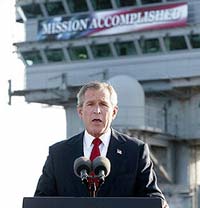
More Avian Flu
As it's been noted in the past here, as the Avian Flu sitution gets more and more dire, the mainstream media simply can't continue to stick their head in the sand and ignore it. Earlier this week, the Boston Globe ran some stuff on it. Now it's the Washington Post
On Front Lines Of Asian Battle Against Bird Flu
By Alan Sipress
Washington Post Foreign Service
Sunday, May 22, 2005; Page A01
HANOI -- Behind high gray double doors, Professor Nguyen Thu Van, a simply dressed woman with black hair held back by a barrette, has been laboring tirelessly with her team of researchers in a race to avert a pandemic.
Her white-coated co-workers scurried about one recent day in their small, second-floor laboratory in an elegant French colonial building in the Vietnamese capital. Engaged in a drive to perfect a human vaccine against avian influenza, Van, 50, has produced an experimental version and conducted successful tests on monkeys. She and her researchers have volunteered to be the first subjects in human trials, which she hopes will begin this summer despite warnings from the World Health Organization.
Van is at the forefront of a campaign in Southeast Asia to halt the progress of bird flu. International health specialists say they fear the virus could undergo genetic changes suddenly and become the most deadly disease to strike humanity in modern times. Almost 200 million chickens, ducks and other birds throughout Southeast Asia have died from the virus or been slaughtered to contain it in the last two years.
So far, bird flu has killed 53 people, mostly as a result of close contact with infected poultry. But international health experts say they suspect the virus has also begun to spread among humans.
With bird flu endemic among birds in the Asian countryside, the disease could pose a threat to humans for years. And in an age of global travel, health experts predict that an easily transmitted human strain could move beyond Asia in a matter of weeks and infect tens of millions of people worldwide.
What struck me was both the title and were this article is located... it's A01! the tone here is very serious through out the article, which is quite long. There are also some interesting bits about how some researchers are trying to make a vaccine and the author makes a point to throw in some jabs against laws and international health guidelines so the focus of the article can come across as more heroic, just like in the movies.
The article is well worth reading and supports a lot of the stuff that Melanie has warned us about for months and months. Oh, and another reason the Post probably put this on the front page is because of the following announcement:
China in national bird flu alert
China has ordered nationwide emergency measures to try to stop the spread of bird flu after discovering that wild geese had been killed by the virus.
Agriculture officials say the migratory birds may have brought a more virulent flu strain into China from South East Asia, Xinhua official news agency said.
Tests confirmed that the geese found dead in Qinghai province had been infected with the H5N1 virus.
The virus has killed at least 53 people in South East Asia since late 2003.
China has had confirmed outbreaks of H5N1 in birds before, but no-one has yet died from avian flu on the mainland.
In Hong Kong, six people died after being infected when the strain spread from wildfowl to chickens to humans in 1997.
An expert from the national bird flu reference laboratory, Cui Shangjin, told Xinhua that "people need not be too worried" as the controls introduced should be effective.
The measures include:
* Banning people from habitats of migratory birds
* Immunising poultry raised near habitats and routes of migratory birds
* Asking public to stop contact with poultry
* Introducing quarantine measures in Qinghai
Now manybe the Chinese will have some more success in limiting the spread of the flu, but you know it's serious when the news agency there comes out and says there is a problem, no matter how they try and downplay it. This really has me worried because I remember what their initial responce was to SARS just a few years ago.
Workers Giving Up Vacations
At the Breaking Point, Passing Up Vacation
Workers Give Back 421 Million Days in 2005
By Amy Joyce
Washington Post Staff Writer
Sunday, May 22, 2005; Page F06
Are you vacation-deprived?
According to a new study from Expedia.com (okay, I understand it behooves a company that sells travel arrangements to say this): You probably are.
Americans are likely to give back more than 421 million vacation days in 2005, according to the survey of more than 2,000 people conducted by Harris Interactive and released this week. That means each employed U.S. adult will leave an average of three vacation days unused this year. Nearly one third (31 percent) of Americans say they do not use all their vacation days, even though many of them say they feel rejuvenated when they return to work after a vacation.
We all talk about vacations and vacation time. It's important enough that it makes its way onto the small talk list at cocktail parties (how's work, can you believe this weather, are you going away anytime soon?). But according to this study, and in talking to hard workers out there, vacation is not always important enough to force us to take as much as we're offered.
The average length of vacation time spent away from home was four days in 2003, compared with 5.4 nights in 1985 and more than a week 25 years ago, according to the Travel Industry Association.
With the economy sending us all on a roller coaster ride (long weekend to an amusement park, anyone?), workers around the nation have been a little stingier with their paid days off. It's important for employees to work hard, look like they are working hard, and be at the ready when the boss is looking for someone to take on another project.
Just one more indication of the extent to which employers have the upper hand in America: many workers don't feel they're able to take the vacation they're theoretically entitled to.
The rest of the article's behind the cut.
This week's study found that of the 31 percent of U.S. adults who said they don't always take all their vacation days, 13 percent said that is because they get money back for unused days, 12 percent said it was because they need to schedule a vacation in advance (so get with the program, folks), and 10 percent said they were simply too busy at work to get away.
For Thomas Kim, it's a combination of all those factors that has left him vacationless for longer than he can remember. Kim runs a Web and software development firm in Washington that recently merged with a lobbying organization. Between that and a 1-year-old, Kim and his wife, a lawyer, haven't had a vacation "in a couple of years."
Other than a long weekend to Chicago for a recent wedding, they have mostly been tied to their work. Kim said that although owning his own business may make it hard to get away, it also offers a more flexible environment, so he can take longer lunches or stay home if his son is sick.
But still, he said, that's no vacation. "It would be wonderful to just kind of get away and unplug for a week and recoup, reenergize myself. But I don't really feel like it's an absolute necessity right now," he said. "And if I were to go away, I'm sure I'd still check e-mail or bring my BlackBerry."
Kim's not alone in that no-vacation vacation so many people take. According to the survey, 16 percent of respondents checked work e-mail or voice mail while vacationing. ( Just 16 percent?)
That's why Nancy Palazza, president of Alternative Employment Specialists in Herndon, likes to take vacations abroad: Her cell phone doesn't work there. "That's the only time I really feel like I'm on vacation. Other times, I'm always connected," she said. Palazza likes to plan a vacation as soon as she gets home from one so she has something to look forward to. Because her husband is a high school teacher, she takes breaks when his schedule allows. Her next vacation? France in July.
"I encourage my staff to do the same thing," she said. "Because I think if you don't take the time to go and do it, you feel like you're working forever, and you need down time."
However, Palazza refuses to take a vacation of more than 10 days because "that's the limit where I feel comfortable," she said.
That mind-set is very American, according to the survey.
Thirty-eight percent of employees who have vacation time in 2005 say they will take one full week of vacation and use the rest of the time here and there. (Expedia calls it a "power week.")
France, the land of vacation time, provides its workers with an average of 39 days a year, while nearly half of its workers take one three- to four-week vacation each year.
Employed Canadian adults receive an average of 20 days of vacation, but its workers are tied with Americans in giving back the most vacation days per person: three days on average.
"I always take all of it and, in fact, wish I had more," said Kari Swartz, Expedia's product manager for leisure travel, who gets three weeks a year. So what does the state of the survey make her think? "It's sad."
Why sad? Because we need to take vacations. Sure, the e-mails pile up, and all the problems that weren't taken care of while we were away await us. But as 48 percent of the more than 2,000 respondents said, they feel rested and more productive when they get back from taking a vacation.
"I envy the folks that do," Kim said.
horrible
In U.S. Report, Brutal Details of 2 Afghan Inmates' Deaths
By TIM GOLDEN
New York Times
May 20, 2005
Even as the young Afghan man was dying before them, his American jailers continued to torment him.
The prisoner, a slight, 22-year-old taxi driver known only as Dilawar, was hauled from his cell at the detention center in Bagram, Afghanistan, at around 2 a.m. to answer questions about a rocket attack on an American base. When he arrived in the interrogation room, an interpreter who was present said, his legs were bouncing uncontrollably in the plastic chair and his hands were numb. He had been chained by the wrists to the top of his cell for much of the previous four days.
Mr. Dilawar asked for a drink of water, and one of the two interrogators, Specialist Joshua R. Claus, 21, picked up a large plastic bottle. But first he punched a hole in the bottom, the interpreter said, so as the prisoner fumbled weakly with the cap, the water poured out over his orange prison scrubs. The soldier then grabbed the bottle back and began squirting the water forcefully into Mr. Dilawar's face.
"Come on, drink!" the interpreter said Specialist Claus had shouted, as the prisoner gagged on the spray. "Drink!"
At the interrogators' behest, a guard tried to force the young man to his knees. But his legs, which had been pummeled by guards for several days, could no longer bend. An interrogator told Mr. Dilawar that he could see a doctor after they finished with him. When he was finally sent back to his cell, though, the guards were instructed only to chain the prisoner back to the ceiling.
"Leave him up," one of the guards quoted Specialist Claus as saying.
Several hours passed before an emergency room doctor finally saw Mr. Dilawar. By then he was dead, his body beginning to stiffen. It would be many months before Army investigators learned a final horrific detail: Most of the interrogators had believed Mr. Dilawar was an innocent man who simply drove his taxi past the American base at the wrong time.
The story of Mr. Dilawar's brutal death at the Bagram Collection Point - and that of another detainee, Habibullah, who died there six days earlier in December 2002 - emerge from a nearly 2,000-page confidential file of the Army's criminal investigation into the case, a copy of which was obtained by The New York Times.
Like a narrative counterpart to the digital images from Abu Ghraib, the Bagram file depicts young, poorly trained soldiers in repeated incidents of abuse. The harsh treatment, which has resulted in criminal charges against seven soldiers, went well beyond the two deaths.
In some instances, testimony shows, it was directed or carried out by interrogators to extract information. In others, it was punishment meted out by military police guards. Sometimes, the torment seems to have been driven by little more than boredom or cruelty, or both.
Beneath the cut, the details get even more graphic. Even after everything I'd already learned since the Abu Ghraib story broke last year, it stuns me that such brutality was committed in the name of America. Basically, they beat and hanged this guy to death over the course of several days, just because. He was just some poor schlub in the wrong place at the wrong time, and we put him in a hell on earth. Most of the time this torture was going on, they weren't even interrogating him.
Horrible. Just horrible.
Who knows how many of the 108 persons known to have died in U.S. custody in Iraq and Afghanistan spent the last hours and days of their lives in a similar hell.
In sworn statements to Army investigators, soldiers describe one female interrogator with a taste for humiliation stepping on the neck of one prostrate detainee and kicking another in the genitals. They tell of a shackled prisoner being forced to roll back and forth on the floor of a cell, kissing the boots of his two interrogators as he went. Yet another prisoner is made to pick plastic bottle caps out of a drum mixed with excrement and water as part of a strategy to soften him up for questioning.
The Times obtained a copy of the file from a person involved in the investigation who was critical of the methods used at Bagram and the military's response to the deaths.
Although incidents of prisoner abuse at Bagram in 2002, including some details of the two men's deaths, have been previously reported, American officials have characterized them as isolated problems that were thoroughly investigated. And many of the officers and soldiers interviewed in the Dilawar investigation said the large majority of detainees at Bagram were compliant and reasonably well treated.
"What we have learned through the course of all these investigations is that there were people who clearly violated anyone's standard for humane treatment," said the Pentagon's chief spokesman, Larry Di Rita. "We're finding some cases that were not close calls."
Yet the Bagram file includes ample testimony that harsh treatment by some interrogators was routine and that guards could strike shackled detainees with virtual impunity. Prisoners considered important or troublesome were also handcuffed and chained to the ceilings and doors of their cells, sometimes for long periods, an action Army prosecutors recently classified as criminal assault.
Some of the mistreatment was quite obvious, the file suggests. Senior officers frequently toured the detention center, and several of them acknowledged seeing prisoners chained up for punishment or to deprive them of sleep. Shortly before the two deaths, observers from the International Committee of the Red Cross specifically complained to the military authorities at Bagram about the shackling of prisoners in "fixed positions," documents show.
Even though military investigators learned soon after Mr. Dilawar's death that he had been abused by at least two interrogators, the Army's criminal inquiry moved slowly. Meanwhile, many of the Bagram interrogators, led by the same operations officer, Capt. Carolyn A. Wood, were redeployed to Iraq and in July 2003 took charge of interrogations at the Abu Ghraib prison. According to a high-level Army inquiry last year, Captain Wood applied techniques there that were "remarkably similar" to those used at Bagram.
Last October, the Army's Criminal Investigation Command concluded that there was probable cause to charge 27 officers and enlisted personnel with criminal offenses in the Dilawar case ranging from dereliction of duty to maiming and involuntary manslaughter. Fifteen of the same soldiers were also cited for probable criminal responsibility in the Habibullah case.
So far, only the seven soldiers have been charged, including four last week. No one has been convicted in either death. Two Army interrogators were also reprimanded, a military spokesman said. Most of those who could still face legal action have denied wrongdoing, either in statements to investigators or in comments to a reporter.
"The whole situation is unfair," Sgt. Selena M. Salcedo, a former Bagram interrogator who was charged with assaulting Mr. Dilawar, dereliction of duty and lying to investigators, said in a telephone interview. "It's all going to come out when everything is said and done."
With most of the legal action pending, the story of abuses at Bagram remains incomplete. But documents and interviews reveal a striking disparity between the findings of Army investigators and what military officials said in the aftermath of the deaths.
Military spokesmen maintained that both men had died of natural causes, even after military coroners had ruled the deaths homicides. Two months after those autopsies, the American commander in Afghanistan, then-Lt. Gen. Daniel K. McNeill, said he had no indication that abuse by soldiers had contributed to the two deaths. The methods used at Bagram, he said, were "in accordance with what is generally accepted as interrogation techniques."
The Interrogators
In the summer of 2002, the military detention center at Bagram, about 40 miles north of Kabul, stood as a hulking reminder of the Americans' improvised hold over Afghanistan.
Built by the Soviets as an aircraft machine shop for the operations base they established after their intervention in the country in 1979, the building had survived the ensuing wars as a battered relic - a long, squat, concrete block with rusted metal sheets where the windows had once been.
Retrofitted with five large wire pens and a half dozen plywood isolation cells, the building became the Bagram Collection Point, a clearinghouse for prisoners captured in Afghanistan and elsewhere. The B.C.P., as soldiers called it, typically held between 40 and 80 detainees while they were interrogated and screened for possible shipment to the Pentagon's longer-term detention center at Guantánamo Bay, Cuba.
The new interrogation unit that arrived in July 2002 had been improvised as well. Captain Wood, then a 32-year-old lieutenant, came with 13 soldiers from the 525th Military Intelligence Brigade at Fort Bragg, N.C.; six Arabic-speaking reservists were added from the Utah National Guard.
Part of the new group, which was consolidated under Company A of the 519th Military Intelligence Battalion, was made up of counterintelligence specialists with no background in interrogation. Only two of the soldiers had ever questioned actual prisoners.
What specialized training the unit received came on the job, in sessions with two interrogators who had worked in the prison for a few months. "There was nothing that prepared us for running an interrogation operation" like the one at Bagram, the noncommissioned officer in charge of the interrogators, Staff Sgt. Steven W. Loring, later told investigators.
Nor were the rules of engagement very clear. The platoon had the standard interrogations guide, Army Field Manual 34-52, and an order from the secretary of defense, Donald H. Rumsfeld, to treat prisoners "humanely," and when possible, in accordance with the Geneva Conventions. But with President Bush's final determination in February 2002 that the Conventions did not apply to the conflict with Al Qaeda and that Taliban fighters would not be accorded the rights of prisoners of war, the interrogators believed they "could deviate slightly from the rules," said one of the Utah reservists, Sgt. James A. Leahy.
"There was the Geneva Conventions for enemy prisoners of war, but nothing for terrorists," Sergeant Leahy told Army investigators. And the detainees, senior intelligence officers said, were to be considered terrorists until proved otherwise.
The deviations included the use of "safety positions" or "stress positions" that would make the detainees uncomfortable but not necessarily hurt them - kneeling on the ground, for instance, or sitting in a "chair" position against the wall. The new platoon was also trained in sleep deprivation, which the previous unit had generally limited to 24 hours or less, insisting that the interrogator remain awake with the prisoner to avoid pushing the limits of humane treatment.
But as the 519th interrogators settled into their jobs, they set their own procedures for sleep deprivation. They decided on 32 to 36 hours as the optimal time to keep prisoners awake and eliminated the practice of staying up themselves, one former interrogator, Eric LaHammer, said in an interview.
The interrogators worked from a menu of basic tactics to gain a prisoner's cooperation, from the "friendly" approach, to good cop-bad cop routines, to the threat of long-term imprisonment. But some less-experienced interrogators came to rely on the method known in the military as "Fear Up Harsh," or what one soldier referred to as "the screaming technique."
Sergeant Loring, then 27, tried with limited success to wean those interrogators off that approach, which typically involved yelling and throwing chairs. Mr. Leahy said the sergeant "put the brakes on when certain approaches got out of hand." But he could also be dismissive of tactics he considered too soft, several soldiers told investigators, and gave some of the most aggressive interrogators wide latitude. (Efforts to locate Mr. Loring, who has left the military, were unsuccessful.)
"We sometimes developed a rapport with detainees, and Sergeant Loring would sit us down and remind us that these were evil people and talk about 9/11 and they weren't our friends and could not be trusted," Mr. Leahy said.
Specialist Damien M. Corsetti, a tall, bearded interrogator sometimes called "Monster" -he had the nickname tattooed in Italian across his stomach, other soldiers said - was often chosen to intimidate new detainees. Specialist Corsetti, they said, would glower and yell at the arrivals as they stood chained to an overhead pole or lay face down on the floor of a holding room. (A military police K-9 unit often brought growling dogs to walk among the new prisoners for similar effect, documents show.)
"The other interrogators would use his reputation," said one interrogator, Specialist Eric H. Barclais. "They would tell the detainee, 'If you don't cooperate, we'll have to get Monster, and he won't be as nice.' " Another soldier told investigators that Sergeant Loring lightheartedly referred to Specialist Corsetti, then 23, as "the King of Torture."
A Saudi detainee who was interviewed by Army investigators last June at Guantánamo said Specialist Corsetti had pulled out his penis during an interrogation at Bagram, held it against the prisoner's face and threatened to rape him, excerpts from the man's statement show.
Last fall, the investigators cited probable cause to charge Specialist Corsetti with assault, maltreatment of a prisoner and indecent acts in the incident; he has not been charged. At Abu Ghraib, he was also one of three members of the 519th who were fined and demoted for forcing an Iraqi woman to strip during questioning, another interrogator said. A spokesman at Fort Bragg said Specialist Corsetti would not comment.
In late August of 2002, the Bagram interrogators were joined by a new military police unit that was assigned to guard the detainees. The soldiers, mostly reservists from the 377th Military Police Company based in Cincinnati and Bloomington, Ind., were similarly unprepared for their mission, members of the unit said.
The company received basic lessons in handling prisoners at Fort Dix, N.J., and some police and corrections officers in its ranks provided further training. That instruction included an overview of "pressure-point control tactics" and notably the "common peroneal strike" - a potentially disabling blow to the side of the leg, just above the knee.
The M.P.'s said they were never told that peroneal strikes were not part of Army doctrine. Nor did most of them hear one of the former police officers tell a fellow soldier during the training that he would never use such strikes because they would "tear up" a prisoner's legs.
But once in Afghanistan, members of the 377th found that the usual rules did not seem to apply. The peroneal strike quickly became a basic weapon of the M.P. arsenal. "That was kind of like an accepted thing; you could knee somebody in the leg," former Sgt. Thomas V. Curtis told the investigators.
A few weeks into the company's tour, Specialist Jeremy M. Callaway overheard another guard boasting about having beaten a detainee who had spit on him. Specialist Callaway also told investigators that other soldiers had congratulated the guard "for not taking any" from a detainee.
One captain nicknamed members of the Third Platoon "the Testosterone Gang." Several were devout bodybuilders. Upon arriving in Afghanistan, a group of the soldiers decorated their tent with a Confederate flag, one soldier said.
Some of the same M.P.'s took a particular interest in an emotionally disturbed Afghan detainee who was known to eat his feces and mutilate himself with concertina wire. The soldiers kneed the man repeatedly in the legs and, at one point, chained him with his arms straight up in the air, Specialist Callaway told investigators. They also nicknamed him "Timmy," after a disabled child in the animated television series "South Park." One of the guards who beat the prisoner also taught him to screech like the cartoon character, Specialist Callaway said.
Eventually, the man was sent home.
The Defiant Detainee
The detainee known as Person Under Control No. 412 was a portly, well-groomed Afghan named Habibullah. Some American officials identified him as "Mullah" Habibullah, a brother of a former Taliban commander from the southern Afghan province of Oruzgan.
He stood out from the scraggly guerrillas and villagers whom the Bagram interrogators typically saw. "He had a piercing gaze and was very confident," the provost marshal in charge of the M.P.'s, Maj. Bobby R. Atwell, recalled.
Documents from the investigation suggest that Mr. Habibullah was captured by an Afghan warlord on Nov. 28, 2002, and delivered to Bagram by C.I.A. operatives two days later. His well-being at that point is a matter of dispute. The doctor who examined him on arrival at Bagram reported him in good health. But the intelligence operations chief, Lt. Col. John W. Loffert Jr., later told Army investigators, "He was already in bad condition when he arrived."
What is clear is that Mr. Habibullah was identified at Bagram as an important prisoner and an unusually sharp-tongued and insubordinate one.
One of the 377th's Third Platoon sergeants, Alan J. Driver Jr., told investigators that Mr. Habibullah rose up after a rectal examination and kneed him in the groin. The guard said he grabbed the prisoner by the head and yelled in his face. Mr. Habibullah then "became combative," Sergeant Driver said, and had to be subdued by three guards and led away in an armlock.
He was then confined in one of the 9-foot by 7-foot isolation cells, which the M.P. commander, Capt. Christopher M. Beiring, later described as a standard procedure. "There was a policy that detainees were hooded, shackled and isolated for at least the first 24 hours, sometimes 72 hours of captivity," he told investigators.
While the guards kept some prisoners awake by yelling or poking at them or banging on their cell doors, Mr. Habibullah was shackled by the wrists to the wire ceiling over his cell, soldiers said.
On his second day, Dec. 1, the prisoner was "uncooperative" again, this time with Specialist Willie V. Brand. The guard, who has since been charged with assault and other crimes, told investigators he had delivered three peroneal strikes in response. The next day, Specialist Brand said, he had to knee the prisoner again. Other blows followed.
A lawyer for Specialist Brand, John P. Galligan, said there was no criminal intent by his client to hurt any detainee. "At the time, my client was acting consistently with the standard operating procedure that was in place at the Bagram facility."
The communication between Mr. Habibullah and his jailers appears to have been almost exclusively physical. Despite repeated requests, the M.P.'s were assigned no interpreters of their own. Instead, they borrowed from the interrogators when they could and relied on prisoners who spoke even a little English to translate for them.
When the detainees were beaten or kicked for "noncompliance," one of the interpreters, Ali M. Baryalai said, it was often "because they have no idea what the M.P. is saying."
By the morning of Dec. 2, witnesses told the investigators, Mr. Habibullah was coughing and complaining of chest pains. He limped into the interrogation room in shackles, his right leg stiff and his right foot swollen. The lead interrogator, Sergeant Leahy, let him sit on the floor because he could not bend his knees and sit in a chair.
The interpreter who was on hand, Ebrahim Baerde, said the interrogators had kept their distance that day "because he was spitting up a lot of phlegm."
"They were laughing and making fun of him, saying it was 'gross' or 'nasty,' " Mr. Baerde said.
Though battered, Mr. Habibullah was unbowed.
"Once they asked him if he wanted to spend the rest of his life in handcuffs," Mr. Baerde said. "His response was, 'Yes, don't they look good on me?' "
By Dec. 3, Mr. Habibullah's reputation for defiance seemed to make him an open target. One M.P. said he had given him five peroneal strikes for being "noncompliant and combative." Another gave him three or four more for being "combative and noncompliant." Some guards later asserted that he had been hurt trying to escape.
When Sgt. James P. Boland saw Mr. Habibullah on Dec. 3, he was in one of the isolation cells, tethered to the ceiling by two sets of handcuffs and a chain around his waist. His body was slumped forward, held up by the chains.
Sergeant Boland told the investigators he had entered the cell with two other guards, Specialists Anthony M. Morden and Brian E. Cammack. (All three have been charged with assault and other crimes.) One of them pulled off the prisoner's black hood. His head was slumped to one side, his tongue sticking out. Specialist Cammack said he had put some bread on Mr. Habibullah's tongue. Another soldier put an apple in the prisoner's hand; it fell to the floor.
When Specialist Cammack turned back toward the prisoner, he said in one statement, Mr. Habibullah's spit hit his chest. Later, Specialist Cammack acknowledged, "I'm not sure if he spit at me." But at the time, he exploded, yelling, "Don't ever spit on me again!" and kneeing the prisoner sharply in the thigh, "maybe a couple" of times. Mr. Habibullah's limp body swayed back and forth in the chains.
When Sergeant Boland returned to the cell some 20 minutes later, he said, Mr. Habibullah was not moving and had no pulse. Finally, the prisoner was unchained and laid out on the floor of his cell.
The guard who Specialist Cammack said had counseled him back in New Jersey about the dangers of peroneal strikes found him in the room where Mr. Habibullah lay, his body already cold.
"Specialist Cammack appeared very distraught," Specialist William Bohl told an investigator. The soldier "was running about the room hysterically."
An M.P. was sent to wake one of the medics.
"What are you getting me for?" the medic, Specialist Robert S. Melone, responded, telling him to call an ambulance instead.
When another medic finally arrived, he found Mr. Habibullah on the floor, his arms outstretched, his eyes and mouth open.
"It looked like he had been dead for a while, and it looked like nobody cared," the medic, Staff Sgt. Rodney D. Glass, recalled.
Not all of the guards were indifferent, their statements show. But if Mr. Habibullah's death shocked some of them, it did not lead to major changes in the detention center's operation.
Military police guards were assigned to be present during interrogations to help prevent mistreatment. The provost marshal, Major Atwell, told investigators he had already instructed the commander of the M.P. company, Captain Beiring, to stop chaining prisoners to the ceiling. Others said they never received such an order.
Senior officers later told investigators that they had been unaware of any serious abuses at the B.C.P. But the first sergeant of the 377th, Betty J. Jones, told investigators that the use of standing restraints, sleep deprivation and peroneal strikes was readily apparent.
"Everyone that is anyone went through the facility at one time or another," she said.
Major Atwell said the death "did not cause an enormous amount of concern 'cause it appeared natural."
In fact, Mr. Habibullah's autopsy, completed on Dec. 8, showed bruises or abrasions on his chest, arms and head. There were deep contusions on his calves, knees and thighs. His left calf was marked by what appeared to have been the sole of a boot.
His death was attributed to a blood clot, probably caused by the severe injuries to his legs, which traveled to his heart and blocked the blood flow to his lungs.
The Shy Detainee
On Dec. 5, one day after Mr. Habibullah died, Mr. Dilawar arrived at Bagram.
Four days before, on the eve of the Muslim holiday of Id al-Fitr, Mr. Dilawar set out from his tiny village of Yakubi in a prized new possession, a used Toyota sedan that his family bought for him a few weeks earlier to drive as a taxi.
Mr. Dilawar was not an adventurous man. He rarely went far from the stone farmhouse he shared with his wife, young daughter and extended family. He never attended school, relatives said, and had only one friend, Bacha Khel, with whom he would sit in the wheat fields surrounding the village and talk.
"He was a shy man, a very simple man," his eldest brother, Shahpoor, said in an interview.
On the day he disappeared, Mr. Dilawar's mother had asked him to gather his three sisters from their nearby villages and bring them home for the holiday. But he needed gas money and decided instead to drive to the provincial capital, Khost, about 45 minutes away, to look for fares.
At a taxi stand there, he found three men headed back toward Yakubi. On the way, they passed a base used by American troops, Camp Salerno, which had been the target of a rocket attack that morning.
Militiamen loyal to the guerrilla commander guarding the base, Jan Baz Khan, stopped the Toyota at a checkpoint. They confiscated a broken walkie-talkie from one of Mr. Dilawar's passengers. In the trunk, they found an electric stabilizer used to regulate current from a generator. (Mr. Dilawar's family said the stabilizer was not theirs; at the time, they said, they had no electricity at all.)
The four men were detained and turned over to American soldiers at the base as suspects in the attack. Mr. Dilawar and his passengers spent their first night there handcuffed to a fence, so they would be unable to sleep. When a doctor examined them the next morning, he said later, he found Mr. Dilawar tired and suffering from headaches but otherwise fine.
Mr. Dilawar's three passengers were eventually flown to Guantánamo and held for more than a year before being sent home without charge. In interviews after their release, the men described their treatment at Bagram as far worse than at Guantánamo. While all of them said they had been beaten, they complained most bitterly of being stripped naked in front of female soldiers for showers and medical examinations, which they said included the first of several painful and humiliating rectal exams.
"They did lots and lots of bad things to me," said Abdur Rahim, a 26-year-old baker from Khost. "I was shouting and crying, and no one was listening. When I was shouting, the soldiers were slamming my head against the desk."
For Mr. Dilawar, his fellow prisoners said, the most difficult thing seemed to be the black cloth hood that was pulled over his head. "He could not breathe," said a man called Parkhudin, who had been one of Mr. Dilawar's passengers.
Mr. Dilawar was a frail man, standing only 5 feet 9 inches and weighing 122 pounds. But at Bagram, he was quickly labeled one of the "noncompliant" ones.
When one of the First Platoon M.P.'s, Specialist Corey E. Jones, was sent to Mr. Dilawar's cell to give him some water, he said the prisoner spit in his face and started kicking him. Specialist Jones responded, he said, with a couple of knee strikes to the leg of the shackled man.
"He screamed out, 'Allah! Allah! Allah!' and my first reaction was that he was crying out to his god," Specialist Jones said to investigators. "Everybody heard him cry out and thought it was funny."
Other Third Platoon M.P.'s later came by the detention center and stopped at the isolation cells to see for themselves, Specialist Jones said.
It became a kind of running joke, and people kept showing up to give this detainee a common peroneal strike just to hear him scream out 'Allah,' " he said. "It went on over a 24-hour period, and I would think that it was over 100 strikes."
In a subsequent statement, Specialist Jones was vague about which M.P.'s had delivered the blows. His estimate was never confirmed, but other guards eventually admitted striking Mr. Dilawar repeatedly.
Many M.P.'s would eventually deny that they had any idea of Mr. Dilawar's injuries, explaining that they never saw his legs beneath his jumpsuit. But Specialist Jones recalled that the drawstring pants of Mr. Dilawar's orange prison suit fell down again and again while he was shackled.
"I saw the bruise because his pants kept falling down while he was in standing restraints," the soldier told investigators. "Over a certain time period, I noticed it was the size of a fist."
As Mr. Dilawar grew desperate, he began crying out more loudly to be released. But even the interpreters had trouble understanding his Pashto dialect; the annoyed guards heard only noise.
"He had constantly been screaming, 'Release me; I don't want to be here,' and things like that," said the one linguist who could decipher his distress, Abdul Ahad Wardak.
The Interrogation
On Dec. 8, Mr. Dilawar was taken for his fourth interrogation. It quickly turned hostile.
The 21-year-old lead interrogator, Specialist Glendale C. Walls II, later contended that Mr. Dilawar was evasive. "Some holes came up, and we wanted him to answer us truthfully," he said. The other interrogator, Sergeant Salcedo, complained that the prisoner was smiling, not answering questions, and refusing to stay kneeling on the ground or sitting against the wall.
The interpreter who was present, Ahmad Ahmadzai, recalled the encounter differently to investigators.
The interrogators, Mr. Ahmadzai said, accused Mr. Dilawar of launching the rockets that had hit the American base. He denied that. While kneeling on the ground, he was unable to hold his cuffed hands above his head as instructed, prompting Sergeant Salcedo to slap them back up whenever they began to drop.
"Selena berated him for being weak and questioned him about being a man, which was very insulting because of his heritage," Mr. Ahmadzai said.
When Mr. Dilawar was unable to sit in the chair position against the wall because of his battered legs, the two interrogators grabbed him by the shirt and repeatedly shoved him back against the wall.
"This went on for 10 or 15 minutes," the interpreter said. "He was so tired he couldn't get up."
"They stood him up, and at one point Selena stepped on his bare foot with her boot and grabbed him by his beard and pulled him towards her," he went on. "Once Selena kicked Dilawar in the groin, private areas, with her right foot. She was standing some distance from him, and she stepped back and kicked him.
"About the first 10 minutes, I think, they were actually questioning him, after that it was pushing, shoving, kicking and shouting at him," Mr. Ahmadzai said. "There was no interrogation going on."
The session ended, he said, with Sergeant Salcedo instructing the M.P.'s to keep Mr. Dilawar chained to the ceiling until the next shift came on.
The next morning, Mr. Dilawar began yelling again. At around noon, the M.P.'s called over another of the interpreters, Mr. Baerde, to try to quiet Mr. Dilawar down.
"I told him, 'Look, please, if you want to be able to sit down and be released from shackles, you just need to be quiet for one more hour."
"He told me that if he was in shackles another hour, he would die," Mr. Baerde said.
Half an hour later, Mr. Baerde returned to the cell. Mr. Dilawar's hands hung limply from the cuffs, and his head, covered by the black hood, slumped forward.
"He wanted me to get a doctor, and said that he needed 'a shot,' " Mr. Baerde recalled. "He said that he didn't feel good. He said that his legs were hurting."
Mr. Baerde translated Mr. Dilawar's plea to one of the guards. The soldier took the prisoner's hand and pressed down on his fingernails to check his circulation.
"He's O.K.," Mr. Baerde quoted the M.P. as saying. "He's just trying to get out of his restraints."
By the time Mr. Dilawar was brought in for his final interrogation in the first hours of the next day, Dec. 10, he appeared exhausted and was babbling that his wife had died. He also told the interrogators that he had been beaten by the guards.
"But we didn't pursue that," said Mr. Baryalai, the interpreter.
Specialist Walls was again the lead interrogator. But his more aggressive partner, Specialist Claus, quickly took over, Mr. Baryalai said.
"Josh had a rule that the detainee had to look at him, not me," the interpreter told investigators. "He gave him three chances, and then he grabbed him by the shirt and pulled him towards him, across the table, slamming his chest into the table front."
When Mr. Dilawar was unable to kneel, the interpreter said, the interrogators pulled him to his feet and pushed him against the wall. Told to assume a stress position, the prisoner leaned his head against the wall and began to fall asleep.
"It looked to me like Dilawar was trying to cooperate, but he couldn't physically perform the tasks," Mr. Baryalai said.
Finally, Specialist Walls grabbed the prisoner and "shook him harshly," the interpreter said, telling him that if he failed to cooperate, he would be shipped to a prison in the United States, where he would be "treated like a woman, by the other men" and face the wrath of criminals who "would be very angry with anyone involved in the 9/11 attacks." (Specialist Walls was charged last week with assault, maltreatment and failure to obey a lawful order; Specialist Claus was charged with assault, maltreatment and lying to investigators. Each man declined to comment.)
A third military intelligence specialist who spoke some Pashto, Staff Sgt. W. Christopher Yonushonis, had questioned Mr. Dilawar earlier and had arranged with Specialist Claus to take over when he was done. Instead, the sergeant arrived at the interrogation room to find a large puddle of water on the floor, a wet spot on Mr. Dilawar's shirt and Specialist Claus standing behind the detainee, twisting up the back of the hood that covered the prisoner's head.
"I had the impression that Josh was actually holding the detainee upright by pulling on the hood," he said. "I was furious at this point because I had seen Josh tighten the hood of another detainee the week before. This behavior seemed completely gratuitous and unrelated to intelligence collection."
"What the hell happened with that water?" Sergeant Yonushonis said he had demanded.
"We had to make sure he stayed hydrated," he said Specialist Claus had responded.
The next morning, Sergeant Yonushonis went to the noncommissioned officer in charge of the interrogators, Sergeant Loring, to report the incident. Mr. Dilawar, however, was already dead.
The Post-Mortem
The findings of Mr. Dilawar's autopsy were succinct. He had had some coronary artery disease, the medical examiner reported, but what caused his heart to fail was "blunt force injuries to the lower extremities." Similar injuries contributed to Mr. Habibullah's death.
One of the coroners later translated the assessment at a pre-trial hearing for Specialist Brand, saying the tissue in the young man's legs "had basically been pulpified."
"I've seen similar injuries in an individual run over by a bus," added Lt. Col. Elizabeth Rouse, the coroner, and a major at that time.
After the second death, several of the 519th Battalion's interrogators were temporarily removed from their posts. A medic was assigned to the detention center to work night shifts. On orders from the Bagram intelligence chief, interrogators were prohibited from any physical contact with the detainees. Chaining prisoners to any fixed object was also banned, and the use of stress positions was curtailed.
In February, an American military official disclosed that the Afghan guerrilla commander whose men had arrested Mr. Dilawar and his passengers had himself been detained. The commander, Jan Baz Khan, was suspected of attacking Camp Salerno himself and then turning over innocent "suspects" to the Americans in a ploy to win their trust, the military official said.
The three passengers in Mr. Dilawar's taxi were sent home from Guantánamo in March 2004, 15 months after their capture, with letters saying they posed "no threat" to American forces.
They were later visited by Mr. Dilawar's parents, who begged them to explain what had happened to their son. But the men said they could not bring themselves to recount the details.
"I told them he had a bed," said Mr. Parkhudin. "I said the Americans were very nice because he had a heart problem."
In late August of last year, shortly before the Army completed its inquiry into the deaths, Sergeant Yonushonis, who was stationed in Germany, went at his own initiative to see an agent of the Criminal Investigation Command. Until then, he had never been interviewed.
"I expected to be contacted at some point by investigators in this case," he said. "I was living a few doors down from the interrogation room, and I had been one of the last to see this detainee alive."
Sergeant Yonushonis described what he had witnessed of the detainee's last interrogation. "I remember being so mad that I had trouble speaking," he said.
He also added a detail that had been overlooked in the investigative file. By the time Mr. Dilawar was taken into his final interrogations, he said, "most of us were convinced that the detainee was innocent."
Ruhallah Khapalwak, Carlotta Gall and David Rohde contributed reporting for this article, and Alain Delaqueriere assisted with research.
May 21, 2005
Something Amusing
I noticed this article yesterday and got a good laugh from it.
It's comforting to know that at least one form of advertising is banned in the US, at least for the time being. So, I can stilll look forward to taking my children out on a clear night and teach them where the Big Dipper or Cancer is without having to avoid some low orbiting golden arches.
Disturbing Cancer News
Breast cancer surges in under 40s
Sarah-Kate Templeton
May 22, 2005
The Sunday Times - Britain
HE number of women under the age of 40 with breast cancer has increased by more than 50% in a generation.
Only in the 50 to 64 age group was the rise higher, but among these women much of the increase was due to improved detection by the national screening programme, introduced in 1988.
Younger women are not routinely screened, but some experts believe a programme targeted at those in high-risk groups might now be justified.
Yesterday the surgeon who operated on Kylie Minogue, the 36-year-old Australian singer, announced that her operation for the disease had been successful.
When Minogue announced last week she had been diagnosed with breast cancer, there was widespread surprise that such a young and otherwise healthy woman could be affected.
But the figures, provided by Michel Coleman, professor of epidemiology at the London School of Hygiene and Tropical Medicine, show growing numbers of women of Minogue’s age are contracting the disease.
In 1975, 14 in every 100,000 women under 40 were diagnosed with breast cancer. This rose to 22 by 2001.
The reasons for the increase are not fully known, but women delaying having children until they are older is believed to be one of the main risk factors. Those who drink higher than recommended amounts of alcohol and those taking the contraceptive pill over a long period might also be more vulnerable.
Flying regularly and eating large amounts of animal fat might contribute but the extent has not been established.
I really don't know what else to say, except that I wish we knew why there is this sudden increase. I can think of 8 or 9 people I know under 40 who have suffered from breast cancer and while I don't know their family's medical histories, all came from very diverse backgrounds with the only common factor being the cancer.
I would hope that this increase has more to do with better forms of detection, but that's wishful thinking. Perhaps, as the article points out, the fact that women are waiting longer to have children (thus staying on the pill longer) may be one of the main reasons for this. I hope it isn't something environmental, but I don't know enough science to be able to prove or disprove that at all.
I do know that the world is without a shining light because of it. 2 and a half years ago one of my oldest friends called me about an obituary he found in the paper. A young lady we had attended elementary school with, Melissa Brown, had died at 32 due to breast cancer.
Melissa was one of the best of our class. She was smart, beautiful, and much kinder than anyone knew. She was an increadible musican who was also very talented in art. She eventually attended and graduated from Dartmouth with a BFA. She was working in San Fransico as Melissa Hurlock-Hobson (Hurlock was her grandmother's name and Hobson was her husband's) when she contracted the cancer. I'm sorry to say that I not seen any of her work.
I will always associate her with pink roses. At our middle school for Valentine's Day, you could purchase roses for people. Red was for someone you loved and pink was for a good friend. I was quite a loner in middle school and really didn't think that anyone liked me and yet, in 8th grade, the most popular girl in our class sent me a pink rose and a note thanking me for being her friend. She did the same the next year in 9th grade (and I sent her one too) and then we both went to new schools and didn't see each other again. I just wish that I had made an opportunity to tell her how much those flowers meant to me then, and still do even some 20 years later.
Please, if you or your loved ones aren't already doing it, make sure that your doctors are looking out for stuff like this. We all need to be thinking about it now instad of saying it can't happen to us.
First we came for the oil
U.S. Proposal in the O.A.S. Draws Fire as an Attack on Venezuela
By JOEL BRINKLEY
Published: May 22, 2005
WASHINGTON, May 21 - An American proposal to create a committee at the Organization of American States that would monitor the quality of democracy and the exercise of power in Latin America is facing a hostile reception from many countries in part because it is being viewed as a thinly veiled effort to attack Venezuela.
Roger F. Noriega, assistant secretary of state for Western Hemisphere affairs and a principal architect of the proposal, said in an interview this week that he was "not surprised they are seeing this in the context of Venezuela," but he added, "I am determined that it not be regarded as some kind of effort to isolate Venezuela."
Last month, however, he and other administration officials made several statements tying the effort directly to their concern about Hugo Chávez, Venezuela's populist, anti-American president. Mr. Chávez has curtailed some press freedoms and judicial independence while forming close ties with Cuba, an alliance that, more than anything else, infuriates some Bush administration officials.
The relationship between the United States and Mr. Chávez, which was already tense, deteriorated in 2002, after the United States tacitly backed a coup that briefly toppled him. The animosity has deepened since then, which is one reason many Latin American envoys remain skeptical of the reasoning Washington offers for its proposal.
"This explanation is going to be impossible to sell to any adult human being," said Rodolfo Hugo Gil, the Argentine ambassador to the Organization of American States.
The American proposal is to be offered for approval during a meeting of the regional organization in early June in Florida. It emerged from a statement made last month in Santiago, Chile, by José Miguel Insulza, the organization's newly elected secretary general, at the insistence of American officials.
"The elected governments that do not govern democratically should be held accountable by the O.A.S.," he said as Secretary of State Condoleezza Rice stood beside him. Ms. Rice and other American officials had wrested that remark from him in exchange for American support for his candidacy.
Immediately afterward, senior American officials told reporters traveling with Ms. Rice that Mr. Insulza's new plan would "hold the O.A.S. accountable for holding the Venezuelan government accountable for governing democratically," as one of them put it.
HAHAHAHAHAHAHAHAHAHA! (emphasis mine)
Seriously, just who does Condi think she is fooling? Maybe the only ones that she might fool with this are the Freshmen who tanked on my exam on Friday (many of whom couldn't find Venezula or Russia on regional maps of the world).
After all, wasn't it her boss that jumped up and down in excitement when an "independent" coup knocked Chavez out of power a couple of years ago and then was forced to back down and save face after Chavez returned to power in under 48 hours? Why wouldn't he try to meddle with our neighbors to the south, at least we could get some oil from them which is more than we are getting from our newest province in Mesopotamia.
Besides, if the O.A.S. really did use those bolded standards for ALL of its members, then I'm sure they have some interesting things to say about the largest member of the group that has had questionable elections for their President and currently is enacting policies that are very undemocratic. But, somehow I don't think we have to worry about that happening...
Choose Your Tyrant
Hitler, Darth Vader invade Senate in bitter fight on judges
BY JILL ZUCKMAN
Chicago Tribune
WASHINGTON - (KRT) - The debate over judicial nominations last week was, on the surface, full of the lofty rhetoric and formal discourse for which the Senate has long been known.Senators addressed one another as "my distinguished colleague." They cited the Constitution, repeatedly referring to "checks and balances," as well as "advice and consent." Many turned to history to guide their floor speeches.
But infused throughout the back-and-forth speeches of the world's foremost deliberative body were passion and bitterness more typically seen in the people's chamber, the House of Representatives.
Sen. Rick Santorum, R-Pa., compared Democrats to Adolf Hitler. Senate Majority Leader Bill Frist, R-Tenn., accused Democrats of trying "to kill, to defeat, to assassinate" nominees for the federal bench.
Democrats were not without their own colorful comparisons. Senate Minority Leader Harry Reid, D-Nev., told his colleagues, "When Americans think of a scary person in a black robe, they should be thinking of Darth Vader, not Republicans' choices for judges."
With such rhetoric punctuating the debate, political analysts and longtime observers of the Senate say something has changed and not for the better.
"There's a lot of acrimony and a lot of partisanship, and the Senate used to have more decorum and respect for the opposition," said Darrell West, a Brown University political scientist, attributing the harsh tone to a national political climate of polarization.
Ross Baker, a political scientist at Rutgers University, said the Senate is at risk of becoming "a slower, more unpleasant and frustrating place to do business."
"There are forces that are driving the Senate that are overwhelming their sense of propriety and self-admiration," Baker said, noting that "senators have always been struck with their own importance."
The forces that are driving Frist and Santorum are driving the Senate into irrelevance. They will become a rubber-stamp for the Bush Adminstration if they go for the nuclear option. Why does Bushco drive it's own party into habits of self-destruction?
Campaign Finance Unreform
This was in Thursday's WaPo; between Iraq, Newsweek, and the "nuclear option," this story seems to have slipped through unnoticed. I think it deserves a look-see.
GOP Targets Spending Limit
By Thomas B. Edsall
Washington Post Staff Writer
Thursday, May 19, 2005; Page A16
House Republicans are gearing up to push campaign finance legislation that would scrap post-Watergate restrictions on the total amount of money individuals can donate and parties can spend on candidates.
House Democratic leaders, who see the GOP gaining a huge financial advantage, yesterday protested the bill, as did campaign finance advocacy groups.
Rep. Mike Pence (R-Ind.), the bill's chief sponsor, said the measure makes a "a few modest changes" in the 2002 campaign finance law that "will restore freedom and fairness to the political economy of our nation."
But Minority Leader Nancy Pelosi (D-Calif.) and Minority Whip Steny H. Hoyer (D-Md.) wrote House Democrats that the bill, to be taken up next week by the House Administration Committee, would "enable wealthy individuals and interests to pour unlimited amounts of hard money into elections."
A person can donate $101,400 to federal candidates and parties in each two-year election cycle. The Pence bill would eliminate this limit. The limit an individual can contribute to a candidate or a political party would not change. Instead, individual donors could give Republican or Democratic committees a total of more than $1.1 million every two years: $53,400 to each of the three major (national, senatorial and congressional) party campaign committees and $20,000 to each of the 50 state parties.
Critics of the legislation contend that an enterprising donor could give $1.1 million to one campaign by giving the maximum allowed to all national and state committees, and asking them to put it into one race.
Lifting the limit would also allow any donor to make $4,200 contributions to any number of federal candidates.
Leaders of campaign finance advocacy groups charged that the House GOP leadership was undermining existing law to limit the influence of interest groups just when House Majority Leader Tom DeLay (R-Tex.) and House Administration Committee Chairman Robert W. Ney (R-Ohio) are at the center of controversies involving lobbyist-paid trips and campaign contributions allegedly tied to favorable action on Indian gambling proposals.
"Representative Ney should be promoting legislation to clean up Congress and his own House, not legislation that brings more special-interest money into politics," said Public Citizen President Joan Claybrook.
The Pence legislation, which is co-sponsored by Rep. Albert R. Wynn (D-Md.), would also allow the parties to spend unlimited amounts in behalf of House, Senate and presidential candidates. In Senate races, for example, the limit on the total given by parties ranges from $2.1 million in California to just over $100,000 in such small states as Vermont and Wyoming; under the Pence-Wynn bill, there would be no limits.
So far in the 2005-2006 election cycle, the three national Republican committees have far outraised their Democratic counterparts, $63.9 million to $38.7 million; GOP committees have $37.5 million cash on hand with no debt, while Democratic committees had $15.6 million with $4.4 million in debts, for net assets of $11.2 million.
Wynn's co-sponsorship has angered some Democratic colleagues. He said yesterday he is trying to "educate" his critics to show the bill could benefit the Democratic Party.
The Senate is considering separate campaign finance legislation, which Democrats have denounced. Senate Democratic leader Harry M. Reid (Nev.) said it is "clear to supporters of McCain-Feingold [the 2002 campaign finance law] that Republicans see this bill as an opportunity to subvert that reform legislation to their partisan benefit, not as an opportunity to advance reform."
This bill would enable wealthy individuals and interests to pour literally ten times as much money into elections as they used to. McCain-Feingold leveled the field; this would unlevel it again, in a big way. Let your congresscritters know how you feel.
Off The Hook
The unknown unknowns of the Abu Ghraib scandal
Seymour Hersh: The 10 inquiries into prisoner abuse have let Bush and Co off the hook
Saturday May 21, 2005
The Guardian
The 10 official inquiries into Abu Ghraib are asking the wrong questions, at least in terms of apportioning ultimate responsibility for the treatment of prisoners. The question that never gets adequately answered is this: what did the president do after being told about Abu Ghraib? It is here that chronology becomes very important.The US-led coalition forces swept to seeming immediate success in the March 2003 invasion of Iraq, and by early April Baghdad had been taken. Over the next few months, however, the resistance grew in scope, persistence and skill. In August 2003 it became more aggressive. At this point there was a decision to get tough with the thousands of prisoners in Iraq, many of whom had been seized in random raids or at roadside checkpoints. Major General Geoffrey D Miller, an army artillery officer who, as commander at Guantánamo, had got tough with the prisoners there, visited Baghdad to tutor the troops - to "Gitmo-ize" the Iraqi system.
By the beginning of October 2003 the reservists on the night shift at Abu Ghraib had begun their abuse of prisoners. They were aware that some of America's elite special forces units were also at work at the prison. Those highly trained military men had been authorized by the Pentagon's senior leadership to act far outside the normal rules of engagement. There was no secret about the interrogation practices used throughout that autumn and early winter, and few objections. In fact representatives of one of the Pentagon's private contractors at Abu Ghraib, who were involved in prisoner interrogation, were told that Condoleezza Rice, then the president's national security adviser, had praised their efforts. It's not clear why she would do so - there is still no evidence that the American intelligence community has accumulated any significant information about the operations of the resistance, who continue to strike US soldiers and Iraqis. The night shift's activities at Abu Ghraib came to an end on January 13 2004, when specialist Joseph M Darby, one of the 372nd reservists, provided army police authorities with a disk full of explicit images. By then, these horrors had been taking place for nearly four months.
Three days later the army began an investigation. But it is what was not done that is significant. There is no evidence that President Bush, upon learning of the devastating conduct at Abu Ghraib, asked any hard questions of Rumsfeld and his own aides in the White House; no evidence that they took any significant steps, upon learning in mid-January of the abuses, to review and modify the military's policy toward prisoners. I was told by a high-level former intelligence official that within days of the first reports the judicial system was programmed to begin prosecuting the enlisted men and women in the photos and to go no further up the chain of command.
In late April, after the CBS and New Yorker reports, a series of news conferences and press briefings emphasized the White House's dismay over the conduct of a few misguided soldiers at Abu Ghraib and the president's repeated opposition to torture. Miller was introduced anew to the American press corps in Baghdad and it was explained that the general had been assigned to clean up the prison system and instill respect for the Geneva conventions.
Despite Abu Ghraib and Guantánamo - not to mention Iraq and the failure of intelligence - and the various roles they played in what went wrong, Rumsfeld kept his job; Rice was promoted to secretary of state; Alberto Gonzales, who commissioned the memos justifying torture, became attorney general; deputy secretary of defense Paul Wolfowitz was nominated to the presidency of the World Bank; and Stephen Cambone, under-secretary of defense for intelligence and one of those most directly involved in the policies on prisoners, was still one of Rumsfeld's closest confidants. President Bush, asked about accountability, told the Washington Post before his second inauguration that the American people had supplied all the accountability needed - by re-electing him. Only seven enlisted men and women have been charged or pleaded guilty to offenses relating to Abu Ghraib. No officer is facing criminal proceedings.
This is the "anything goes" administration. If you're high enough up in the chain of command you're not only protected from disgrace, you're rewarded for being disgraceful.
Bush's Judges
Hey there!
I wanted to give everyone a head's up about a wonderful article that Salon has up about the judges that Bush considers worthy enough to risk a Constitutional Crisis over. While the day pass is annoying, it's worth it just to take a look at these voting profiles.
To no one's surprise, they are almost all pro-corporate and anti-average American as you can find. It is especially noteworthy to read about the records of the two that are being used to trigger all of this. The Republicans are clearly playing both the race and gender card in a way that is SO cynical that Brother Clarence's nomination some 13 years ago almost comes across as subtle.
This gang is why so many people are against the proposed compromises that will allow some, but not all of the judges to get a vote. Look, do any of us really think that if the good Doctor from Tenn. actually had the votes to ram these thugs through, that he wouldn't have already done so? Contact your senators, especially if they are reasonable (I'm stuck with Dole and Burr and, God help me, she's the reasonable one of the two), and let them know where you stand on this issue.
And we need to stand up now because as nasty as this is, with the Nazi rhetoric flowing from the Right, it's going to be 100 times worse if it's a Supreme Court spot.
MD Gov. Ehrlich Vetoes Practically Everything
Ehrlich Vetoes Bill Extending Rights to Gay Couples
Increase in Minimum Wage Among 24 Measures Rejected
By John Wagner
Washington Post Staff Writer
Saturday, May 21, 2005; Page A01
Maryland Gov. Robert L. Ehrlich Jr. vetoed a bill yesterday that would have granted rights to gay partners who register with the state, concluding after weeks of intense deliberations that the legislation threatened "the sanctity of traditional marriage."
The emotionally charged bill was among 24 that Ehrlich (R) rejected yesterday afternoon, including legislation to raise the state's minimum wage by $1, allow early voting in elections and heighten oversight of the state's troubled juvenile justice system. Another measure sought by gay rights activists that would have extended a property transfer tax exemption to domestic partners was also scuttled.
Ehrlich's decision to side, almost without exception, with business interests and social conservatives surprised some analysts, who thought he might try to burnish his credentials as a moderate by allowing some of the session's more controversial bills to become law.
(more at the link)
Ehrlich's choice doesn't surprise me one bit. He's following GWB's lead: (1) run initially with enough moderate-seeming appearance to get into office; (2) gradually sever all connections with the moderate stances that had won him enough moderate votes to be elected; and (3) brazen it out from there.
Here's what Ehrlich has vetoed:
· Senate Bill 796: Provide domestic partners certain medical and funeral rights afforded to married couples.
· House Bill 1298: Exempt domestic partners from real estate transfer and recordation taxes.
· HB 391: Increase the minimum wage for workers in the state from $5.15 to $6.15 an hour.
· HB 443: Allow Montgomery County police to use speed-monitoring cameras.
· SB 281: Create a commission to study Southern Maryland's transportation needs.
· HB 979: Create a legislative oversight committee to monitor the Department of Juvenile Services.
· HB 1342: Transfer the state's independent juvenile justice monitor office to the office of the attorney general.
· SB 849/HB 479: Begin a study of ways to independently verify ballot results from computerized voting machines.
· SB 287: Revise procedures for challenging a voter's identity and counting provisional ballots.
· SB 444: Reconstitute the State Elections Board.
· SB 478: Allow voters to cast ballots at the polls in advance of Election Day.
So he's killed a minimum-wage increase, he's prevented Wal-Mart from being required to be a decent corporate citizen (per Chuck's post yesterday), he's killed legislation that would enable domestic partners (straight, gay, or whatever) to be treated as family when one's SO is in the hospital or a nursing home; and he's vetoed a number of election-reform measures, including studying ways of verifying the honesty of Maryland's computerized balloting.
He's revealed his true colors.
May 20, 2005
Do as we say, not as we do
Army Warns Iraqi Forces On Abuse Of Detainees
By Bradley Graham
Washington Post Staff Writer
Friday, May 20, 2005; Page A01
BAGHDAD, May 19 -- Before leaving Iraq in February, the 1st Cavalry Division compiled a list of more than 100 allegations of abusive treatment of detainees over the previous six months -- not by U.S. troops, but by Iraqi soldiers and police.
The 3rd Infantry Division, which has since taken over responsibility for the Baghdad region, has recorded 28 more such allegations, 15 of which have been substantiated, division lawyers say.
These previously undisclosed U.S. military records documenting Iraqi mistreatment of detainees, often accompanied by photos showing prisoners bruised or cut, highlight what U.S. commanders are calling a high-priority concern. As Iraq's military and police assume greater responsibility for fighting insurgents, senior U.S. officers say they have cautioned Iraqi authorities repeatedly -- in formal letters from commanders and in face-to-face encounters at detention centers and elsewhere -- against abusing prisoners.
This effort has led to friction between U.S. and Iraqi forces in the field, with Iraqis at times questioning demands for humane treatment of enemy fighters who themselves show no respect for the laws of war. U.S. officers say they regularly warn the Iraqis that failure to curtail abusive behavior could tarnish the image of the new security services, risking a loss of Iraqi public support and jeopardizing U.S. and other foreign assistance.
Privately, U.S. commanders also express worry about their troops getting drawn into an Iraqi dirty war, particularly as several thousand military advisers embed this year with Iraqi units, putting them in a position to witness abusive action or be accused of acquiescing to it. The U.S. military has spent the past year struggling to get out from under the shadow of mistreatment by U.S. soldiers at Abu Ghraib prison and other detention facilities in Iraq, Afghanistan and Guantanamo Bay, Cuba.
In a letter last month to troops preparing to serve as advisers to Iraqi units, Army Gen. George Casey, the senior U.S. officer in Iraq, said one of their principal missions would be to ensure that Iraqi forces understood and complied with proper standards of detainee treatment.
(more at the link)
After all they've done to the people we've taken captive - and gotten away with it - it just stuns me that our military has the chutzpah to insist that the Iraqi security forces hold to standards that we trampled. We have no credibility, no moral standing to make them treat their captives decently.
Walmart Wins
Maryland Governor Vetoes Wal-Mart Bill
By GRETCHEN PARKER
The Associated Press
Friday, May 20, 2005; 11:16 AM
PRINCESS ANNE, Md. -- Gov. Robert Ehrlich vetoed a bill aimed at making Wal-Mart pay higher health care benefits or contribute more to Medicaid and said the measure threatened the economic health of the community.
The retail giant plans a distribution center in this lower Eastern Shore town. Ehrlich was joined at the veto ceremony by a Wal-Mart executive and 200 people, including a handful of protesters. A high school band played "God Bless America."
The Fair Share Health Care Act, passed by lawmakers in April, would require a company with more than 10,000 employees to spend at least 8 percent of its payroll on health care benefits or pay more into the state Medicaid fund. Currently, only Wal-Mart fits that criterion.
Eduardo Castro-Wright, chief operating officer of Wal-Mart stores USA division, said the company already spends 7 percent to 8 percent of its payroll on health benefits.
He said the Bentonville, Ark.-based retailer still opposed such a bill, saying it could be dangerous if broadly applied.
It's so nice to have friends' in high places. It's just too bad that the same can't be said for the voters and citizens of Maryland.
Maybe someone should give the governor a high school economics lesson on how the health care crisis is bleeding the state's treasury dry (it certainly is here in North Carolina)? It's not like no one knows about it, or about how poorly Walmart treats their employees. How #$@%! difficult is it?
Or perhaps the voters need to take the John Locke option and put in a government that will meet their needs, because I'm sure that many families of those band members probably will need God's blessing when they get sick, since their employer won't help them.
Preventing Childhood Obesity
Why you should worry if your child watches TV for 8 hours a week
Sarah Boseley, health editor
Friday May 20, 2005
The Guardian
In a bid to check the expanding girth of the nation, health experts have come up with eight warning signs that can pinpoint the three-year-olds who are likely to run to serious flab before they have even left primary school. Some of the factors are obvious, such as substantial weight gain as a baby or child, and a mum and dad who are obese.
But there are items that may give many parents pause. The doctors say that the three-year-old who watches more than eight hours of television a week is at increased risk of obesity. So is the child who sleeps less than ten and a half hours a night.
There is concern among public health doctors about the number of children who are courting serious health problems, such as diabetes, through obesity. Between 1995 and 2003, the percentage of two to 10-year-olds who were obese rose from 9.9% to 13.7% in England. The percentage of those who were overweight shot up even more, from 22.7% to 27.7%, according to government figures released last month.
This is one of the most complete articles on this study that I've seen on the net, even though multiple people have reported on it. The actual study can be read here The list of items at the end of the article are very interesting, especially for someone like me who has a pair of 2 year olds.
The fact is, there are many things we can be doing public policy wise to fight obesity. I'm not going to blame the government for the fact that I'm seriously overweight... that has as much to do with a schedule that makes it difficult to exercise regularly combined with some rather poor eating habits. Still, that doesn't mean they can't do things to encourage better "lifestyle choices".
At the local level, they can build more parks and sidewalks (there are none in my neighborhood which was designed back in the 1950's) for one thing. They can fund the local school system well enough so they don't have to enter into Faustian bargains with soft drink companies to be able to raise money for the schools.
There is a great book my wife got for me a couple of holidays ago entitled Food Politics by Marion Nestle which explores many of the government's policies dealing with food. It makes for an interesting companion to Fast Food Nation .
Avian Flu Redux
Bird flu spread to humans feared
WHO report says virus is mutating
By Reuters
May 20, 2005
HONG KONG -- The spate of human bird flu cases in Vietnam this year suggests the deadly virus may be mutating in ways that are making it more capable of being passed between humans, the World Health Organization said.
The findings in a six-page report produced by WHO point to health specialists' greatest fear that the H5N1 virus could unleash a pandemic and kill millions around the world if it gained the ability to be transmitted among humans efficiently.
While investigators could not prove human-to-human transmission had occurred, the report said that ''the pattern of disease appeared to have changed in a manner consistent with this possibility."
''They [the findings] demonstrate that the viruses are continuing to evolve and pose a continuing and potentially growing pandemic threat," WHO said in the report.
Klaus Stohr, WHO's global influenza program coordinator, said at a news briefing in Geneva: ''We don't know whether the pandemic will occur next week or next year. . . . We should continue very intensively with pandemic preparations."
H5N1 made its first known jump to humans in Hong Kong in 1997, and specialists have established that the mode of transmission was through direct contact with birds.
But the virus has mutated since, raising fears among specialists that it may one day adapt in humans and become easily passed between them, setting off a pandemic.
In the report, produced after a meeting of specialists in Manila earlier this month, WHO said at least 92 adults and children in Vietnam, Thailand, and Cambodia had become ill after being infected with H5N1 since late 2003, and 52 of them had died. Stohr said the toll had risen to 97 cases with 53 deaths.
While for many of us on here, this isn't new news, but what interested me more was where I found it, namely the Boston Globe. Obviously this is an issue we need to keep our eyes and ears open because if it's getting serious enough that that major newspapers are running with it, then things must be serious.
Away
The guest posters are taking over for the weekend. I'm out of here to teach and preach for the UU Church of Ft. Myers. Time for a little get away. Mike, Wayne, Chuck and RT will give you a great weekend.
May 19, 2005
Looking Homeward
Good news for anyone who values good writing:
Keillor Tells E&P; a Talk With Dave Barry Helped Lead to New TMS Column
By Dave Astor
Published: May 18, 2005 5:40 PM ET
NEW YORK Early one morning last year, humorists Garrison Keillor and Dave Barry were sharing a van as they headed to the airport from a Spokane, Wash., hotel."We were having a little conversation about newspaper columns, and I was telling Dave why he ought to keep doing his," Keillor recalled in an E&P; phone interview. "He said, 'Why don't you do one?'"
Barry didn't take Keillor's advice, but Keillor took Barry's. On July 3 -- about six months after Barry began an indefinite leave of absence from his Miami Herald/Tribune Media Services column -- Keillor will start writing a feature for TMS (E&P; Online, May 17).
What approach will the host of radio's "A Prairie Home Companion" take in his weekly column? "I'm not a pundit," replied the Minnesota-based humorist. "I'm not an authority on the Mideast, Congress, or taxation. I'm not a crusader or an apologist." Keillor said his feature will instead be "an odd amalgam" of the sensibility of local newspaper columnists -- who he called "real treasures" -- and national newspaper columnists as he discusses the big-picture meaning of "small current events."
When asked for an example of this approach, Keillor recalled recently standing in a South Dakota parking lot watching a woman from Los Angeles interacting with local residents. "She was taller than I, because she was wearing 8-inch heels, and she had atomic orange hair," said Keillor. Yet the woman and residents were interacting in an amicable way.
The lesson for Keillor -- and what he might say if he wrote about this South Dakota scene in a column -- is that "this red-state, blue-state business is horse hockey. I find it irritating."
Keillor's politics lean more liberal than conservative. For instance, he's a big fan of progressive New York Times/New York Times News Service columnist Paul Krugman. But Keillor also admired the conservative Times column by William Safire that ended this winter.
I love the gentle good sense of his writing and the way he can render a believable character with real affection for their foibles. When I was first in DC and very homesick for Minnesota (it still happens sometimes) his books reminded my of the very best of my native state: the basic decency of the people. Minnesota nice is real.
Confidence?
Canadian Government Faces Confidence Vote
By BETH DUFF-BROWN
Associated Press Writer
TORONTO (AP) -- Canadian eyes were turned to Parliament Hill for Thursday's confidence vote - the most dramatic in decades - but with the defection of a Conservative member of parliament to the Liberal ranks the defeat for the minority government of Prime Minister Paul Martin has grown less certain.Canadians will also be eager to see the next episode in what has overnight become a political soap opera not seen since the days of Margaret and Pierre Trudeau, the Liberal first couple who separated in office during the 1970s.
Martin's chances of remaining in power appeared grim before this week, with the opposition Conservatives seizing on a corruption scandal within his Liberal Party. But Conservative MP Belinda Stronach stunned Parliament Hill on Tuesday by crossing over to the Liberals and pledging to help them pass the federal budget on Thursday.
That vote will stand as an official test of confidence in Martin's 11-month minority government. If the budget fails, Martin has said he would dissolve Parliament, triggering general elections in June.
Stronach's defection was a huge blow for Stephen Harper, the leader of the Conservatives who up until a few days ago believed he could topple Martin.
"The stakes are very high here for those two men," said Grace Skogstad, a professor of political science at the University of Toronto.
If the Conservatives were to come to power after new elections, they would make it very difficult for the Liberals to push through their contentious legislation to legalize same-sex marriage nationwide. Pledges by Liberals for more social spending and corporate tax cuts would also be quashed.
None of the Canadians I know have much enthusiasm for another election this spring, whatever their political stripe. Here are some places you can go to see what they are thinking:
Our friend pogge also participates in the Blogs Canada E-Group which features a variety of political persuasions. pogge's blogroll is also a great resource.
CBC backgrounder
Rummy's Fingerprints
Pentagon Aims to Disperse Facilities
Rumsfeld's Strategy For Capital Region Embedded in Report
By Spencer S. Hsu
Washington Post Staff Writer
Thursday, May 19, 2005; Page A01
The Pentagon's recommendation to move more than 20,000 defense jobs from sites in the Washington area is based in part on Defense Secretary Donald H. Rumsfeld's goal of shifting operations out of the capital region, according to the base realignment and closure plan released last week.The dispersal strategy, which had not been announced previously, is mentioned numerous times in the base-closings report as a justification for abandoning leased office space in Northern Virginia and transferring some facilities from Maryland and the District.
The report does not explain why Rumsfeld wants to reduce the concentration of Defense Department activities in and near Washington, and Pentagon officials declined to elaborate yesterday. Several local members of Congress said the policy appears to be an effort to make the department less vulnerable in the event of another terror attack or a natural disaster in the nation's capital.
Several of the lawmakers, including John W. Warner (R-Va.), chairman of the Senate Armed Services Committee, expressed concern about Rumsfeld's goal. A Warner spokesman said yesterday that the senator questions the security standards the Pentagon has developed both for buildings and for the metropolitan area. He also said the guidelines could increase defense costs by requiring new construction elsewhere.
"Senator Warner is very concerned about the proposed closures. He has not seen a justification from DOD for the savings that these closures are expected to produce," Warner spokesman John Ullyot said. "He intends to very closely scrutinize the standards -- the force-protection standards and the savings rationale for the closure of leased office space."
Rep. James P. Moran Jr. (D), who represents Arlington County and Alexandria, called the decision to move defense jobs outside the region "arbitrary" and said the dispersal goal was not included in the criteria the Pentagon had said would guide the new round of base closings.
"What do they accomplish by moving away from the very center of decision-making they have to be a part of?" Moran asked, noting that the Defense Department's headquarters -- the Pentagon -- is not moving.
The plan released Friday would eliminate or reduce forces at more than 800 military installations across the country, with the aim of consolidating far-flung operations and saving $49 billion over 20 years. A nine-member commission is reviewing the plan and has until Sept. 8 to produce a final list that President Bush must accept or reject in its entirety and forward to Congress.
The Washington area would have a net loss of 14,459 defense jobs, more than any other metropolitan region in the country, according to the Pentagon's calculations. Its definition of the D.C. area, however, does not include some outer counties that would gain employment, such as Anne Arundel, where Fort Meade would get an additional 5,361 military and civilian jobs.
Arlington and Alexandria would be the hardest-hit jurisdictions, losing almost 23,000 defense workers now housed in leased office space.
The DC Metro area has always been considered more-or-less recession proof because of the Feds, and particularly for the Defense Department and the resulting defense contractors. If the DoD goes through with this (and getting it past John Warner isn't going to be a gimme) the supposedly bullet-proof housing market will go into the tank. The bubble housing markets on the coasts are the only thing keeping the country from going into a recession, so this is a big deal.
At the Seams
Sunnis Complain of “State Terror” in Iraq
“They (Iraqi forces) are trying to hide the truth and cover up those behind the killings,” Dari said.
By Samir Haddad, IOL Correspondent
BAGHDAD, May 17, 2005 (IslamOnline.net) – The gruesome discovery of mutilated bodies sparked fears sectarian killings in Iraq, with Sunni leaders accusing the dominant-Shiite newly-formed security forces of pursuing a policy of “state terror” against Iraq’s Sunni Arabs.“The mass killings and the crackdown and detention campaigns in north-eastern Baghdad over the past two days by members of the Iraqi police or by an Interior Ministry special force, known as the ‘Wolf Brigade’, are part of a state terror policy,” Mothana Harith Al-Dari, spokesman of the Association of Muslim Scholars, (AMS) told IslamOnline.net Monday, May 16.
Up to 48 bodies were found slain and mutilated across Iraq Sunday and Monday, Fifteen of them uncovered in a Baghdad’s predominantly Sunni neighborhood after they were shot in the head.
“The bodies were of Iraqis detained by the Iraqi security forces during a crackdown operation in the neighborhood on Sunday,” the AMS said in a statement.
Two of the victims, who were still alive, said the “Wolf Brigade”, an interior ministry special force, was responsible for their killing.
“They arrested us and fired bullets at our heads after having our mouths muzzled and hands tied behind backs,” the statement quoted the survivors as saying.
The two victims were immediately admitted to a Baghdad hospital but the Iraqi national guardsmen stormed the building and took away one of the victims to an unidentified area.
“They (Iraqi forces) are trying to hide the truth and cover up those behind the killings as they did in the city of Madaen,” Dari said.
Earlier this month, a 1,500-strong Iraqi force backed by US troops stormed the Iraqi city of Madaen to rescue what they said were Shiite hostages in the city, but there was no sign of hostage-taking in the city.
Civil war, anyone?
Stumbling Onward
The lies that led to war
A leaked British memo, and other documents, make it clear that Bush intended all along to invade Iraq -- and lied about it to the American people. The full gravity of his offense has not yet sunk in.
- - - - - - - - - - - -
By Juan Cole
May 19, 2005 | When Newsweek's source admitted that he had misidentified the government document in which he had seen an account of Quran desecration at Guantánamo prison, Pentagon spokesman Lawrence Di Rita exploded, "People are dead because of what this son of a bitch said. How could he be credible now?"Di Rita could have said the same things about his bosses in the Bush administration.
Tens of thousands of people are dead in Iraq, including more than 1,600 U.S. soldiers and Marines, because of false allegations made by President George W. Bush and Di Rita's more immediate boss, Secretary of Defense Donald Rumsfeld, about Saddam Hussein's nonexistent weapons of mass destruction and equally imaginary active nuclear weapons program. Bush, Rumsfeld, Vice President Dick Cheney and Secretary of State Condoleezza Rice repeatedly made unfounded allegations that led to the continuing disaster in Iraq, much of which is now an economic and military no man's land beset by bombings, assassinations, kidnappings and political gridlock.
And we now know, thanks to a leaked British memo concerning the head of British intelligence, that the Bush administration -- contrary to its explicit denials -- had already made up its mind to attack Iraq and "fixed" those bogus allegations to support its decision. In short, Bush and his top officials lied about Iraq.
Going to war is the most serious decision a president can make. It should never be approached in a cavalier fashion. American lives, the prestige and influence of the country, international relations, the health of its defenses, and the future of the next generation are at stake. Yet every single piece of evidence we now have confirms that George W. Bush, who was obsessed with unseating Saddam Hussein even before 9/11, recklessly used the opportunity presented by the terror attacks to march the country to war, fixing the intelligence to justify his decision, and lying to the American people about the reasons for the war. In other times, this might have been an impeachable offense.
....
The British memo is only the most decisive in a long list of documents that make it inescapably clear that Bush had decided to go to war long before. Indeed, Bush had decided as early as his presidential campaign in the year 2000 that he would find a way to fight an Iraq war to unseat Saddam. I was in the studio with Arab-American journalist Osama Siblani on Amy Goodman's "Democracy Now" program on March 11, 2005, when Siblani reported a May 2000 encounter he had with then-candidate Bush in a hotel in Troy, Mich. "He told me just straight to my face, among 12 or maybe 13 Republicans at that time here in Michigan at the hotel. I think it was on May 17, 2000, even before he became the nominee for the Republicans. He told me that he was going to take him out, when we talked about Saddam Hussein in Iraq." According to Siblani, Bush added that "he wanted to go to Iraq to search for weapons of mass destruction, and he considered the regime an imminent and gathering threat against the United States." Siblani points out that Bush at that point was privy to no classified intelligence on Iraqi weapons programs and had already made up his mind on the issue.Siblani's account of Bush's stance is virtually identical to the impressions Dearlove brought back from Washington a little over two years later: "Bush wanted to remove Saddam, through military action, justified by the conjunction of terrorism and WMD." Iraq had long played the great white whale to W.'s Ahab, and the chance to move decisively against Saddam was intrinsic to his presidential ambitions.
Former Treasury Secretary Paul O'Neill described to Ron Susskind in "The Price of Loyalty" the first Bush national security meeting of principals on Jan. 30, 2001. He writes that after Bush announced he would simply disengage from the Israeli-Palestinian conflict and "unleash Sharon," he made it clear that Iraq would be a priority. "The hour almost up, Bush had assignments for everyone ... Rumsfeld and [Joint Chiefs chair Gen. H. Hugh] Shelton, he said, 'should examine our military options.' That included rebuilding the military coalition from the 1991 Gulf War, examining 'how it might look' to use U.S. ground forces in the north and the south of Iraq ... Ten days in, and it was about Iraq." Bush hit the ground running with regard to Iraq, shunting aside key U.S. foreign-policy goals -- such as a resolution of the Arab-Israeli conflict -- in favor of exploring military options against Saddam Hussein. O'Neill reports a sense at the meeting that the reluctance to commit ground forces to an Asian war, a legacy of the Vietnam War, had ended with the advent of the Bush presidency.
An Iraq war might have been a hard sell, even for the skilled and highly manipulative Bush team. But Sept. 11 ensured that they could get congressional approval and public support for a war. Americans were angry and willing to lash out in any direction specified by the president. Former terrorism czar Richard Clarke related that on the evening of Sept. 12, 2001, Bush "grabbed a few of us and closed the door to the conference room. 'Look,' he told us, 'I know you have a lot to do and all ... but I want you, as soon as you can, to go back over everything, everything. See if Saddam did this. See if he's linked in any way...'" When Clarke protested that it was clearly an al-Qaida operation, Bush insisted, "Just look. I want to know any shred ... Look into Iraq, Saddam." According to Clarke, Bush said it "testily."
....
Why has there not been more outrage in the United States at these revelations? Many Americans may have chosen to overlook the lies and deceptions the Bush administration used to justify the war because they still believe the Iraq war might have made them at least somewhat safer. When they realize that this hope, too, is unfounded, and that in fact the war has greatly increased the threat of another terrorist attack on U.S. soil, their wrath may be visited on the president and the political party that has brought America the biggest foreign-policy disaster since Vietnam.
The ghost of H. L. Menken hovers over all.
Calling it Out
Frist Rings Opening Bell in GOP-Democrat Showdown
By Maura Reynolds
Times Staff Writer
8:09 PM PDT, May 18, 2005
In the session's opening minutes, Reid declined to agree to the usual courtesy of waiving a Senate rule requiring committees to limit meetings to two hours while the chamber is in session.As a result, several panels had to adjourn hearings after two hours. The Banking Committee was forced to postpone the confirmation hearing of Ben S. Bernanke as a member of the president's Council of Economic Advisers and the Homeland Security Committee had to postpone a confirmation hearing for Linda M. Springer as director of the Office of Personnel Management.
While the debate officially centered on Owen's nomination, the stakes went far beyond her proposed seat on the 5th U.S. Circuit Court of Appeals in New Orleans. And it went beyond a second pending nomination, that of California Supreme Court Justice Janice Rogers Brown to the court of appeals for the District of Columbia. At the heart of the debate was the filibuster, the traditional right of senators to stall a vote by refusing to end debate. It takes 60 votes to end a filibuster. Republicans currently have 55 seats in the Senate. They propose that all judicial nominees have a right to an up-or-down vote, in which they would win confirmation with a simple majority.
"Should we allow a minority of senators to deny votes on judicial nominees that have the support of a majority of senators?" Frist asked in his opening remarks.
Also at stake was an even larger prize: who will serve on the third branch of the federal government -- the judiciary, including the Supreme Court.
Republicans, angry over federal court decisions on social issues like abortion that they believe are too liberal, want a freer hand in appointing conservatives to the bench. And they especially want the filibuster abolished as the prospect looms of impending vacancies to the Supreme Court.
Democrats, alarmed by what they see as the nomination of increasingly ideological judges, say they should be permitted to use all parliamentary tactics -- including the filibuster -- to derail "extremist" nominees.
"The president would like the power to name anyone he wants to lifetime seats on the Supreme Court and other federal courts," Reid said. "And that is why the White House has been aggressively lobbying Senate Republicans to change Senate rules in a way that would hand dangerous new powers to the president over two separate branches -- the Congress and the judiciary."
Reid accused Frist -- who is courting social conservatives as he prepares for a possible 2008 presidential bid -- of provoking the confrontation in order to do away with the filibuster before the next Supreme Court vacancy occurs.
It's war and the Dem leader is refusing to play nice. I trust Sen. Reid on the procedure, he's steeped in the stuff and the rest of us are learning about it
The Spies in the Closet
U.S. probe of ex-AIPAC staffers focusing on alleged conversations
By Ron Kampeas and Matthew E. Berger
WASHINGTON, May 17 (JTA) — Conversations that two top American Israel Public Affairs Committee staffers allegedly had with a Washington Post reporter and an Israeli diplomat appear to be a focus of a U.S. government investigation that could lead to espionage charges against the two.In addition, information garnered during the investigation into alleged leaks from a Pentagon analyst to the two former AIPAC staffers suggests the FBI began probing AIPAC officials just before the Sept. 11, 2001, terrorist attacks.
There is mounting evidence that the government plans to indict Steve Rosen, AIPAC’s former policy director, and Keith Weissman, its former senior Iran analyst.
The pro-Israel lobby fired the two men last month, citing new information.
But AIPAC is continuing to pay the men’s attorneys, incurring legal costs that one source says have reached $1 million. Rosen is being represented by Abbe Lowell, one of Washington’s top lawyers.
Howard Kohr, the organization’s executive director, told staff in a recent conference call that he fired Rosen and Weissman on the advice of Nathan Lewin, the attorney the organization hired to deal with the case, JTA has learned. Lewin came across the information in the course of reviewing the government’s case. Kohr told his staff that Lewin did not reveal the nature of the information, according to sources.
The crux of the government’s case, multiple sources say, is Weissman’s meeting with Larry Franklin, a mid-level Pentagon Iran analyst, on July 21, 2004, outside a Nordstrom’s outlet in the Pentagon City mall in Arlington, Va.
Franklin allegedly warned Weissman that Iranian agents in predominantly Kurdish northern Iraq planned to kidnap, torture and kill American and Israeli agents in the region.
Weissman didn’t realize that Franklin apparently had been cooperating with the FBI for several months and was being used in what is believed to have been a sting against AIPAC staffers, sources said.
Weissman immediately informed Rosen and the information was relayed to the White House, sources close to the defense said.
Rosen and Weissman then called Naor Gilon, who heads the political desk at the Israeli Embassy in Washington, and Glenn Kessler, the State Department correspondent for the Washington Post, the sources said.
The FBI is believed to have co-opted Franklin a year earlier, after observing a lunchtime meeting he had with Rosen and Weissman at Tivoli, a restaurant in Arlington.
In a criminal charge sheet filed earlier this month against Franklin, the government said that over lunch, Franklin verbally related top-secret information to two U.S. citizens. JTA has confirmed the two were Rosen and Weissman.
We really are being run by felons and theives. All that is needed are the charge sheets.
City on a Hill
Boy, this is really out of the closet. We are completely f&*ked in Iraq and the generals are willing to talk about it? W must be sh&tting; himself to prepare the public for losing.
Generals Offer Sober Outlook on Iraqi War
By JOHN F. BURNS and ERIC SCHMITT
Published: May 19, 2005
BAGHDAD, Iraq, May 18 - American military commanders in Baghdad and Washington gave a sobering new assessment on Wednesday of the war in Iraq, adding to the mood of anxiety that prompted Secretary of State Condoleezza Rice to come to Baghdad last weekend to consult with the new government.In interviews and briefings this week, some of the generals pulled back from recent suggestions, some by the same officers, that positive trends in Iraq could allow a major drawdown in the 138,000 American troops late this year or early in 2006. One officer suggested Wednesday that American military involvement could last "many years."
Gen. John P. Abizaid, the top American officer in the Middle East, said in a briefing in Washington that one problem was the disappointing progress in developing Iraqi police units cohesive enough to mount an effective challenge to insurgents and allow American forces to begin stepping back from the fighting. General Abizaid, who speaks with President Bush and Defense Secretary Donald H. Rumsfeld regularly, was in Washington this week for a meeting of regional commanders.
In Baghdad, a senior officer said Wednesday in a background briefing that the 21 car bombings in Baghdad so far this month almost matched the total of 25 in all of last year.
Against this, he said, there has been a lull in insurgents' activity in Baghdad in recent days after months of some of the bloodiest attacks, a trend that suggested that American pressure, including the capture of important bomb makers, had left the insurgents incapable of mounting protracted offensives.
But the officer said that despite Americans' recent successes in disrupting insurgent cells, which have resulted in the arrest of 1,100 suspects in Baghdad alone in the past 80 days, the success of American goals in Iraq was not assured.
"I think that this could still fail," the officer said at the briefing, referring to the American enterprise in Iraq. "It's much more likely to succeed, but it could still fail."
The officer said much depended on the new government's success in bolstering public confidence among Iraqis. He said recent polls conducted by Baghdad University had shown confidence flagging sharply, to 45 percent, down from an 85 percent rating immediately after the election. "For the insurgency to be successful, people have to believe the government can't survive," he said. "When you're in the middle of a conflict, you're trying to find pillars of strength to lean on."
Another problem cited by the senior officer in Baghdad was the new government's ban on raids on mosques, announced on Monday, which the American officer said he expected to be revised after high-level discussions on Wednesday between American commanders and Iraqi officials.
The officer said the ban appeared to have been announced by the new defense minister, Sadoun al-Dulaimi, without wider government approval, and would be replaced by a "more moderate" policy.
To raise the level of public confidence, the officer said, the new government would need success in cutting insurgent attacks and meeting popular impatience for improvements in public services like electricity that are worse, for many Iraqis, than they were last year. But he emphasized the need for caution - and the time it may take to complete the American mission here - notes that recur often in the private conversations of American officers in Iraq.
Translation: we are going to be there for decades and a draft is inevitable. That will play well in the 2006 elections.
Holding Up The City At GunPoint
Bloomberg's Billionaire Boondoggle
By BOB HERBERT
Published: May 19, 2005
That the M.T.A., which is hemorrhaging cash, is ready to give hundreds of millions of dollars to the Jets is beyond absurd. Over the past couple of years it has raised fares, reduced service on subway and bus lines, closed dozens of subway token booths, cut back on maintenance and cleaning, and treated its riders to a long succession of major fires, foul-ups and breakdowns.That's the first thing you need to know.
The second thing is that hardly any of the ordinary taxpayers and transit riders subsidizing this glittering playground on the Hudson will be able to see the Jets play there. This is not like Yankee Stadium, where you can actually go to a game. Unless you've already got season tickets (or unless you're wealthy and can afford one of the staggeringly expensive luxury suites), you're out of luck.
The Jets' Web site couldn't be clearer about this. Under the heading "Waitlist Policy," it says: "The New York Jets are sold out on a season ticket basis. There are NO individual game tickets available. If you are not a season ticket holder, you may join our Waitlist. There are currently over 10,000 people on our Waitlist."
You have to pay $50 a year just to be on the waiting list. The wait is approximately 10 years. And after waiting 10 years, the maximum number of tickets you can buy is four. Does this sound like a good deal for a stadium that you're helping to pay for?
What we have here is a multibillionaire owner of a sports franchise that is so successful it is completely sold out for a decade. And he has the brass to come to the city and the State of New York with his hand out. It's like Donald Trump's asking the Partnership for the Homeless to help finance one of his luxury towers.
The third thing you need to know about this stadium is that it's part of a proposed Far West Side development scheme that would be in direct competition with the struggling effort to rebuild the downtown area devastated by the Sept. 11 attacks. The implications of this have not been fully analyzed by the stadium zealots.
Sheldon Silver, the speaker of the State Assembly and one of the three top state officials who must sign off on the stadium, said that the potential conflict between the West Side proposal and the redevelopment of "ground zero and its surrounds" (which he represents) is one of several reasons he feels that the stadium proposal "does not make sense."
Nevertheless, he said, he likes Mayor Bloomberg, and the mayor has made the stadium "the issue."
He certainly has. Woody Johnson wants that stadium, and Mayor Bloomberg has made it clear that he's willing to move heaven and earth to give it to him.
This is extortion and for what? The right to have a sports franchise with one's name on it? DC was willing to put their tax base at risk for a MLB franchise. I think it is sick. If the wealthy owners want a sports franchise, let them pay for the stadium, since the people like you and me ain't ever going to see the inside of the place. Sell the cost to FedEx or whatever, but don't tax me for the right to sell the interest to some company. That's sick.
May 18, 2005
Here we come Buck Rogers!
Golly golly Dr. Zharkhov, look at what those guys in the Pentagon think we need now!
Air Force Seeks Bush's Approval for Space Weapons Programs
By TIM WEINER
May 18, 2005
The Air Force, saying it must secure space to protect the nation from attack, is seeking President Bush's approval of a national-security directive that could move the United States closer to fielding offensive and defensive space weapons, according to White House and Air Force officials.
The proposed change would be a substantial shift in American policy. It would almost certainly be opposed by many American allies and potential enemies, who have said it may create an arms race in space.
A senior administration official said that a new presidential directive would replace a 1996 Clinton administration policy that emphasized a more pacific use of space, including spy satellites' support for military operations, arms control and nonproliferation pacts.
Any deployment of space weapons would face financial, technological, political and diplomatic hurdles, although no treaty or law bans Washington from putting weapons in space, barring weapons of mass destruction.
Any deployment of space weapons would face financial, technological, political and diplomatic hurdles, although no treaty or law bans Washington from putting weapons in space, barring weapons of mass destruction.
A presidential directive is expected within weeks, said the senior administration official, who is involved with space policy and insisted that he not be identified because the directive is still under final review and the White House has not disclosed its details.
Air Force officials said yesterday that the directive, which is still in draft form, did not call for militarizing space. "The focus of the process is not putting weapons in space," said Maj. Karen Finn, an Air Force spokeswoman, who said that the White House, not the Air Force, makes national policy. "The focus is having free access in space."
The effort to develop a new policy directive reflects three years of work prompted by the report. The White House would not say if all the report's recommendations would be adopted.
In 2002, after weighing the report of the Rumsfeld space commission, President Bush withdrew from the 30-year-old Antiballistic Missile Treaty, which banned space-based weapons.
The Air Force believes "we must establish and maintain space superiority," Gen. Lance Lord, who leads the Air Force Space Command, told Congress recently. "Simply put, it's the American way of fighting." Air Force doctrine defines space superiority as "freedom to attack as well as freedom from attack" in space.
The mission will require new weapons, new space satellites, new ways of doing battle and, by some estimates, hundreds of billions of dollars. It faces enormous technological obstacles. And many of the nation's allies object to the idea that space is an American frontier.
Yet "there seems little doubt that space-basing of weapons is an accepted aspect of the Air Force" and its plans for the future, Capt. David C. Hardesty of the Naval War College faculty says in a new study.
A new Air Force strategy, Global Strike, calls for a military space plane carrying precision-guided weapons armed with a half-ton of munitions. General Lord told Congress last month that Global Strike would be "an incredible capability" to destroy command centers or missile bases "anywhere in the world."
Pentagon documents say the weapon, called the common aero vehicle, could strike from halfway around the world in 45 minutes. "This is the type of prompt Global Strike I have identified as a top priority for our space and missile force," General Lord said.
The Air Force's drive into space has been accelerated by the Pentagon's failure to build a missile defense on earth. After spending 22 years and nearly $100 billion, Pentagon officials say they cannot reliably detect and destroy a threat today.
Senior military and space officials of the European Union, Canada, China and Russia have objected publicly to the notion of American space superiority.
They think that "the United States doesn't own space - nobody owns space," said Teresa Hitchens, vice president of the Center for Defense Information, a policy analysis group in Washington that tends to be critical of the Pentagon. "Space is a global commons under international treaty and international law."
No nation will "accept the U.S. developing something they see as the death star," Ms. Hitchens told a Council on Foreign Relations meeting last month. "I don't think the United States would find it very comforting if China were to develop a death star, a 24/7 on-orbit weapon that could strike at targets on the ground anywhere in 90 minutes."
The extra emphasis is mine. Wow, I'll bet outside of what I caught in the car on NPR coming home hardly anyone else has really touched this. So after all of that money we've spent on missile defense that still can't pass the most basic and easest test they can devise, we are going to head into another area that, for the moment, we don't have the technology for nor do we have the type of international support that weapons in space *should* have.
The Russians and Chinese and anyone else have a right to have a beef with this, epsecially given this administration's track record in manufacturing reasons to go after "terrorists" and other troublemakers. The last thing we need is to get into some type of arms race that quite frankly, we can't afford.
Besides, what happens if THEY decide to pursue this technology? Do we really want the following conversation to take place:
President Merkin Muffley: But this is absolute madness, Ambassador! Why should you *build* such a thing (Doomsday Device)?
Ambassador de Sadesky: There were those of us who fought against it, but in the end we could not keep up with the expense involved in the arms race, the space race, and the peace race. At the same time our people grumbled for more nylons and washing machines. Our doomsday scheme cost us just a small fraction of what we had been spending on defense in a single year. The deciding factor was when we learned that your country was working along similar lines, and we were afraid of a doomsday gap.
Dr. Strangelove: Based on the findings of the report, my conclusion was that this idea was not a practical deterrent for reasons which at this moment must be all too obvious.

Dr. Strangelove or: How I Learned to Stop Worrying and Love the Bomb 1964
Ignorance is Strength
While I don't normally point out other blogs, Racerx over at Kos has an important post over there from the Heritage Foundation about the government's new and creative interpretation of FOIA (Freedom of Information Act).
The article here points out that a recent court case has emboldened the administration to believe that so long as a FOIA request is eventually met, the cost for the legal fees to force the agency to stop dragging its feet must be paid by the person requesting the files.
It seems like the administration is trying once again to limit the public's right to know what the government is doing with *ahem* OUR TAX DOLLARS or in our name. This financial limitation would make it nearly impossible for many investigative reporters (I'm sure there are still some left) or even concerned citizens to access what the government is doing, or how a ruling is affecting them.
As the article points out, there is at least one senator who is looking to turn back the tide, but this is an item that must be shown to everyone. My wife works with public records here in North Carolina and as she reminds me, it is the duty of the government of the people to remain transparent whenever possible.
Plus, the historian in me just has to wonder what sort of goodies are being hidden by all of these changes...
Eyes off the Ball
This is appalling. We've got a health care system which is only getting more broken, rising income inequity, a food safety regulation system that doesn't work, our public health system is in collapse, and the House is holding hearing on the use of steroids in sports. Jim Moran will be hearing from me. Who gives a f&*k about this when the ability of ordinary Americans to make a living is going down the tubes?
Chiefs Tell House to Let Them Police Drugs
By TIMOTHY WILLIAMS
Published: May 18, 2005
Executives of professional sports leagues told a Congressional panel today that neither Congress nor any other outside entity should set standards on the use of banned performance-enhancing drugs or penalties for the athletes who use them.The baseball commissioner, Bud Selig; the commissioner of the National Basketball Association, David Stern; the commissioner of Major League Soccer, Don Garber; and the commissioner of the National Hockey League, Gary B. Bettman, agreed that rules and punishments were best left to the respective sports' authorities.
"A policy that is the product of an agreement between management and labor will always be superior to one that is imposed from the outside," Mr. Stern told members of the House Commerce, Trade and Consumer Protection subcommittee in his opening statement.
But Frank Shorter, a former chairman of the United States Anti-Doping Agency, an affiliate of the World Anti-Doping Agency, testified that having American-based sports adopt prevailing international standards was the only hope for restoring and maintaining their credibility.
"In today's society, where the rewards of success in sport are great, the penalty for doping must be strong enough to be an effective deterrent," said Mr. Shorter, who won an Olympic gold medal in the marathon in 1972.
The Capitol Hill hearing was held as part of the continuing debate about athletes' use of performance-enhancing substances, particularly steroids. The issue of steroids in sports drew intensified Congressional interest after the former major leaguer Jose Canseco wrote a book asserting that several former teammates, including some of baseball's biggest stars, had used steroids to enhance their skills and performance.
A House committee held hearings in March, and Representative Cliff Stearns, Republican of Florida, later introduced legislation, the Drug Free Sports Act, that would require all professional sports in the United States to adopt steroid-testing rules similar to those that govern Olympic sports and many other international
sports federations, like the World Anti-Doping Agency.
I watched part of the hearings (yeah, I know that says some seriously wonky things about me, but that's who I am) and got angrier and angrier at the waste of time. This is part of the Repub's values/morals agenda, but I can't think that your average Republican voter is getting very exercised about this. I know what the lives of those suburban soccer moms are like: I needed to reschedule a meeting with one of them earlier this week. She's already overscheduled three weeks out. The Repubs haven't yet figured out that the last thing those "stay at home moms" do is stay home.
Gawd-Awful TV
Gawd, I can hardly wait until Judy Woodruff retires from CNN. How can such ill-informed, empty headed people get a national forum like that. She's interviewing Arlen Specter on the "nuclear option," and it's clear she hasn't been paying any attention at all to the issue, Specter is spinning and she doesn't know enough to question him. Good thing I haven't yet moved it to my summer footware, Dr. Scholl's. There is real danger of breaking the tv set when I toss them at the screen.
UPDATE:Guest poster Wayne Pearce has a solution for me. And maybe for you. Go look.
UPDATE 2: I need a new pair of Dr. Scholl's, I've repaired the souls with Shoe Goo dozens of times, but now the leather on the upper has broken down. I haven't been in a retail store in so long that I don't know where to buy them anymore and I don't have time for the Internet and mail. What chains carry these things? CVS? Macy's? I have no idea. I need them for my trip this weekend.
Missing the Point, III
Robert Scheer:
U.S. Is Its Own Worst Enemy in Iraq
To avenge the 9/11 attack by some of the region's Muslim fanatics, led by Osama bin Laden, President Bush lashed out at the secular regime of Saddam Hussein despite two crucial facts: There was no evidence linking Hussein with Bin Laden, and the two were sworn enemies.As the head of British foreign intelligence reported to Prime Minister Tony Blair seven months before the 2003 invasion of Iraq, Bush was obsessed with overthrowing Hussein, and so "intelligence and facts were being fixed around the policy." That's when the great WMD hoax was launched. But "the case was thin," summarized the notes taken by a British national security aide at the meeting and released earlier this month. "Saddam was not threatening his neighbors and his WMD capability was less than that of Libya, North Korea or Iran."
Nevertheless, thousands of lives and billions of dollars have been spent deposing a defanged dictatorship that posed no immediate threat to the U.S., creating a terrorist jungle in its place. We can describe the situation in Iraq today as "mission accomplished" only if our goal was to unite fanatical Islamic jihadis with their longtime enemies, the secular nationalist Baathists.
A major irony in this tragedy is that, according to a Washington Post review of Internet postings paying tribute to the suicide-bombing "martyrs" in Iraq, most of the foreign terrorists wreaking mayhem there come from Saudi Arabia, a nation the U.S. protected from Hussein's army in the Persian Gulf War. Saudi Arabia also was the country of origin of Bin Laden and 15 of the 19 Sept. 11 bombers.
To begin to understand the insurgency, the Bush neocons would have to concede that their adventure in nation-building has turned U.S.-occupied Iraq into a deeply alluring target for anti-American rage among Islamic fundamentalists. This Pandora's box once opened cannot be shut by shoving a few ex-Baathists into the new Baghdad government, as urged by Secretary of State Condoleezza Rice on her photo-op visit last weekend.
....
The answer is to leave the Iraqis to control their own affairs, rather than pretending to govern from half-empty legislative meetings in the locked-down Green Zone in Baghdad. The U.S. is now part of the problem, rather than the solution.
Um? Bob? The US was always the problem. We shouldn't be there in the first place, remember?
Press Averts Their Eyes
Grenade thrown at Bush on Georgia trip, FBI says
(Filed: 18/05/2005)
A live grenade was thrown at George W Bush during the American president's visit to Georgia, it has emerged.The device was thrown into a crowd during a key note speech last week but failed to explode because of a malfunction, a FBI official at the US embassy said in a statement.
Mr Bush was speaking in Tbilisi's Freedom Square when the grenade landed within 100 feet."We consider this act to be a threat against the health and welfare of both the president of the United States and the president of Georgia as well as the multitude of Georgian people that had turned out at this event," the statement said.
"This hand grenade appears to be a live device that simply failed to function due to a light strike on the blasting cap induced by a slow deployment of the spoon activation device," it added.
The statement contradicted an account by Georgian police at the time which said the grenade was a dud, left at the spot to sow panic among the tens of thousands who turned out to greet Mr Bush.
A White House spokesman had also said at the time that no danger had been posed.
Have you seen this anywhere in the American press? I haven't.
Not a Pretty Picture
Looking this war in the face proves difficult when the press itself won't even put in an appearance
by Sydney H. Schanberg
May 17th, 2005 2:22 PM
"History," Hegel said, "is a slaughterhouse." And war is how the slaughter is carried out.If we believe that the present war in Iraq is just and necessary, why do we shrink from looking at the damage it wreaks? Why does the government that ordered the war and hails it as an instrument of good then ask us to respect those who died in the cause by not describing and depicting how they died? And why, in response, have newspapers gone along with Washington and grown timid about showing photos of the killing and maiming? What kind of honor does this bestow on those who are sent to fight in the nation's name?
The Iraq war inspires these questions.
The government has blocked the press from soldiers' funerals at Arlington National Cemetery. The government has prevented the press from taking pictures of the caskets that arrive day after day at the Dover Air Force Base military mortuary in Delaware, the world's largest funeral home. And the government, by inferring that citizens who question its justifications for this war are disloyal Americans, has intimidated a compliant press from making full use of pictures of the dead and wounded. Also worth noting: President Bush's latest rationale for the war is that he is trying to "spread democracy" through the world. He says these new democracies must have a "free press." Yet he says all this while continuing to restrict and limit the American press. There's a huge disconnect here.
Moving Heaven and Earth
Senate Talks Continue As Fight on Judges Nears
By Dan Balz and Shailagh Murray
Washington Post Staff Writers
Wednesday, May 18, 2005; Page A01
With the Senate poised to open debate on President Bush's appellate court nominees, a bipartisan group of senators carried on furious negotiations yesterday aimed at heading off a constitutional showdown that threatens to poison relations between the two parties and disrupt normal business in Congress.Settlement talks remained fluid through much of the day as Republican senators initially balked at both the broad outlines and the crucial details of a compromise offered Monday by Democratic negotiators. Republicans claimed that the Democrats were asking them to give up too much in the deal, according to sources in both camps. But negotiations continued, with more set for today.
Meanwhile, the long-simmering battle is scheduled to go to the Senate floor this morning, although it may not be until next Tuesday or Wednesday that the Republicans move to invoke what has become known as the "nuclear option," a phrase used to describe its potentially disruptive effect on the Senate. That will happen if Senate Majority Leader Bill Frist (R-Tenn.) seeks to change the rules to allow senators to shut off debate on judicial nominees with a simple majority, rather than with the 60 votes now required to halt a filibuster.As the two sides continued their discussions, two nominees at the center of the storm, Janice Rogers Brown of California and Priscilla Richman Owen of Texas, held a series of high-profile meetings at both ends of Pennsylvania Avenue, talking with Bush at the White House and attending a photo opportunity with Frist and other Republican leaders in the Senate.
Absent a deal, one of them will be the vehicle for what promises to be a historic clash between the parties. Bush has nominated Brown to a seat on the U.S. Court of Appeals for the District of Columbia Circuit and Owen to a seat on the U.S. Court of Appeals for the 5th Circuit. Democrats have vowed to filibuster both, as they did during Bush's first term.
At issue is the extent to which Bush and the Republican majority in the Senate can reshape the federal judiciary and, most important, the Supreme Court, if vacancies occur there. The nuclear option is widely seen as the first and perhaps most important test of where the balance of power will lie for the anticipated battles over future Supreme Court nominees.
What I'm hearing: serious negotiations are being held in a number of offices. Nobody really wants the "nuclear option" to happen.
May 17, 2005
Feeling More Secure?
Feds eye new cybersecurity post
By Declan McCullagh
For the last few years, it hasn't always been clear who in the U.S. government is responsible for overseeing national "cybersecurity" efforts--and how long that person will stick around.
Now Congress may try to quell some of the turmoil over at the Department of Homeland Security by creating a more prestigious post. On Tuesday, the House of Representatives is scheduled to begin deliberating a proposal for an assistant secretary for cybersecurity.
The position, long a favorite of congressional security hawks, would require an appointment by the president and confirmation by Congress. Whoever fills it will be responsible for coordinating with other federal agencies, some of which have had spotty records in the past.
Currently the department's chief cybersecurity official is a low-to-mid-level official who is two levels of bureaucracy removed from Secretary Michael Chertoff. An assistant secretary would have more access to Chertoff.
The assistant secretary proposal is part of a broader homeland security bill for the 2006 fiscal year. It also requires the department to establish a National Terrorism Exercise Program to "prevent" and "recover from" terrorist acts, including cybersecurity breaches.
Why doesn't this make me feel any better? Hmmm... let's look at the past record for political appointees by the head of this administration...
Ashcroft, Chow, Paige, Negroponte, Goss, Gonzalez, Rice, Rumsfeld, whomever is in Treasury this week, judges that want to return back to the Gilded Age, and everyone's favorite:
George Bush!
Note to self: Never tell yourself that things can't get worse... because Fate always seems to be listening.
Bloody Hell
2,500 a month? Where do I sign up?
Like Mr. Denton, she was careful not to discuss specifics of Gawker's business, including how much its editors are paid. But a published interview with Mr. Steele earlier this year provides some insight. Bloggers are paid a set rate of $2,500 a month, he told a digital journalism class at New York University taught by Patrick Phillips, the editor and founder of I Want Media, a Web site focusing on media news.
Um 2,500 a month, I'd kill for that. Ana Maria Cox doesn't appear to have a clue.
Here is the real news this evening:
We are on the threshold of a radically altered society. Senate Majority
Leader Bill Frist's intention to use the "Nuclear Option" outlawing any
filibuster against the judicial candidates of the religious right is more
than discarding "policy procedures of the Senate" and a disagreement over
selection of judges. It's an attempt, instigated by a hard core of rightwing
Christian fundamentalists, to consolidate power under a regime with leaders
the likes of George W. Bush, Tom DeLay, and Antonin Scalia.
These people actually oppose the current form of secular government. They
envision a religiously-based authoritarian society, with a Biblical mandate
to interpret God's will for the United States and the world. Their "cure"
for a suffering world is a war-imposed global U.S. hegemony that paves the
way for "Christianizing the world" while feeding the imperial economy.
This issue is coming to a head starting this week in Washington. What
happens with these current court nominees will then set the stage for
control of the Supreme Court. Many organizations are asking you to contact
Senators. This week, starting Wednesday May 18th, we call for a "peoples'
filibuster" on the Mall where people of conscience, well known and not,
speak out against this dismantling of the separation of powers. Inspired by
the example of celebrities who came in waves to the South African Embassy to
protest apartheid, we envision growing this protest as the debate builds.
We ask you to stop what you are doing and come to Washington. Be visible in
the streets, in the halls of power, in the media, and in the churches and
schools to say NO! Not in our name! Those who can't be in Washington can
heed the call of the students at Princeton University who held a similar
"Filibuster Frist" for 3 solid weeks, and are spreading this action to
college campuses across the country this week.
As we said in the second Not In Our Name statement, "The Bush government
seeks to impose a narrow, intolerant, and political form of Christian
fundamentalism as government policy. No longer on the margins of power, this
extremist movement aims to strip women of their reproductive rights, to
stoke hatred of gays and lesbians, and to drive a wedge between spiritual
experience and scientific truth."
It is not too late to stop this. Let us not be recorded as the generation
that sat waiting for the pendulum to swing back. Act now. Be part of saying
Not in our Name!"
Speaking Power to Truth
via The New York Review of Books
My emphasis. Why has Newsweek retracted it's story? Power has spoken.
The Real Story
Juan Cole posted this guest editorial this afternoon. Read the whole thing, it is from the Bill Fisher. He shares part of an email he received from a friend working an NGO in Iraq
"I long ago stopped believing anything our government told us about Iraq. Now, like millions of other Americans, I have stopped believing what our mainstream media tells us about Iraq. What has become a substitute for a credible and holistic picture of what is really happening in this tortured country is a pair of bookends: at one end, endless images of car bombs exploding, with commentary from journalists who are mostly unable to leave their Baghdad hotels; at the other end, the feelgood press releases from the White House and the Pentagon.
"So now I get my news from a few knowledgeable Iraqi and other bloggers and from the emails I receive from trusted friends who work there.
"Below is the email I received this week (names and locations have been deleted to protect their safety):"
The Baathist purge office has been reactivated, again under the guidance of Chalabi, and this cannot accomplish anything except make the insurgency worse. The average Iraqi does not care about mid-level Baathists, they care about peace, and if peace is contingent upon keeping or hiring a few Baathists with ties to Saddam, that is an acceptable contingency.The two elements to the witch-hunt, the first against Allawi and the second against Baathists, make for palatable unease on the street (we have to remember that in general people liked Allawi, but they could not vote for him over Sistani). Combine the witch-hunt with suicide bombers and the optimism of the last months is gone.
I am now at my most pessimistic. Never did I think it would get this bad.
A Big FU to the American People
Bush's Biking An Exercise In Effrontery
By Marc Fisher
Tuesday, May 17, 2005; Page B01
When the wayward Cessna approached the White House last week, the president was out riding his mountain bike on the winding trails of Patuxent Research Refuge, 12,790 acres of woods and ponds where endangered whooping cranes live, migratory birds make their pit stops, and hikers, hunters and bird-watchers spend their leisure hours.But don't expect to follow President Bush's example in the late afternoon or evening, or on Memorial Day, the Fourth of July or any other national holiday, because the same president who repairs to Patuxent for his recreation has saddled the refuge with budget cuts that have forced a sharp reduction in its public opening hours and other services.
Even as the refuge faces sharply rising energy costs and deferred maintenance demands, the facility has been hit with a 2 percent midyear budget cut, a decline in staffing and steadily increasing responsibilities, including post-9/11 mandates that it hire more law enforcement officers.
"It's been a pretty stressful, trying year here because we just don't have the resources to maintain the facilities," says refuge director Brad Knudsen. "We're definitely in a downward trend."
....
wo of the scientists' major facilities at Patuxent have been shuttered recently because the refuge lacked money to maintain the buildings, Knudsen says. One closed facility, Stickel Laboratory, became famous as the site of the studies on the pesticide DDT that inspired Rachel Carson's classic work of environmental journalism, "Silent Spring.""The building had so many failing systems that we really had no choice but to shut it," Knudsen says.
To make its budget, Patuxent also has ended its long-standing Boy and Girl Scout camping programs
Bush has used Patuxent, east of the Baltimore-Washington Parkway in Prince George's and Anne Arundel counties, for bike-riding jaunts for several years, according to volunteers and staffers. Knudsen says he is not permitted to comment on the visits.
....
But what volunteers and staffers find most galling is the disconnect between the president's personal behavior and his administration's policies. A coalition of refuge supporters across the ideological divide -- including the National Rifle Association, the Audubon Society and 18 other environmental, hunting, fishing and birding groups -- has pressed the government to pull wildlife refuges out of a situation so dire that about 200 refuges have no staff at all, and a majority have so few workers that a backlog of more than $2 billion in maintenance projects has developed.Now, "the system is facing cuts of 300 staff positions in the next year," Hirsche says -- a loss of one in 10 slots.
The levels of hypocrisy are so deep that it is hard to know where to start. How 'bout, how many of you have the time to go for a pleasant ride in the woods on the middle of a workday? This man spends more time on vacation than any modern president, but he still gets to take time out in the middle of the day to for a pleasant pedal. He is so disconnected from your life and mine that he probably doesn't even appreciate the bullshit factor so obvious to the rest of us.
Fisher craps out in the last graph, giving us a picture of a lonely president riding alone in the woods, "lonliest job in the world" screed. C'mon, this guy genuinely isn't interested in other people beyond his own little circle. I seem to recall that the Big Dog didn't have any trouble interacting with the little people.
Missing the Point II
WaPo's Howie Kurtz is a hack, but even a stopped clock is right twice a day. From his online column today, on the Newsweek flap:
"You know, conservatives weren't exactly declaring Mike Isikoff an enemy when he was uncovering the Clinton sex scandals."
And he quotes Richard Bradley's Huffington Post column:
"Let's hold off a bit before completely trashing Newsweek, shall we? While its apology suggests that it may have gotten some of the story wrong, what's less clear is the fundamental question at issue: whether U.S. officials desecrated the Koran during interrogations at Guantanomo Bay. Maybe they did, maybe they didn't--but Newsweek has not retracted that part of its story.
"Predictably, the backlash has begun. 'People are dead because of what this son of a bitch said,' Pentagon spokesman Lawrence DeRita said, apparently referring to Newsweek's source.
"No--people are dead because angry Muslims rioted, not because of something printed in a free press in a democracy where, thankfully, that kind of reaction to a magazine article is frowned upon rather than encouraged. . . .
"Newsweek needs to figure out what it got right and what it got wrong, and fast. But let's not blame the messenger for violence prompted by reporting--even if that reporting turns out to be inaccurate."
Unjust Power
In Real Life, a Power We Shouldn't Have
By Richard Cohen
Tuesday, May 17, 2005; Page A21
Whatever the case, no execution is a private act. Every time the state executes someone, it threatens the rest of us. The power to take life is too awesome to be given to government. It's not just that it has been abused throughout history, it's also that governments are incompetent at it. After all, the same government that assured us that Iraq bristled with weapons of mass destruction also guarantees that there is nary a slip between the cup and the lip when it comes to executions. Lately DNA testing has given the lie to that. Mistakes are still being made. Sorry.On television, which is where most Americans spend their lives, mistakes rarely happen. On the crime shows, some doll wearing latex gloves finds a microscopic speck and sends it to a lab that looks like Martha Stewart's kitchen. Then a technician wearing an Armani T-shirt puts it into a high-tech Vegematic and gets the results back right after the commercial break. In real life, though, consider the case of Christa Worthington. She was murdered on Cape Cod in 2002. Her alleged killer was recently arrested based on DNA evidence. It took the cops two years to collect the sample. It took the state more than a year to analyze it.
Or consider Virginia. Gov. Mark Warner, a prudent man, has ordered an audit of 150 cases in which DNA was a factor in conviction. He did this after the state's crime lab -- one of the best in the nation -- apparently botched the results in a case that led to a murder conviction. That's not TV. That's life.
It would be wrong to say mistakes happen frequently. It would be just as wrong to say they never happen. They happen because lab technicians are sometimes distracted, sometimes rushing to take an early lunch and sometimes just plain inept. They happen, in other words, because human beings are central to the process and we are, I am here to tell you, a bit shy of perfect.
Good riddance to Michael Bruce Ross. He killed and he was killed in return -- a facile symmetry that seems both satisfying and self-contained but merely continues the tragedy. Ross killed innocent people. Sooner or later, we will discover, so have we.
This is precisely my argument with the death penalty, or state-sponsored premeditated murder. It is morally offensive on its face and cannot be undone. It's a human process and mistakes will be, and certainly have been, made.
The baser motives which underly the willingness to use this awful device could use a little examination in the national conversation on crime and punishment.
What's the Matter with Kansas?
The Evolution of Creationism
Published: May 17, 2005
Meanwhile, Darwin's critics around the country began pushing a new theory - known as intelligent design - that did not mention God, but simply argued that life is too complex to be explained by the theory of evolution, hence there must be an intelligent designer behind it all.The political popularity of that theory will be tested today in a school board primary election in Dover, Pa., where the schools require that students be made aware of intelligent design as an alternative to Darwinism. The race pits those who voted last year for that rule against those who oppose it.
Now the anti-evolution campaigners in Kansas, who again have a state school board majority, have scrubbed things even cleaner. They insist that they are not even trying to incorporate intelligent design into state science standards - that all they want is a critical analysis of supposed weaknesses in the theory of evolution. That may be less innocuous than it seems. Although the chief critics say they do not seek to require the teaching of intelligent design, they add the qualifier "at this point in time." Once their foot is in the door, the way will be open.
The state science standards in Kansas are up for revision this year, and a committee of scientists and educators has proposed standards that enshrine evolution as a central concept of modern biology. The ruckus comes about because a committee minority, led by intelligent-design proponents, has issued its own proposals calling for more emphasis on the limitations of evolution theory and the evidence supposedly contradicting it. The minority even seeks to change the definition of science in a way that appears to leave room for supernatural explanations of the origin and evolution of life, not just natural explanations, the usual domain of science.
The fact that all this is wildly inappropriate for a public school curriculum does not in any way suggest that teachers are being forced to take sides against those who feel that the evolution of humanity, in one way or another, was the work of an all-powerful deity. Many empirical scientists believe just that, but also understand that theories about how God interacts with the world are beyond the scope of their discipline.
The Kansas board, which held one-sided hearings this month that were boycotted by mainstream scientists on the grounds that the outcome was preordained, is expected to vote on the standards this summer. One can only hope that the members will come to their senses first.
Look, I'm more than happy to enter into conversations about the three creation stories in Genesis as metaphor and myth, but in science classrooms I expect to hear science taught. My American Street colleague PZ Myers a college biology professor, explains the difference and does it with a fair amount of poetry. Yes, science can be beautiful.
Split Court
What got into Supreme Court justices Antonin Scalia and Clarence Thomas? Eternally joined at the hip, these deeply conservative justices parted ways Monday over fine wine. ..... Given the Constitution's ban on interstate trade barriers, the question is why four members of the court — Thomas, Chief Justice William H. Rehnquist, Sandra Day O'Connor and Stephen G. Breyer — voted to uphold blatant discrimination against out-of-state wineries. Thomas wrote the main dissent, hinging on the unique sweep of a state's power to regulate liquor sales, derived from the constitutional amendment that ended Prohibition. The amendment and federal law "took those policy choices away from judges and returned them to the states," wrote Thomas.That's nonsense. This is a case of simple protectionism. States can ban online liquor sales, but cannot ban them only for interstate transactions.
The lack of clarity emanating from the 5-4 decision on a basic constitutional question reflects a rift running through the conservative cause: libertarianism and free trade versus states' rights and regulation of morality. The wineries were represented before the court by the conservative-libertarian Institute for Justice, and their opponents were backed by such morally conservative groups as the Eagle Forum and National Assn. of Evangelicals. In a more civilized way, it's the same split so visible in the Schiavo case.
The court made California's small wineries big economic winners Monday. What court-watchers talked about at the water cooler, though, was Scalia and Thomas, apart.
I'll let more seasoned court watchers than myself weigh in on the significance of this split. I'm just glad that I'm going to have more selection for the plonk I swill.
Drumming the War
White House challenges UK Iraq memo
Tuesday, May 17, 2005 Posted: 6:45 AM EDT (1045 GMT)
WASHINGTON (CNN) -- Claims in a recently uncovered British memo that intelligence was "being fixed" to support the Iraq war as early as mid-2002 are "flat out wrong," White House press secretary Scott McClellan said Monday.McClellan insisted the process leading up to the decision to go to war was "very public" -- and that the decision to invade in March 2003 was taken only after Iraq refused to comply with its "international obligations."
"The president of the United States, in a very public way, reached out to people across the world, went to the United Nations and tried to resolve this in a diplomatic manner," McClellan said.
"Saddam Hussein was the one, in the end, who chose continued defiance. And only then was the decision made, as a last resort, to go into Iraq."
However, McClellan also said he had not seen the "specific memo," only reports of what it contained.
Earlier this month, the Times of London published the minutes of a meeting of top British officials in mid-2002, including Prime Minister Tony Blair, Bush's staunchest ally in the Iraq war.
According to the minutes cited by the Times, a British official identified as "C" said that he had returned from a meeting in Washington and that "military action was now seen as inevitable" by U.S. officials.
"Bush wanted to remove Saddam, through military action, justified by the conjunction of terrorism and WMD. But the intelligence and facts were being fixed around the policy," the memo said, according to the newspaper.
The minutes also quoted the unnamed British official as saying the U.S. National Security Council had "no patience" with taking the dispute to the United Nations and "no enthusiasm for publishing material on the Iraqi regime's record."
"There was little discussion in Washington of the aftermath after military action," the official said, according to the minutes published by the Times.
The (London) Times Online story on the memo is here and it is a whole lot more specific than CNN will have you believe.
May 16, 2005
Missing the Point
Think Progress says:
The White House has joined the coordinated, politicized attack on Newsweek, all but guaranteeing another few days of Rathergate-style coverage of our “Blame America First” liberal media.
Just out from Reuters…
“It’s puzzling that while Newsweek now acknowledges that they got the facts wrong, they refused to retract the story,” White House spokesman Scott McClellan said. …McClellan complained that the story was “based on a single anonymous source who could not personally substantiate the allegation that was made.”
“The report has had serious consequences,” he said. “People have lost their lives. The image of the United States abroad has been damaged.”
This is factually incorrect. Newsweek and its source stand by their stories regarding the use of the Quran during interrogations. The source “clearly recalled reading investigative reports about mishandling the Qur’an, including a toilet incident,” Newsweek says. Indeed, variou s other reports in the media and by NGOs suggest that U.S. interrogators have desecrated the Quran on multiple occassions. The “error” in the Newsweek story is not in whether the desecration happened but in whether or not details about it are included in a new SouthCom report on Guantanamo.
Beginning with Abu Ghraib, and continuing for more than a year, accurate accounts of objectionable U.S. interrogation techniques (like the one in Newsweek) have pushed global anti-American sentiment to historic highs. The Bush administration initiated investigations and prosecutions that, while deeply flawed, at least gave the impression that Washington was concerned about the allegations.
The White House comments on Newsweek represent a significant shift from this approach. Now, instead of at least feigning responsibility, they are attacking Newsweek. The media may prefer RatherGate Part II, but this is the real story.
Creative Lobbying
Nuclear Option Flash Mob
"Nuclear Option" Mass Immediate Reponse
With the Nuclear Option’s timing in Senate Majority Leader Bill Frist’s hands, there won’t be enough warning to send out an email alert the moment he drops the bomb on the Senate. But we can deliver a text message straight to your mobile that embeds a Senate phone number based on your state.
People are trying really creative things.
The Fearful Cessna
The Flight of Common Sense?
Post
Monday, May 16, 2005; A16
As an airline passenger I am not allowed to use the toilet within 50 miles of the Washington area, and little old ladies are required to take their shoes off at airports so that vigilant guards can be certain they are not concealing dangerous weapons.Yet a private pilot who cannot recognize the U.S. Capitol from the air, flying an aircraft that lacks all the instruments that ought to be required for any aircraft flying within 50 miles of the Capitol, slips casually through the safety net.
Is Congress going to continue to tolerate the weird policies and priorities at a lavishly funded agency that is supposed to protect our homeland?
STANLEY E. COHEN
Chevy Chase
That sums up the whole, weird affair for me.
Upside Down
Why Bush's Ban Could Be Reversed
As states push ahead with new research that the public seems to want, Congress is poised to expand the uses of federal funding beyond what the President's order allows
By KAREN TUMULTY
Posted Monday, May. 16, 2005
It was the toughest call of his young presidency, and George Bush chose an event no less momentous than his first prime-time address to announce that he had found a thin ridge of moral high ground on which to perch. The wrenching decision: whether to lend federal support to embryonic-stem-cell research, unleashing potential cures for horrific illnesses and life-shattering injuries, but at the cost of giving government sanction to the destruction of human embryos. Bush had searched both his soul and his 3-in.-thick briefing book. He had quizzed experts and ethicists and even the doctors in the White House medical unit. In that 11-min. speech, set not in the Oval Office but against an expanse of Texas prairie, the President talked about the dream of wiping out Alzheimer's disease and childhood diabetes but also of the nightmarish "hatcheries" of Aldous Huxley's Brave New World. The issue, Bush declared, "lies at a difficult moral intersection, juxtaposing the need to protect life in all its phases with the prospect of saving and improving life in all its stages." The government would move forward carefully, he promised, providing federal money for research on cell colonies that had already been created by that point, August 2001, but not edging one inch further down the slope of destroying additional human embryos. "I spent a lot of time on the subject," he later told reporters. "I laid out the policy I think is right for America, and I'm not going to change my mind."Now, the once solid ground that Bush staked out almost four years ago is crumbling beneath him, and he will probably soon find himself once again in the middle of an argument that he had declared settled. As early as next week, the Republican-controlled House--the same House that held a Palm Sunday session so that it could deliver a lifeline to Terri Schiavo--is expected to consider legislation that could dramatically expand the number of stem-cell "lines" available to federally funded research by making accessible tens of thousands of embryos that have been created through in vitro fertilization. The bill contains a number of safeguards aimed at ensuring that it would apply only to embryos that would otherwise have been discarded. It stipulates that the embryos must have been created by individuals seeking fertility treatment and who then discovered that they had produced "in excess of the clinical need." It also requires that those donors give permission for the embryos to be used in stem-cell research, and forbids them from receiving any compensation.
As things look now, the bill has a good shot. By the end of last week, 200 members of the House--nearly half--had signed on as co-sponsors to the legislation authored by Delaware Republican Mike Castle and Colorado Democrat Diana DeGette. And the number of supporters is expected to grow when it is put to a vote. Predictions are that as many as 50 Republicans could join Democrats in favor of it. While the legislation presents Republican moderates a rare opportunity for victory on Capitol Hill, it has also attracted the interest and support of some conservatives who say they discern a growing pro- life case for what embryonic-stem-cell research has to offer.
It looks like Bush's entire agenda is unraveling. History will not be kind to this administration. He certainly doesn't seem to understand that the dynamics of the second term are completely different from the first: the GOP may have the lock on both houses of Congress, but all politics is local and this is an issue that's going to be easy to sell back in the district. The Repubs are also walking away from the evangelicals with this one, having discovered that they are a minority.
Good News, at Last
Can't wait to see it.
'Star Wars' saga comes to an end... with jab at Bush's empire
Sun May 15, 3:11 PM ET
CANNES, France (AFP) "Star Wars: Episode III -- Revenge of the Sith" was seen ahead of a celebrity-laden evening screening to be attended by its creator and director, George Lucas, and its cast, including Natalie Portman and Hayden Christensen.Reaction at advance screenings was effusive, with festival-goers, critics and journalists at Cannes applauding at the moment the infamous Darth Vader came into being.
But there were also murmurs at the parallels being drawn between Bush's administration and the birth of the space opera's evil Empire.
Baddies' dialogue about bloodshed and despicable acts being needed to bring "peace and stability" to the movie's universe, mainly through a fabricated war, set the scene.
And then came the zinger, with the protagonist, Anakin Skywalker, saying just before becoming Darth Vader: "You are either with me -- or you are my enemy."
To the Cannes audience, often sympathetic to anti-Bush messages in cinema as last year's triumph here of Michael Moore's "Fahrenheit 9/11" attested, that immediately recalled Bush's 2001 ultimatum, "You're either with us or against us in the fight against terror."
Lucas, speaking to reporters, emphasised that the original "Star Wars" was written at the end of the Vietnam war, when Richard Nixon was US president, but that the issue being explored was still very much alive today.
"The issue was, how does a democracy turn itself into a dictatorship?" he said.
I love good science fiction. The fact that it is also a critique of Bushco will make it that much more satisfying. This is something to look forward to.
Another piece of excellent news:
Supreme Court Strikes Down Shipping Ban
By Fred Barbash
Washington Post Staff Writer
Monday, May 16, 2005; 1:03 PM
Small vintners across America and their potential wine-loving customers won a major victory today when the Supreme Court struck down protectionist state laws banning direct sales to consumers by out-of-state vineyards.As a result, for example, a New Yorker will be able for the first time to order wine on the Internet from a wine producer in Virginia, not just from wine producers in New York.
The decision ends what the court described as an "ongoing low level trade war" in which some states, including Maryland, made it illegal for residents to order wine from out-of-state producers but not from in-state vineyards.
In a 5-4 ruling, the court said these laws violate the Constitution's Commerce Clause, which mandates the free flow of trade among the states.
This will increase competition and bring prices down, as well as dramatically increasing wine drinkers' choices. Wine is the only alchohol I drink any more, so this is good news for me.
In Harm's Way
Islam as interrogation tool: need for limits?
There's a right way and a wrong way to use suspects' religion to extract information, experts say.
By Jane Lampman | Staff writer of The Christian Science Monitor
Army Sgt. Erik Saar couldn't wait to get to Guantánamo Bay to help ferret information from the terrorists being held there. When the intelligence linguist arrived, however, he was startled to hear the Muslim call to prayer. Why, he wondered, would America make such a "concession to the religious zealotry" of the detainees?Yet as he worked as an interpreter in the cell blocks and interrogation rooms, Sergeant Saar's attitude changed. Methods that demeaned Islamic beliefs and tried to make detainees feel separate from God struck him as counterproductive. They not only failed to produce information, he says, but also fueled the sense there and abroad that the US is at war with Islam.
"We say we're trying to win the hearts and minds of Muslim people around the world, yet they can see we are using their religion against them," says Saar in a phone interview. "I don't think that's in line with our values."Religious disrespect - or even a perception of disrespect - can be an explosive matter in Islamic countries. In recent days, thousands took to the streets in violent protests in Afghanistan, Pakistan, and at least three other nations, reacting to a news report, not yet substantiated, that American personnel desecrated the Koran during interrogations at Guantánamo. The US has promised an investigation and insists disrespect for the Koran will not be tolerated.
Such reports dismay many Americans, too. Among them are former military intelligence officers who object to certain interrogation techniques that have come to light in reports from people posted at Guantánamo, which they say exploit religion. Recently released FBI memos called some of these methods "torture." Saar and Time correspondent Viveca Novak, too, relay Saar's eyewitness account of life at Guantánamo in 2003 in their new book "Inside the Wire."
How America employs religion in interrogation strategy holds long-term consequences for its struggle against terrorism and for relations with the Muslim world, critics say. "The people doing the interrogating [at Guantánamo] know nothing about Islam and not much about interrogation.... You couldn't have a greater recipe for failure," says Col. Patrick Lang, former head of military intelligence at the Defense Intelligence Agency, and an expert on the Middle East.
Bushco manages to do everything perfectly wrong. We've got rioting going on in Afghanistan, with American lives lost. Bushco isn't paying the price. If this is "respecting the troops," I don't need to know what disrespect looks like.
Telling it Square
Iraq is a bloody no man's land. America has failed to win the war. But has it lost it?
Ten US troops were killed in action across Iraq last week. The fighting is now sustained and ferocious. Patrick Cockburn, winner of the Martha Gellhorn prize for journalism, reports from the frontline of America's war on terror
15 May 2005
"The battlefield is a great place for liars," Stonewall Jackson once said on viewing the aftermath of a battle in the American civil war.The great general meant that the confusion of battle is such that anybody can claim anything during a war and hope to get away with it. But even by the standards of other conflicts, Iraq has been particularly fertile in lies. Going by the claims of President George Bush, the war should long be over since his infamous "Mission Accomplished" speech on 1 May 2003. In fact most of the 1,600 US dead and 12,000 wounded have become casualties in the following two years.
The ferocious resistance encountered last week by the 1,000-strong US marine task force trying to fight its way into villages around the towns of Qaim and Obeidi in western Iraq shows that the war is far from over. So far nine marines have been killed in the week-long campaign, while another US soldier was killed and four wounded in central Iraq on Friday. Meanwhile, a car bomb targeting a police patrol exploded in central Baghdad yesterday, killing at least five Iraqis and injuring 12.
Iraqi President Jalal Talabani, the leader of one of the Kurdish parties, confidently told a meeting in Brasilia last week that there is war in only three or four out of 18 Iraqi provinces. Back in Baghdad Mr Talabani, an experienced guerrilla leader, has deployed no fewer than 3,000 Kurdish soldiers or peshmerga around his residence in case of attack. One visitor was amused to hear the newly elected President interrupt his own relentlessly upbeat account of government achievements to snap orders to his aides on the correct positioning of troops and heavy weapons around his house.
There is no doubt that the US has failed to win the war. Much of Iraq is a bloody no man's land. The army has not been able to secure the short highway to the airport, though it is the most important road in the country, linking the US civil headquarters in the Green Zone with its military HQ at Camp Victory.
Ironically, the extent of US failure to control Iraq is masked by the fact that it is too dangerous for the foreign media to venture out of central Baghdad. Some have retreated to the supposed safety of the Green Zone. Mr Bush can claim that no news is good news, though in fact the precise opposite is true.
Gotta read the foreign press to find out about it.
Fear and Loathing
The Wild, Wild West
Outed and accused of sexual abuse, the mayor of Spokane might have dodged one of his own barbaric bullets.
by Knute Berger
The headline in the Seattle Post- Intelligencer last week screamed, "Gay Sex Scandal Rocks Spokane," but the "gayness" of the scandal was the least of it. The issue isn't whether West is bisexual or gay or confused, or whether he does it in the office, in the parking lot, or even with prospective interns. Nor is it about a politician succumbing to the twin aphrodisiacs of power and secrecy. Let's stay focused: There are alleged victims who say he's a serial pedophile.While some of his supporters are no doubt horrified by West's wild gay ways, and while liberals relish the downfall of another self-loathing conservative queer, dwelling on his gayness is a distraction. His lies, explanations, and bad judgment offer us, at most, context for the truly serious charge that he molested kids in the 1970s and '80s while he was a Boy Scout leader and deputy sheriff—sometimes in his squad car. West denies the charges and is on leave to defend against them.
The headline "Boy Scout leader molests boys" is starting to read like a dog-bites-man pronouncement that surprises no one these days. But the alleged crimes here aren't about public outrage but about the real, sometimes lifelong damage done when adults sexually exploit kids. These crimes go way beyond the stupidity of using your government computer for sex chats or having a private life completely at odds with the public policies you propound. We're talking about rape by folks who are trusted to take care of the kids they're abusing.
And they say gay marriage will destroy our sacred institutions.
The Spokesman-Review should be commended for getting these allegations out in the open with two victims willing to go on the record. There was a time when such stories went unreported, or were actively suppressed. Longtime Seattleites will remember that rumors swirled for years around King County Superior Court Judge Gary Little, a charismatic and well-connected man who sexually abused teenage boys. Media investigations never quite seemed to get the goods on him, and his behavior was a kind of creepy open secret for years before he was finally nailed by reporter Duff Wilson, then at the P-I. On the eve of exposure in 1988, Little took his own life, but the question that lingered long after his death was: Why did it take so long to stop this guy?
The Spokesman-Review took its time: The stories about West capped a three-year probe. During that time, we all went to school on the massive Catholic Church abuse scandals, which have helped to educate the public on how widespread abuse is and how the patterns of abuse, cover-up, and denial work. The benefit of the doubt is now shifting from the powerful perpetrators to the victims and accusers. The West story might never have been reported had not so many victims in other cases stepped forward and found vindication, and had not the stigma of being a victim decreased a little.
West is having his day in the court of public opinion. Whether that leads to any other days in court is unknown. If so, it's lucky for him he hasn't always gotten his way. Back in 1990, when West was pushing the bill to ban teen sex, GOP right-wingers in Olympia were pushing a bill that would allow the state to castrate sex offenders. A proposal to make castration mandatory died in committee, but a second bill, co-sponsored by state Sen. Ellen Craswell, would have incentivized castration by offering offenders shorter sentences in exchange for their family jewels. The Senate passed the bill. West was one of those voting "yea."
So West should thank his lucky stars that wiser heads eventually prevailed and that the barbaric bill never became law.
Taking self-loathing to whole new heights. What kind of society have we become that a gay man can do such things?
Teach a Man to Fish
Free trade crushes world's poorest farmers: British charity
Sun May 15, 7:48 PM ET
LONDON (AFP) - Free-trade development strategies designed by the
International Monetary Fund (
IMF) and the
World Bank have devastated poor countries and left their farmers worse off, a British aid group said in a report.
The hardline policies of liberalization and privatization, backed by Britain and other Western governments, have led to a suicide "epidemic" among Indian farmers and inflicted terrible social costs in other developing countries, Christian Aid said.In its report, the London-based group urged Prime Minister
Tony Blair to use Britain's temporary presidency of the G8 group of leading industrial countries and, from July, of the
European Union to "bring about a radical change of direction" in development policy."It is a scandal that the British government has backed policies and pumped British taxpayers' money into schemes which have contributed to poor Indian farmers killing themselves and Indian workers being laid off in huge numbers," Christian Aid director Daleep Mukarji said in a statement.
Three case studies in the report illustrate the costs of what the group termed the "free market credo": in India, the crop farmers are driven to suicidal despair; in Ghana, it has crushed poultry producers and threatened democratic institutions; and in Jamaica sugar cane production has plummeted, sending women into drug-running and prostitution.
When the IMF and World Bank stepped in to help India in 1991, they encouraged the government to devalue the rupee in a bid to boost exports, while farmers were told to produce cash crops for export, like cotton and sugar, at the expense of staple crops like rice and wheat.
But the move pushed farmers into debt, as they borrowed money to pay for seeds, fertilizers, pesticides, water and power while state subsidies on fertilizers and other needed products were cut.
Meanwhile, liberal banking reforms meant that interest rates grew unchecked, making it harder to get loans and easier to have property seized when farmers could not pay back debts.
Guess what? Maybe western-style, highly chemical farming doesn't work so well else where? Maybe it isn't sustainable? Maybe isn't so terrific on our own soil?
Reality Bites
The Reality Gap
By WILLIAM S. LIND
When people ask me what to read to find an historical parallel with America's situation today, I usually recommend J.H. Elliott's splendid history of Spain in the first half of the 17th century, The Count-Duke of Olivares: A Statesman in an Age of Decline. One of the features of the Spanish court in that period was its increasing disconnection with reality. At one point, Spain was trying to establish a Baltic fleet while the Dutch navy controlled the Straits of Gibraltar. .... The idea that the U.S. military cannot be defeated is disconnected from reality.Let me put it plainly: the U.S. military can be beaten. Any military in history could be beaten, including the Spanish army of Olivares's day, which had not lost a battle in a century until it met the French at Rocroi. Sooner or later, we will march to our Rocroi, and probably sooner the way things are going.
Why? Because war is the province of chance. You cannot predict the outcome of a war just by counting up the stuff on either side and seeing who has more. Such "metrics" leave out strategy and stratagem, pre-emption and trickery, generalship and luck. They leave out John Boyd's all-important mental and moral levels. What better example could we have than the war in Iraq, which the Pentagon was sure was over the day we took Baghdad? Can these people learn nothing?
The Post article suggests the reality gap is even greater than it first appears. It quotes the Pentagon's classified annual risk assessment as saying "that the risk is increased but is trending lower" - - as we prepare to attack Iran. It reports that the Army obtained less than 60% of the recruits it needed in April. Most strikingly, it says that so far in fiscal 2005, which is more than half over, the Army has trained only 7,800 new infantrymen. Fourth Generation war and urban warfare are above all infantry warfare. My guess is that our opponents in Iraq alone have probably recruited 7,800 new fighters in this fiscal year.
Why do our senior military leaders put out this "we can't be beaten" bilge? Because they are chosen for their willingness to tell the politicians whatever they want to hear. A larger question is, why do the American press and public buy it? The answer, I fear, is "American exceptionalism" the belief that history's laws do not apply to America. Unfortunately, American exceptionalism follows Spanish exceptionalism, French exceptionalism, Austrian exceptionalism, German exceptionalism and Soviet exceptionalism.
Reality tells us that the same rules apply to all. When a country adopts a wildly adventuristic military policy, as we have done since the Cold War ended, it gets beaten. The U.S. military will eventually get beaten, too. If, as seems more and more likely, we expand the war in Iraq by attacking Iran, our Rocroi may be found somewhere between the Euphrates and the Tigris rivers.
What Lind points to is the fact that we have already lost in Iraq. The Pentagon and the media can't tell you this, of course, but all that is left to be discerned is how we will withdraw. That sterling drive to Baghdad accomplished exactly what?
The end of empire will be accomplished when the Chinese call in their markers. They own 3/4 of our debt. We are already their colony and just don't know it yet.
The Present Danger
Polio Is on the Rise Again Despite Global Effort
# The virus flared in Nigeria and was carried to Asia. In response to the outbreak, 77 million African children are being vaccinated.
By Charles Piller, Times Staff Writer
The latest outbreak of polio, which has spread from Nigeria as far as Indonesia, is the result of an untimely confluence of religion, war and waning vaccination efforts in some countries.Since 2003 — when the virus started to spread from Africa to the Middle East to Asia — new infections have been reported in 17 countries that had been declared free of the disease.
Most of those countries have reported only sporadic cases, but Yemen now faces a major outbreak with 63, and Indonesia, which has reported eight cases so far, may be on the verge of a significant flare-up.
Each known case typically represents up to 200 undetected infections, so the virus is far more widely distributed than the statistics indicate.
With the summer approaching — the high season for polio transmission — the $4-billion global effort to stamp out the disease, led by the World Health Organization, is facing its most serious challenge since it began its campaign in 1988.
"These are not small setbacks," said Dr. Donald A. Henderson, who led the effort that rid the world of smallpox in 1980. "It's a daunting set of problems they have ahead."
Dr. Bruce Aylward, coordinator of global polio eradication for WHO, said he was confident that the agency would meet its goal of ending polio transmission this year or in early 2006.
The eradication campaign has launched a massive drive to vaccinate 77 million children across Africa to quell the outbreak.
But given the hardiness of the virus, the poverty of countries in which it thrives and the easy flow of people between continents, some scientists question whether it is realistic or prudent to expect that polio will ever disappear."I don't think we can ever stop vaccinating — or should," said Dr. Mark A. Miller, associate director for research of the Fogarty International Center, a part of the National Institutes of Health. "The sooner we come to terms with that, the better we'll all be."
While Bush slashes the public health budget, the threats don't go away. I've got calls out to find out what our vaccine structure and efficacy looks like for this.
Gen X and Y won't remember the havoc polio wreaked before the Salk and Sabine vaccines became widely available, or remember what mumps and measles did to generations of people. Both vaccines are under threat at the moment as our public health structure collapses under Bush and avian flu lurks. You have no idea how much danger we are in.
May 15, 2005
Next?
Krugman
Next year, reports Jane's Defense Industry, the United States will spend as much on defense as the rest of the world combined. Yet the Pentagon now admits that our military is having severe trouble attracting recruits, and would have difficulty dealing with potential foes - those that, unlike Saddam's Iraq, might pose a real threat.In other words, the people who got us into Iraq have done exactly what they falsely accused Bill Clinton of doing: they have stripped America of its capacity to respond to real threats.
So what's the plan?
The people who sold us this war continue to insist that success is just around the corner, and that things would be fine if the media would just stop reporting bad news. But the administration has declared victory in Iraq at least four times. January's election, it seems, was yet another turning point that wasn't.
Yet it's very hard to discuss getting out. Even most of those who vehemently opposed the war say that we have to stay on in Iraq now that we're there.
In effect, America has been taken hostage. Nobody wants to take responsibility for the terrible scenes that will surely unfold if we leave (even though terrible scenes are unfolding while we're there). Nobody wants to tell the grieving parents of American soldiers that their children died in vain. And nobody wants to be accused, by an administration always ready to impugn other people's patriotism, of stabbing the troops in the back.
But the American military isn't just bogged down in Iraq; it's deteriorating under the strain. We may already be in real danger: what threats, exactly, can we make against the North Koreans? That John Bolton will yell at them? And every year that the war goes on, our military gets weaker.
So we need to get beyond the clichés - please, no more "pottery barn principles" or "staying the course." I'm not advocating an immediate pullout, but we have to tell the Iraqi government that our stay is time-limited, and that it has to find a way to take care of itself. The point is that something has to give. We either need a much bigger army - which means a draft - or we need to find a way out of Iraq.
So, what's the plan?
What's Your Worldview?
OK Bumpers. Relaxing on a Sunday evening, here's a new quiz for you:
What is Your World View?
Here's mine:
 | ||||||||||||||||||||||||||||||||
You scored as Cultural Creative. Cultural Creatives are probably the newest group to enter this realm. You are a modern thinker who tends to shy away from organized religion but still feels as if there is something greater than ourselves. You are very spiritual, even if you are not religious. Life has a meaning outside of the rational.
What is Your World View? created with QuizFarm.com |
Shooting to Kill
Via Charles Norman Todd guest posting for Lindsey at Majikthise:
GOP Seeks More Curbs On Courts
Sensenbrenner Proposes An Inspector General
By Mike Allen
Washington Post Staff Writer
Thursday, May 12, 2005; Page A03
With conservative anger at the judiciary peaking, House Republican leaders plan to use budgetary, oversight and disciplinary authority to assert greater control over the federal courts before next year's elections.The legislative challenge to the courts reflects longtime conservative suspicion of the courts and displeasure over the courts' refusal to restore a feeding tube to Terri Schiavo, the brain-damaged Floridian who died March 31. A review was ordered by House Majority Leader Tom DeLay (R-Tex.), who complained about an "arrogant, out-of-control, unaccountable judiciary."
Although DeLay made the issue a party signature, House Judiciary Committee Chairman F. James Sensenbrenner Jr. (R-Wis.) has quietly been pursuing a court-oversight agenda for years, mostly overlooked except for a few high-profile speeches he has given. Sensenbrenner said in an interview that his efforts would not be punitive and would be aimed at making the judicial branch stronger, not at retribution."In the early days of the Republic, the precedent was set that judges are not impeached for unpopular decisions," he said.
Sensenbrenner, 61, who has a degree from the University of Wisconsin Law School, suggested in a speech at Stanford University this week that Congress should create an inspector general for the courts to field complaints and conduct investigations.
Sensenbrenner also vowed to pursue a longtime Republican effort to split up the U.S. Court of Appeals for the 9th Circuit, which is based in San Francisco and is considered to be one of the most liberal circuits in the country. Conservatives were infuriated when the court ruled in 2002 that the Pledge of Allegiance was unconstitutional because it describes the United States as "one nation under God."
During the interview, Sensenbrenner said he will be "very active" during the final year and a half of his chairmanship in seeking to curb the judiciary -- starting with passage of a tougher disciplinary mechanism for judges. He said he will not be deterred by criticism that his party is trying to alter the balance of power among the three branches of government.
Like hell they aren't. I didn't catch this until today. If this doesn't scare the crap out of you, you haven't been paying attention. This means the end of an independent judiciary and balance of power, the end of the Constitution. It was a nice little experiment in democracy while it lasted.
From the North
`America kept in dark' as carnage escalates
U.S. TV accused of ignoring situation
Iraq on brink of civil war, analysts say
TIM HARPER
WASHINGTON BUREAU
While American TV viewers turn to runaway brides, fast-food fingers and the daily Michael Jackson aberration, they are missing the story of an increasingly massive foreign policy failure.The number of car bomb attacks in Iraq jumped from 64 in February to 135 in April, a record, according to U.S. military statistics. Insurgents are reported to have stockpiled car bombs and the attacks are becoming more brazen as Sunni insurgents and foreign fighters try to provoke civil war with the Shiite majority.
"There is an apparent free flow of suicide bombers into Iraq," a Western diplomat told the London-based Guardian newspaper.
The U.S. death toll is at 1,611 and U.S. legislators this week approved funding which pushes the cost of the Iraq war beyond $250 billion (U.S.)
The chairman of the U.S. Joint Chiefs of Staff, Gen. Richard Myers, called again this week for patience.
`The only thing that can stop civil war is to bring this insurgency under control.'
"One thing we know about insurgencies is that they last from, you know, three, four years to nine years," he said. "These are tough fights. And in the end, it's going to have to be the Iraqis that win this.
"If there was a magic bullet, then Gen. (George) Casey and Gen. (John) Abizaid or I, or somebody on the staff more likely, would have found it."
While U.S. authorities say they believe most of the jihadists are foreign fighters — and have launched a major offensive near the Syria border to try to choke off the influx — J. Patrick Lang, a former chief of Middle East intelligence for the Defence Intelligence Agency, told National Public Radio this week that he believed the insurgents are 90 per cent home-grown.
He said they're a mix of former military, intelligence, police personnel and Baath party functionaries taking directions from a government-in-exile.
David Phillips of the non-partisan Council on Foreign Relations and author of Losing Iraq: Inside the Postwar Reconstruction Fiasco, said the spike in the insurgency can be blamed on three factors.
He said the delay of Iraqis in convening a new government to validate the January elections, the preponderance of Shiites and Kurds in the government plus the intensification of the de-Baathification process simply backed the Sunni view that there is no role for them in the new government.
But, Phillips also points to statements from the White House that U.S. Vice-President Dick Cheney and U.S. Secretary of State Condoleezza Rice had intervened to try to break the cabinet stalemate as another spark.
"It reinforced the view in Iraq that (Prime Minister Ibrahim) Jaafari was merely a proxy for those people in Washington," he said.
The damage done by a decision to give Sunnis a small representation in the cabinet unveiled last month seems to have been exacerbated with the decision to appoint only two Sunnis to the 55-member committee chosen to write Iraq's permanent constitution.
It will only play to the sense of despair and disenfranchisement among Sunnis, many analysts say.
Feldman said the Shiite population in Iraq has shown patience of historic proportion in not retaliating against the Sunni attacks.
"The reason I say we are on the edge of civil war is that you can't have one if only one side is attacking," he said. "But the truth is, Shiites are only human and they will run out of patience," he said. "The only thing that can stop civil war is to bring this insurgency under control."
But to do so, he said, Iraqi security forces have to convince Sunnis that violence will not work and they should join the political process.
Sunni fighters, however, are convinced they can hasten the departure of some 139,000 American troops by starting a civil war, Feldman wrote.
Conversely, he said, should U.S. troops depart, civil war is guaranteed.
Phillips is even more pessimistic. When asked about the chances that the brakes could be put on the insurgency in the short term, he answered: "None. This insurgency will go on for years and years, regardless of what the U.S. does."
The insurgency can never be defeated by military force, he said. Instead, Iraqis have to believe that their institutions are worth defending and that defence has to come from Iraqi troops.
But you have to read a Canadian paper to find out about it.
The Forgotten War
In Afghanistan, the Taliban rises again for fighting season
Instead of fizzling out, the rebels are staging their annual spring resurgence with a surprising new spirit, writes Nick Meo from Kabul. This wasn't what US military planners were expecting
15 May 2005
Instead of fizzling out, the Taliban have staged what has become a now-annual spring resurgence, and with a surprising new fighting spirit. Particularly worrying are signs that al-Qa'ida may once again be taking an interest in the war in Afghanistan. Since their rout in 2001 and the fall of their Taliban allies, the Arab and Chechen fighters loyal to Osama bin Laden seem to have concentrated efforts on Iraq, or simply on survival in the tribal belt of Pakistan. Now there are fears that surviving elements may be trying to open a second front to Iraq. Fighting spirit has been rare among the Afghan recruits from the religious schools, the boys the Taliban fling into battle usually to be slaughtered. But this year their ranks seem to have been reinforced by more experienced and more determined men.The soldiers at Deh Chopan found evidence of that. When they had finished combing through the body parts of their enemies, among the 44 dead were Chechens and Pakistanis, feared al-Qa'ida fighters. Other reports indicate that more sophisticated tactics are being used and that new weapons are being smuggled in over the Pakistan border. When a Romanian soldier was killed near Kandahar last month it was a modern anti-tank mine that blew up his armoured personnel carrier, not an improvised bomb or one of the old Soviet landmines that frequently don't work.
Further north along the Pakistan border, near Khost, the war hasbecome a hot one - human waves of Taliban fighters launch night assaults against the fortified bases of an Afghan mercenary force recruited by the CIA. Those insurgents are under the command of an old warlord with links to Saudi Arabia - Jalaluddin Haqqani - whose Pakistan-based operations seem to have received a new infusion of Gulf money.
The capital, Kabul, has also seen a revival in terrorism. An apparent suicide bomb attack on a Kabul internet café popular with foreigners killed a UN employee and terrified foreign aid workers and diplomats. Then the worst anti-US riots since the fall of the Taliban devastated eastern Afghanistan last week. Seven died, aid agency buildings were burnt and looted, causing millions of dollars of damage.
Orchestrated as they may have been, the riots showed a new mood of anti-Americanism which will worry the US military and the Kabul government. The flashpoint for the protests were claims that the Koran had been desecrated during an interrogation at Guantanamo Bay, but the agitators found a willing following among Afghans angry with America. US commanders still insist they are winning in Afghanistan. In briefings they claim that Afghans who are sick of the war increasingly come forward with information about insurgent activity.
The tone has changed in recent months, however, with the outgoing US commander, General David Barno, warning of the danger of "terrorist spectaculars" and of a hard core of Taliban who would not surrender but fight on as a "wholly owned al-Qa'ida subsidiary".
The US military machine cannot really be damaged by a low-level insurgency that refuses to die, and US forces suffer nothing like the terrible casualty figures in Iraq. But increasingly it looks less and less as if the US military has won and more and more as if GIs are bogged down in a guerrilla war that threatens to go on for years to come.
Lots of silliness here. The US military machine IS being damaged, and for a long time, by being badly used in both Iraq and Afghanistan. We don't have enough forces in either place to "do the job," whatever the job is. That is a really interesting question, by the way.
The American Exception
Deadly firefight in a desert town shocks marines
Tony Allen-Mills in Washington and Ali Rifat in Baghdad
The last thing the Lima platoon expected was the firefight that awaited them. The ferocious battle that erupted in a single-storey house in northwestern Iraq proved the kind of deadly urban encounter that coalition troops had feared but rarely endured on their advance into Baghdad two years ago.The lethal tactics displayed by the insurgents in Ubaydi showed how vulnerable the US and British-led effort in Iraq remains to a nimble and well-armed enemy. Last week insurgents across Iraq killed more than 100 people. Yet it was a battle the insurgents lost that may have worried coalition commanders most.
A burst of machinegun fire greeted the first two marines through the door of the Ubaydi house. One was injured, the other fatally wounded. Then a rocket-propelled grenade blasted through the door, fired from somewhere inside the house. The marines heard screams of “Allahu Akbar” — God is greatest.
The men of Lima company rushed for cover. They were forced to leave their wounded comrades lying where they fell. Moments later two insurgents were seen running from the back of the house. Both were shot and killed, and the marines gingerly re-entered, thinking the house must now be empty.
According to Ellen Knickmeyer, a Washington Post reporter with the unit, Sergeant Dennis Woullard pulled one of the injured men to safety while the rest of the platoon began a search of the house. One marine began to open the door of what appeared to be a storage cupboard. Then the floor erupted with flying metal.
Insurgents hidden below the concrete floor started spraying the room above with armour-piercing bullets that blasted upwards through the house, shattering ceilings and exterior walls. “I’ve never seen anything like this in my life,” said Woullard. “No one’s ever seen or heard of guys getting attacked from under a house.”
Amid more screams of “Allahu Akbar”, the concealed insurgents forced the marines to retreat, once again without their wounded comrade, who would later be recovered dead. The marines fired back into the house but they lacked heavy-calibre ammunition that could penetrate the walls and floors.
Time passed as the soldiers regrouped. Another effort was made to retrieve the body but it was once again repelled by heavy machinegun fire.
The marines concluded that the insurgents had built a bunker under the house, and the only way to destroy it was to call in a tank. When it arrived the tank fired a round into the house, igniting a propane container that engulfed part of the building in flames. The tank’s heavy cannon fired seven rounds in all, several of them bunker-busting shells.
When the dust settled and the flames went out, there was silence in the house. The marines waited, then cautiously advanced. Woullard said later “nobody should have survived” the tank barrage. Yet the moment the marines neared the door, an insurgent’s machinegun opened fire again.
As darkness fell, the marines called in air support. An F/A-18 attack plane dropped a pair of bombs; according to Knickmeyer, one missed the house and the other failed to explode.
It was not until daylight on Monday that the marines were able to set up a rocket position to collapse the remaining walls of the house on top of the insurgents’ bunker. On the marines’ fifth approach, there was no returning fire.
The “bunker” turned out to be little more than a crawl space beneath the thin concrete floor. The marines could see the bodies of at least two insurgents, both foreign-looking, but were reluctant to move them in case they were booby-trapped. They dropped a grenade into the crawl space to be sure there were no survivors.
Hubris always beckons Nemesis. Arrogant Americans think we know everything and that the stupid sand niggers won't fight to the death to end an occupation they never asked for. We pay a real price for forgetting that the rest of the world is human and reacts pretty much the same way we would if the roles were reversed. We like to treat ourselves as a separate case, and the price of such idiocy is nearly always fatal.
The Cost of Their Toys
Trigger-happy US troops 'will keep us in Iraq for years'
By Sean Rayment
(Filed: 15/05/2005)
British defence chiefs have warned United States military commanders in Iraq to change their rules for opening fire or face becoming bogged down in a terrorist war for a decade or more.The Telegraph has learnt that the warning was issued last month in response to a series of incidents that led to the deaths of Iraqi civilians, mainly at checkpoints, after soldiers opened fire in the mistaken belief that they were being attacked by suicide bombers.
US soldiers secure the site of an explosion at busy market in Baghdad
US soldiers secure the site of an explosion in BaghdadThe warning is said to have taken the form of advice from senior officers who accompanied Gen Sir Mike Jackson, the chief of the General Staff, on a recent trip to southern Iraq and Baghdad to visit British troops.
A conversation took place between officers on the differences between British and American rules of engagement, during which British commanders expressed their concerns over the use of US tactics.
They attempted to explain that in their experience of post-war counter-insurgency operations it paid to adopt a low-key and less aggressive stance.
Iraq factfileAmerican officers were told that when the British Army had made mistakes, such as in Londonderry in Northern Ireland in 1972 when troops shot dead 13 civilians during a civil rights march, the political and military consequences had been disastrous.
In the past month alone in Iraq there have been more than 130 car bombings and 67 suicide attacks that have killed more than 400 people. The attacks have led to renewed fears among coalition officials that American and Iraqi forces are losing the fight against the insurgency.
According to senior British officers, US military operations are typified by "force protection" - the protection of troops at all costs - that allows American troops to open fire, using whatever means available, if they believe that their lives are under threat.
By contrast, the British military has a graduated response to a threat and its rules of engagement are based on the principle of minimum force. Troops also have to justify their actions in post-operation reports that are reviewed by the Royal Military Police, and any discrepancy can lead to charges including murder.
The US "shoot it if it moves" doctrine isn't going to make us any friends and will hasten our exit from the field. But Donald Rumsfeld, the most incompetent SecDef in decades, doesn't know that yet. It amazes me that our leaders are so stupid and the public tolerates it so.
The American Dream
The American Dream? Mirrors and blue smoke. A Closer Look at Income Mobility
By DAVID LEONHARDT
Published: May 14, 2005
Mobility -- the movement of families up and down the economic ladder -- is the promise that lies at the heart of the American dream. Economists sometimes study mobility by examining what percentage of families move to a different section of the income spectrum over time. Some families do move up and down the income spectrum, but it does not seem to be happening quite as often as it used to.
GO TO INTERACTIVE GRAPHIC >>
May 14, 2005
Seeds of Peace?
Some Sunnis Hint at Peace Terms in Iraq, U.S. Says
By STEVEN R. WEISMAN and JOHN F. BURNS
WASHINGTON, May 14 - The Bush administration, struggling to cope with a recent intensification of insurgent violence in Iraq, has received signals from some radical Sunni Arab leaders that they would abandon fighting if the new Shiite majority government gave Sunnis more political power, administration officials said this week.The officials said American contacts with what they called "rejectionist" elements among Sunni Arabs - the governing minority under Saddam Hussein, which has generated the insurgency, and largely boycotted January's elections - showed that many wanted to participate in the political system, including the writing of a permanent constitution.
But the political feuding that delayed the formation of the government for nearly three months after the elections has so far blocked the kind of concessions the Sunnis are demanding.
In particular, the Americans are pressing for Shiite hard-liners in the Jaafari government to make conciliatory gestures that would include allowing former Baath Party members to serve in the government, granting pensions to former army officers who served under Mr. Hussein, the ousted ruler, and setting up courts that would try detainees seized in the anti-insurgency drive. The courts held many of them for a year or more without legal recourse.
The government that took office almost two weeks ago under Prime Minister Ibrahim al-Jaafari had a faltering start, leaving several cabinet posts earmarked for Sunni Arabs vacant, then filling them with officials - including a defense minister - who were rejected by some hard-line Sunni representatives.
These critics said the nominees, though Sunni Arabs, were effectively pawns of the two Iran-backed religious parties at the head of the Shiite alliance that won the elections and now dominates the government.
The country is so brutalized and factionalized at this point, that I can't see anything coming of this. Add to that the famous Bush incompetence and I'm really curious about how this story even got into the press. I suppose one could make the case that this bolsters Bush's theory that every day in every way, things are getting better and better. Of course it's not true, and this is simply another opportunity for things to blow up.
In the Offing
Atlantic Primed for Heavy Storms
# The Eastern and Gulf coasts are in for another severe hurricane season, and the volatility could last for the next two decades, forecasters say.
By John-Thor Dahlburg, Times Staff Writer
TAMPA, Fla. — With the onset of the 2005 hurricane season little more than two weeks away, meteorologists Friday warned that conditions in the Atlantic again were ripe for spawning tropical storms that could slam into Florida or other parts of the Eastern U.S. or Gulf Coast with potentially devastating and deadly consequences.Last season, Florida was hit by four hurricanes in six weeks, an unprecedented succession of natural disasters in the state that was blamed for 123 deaths and more than $42 billion in property damage.
Although predicting precisely where and when storms will make landfall is impossible, forecasters attending Florida's 19th annual Governor's Hurricane Conference agreed that the Atlantic Ocean was in the throes of an active period that could last two decades or more, and that the resulting increase in the number of tropical storms heightened the chance of one or more reaching the United States.
"We're in a new era now, and we're going to see a lot more major storms," said William Gray, a professor in Colorado State University's department of atmospheric science, who issues a much-awaited yearly prediction of hurricane activity in the Atlantic basin.
The most recent calculations by Gray and his research associate Philip J. Klotzbach, presented on the final day of the conference, call for a 73% chance that a major hurricane — defined as one carrying sustained winds of 111 mph or more — will hit the U.S. coast between June 1 and November 30.
There was a 53% chance of a major hurricane making landfall this year in the Florida peninsula, they said, and a 41% likelihood of one coming ashore somewhere along the Gulf Coast from the Florida Panhandle to Texas.
"Right now, the Atlantic looks very favorable for storms," Klotzbach told the conference. "The sea surface temperatures are incredibly warm, much warmer than normal, and the sea-level pressures have been quite low."
I've been through hurricanes on every part of the East Coast, Florida is hardly alone in being at risk. We got clobbered with a dying storm in Isabel two years ago here. The level of economic havoc this can cause with our soft economy is pretty frightening.
Peace and Freedom
Human Rights Group Says 200 Have Been Killed in Uzbekistan
By THE ASSOCIATED PRESS
Published: May 14, 2005
Filed at 6:58 a.m. ET
ANDIJAN, Uzbekistan (AP) -- Thousands of terrified Uzbeks fled for the border Saturday but hundreds angrily returned to the square where police fired on demonstrators to put down an uprising against country's authoritarian U.S.-allied leader. A human rights monitor said about 200 people were killed.A human rights group said today that 200 people had been killed in clashes between protesters and soldiers. The government said only that "many" had died.
Two woman walked past burned-out cars in Andijan, Uzbekistan, where violence erupted between protesters and soldiers.
Uzbek President Islam Karimov said 10 government troops and ''many more'' protesters were killed but refused to be more specific. He spoke at a news conference in the capital Tashkent a day after the unprecedented clashes in his tightly controlled country, which he has led since before the 1991 Soviet collapse.
In the eastern city of Andijan, hundreds of protesters gathered at the square, displaying the bodies of six people killed in Friday's bloodshed and tearfully denouncing the government.
''Our women and children are dying,'' said Daniyar Akbarov, 24, who claimed to have seen at least 300 people killed in the violence.
This would be the country run by Bush good friend Islam Karimov. Oh, yeah, we support freedom and democracy. Bullshit.
BRAC
Military Is Consolidating Into Large Installations
Reshuffling of Forces Would Create Big Multi-Service Bases
By Ann Scott Tyson
Washington Post Staff Writer
Saturday, May 14, 2005; Page A10
In its first round of base closures in a decade, the Pentagon announced yesterday a sweeping plan to close or reduce forces at 62 major bases and nearly 800 minor facilities -- consolidating military capabilities in large installations that are best equipped to train and quickly deploy forces in wartime.In contrast to prior rounds, this one will produce big winners in communities around the country as well as losers, as the Army beefs up its ranks and brings back about 70,000 troops from overseas, while the Navy shuts down large bases, shipyards and air stations.
The Pentagon's 2005 Base Realignment and Closure (BRAC) list would eliminate only 5 percent of the military's installation structure, as measured in replacement value. But it would amount to a large-scale reshuffling of forces to organize them for the type of conflicts envisioned over the next 20 years.
"The number of actions this time are far bigger, [and] the savings they are projecting are significantly larger," said Barry Holman, a Government Accountability Office expert on BRAC. The Pentagon anticipates nearly $49 billion in savings over two decades. The BRAC list now goes for review to an independent commission, which will present its recommendations in September to the president, who can either reject them or accept them entirely. Congress then must approve or reject the entire list without changes.
In effect, the Pentagon is trimming away hundreds of inefficient bits and pieces of its military infrastructure while concentrating its assets in big bases, where it can reap economies of scale. A major goal is for the Army, Air Force, Navy and Marines to share facilities in joint, multi-service installations -- both to save money and benefit from closer cooperation.
This is nothing more than the DoD's press release. Let me see if I can go find some real reporting. The WaPo didn't even put their Service reporters on this. For shame.
The Reasonable Man
SCIENCE FUNDING DIPS IN U.S. WHILE SOARING IN CHINA
The Bush administration routinely intimidates or silences its own scientists if their findings contradict administration policy or would anger Christian conservatives. A Web page of the National Cancer Institute used to state, correctly, that the best research shows "no association between abortion and breast cancer." Now, the Web site says the research is inconclusive. The Centers for Disease Control and Prevention has been similarly hampered in efforts to disseminate factual information about condom use.Meanwhile, the Chinese government is using the money pouring into its coffers from Americans' purchases of everything from cheap TVs to toys to bath towels to modernize their military and to increase funding for research and development. Writing this month in The Wall Street Journal, Norman Augustine, a former CEO of Lockheed Martin Corp., and Burton Richter, a Nobel laureate in physics, said:
"As a percentage of
GDP, federal investment in physical science research is half of what it was in 1970. (By contrast), in China, R&D; expenditures rose 350 percent between 1991 and 2001, and the number of science and engineering Ph.D.s soared 535 percent."Speaking last month to the American Society of Newspaper Editors, former House Speaker Newt Gingrich cited significant challenges facing the country, including China's rise and the decline in science and math education here.
"If we don't really take seriously the rise of China and India ... and what it is going to take for us to be competitive, you should assume that by the middle of the century your children and grandchildren will live in a country which is no longer the leading country in the world," Gingrich said.
Um, Newt? You are supposed to be a historian. Since you aren't paying attention, I can tell you that we have about five years. History moves a little faster than generations these days. Hating math and science, and the students who study them, is going to hurt us big time.
Hard Times, Come Again No More
Who Pays for Pensions?
Friday, May 13, 2005; Page A22
EVERY TIME a company promises a pension benefit, taxpayers are potentially on the hook. The company is supposed to put aside money to back its promise, but if it goes bust without doing so, a government agency, the Pension Benefit Guaranty Corp., shoulders its obligations to workers. By the end of 2004, this government backstop had taken over pension plans whose liabilities exceeded assets by $23 billion, and the current trouble in the airline industry seems likely to inflate that total. Somebody has to pay for this, and Congress appears to think you should.The Bush administration has a better proposal. To plug the deficit, companies with defined-benefit pension plans (the sort that, unlike 401(k) plans, promise a certain share of final salary after retirement) should pay larger premiums for their government insurance; the administration suggests a raise of about $18 billion over five years. Meanwhile, to reduce the risk that new liabilities will be dumped on the government, pension plans should be required to fund their promises fully within seven years. Firms with pensions that are chronically underfunded should not be allowed to exacerbate the problem by making new pension promises. Firms at greater risk of going bust (those whose bonds carry poor credit ratings) should pay higher premiums, reflecting the threat they pose to taxpayers and deterring the companies from making reckless promises.
The recent budget resolution adopted by Congress raised doubts about one part of this good plan. Instead of increasing premiums by $18 billion over five years (which would reduce the insurer's deficit by about three-quarters), negotiators floated an increase of just $6.6 billion. Meanwhile, the proposals to limit additional liabilities being dumped on the government have been countered by business lobbyists, whose clients want to keep forcing taxpayers to underwrite their pension promises. A requirement that companies should fund such promises within seven years is regarded as impossibly draconian; the idea that risky companies should pay higher insurance premiums is regarded as unfair. If the lobbyists get their way, the deficit at the Pension Benefit Guaranty Corp. is likely to grow. And if it's not going to be plugged by adequate premiums, it will have to be plugged by taxpayers.
Congress's hesitation on this question is especially depressing because the airline industry is making an eloquent case for reform. On Tuesday a court allowed United Airlines to hand off responsibility for its pension plans to the government; those plans have a deficit of nearly $10 billion. United workers and retirees with generous pensions will suffer, because there is a cap on what the government will pay to each of them. But even after United Airlines beneficiaries are deprived of about $3 billion, the government will be on the hook for more than $6 billion. Delta Air Lines is threatening to follow United into bankruptcy, and Northwest may not be far behind.
What is bugging me about this is that both we as insurer and the legatee, the United worker, are going to get screwed. I have friends at United who want to retire soon. I hope they can. I hope I can retire one day, too, but have no trust that I will be able to. I expect to work until I drop. And that there will be nothing to help me out, once the Repubs finish looting Social Security.
May 13, 2005
The New Uncle Joe
Ten killed as troops open fire to crush protest in Uzbekistan
By Peter Boehm
14 May 2005
The Uzbek military has violently crushed a mass protest in east Uzbekistan, opening fire on crowds after demonstrators stormed a prison to release 23 businessmen accused of Islamic extremism.
Some reports said that at least 10 people were kiled and as many as 50 civilians were shot by security forces as they attempted to end a stand-off with thousands of protesters camped out in the central square in the town of Andijan.
It was the worst flare-up of violence in the central Asian republic, ruled by authoritarian President Islam Karimov, since a spate of bombings last year. The stand-off followed a night of intense fighting, in which at least 10 people were killed and more than 30 injured, official sources said.
The fighting followed two days of peaceful demonstrations in front of the Andijan court house against the trial of the businessmen.
The hardline Uzbek authorities accuse them of setting up an extremist religious organisation and undermining the constitution. Several thousand people, many of them relatives and employees of the defendants, had gathered to protest against the trial.
At the beginning of the trial in February, the father of one of the defendants, Bakhrom Shakirov, told Forum 18, a lobby group for religious freedom, all the detainees were devout believers but had no political goals. He said they had donated $20,000 (£11,000) to local schools and orphanages. Local human rights groups support this account.
The authorities accuse the men of being followers of Akram Yuldashev, a Muslim dissident and former teacher. In the early Nineties, he gained local prominence by writing a theological pamphlet, TheRight Path, and was imprisoned in the sweep that followed bomb attacks in Tashkent in February 1999. Protest leaders were calling for his release yesterday.
Human rights organisations and Western diplomats have frequently criticised the Uzbek government's crackdown on Muslims. Human Rights Watch said that 7,000 non-violent religious prisoners are held in Uzbek prisons.
The European Union blamed the Tashkent government for the violence. "The protests are an indication of the tension built up by the government that has not paid sufficient respect to human rights, rule of law and poverty alleviation," a spokesman for the European Commission said.
Britain and America, which has an air base in Uzbekistan, called last night on the government and demonstrators to show restraint. The country is also one of the US's key allies in the "war on terror"
The last sentence is the money quote. Everyone knows that Karimov is a thug of the first order. Heck, there have even been rumors that he is one of the people we are "outsourcing" our interegations to. Not surprising since he likes to have his opponents boiled alive.
If you believe the Administration, after 9-11 everything changed and you're either with us or you hate freedom. Yet those of us old enough to remember such luminaries as Marcos, Noriega, De Clerk, and Pinochet (just to name a few from my lifetime) know that our foriegn policy often is more practical than the rhetoric would like us to believe. We'll cozy up to almost any dictator, so long as they either give us oil or host a military base.
I get that the mantra some of the former Cold Warriors in the White House might be "The Enemy of my Enemy is my Friend." but might a better one be that "You can judge a man by whom they associate with."? After all, that's something I preach to my students, especially the freshmen, every single day. And right now, that's how the world is judging us.
Torture Memo
Torture's Dirty Secret: It Works
The Nation.
lookout | posted May 12, 2005 (May 30, 2005 issue)
Naomi Klein
I recently caught a glimpse of the effects of torture in action at an event honoring Maher Arar. The Syrian-born Canadian is the world's most famous victim of "rendition," the process by which US officials outsource torture to foreign countries. Arar was switching planes in New York when US interrogators detained him and "rendered" him to Syria, where he was held for ten months in a cell slightly larger than a grave and taken out periodically for beatings.Arar was being honored for his courage by the Canadian Council on American-Islamic Relations, a mainstream advocacy organization. The audience gave him a heartfelt standing ovation, but there was fear mixed in with the celebration. Many of the prominent community leaders kept their distance from Arar, responding to him only tentatively. Some speakers were unable even to mention the honored guest by name, as if he had something they could catch. And perhaps they were right: The tenuous "evidence"--later discredited--that landed Arar in a rat-infested cell was guilt by association. And if that could happen to Arar, a successful software engineer and family man, who is safe?
In a rare public speech, Arar addressed this fear directly. He told the audience that an independent commissioner has been trying to gather evidence of law-enforcement officials breaking the rules when investigating Muslim Canadians. The commissioner has heard dozens of stories of threats, harassment and inappropriate home visits. But, Arar said, "not a single person made a public complaint. Fear prevented them from doing so." Fear of being the next Maher Arar.
The fear is even thicker among Muslims in the United States, where the Patriot Act gives police the power to seize the records of any mosque, school, library or community group on mere suspicion of terrorist links. When this intense surveillance is paired with the ever-present threat of torture, the message is clear: You are being watched, your neighbor may be a spy, the government can find out anything about you. If you misstep, you could disappear onto a plane bound for Syria, or into "the deep dark hole that is Guantánamo Bay," to borrow a phrase from Michael Ratner, president of the Center for Constitutional Rights.
But this fear has to be finely calibrated. The people being intimidated need to know enough to be afraid but not so much that they demand justice. This helps explain why the Defense Department will release certain kinds of seemingly incriminating information about Guantánamo--pictures of men in cages, for instance--at the same time that it acts to suppress photographs on a par with what escaped from Abu Ghraib. And it might also explain why the Pentagon approved the new book by a former military translator, including the passages about prisoners being sexually humiliated, but prevented him from writing about the widespread use of attack dogs. This strategic leaking of information, combined with official denials, induces a state of mind that Argentines describe as "knowing/not knowing," a vestige of their "dirty war."
"Obviously, intelligence agents have an incentive to hide the use of unlawful methods," says the ACLU's Jameel Jaffer. "On the other hand, when they use rendition and torture as a threat, it's undeniable that they benefit, in some sense, from the fact that people know that intelligence agents are willing to act unlawfully. They benefit from the fact that people understand the threat and believe it to be credible."
And the threats have been received. In an affidavit filed with an ACLU court challenge to Section 215 of the Patriot Act, Nazih Hassan, president of the Muslim Community Association of Ann Arbor, Michigan, describes this new climate. Membership and attendance are down, donations are way down, board members have resigned--Hassan says his members fear doing anything that could get their names on lists. One member testified anonymously that he has "stopped speaking out on political and social issues" because he doesn't want to draw attention to himself.
This is torture's true purpose: to terrorize--not only the people in Guantánamo's cages and Syria's isolation cells but also, and more important, the broader community that hears about these abuses. Torture is a machine designed to break the will to resist--the individual prisoner's will and the collective will.
They have placed the hood over our heads and attached the wires.
As you treat the least of my friends, so you treat me
By PAUL KRUGMAN
Published: May 13, 2005
Last week Standard and Poor's, a bond rating agency, downgraded both Ford and General Motors bonds to junk status. That is, it sees a significant risk that the companies won't be able to pay their debts.Standard and Poor's downgraded GM and Ford sooner rather than later because it believes that the public is losing interest in S.U.V.'s. But the companies were vulnerable because they still pay decent wages and offer good benefits, in an age when taking care of employees has gone out of style. In particular, they are weighed down by health care costs for current and retired workers, which run to about $1,500 per vehicle at G.M.
So the downgrade was a reminder of how far we have come from the days when hard-working Americans could count on a reasonable degree of economic security.
In 1968, when General Motors was a widely emulated icon of American business, many of its workers were lifetime employees. On average, they earned about $29,000 a year in today's dollars, a solidly middle-class income at the time. They also had generous health and retirement benefits.
Since then, America has grown much richer, but American workers have become far less secure.
Today, Wal-Mart is America's largest corporation. Like G.M. in its prime, it has become a widely emulated business icon. But there the resemblance ends.
The average full-time Wal-Mart employee is paid only about $17,000 a year. The company's health care plan covers fewer than half of its workers.
True, not everyone is badly paid. In 1968, the head of General Motors received about $4 million in today's dollars - and that was considered extravagant. But last year Scott Lee Jr., Wal-Mart's chief executive, was paid $17.5 million. That is, every two weeks Mr. Lee was paid about as much as his average employee will earn in a lifetime.
Not that many of them will actually spend a lifetime at Wal-Mart: more than 40 percent of the company's workers leave every year.
I'm not trying either to romanticize the General Motors of yore or to portray Wal-Mart as the root of all evil. GM was , and Wal-Mart is, a product of its time. And there's no easy way to reverse the changes.
What should be clear, however, is that the public safety net F.D.R. and L.B.J. created is more important than ever, now that workers in the world's richest nation can no longer count on the private sector to provide them with economic security.
When they reach 65, most Wal-Mart employees will rely heavily on Social Security - if the privatizers don't kill it. And many Wal-Mart employees already rely on Medicaid to pay for health care, especially for their children.
Indeed, a growing number of working Americans have turned to Medicaid. As the Kaiser Family Foundation points out, that's why children have for the most part have retained health coverage, despite a sharp decline in employer-based health insurance since 2000.
Yet our current political leaders are trying to privatize Social Security and reduce benefits. And they are slashing funds for Medicaid even as they give big tax cuts to people like Mr. Lee.
The attack on the safety net is motivated by ideology, not popular demand. The public isn't taken with the vision of an "ownership society"; it seems to want more, not less, social insurance. According to a poll cited in a recent Business Week article titled "Safety Net Nation," 67 percent of Americans think we should guarantee health care to all citizens; just 27 percent disagree.
The question is whether the public's desire for a stronger safety net will finally be seconded by corporations that haven't yet adopted the Wal-Mart model of minimal benefits and always low wages.
Last year Richard Wagoner Jr., G.M.'s chief executive, gave a speech about the costs of America's "Kafkaesque" health care system that sounded a lot like my recent columns. And his company has made it clear that it likes Canada's system: in 2002 the president of General Motors of Canada and the head of the Canadian Auto Workers signed a joint letter declaring that "it is vitally important that the publicly funded health care system be preserved and renewed."
But according to The Journal Register News Service, which covered Mr. Wagoner's speech, he "stressed later to reporters that he was not proposing a national health care plan." Why not"
Fuck fair use. I'm paying $300/month for cobra health care on no wages to speak of. What is the matter with this country? That is the question Krugman is asking and I don't hear any answer. Do you? If you are sick and poor, fuck you. America is not for the sick and the poor, it is for the corporate and well connected. Don't come here without the capacity to do very well. Otherwise you'll get bent over someone's sofa and have your ass reamed.
Be warned.
Pravada 2005
House Democrats Seek Probe of 'Political Ideology' at CPB
By Lisa de Moraes
Thursday, May 12, 2005
The ranking Democrats on two House committees with control over public broadcasting want recent activities of Corporation for Public Broadcasting Chairman Ken Tomlinson investigated to see whether he violated the 1967 law that established the private, nonprofit organization.
"Recent news reports suggesting that the CPB increasingly is making personnel and funding decisions on the basis of political ideology are extremely troubling," Rep. John Dingell (D-Mich.) and Rep. David Obey (D-Wis.) wrote in a letter sent late yesterday to CPB Inspector General Kenneth Konz.
The ranking members on the Energy and Commerce and Appropriations committees, respectively, asked Konz to investigate several recent CPB activities and to turn over all relevant documents to them.
Specifically, they call for an investigation of a report that without the knowledge of his board, Tomlinson contracted an outside consultant last year to monitor the "political content" of PBS's "Now With Bill Moyers" for "anti-Bush," "anti-business" and "anti-Tom DeLay" "biases." (Moyers left the show in December and the program was renamed "Now.")
Dingell and Obey also want Konz to look into a report that Tomlinson told members of the Association of Public Television Stations meeting in Baltimore with CPB and PBS officials last November that they should make sure their programming better reflects the Republican mandate. (Tomlinson has said his comment was in jest; PBS President Pat Mitchell was quoted as saying she present at the time and "surprised by the comment," which she called "inappropriate" in a recent New York Times article.)
The congressmen also cite reports that Tomlinson was involved in securing $5 million in corporate funding for "The Journal Editorial Report," headlined by the editor of the Wall Street Journal's editorial page, and pressed PBS into distributing it. They want investigated whether Tomlinson played a personal role in the funding and approval of a show for PBS hosted by conservative commentator Tucker Carlson, and whether any attempt was made to review the "objectivity and balance" of those two shows in the same way "Now" was scrutinized.
The congressmen noted in their letter that "Congress intended that the CPB serve as a shield rather than a source of political interference into public broadcasting." The Public Broadcasting Act forbids CPB to produce, schedule or distribute programs and requires any assistance to the production and acquisition of programs to be "evaluated on the basis of comparative merit by panels of outside experts, representing diverse interests and perspectives, appointed by the Corporation."
They want Konz to investigate reports that White House personnel were involved in the development and guidelines for the new CPB ombudsmen in reviewing PBS programming for "balance and accuracy."
And they want him to look into news reports that Tomlinson hired Mary Catherine Andrews, while she was still director of the White House Office of Global Communications, to draft guidelines for the ombudsmen's work. She subsequently was hired as a senior staffer at CPB.
And people wonder why I work with the assumption that anyone who spouts off the "liberal media and PBS" line is either a) ignorant, b) stupid, or c) a hack.
Thank goodness they can reflect that overwhelming mandate that Bush and his policies have. Maybe if they show enough reruns of Are You Being Served? no one will notice... we just need to bleep out the queer sounding one to make it family friendly.
Power Corrupts
Air Force Removes Chaplain From Post
Officer Decried Evangelicals' Influence
By T.R. Reid
Washington Post Staff Writer
Friday, May 13, 2005; A04
DENVER, May 12 -- An Air Force chaplain who complained that evangelical Christians were trying to "subvert the system" by winning converts among cadets at the Air Force Academy was removed from administrative duties last week, just as the Pentagon began an in-depth study of alleged religious intolerance among cadets and commanders at the school."They fired me," said Capt. MeLinda Morton, a Lutheran minister who was removed as executive officer of the chaplain unit on May 4. "They said I should be angry about these outside groups who reported on the strident evangelicalism at the academy. The problem is, I agreed with those reports."
"The choice of a new executive officer was a standard transition," said Lt. Col. Laurent Fox, an academy spokesman. "The situation is, both the commanding officer [of the chaplain unit] and the executive officer are scheduled to leave this post in a couple of months. It was decided to replace the executive officer now for reasons of continuity."
Amid a rising chorus of complaints about preferential treatment for evangelical Christians -- and command pressure on non-evangelicals -- among the 4,000 cadets, a Pentagon task force is visiting the Colorado Springs campus this week to study the religious atmosphere and propose possible remedial steps.
Morton, whose removal as executive officer was first reported in USA Today, said she has not been asked to brief the task force.
Surveys of present and former cadets have shown that some students said they felt a heavy and sometimes offensive emphasis on evangelical Christianity, with praise for cadets who pronounce their "born-again" status and insults aimed at Jews, Roman Catholics and non-evangelical cadets.
One staff chaplain reportedly told newly arrived freshmen last summer that anyone not born again "will burn in the fires of hell."
Such slurs have been heard for decades on the campus, according to Mikey Weinstein of Albuquerque, a 1977 academy graduate who said he has repeatedly complained to the Air Force brass about the "religious pressure" on cadets. "This is not Christian versus Jew," Weinstein said. "This is the evangelical Christians against everybody else."
The Air Force's new attention to the issue stems from an earlier scandal at the school in which female cadets said commanding officers ignored or played down numerous cases of sexual assault by male students.
As part of its response to the sexual assault charges, the academy asked a team from Yale Divinity School to visit the campus during the summer training for incoming freshmen.
"We were asked to study the quality of cadet-centered pastoral care," said Yale Prof. Kristen Leslie. "What we found was this very strong evangelical Christian voice just dominating. We thought that just didn't make sense in light of their mission, which was to protect and train cadets, not to win religious converts."
Morton, who was executive officer of the squadron of 16 chaplains at the academy, said she shared the concerns expressed by the study group from Yale.
"The evangelicals want to subvert the system," Morton said. "They have a very clear social and political agenda. The evangelical tone is pervasive at the academy, and it's aimed at converting these young people who are under intense pressure anyway."
When a two-page summary of the "Yale Report" became public this spring, Morton said, the academy's chief chaplain, Col. Michael Whittington, responded angrily. But Morton said she agreed with the criticism in the report.
Morton said she has also criticized the academy's RSVP program, or Respecting the Spiritual Values of All People, a training unit designed to teach academy personnel to tolerate all religious views. "I just think RSVP is a weak program," she said.
Whittington was not available for a comment Thursday; academy officials said he was busy all day with the Pentagon task force
Contemporary evangelicals are the spiritual heirs of the early Puritans, enforcing a very spartan moral code and excluding everyone else from their version of salvation. When religion becomes a force for division, rather than for seeking the heart's deepest longings in a communal setting, it becomes one of the "powers and principalities" that the Bible decries. It seems to me that we in the US need a Lord Acton right about now.
Pressure Tactics
Republican Moderates in Senate Sense Intensifying Pressures
By SHERYL GAY STOLBERG
Published: May 13, 2005
The pressure from the White House and Republican leadership can at times be unrelenting. So much so that some have learned how to pre-empt it.Mr. Chafee told reporters repeatedly that he was inclined to support Mr. Bolton, a move that his spokesman, Steven Hourahan, said was intended to send a clear signal to the White House about where Mr. Chafee stood.
As a result, Mr. Hourahan said, the senator received just one call from a high-level official. Mr. Card telephoned on the eve of what was supposed to be a committee vote on the nomination. The vote was delayed by Mr. Voinovich, who insisted on having more time to investigate accusations about Mr. Bolton's temperament and management style.
The senator has met administration officials, as well as Mr. Bolton, and has visited with Senator Bill Frist, the majority leader.
But he was careful not to take the White House and the leadership by surprise. In the days leading up to the vote, he informed Senator Richard G. Lugar, the Foreign Relations Committee chairman, and Dr. Frist of his decision. "Senator Voinovich arrived at his decision," said Eric Ueland, Dr. Frist's chief of staff, "and we arrived at the process for moving the nomination to the full Senate."
The next squeeze, for the moderates, will be the explosive question of whether Republican leaders should change Senate rules to bar Democrats from using the filibuster, a two-century-old parliamentary tactic, to block the judicial nominees. Dr. Frist is advocating the change, and a confrontation is widely expected next week.
Mr. McCain and Mr. Chafee have said they will oppose it, and Ms. Snowe has indicated strongly that she will do so, too.
Mr. Specter is in a particularly tight spot. He is trying to remain neutral, but as Judiciary Committee chairman is expected to advocate for the nominees. John Breaux, a centrist Democrat who was in the Senate until last year, said defying party leaders could be especially risky for a committee chairman.
"They can put an awful lot of pressure on you," he said of the leaders. "They say, 'Look, you're a chairman because your party is in control, and you've got to be with the party.' So when you break with them, you have to be fast on foot to explain it."
Ms. Collins, chairwoman of the domestic security committee, is also taking that risk. Along with Ms. Snowe, she has expressed reservations about the rules change, as well as the Social Security plan. Last week, the two returned to Maine to find themselves the targets of an advertising campaign on the judicial nominees, a campaign that had the endorsement of Dr. Frist.
By this week, Ms. Collins seemed a bit worn down by that debate. "It seems like it's issue after issue this year," she said, adding that she often envies "those senators for whom everything is black and white."
Ms. Snowe, meanwhile, had a message for fellow Republicans: "Frankly," she said, "the election of the president drew from Americans who describe themselves as moderates, which is about 45 percent of Americans today. That's something we overlook at our own peril."
I'm meditating on the fact that the plurality of the country are moderates but rightwing pressure is what is driving policy. That doesn't sound to me like a strategy for retaining political control.
What is it Good for?
Senators Wrangle as Panel Approves Judicial Nominee
By CARL HULSE and NEIL A. LEWIS
Published: May 13, 2005
WASHINGTON, May 12 - The Senate Judiciary Committee approved a fourth contested federal appeals court nominee on Thursday as Senate leaders engaged in tense last-ditch maneuvering over judicial candidates in an unanticipated exchange on the Senate floor. Manuel Balce Ceneta/Associated PressIn the heated back-and-forth, which lasted more than an hour, Senator Harry Reid of Nevada, the Democratic leader, offered to allow three Michigan candidates for an appeals court to receive floor votes, bringing to four the number of judges that Democrats said this week that they would not block by filibuster.
"I say to my Republican colleagues, do you want to confirm judges or do you just want to provoke a fight?" Mr. Reid said.
After hurrying to the floor to rebut Mr. Reid, Senator Bill Frist of Tennessee, the majority leader, said that all of President Bush's candidates for the federal bench deserved a vote, and he accused Democrats of holding them hostage.
"How can you explain that to the American people at this juncture after what are an unprecedented number of filibusters in the last Congress?" Dr. Frist asked.
His position drew a pointed caution from Senator Robert C. Byrd, Democrat of West Virginia, a former majority leader and a master of Senate rules. Mr. Byrd joined the current leaders on the floor and urged Dr. Frist to retreat from threats to force a vote as early as next week on prohibiting filibusters against judicial nominees.
"Who wishes, Mr. Leader, to have that kind of legacy to confront him," asked Mr. Byrd, "that he helped to kill freedom of speech in the United States Senate?"
The sparring followed a vote along party lines by the Judiciary Committee to approve William H. Pryor Jr.'s nomination to a seat on the federal appeals court in Atlanta - like all such judgeships, a lifetime seat. The tone also illustrated the anxiety both sides are experiencing as they near a politically charged showdown on Senate procedure and provided a taste of the coming debate.
Democrats and Republicans are bracing for the vote after years of maneuvers by both parties to stymie the court choices of Democratic and Republican presidents. They expect Dr. Frist to move next week to change the Senate rules, which will be followed by Democrats trying to slow Senate business to a crawl, if not a full stop, should Republicans succeed.
The two party leaders continue to meet regularly to try to find a compromise that would head off a vote. A bipartisan group is negotiating as well. But talks continue to stick over the Republican stance that all judicial nominees must eventually get a vote, while Democrats are resisting votes on a few judges and want to retain the ability to block any Supreme Court nominee they deem extreme.
Let's get real. The Senate used to have a variety of procedural methods to block a nomination. Orin Hatch, the previous chair of the Judiciary Committee, changed them when it was to the favor of the Republicans, and they never hesitated to use the "blue slip" when there was a Democrat in the White House. Sixty-odd of Clinton's nominees never received so much as a hearing, and as noted earlier, Clinton's nominees were hardly left-wing extremists. As military theorist Karl von Clausewitz noted more than a century and a half ago, "war... is the continuation of politics by other means."
The Think Tank
Yesterday will get some screen time in the highlight reel of my life. Since I began reading the blogs back in 2002 and blogging myself in 2003, I've had several opportunities to meet, in meat space, some of the writers and readers of blogs I've come most to admire. Yesterday was such a day. I spent the afternoon learning from a Revere at Effect Measure. This Revere is passionate and funny and deeply thoughtful. I will out him enough to say he's a man (he did refer to Mrs. Revere at one point on the blog) but beyond that I'll try to protect his pseudonmity. I deeply enjoyed our time together, we did laugh as well as sharing our deep concern about the state of public health and health care in general in this country. Revere was on one of those think tank panel presentations you see here in DC, I watch them on C-Span and will be attending more of them in the future (I'm looking for a press credential for the next Center for American Progress conference and organizations are becoming more willing to extend press passes to bloggers, so my lap top and I will get a little more play.)
I'll have some highlights from yesterday's event for you later. The battery on the laptop needs to be re-charged before I try to transfer the file to my desktop. After the event was over, it was on biosecurity, biohazards and the world we are about to enter (google "temporal discontinuity" and see what you find, that is the world we are living in) and I hooked up with Revere after all his admirers had taken their minute of concern with him, he asked, "Whadya think?" I said, "Two words: we're fucked."
The public health infrastructure in the US has been decaying for a generation. We have no vaccine industry to speak of as the superbugs are beginning to emerge out of the warm places on the planet, and we have no group commitment to health. With the emergence of the superbugs, this is now a global project, and there is no strategy. If avian flu strikes, the only weapon we have in the public health sphere is quarantine. The economy of the Canadian province of Ontario is still recovering from what this strategy did in Ontario with SARS last year. A genuine pandemic, and SARS wasn't, will level the world economy. An that's not even counting the sequelae of mass morbidity and mortality on a scale the world has rarely seen.
As Revere said in the panel discussion, what we've allowed to happen to public health and health care in general in this country has become morally repugnant. There are other emerging threats that show similar capabilities to avian influenza: drug resistant TB, the malaria threat grows with global warming, HIV. And drug resistence is a major problem, the drug companies have done little to address it (Viagra, anyone?) and the free market is a lousy place to address health care. Africa is a sink for microbial development with close contact between animal and human populations. But poor, black countries are off the radar screen for development.
Tax law has turned big Pharma into a near monopoly which has little real interest in genuine health issues. Counter measures to the real disease issues facing us aren't in the pipeline. The vaccine industry is near death. Again, I say, viagra and Lipitor, the stuff that fuels boomer dreams, are driving the likes of Phizer, not real solutions to emerging problems. We are in a world of hurt, and by the time we figure it out, we are going to be dying from lack of consciousness about it. If you have not read Flu you'd better. I read Laurie Garrett's magnificent The Coming Plague in one sitting on a hot July weekend a couple of years ago, drenched in cold sweat that the weather couldn't cure.
You think this is the stuff of monkey movies and labs in Reston, Virginia? Some of it is that, new biohazards, some of them gene manufactured escaping the labs, and this will happen. But before we can get to what humans can do wrong (we already have the tools to do a lot wrong) waiting in the wings is Mother Nature, and she is overdue to deliver something really nasty.
I'm an almost obsessive student of the flu pandemic of 1918. A bug similar to that one would probably kill north of 250 million people today. Hundreds of millions more would be sickened. The economic cost, alone (I can't measure the human tragedy) is incalculable. We don't have the hospital space, the ventilators to treat this, nor the vaccines to prevent it. Revere will correct me if my figures are wrong.
We are both fucked and clueless when the superbug emerges. And it will. It always has. The Black Death in the 14th Century was one such, it cut the population of Europe nearly in half. The "Spanish Flu" of 1917-1918 was another.
On the panel was some clueless LA from Lieberman's office. But he's got his Tamiflu in stock. There is a moral issue here because rationing will be in place if/when the bug hits. The whole afternoon was very frightening.
I'm sure I'll have more to say about this after some more reflection.
May 12, 2005
Verbatim, as it were
Quotes From Bolton Nomination Hearing
By The Associated Press
The Associated Press
Thursday, May 12, 2005; 2:45 PM
Remarks from members of the Senate Foreign Relations Committee, which met Thursday on the nomination of John Bolton to be United Nations ambassador:"What message are we sending to the world community when in the same breath we have sought to appoint an ambassador to the United Nations who himself has been accused of being arrogant, of not listening to his friends, of acting unilaterally, of bullying those who do not have the ability to properly defend themselves?" _ Sen. George Voinovich, R-Ohio.
___
"That being said, Mr. Chairman, I am not so arrogant to think that I should impose my judgment and perspective of the U.S. position in the world community on the rest of my colleagues." _ Voinovich, concluding his statement by saying he would approve sending Bolton's nomination to the full Senate for a vote.
___
"The picture is one of an aggressive policy-maker who pressed his missions at every opportunity and argued vociferously for his point of view. In the process, his blunt style alienated some colleagues. But there is no evidence that he has broken laws or engaged in serious ethical misconduct." _ Committee Chairman Richard Lugar, R-Ind.
___
"I don't believe it's in the national interest to have an ideologue who appears to have no governor on his internal engine representing the United States at the U.N. Is it in the national interest to have someone who has a reputation for exaggerating intelligence seeking and speaking for the U.N. when the next crisis arises, whether it's Iran or Syria? And it will arise. We have already lost a lot of credibility at home and abroad after the fiasco over the intelligence on Iraq, and Mr. Bolton is not the man to help us to rebuild it." _ Sen. Joseph Biden, D-Del.
___
"We are not electing Mr. Congeniality. We do not need Mr. Milquetoast in the United Nations. We're not electing Mr. Peepers to go there and just be really happy, and drinking tea with their pinkies up and just saying all these meaningless things when we do need a straight talker, and someone who's going to go there and shake it up." _ Sen. George Allen, R-Va.
I hate to tell you Senator Allen, but a major diplomatic job requires a real diplomat with real diplomatic skills. Bolton ain't got it.
Update: I just wanted to add that Voinovich may be playing it close to the vest. He has made his point in the commitee by delaying the vote. And his "endorsement" doesn't exactly ring. He may have voted Bolton out so that he could vote his conscience in the floor vote.
Speaking the Truth
In yesterday's column about the debate over the proposed Central American Free Trade Agreement (CAFTA), Steven Pearlstein says the Central American republics are likely to be spoken of patronizingly by both parties, which is probably true. But then he lands this gem:
In truth, in terms of its politics and its economics, it is the United States that is looking like a banana republic these days. The iron-fisted one-party rule. The politicization of the military and the judiciary. The dangerously high budget and trade deficits. The landed oligarchy with Congress in its pocket.
It's good to hear someone in the MSM besides Krugman say it.
And this was in the WaPo's business section.
For Every Action...
3 More Die in Afghanistan Anti-U.S. Riot
By STEPHEN GRAHAM
Associated Press Writer
Thursday May 12, 2005
KABUL, Afghanistan (AP) - Police clashed with anti-U.S. demonstrators in two Afghan towns, killing at least three people, and Afghan students burned an American flag in Kabul on Thursday as protests spread over reported abuse of Islam's holy book at the U.S. jail in Guantanamo Bay.
The unrest came a day after riots in the eastern city of Jalalabad left four people dead - the worst anti-American protests in Afghanistan since the fall of the Taliban in 2001.
While most of the protesters appeared to be students, officials have suggested that elements opposed to the country's U.S.-backed re-emergence were stirring the violence, which also has targeted the United Nations and American troops.
``It's the symbols of this change in Afghanistan that have been singled out,'' said Paul Barker, director of CARE International, one of the largest international relief groups in Afghanistan. ``There are probably people around the country inciting this.''
In Kabul, more than 200 young men marched from a dormitory block near Kabul University chanting ``Death to America!'' and carrying banners including one stating: ``Those who insult the Quran should be brought to justice.''
Ahmad Shah, a political sciences undergraduate, said the students decided to protest after hearing of the deaths in Jalalabad on Wednesday.
``America is our enemy and we don't want them in Afghanistan,'' Shah said as the students ended their protest and returned to classes later Thursday. ``When they insult our holy book they have insulted us.''
The source of anger was a brief report in the May 9 edition of Newsweek magazine that interrogators at Guantanamo Bay, Cuba, placed Qurans on toilets in order to rattle suspects, and in at least one case ``flushed a holy book down the toilet.''
Many of the 520 inmates in Guantanamo are Pakistanis and Afghans captured after the Sept. 11 attacks. Despite both governments' support of the U.S.-led war on terrorism, suspicion lingers in the conservative Muslim nations about the American military.
Growing urban unrest could pose another security challenge for the U.S.-backed Afghan government, which is already battling a reinvigorated Taliban insurgency. About 18,000 U.S. troops are in Afghanistan, fighting rebels and searching for Taliban and al-Qaida leaders, including Osama bin Laden.
Peaceful demonstrations have been reported in at least five other Afghan provinces.
The Pakistani government said at the weekend it was ``deeply dismayed'' over the Newsweek report, which Pentagon and White House officials said would be investigated.
I do wish this author had pointed out how precarious the situation is there. The international troops in Afghanistan really don't control a majority of that nation, just the area around the capital of Kabul.
Even so, we are reaping what has been sown. If someone flushed a Christian Bible down the toilet as a way to insult or intimidate, how long would it take the TV Pastors to come on to encourage their followers to strike back?
Bad Bugs
I'm outtahere for the rest of the day. The Center for American Progress is sponsoring a panel today on biohazards and one of my favorite chronic disease epidemiologists is on the panel and we're having dinner after. The subject of avian flu will come up.
The guest posters will be around as they can be. Be sure to keep them hopping. Here's a spring day open thread.
All Torn Up
Demise of a Hard-Fighting Squad
Marines Who Survived Ambush Are Killed, Wounded in Blast
By Ellen Knickmeyer
Washington Post Foreign Service
Thursday, May 12, 2005; A01
Among the four Marines killed and 10 wounded when an explosive device erupted under their Amtrac on Wednesday were the last battle-ready members of a squad that four days earlier had battled foreign fighters holed up in a house in the town of Ubaydi. In that fight, two squad members were killed and five were wounded.In 96 hours of fighting and ambushes in far western Iraq, the squad had ceased to be.
Every member of the squad -- one of three that make up the 1st Platoon of Lima Company, 3rd Battalion, 25th Regiment -- had been killed or wounded, Marines here said. All told, the 1st Platoon -- which Hurley commands -- had sustained 60 percent casualties, demolishing it as a fighting force.
"They used to call it Lucky Lima," said Maj. Steve Lawson, commander of the company. "That turned around and bit us."
Wednesday was the fourth day of fighting in far western Iraq, as the U.S. military continued an assault that has sent more than 1,000 Marines down the ungoverned north bank of the Euphrates River in search of foreign fighters crossing the border from Syria. Of seven Marines killed so far in the operation, six came come from Lima Company's 1st Platoon.
Lima Company drew Marine reservists from across Ohio into the conflict in Iraq. Some were still too young to be bothered much by shaving, or even stubble.
Let this moment and these troops serve as a paradigm for what is really happening in Iraq: it is a meatgrinder that is turning the Army and Marines into worn-out shoe leather. The "finest fighting force in the world" is in ruins because of this ineptly planned war.
A Bumper Speaks
Albany, GA, attorney Jim Finkelstein sent me this Op-Ed that he is submitting to his local paper. With his permission, here it is. I am warmed and moved by his words.
AMERICA- LAND OF THE FREE, HOME OF THE... TORTURERS?If The Albany Herald were to walk into a psychiatrist’s office and ask for a diagnosis, the likely result would be “schizophrenia.” How else to explain how a newspaper can run op-ed columnists who don’t just have different opinions about issues, but have different realities as well? The latest head scratcher came last week from Cal Thomas, who, lacking real life experiences on which to justify his column in praise of torture, had to resort to a scene from a fictional television series, “24” (from Fox, naturally), in which the hero has to torture a prisoner to locate a terrorist who has stolen the President’s nuclear launch codes. In stark contrast, a few months ago the Herald ran an Ellen Goodman column in which she took President Bush to task for his breathtaking hypocrisy in his second Inaugural Address. His exhortation to the country to be the beacon of liberty and democracy around the world stunned Ms. Goodman, who asked: “Does liberty coexist with torture?”
We Americans like to think well of ourselves. We sing songs about how wonderful we are- part of the title of this column is composed from the last words of the Star Spangled Banner (not “play ball,” as I mistakenly believed growing up). Here in America on holiday after holiday we celebrate our freedoms and pay tribute to the concept of human rights and those who fought for our freedom. So what on earth are we doing having our military running prisons in Cuba, Iraq, and Afghanistan where we have physically and mentally tortured human beings, violating fundamental human rights guaranteed by our Constitution, the Geneva Conventions, and international law?
Bob Herbert, the New York Times columnist, writes of Aidan Delgado, an army reservist stationed at Abu Ghraib prison in Iraq who was so sickened by the abuse of inmates that he finally turned in his weapon and successfully sought conscientious objector status. “The violence there was sickening,” Delgado said. “Some inmates were beaten nearly to death.” And once we allow our military to slide down the slippery slope of dehumanizing our opponents, other atrocities are virtually inevitable. Outside of the Abu Ghraib prison walls, Delgado witnessed one soldier whipping children with an antenna from a Humvee and another who viciously kicked a six year old child in the chest.
Worse yet- if it’s possible to get worse than the murders and human rights abuses carried out under our name at Guantanamo Bay and Abu Ghraib- are the murders and tortures carried out by our surrogates. The New York Times reports that the United States has used countries like Uzbekistan to torture prisoners. Imagine for one moment that a loved one has been snatched up by the CIA or special forces and “renditioned” to lovely Uzbekistan, where he or she will be greeted by the following welcome:
“State Department officials wrote, noting that the most common techniques were "beating, often with blunt weapons, and asphyxiation with a gas mask." Separately, international human rights groups had reported that torture in Uzbek jails included boiling of body parts, using electroshock on genitals and plucking off fingernails and toenails with pliers. Two prisoners were boiled to death, the groups reported. The February 2001 State Department report stated bluntly, "Uzbekistan is an authoritarian state with limited civil rights."”
As Americans, we have to ask: who are we now? Are we like Cal Thomas, who is willing to let his irrational fears from a fictional TV show trump his sense of human decency and any concerns for the Bush Administration’s vaunted “culture of life?” Thank goodness we are not remotely close to a Nazi Germany, with a planned Holocaust which murdered millions. The evil we do is done from a different atavistic corner of our brains, and when the evidence is overwhelming- as it was when digital photographs appeared in the media last year- we will even prosecute the lowest level underlings involved. But that is scant consolation to those who have suffered the horrors inflicted in our name.
Many Americans are rightfully outraged by the violations of human rights by their government. But after more than a year, right thinking people have to ask why no one has been held accountable other than the lowest level guards at Abu Ghraib- the latest being Army Pfc. Lynndie England, who famously was photographed holding a dog leash attached to a naked Iraqi prisoner. With this albatross around our collective necks, our complaints about human rights violations in other nations, including Syria, China and North Korea, ring hollow. It should be embarrassing to us that their dictators can now accurately tell us to get our own house in order before we rebuke them for their human rights abuses. Our glass house now covers officially sanctioned tortures, murders and violations of every law we profess to revere, from the Constitution on down.
Those who agree with Cal Thomas argue that we can’t afford to play by our civilized rules in an uncivilized world where fanatics take hostages and cut off their heads on video aired on the Internet. Those who value our country’s ideals respond that America has faced all kinds of obstacles in its history- invasion by the British in 1812 who burned the White House, a Civil War, and two opponents in the 20th century- Nazis and Communists- who murdered millions in their quests for world domination. Yet never before have we officially thrown off the self imposed restraints of human decency, respect for our own laws, and regard for human rights, as we did with the famous January 2002 memo by then White House Counsel (now Attorney General) Alberto Gonzalez, which provided the legal cover for torture of prisoners taken in Afghanistan, and later, Iraq. Gonzalez called the strictures of the Geneva Convention “quaint” and “anachronistic” as he left a huge loophole for mistreatment of prisoners under the cover of “military necessity.”
To Cal Thomas I say: the faceless, mostly nameless opponents we face now are a paltry threat compared to the great nations which opposed us over the last 65 years, and we lower ourselves to think that we need to abandon all we profess to hold dear to defeat them.
As for the rest of us, we can ignore what’s out there and complain about gasoline prices and Michael Jackson’s defense while we provide the cash that fuels the countries in the Middle East that hate us and what we used to stand for. But the old saying still holds: evil triumphs when good people do nothing. I wrote this column and I’ll continue to publicly stand up for human rights. What are you going to do?
Thank you, Jim. That is a very good question. And why we fight for a free and independent judiciary that won't countenance these kinds of human rights abuses.
Bolton Day
Senate Panel Probing Bolton Down to Wire
By ANNE GEARAN, AP Diplomatic Writer
Wednesday, May 11, 2005
(05-11) 18:09 PDT WASHINGTON, (AP) --
The Senate on Wednesday kept up an investigation of John R. Bolton on the eve of a showdown vote on the troubled nominee to be U.S. ambassador to the United Nations. Democrats who claim he is too hotheaded or unbending say they could try to hold up a final vote in the full Senate.A Senate committee held private interviews with two State Department officials who worked with Bolton in his current job as the department's arms control chief. The Democrat who is leading the opposition to Bolton said he is asking the nominee directly for additional information.
Republicans claimed to have the support in the Senate Foreign Relations Committee needed to confirm Bolton. Democrats acknowledged as much, saying they probably could not stop Bolton at the committee's scheduled meeting on Thursday.
The committee planned a lengthy debate, largely on the Democrats' accounting of three weeks of inquiry into Bolton's conduct and fitness for the job.
All eight Democrats on the 18-member GOP-led committee oppose Bolton. For weeks, they have tried to raise enough questions about Bolton's conduct and temperament to persuade at least one Republican committee member to defect.
"Democrats continue to feel that Mr. Bolton is the wrong person for the job," said Sen. Barack Obama, D-Ill.
A 10-8 party-line vote would send Bolton's nomination on to the full Senate, where Republicans have a larger majority.
The committee's top Democrat, Sen. Joseph R. Biden Jr. of Delaware, and Sen. Christopher Dodd, D-Conn., said it is possible that Bolton's nomination could be blocked by a Democratic filibuster in the full Senate.
"It is not my intention to do that but it depends on how this plays out," Biden said.
Added Dodd: "It's certainly a real possibility."
Among four committee Republicans who have expressed reservations about Bolton, only Sen. George Voinovich, R-Ohio, appeared to remain on the fence.
"At this stage of the game we're going to make that decision tomorrow," Voinovich said.
Bolton met on Wednesday with one of those Republicans, Sen. Lisa Murkowski of Alaska. She told reporters afterward that she was prepared to support him.
Sen. Lincoln Chafee, R-R.I., indicated he would vote for Bolton, barring a last-minute development.
Sen. Chuck Hagel, R-Neb., has said he was waiting to hear what would come out Thursday, but that he had seen nothing thus far to keep him from voting for Bolton.
"My hope and my general prediction is that we will have a motion that will bring John Bolton to the floor and that that will succeed," said the committee chairman, Sen. Richard Lugar, R-Ind.
Everything I've read shows Bolton to be a stinker, who, singlehandedly screwed up negotiations with a now-nuclear North Korea. Today will mostly be Bolton day in the news, we'll see what happens.
An unscientific opinion poll
From AFP via ABC News Online:
Iraqi police vent anger at US after car bombings
Iraqi police hurled insults at US soldiers after two suicide car bomb blasts in Baghdad killed at least seven people and left 19 wounded, including policemen.
"It's all because you're here," a policeman shouted in Arabic at a group of US soldiers after the latest in a bloody wave of attacks that have rocked Baghdad this month.
"Get out of our country and there will be no more explosions," he told the uncomprehending Americans staring at the smouldering wreck of a car bomb.
The explosion wounded three policemen as they stood guard at the entrance to the River Police compound on Abu Nawas street in the centre of the capital.
"We were near the headquarters and all of a sudden a Ford car rushed very fast at the closed gate. One of the guards opened fire and the car stopped, but moments later it exploded," Sergeant Abbas Mohammed told AFP.
"One guard was burnt and is in very critical condition. Two others were caught by the blast," he said.
Another suicide bomber also tried to attack a US army patrol on the central Saadun street but missed and smashed into other vehicles, setting them ablaze.
At least seven civilians were killed and 16 wounded, police and medics said.
"I was driving my bus with many passengers and on the other side of the street a US convoy was passing by," 45-year-old minibus driver Abdullah Jassim Mohammed said.
"All of a sudden there was a big explosion and I saw a man dying in front of me. The US convoy was unharmed," the driver said, who sustained slight head wounds.
"Since Americans invaded our country they have brought nothing but evil."
Saddam was a bastard, but Iraqis were at least able to walk the streets safely then
Un-Commerce
Dear eBay and related sites:
Isn't it time that you got your act together so that your emails didn't take me to dead-ends where I can't really manage my email or all of the spam you want to dump in my email?
Right now, you are just another crap sight with nothing to offer but spam. Isn't it time to clean up your act? I'm heartily tired of the crap spewed from your site. Perhaps you'd like some in return. I can arrange it.
Melanie
May 11, 2005
The More Things Change...
Millions 'live in modern slavery'
Wednesday, 11 May, 2005
Some 12.3 million people are enslaved worldwide, according to a major report.
The International Labour Organization says 2.4 million of them are victims of trafficking, and their labour generates profits of over $30bn.
The ILO says that while the figures may be lower than recent estimates, they reflect reported cases which may rise as societies face the problem.
The organisation says forced labour is a global problem, in all regions and types of economy.
The largest numbers are in poor Asian countries and Latin America, but there are more than 350,000 cases in the industrialised world.Four-fifths of forced labour is exacted by private agents and most victims are women and children, the ILO says.
The report has uncovered a significant amount of the kinds of forced labour which have been known about for a long time.
An example is bonded labour - where children are forced to do the same jobs as their parents, without hope of release.
Modern slavery is growing in some conflict zones, with the seizure of children as soldiers or sex slaves.
But the report sees the biggest deterioration in the newly globalised economy, in sectors such as the sex industry, agriculture, construction and domestic service.
The ILO suggests that wealthier countries could tackle the issue by looking at their labour and migration policies.
This is so frustrating. You would think after some 10,000 + years of recorded history and so many documented atrocities that humans would understand how damaging this behavor is. I did find the expanded definition of slavery that the BBC used to be interesting -- namely people that have gone to work and can go home and those who are trapped in their situation against thier will.
Another shocking thing was the follow chart :
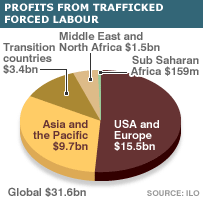
That's right. Here in North America, over $15 billion is made off of these type of empoyment activities. In other words, we're not just discussing Wally World (tm) (Walmart) and their cheap Chinese products, but products that come from all over the globe. The BBC even focuses on many of the illegal Hispanic workers that cross the border every year to work the fields here in America. Yet, areas which fit the stereotype of "backwards" civilizations make very little off of this kind of labor, with the Middle East and North Africa near the bottom of the chart.
There are some other excellent pages dealing with slavery through out the world in this series of articles. Yet, despite this, the great "Christian" nation of the USA hasn't shown much real moral leadership on this subject. Let's face it, this is the first I've heard about this report but I know all about how terrified Congressional Staffers were this morning.
It strikes me that a push for "fair and ethical" treatment of all workers would be an issue that everyone can get behind. Not only does it jibe well with the Bible Beaters, but it's also one that labor can get behind since better conditions also includes better pay, which makes some of these areas less enticing for companies to move overseas to.
A smart politican could take those points and issues like child labor and forced sex workers to launch a moral crusade that most Americans of all political stripes would be willing to work towards ending, not to mention providing perfect photo ops to boot.
The Real History
ACSBlog has an interesting guest blogger today. Herman Schwartz, Professor of Law, Washington College of Law American University, is the author of Right Wing Justice: The Conservative Campaign to Take Over the Courts (2004), from which the material for this article is drawn. He sets right the history that Bill Frist is working so hard to obscure:
When Bill Clinton became President in 1993, there were over 100 judicial vacancies, and with Democrats controlling the Senate, Clinton had an opportunity to restore some ideological balance to the federal bench. It was not to be. Clinton was more conservative than many liberal Democrats realized and was interested only in reducing white male dominance on the bench. In this he succeeded, transforming the face of the federal bench. Philosophically, however, both conservatives and liberal observers have concluded that his nominees were not noticeably different from many of those of George H. W. Bush.The first few years of Clinton’s tenure, 1993-95, were relatively calm, even after Republicans took over the Senate in 1994. 1996 was an election year, however, and soon things turned ugly.
Looking for a campaign issue, Republican Presidential candidate Senator Robert Dole attacked Clinton-appointed judges as “judicial activists” who were “soft” on crime, even though everyone seemed to agree that Clinton’s judges were closer in their decision-making to George H. W. Bush’s judges than to those of recent Democratic presidents. Texas Congressman and now House Majority Leader Tom DeLay joined the battle, escalating the rhetoric. The Senate Judiciary Committee chaired by Orrin Hatch began to delay and stall on Clinton’s nominations, a sign of things to come. In 1996, despite an agreement between Senate Majority Leader Trent Lott and Minority Leader Tom Daschle to confirm 23 judges, the Republicans confirmed only 17 – the lowest in 27 years – and all of them district judges. Twenty-seven nominations were not voted upon at all, leaving 90 judicial vacancies. The Republicans also refused to add new judges as recommended by to the Judicial Conference. The Courts were overwhelmed and in crisis.
During Clinton’s second term the judicial wars escalated. DeLay took the low road, attacking judges who has issued opinions he didn’t like, saying “the judges need to be intimidated,” and if they didn’t rule as he thought they should, “we’re going to go after them in a big way,” a threat he repeated in 2005 after his intervention in the Terri Schiavo case backfired and he faced serious ethics charges.
Hatch and Senate Republican made fewer threats but effectively stalled or killed numerous nominations, either denying them a hearing or, if they received a hearing, not giving them a Committee vote or a floor vote – in effect, a silent filibuster. Even when votes did take place, they were often delayed for many months and even years. Numbers give some indication of the Republican tactics: for Bush nominees in 1991-1992, with a Democratic Senate, the average number of days between the time a District court nomination was received by the committee and a hearing was 92.1. For Clinton in 1997-1998, it jumped to 160.6. The average number of days for a Circuit Court hearing in 1997-1998 was 230.9. This omits the many nominees who never got even a committee hearing.
Hell in a Handbasket
While CNN is playing their little game, here's what they are not reporting:
Suicide bombs cause Iraq carnage
Suicide bombers have set off a wave of blasts in Iraq, killing more than 60 people and injuring more than 100 in the bloodiest day since February..The deadliest bombings were in Tikrit, where at least 33 died, and the town of Hawija, where at least 30 were killed.
Two suicide bombings rocked Baghdad, killing at least four people.
The bombings continue an upsurge in violence that has claimed more than 300 lives in the past two weeks, as US forces fight rebels in the west.
Laith Kubba, an Iraqi government spokesman, told the BBC that rebels were lashing out wildly, knowing their "days are numbered".
But the insurgency appears to be gathering pace rather than running out of steam, the BBC's Jim Muir in Baghdad says.
The attacks came a day after the US Senate unanimously approved an emergency spending bill authorising a further $82bn for US military operations in Iraq and Afghanistan, among other activities
Iraq's going to hell in a handbasket, but you aren't going to hear about it from the US media. Shameful.
Making Shft Up II
Is CNN going to spend the rest of the day on this Cessna "incursion" into restricted airspace in the DC non-story? NOTHING HAPPENED. The Air Force scrambles for this kind of thing about a hundred times a year. This is not a story. This is unbelievably bad journalism.
Link.
At least Faux is breaking it up with the MJ trial.
Junkyard Dog
Bolton's British Problem
Fresh complaints of bullying dog an embattled nominee.
By Michael Hirsh
Newsweek
May 2 issue - Colin Powell plainly didn't like what he was hearing. At a meeting in London in November 2003, his counterpart, British Foreign Secretary Jack Straw, was complaining to Powell about John Bolton, according to a former Bush administration official who was there. Straw told the then Secretary of State that Bolton, Powell's under secretary for arms control, was making it impossible to reach allied agreement on Iran's nuclear program. Powell turned to an aide and said, "Get a different view on [the Iranian problem]. Bolton is being too tough."Unbeknownst to Bolton, the aide then interviewed experts in Bolton's own Nonproliferation Bureau. The issue was resolved, the former official told NEWSWEEK, only after Powell adopted softer language recommended by these experts on how and when Iran might be referred to the U.N. Security Council. But the terrified State experts were "adamant that we not let Bolton know we had talked to them," the official said.
The incident illustrates a key allegation that now bedevils Bolton's nomination to be America's next ambassador to the United Nations. Bolton's critics contend that he has consistently taken an extreme and uncompromising line on issues and that he has bullied subordinates and intel analysts who disagreed with him. President Bush last week stood by his embattled nominee, blaming "politics" for Bolton's difficult confirmation process. But it was members of the president's own party who were holding things up. After GOP Sen. George Voinovich of Ohio, a member of the Senate Foreign Relations Committee, unexpectedly blocked a vote last week, it was clear that Bolton's nomination was in trouble. Powell himself, in reported remarks to several senators, expressed worries about Bolton's temperament. Because the eight Democrats on the 18-person committee are solidly against Bolton, a single GOP defector could kill the nomination when it comes to a vote on May 12. The White House still believes that only a hard-liner like Bolton can reform the U.N.
Frankly, this ought to be a no-brainer for the Senate. The guy isn't a diplomat, he's a plain old bully who has only had a career because there are enough other bullies at DoS to sponsor his rise up the ladder. We ought to be a shade concerned that our diplomatic corps harbors people like this. There are certainly assholes in every walk of life (God knows, I've met them) but the idea that they are politcal appointments high in our State Department should make all of us step back a moment. I sure as hell don't want creeps like this guy representing me on the world's stage.
The bully in the White House promotes other bullies, but the Senate doesn't have to enable them.
Armed Camps
Poll Cites GOP Gains Since 9/11
But Party's Internal Divisions Are Called an Obstacle
By Dan Balz
Washington Post Staff Writer
Wednesday, May 11, 2005; A02
The terrorist attacks of Sept. 11, 2001, helped redraw the political landscape in America, giving President Bush and the Republicans an advantage over the Democrats, according to a new survey by the Pew Research Center for the People & the Press. But Republicans may have difficulty consolidating the gains because of divisions within their expanded coalition.The survey underscored how important the issues of terrorism and national security and Bush's personal appeal were in helping the GOP put together a winning coalition of voters in 2004. The findings suggest that Bush's reelection depended not just on motivating the Republican base but also on his success in attracting swing voters and even some Democrats.
Both parties enjoy strong support among their core voters, but the Pew study concluded that Republicans have done a more effective job in attracting support among voters with less allegiance to either party. Bush's campaign attracted support in the middle from well-educated, upbeat voters as well as those who are more down-scale and pessimistic about their own situation.
"In effect, Republicans have succeeded in attracting two types of swing voters who could not be more different," the study reports. "The common threads are a highly favorable opinion of President Bush personally and support for an aggressive military stance against potential enemies of the U.S."
Foreign policy issues now provide the clearest distinction between Republican- and Democratic-leaning voters, with Republicans favoring assertive policies and military action and Democrats calling for diplomacy and multilateral strategies. Before the Sept. 11 attacks, foreign policy differences played a minimal role in distinguishing the party coalitions.
One other important difference defines the Democratic- and Republican-leaning voters. Those who tilt to the GOP are more personally optimistic and believe in the power of the individual, regardless of income, while those inclined toward the Democrats are more negative or even fatalistic in their attitudes about the future.
The study concluded that while the landscape tilts toward the Republicans, the GOP has not yet posted significant gains in party identification. Andrew Kohut, director of the Pew Center, also said internal fissures could cause the Republicans problems in the future. GOP-leaning voters split over such issues as whether the government should do more to help the needy, over whether power is too concentrated in the hands of a few corporations, over whether government regulation of business protects the public interest, and over the environment and immigration.
But Democrats are also divided, particularly on cultural issues such as homosexuality and whether the government should be involved in moral issues. Like Republicans, they are split over immigration.
The Pew study was the fourth in a series that began in 1984 and is designed to provide a political typology of the country. The study was based on two polls, one in December of 2,000 people and a follow-up in March with 1,090 people from the original sample. From those surveys, the Pew Center divided the country into nine groups -- three mostly Republican, three mostly Democratic, two in the political middle and one on the political sidelines.
It's a long article and I'll let you click the link to read the whole thing. I've been thinking about Pew's typology since I heard the story on NPR last night. The Pew poll is on the link. What do you think?
The Expedition
Early morning car-bomb blasts in Iraq kill at least 54, wound 105
Canadian Press
Wednesday, May 11, 2005
BAGHDAD (AP) - Two early morning car-bomb blasts in Iraq killed at least 54 people and injured another 105 on Wednesday.A car bomb exploded outside a police and army recruitment centre in the town of Hawija in northern Iraq, killing 30 people and injuring 35, police said. And a suicide car bomb exploded in a small market near a police station in Saddam Hussein's hometown, killing at least 24 people and wounding 70, police said. Police Lt. Col. Saad Daham said when security prevented the attacker from exploding the vehicle in front of the station in Tikrit, he swerved into a crowd of people at the nearby market.
It was 7:15 a.m. and many day labourers who had travelled to Tikrit from poor areas of Iraq were waiting at the market to be picked up for work at local construction sites, Daham said.
Tikrit, 130 kilometres north of Baghdad, is a mostly Sunni city where Saddam and many of his relatives came from.
In Hawija, police Capt. Sarhad Talbani said it wasn't clear whether the explosion was caused by a car bomb parked at the scene or one driven there by a suicide car bomber.
Hawija is a small town about 240 kilometres north of Baghdad.
Men often line up outside such centres early in the morning to apply for jobs at a time of high unemployment in Iraq. Insurgents often target such centres and Iraqi security forces on patrol.
Over There
Why U.S. troops won't be coming home from Iraq anytime soon.
By Fred Kaplan
Posted Tuesday, May 10, 2005, at 11:03 AM PT
Now that an Iraqi government is taking form, however haltingly, how much longer will American troops have to stay? Judging from the data in two recent official U.S. reports, they probably won't be coming home soon.Read together, the two documents—the latest quarterly report by the Special Inspector General for Iraq Reconstruction, just released today, and the State Department's "Iraq Weekly Status Report" dated May 4—suggest that the Iraqi leaders have a long way to go (by some measures, as long as they've ever had) before they can rebuild their country, secure order, stabilize their regime, and protect their borders without a large American military presence.
The paradox that stumped the U.S. occupation forces two years ago, shortly after the fall of Baghdad, continues to stump them today. On the one hand, their efforts to provide security won't succeed until they restore essential services. On the other hand, they can't restore essential services until the country's key assets—especially its roads, oil pipelines, and electrical generators—are secure.
Oil revenue was supposed to galvanize Iraq's postwar economy. Yet crude oil production has flattened out at around 2 million barrels a day, well below its prewar level of 2.5 million. Electrical power production hovers around 80,000 kilowatt hours—considerably short of the 100,000 KWH output before the war and far below last summer's declared goal of 120,000. Baghdad homes have electricity for nine to 11 hours a day; in other cities, the figure drops to eight or nine hours.
Iraq's reconstruction was going to be funded by a massive infusion of U.S. aid, $18.4 billion worth. Yet that aid—allocated a year and a half ago—is being directed and disbursed very slowly. Just $12.8 billion (roughly two-thirds) has been appropriated—and a mere $4.8 billion (less than one-quarter) has been spent.
In some sectors, the flow of aid is barely a trickle. For instance:
* For the oil infrastructure, $1.72 billion was allocated; just $1 billion has been appropriated to specific projects; only $263 million—about 15 percent of the original amount—has been spent.
* For transportation and communication, $509 million was allocated; $327 million has been appropriated, just $70 million (14 percent) spent.
* For health care, $786 million was allocated, $557 million appropriated, and only $77 million (less than 10 percent) spent.
* For water resources and sanitation, $2.16 billion was allocated, $1.06 billion appropriated, a mere $117 million (5 percent) spent.(For more about this slow rate of spending, and how the situation is even worse than these numbers suggest, click here.)
Part of the reason for this sluggishness is mismanagement. Most of it stems from problems with security. The road to be repaired is impassible; the oil pipeline to be modernized keeps getting blown up.
....
As recently as last winter, some analysts and politicians—here and in Iraq—argued that the insurgents' main targets were American soldiers; hence, end the occupation and the insurgency would dry up. This was always a dubious notion, in both the premise and the logic, but now it's plainly wrong. In recent months, the Americans have cut back on large-scale offensives, yet the insurgents have stepped up attacks against Iraqis. Since the start of this year, 266 American soldiers have been killed in action in Iraq—compared with 724 Iraqi soldiers and police. (Until now, Americans had taken the brunt of casualties.) If the United States pulled out now, the Baathists, Zarqawists, and other insurgents would run wild. The country, rough and ragged as is, would fall apart.
Smoking Gun #1: Second Anniversary
I'm linking to an article that appeared in the Washington Post two years ago today. At the time, I took it to be the 'smoking gun' on the Administration's lies about why we invaded Iraq. I still do. I still feel what's in here is grounds for impeachment.
If you recall, what Bush said was that this war was about the possibility that Iraqi WMDs might wind up in the hands of terrorists who would use them against us:
The danger is clear: Using chemical, biological or, one day, nuclear weapons obtained with the help of Iraq, the terrorists could fulfill their stated ambitions and kill thousands or hundreds of thousands of innocent people in our country or any other. The United States and other nations did nothing to deserve or invite this threat, but we will do everything to defeat it. Instead of drifting along toward tragedy, we will set a course toward safety.
But when we invaded Iraq, when our troops came across alleged WMD sites, they didn't secure them. They had to choose between having enough troops to push towards Baghdad, or leaving troops behind to secure the supposed WMDs:
McPhee saw early in the war that the looters were stripping his targets before he could check them. He cut the planning cycle for new missions -- the time between first notice and launch -- from 96 to 24 hours. "What we found," he said, was that "as the maneuver units hit a target they had to move on, even 24 hours was too slow. By the time we got there, a lot of things were gone."
Short and powerfully built, McPhee has spent his adult life as a combat officer. He calls his soldiers "bubbas" and worries about their mail. "It ain't good" that suspect sites are unprotected, he said, but he refused to criticize fighting units who left evidence unguarded.
"You've got two corps commanders being told, 'Get to Baghdad,' and, oh, by the way, 'When you run across sensitive sites, you have to secure them,' " he said. "Do you secure all those sites, or do you get to Baghdad? You've got limited force structure and you've got 20 missions."
And why did we have such a limited force structure? Because Rumsfeld kept cutting the number of troops that were to invade, against the recommendations of his generals. We could have had enough troops to both secure the WMD sites, and drive on Baghdad. But the Administration chose not to do so.
What this says is that the WMDs were not really regarded as a priority objective of this war. It was all BS.
Now, did the President know there were no WMDs? Maybe; maybe not.
If he did, then he lied to us to get us into war.
If he didn't - if he believed the WMDs were real - then he condoned an approach to the war that would have just about ensured that the very thing we supposedly went to war to prevent - WMDs falling into the hands of terrorists - would occur.
That would be a betrayal of America that would dwarf lying to get us into war.
It's been two years, and Rumsfeld is still Secretary of Defense. Bush obviously is satisfied with his conduct of the war. He's President George W. Bush, and he approves of this policy.
When will one Congressional Democrat have the guts to call for Bush's impeachment?
For Losers
Congress Approves $82 Billion for Wars
Iraq Cost to Pass $200 Billion; Army to Ask for More
By Jonathan Weisman and Shailagh Murray
Washington Post Staff Writers
Wednesday, May 11, 2005; Page A01
The Senate gave final passage yesterday to an $82 billion emergency war-spending bill, sending President Bush a measure that will push the cost of the Iraq invasion well past $200 billion.Even with such large, unanticipated expenditures, Army officials and congressional aides say more money will be needed as early as October. The Army Materiel Command, the Army's main logistical branch, has put Congress on notice that it will need at least two more emergency "supplemental" bills just to finance the repair and replacement of Army equipment. By 2010, war costs are likely to exceed half a trillion dollars, according to nonpartisan congressional researchers.
"We're fighting a war on supplementals, and it's a hell of a way to do business," said retired Army Lt. Gen. John M. Riggs, who until last year was working on the Army's modernization plans. "The base budget of the U.S. Army needs to be adjusted to fight the war on terror, and I have no idea where the money is going to come from."
The final spending measure was nearly identical in cost to the $81.9 billion request Bush submitted in February. Most of the debate in Congress revolved not around the money but around unrelated immigration measures. The bill includes a provision that would make it more difficult for illegal immigrants to acquire driver's licenses that the federal government would recognize as identification. It would also expand the list of terrorism-related activities that will make an immigrant inadmissible or deportable, tighten rules on political asylum, and add federal powers to ease construction of border barriers.
We have no trouble at all utterly bankrupting ourselves on a war that never needed to be fought, spending lives and money. What idiocy.
And Rest
United Air Wins Right to Default on Its Employee Pension Plans
By MICHELINE MAYNARD
Published: May 11, 2005
United Airlines, which is operating in bankruptcy protection, received court permission yesterday to terminate its four employee pension plans, setting off the largest pension default in the three decades that the government has guaranteed pensions. Chip Somodevilla/Getty ImagesMembers of the Association of Flight Attendants marched in Washington Tuesday to urge a judge to stop United from ending pension plans.
The ruling by Judge Eugene R. Wedoff of Federal Bankruptcy Court came after a lengthy hearing in a crowded Chicago courtroom, near where United is based.
Despite pleas by union lawyers, Judge Wedoff sided with United, which had insisted that it could not emerge from bankruptcy protection with its pension plans in place.
The ruling releases United, a unit of the UAL Corporation, from $3.2 billion in pension obligations over the next five years. The federal agency that guarantees pensions, the Pension Benefit Guaranty Corporation, will assume responsibility for the plans, which cover about 134,000 people.
Some retirees could see sharply lower pension payments as a result; others will see little change in benefits, depending on a variety of factors. Some retirees at US Airways, which has terminated its plans, have seen benefits drop by as much as 50 percent.
The airline, which has been in bankruptcy protection since December 2002, has been pushing to end its pensions since losing its bid for a federal loan package last year. But unions representing United's employees fought the action, threatening to strike if the pensions were set aside.
Along with raising that prospect, the action has significant implications for the airline industry, which has lost more than $30 billion since 2000, and perhaps for other industries like automobiles, with similarly heavy legacy costs.
One of my best friends put in 39 years with United and was scheduled to retire this month. I hope she still can.
The larger question, should the Pension Benefit Corporation Guarantee fund have to bail out these private employers, I'll leave for wiser heads. I'm worried about my friend, for now.
Things to think about: who is responsible for the social safety net? Should employers be able to brush their hands and walk away?
May 10, 2005
Growing the Gulag
U.S. to Expand Prison Facilities in Iraq
By Bradley Graham
Washington Post Staff Writer
Tuesday, May 10, 2005; Page A15
BAGHDAD, May 9 -- The number of prisoners held in U.S. military detention centers in Iraq has risen without interruption since autumn, filling the centers to capacity and prompting commanders to embark on an unanticipated prison expansion plan.
As U.S. and Iraqi forces battle an entrenched insurgency, the detainee population surpassed 11,350 last week, a nearly 20 percent jump since Iraq's Jan. 30 elections. U.S. prisons now contain more than twice the number of people they did in early October, when aggressive raids began in a stepped-up effort to crush the insurgency before January's vote.
Anticipating continued growth in the detainee population, U.S. commanders have decided to expand three existing facilities and open a fourth, at a total cost of about $50 million.
The steady influx of prisoners has also required additional U.S. military police officers to guard the detention centers. Commanders had hoped to use the MPs to help train Iraqi police, but management of the detention centers has taken priority.
"We've got a normal capacity and a surge capacity," said Maj. Gen. William H. Brandenburg, who oversees U.S. military detention operations in Iraq. "We're operating at surge capacity."
Last month at Abu Ghraib prison, on the outskirts of Baghdad, the detainee population had grown so large that U.S. authorities decided to stop accepting new arrivals for a few days, Brandenburg said. Instead, detainees were held longer at field camps before being moved to Abu Ghraib. Tents there that normally house 20 inmates now hold 25 to 30, the general said.
The large number of detainees and uncertainty about their fates have become a political issue, with representatives of Iraq's Sunni Arab minority demanding that the inmates be tried quickly or released. More than three-fourths are Sunnis, a fact that U.S. military officers here say reflects the dominant role Sunni groups have played in the insurgency.
Brandenburg said he has argued for allowing the cases to work their way through a process that includes a review board staffed by six Iraqis and three members of the U.S.-led multinational force. As of last week, he said, the board had looked at 10,000 cases and approved the release of about 6,000 people.
But Brandenburg acknowledged that the prisons were filling up faster than cases could be reviewed. "We're still getting more detainees in than we're getting rid of," he said.
A second review board is being established this week to relieve some of the strain on the reviewers, who are facing a heavier workload. Together, the two boards should be able to handle 650 to 700 reviews a week, Brandenburg said. Iraq's Central Criminal Court, created a year ago, has also picked up its pace. It handled 87 trials and 50 pretrial investigative hearings in March.
Various indicators, however, point to a detainee population that is increasingly hard-core and therefore likely to remain locked up. Before January, for instance, the review board had ordered releases in about 60 percent of the cases it considered. In recent months, the figure has dropped to 40 percent.
Similarly, since January, 88 percent of those detained have been rated "high risk" under a six-point system that takes into account the circumstances of capture, severity of the alleged offense and affiliation with known insurgent groups.
Other profiling information provided by Brandenburg shows that 96 percent of those in the detention camps are Iraqis and about 60 percent are either from Baghdad or Anbar provinces -- two areas where much of the insurgency has been concentrated. Only five detainees are female. Nearly three-fourths of the inmate population is between the ages of 20 and 40, and about 60 percent of the detainees have less than a high school education.
Crowded camp conditions and tougher inmates present a combustible mix, confronting U.S. forces with a growing risk of prison violence. Camp Bucca, a sprawling detention facility in the southern Iraqi desert near the Kuwaiti border where the majority of prisoners are held, has experienced two large riots within two months.
As of Friday, Camp Bucca's detainee population had reached 6,370. Another 3,538 are now at Abu Ghraib, the U.S. military's primary interrogation center and the site of highly publicized detainee abuses. Camp Cropper, near the Baghdad airport, houses 114 detainees who are labeled "high value." Another 1,331 suspected insurgents are being held for initial screenings at military brigade and division-level detention facilities, according to military figures.
To cope with the continuing influx, Brandenburg said Camp Bucca, which has eight compounds, is adding two, enough to accommodate about 1,400 additional prisoners. Space for another 800 detainees is being built at Abu Ghraib.
Camp Cropper is also expanding, from a current capacity of about 120 prisoners to 2,000 by the end of this year. U.S. authorities also plan to turn a Russian-built former Iraqi military barracks near the northern city of Sulaymaniyah into a prison for 2,000 inmates and call it Fort Suse.
After briefing Defense Secretary Donald H. Rumsfeld last month on the new construction plans, Brandenburg received word that the Pentagon had approved $12 million to finish the Camp Bucca expansion and $30 million to enlarge Camp Cropper. Another $7.5 million had been authorized earlier to build Fort Suse. The additional capacity at Abu Ghraib will cost less than $1 million, Brandenburg said.
"I think we'll be all right," he said. "But we are very tight."
Building more prisons, huh? Gives a country that homey, American touch. We must be winning more hearts and minds over there.
What we're effectively doing, right now, is taking sides in a civil war, and imprisoning people we think are on the wrong side.
Now don't get me wrong: the Sunni insurgents are the wrong crowd; they're nasty people who are willing to use abhorrent tactics. They don't mind blowing up innocent civilians on the street, in order to render the nascent Iraqi government meaningless. But there isn't exactly a 'right' crowd in Iraq to side with. And it's doubtful that we can toss enough Sunnis in prison to slow down the insurgency, considering that the very act of imprisoning people makes their brothers and their cousins more willing to be more active in the insurgency.
I don't have a brilliant solution to this. But as Rocky Balboa said in the first Rocky movie, "You shoulda planned ahead." Rumsfeld & Co. didn't, and now we're having to pursue repulsive courses of action just to keep treading water.
New Blog
This is cool. The law students filibustering up at Princeton have got a blog, with the assistence of Center for American Progress/Campus Progress. They've got a donation link up, you can support their protest. Go take a look and show 'em a little love if you can today.
Asheesh Kapur Siddique, a member of the Princeton Class of 2007, is the editor of the Princeton Progressive Review and one of the organizers of the Frist filibuster protest. Here is part of his artcle in The Nation Online:
As Congressman Rush Holt, who filibustered in front of the Frist Center this past Friday, reminded us, "Any fool can design a government run by the majority. In fact, almost by definition, the majority can get what it wants. What is very, very hard is to design a government, self-governed by the people, representing majority rule, that protects the rights of minorities."Even if all the President's disputed nominees were to be confirmed through Senator Frist's "nuclear option," the Princeton filibuster will have been a success. It has energized the progressive movement on this campus and has shown the nation that college students are engaged in politics and care deeply about the issues--contrary to what the pundits like to say about youth apathy. Moreover, it has given individual students a sense of empowerment--a feeling that they have a voice, even as first-time voters and political constituents, and that their vision for an America that continues to aspire toward the dream of its founders must and will be heard.
As one participant told me, "I filibustered because I want to believe that we really are a democracy." Bill Frist, are you listening?
UPDATE: The kids are good. I got a press release from them in under an hour from putting up the link.
Washington, DC - Scores of college students will converge on the Capitol Reflecting Pool on Wednesday to stage a 24 hour filibuster in protest of the "Nuclear Option" being considered by Senate Republicans to end filibusters on controversial judicial nominees.The mock filibuster, initiated two weeks ago by a group of Princeton
students outside the Frist Campus Center at Princeton University, a
building financed by a $25 million gift from the Senate majority
leader's family, has been running round-the-clock for over 300 hours and
has attracted wide spread media attention.With action on the nuclear option expected within days, Princeton
students will travel by bus to Washington, D.C. on Wednesday morning,
joining area college students and congressional leaders to continue
their filibuster at the Capitol Reflecting Pool within sight of Senator
Frist's Capitol office."This student-powered filibuster shows that political activism on
college campuses is strong and building. It also demonstrates the
overwhelming support for the 200 year-old institution of the Senate
filibuster," said Asheesh Siddique, editor of the Princeton Progressive
Review, one of the filibuster's sponsors. "Buoyed by the dedication of
hundreds of Princeton University students and other students across the
nation, we are now bringing the fight for a fair and independent
judiciary directly to Senator Frist," said Siddique. The Princeton
Progressive Review is one of fourteen of progressive college papers
across the country supported by Campus Progress, a new project of the
Center for American Progress.The Washington mock filibuster will be similar to the original Princeton
protest, with students reading from texts that range from the
Constitution and the Declaration of Independence, to Shakespeare and
physics texts. Students from Howard University, Georgetown University,
Trinity University, George Washington University and American University
will also take turns speaking over the 24 hour filibuster.The protest and its organizers have received coverage from CNN, MSNBC,
Fox News, ABC News, New York Times, Washington Post, UK Guardian, the
popular blog Talking Points Memo, and Air America Radio. A live Webcam,
daily blog, and schedule of special guests will be available at
FilibusterFrist.comThe student filibuster will begin at 10 a.m. on Wednesday and will
continue throughout the night, ending at 11 a.m. Thursday with press
conference and rally with members of the House and Senate.The event is being supported by Campus Progress and Young People For, a
project of People for The American Way Foundation.Event Highlights:
Wednesday, May 11
9:00 a.m. (approximately) - Princeton students arrive via bus at the
Capitol Reflecting Pool (3rd St SW & Maryland Ave SW)Thursday, May 12
11:00 a.m. - Rally and Press Conference with Members of Congress
Youthful activism is not dead in this country. Kudos to Campus Progress and PFAW Foundation. We're re-building progressivism one person at a time. If you are in the DC area and can make your way down to the reflecting pool to support the students or take a turn on the filibuster yourself, here's the poop. I'm going to try to get down there tomorrow night after a dinner engagement.
Hard News
The brand spanking new Huffington Post's Jim Lampley breaks one hell of a story:
At 5:00 p.m. Eastern time on Election Day, I checked the sportsbook odds in Las Vegas and via the offshore bookmakers to see the odds as of that moment on the Presidential election. John Kerry was a two-to-one favorite. You can look it up.People who have lived in the sports world as I have, bettors in particular, have a feel for what I am about to say about this: these people are extremely scientific in their assessments. These people understand which information to trust and which indicators to consult in determining where to place a dividing line to influence bets, and they are not in the business of being completely wrong. Oddsmakers consulted exit polling and knew what it meant and acknowledged in their oddsmaking at that moment that John Kerry was winning the election.
And he most certainly was, at least if the votes had been fairly and legally counted. What happened instead was the biggest crime in the history of the nation, and the collective media silence which has followed is the greatest fourth-estate failure ever on our soil.
....
Karl Rove isn't capable of conceiving and executing such a grandiose crime? Wake up. They did it. The silence of traditional media on this subject is enough to establish their newfound bankruptcy. The revolution will have to start here. I challenge every other thinker at the Huffington Post: is there any greater imperative than to reverse this crime and reestablish democracy in America? Why the mass silence? Let's go to work with the circumstantial evidence, begin to narrow from the outside in, and find some witnesses who will turn. That's how they cracked Watergate. This is bigger, and I never dreamed I would say that in my baby boomer lifetime.
We all suspected it. Lampley's right, it is going to be up to the blogs to break through with this story, the MSM are utterly useless. This is a bombshell.
Threats with Knives
A GOP Plan to 'Fix' the Democrats
By E. J. Dionne Jr.
Tuesday, May 10, 2005; Page A21
The stakes in politics are about to get a lot higher. .... The current acrimony in politics is incomprehensible unless it is understood as the inevitable next act of a long-term struggle. Its ferocity arises from the Democrats' refusal to accept the role assigned them by their opponents. They are taking a stand across a broad front not simply to "obstruct" current GOP designs but to reverse a Republican political offensive that began during Bill Clinton's presidency.In fact, every one of today's fights can be seen as a response to something that happened in the 1990s.
Democrats in the Senate insist on their right to stop some of President Bush's judges because Republicans were so aggressive in stopping Clinton judges in the '90s.
Privately, Senate Democrats are especially furious that Republicans have completely reversed their position on whether there is even a need for more federal judicial appointments. During the Clinton administration, many Republican senators insisted that there were too many federal judges and that it was therefore unnecessary for the president to fill all the vacancies that came up at the time. Republicans changed their story after President Bush's election, talking about a "vacancy crisis." Democrats are dug in on judges precisely because they do not want to reward Republican obstruction in the 1990s. The theory is that one wave of obstruction deserves -- even demands -- another.
In refusing to deal with Bush on Social Security privatization, Democrats recall the battle over Clinton's health care plan. While a few moderate Republicans, notably the late Sen. John Chafee of Rhode Island, were willing to bargain with Clinton, the party as a whole put up a front of opposition. Republican House Speaker Newt Gingrich made it a matter of party discipline to bar anyone in his caucus from negotiating with the Democrats.
Now that Republicans are in control of the presidency and both houses, Democrats -- even moderates who might otherwise favor modest Social Security changes -- see no reason to help Republicans dismantle any aspect of a program that is central to the Democratic legacy. They note (sometimes with grudging admiration) that Republicans paid no price for obstructing health care reform in the 1990s and that Republicans have no right to demand Democratic complicity with Bush now.
As for DeLay, there is singular Democratic satisfaction in seeing that the moralist who insisted that Clinton be impeached is now embroiled in a series of ethical scandals. DeLay, it should be recalled, pressured many House Republicans to vote, against their own instincts, for impeachment.
Moreover, the DeLay scandals go to the heart of how Republicans have achieved power since 1994: the creation of an interlocking directorate of politicians, lobbyists, fundraisers and interest groups. For Democrats, the DeLay scandal is not simply a political gift but also an opportunity for public education on the nature of the Republicans' congressional machine.
DeLay's fate will depend on how long his party stays loyal to him and whether there are new revelations. But even on the issues of Social Security and judges, there can be no easy compromise, because both sides understand the stakes in these battles in exactly the same way.
DeLay himself drew the line sharply the day after the 2004 elections. "The Republican Party is a permanent majority for the future of this country," DeLay declared. "We're going to be able to lead this country in the direction we've been dreaming of for years."
Grover Norquist, the president of Americans for Tax Reform and a leading figure in both the DeLay and Bush political operations, chose more colorful post-election language to describe the future. "Once the minority of House and Senate are comfortable in their minority status, they will have no problem socializing with the Republicans," he told Richard Leiby of The Post. "Any farmer will tell you that certain animals run around and are unpleasant. But when they've been 'fixed,' then they are happy and sedate. They are contented and cheerful."
If you wonder in the coming weeks why Democrats are so reluctant to give ground, remember Norquist's jocular reference to neutering the opposition party. Democrats are neither contented nor cheerful over the prospect of being "fixed." Should that surprise anyone?
As Ron Suskind reminds us, the Dems seem to have figured out that they are up against "We will fuck him. Do you hear me? We will fuck him. We will ruin him. Like no one has ever fucked him!"
Making Shft Up
Yalta was no Betrayal, Mr. Bush
by Conrad Black
Conrad Black is an FDR biographer
Tuesday, May 10, 2005
In February of 1944, the European Advisory Commission, against the wishes of the United States, produced a plan for the division of postwar Germany into three approximately equal zones. This was a triumph for the British, who would have only a fraction of the forces of the Americans in Western Europe at the end of hostilities, much less the Russians. Not knowing that Tehran had a secret agreement and changed the Polish borders, the commissioners awarded most of the Russian zone of prewar Germany from territory that would be Polish.This condemned Poland to Russian occupation, but also assured that Germany would move demographically to the West and become an unambiguously Western country for the first time. About 10 million Germans decamped to the West ahead of the Red Army. It was a tragedy for the Poles but a good geopolitical trade for the West. The United States had not wanted to demarcate occupation zones in Germany but leave it to where the armies ended up. Roosevelt correctly believed that the Germans would resist more fiercely in the East against the Russians than against the Western Allies, who generally observed the Geneva Conventions.
Winston Churchill, who was hardly soft on communism and was leader of the opposition to the 1938 Munich agreement, went to Moscow in October of 1944 and agreed that the Soviet Union would have pre-eminent influence in Romania, Bulgaria and Hungary; that the West would prevail in Greece; and that Yugoslavia would be a 50-50 division between them. This was essentially what occurred. It was, in Churchill's phrase, a "naughty" arrangement, made against Roosevelt's wishes, but it reflected military realities on the ground. Apart from these agreements, Eastern Europe was not formally carved up or assigned among the Great Powers.
The Russians were taking almost 90 per cent of the casualties among the Big Three Allies in fighting the Germans. It has never been clear how Roosevelt and Churchill were to deny Stalin what he considered his share of the spoils. Roosevelt wanted the Russians to take some of the anticipated one million casualties that would be involved in subduing Japan, if atomic weapons did not work. The first atomic test was only in July of 1945, more than five months after Yalta.
Roosevelt had hoped that the existence of atomic weapons in the hands of the U.S., plus a promise of immense economic assistance and co-operation in the durable demilitarization of Germany, could induce Stalin to be comparatively flexible in Eastern Europe. Stalin's rejection of this offer from Roosevelt and Harry Truman was a colossal blunder. The violated Yalta accords furnished much of the moral basis for the Western conduct of the Cold War, which ultimately the Russians could not win and which led to the collapse of the Soviet Union and of communism itself.
Mr. Bush should remember, even if he does not want to repeat it to live audiences in Eastern Europe, that, of all those countries, only the Czechs were politically distinguished before the war. The Hungarians and Poles jubilantly joined in tearing up Czechoslovakia after Munich. Munich was a bad arrangement, undertaken with good intentions by British prime minister Neville Chamberlain, because he knew that Britain and France could not go to war against the desire of the Sudeten Germans to join Germany.
The Nazi-Soviet Pact of 1939 was an act of stupefying cynicism, carving up Poland and the Baltic states, and submitting them all to brutal occupation. Yalta was an unexceptionable arrangement that required 45 years of vigilant containment to enforce. Mr. Bush should not perpetuate the Yalta myth and should not give ammunition to the forces of anti-Americanism in Europe, which claim that the English-speaking countries betrayed Eastern Europe. The West went to war for Poland. The English-speaking countries liberated Western Europe and, with those liberated countries, withheld recognition of Stalin's violation of his Yalta promises until Eastern Europe, too, was liberated.
Sixty years after V-E Day, this Republican president should stop parroting McCarthyite defamations of Roosevelt, Churchill and Truman. He cannot seriously lament that the West did not go to war with the USSR over Eastern Europe in 1945. He should stop apologizing for what was not, in fact, a discreditable episode in American diplomatic history.
Bush can get away with this kind of bullshft because Americans don't care about history and don't even know their own. Pity. He made an ass of himself and us and we don't care and the media won't report it.
Here's more:
By Jacob Heilbrunn, Jacob Heilbrunn is a Times editorial writer.
But what actually happened at Yalta? Let's review the facts. The conference itself took place in the seaside Crimean city in February 1945, during the final months of the war. A delegation of more than 600 British and U.S. officials, including FDR and Churchill, met with Stalin. They discussed postwar borders and issued a "Declaration on Liberated Europe" calling for free elections in Poland and elsewhere.The truth is that Yalta did not hand Eastern Europe to the Soviets. That territory was already in their possession. Stalin had made clear his plan to take over as much territory as possible back in the Molotov-Ribbentrop pact of 1939, which carved Poland in half and gave the Soviets the Baltic states. The discovery in 1943 of the massacre of Polish officers by the Soviet army in the Katyn forest was further evidence of Stalin's malign intention to exterminate the leadership of Poland. Then, in 1944, during the Warsaw uprising by the Polish Home Army, Stalin halted the advance of his army on the banks of the Vistula River and allowed Nazi SS units to return to slaughter the Poles. By the time of Yalta, the Red Army occupied all of Poland and much of Eastern Europe.
Theoretically, Churchill and Roosevelt could have refused to cut any deal with Stalin at Yalta. But that could have started the Cold War on the spot. It would have seriously jeopardized the common battle against Germany (at a moment when Roosevelt was concerned with winning Soviet assent to help fight the Japanese, which he received).
Supreme Allied Commander Dwight Eisenhower was happy to let the Soviets bear the brunt of the fighting as they marched toward Berlin, and he was unwilling to expend American troops on storming the German capital. The only one who was eager to do that was Gen. George Patton, who hoped to take on the Russians as well. Given the domestic pressure to "bring the boys back home," Roosevelt would have been taking a politically suicidal course had he broken with our allies, the Soviets.
Roosevelt was hardly perfect at Yalta. He was naive about Stalin's intentions and believed he could cajole the dictator into following more moderate policies. But FDR's approach was not particularly different from that of Churchill (who had declared that he would "sup with the devil" to win the war, which is what he and Roosevelt, in effect, did).
As for the charges about Hiss' influence, they've been overblown by the right for political purposes; in fact, Hiss was a minor player at Yalta.
What's more, it was the isolationist right that never wanted to fight the war in the first place, which it conveniently forgot once it began attacking Democrats as being soft on communism. Nothing of course could be further from the truth. Roosevelt went on to recognize Stalin's perfidy shortly before he died, and it fell to Truman to fight the Cold War.
Roosevelt's record is no cause for shame, but Bush's comments are.
Losing
Marines surprised by insurgent's preparation for attack
BY JAMES JANEGA
Chicago Tribune
AL QAIM, Iraq - (KRT) - The Marines who swept into the Euphrates River town of Ubaydi confronted an enemy they had not expected to find - and one that attacked in surprising ways.As they pushed from house to house in early fighting, trying to flush out the insurgents who had attacked their column with mortar fire, the Marines ran into sandbagged emplacements behind garden walls. Commanders said Marines also found a house where insurgents were crouching in the basement, firing rifles and machine guns upward through holes at ankle height in the ground-floor walls, aiming at spots that the Marines' body armor did not cover.
The shock was that the enemy was not supposed to be in Ubaydi at all. Instead, American intelligence indicated that the insurgency had massed on the other side of the river. Marine commanders expressed surprise Monday not only at the insurgents' presence but also the extent of their preparations, as if they expected the Marines to come.
"That is the great question," said Col. Stephen Davis, commander of Marine Regimental Combat Team 2, responsible for this rugged corner of Anbar province near the Syrian border. American officials describe the region, known as the Jazirah Desert, as a haven for foreign fighters who shuttle across the porous Syrian border, using the broken terrain for cover.
Three Marine companies and supporting armored vehicles crossed to the north side of the Euphrates River early Monday, using rafts and a newly constructed pontoon bridge. From there they were expected to roll west toward the border, raiding isolated villages where insurgents are believed to cache weapons and fighters. The offensive, planned for weeks, is expected to stretch on for several days.
"We're north of the river (and) we're moving everywhere we want to go," Davis said late Monday. "Resistance is predictably low, but I do not expect it to stay that way."
In recent weeks, intelligence suggested that insurgents were using the area to build car bombs that later would be used in attacks in Baghdad and other cities. More than 300 Iraqis have been killed in insurgent attacks in the past two weeks, following the formation of a Shiite-dominated government.
A senior military official in Washington told The Associated Press that the Marines were targeting followers of terrorist leader Abu Musab al-Zarqawi, who has been linked to many of the most violent attacks on U.S. and Iraqi forces.
The offensive that began Sunday is described as one of the largest involving U.S. troops since the assault on Fallujah last fall. It involves more than 1,000 Marines and Army personnel, backed by helicopters and jet fighters.
With the Marines pressing the assault, new details emerged about the pitched battles that took place Sunday in Ubaydi, a town perched on the tip of a bend in the Euphrates, about 12 miles east of the Syrian border. As Army engineers worked to build the pontoon bridge, waiting Marines came under mortar fire from a town they had assumed was free of the enemy.
After calling in air strikes from prowling fighter jets and helicopter gunships, the Marines entered the town in armored personnel carriers and light armored vehicles. At times the fighting was door to door as Marines sifted through areas where resistance was stiffest.
We have no intelligence. None. We are making this up as we go along, and how well is that working out? We are bombing civilians, pulling them out of their houses in the middle of the night, which is not the way to make friends. Fourth generation warfare is never won this way.
The New World Order
U.S. Forces Mount Offensive Near Syrian Border With Iraq
By RICHARD A. OPPEL Jr.
Published: May 9, 2005
BAGHDAD, Iraq, May 9 - A Marine task force swept through a wide area of western Iraq near the Syrian border today, killing at least 100 insurgents and raiding desert outposts and city safehouses belonging to insurgents who have used the area to import cars, money, weapons and foreigners to fight American and Iraqi forces, American military officials said.The attack appears to be the largest combat offensive in Iraq since the Marines invaded Falluja six months ago, and it comes as senior American commanders have increasingly blamed the porous border with Syria for allowing a never-ending stream of armed jihadists to enter Iraq and replenish the insurgency as quickly as United States and Iraqi troops can kill and capture them.
Some of the insurgents killed in the operation by the Marines are believed to be foreign fighters, military officials said. The operation reflects the increasing concern among senior American commanders that insurgents have had a free run in the heavily Sunni area in an around al Qaim, in the Al Jazirah Desert near where the Euphrates River crosses from Syria to Iraq.
The operation began over the weekend and involves more than 1,000 marines supported by helicopter gunships, fighter jets, tanks, and light armored vehicles.
F-15E fighters from the Air Force dropped two GBU-12 500 pound laser-guided bombs and fired 510 20 millimeter cannon rounds on Sunday against insurgents in the vicinity of al Qaim, where the Marines were fighting, according to an official summary of coalition air operations. Marine F/A-18 fighters also fired 319 20 millimeter cannon rounds during the same operation.
"The enemy honestly felt that they had a sense of security up there," said Col. Bob Chase, the chief of operations for the Second Marine Division, which is based at Camp Blue Diamond in Ramadi. "It had been a safe haven, and a lot of folks up there were former Baathists."
"Now, it is no longer a safe haven," Colonel Chase said. "And it will never be a safe have again." Insurgents have had a network of illegal "rat lines" of men and materials moving from Syria into Iraq that had to be interdicted, Colonel Chase said.
"We are going to continue this for a number of days," he said. "The objective is to totally disrupt the safe havens and rat lines that have allowed them to bring those materials across the border. This had been a very secure area for the insurgents." So far, there have been "a handful" of marine casualties, Colonel Chase said, without giving specifics.
Since there are no journalists on the scene, this is a press release from the Pentagon. Pity.
We should fight all of our wars without press on the scene. Then we can tell you whatever we want to.
Sham War
U.S. Forces Mount Offensive Near Syrian Border With Iraq
By RICHARD A. OPPEL Jr.
Published: May 9, 2005
BAGHDAD, Iraq, May 9 - A Marine task force swept through a wide area of western Iraq near the Syrian border today, killing at least 100 insurgents and raiding desert outposts and city safehouses belonging to insurgents who have used the area to import cars, money, weapons and foreigners to fight American and Iraqi forces, American military officials said.The attack appears to be the largest combat offensive in Iraq since the Marines invaded Falluja six months ago, and it comes as senior American commanders have increasingly blamed the porous border with Syria for allowing a never-ending stream of armed jihadists to enter Iraq and replenish the insurgency as quickly as United States and Iraqi troops can kill and capture them.
Some of the insurgents killed in the operation by the Marines are believed to be foreign fighters, military officials said. The operation reflects the increasing concern among senior American commanders that insurgents have had a free run in the heavily Sunni area in an around al Qaim, in the Al Jazirah Desert near where the Euphrates River crosses from Syria to Iraq.
The operation began over the weekend and involves more than 1,000 marines supported by helicopter gunships, fighter jets, tanks, and light armored vehicles.
F-15E fighters from the Air Force dropped two GBU-12 500 pound laser-guided bombs and fired 510 20 millimeter cannon rounds on Sunday against insurgents in the vicinity of al Qaim, where the Marines were fighting, according to an official summary of coalition air operations. Marine F/A-18 fighters also fired 319 20 millimeter cannon rounds during the same operation.
"The enemy honestly felt that they had a sense of security up there," said Col. Bob Chase, the chief of operations for the Second Marine Division, which is based at Camp Blue Diamond in Ramadi. "It had been a safe haven, and a lot of folks up there were former Baathists."
How long do you have to live on this planet before you know that shit stinks?
Oh, and by the way, when did we start doing "body counts?"
Settling Scores
Former ministers flee as Iraq begins corruption inquiry
By Patrick Cockburn in Baghdad
09 May 2005
Former Iraqi ministers are fleeing the country because of reports that the new administration may prevent them going abroad while accusations of corruption are being investigated.The incoming government of Ibrahim al-Jaafari, who completed his cabinet yesterday, has pledged to fight pervasive corruption among officials. The outgoing administration of Iyad Allawi was regarded as highly corrupt by Iraqis.
Officials say that some former ministers have left Iraq in the past few days because they fear they will be detained if they try to leave later. "I have heard that [the government] are considering preventing any minister of the former government leaving the country," said Adnan Pachachi, a former foreign minister and veteran political leader. The new administration is able to do this under emergency legislation introduced by Mr Allawi.
Iraqi businessmen say that since the overthrow of Saddam Hussein the government machinery has become corrupt. "I am thinking of pulling out of business entirely in Iraq," said one businessman. "Officials at every level demand bribes just to do their jobs so there is no profit left for my company at the end of the day."
The corruption relates to the awarding of contracts and jobs. Political parties treat the ministries they control as a source of patronage and funds. The collapse of civil order after the war in 2003 meant that until now there had been little fear of punishment.
Mr Pachachi says he suspects that some allegations of corruption against former ministers may be a settling of scores by government ministers against rivals whom they dislike.
Many ministers in Mr Allawi's government spent so much of their time on foreign trips that it is difficult to identify precisely who will stay abroad for fear of investigation in Iraq. A diplomat in Baghdad said there was another reason for the sudden departures: "They feel they will not have enough protection. The insurgents will find it difficult to kill a serving minister, so they may see a former minister as an easier target.
Democracy. Whisky. Sexy. This is the face of Democracy in Iraq. We can't insure security. It is a sham state.
May 09, 2005
Repealing the Enlightenment
AtBOPNews, Ian Walsh discusses what's really at stake with the "nuclear option."
I haven't written much about the filibuster because everyone else is, and they're doing a fine job. I do want to emphasize something, though - this is a precursor, a necessary precondtion, to the real work of creating Rove's Republic. It's not an accident that we've been hearing all this squealing about judigical activism from the right - they know that judges are the last group who will be able to derail the changes they want to make to the Constitution.Yeah, that's right. The Constitution. The Constitution isn't just the document, or the amendments to it - it's really the interpretations of what they mean. The Republicans know, for all they deny it, that the Constitution is and always has been a living document - it means what people think it means and there are a lot of different ways you can read those venerable words. Having been on the losing side of a lot of those readings they are determined to make sure the next set will go their way.
So - they end the judicial filibuster, stack the federal courts and do what FDR only threatened to do - stack the Supreme Court. Then they pass a bunch of laws which can't be filibustered (because the nuclear option once used is always there and is the end of the filibuster no matter how much people whinge that it's just for judicial nominations). Those laws are unconstitional by current understandings of the Constitution. They work their way up to the Supreme Court and the Supreme Court comes up with a rationale for why they are Constitutional.
And the New Deal constitution goes into exile.
Ian's right, the stakes are that big. If you aren't on the phone with your senators, ya ain't doin' yer job.
The more I learn about this on my day gig the more upset I become.
Having a Little Fun
We haven't had a contest in a while. Here's one you can play, courtesy of WashPo's "In the Loop" columnist Al Kamen:
Don't forget to enter the In the Loop Name That Scandal contest. This is to pick a name for the investigations into House Majority Leader Tom DeLay 's travels. Themes might reflect investigations into his golfing in Scotland (a trip allegedly paid for by tribal casino interests), travel to Russia, ties to lobbyists, or termites.Send your entry -- and rationale -- via e-mail to [email protected] or mail to In the Loop, The Washington Post, 1150 15th St. NW, Washington, D.C. 20071. Deadline is midnight Friday. Top 10 winners get a still-rare, highly coveted In the Loop T-shirt. Entries on background are welcome, but everyone must include telephone numbers to be eligible. Please, no more Hammer-gates.
Have at it, kids. Exterminatorgate? Raid-a-thon? I'd like to win one of those t-shirts.
Pulpit Politics
Members' ouster a `misunderstanding'
Pastor's stance on supporting Bush leaves many in flock burning
PAUL NOWELL
Associated Press
WAYNESVILLE - Calling it a "great misunderstanding," the pastor of a small church who led the charge to remove nine members for their political beliefs tried to welcome them back Sunday, but some insisted he must leave for the wounds to heal.The Rev. Chan Chandler didn't directly address the controversy during the service at East Waynesville Baptist Church, but issued a statement afterward through his attorney saying the church does not care about its members' political affiliations.
"No one has ever been voted from the membership of this church due to an individual's support or lack of support for a political party or candidate," he said.
Nine members said they were ousted during a church gathering last week by about 40 others because they refused to support President Bush. They attended Sunday's service with their lawyer and many supporters.
Chandler, 33, noted their presence in his welcome to the congregation, saying, "I'm glad to see you all here. ... We are here today to worship the Lord. I hope this is what you are here for."
But Chandler's statement and his welcome didn't convince those members who were voted out that things would soon change, and some called for him to resign. He has been at the church for less than three years.
"This all started over politics and our right to vote for whoever we wanted to," said Thelma Lowe, who has been attending the church for 42 years. She and her husband, Frank, a deacon at the church for 35 years, were among those voted out.
"Things will never be the same here until he leaves," she said.
This young man doesn't know it yet, but he has just ended his ministerial career, and the only reason the IRS won't come calling is because they are enforcing the laws on a partisan basis.
But this will follow him once he gets fired from this little church, and he will.
Iraq's unreality-based oil minister
Iraq promises to boost oil output
BBC News, Sunday, 8 May 2005
Iraq is hoping to boost its oil exports back to the levels of a year ago in order to re-assert its role in oil cartel Opec, its new oil minister says.
Ibrahim Bahr al-Uloum, one of the final appointments to Iraq's new government, promised to make boosting production his highest priority.
Frequent sabotage has handicapped Iraq's efforts to get production back to the levels seen before March 2003.
Iraq currently pumps 1.7 million barrels a day, and exports 1.4 million.
Before the US-led invasion which ousted Saddam Hussein, daily production was some 3 million barrels.
Iraq is reckoned to have the world's second largest oil reserves after Saudi Arabia, and is dependent on oil for almost all its export earnings.
Oil-rich, petrol-poor
By joining the cabinet, Mr Bar al-Uloum is returning to his old job.
He was formerly oil minister from September 2003 to June 2004, at which time exports were about 1.75 million barrels a day.
"We will work towards increasing production with the aim of reaching previous output levels," he said just after his appointment was confirmed.
"Our new motto in the ministry is fight corruption and boost production."
His hopes for a production boost were not just for export purposes, he promised, but to help ease the dearth of fuel on the domestic market.
"We will try to alleviate the suffering of the Iraqi people by putting an end to these shortages," he said.
A return to former production levels would also put Iraq back at the heart of Opec, according to Mr Bahr al-Uloum.
All I can ask is, did the Bush Administration hand-pick this guy? He certainly has the appropriate disconnect with reality.
First of all, if sabotage by insurgents is what's keeping Iraqi oil production down, how's al-Uloum going to make that go away? If 140,000 American troops in country can't do the job, al-Uloum doesn't have any answers to that one either. But he gives a great sound bite, doesn't he?
And second, Iraq's beset with so many internal problems that its relative standing within OPEC is the absolute last of its worries. If Iraq someday becomes a viable state, i.e. with secure borders and a government monopoly on nontrivial violence, there will be plenty of time for it to take its place in the appropriate international institutions then.
But right now, Iraq's not a player - its very survival can't be taken for granted.
Town Crier
Stranger Than Fiction
By BOB HERBERT
Published: May 9, 2005
The world now knows that the weapons of mass destruction were a convenient fiction. Less well known is that bumbling administration officials eagerly embraced the ravings of a foreign intelligence source known, believe it or not, as "Curveball." He helped promote the fantasy that Iraq had mobile laboratories for the manufacture of biological weapons.The C.I.A. was warned that Curveball was as crazy as a Peter Sellers character, but the administration wanted this war in the way that a small child wants candy. Curveball's information was swallowed whole.
Amateurs and incompetents have run the war from the start, and fantasy has trumped reality at every turn. If a movie were to be made of the war, the appropriate director would be Mel Brooks. Even as the administration was listening to the likes of Curveball, it was showing the door to the Army's chief of staff, Gen. Eric K. Shinseki, who made the mistake of speaking the plain truth to officials fluent only in self-serving gibberish.
General Shinseki said it would take hundreds of thousands of troops to pacify Iraq. That was the end of his career.
Bush & Co. sent far fewer troops into the war, and many of them were never properly trained or equipped. The results have been nightmarish. Roadside bombs have caused 70 percent of American casualties in Iraq. The military was not prepared for this tactic and has had a miserable record providing protective armor for Humvees and other vehicles carrying soldiers and marines.
So G.I.'s from the wealthiest, most powerful nation in the history of the world have been dying because their nation wouldn't give them up-to-date combat vehicles.
As for training and preparedness, the scandal at Abu Ghraib is instructive. The problems there went far beyond the photos of Lynndie England and others humiliating the Iraqis under their control. We learned last week that Janis Karpinski, the brigadier general whose reserve military police unit was in charge of the prison, had been arrested for shoplifting at a military base in Florida in 2002. The same army that's scouring Iraq for insurgents and terrorists was apparently unaware of the arrest record of the woman assigned to such a sensitive position at Abu Ghraib.
Abu Ghraib was not an aberration. It was a symptom. This is a war in which the people in charge have had no idea what they were doing. One of the recommendations of Maj. Gen. Antonio Taguba, who investigated the scandal at Abu Ghraib, was that a team be sent to Iraq to teach some of the soldiers how to run prisons. How's that for an innovative step?
The United States is now stuck with a war it should never have started. The violence continues to rage out of control. The latest fantasy out of Washington is that somehow, miraculously, Iraqi troops will be able to take over and win the war that we couldn't.
The American public is becoming fed up and with good reason. Support for the war is declining and the reputation of the military is in jeopardy. The Army has been unable to meet its recruitment goals and the search for new soldiers is becoming desperate.
Last week, the chairman of the Joint Chiefs of Staff, Richard Myers, told Congress that the war in Iraq was taking a toll on the military and would make combat operations elsewhere in the world more difficult. That was hardly a comforting thought as the administration was ramping up its rhetoric about North Korea.
If President Bush had consulted with his father before launching this clownish, disastrous war, he might have gotten some advice that would have pointed him in a different direction and spared his country - and the families of the many thousands dead - a lot of grief.
But are you hearing about it on the news channels? No, you are hearing about runaway brides and (this morning) school bus crashes, purely local stories. yankee doodle has a spectacular rant this morning:
CNN tells us a car bomb exploded in central Baghdad and a bunch of people got killed and wounded. But as Professor Cole points out, they fail to explain the significance of the event while Cole does precisely that on his blog. CNN minces words. Independent citizen-blogger Cole does not.Poor media coverage of the Iraq war is only one reason there is a growing distrust of the corporate media, and that distrust grows despite the rules of ethics Adam Cohen lists in his article. Meanwhile, more people turn to citizen-bloggers for trustworthy news and opinion despite our lack of a published set of ethics.
It really pisses me off when the corporate media comes preaching to me about "journalistic ethics" because that set of ethics is always trumped by the ethics of the corporate boardroom. Profit, not participatory democracy, is the prime objective of the corporate media. We find little foreign affairs coverage in the corporate media because foreign news bureaus are expensive to maintain. Corporate ethics emphasize bottom-line profit, foreign bureaus are closed and citizens are less informed as a result.
And what about TV and cable news? In these news media, the corporate culture views all programming, including news, as a mechanism to simply connect audience and advertisers. If corporate market research indicates more viewers will tolerate advertising if viewers find a juicy sex scandal more entertaining than a disasterous Presidential economic policy, guess what we'll see on the corporate news. Please explain which journalistic ethic prevents this corporate algebra.
UPDATE: In the Atlanta Journal Constitution, Cynthia Tucker wrote over the weekend,
FORGET MEDIA ATTENTION IF YOU'RE POOR, BLACK, UGLY OR OLD
By Cynthia Tucker Sat May 7, 8:05 PM ET
As American news consumers, we are discriminating about the sort of victims worthy of our concern. Pretty, middle-class, young, white -- yes; old, ugly, poor, black, brown -- apparently not.Emory University psychology professor Drew Westen says we may lack the ability to empathize with those we view as different from ourselves. "It's probably more clear who we're not interested in than who we are," he said.
"The number of people who are still living in horrible conditions after the tsunami, the number of people dying daily in Darfur ... those clearly eclipse Laci Peterson, (Terri) Schiavo, the runaway bride. But the media attention paid to the latter is probably a thousand-, two-thousand-fold" that paid to the larger tragedies.
Westen added: "I've wondered for a long time whether the ability to empathize with someone who has a skin color or culture or language different from our own takes not just an effort but a deliberate suppression of mechanisms that lead us to have an immediate reaction of repulsion or lack of interest. ... There are now clear data that show that when seemingly low-prejudiced whites see black faces, there is an automatic association with negatives."
There are, no doubt, black and brown celebrities whose travails draw intense interest. Think O.J. and M.J. -- or Wacko and Jacko -- both troubled has-beens who found themselves in criminal court. And if Halle Berry or Rosario Dawson disappeared, Fox News' Greta Van Susteren and CNN's Nancy Grace would go into overdrive, sending out their rapid deployment teams. In this country, celebrity trumps everything else.
But the tragedies of ordinary women of color lack the cachet that provokes intense interest, sympathy or even simple voyeurism. That's too bad. No arrests have been made in the Sappleton case; police are baffled. (Her fiance was in Detroit at the time of her disappearance and was ruled out as a suspect.)
If Greta and Nancy are interested in justice, and not just ratings, they'd devote some time to Sappleton's story. She, too, was a young woman hopeful about the future. Her loved ones, too, deserve some answers.
A-historical Man
In Russia, a Public Show of Cordiality
Ahead of WWII Anniversary Celebration, Bush and Putin Disregard Dispute Over Soviet Past
By Peter Baker
Washington Post Staff Writer
Monday, May 9, 2005; Page A17
MOSCOW, May 8 -- President Bush opened a diplomatically sensitive 24-hour visit here Sunday and moved immediately to smooth over days of prickly exchanges with President Vladimir Putin about past Soviet tyranny and Russia's current drift toward authoritarianism.Bush and Putin embraced and smiled broadly as they greeted each other at the Russian presidential residence, then took a joy ride in a vintage 1956 Soviet automobile and finally sat down to dinner together with their wives. The determined show of friendship appeared intended to demonstrate that the recent fracas about the Soviet legacy after World War II would not damage the relationship.
While aides said Bush raised concerns about Russian democracy during a private meeting with Putin, the president decided to keep his remarks on the subject behind closed doors, at least until he leaves. In a departure from the usual practice, the White House arranged a schedule in which Bush will give no speech or news conference while in Moscow to avoid spoiling Putin's big moment Monday as he hosts dozens of world leaders for a Red Square celebration of the 60th anniversary of the victory over Nazi Germany."I am looking forward to the celebration tomorrow," Bush said in brief comments at Putin's dacha, or country house, nestled among birch trees outside Moscow. "It is a moment where the world will recognize the great bravery and sacrifice the Russian people made in the defeat of Nazism. The people of Russia suffered incredible hardship, and yet the Russian spirit never died out."
In praising Russian courage, Bush left out his balancing assessments of recent days in which he pointed out that the end of World War II also ushered in a half-century of Soviet oppression for Central and Eastern Europe. Aides said that in the session they attended, Bush did not bring up the Molotov-Ribbentrop pact of 1939 that resulted in Soviet occupation of the Baltic states, an agreement U.S. officials had urged Putin to renounce.
Yeah, like he actually understands any of this history. Click the link and read Steve Gilliard, who does.
Un-Funny
Row of Loosely Guarded Targets Lies Just Outside New York City
By DAVID KOCIENIEWSKI
Published: May 9, 2005
KEARNY, N.J., May 7 - It is the deadliest target in a swath of industrial northern New Jersey that terrorism experts call the most dangerous two miles in America: a chemical plant that processes chlorine gas, so close to Manhattan that the Empire State Building seems to rise up behind its storage tanks.According to federal Environmental Protection Agency records, the plant poses a potentially lethal threat to 12 million people who live within a 14-mile radius.
That chemical plant is just one of dozens of vulnerable sites between Newark Liberty International Airport and Port Elizabeth, which extends two miles to the east. A Congressional study in 2000 by a former Coast Guard commander deemed it the nation's most enticing environment for terrorists, providing a convenient way to cripple the economy by disrupting major portions of the country's rail lines, oil storage tanks and refineries, pipelines, air traffic, communications networks and highway system.
Are you feeling safer?
Look, I'm no specialist, but I don't live far from the nuclear power plant at Lake Anna in Virginia. Is that place guarded and patroled? I don't think so. You don't have to be a genius to figure this stuff out. We already know something about how easy it is to take the entire east coast power grid down. We're hugely vulnerable and we've spent a wad on things that don't work while ignoring the the obvious. Homeland Security? It's a joke. The entire project is a joke when targets like those in the article are being ignored.
The Terrorism Reader
Case of Cuban Exile Could Test the U.S. Definition of Terrorist
By TIM WEINER
Published: May 9, 2005
MIAMI, May 5 - From the United States through Latin America and the Caribbean, Luis Posada Carriles has spent 45 years fighting a violent, losing battle to overthrow Fidel Castro. Now he may have nowhere to hide but here. Jose Goitia/Associated PressIn Panama in 2000, Fidel Castro displayed a photograph of Luis Posada Carriles. He calls Mr. Posada the worst terrorist in the hemisphere.
Teresita Chavarria/Agence France-Presse--Getty ImagesLuis Posada Carriles in prison in Panama in May 2003.
Mr. Posada, a Cuban exile, has long been a symbol for the armed anti-Castro movement in the United States. He remains a prime suspect in the bombing of a Cuban commercial airliner that killed 73 people in 1976. He has admitted to plotting attacks that damaged tourist spots in Havana and killed an Italian visitor there in 1997. He was convicted in Panama in a 2000 bomb plot against Mr. Castro. He is no longer welcome in his old Latin America haunts.
Mr. Posada, 77, sneaked back into Florida six weeks ago in an effort to seek political asylum for having served as a cold war soldier on the payroll of the Central Intelligence Agency in the 1960's, his lawyer, Eduardo Soto, said at a news conference last month.
But the government of Venezuela wants to extradite and retry him for the Cuban airline bombing. Mr. Posada was involved "up to his eyeballs" in planning the attack, said Carter Cornick, a retired counterterrorism specialist for the Federal Bureau of Investigation who investigated Mr. Posada's role in that case. A newly declassified 1976 F.B.I. document places Mr. Posada, who had been a senior Venezuelan intelligence officer, at two meetings where the bombing was planned.
As "the author or accomplice of homicide," Venezuela's Supreme Court said Tuesday, "he must be extradited and judged."
The United States government has no plan yet in place for handling the extradition request, according to spokesmen for several agencies. Roger F. Noriega, the top State Department official for Western Hemisphere affairs, said he did not even know whether Mr. Posada was in the country. In fact, Mr. Posada has not been seen in public, and his lawyer did not return repeated telephone calls seeking to confirm his presence.
A terrorist is what I say he is, said the Red Queen.
Pllaying At Governing
The Final Insult
By PAUL KRUGMAN
Published: May 9, 2005
In last fall's debates, Mr. Bush asserted that "most of the tax cuts went to low- and middle-income Americans." Since most of the cuts went to the top 10 percent of the population and more than a third went to people making more than $200,000 a year, Mr. Bush's definition of middle income apparently reaches pretty high.But defenders of Mr. Bush's Social Security plan now portray benefit cuts for anyone making more than $20,000 a year, cuts that will have their biggest percentage impact on the retirement income of people making about $60,000 a year, as cuts for the wealthy.
These are people who denounced you as a class warrior if you wanted to tax Paris Hilton's inheritance. Now they say that they're brave populists, because they want to cut the income of retired office managers.
Let's consider the Bush tax cuts and the Bush benefit cuts as a package. Who gains? Who loses?
Suppose you're a full-time Wal-Mart employee, earning $17,000 a year. You probably didn't get any tax cut. But Mr. Bush says, generously, that he won't cut your Social Security benefits.
Suppose you're earning $60,000 a year. On average, Mr. Bush cut taxes for workers like you by about $1,000 per year. But by 2045 the Bush Social Security plan would cut benefits for workers like you by about $6,500 per year. Not a very good deal.
Suppose, finally, that you're making $1 million a year. You received a tax cut worth about $50,000 per year. By 2045 the Bush plan would reduce benefits for people like you by about $9,400 per year. We have a winner!
I'm not being unfair. In fact, I've weighted the scales heavily in Mr. Bush's favor, because the tax cuts will cost much more than the benefit cuts would save. Repealing Mr. Bush's tax cuts would yield enough revenue to call off his proposed benefit cuts, and still leave $8 trillion in change.
The point is that the privatizers consider four years of policies that relentlessly favored the wealthy a fait accompli, not subject to reconsideration. Now that tax cuts have busted the budget, they want us to accept large cuts in Social Security benefits as inevitable. But they demand that we praise Mr. Bush's sense of social justice, because he proposes bigger benefit cuts for the middle class than for the poor.
Sorry, but no. Mr. Bush likes to play dress-up, but his Robin Hood costume just doesn't fit.
May 08, 2005
Pope Benedict and the Media
This article just struck me as a bit odd, but maybe that's just the cynic in me.
Pope Calls on Media to Report Objectively
By NICOLE WINFIELD
Associated Press Writer
Sunday May 8, 2005
VATICAN CITY (AP) - Pope Benedict XVI said Sunday that the media can spread peace but also foment violence, and called for journalists to exercise responsibility to ensure objective reports that respect human dignity and the common good.
Benedict made the comments during a brief appearance at his studio window to bless the thousands of people in St. Peter's Square below, following in the beloved Sunday tradition of Pope John Paul II.
Noting that Sunday was the world day of social communications, the pope praised the media for what he called the ``extraordinary'' coverage of the death and funeral of John Paul. ``But everything depends on the way it (the media) is used,'' he said.
``These important tools of communication can favor reciprocal knowledge and dialogue, or on the contrary, they can fuel prejudice and disdain between individuals and peoples; they can contribute to spreading peace or fomenting violence.''
As a result, Benedict called for members of the media to exercise ``personal responsibility'' to ensure objective reports that respect human dignity and pay attention to the common good.
John Paul made similar calls during his nearly 27-year pontificate.
Now, generally speaking, if I hear a member of a group start to lecture the media on it's responsibilities I automatically get a bit sucpicious that they are trying to "work the refs" much like Coach K over at the local Methodist school does during basketball season. It never hurts to give the media a couple of warning shots, just to keep them honest or off balance so they'll accept your view of the world. While some of that is probably going on, I'm going to cut him some slack for this reason.
B.T. (Before Twins), I was working on a Masters in Media Literacy (in case you are wondering, I'm the one standing in the back middle in the group shot in NYC with the Hitchcock shirt). Since I've blogged a lot about the media, this should come as no real surprise to anyone. Media Literacy is a growing discipline in the United States focused on teaching people about how the media works and influences people.
When I took my first classes in it at Boone, I was surprised to have some nuns in the group. At the New York class, we had sisters from the Phillipeans and Malaysia with the group (Sister Theresa from Malaysia even cooked us dinner one night which was incredible and HOT). The Pauline Order, which they are members of, have been very active in Media Literacy and incorporating that as part of their outreach and teaching activities. Apparently from what I gathered from them, the Catholic Church also understands the importance of this, so maybe that is what the pope is doing.
This program in Boone is simply incredible. The professor in charge of it, David Considine is simply incredible and he has been able to attract a wide variety of students from many different disciplines to this program. I hope to be able to at least get my certification once the kids get a little older and we have some spare money (like what we will save from diapers once toliet training is done sometime in the next year).
COMPROMISE?
Senate GOP Hopes Deal Will End Filibusters
By JOHN HEILPRIN
The Associated Press
Sunday, May 8, 2005; 1:22 PM
WASHINGTON -- A leading Senate Republican expressed hope Sunday for a deal to end the divisive fight over the filibustering of judicial nominees, saying that "some of us might be moderately intelligent enough to figure this out.""We need to work through this," said Sen. Chuck Hagel, R-Neb., who is publicly undecided about whether to endorse the GOP threat to use their Senate majority to ban such filibusters.
Hagel noted that private talks are continuing between Senate Majority Leader Bill Frist, R-Tenn., and Senate Minority Leader Harry Reid, D-Nev., in an effort to work out a compromise.
"My goodness, you've got 100 United States senators. Some of us might be moderately intelligent enough to figure this out. We would, I think, debase our system and fail our country if we don't do this," Hagel told ABC's "This Week."
"But you can't give up a minority rights tool in the interest of the country, like the filibuster," he said.
To Sen. Carl Levin, D-Mich., "It's that kind of statement that gives us hope."
The GOP is talking about seeking a parliamentary ruling that declares filibusters are not permitted against judicial nominees. That ruling would ultimately be submitted to the full Senate for a vote, with a simple majority required to prevail.
During President Bush's first term, Democrats filibustered 10 nominees to federal appeals courts and have said they will do so again this year for the seven that Bush renominated. As of late March, the Senate had confirmed 204 judges chosen by Bush, according to the Senate Judiciary Committee.
"I know that Senator Frist and Senator Reid both want to work this out," Hagel said.
I think the AP botched the headline, but also gave us an insight into what the GOP really wants.
Filibuster Fight Nears Showdown
By CARL HULSE
Published: May 8, 2005
WASHINGTON, May 7 - With the Senate clock ticking toward a momentous procedural clash over judicial nominees, lawmakers and advocates on each side are readying a final push to win over the few uncommitted lawmakers and frame the fight to their best political advantage..Beginning Monday, when both Republicans and Democrats will mark the four-year anniversary of President Bush's initial round of nominations, the parties and their allies will follow a day-by-day schedule of demonstrations, legislative maneuvers and other public events in anticipation of an imminent floor showdown.
With the climax nearing, the tone of the debate is escalating. A radio address taped by three Christian conservative leaders for broadcast Monday called the judiciary "the last playground of the liberal left." In the address, James C. Dobson, the founder of Focus on the Family, described the fight as the tipping point of the Bush presidency. "Nothing good took place last November, only the potential for something good," Dr. Dobson said.
Senator Charles E. Schumer, Democrat of New York, used the party's Saturday radio address to hit back at conservatives who are urging that the filibuster be prohibited, accusing them of "trying to undermine the age-old checks and balances that the founding fathers placed at the center of the Constitution and the Republic."
The heightened level of activity is being driven by signs from Republican senators and senior aides that Senator Bill Frist of Tennessee, the majority leader, will soon take aim at the Senate's signature parliamentary weapon by forcing a vote to eliminate Democratic filibusters against Mr. Bush's choices for the federal bench.
The only "compromise" that Frist wants is one that eliminates the filibuster.
Off the Radar
Soldier lifts lid on Camp Delta
For the first time, an army insider blows the whistle on human rights abuses at Guantánamo
Paul Harris in New York
Sunday May 8, 2005
The Observer
An American soldier has revealed shocking new details of abuse and sexual torture of prisoners at Guantánamo Bay in the first high-profile whistleblowing account to emerge from inside the top-secret base.Erik Saar, an Arabic speaker who was a translator in interrogation sessions, has produced a searing first-hand account of working at Guantánamo. It will prove a damaging blow to a White House still struggling to recover from the abuse scandal at Abu Ghraib jail in Iraq.
In an exclusive interview, Saar told The Observer that prisoners were physically assaulted by 'snatch squads' and subjected to sexual interrogation techniques and that the Geneva Conventions were deliberately ignored by the US military.
He also said that soldiers staged fake interrogations to impress visiting administration and military officials. Saar believes that the great majority of prisoners at Guantánamo have no terrorist links and little worthwhile intelligence information has emerged from the base despite its prominent role in America's war on terror.
Saar paints a picture of a base where interrogations of often innocent prisoners have spiralled out of control, doing massive damage to America's image in the Muslim world.
Saar said events at Guantánamo were a disaster for US foreign policy. 'We are trying to promote democracy worldwide. I don't see how you can do that and run a place like Guantánamo Bay. This is now a rallying cry to the Muslim world,' he said.
If you can find this story anywhere in the US media, post a link in comments. I saw something yesterday that's also being studiously ignored by the US press. David Ray Griffin has an utterly convincing and devestating critique of the 9-11 Commission report. He demonstrates that it is a complete work of fiction. Be watching Book TV's schedule for a replay over the coming few weekend. This is really "must-see TV." Video link.
UPDATE: In comments, wayne reminds us:
Eric Saar appears on Book TV this afternoon:
03:00 PM EDT
0:36 (est.)
Forum
Inside the Wire: Life at Guantanamo
Olsson's Books and Records
Viveca Novak , Time Magazine
Erik R. Saar , U.S. Army
I'll be watching. It's being followed by Booknotes last interview with Col. David Hackworth who died this week. I'll be watching that, too. The man was a personal hero of mine.
Credo
Let me pull up something I said to Riggsveda earlier in a comment to one of her posts, the one on the basic principles of liberalism. Yes, there is a spirituality at work behind the basic liberal ideas she postulates, and I would make the case that the tension between liberalism and conservatism comes down to a tension which exists in the Judeo-Christian tradition: which theme rules, love or judgement?
One of my favorite theologians, Bernard Lonergan, a Jesuit, said that there are five states a person needs to live in to be fully alive and he called them the "transcendental imperatives:" be attentive; be intelligent; be reasonable; be responsible; be in love. During his life, Lonergan was seen by his colleagues as a brilliant, productive and extremely mean drunk. He wrote a huge body of work which includes one of the most difficult to grasp tomes of systematic theology of the last century, Method in Theology. But, taken at its essence, it comes down to those five ontologies I just listed. Here is the kicker: late in his life, Lonergan fell in love with a woman. No one but his intimates know if it was consummated. His first four imperatives all imply judgement. The last was added late in his life and work when he experienced love for the first time himself. What he meant by "be in love" wasn't the drunk state of falling into romantic love but rather an open-hearted experience of being receptive to all of life, the good and the hurtful, and the willingness to be changed by it. Even the ugly stuff that life hands out has something to teach, if only by negative example (though it is rarely that simple.)
The animating spiritual principle behind liberalism, in faith and politics, is a confident faith in the transforming power of love. Whether or not a person considers themselves a "believer" in any formal sense, a person can point to a friend, their significant other or their child and say, "Yes, loving and being loved by him or her changed me." As liberals, we believe that the power of love is the most important force on the planet, if we are believers, then it transcends this planet.
The Complicated World of Al-Jazeera
Al-Jazeera Puts Focus on Reform
Mideast Coverage by Network Reviled in Washington Is Boon for Bush
By Robin Wright
Washington Post Staff Writer
Sunday, May 8, 2005; Page A16
DOHA, Qatar -- From its headquarters, dispersed among cramped trailers, air-conditioned tents and a squat box of a building on a dusty lot crawling with stray cats, an unlikely ally has emerged in this desert capital for the Bush administration's new Middle East democracy campaign -- al-Jazeera.
The Arab world's most-watched satellite channel has been reviled in Washington since it began airing Osama bin Laden tapes and footage of insurgent strikes on U.S. troops in Iraq. Yet as the Bush administration struggles to design a public diplomacy program for its democracy campaign, al-Jazeera has become a leading vehicle for the region's budding reform movements.
Arab and U.S. analysts say the network helps give voice to the reformers. In January, it saturated the airwaves with coverage of the Palestinian and Iraqi elections. After the assassination of former Lebanese prime minister Rafiq Hariri in February, it aired 10 straight hours of footage from Lebanon as street protesters demanded the ouster of the country's government and Syria's troops.
It deployed four correspondents to report on the Egyptian reform movement known as Kifaya, or Enough, this spring. And it has run long stories on Kuwait's new women's suffrage movement and Morocco's commission on human rights abuses and missing people.
"During the last weeks, everyone is talking about change, reform, political transformation and democracy in the Arab world," said Wadah Khanfar, al-Jazeera's managing director, who studied in South Africa during its political transformation. "The realities are changing, and so is what is dominating the news -- Lebanon, Egypt, Morocco. The whole discussion taking place in the region has found itself on our screen."
In a move the network says will expand regional debate on democracy, al-Jazeera last month launched a 24-hour Arab equivalent of C-SPAN. "Al-Jazeera Live" has run parliamentary doings in Iraq, Lebanon and the Palestinian territories, as well as President Bush's recent speech on the energy bill, a news conference by Defense Secretary Donald H. Rumsfeld and daily White House and State Department briefings.
Teams of workers are building a vast extension at the back of al-Jazeera's building, mainly to house a 24-hour English-language channel due to be launched later this year. It will broadcast four hours each from Washington, London and Malaysia and 12 hours from its headquarters here.
Now, as the network has intensified coverage of Middle East reform movements, it is becoming increasingly unwelcome in its own world. Its correspondents are banned in Saudi Arabia, Kuwait, Algeria and Tunisia, all with autocratic governments, as well as in Iraq. Iran this month suspended al-Jazeera's coverage rights -- and threatened to prosecute the network -- after it reported on two days of unrest among Iran's Arab minority, which is unhappy with the country's government.
Arab leaders have never much liked the network. When Egyptian President Hosni Mubarak visited its headquarters, he commented in an aside to his Qatari host, "All this trouble from a matchbox!" according to al-Jazeera staff.
Al-Jazeera still runs footage that enrages the Bush administration, such as video that insurgents took last month when they shot down a Bulgarian helicopter, killing six American security contractors, three Bulgarians and two Fijians.
"It's still the enemy. It still does stupid things," a senior State Department official said, speaking on condition of anonymity. When Deputy Secretary of State Robert B. Zoellick was in Fallujah last month, "al-Jazeera reported his convoy was attacked. There was not a germ of truth. It was sensational, unprofessional and unsubstantiated, and fit into the past pattern of its coverage. Whatever else it's doing, the reaction here was: 'There they go again.' "
Since it was launched in 1996, al-Jazeera's popularity has given rise to more than 100 satellite channels in the region. Together, they are called the most dynamic force for political change in the Middle East, "like the genie let out of the bottle," according to a new report by the U.S. Institute of Peace, a government-funded think tank.
"It is the satellite channels that show the greatest potential for ushering in political change in the region . . ." the report says. "Inadvertently or not, they offer a locus for the Arab street to vent, formulate and discuss public affairs. They bring Arabs closer together, breaking taboos and generally competing with each other and their respective governments for the news agenda. All in all, Arab satellite stations have pushed ajar the door of democracy and flanked state monopoly on media."
Editors at al-Jazeera -- which is financed by the government of Qatar, the only country in the region that the network does not cover critically -- say it is shifting into a new phase as the Middle East changes.
In the past year, al-Jazeera has issued a new code of conduct, pledging balance, independence and the correction of mistakes, and has replaced some key personnel. It still runs graphic pictures of Palestinians killed in confrontations with Israeli troops, but it also interviews senior Israeli officials. It interviews Islamic leaders but also extensively covered the death and funeral of Pope John Paul II. It covers anti-U.S. sentiment in the region, but its Washington bureau also had four correspondents devoted to the U.S. presidential campaigns and elections.
The range of news and views -- including the popular "Opposite Direction," a program much like CNN's "Crossfire" or MSNBC's "Hardball" -- is the key to its impact, say Arab and U.S. analysts.
"There is extraordinary diversity. They're presenting the full range of opinions. Even if reporters or producers are great critics of U.S. policy, they still report on the U.S. point of view," said Abdallah Schleifer, the U.S.-born director of the Adham Center for Television Journalism at the American University in Cairo. "The side effect is that it's educating the Arab public on the democratic process."
Al-Jazeera editors and reporters say they are largely responding to the rising ripple of activism in the Middle East, such as Lebanon's popular revolt. "It was really remarkable," said Ahmed Sheikh, al-Jazeera's editor in chief. "It was the first time people in this region have been able to topple a government. We were all captivated." Syrian troops tried to physically block al-Jazeera camera operators from covering their withdrawal from Lebanon, he added.
As al-Jazeera increasingly focuses on political reform, its editors acknowledge sharing, unintentionally, an agenda with the Bush administration. "We are unlikely allies," Sheikh reflected. "But if both of us are targeting reform in the Arab world, then it's true."
The authoritarian regimes of the Middle East would love to put Al Jazeera out of business. The Bush Administration would be happy to see it go under, too. But if we're really for democracy in the region, then a strong independent Arab media is something we need, even if it makes us look bad on occasion.
The Blabfest
The Talk Shows.
What's interesting is who is missing. This is pretty much an all "foreign policy" Sunday while the Senate whips are counting votes for a possible "nuclear option" floor vote as early as Tuesday. Personally, I don't think Frist has the votes. He sure as hell doesn't have popular opinion.
We shan't get bored this week.
Public Relations
Captured Al-Qaeda kingpin is case of ‘mistaken identity’
Christina Lamb and Mohammad Shehzad Islamabad
THE capture of a supposed Al-Qaeda kingpin by Pakistani agents last week was hailed by President George W Bush as “a critical victory in the war on terror”. According to European intelligence experts, however, Abu Faraj al-Libbi was not the terrorists’ third in command, as claimed, but a middle-ranker derided by one source as “among the flotsam and jetsam” of the organisation.Al-Libbi’s arrest in Pakistan, announced last Wednesday, was described in the United States as “a major breakthrough” in the hunt for Osama Bin Laden.
Bush called him a “top general” and “a major facilitator and chief planner for the Al- Qaeda network”. Condoleezza Rice, secretary of state, said he was “a very important figure”. Yet the backslapping in Washington and Islamabad has astonished European terrorism experts, who point out that the Libyan was neither on the FBI’s most wanted list, nor on that of the State Department “rewards for justice” programme.
Another Libyan is on the FBI list — Anas al-Liby, who is wanted over the 1998 East African embassy bombings — and some believe the Americans may have initially confused the two. When The Sunday Times contacted a senior FBI counter-terrorism official for information about the importance of the detained man, he sent material on al-Liby, the wrong man.
“Al-Libbi is just a ‘middle-level’ leader,” said Jean-Charles Brisard, a French intelligence investigator and leading expert on terrorism finance. “Pakistan and US authorities have completely overestimated his role and importance. He was never more than a regional facilitator between Al-Qaeda and local Pakistani Islamic groups.”
According to Brisard, the arrested man lacks the global reach of Al-Qaeda leaders such as Ayman al-Zawahiri, Bin Laden’s number two, Khalid Shaikh Mohammad, the mastermind of the September 11 attacks, or Anas al-Liby.
Although British intelligence has evidence of telephone calls between al-Libbi and operatives in the UK, he is not believed to be Al-Qaeda’s commander of operations in Europe, as reported.
The USG doesn't have a clue about who any of these folks are or what they do. They are just making shft up to to sell the American public up on the idea that they are "making progress" against the "terrorists." This is all PR.
I note that "The Times" is one of the more conservative papers in the UK.
May 07, 2005
Rolling Stone: Iraq On the edge of Civil War
The Quagmire
As the Iraq war drags on, it's beginning to look a lot like Vietnam
By ROBERT DREYFUSS
The news from Iraq is bad and getting worse with each passing day. Iraqi insurgents are stepping up the pace of their attacks, unleashing eleven deadly bombings on April 29th alone. Many of the 150,000 Iraqi police and soldiers hastily trained by U.S. troops have deserted or joined the insurgents. The cost of the war now tops $192 billion, rising by $1 billion a week, and the corpses are piling up: Nearly 1,600 American soldiers and up to 100,000 Iraqi civilians are dead, as well as 177 allied troops and 229 private contractors. Other nations are abandoning the international coalition assembled to support the U.S., and the new Iraqi government, which announced its new cabinet to great fanfare on April 27th, remains sharply split along ethnic and religious lines.
But to hear President Bush tell it, the war in Iraq is going very, very well. In mid-April, appearing before 25,000 U.S. soldiers at sun-drenched Fort Hood, in Texas, Bush declared that America has succeeded in planting democracy in Iraq, creating a model that will soon spread throughout the Middle East. "That success is sending a message from Beirut to Tehran," the president boasted to chants of "U.S.A.! U.S.A.!" from the troops. "The establishment of a free Iraq is a watershed event in the global democratic revolution." Staying on message, aides to Gen. George Casey, the top U.S. commander in Iraq, later suggested that U.S. forces could be reduced from 142,000 to 105,000 within a year.
In private, however, senior military advisers and intelligence specialists on Iraq offer a starkly different picture. Two years after the U.S. invasion, Iraq is perched on the brink of civil war. Months after the election, the new Iraqi government remains hunkered down inside the fortified Green Zone in Baghdad, surviving only because it is defended by thousands of U.S. troops. Iraqi officials hold meetings and press conferences in Alamo-like settings, often punctuated by the sounds of nearby explosions. Outside the Green Zone, party offices and government buildings are surrounded by tank traps, blast walls made from concrete slabs eighteen feet high, and private militias wielding machine guns and AK-47s. Even minor government officials travel from fort to fort in heavily armed convoys of Humvees.
"I talk to senior military people and combat commanders who tell me that the situation is much more precarious than admitted," says Col. Patrick Lang, former Middle East chief for the Defense Intelligence Agency. "Even inside the Green Zone you are not safe, because of indirect fire. And if you were to venture outside at night, they'd probably find your headless body the next morning."
The writer gives overviews of the Shiite, Sunni, and Kurdish situations and motivations. A quick summary: the Shiite Mahdi Army is enforcing a particularly harsh level of Sharia law in Basra; the Sunnis are well armed and well organized; and the Kurds think of Kurdistan as an independent country, rather than part of Iraq. The new government has no credibility unless they oppose the occupation, but they couldn't last a week without us.
That's obviously extremely oversimplified. Click on the link; read the whole thing.
The Fall Guys
Abu Ghraib's message for the rank and file
Six lower-level enlistees have been punished, though Lynndie England's fate is unsettled.
By Faye Bowers | Staff writer of The Christian Science Monitor
WASHINGTON – The trial that was supposed to close the book on a year of shame and condemnation of US military operations at Abu Ghraib didn't follow the script. And now the infamous photographic icon, Pfc. Lynndie England, is likely to be the focus of new military legal machinations for weeks, if not months.
But what the latest case did accomplish, even though it ended abruptly in a mistrial, was to refocus attention on who is facing courts-martial and who isn't. So far, six lower-level enlisted men and women have been punished by the military for inflicting humiliation and torture on Iraqi prisoners at Abu Ghraib prison. Ms. England's fate remains unknown at the moment. Another solider is scheduled to go on trial soon.
Although some 10 Pentagon investigations have highlighted "systemic" problems in the Iraqi operation, they found that higher-level officials issued no policies nor orders that could have led to the prisoner abuses that were aired around the world in a series of graphic photos. Only two senior officers with direct command responsibility for Abu Ghraib - Brig. Gen. Janis Karpinski and Col. Thomas Pappas - have been reprimanded, but not prosecuted, for their oversight of the facility.
Lessons from the trials
If any lesson can be drawn from the Abu Ghraib prisoner abuse legal fallout so far, it may be this: The lowest-level soldier has the highest level of responsibility. The rank and file must clearly know right from wrong - both in terms of their own actions and orders from superiors.
"What the average soldier is going to take away from Abu Ghraib is a reinforcement of what he learned at boot camp - that he's responsible for his actions," says Mary Hall, a former military judge now in private practice. "These Abu Ghraib courts-martial are a blunt reminder to even the newest private that they have a duty to just say 'no.' "
Of course, nobody gave the noncoms any training to clue them in on when they might have to say 'no'. Nobody tested them on their knowledge of the Geneva Conventions or the military interrogation manual; nobody even showed them these things. Sure, they knew what they were doing was wrong, but you do a lot of wrong things in war. You can get court-martialed for refusing to obey orders, and it doesn't matter whether the things you're being ordered to do are morally wrong or not. What matters is whether they're legal, and the noncoms had no way of knowing. So they were damned if they did and damned if they didn't, while those that put them in that situation are getting off scot-free. The article continues:
According to one retired Army general, there are clear-cut rules for accountability in the military.
"The lowest level would be the military guards and intelligence officers in this case. They are held accountable for their personal actions," says the retired general, who asks that his name not be used because he still works for the Pentagon.
"The second level is supervisory - those people can be held responsible for not only things they've done, but for things they've failed to do.
"The third level is ... the ones who might create an environment that encourages, permits, or tolerates these kinds of activities," he says.
So far, of course, only those on the lowest level have been charged. But it is clear other groups - including the Senate Armed Services Committee and the ACLU - have more questions about the environment created by higher-ups in Iraq. The Senate panel is planning at least one more round of hearings to study the Pentagon's internal investigations.
"We're continuing to press very aggressively on getting disclosure of documents under the Freedom of Information Act, and we are pursuing four civil lawsuits," says Lucas Guttentag, lead counsel in the lawsuits and director of the Immigrants' Rights Project at the ACLU.
Legal actions against top brass
The ACLU filed four separate civil suits earlier this year, charging that four high-level officials should be held accountable for the abuses. Those include secretary of Defense Donald Rumsfeld; Lt. Gen. Ricardo Sanchez, who at the time of the Abu Ghraib scandal oversaw US military operations in Iraq; Brig. Gen. Janis Karpinski, who had direct responsibility for the military police at Abu Ghraib; and Col. Thomas Pappas, who oversaw military interrogations at Abu Ghraib. All four cases await pretrial hearings.
Meanwhile, the Army is rewriting its interrogations manual. The new rules of conduct are expected to ban the types of procedures that were used - and photographed - at Abu Ghraib. But many experts note that those practices were not permitted in the previous manual. In fact, during a congressional hearing last week, Sen. John McCain (R) of Arizona sparred with Stephen Cambone, undersecretary of Defense for intelligence, over the new manual.
"So we didn't do anything wrong, but we won't do it again," McCain said.
The Wrong Sort of Boom
Coffin Industry Booming in Iraq
BAGHDAD, May7 , 2005 (IslamOnline.net) – Against a backdrop of almost daily bombings, shuddering explosions and US raids that claim the lives of innocent Iraqi civilians, the demand for coffins is so high and undertakers are burying bodies at a huge profit.
“The spiraling death rate in the country has definitely reflected positively on undertakers,” Mohammad Sakran, who owns a tomb in east Baghdad, told the London-based Al-Quds Press news agency.
“The tomb is running out of space,” he added, recalling that many of the Shiite casualties who were killed in deadly clashes between US occupation forces and militias of Shiite leader Moqtada Al-Sare had been buried in his tomb.
In the past, it was just a funeral here and there. But now dozens of Iraqis are laid to rest day in and day out with tombs bursting at the seams, said the news agency.
Burial grounds have not only mushroomed in recent months across the country, but have become the size of such cities as An-Najaf as every family has almost lost one to an indiscriminate car bomb, US bullets or assassinations.
In other cities, bodies remain uncollected in morgues.
Burial Tag
But there is also bitterness in the scene as the misfortunes of others are fortunes to Iraqi undertakers.
The burials are priced differently according to the family lineage, an undertaker, who requested anonymity, told Al-Quds Press.
“Well-off families are paying generously without argument,” he said.
“We don’t put a price tag, but leave it to the families, who might pay much than expected.”
But he said that the age and the cause of death set a minimum and maximum price.
"If s/he is old and died of a certain disease, the burial price ranges between 25,000 to 40,000dinars (between 18 and 35 dollars)," noted the undertaker.
“The price could rise if s/he is young and was assassinated or killed in a car bomb.”
We're making progress in Iraq, our leaders tell us. I suspect they'd have a hard time convincing the Iraqis of that.
Making Stuff Up
MoDo manages another decent half of a column today. Given the dearth of female op-eders, I think that there would be better use for this particular piece of real estate.
What Rough Beasts?
By MAUREEN DOWD
Published: May 7, 2005
WASHINGTON
Mary Shelley was right. Playing Creator is tricky - even if you chase down your accidents with torches.President Bush's experiments in Afghanistan and Iraq created his own chimeras, by injecting feudal and tribal societies with the cells of democracy, and blending warring factions and sects. Some of the forces unleashed are promising; others are frightening.
In a chilling classified report to Congress last week, Gen. Richard Myers, chairman of the Joint Chiefs, conceded that Iraq and Afghanistan operations had restricted the Pentagon's ability to handle other conflicts.
That's an ominous admission in light of North Korea's rush toward nukes, which was spurred on by the Iraq invasion and North Korea's conviction that, in bargaining with Mr. Bush, real weapons trump imaginary - or chimerical - ones.
The U.S. invasion also spawned a torture scandal, and its own chimeric (alas, not chimerical) blend of former enemies - the Baathists and foreign jihadists - with access to Iraqi weapons caches.
The Republican Party is now a chimera, too, a mutant of old guard Republicans, who want government kept out of our lives, and evangelical Christians, who want government to legislate religion into our lives.
But exploiting God for political ends has set off powerful, scary forces in America: a retreat on teaching evolution, most recently in Kansas; fights over sex education, even in the blue states and blue suburbs of Maryland; a demonizing of gays; and a fear of stem cell research, which could lead to more of a "culture of life" than keeping one vegetative woman hooked up to a feeding tube.
Even as scientists issue rules on chimeras in labs, a spine-tingling he-monster with the power to drag us back into the pre-Darwinian dark ages is slouching around Washington. It's a fire-breathing creature with the head of W., the body of Bill Frist and the serpent tail of Tom DeLay.
I find it fantastic and strange that we still haven't finished the Scopes trial.
Facts on the Ground
Creation of Jobs Surged in April, and Income Rose
By LOUIS UCHITELLE
Published: May 7, 2005
Saturday, May 7, 2005
The government reported yesterday that the nation's employers generated an unexpectedly large number of jobs in April - 274,000 - even as they gave their existing employees additional hours of work.The employment report was the most positive news about the economy in weeks. It dented the gloom that had accumulated after a number of recent measures provided evidence that last year's robust growth might be fading.
"The main thing I think these employment numbers tell you is that all this worry about the economy experiencing a significant soft patch has been exaggerated," said Richard D. Rippe, chief economist at the Prudential Equity Group.
Employment rose across all sectors except manufacturing. The Bureau of Labor Statistics also revised its estimates for February and March, adding 93,000 jobs - enough to erase the impression that job growth had faltered, particularly in March.
The unemployment rate last month was 5.2 percent, unchanged from March but well below the 6.3 percent rate of nearly two years ago.
The Bush administration greeted the April jobs report as a sign of better times ahead. Treasury Secretary John W. Snow said in a statement that the surge in job creation showed that "President Bush's jobs and growth agenda has again produced results for Americans."
For the broad group of workers below management ranks, hourly wages were up 5 cents, to $16 an hour, and up 2.7 percent over the last year. That was not enough to keep up with a 3.1 percent annual inflation rate, but the average number of hours worked in a week rose for the first time this year, and the increase in pay that resulted brought average weekly pay to $542, a rise of 3.3 percent in the last 12 months.
"Unless the April numbers are a blip," said Jared Bernstein, an economist at the liberal Economic Policy Institute, "they tell you that employers are feeling more optimistic about where the economy is headed than some of us who have been looking at the economy from 30,000 feet up."
Jared, get a grip. Until this is going on for three months, it is a blip, and my lookabout from down here on the ground tells me that there is nothing new going on. You should get off of your airplanes and come down here where the common folk live more often.
The More Things Change, The More They Remain the Same
Vatican Is Said to Force Jesuit Off Magazine
By LAURIE GOODSTEIN
An American Jesuit who is a frequent television commentator on Roman Catholic issues resigned yesterday under orders from the Vatican as editor of the Catholic magazine America because he had published articles critical of church positions, several Catholic officials in the United States said.The order to dismiss the editor, the Rev. Thomas J. Reese, was issued by the Vatican's office of doctrinal enforcement - the Congregation for the Doctrine of the Faith - in mid-March when that office was still headed by Cardinal Joseph Ratzinger, the officials, who spoke on condition of anonymity because they were not authorized to speak on the matter, said. Soon after, Pope John Paul II died and Cardinal Ratzinger was elected pope, taking the name Benedict XVI.
America magazine, a weekly based in New York City, is a moderate-to-liberal journal published by the Jesuits, a religious order known for producing the scholars who run many of the church's universities and schools. The Jesuits prize their independence, but like everyone in the church, even their top official, the Jesuit superior general in Rome, ultimately answers to the pope.
In recent years America has featured articles representing more than one side on sensitive issues like same-sex marriage, relations with Islam and whether Catholic politicians who support abortion rights should be given communion. Church officials said it was the publication of some of these articles that prompted Vatican scrutiny.
Father Reese, in a statement yesterday, confirmed his departure but gave no indication that he was resigning under duress: "I am proud of what my colleagues and I did with the magazine, and I am grateful to them, our readers and our benefactors for the support they gave me. I look forward to taking a sabbatical while my provincial and I determine the next phase of my Jesuit ministry."
Catholic scholars and writers said in interviews yesterday that they feared that the dismissal of such a highly visible Catholic commentator was intended by the Vatican as a signal that debating church teaching is outside the bounds.
Some Jesuits said that within the last two years they had received spoken or written warnings from then-Cardinal Ratzinger's office about articles or books they had published.
Stephen Pope, a moral theologian at Boston College who wrote the article critical of the church's position on same-sex marriage, said of the dismissal: "If this is true, it's going to make Catholic theologians who want to ask critical questions not want to publish in Catholic journals. It can have a chilling effect."
Father Reese, who is 60 and has been editor of America for seven years, is a widely regarded political scientist. He has written several books that examine the Roman Catholic Church as a political institution as well as a religious one, a rather secular approach that was not appreciated in Cardinal Ratzinger's office, an official there said in an interview last month.
Jesuit officials said Father Reese was informed of his ouster just after he had returned from Rome, where he had been interviewed by nearly every major American news outlet covering the pope's funeral and the elevation of Cardinal Ratzinger to pope.
He is being replaced by his deputy, the Rev. Drew Christiansen, a Jesuit who writes often on social ethics and international issues, and whom Father Reese recruited to the magazine in 2002.
Catholic experts said yesterday that they were stunned to learn of Father Reese's dismissal. "I'd think of him as sort of a mainstream liberal," said Philip F. Lawler, the editor of Catholic World News, a news outlet on the more conservative end of the spectrum. "I think he's been reasonably politic. I watched him during the transition, and I cannot think of a single thing I heard that would have put him in jeopardy."
The Congregation for the Doctrine of the Faith first complained to Jesuit officials about the magazine four years ago, the church officials said, after America published a special issue with articles criticizing "Dominus Jesus," a document on interfaith relations and the supremacy of Catholicism that had been issued by the Congregation.
Dominus Jesus was broadly denounced by many Catholic and non-Catholic theologians who said it would undermine decades of bridge-building with other faiths, and even with other Christian denominations.
"They were just reporting what a lot of people were saying, they weren't stirring up trouble," said the Rev. Mark Massa, a Jesuit who leads the Center for American Catholic Studies at Fordham University. "I can't think of anything they've reported that was scandalous."
Cardinal Ratzinger's office also complained to the Jesuits about articles America had published on gay priests and on the work of the Congregation itself. The Congregation threatened either to order the dismissal of Father Reese or to impose a committee of censors to review the magazine's content, but backed down after discussions with the Jesuits, church officials said in interviews yesterday.
The magazine then began to more regularly solicit articles examining a single issue from a variety of viewpoints. In 2001, it published a piece Father Reese had solicited from then-Cardinal Ratzinger as a response to an article by Cardinal Walter Kasper, a German who works in the Vatican, that had criticized the Vatican and in particular the Congregation as failing to give local churches and bishops sufficient autonomy.
"For a long while," Cardinal Ratzinger wrote, "I hesitated to accept this invitation because I do not want to foster the impression that there is a longstanding theological dispute between Cardinal Kasper and myself, when in fact none exists."
Then in 2004, the Congregation took issue with two more articles: one by Professor Pope of Boston College on same-sex marriage, which criticized the Congregation for issuing a document that he argued dehumanized gay men and lesbians; and one by Representative David R. Obey, a Wisconsin Democrat, who bristled at bishops who would deny communion to Catholic politicians like himself who support abortion rights.
In both of these cases, Father Reese published opposing viewpoints. Mr. Obey's piece was actually a response to an earlier article in America by Archbishop Raymond L. Burke, now of St. Louis, who had called for Catholic politicians who support abortion rights to change their positions or be denied communion.
The Rev. Richard John Neuhaus, editor of another Catholic journal based in New York, First Things, which is more conservative than America, said yesterday, "It would be fair to say that during the pontificate of John Paul II that America apparently saw itself or at least certainly read as a magazine of what some would describe as the loyal opposition. And, needless to say, there's dispute over the definition of 'loyal' and the definition of 'opposition.' "
But Father Neuhaus added that he considered Father Reese a friend who was always "fair-minded" even when they disagreed.
Here is Benedict XVI's church, just as I'd feared. America has been one of the most important print voices trying to find a middle way. The new Pope wants a smaller and more loyal church, and he is going to get it. I said to a friend on the day he was elected, "The world-wide Anglican communion just got their best recruiter."
MORE: From yesterday's National Catholic Reporter:
According to one source, the communication about Reese's fate was carried on between the Congregation for the Doctrine of the Faith and the superior general of the Jesuits, Dutch Fr. Peter-Hans Kolvenbach, with the content then relayed to Reese's Jesuit superiors in the United States. Although critics of Reese both in the United States and Rome have occasionally accused him of an anti-hierarchical mentality, supporters noted in their responses to the congregation that over his seven years as editor, America routinely published weighty pieces by prominent members of the hierarchy, at one stage including Ratzinger himself.In February 2002, the Congregation for the Doctrine of the Faith proposed creating a three-member commission of censors for the magazine, though the idea was never implemented. According to sources, the congregation told the Jesuits that the action was in response to concern from bishops in the United States.
Sources said no bishops were identified by name and that Reese was never directly contacted. According to a source close to the magazine, Jesuit superiors said some bishops were upset that Reese often commented on church matters for general media and that such commentary should be solely the province of bishops.
Reese often made himself available to media during the bishops' meetings and other special church events to explain aspects of church life and the intricacies of the U.S. Conference of Catholic Bishops. He is the author of three highly respected studies of the Catholic hierarchy: Archbishop, Inside the Power Structure of the American Catholic Church;A Flock of Shepherds: The National Conference of Catholic Bishops; and Inside the Vatican: The Politics and Organization of the Catholic Church.
The entire matter of his disciplining was handled "by chain of command, and the Jesuits were able to hold off for five years, but in the end, saw it as unwinnable. It was either Reese goes or they would appoint a board of censors," said one source.
America, though clearly left-leaning in some of its editorial stances, was widely viewed as a moderate publication that gave vent to a wide spectrum of views. Among its contributors were top theologians, a number of bishops, and, in one instance, Ratzinger himself in an article published in dialogue with Cardinal Walter Kasper, another German cardinal. Over the years, the magazine has also published dozens of articles by noted conservative Cardinal Avery Dulles.
Though pressure for Reese's ouster clearly came from the Congregation for the Doctrine of the Faith, to what degree Ratzinger was personally involved in the decision is not known.
In the May 6 release, Reese said, "I am proud of what my colleagues and I did with the magazine, and I am grateful to them, our readers and our benefactors for the support they gave me. I look forward to taking a sabbatical while my provincial and I determine the next phase of my Jesuit ministry."
Christiansen, an accomplished educator, writer and editor, previously was a senior fellow at the Woodstock Theological Center at Georgetown University. He was director of the Office of International Justice and Peace for the United States Catholic Conference from 1991 to 1998 and served as counselor for international affairs for the bishops until December 2004.
"I know I am speaking for all the editors in saying that we are sorry to see Tom go," said Christiansen in the May 6 release. "Fr. Reese greatly improved the magazine, adding news coverage, color and the Web edition. … By inviting articles that covered different sides of disputed issues, Fr. Reese helped make America a forum for intelligent discussion of questions facing the church and the country today."
Translation for non-Catholics: same old, same old.
May 06, 2005
Back to TV Land
Appeals court tosses FCC's broadcast flag rule
By Peter Kaplan
Reuters
Friday, May 6, 2005
WASHINGTON (Reuters) - A U.S. appeals court on Friday struck down a Federal Communications Commission rule designed to limit people from sending copies of digital television programs over the Internet.
The U.S. Court of Appeals for the District of Columbia said the FCC had "exceeded the scope of its delegated authority" with the 2003 rule, which would have required TV set manufacturers to start using new anti-piracy technology by July 1.
"We can find nothing in the statute, its legislative history, the applicable case law, or agency practice indicating that Congress meant to provide the sweeping authority the FCC now claims over receiver apparatus," the three-judge appeals court panel said in its opinion.
FCC officials have said copyright protections were needed to help speed the adoption of digital television, which offers higher-quality signals and broadcasters said they would ask Congress to step in to address the matter.
The music industry has been plagued by consumers copying and sharing songs for free over the Internet, violating copyright laws. Hollywood wants to prevent similar problems with its programs as it rolls out more digital content.
"Without a 'broadcast flag,' consumers may lose access to the very best programming offered on local television," said National Association of Broadcasters President Edward Fritts. "We will work with Congress to authorize implementation of a broadcast flag..."
Under the FCC rule, programers could attach a code, or flag, to digital broadcasts that would, in most cases, bar consumers from sending unauthorized copies over the Web.The regulation required manufacturers of television sets that receive digital over-the-air broadcast signals to produce sets that can read the digital code. Consumers could record and copy shows but would have been limited from sending them.
Opponents complained the rule could raise prices to consumers and would set a bad precedent by allowing broadcasters to dictate how computers and other devices should be built.
The ruling brought praise from the American Library Association and other non-profits who brought the court challenge. They said the broadcast flag rule "seriously undermined" educators rights to distribute digital material.
emphasis mine
When something "good" comes from this administration, I'm always a bit concerned that there is a catch. It's like coming home from a dental appointment when the dentist says, "Considering your gum disease, yellow teeth, and otherwise poor oral hygiene it's a wonder how you avoided major surgery this time." There is just this nagging sense of dread that SOMETHING is going to happen to spoil it all.
Besides, as an educator who has received the copyright lecture multiple times, I'm still not sure what I can and can't show in my classroom aside from no Disney stuff. I think that I can only show items tapped off of TV for 2 years before purchasing them and movies aren't supposed to come from my personal collection (which means I'm in trouble for the Animaniacs clip I used Thursday).
Even without this flag, does anyone really think that PBS or the History Channel is going to track me down because I used their programming 6 months after the law says I'm not supposed to?
The real reasons the networks and movie companies are concerned is because they don't want their insane profits cut into. The law and regulations here, like in many other areas, is having a really hard time keeping up with the technology.
Anyway, the government has already given away major gifts to the entertainment industry like the Sonny Bono Act that protects trademarks from embarrassing incidents like Uncensored Mouse (which is quite good, especially if you love cartoons or animation like I do... I got my copies off of Ebay for @ $3 or so each) so hopefully, the executives won't sulk too long. And I don't think we have to worry about the emphasized threat up there... so long as they can sell advertising, product will be on the television.
What we're up against
via Kos
Hatching A New Filibuster Precedent: The Senator From Utah's Revisionist History
By JOHN W. DEAN
----
Friday, May. 06, 2005
The debate over whether to use the "nuclear option" when it comes to Senate filibuster rules continues. Senate Republicans, consistent with their conservative beliefs, claim they are only employing the "nuclear option" to preserve a Senate tradition - not to change one. It is not their own "nuclear option," but rather the Democrats' use of the filibuster to block judicial nominations that, they claim, is truly "unprecedented."Leading this charge is Senator Orrin Hatch of Utah - who has repeatedly made this very claim on the Senate floor. But he is dead wrong.
Click here to find out more!I should know: I was there when the history he is trying to rewrite was made. And not only does this very use of the filibuster have precedent, but that precedent was made by Republicans.
I know this for a certainty based on information I received directly from the Senate Republican caucus at the time. Yet, for purposes of this column, I think it better to let the record speak for itself.
Filibuster Background: The Basics
As many readers will be aware, the "nuclear option" would change the Senate rules. It would be done by a ruling of the presiding officer of the Senate (probably Vice President Cheney), who would declare it unconstitutional to filibuster a judicial nomination. Rulings of the presiding officer can be upheld by a simple majority.
Currently, a "cloture" vote to stop a filibuster requires a supermajority of the Senate. The "nuclear option" simply eliminates filibusters for judicial nominations.
The intent behind such a rule change would be to make the Senate a rubber stamp for the President's judicial nominees, no matter how extreme. And the result would not only be the approval of the President's current nominees to the U.S. Court of Appeals. Actually, the real issue here is what the ground rules will be for the forthcoming fight over the next opening(s) on the U.S. Supreme Court.
To make sure this fight goes their way, Republicans need to dispose of their own filibuster precedent before it starts. This explains their concerted effort to revise history to suit their agenda - even if it means utterly ignoring the facts.
Please read the whole article. This is what we're up against. i wish I could post at Judging the Future.
Why Judges Matter
Judge Ends Ethics Case By Leaving Foundation
Appearance of Partiality Is at Issue
By Carol D. Leonnig
Washington Post Staff Writer
Friday, May 6, 2005; Page A21
A federal judge in Maryland has ended an ethics complaint against him by resigning from the board of a corporate-funded group that opposes environmental regulation and provides free seminars and trips to judges.An environmental advocacy organization sought U.S. District Judge Andre M. Davis's departure from the organization last year when it filed an ethics complaint against the Baltimore-based trial judge, citing his position on the board of the Foundation for Research on Economics and the Environment (FREE). The group has filed similar complaints against three prominent federal appellate judges who are on FREE's board.
Davis's decision could put pressure on those judges, Douglas H. Ginsburg, chief judge of the U.S. Court of Appeals for the District of Columbia Circuit; Danny J. Boggs, chief judge of the 6th Circuit appeals court; and Jane R. Roth, a judge on the 3rd Circuit appeals court.Davis's decision was detailed in an order released yesterday by the chief judge of the 4th Circuit appeals court, who dismissed the complaint by the Community Rights Counsel as moot. It said no court action was needed "because appropriate action has been taken to remedy the problem raised by the complaint."
....
At issue is whether federal judges -- especially circuit judges who are likely to hear cases in which businesses and other groups challenge environmental regulations -- create the appearance of partiality when they serve on a board funded by corporations that have sued for the removal of environmental constraints on their business operations.FREE has received sponsorship from petroleum corporations such as Exxon and Texaco, as the companies were then known, and Koch Industries, as well as Georgia Pacific, a major paper and timber company. All have fought environmental fines and rules in federal court.
The Montana-based foundation has drawn criticism for sponsoring all-expense-paid judicial education trips for judges that include ample time for horseback riding, fly-fishing and hiking at Rocky Mountain resorts.
Boggs said yesterday that he will take the action a fellow chief judge deems appropriate. Because Boggs and Ginsburg are chief circuit judges, an 8th Circuit chief judge will rule on their cases.
"As far as I know, the ethics complaint against me is running its due course, and I'm happy to abide by whatever is decided," Boggs said.
Ginsburg and Roth did not return telephone calls to their chambers yesterday asking about their response to the complaints. Community Rights Counsel attorney Doug Kendall applauded Davis's resignation and said it sets a precedent that will be hard for other judges to ignore.
"For the first time, the federal judiciary is forced to look hard at the facts and it finds there's a problem," he said.
See why this is important?
Declining Detriot
GM, Ford Bond Ratings Cut to Junk Status
By Greg Schneider
Washington Post Staff Writer
Friday, May 6, 2005
The two biggest U.S. automakers had their bond ratings slashed to junk status yesterday by Standard & Poor's, as the rating service released a grim report on the business outlook for General Motors Corp. and Ford Motor Co.
The slip might have been expected after weeks of financial trauma at GM and Ford, but yesterday's announcement caught Wall Street off guard and caused both companies' stocks to drag down the whole market.
"It's a big psychological impact on the bond market and on investor psychology," said David B. Healy, an auto industry analyst at Burnham Securities Inc.
The news humbled two proud symbols of U.S. industry, both of which have lost market share to Asian competitors and are struggling with health care and production costs. The biggest single cause of the companies' financial problems, S&P; said in its report, is the mighty sport-utility vehicle. Both Ford and GM make much of their profits on SUVs and relied on the nation's appetite for them to hold off overseas competition during the 1990s.
But high gasoline prices and consumer whims are turning the market against large SUVs, and GM and Ford have been caught flat-footed, with "severe ramifications," S&P; said in its report
S&P; said both GM and Ford are in risky financial positions for some time to come. Both companies have been losing market share to Asian rivals Toyota, Honda, Nissan and Hyundai, even as the overall number of new vehicles purchased each year in North America has hovered at record highs. Rising interest rates could keep the market from growing much more, the ratings agency said, and any reduction in demand "would be a traumatic event for GM and Ford."
More ominously, sales of medium and large SUVs declined last year and are down more steeply so far this year. North Americans bought 17.1 percent fewer large SUVs in the first three months of this year than in the same period in 2004, according to S&P.; Buyers increasingly prefer "crossovers" -- small, car-like SUVs -- but many of the new products Ford and GM plan for the next two years are big trucks.
Welcome to the Brave New World. I'm so glad to see that the United States is going through the recovery stage of the economic cycle, because I'd hate to see what the downward slope is like. At the end of the article, the author takes a swipe at the unions, but I think they aren't the real reason why these companies are struggling.
Actually, this report shouldn't come as a surprise. Neither company is seriously trying to go into new markets, especially with Hybrids and other cars that are more efficient. Instead, they are trying to milk the big car/SUV/truck one for all it is worth. If I remember the Adam Smith that I teach in Economics, if a company doesn't change with the marketplace (in this case, higher than usual gas prices for the near future) then.... oh well. That is, unless you are a major airline, then you're special.
The Selling of Intelligent Design
Teachers, Scientists Vow to Fight Challenge to Evolution
Creationists Seek Curriculum Change; Kan. Education Hearings Open Today
By Peter Slevin
Washington Post Staff Writer
Thursday, May 5, 2005; Page A03
TOPEKA, Kan., May 4 -- Alarmed by proposals to change how evolution is taught, scientists and teachers are mobilizing to fight back, asserting that educational standards are being threatened by what they consider a stealth campaign to return creationism to public schools.
This week's battle is focused on Kansas, where State Board of Education hearings begin Thursday on evolution and intelligent design, a carefully marketed theory that challenges accepted understandings of Earth's origins in favor of the idea that a creator played a guiding role.
Scientists warn that introducing challenges to evolution in the public school curriculum would weaken education, harm the economy and, as one paleontologist put it, open Kansas to ridicule as "the hayseed state." Science organizations are boycotting the hearings but plan to offer daily critiques.
Teachers and trade groups around the country are working to build e-mail lists, lobby lawmakers and educate the public about the perceived perils of intelligent design. Lawyers are examining prospects for court challenges. Evolution's defenders would love to repeat the success of nuclear physicist Marshall Berman, who led a counterattack after winning a seat on the New Mexico education board.
The activism marks a tactical shift for scientists and educators who dismissed intelligent design as little more than a fad of the religious right, only to see the concept gain favor and media attention. Where experts previously treated the issue as a hyper-rational debate over evidence they consider beyond dispute, they are learning what their opponents long knew.
"It's a political battle. Education and evolution are hot-button items," said Jack Krebs, vice president of Kansas Citizens for Science. "Some scientists are starting to understand that this is a serious threat."
Krebs and like-minded people are looking for ways to mobilize adherents and persuade the public. "Partly because scientists like to talk to themselves and not the public, the word's not getting out," said Peter Folger, outreach director at the American Geophysical Union.
One goal is to show how few scientists around the world doubt evolutionary theory.
The Discovery Institute, the strongest voice behind intelligent design, at one point gathered the names of 356 scientists who questioned evolution. In response, the National Center for Science Education located 543 scientists named Steve -- including a few Stephanies -- who declared the evidence "overwhelmingly in favor of the idea that all living things share a common ancestry."
The NCSE was created to fight the dilution of evolutionary theory. With an annual budget of about $700,000, the California-based operation serves as a clearinghouse for worried teachers and citizen groups. Its Web site is stocked with news bulletins and teaching guides. Executive director Eugenie C. Scott rides the circuit, debating intelligent design proponents and giving speeches in what has become a growth industry.
"We know a phenomenal amount about evolution," Scott told hundreds of science teachers in Dallas last month. "The science in creationism is terrible."
Scott's opponents, who tend to be better funded, include the Discovery Institute, a Seattle think tank that spends more than $1 million a year for research and multimedia efforts. Others are Liberty University in Virginia and Answers in Genesis, a Kentucky organization.
The science organizations concede that the anti-evolution forces have a catchier message. "Teach the controversy" and "Evolution is a theory, not a fact," resonate with many Americans who tell pollsters that God -- working alone or with evolutionary theory -- shaped the world. Discovery Institute geophysicist Stephen C. Meyer calls efforts to change standards "an academic freedom proposal."
"Intelligent design has no scientific credibility, but they very effectively market a controversy," said Steven B. Case, head of the Kansas science standards committee. "They speak well in sound bites. 'Intelligent design' is a good one. They never specify a designer."
"They appeal to this very nice social science notion of things: 'Oh, just give the kids the information and they'll decide.' There isn't a scientific debate and there's nothing for the kids to weigh. They say there's a controversy. We say there's not. So they say, 'See, we told you there's a controversy.' You get into these ridiculous rhetorical games."
Here's the deal with science and textbooks. First, one develops the science, and publishes it in peer-reviewed journals, duking it out with one's fellow scientists who can actually understand and criticize your work. Only when your theory has passed that test, and has become the accepted theory, does it work its way into the textbooks.
I went to the Discovery Institute's home page to see what they were all about, especially to see if they were making any attempt at independent scientific research. Suffice it to say that they cite lots of newspaper and magazine articles, but there ain't no scholarly research. They were able to produce one review article published in a peer-reviewed journal. A review article isn't original research; it's simply comment and analysis of the work of others.
And even that article worked from the starting point of "here's something the Darwinists haven't completely explained yet," which points to the absence of an independent "theory" of Intelligent Design; just like creationism, Intelligent Design is really about pointing out that there are and will always will be areas where neo-Darwinism hasn't explained everything. This is what happens when the evidence is often hundreds of millions of years old. But just because the state of play in evolutionary theory still has some areas where the evidence is thin and the explanations are incomplete, doesn't mean some grab-bag collection of ideas off the street that addresses those individual problems constitutes an alternative theory.
There's no science behind Intelligent Design, if the Discovery Institute is indicative; it's all about marketing and publicity, about stirring up a controversy where none should exist, in order to justify "teaching the controversy." And yielding that point to them is like paying Danegeld to get rid of the Dane; it provides an incentive for cranks of all sorts to stir up similar controversies. If I developed an alternative arithmetic and called it numeRTacy or some such, and was able to get media play for it, would it deserve a place in math classes alongside conventional arithmetic? Of course it wouldn't. But that is the approach of the Intelligent Design crowd.
My Country
A Serious Drug Problem
By PAUL KRUGMAN
Published: May 6, 2005
Outside the United States, almost every government bargains over drug prices. And it works: the Congressional Budget Office says that foreign drug prices are 35 to 55 percent below U.S. levels. Even within the United States, Veterans Affairs is able to negotiate discounts of 50 percent or more, far larger than those the Medicare actuary expects the elderly to receive under the new plan.After the drug bill's passage, Jacob Hacker and Theodore Marmor of Yale University estimated that a sensible bill could have delivered twice as much coverage for the same price.
Needless to say, apologists for the law insist that the prohibition on price negotiations had nothing to do with catering to special interests - that it was a matter of principle, of preserving incentives to innovate. How can we refute this defense?
One way is to challenge claims that the pharmaceutical industry needs high prices to innovate. In her book "The Truth About the Drug Companies," Marcia Angell, the former editor in chief of The New England Journal of Medicine, shows convincingly that drug companies spend far more on marketing than they do on research - and that much of the marketing is designed to sell "me, too" drugs, which are no better than the cheaper drugs they replace. It should be possible to pay less for medicine, yet encourage more real innovation.
Another answer is to point to the haste with which key players in the drug bill's passage cashed in - making the claims that they wrote a pharma-friendly Medicare bill out of genuine concern for the public's welfare look ludicrous.
Let's look at just two examples.
Billy Tauzin, who shepherded the drug bill through when he was a member of Congress, now heads the Pharmaceutical Research and Manufacturers of America, the all-powerful industry lobby group, for an estimated $2 million a year. In his new job, he's making novel arguments against allowing Americans to buy cheaper drugs from Canada: Al Qaeda, he suggests, might use fake Viagra tablets to get anthrax into this country.
Meanwhile, Thomas Scully, the former Medicare administrator - who threatened to fire Medicare's chief actuary if he gave Congress the real numbers on the drug bill's cost - was granted a special waiver from the ethics rules. This allowed him to negotiate for a future health industry lobbying job at the very same time he was pushing the drug bill.
If all this sounds like a story of a corrupt deal created by a corrupt system, it is. And it was a very expensive deal indeed. According to the Medicare trustees, the fiscal gap over the next 75 years created by the 2003 law - not the financing gap for Medicare as a whole, just the additional gap created by legislation passed 18 months ago - will be $8.7 trillion.
That's about three times the amount President Bush proposes to save by cutting middle-class Social Security benefits.
In fact, I have a suggestion for Mr. Bush. One way to prove that he's really sincere about addressing long-run fiscal problems, that his calls for benefit cuts aren't just part of an ideological agenda, would be to put Social Security aside for a while and fix his own Medicare program. Oh, never mind.
This country isn't yet a vast theme park for corporate interests, but that seems to be the direction we're headed. Voting Republican means that we live in Vioxx land and your health and safety are dependent on the people who make and sell bad drugs, bad food, unsafe products. Because, ya know, the business of America is business.
Pillage, then Burn
Bush ends development ban in national forests
By Seth Borenstein
Knight Ridder Newspapers
WASHINGTON - The Bush administration ended a four-year-old ban on development in roadless areas of national forests Thursday. The move could pave the way for oil and gas drilling, logging, mining and road building in 34.3 million acres of untouched woods.The new rule gives governors of pro-development Western states greater say over forest management in their states, which environmental groups fear will lead to development that threatens fish and wildlife in pristine areas.
The first intrusions into the forests will probably be by natural gas-drilling rigs rather than chainsaws and timber mills because of market forces, according to economists, forest scientists and industry officials.
Either way, change is likely to come, if slowly, to some of the 58.5 million acres that the Clinton administration in its waning days put off-limits to new development.
The new state-by-state rules will affect no more than 34.3 million acres because the other 24.2 million acres have other development bans that aren't being lifted, Bush administration officials said.
Most of those areas are in the West, especially in Idaho, Montana and Alaska.
It's too early to tell how much of the 34.3 million acres will be opened and how much will remain protected, said Undersecretary of Agriculture Mark Rey, a former timber-industry lobbyist.
Changes in the rules for roadless areas can take anywhere from several months to more than two years to complete because the process is based on state recommendations and federal forest scientists, he said.
Republican governors and timber- and energy-industry officials said the rule change would give local residents and officials more say in what happens in their backyards instead of the one-size-fits-all moratorium imposed by the Clinton administration.
Citing numerous legal challenges from Western states, Rey said allowing states to tell the Forest Service how they think their forests should be managed should diffuse a contentious issue that has simmered for 40 years.
"Our approach will foster better collaboration," Rey said in a conference call with reporters.
Democrats and environmentalists see conflict ahead.
"You're going to see tensions dramatically increase over land-use issues in the West, and that's unfortunate," said New Mexico Gov. Bill Richardson, a Democrat.
Environmental groups said the Bush administration talks about collaboration and more public input but is going against public wishes. The initial Clinton rule got the most public comment of any such rule, and more than 90 percent was positive.
The Bush rule, proposed last July, has drawn nearly 1.8 million negative public comments, and Rey said that comprised more than 95 percent of the comments. Still, he dismissed that as insignificant because most were form letters.
Bush Ends Ban on Roads in National Forests
# The states will have 18 months to petition to open the lands or to keep them protected.
By Bettina Boxall, Times Staff Writer
The Bush administration announced Thursday that it was dropping a wide-ranging Clinton administration rule that had placed nearly a third of the country's national forestland off-limits to road building, logging and oil and gas development.
The move was denounced by Democrats and environmentalists and was likely to keep alive a battle over the future of 58.5 million acres of some of the country's most remote and pristine wild lands.
The administration is replacing the road ban started by President Clinton with a regulation that gives governors considerable influence over the fate of federal backcountry, most of which is in the West and Alaska.
The administration has been signaling its displeasure with the roadless rule for several years, and late last year proposed the policy that was formally announced Thursday.
States will have 18 months to petition the federal government to open the lands to roads and development or to keep them protected. The final decision will be up to the secretary of Agriculture.
The road ban, considered the most sweeping conservation move of the Clinton administration, set off a round of lawsuits still playing out in courts. Some Western governors and the timber industry condemned the prohibition, saying it had carved a huge wilderness area out of public lands that should be open to a variety of uses.
In announcing the new rule, which will take effect in a few days, administration officials said they hoped it would resolve conflicts by giving states a voice.
Going back to Teddy Roosevelt, national forests and parks were supposed to belong to all of us, to be a public trust for the future on behalf of the nation. Bush wants to sell them off on behalf of the individual states and private interests. This is the Bush environmental policy: for sale to the highest bidder.
The Biggest Gun
Laura Rozen reports:
A major showdown seems to be looming in the Senate Foreign Relations committee, as the clock ticks to the scheduled May 12 vote on Bolton's nomination. In short, the committee has still not yet received several key pieces of information from the State Department and the NSA, Sen. Lugar has suggested to Secretary Rice that certain pieces of information that would purportedly document Bolton's alleged exaggeration of Syria WMD intelligence are not priorities, and now Lugar, as well as Senate Select Intelligence committee leadership, are also getting snookered by the White House on the NSA intercepts. Steve Clemons has all the gory details. Meantime, Biden is now suggesting that if Lugar doesn't come through on his commitments to secure the material needed for a complete committee investigation by the time allowed, then he may not be held to his commitment to deliver the Democrats for a vote. Are there more shoes to drop? This is a regular centipede. Update: Bolton's new best friend? Richard Armitage. Read it for yourself.
Laugh of the Day
DeLay Calls for Greater Humility
GOP Leader, President Observe National Prayer Day
By Mike Allen
Washington Post Staff Writer
Friday, May 6, 2005; Page A05
House Majority Leader Tom DeLay (R-Tex.) delivered an emotional homily yesterday on the need for greater humility in public servants, declaring himself a sinner before a largely Christian audience and warning that pride has brought down leaders throughout history.
The story's about what you'd expect. But you can't make up headlines like this.
Priceless.
May 05, 2005
365?
My brain is a sieve this morning, but here is what is salient for the next couple of days: I'm mostly tied up with the Judging the Future on Friday, with Life on Saturday and with American Street on Sunday. The guest posters will be around, as will I, but, yaknow, those comments boxes are your blog until we can move this site to a better platform (in the works). Until then, they are your free blog space. Come to think of it, I'll be paying for the new blog, as well, so you still get free space, paid for by me. If you'd like to contribute to the group effort, there's a Pay Pal link at the top of the site. I don't do Steve Gilliard style weeks of fundraising, I came out of the NPR culture and did that for a living for a whole long time and really hate it.
If you like what you see, drop some coin. If you don't, please move on. I'll give you a detailed breakdown of my server and subscription costs later in the weekend (when I've had a chance to catch my breath, the week moved really fast) but what I'm doing isn't free for me. What I'm trying to give you is a "value added" experience, with news and commentary you won't find elsewhere. And I'm spending more than 12 hours a day on it. If you like it, drop me a buck. I'll be able to do it longer.
Dead Tree Author
Good news, Bumpers! The anthology in which some of my work has been collected was released today. Untidy: the Blogs on Rumsfeld is now available. You can purchase it on the link. I had a lot of fun being part of this project and the publisher, William, James and Co. were a pleasure to work with. We're in conversation about a book based on Bump. I've started writing the introduction.
I hope you'll enjoy the anthology. I'm in excellent company with people like Lean Left, Digby's Hullaballoo, The Road to Surfdom and a lot of your other favorite writers. I can't wait to read it myself. I just got a note from the editor saying he shipped my copy today.
This is a great gift for friends or family who may have heard about the blogs but don't really understand what they are. It's a small book and inexpensive. Great subway reading.
The Watch Dogs
Morton Mintz on the collapse of Congressional oversight
SHOWCASE | May 02, 2005
A personal account by the longtime investigative reporter and adviser to this Web site on his experience with Congressional oversight, how it should work, and how Congress and the press are falling terribly short. (The remarks were prepared by Mintz for a recent gathering of Washington, DC, area Nieman fellows.)
By Morton Mintz
In the decade ending in the Fall of 2002, 13 dangerous drugs were withdrawn from the market after causing many hundreds of deaths and many thousands of injuries. Consider the diet pills Pondimin and Redux. Taken in combination, they reliably caused heart-valve damage and sometimes a lung disorder that's fatal more than half the time. The resulting wrongful-conduct litigation was the largest ever against a pharmaceutical manufacturer. It was expected to cost what was then Wyeth-Ayerst Laboratories an astounding $13.2 billion, Sigelman wrote.
Just seven of the unsafe drugs caused more than one thousand deaths. How and why had FDA hurried them to the market? Why had withdrawals been slow? David Willman of the L.A. Times investigated. He found that the FDA had become a partner rather than a watchdog of the pharmaceutical industry. But unlike David, who in 2002 won a Pulitzer for a terrific series, House leaders had no interest in investigating the FDA's role in approving even one of the drugs that caused needless deaths and injuries or in determining what led up to $13 billion in legal claims and costs. Least of all did they want to investigate why and how the FDA had become a partner of an industry that has more lobbyists than Congress has members, that was filling the campaign coffers of friendly lawmakers to overflowing, and that held out the prospect of high-paying jobs for overseers who wouldn't oversee.
As chairman of the House Energy and Commerce Committee, Billy Tauzin had FDA oversight jurisdiction but didn't exercise it. Over the course of 15 years, he took $218,000 from the drug industry. In January 2005, the Louisiana Republican became president of the Pharmaceutical Research and Manufacturers of America. His annual pay package is reportedly worth at least $2 million.
All of you know about Vioxx, which caused an estimated 88,000 to 139,000 heart attacks and strokes. But it and related painkillers such as Bextra and Celebrex were not a problem for Tauzin. Nor for his successor, Joe Barton. The FDA, Barton has declared, should make no more rulings on the effectiveness of drugs; rather, it should confine itself to measuring whether they are "safe, pure, and packaged safely."
James C. Greenwood of Pennsylvania served under Tauzin as chairman of the Subcommittee on Oversight and Investigation. Thus he too had jurisdiction over FDA. Of his 2003-04 donors, the Washington Post reported, 10 identified themselves as drug company presidents; six are vice presidents, and another six are executives." In July, he left the Hill to become President of the Biotechnology Industry organization.
Grassley to the rescue, but where is the press?
Early last year in the Senate, in startling contrast, Charles Grassley broke from the Republican pack. The chairman of the Finance Committee undertook tough oversight of the FDA, notably including its handling of childhood antidepressants and Vioxx and related painkillers. Moreover, Grassley served notice that he'd protect the FDA's internal whistleblowers, such as medical officer David Graham, who had called Vioxx a "profound regulatory failure" by an agency "incapable of protecting America against another Vioxx."
It's all very well to criticize the FDA and the likes of Gingrich, Tauzin, Barton and Greenwood. But does the press deserve a pass? No way. For a full decade, it has failed to inform the public of the prolonged, corrupt pre-Grassley abdication of congressional oversight of the agency responsible for the safety of their medicines and of its causes, consequences and implications. Failed, that is, to connect the dots.
Maybe I've missed something, but I have yet to see a story in which Billy Tauzin, or Joe Barton, or House Speakers, or House and Senate majority leaders, were asked why, say, there'd not been an oversight investigation of the seven drugs that caused the deaths of a thousand Americans. Or a story on why these deaths seemed to matter not at all to them while the death of Terry Schiavo became their be-all and end-all. Or a story in which Mike Enzi was asked why his Senate Health committee hasn't done the FDA oversight that is being done by Charles Grassley's Finance Committee.
Let me end with a few questions:
If over the past dozen years Capitol Hill had properly overseen the FDA, and if the press had seriously and consistently reported on this nonfeasance, would the agency have rushed as it did to release, and not rushed to pull back, the 13 killer drugs, Vioxx, and the rest? Could there be a reasonable doubt that many thousands of Americans would not have been gravely or fatally harmed?
Even more importantly, were the lapses I've described symptomatic of a collapse of congressional oversight—and of press oversight of that oversight—in a host of other areas that bear heavily on national security and our lives, safety, health and pocketbooks?
I'm talking about everything from drug prices to military spending and National Missile Defense, from global warming to protections against another Al Qaeda attack, from the buildup to the invasion of Iraq to the treatment of prisoners and detainees.
We've got a problem.
*********************************************************************************************
Melanie here. I wanted to let Morton Mintz tell his story in a format that's as easy to read as possible, so I dropped the blockquotes. Our government is our protector of second to last resort for a lot of things: unsafe food and drugs being among the most important of them. I'm looking forward to posting my interview with Revere of Effect Measure because one of the things we talked about was food safety and the things he had to say were pretty frightening, even though I already knew most of them.
Our last line of defense is the press, and when they aren't doing their job, we are in danger and don't even know it. I'm on a personal campaign to kibitz, cajole, wheedle and shame the press into doing a better job. I write to reporters, editors, ombuds, anyone who might be able to affect the process. CNN hears from me regularly (I know, but it is better than throwing shoes at the TV.)
More Immediate Threats
Buffett exclusive: trade, taxes, terror
Investment guru expounds on reforms in corporate America, trade deficit and terrorism against U.S.
May 5, 2005: 11:18 AM EDT
NEW YORK (CNN/Money) - The greatest threat facing mankind, according to Warren Buffett, is nuclear, chemical and biological terrorism.In a rare interview on CNN's "Lou Dobbs Tonight" Wednesday, Buffett addressed that issue as well as America's trade deficit, corporate corruption reforms, taxes, Social Security and the growing inequality between the rich and poor.
"There's no question in my mind the number one problem of mankind is the spread of nuclear knowledge," said Buffett, 74, the world's second richest man and chairman of holding company Berkshire Hathaway. "It should be at the top of the list for our government."
Buffett, one of the world's most widely admired investors, recently footed the bill for a hypothetical nuclear doomsday movie called "Last Best Chance."
Buffett's comments, which touched on many of the same issues addressed during Saturday's six-hour shareholder meeting, included the current U.S. trade and budget deficits.
"We exported $1.1 trillion and imported over $1.7 trillion and we are running up obligations to the rest of the world and they are buying our assets at the rate of $2 billion per day and that will have consequences," he said.
"If we keep doing what we're doing now and show no sign of slowing down, the world will own a greater percentage of this country 10 years from now."
Buffett noted that the ballooning trade and budget deficits should be rectified before the President attempts to tackle Social Security reform. He also noted that he didn't understand why the President was spending so much time dealing with a problem so far down the road when the current budget deficit is four times the potential Social Security shortfall.
Known as a significant stakeholder in multiple corporations such as American Express (Research), Coca-Cola (Research) and most recently Anheuser-Busch (Research), Berkshire Hathaway currently sits on approximately $40 billion in cash. While Buffett is keeping mum about an insurance acquisition his company recently made, he indicated that there are very few other investment prospects worthy of his company's roughly $40 billion in cash.
"I just don't find things that are undervalued," he said, indicating that market securities or junk bonds might be potential investments for Berkshire Hathaway. "I'm not happy with 40 billion but one way or another I think we'll manage to invest it."
If the smartest investor in the country is in cash right now, what do you think you should be doing?
I don't know whether terrorism is the greatest threat to mankind right now. In my book it would be emerging pathogens and global climate change, both of which we can be doing something about and aren't. Instead, we're increasing trade and budget deficits and just begging for a currency collapse and ensuing depression. I'd be worried about that if I were the smartest investor in the country.
That little "war on terror" which is our current Iraq imbroglio wouldn't have anything to do with that trade deficit, would it, Mr. Buffet?
UPDATE:
Hey, Mr. Buffet! Here are some cheap bonds!
Standard & Poor's Cuts Ford and G.M. Debt Rating to Junk Status
By THE ASSOCIATED PRESS
Published: May 5, 2005
DETROIT (AP) -- Standard & Poor's Ratings Services cut its corporate credit ratings to junk status for both General Motors Corp. and Ford Motor Co., a significant blow that will increase borrowing costs and limit fund-raising options for the nation's two biggest automakers.Shares of both companies fell 5 percent or more after Thursday's downgrades, and the news sent the overall market lower.
The decision by one of the nation's most respected ratings agencies comes as the two iconic American automakers are losing market share at home to Asian automakers, seeing sales soften for their most profitable models and are facing enormous health care and post-retirement liabilities.
The credit ratings agency said its downgrade of GM's long-term rating below investment-grade status reflects its conclusion that management's current strategies may not be effective in dealing with the automaker's competitive disadvantages.
No US Echo
Impeachment Time: "Facts Were Fixed."
A BUZZFLASH GUEST NEWS ANALYSIS
by Greg Palast
Here it is. The smoking gun. The memo that has "IMPEACH HIM" written all over it.The top-level government memo marked "SECRET AND STRICTLY PERSONAL," dated eight months before Bush sent us into Iraq, following a closed meeting with the President, reads, "Military action was now seen as inevitable. Bush wanted to remove Saddam through military action justified by the conjunction of terrorism and WMD. But the intelligence and facts were being fixed around the policy."
Read that again: "The intelligence and facts were being fixed...."
For years, after each damning report on BBC TV, viewers inevitably ask me, "Isn't this grounds for impeachment?" -- vote rigging, a blind eye to terror and the bin Ladens before 9-11, and so on. Evil, stupidity and self-dealing are shameful but not impeachable. What's needed is a " high crime or misdemeanor."
And if this ain't it, nothing is.
The memo, uncovered this week by the Times, goes on to describe an elaborate plan by George Bush and British Prime Minister Tony Blair to hoodwink the planet into supporting an attack on Iraq knowing full well the evidence for war was a phony.
A conspiracy to commit serial fraud is, under federal law, racketeering. However, the Mob's schemes never cost so many lives.
Here's more. "Bush had made up his mind to take military action. But the case was thin. Saddam was not threatening his neighbors, and his WMD capability was less than that of Libya, North Korea or Iran."
Really? But Mr. Bush told us, "Intelligence gathered by this and other governments leaves no doubt that the Iraq regime continues to possess and conceal some of the most lethal weapons ever devised."
A month ago, the Silberman-Robb Commission issued its report on WMD intelligence before the war, dismissing claims that Bush fixed the facts with this snooty, condescending conclusion written directly to the President, "After a thorough review, the Commission found no indication that the Intelligence Community distorted the evidence regarding Iraq's weapons."
We now know the report was a bogus 618 pages of thick whitewash aimed to let Bush off the hook for his murderous mendacity.
Read on: The invasion build-up was then set, says the memo, "beginning 30 days before the US Congressional elections." Mission accomplished.
You should parse the entire memo and see if you can make it through its three pages without losing your lunch.
Now sharp readers may note they didn't see this memo, in fact, printed in the New York Times. It wasn't. Rather, it was splashed across the front pages of the Times of LONDON on Monday.
It has effectively finished the last, sorry remnants of Tony Blair's political career. (While his Labor Party will most assuredly win the elections Thursday, Prime Minister Blair is expected, possibly within months, to be shoved overboard in favor of his Chancellor of the Exchequer, a political execution which requires only a vote of the Labour party's members in Parliament.)
But in the US, barely a word. The New York Times covers this hard evidence of Bush's fabrication of a casus belli as some "British" elections story. Apparently, our President's fraud isn't "news fit to print."
My colleagues in the UK press have skewered Blair, digging out more incriminating memos, challenging the official government factoids and fibs. But in the US press …nada, bubkes, zilch. Bush fixed the facts and somehow that's a story for "over there."
The Republicans impeached Bill Clinton over his cigar and Monica's affections. And the US media could print nothing else.
Now, we have the stone, cold evidence of bending intelligence to sell us on death by the thousands, and neither a Republican Congress nor what is laughably called US journalism thought it worth a second look.
Over There
Simon Schama'sinsider take on today's UK election is a bit too, um, insiderish for general consumption, but if you're as compulsive about Brit politics as I, click the link. It has moments of high hilarity and a critique of American politics I find useful. He's a historian who has lived on both sides of the pond.
Paying to Play
IBM to cut up to 13,000 employees, mostly in Europe
As expected after its surprise profit miss a few weeks ago, IBM Corp said late yesterday it would cut up to 13,000 employees from its payroll as it seeks to streamline its management and get more power into the hands of the sales people who are making the deals these days.
5 May 2005, 09:56 GMT - The cuts are in line with the Street's expectations, so the company will not be faulted for not cutting deep enough. IBM had about 329,000 employees as 2004 came to a close, and it says it will use a mix of voluntary and involuntary layoffs to reduce its payrolls by between 10,000 and 13,000 employees. That works out to between 3% and 4% of its current payroll.The immediate cause of the layoffs was the shortfall in sales and profits that IBM had as the first quarter came to a close. IBM's sales in the quarter were $22.9bn, up 3.3%, and the company brought $1.4bn to the bottom line, an increase of 2.9% over last year's first quarter. That worked out to 85 cents a share, and because of IBM's share buyback and other financial engineering, earnings per share increased by 7.6%. However, analysts polled by Thomson/First Call had been expecting, on average, for IBM to rake in 90 cents a share on sales of $23.65bn.
But IBM's problems in Europe, which it has not discussed, apparently go deeper than one quarter. The fact that the U.S. dollar is so weak has helped IBM Europe post decent growth in sales and profits in dollars, but at constant currency (mostly in pounds and euros), growth has been a lot less than IBM would like. So IBM is restructuring to get more people selling and fewer people managing--or, at the very least, fewer people managing.
Your life is in the hands of the business cycle. Meditate on that while you think about putting any part of Social Security into that cycle.
The Age of Victimhood
The Christian Complex
By George F. Will
Thursday, May 5, 2005; Page A25
Some Christians should practice the magnanimity of the strong rather than cultivate the grievances of the weak. But many Christians are joining today's scramble for the status of victims. There is much lamentation about various "assaults" on "people of faith." Christians are indeed experiencing some petty insults and indignities concerning things such as restrictions on school Christmas observances. But their persecution complex is unbecoming because it is unrealistic.In just 15 months, Mel Gibson's "The Passion of the Christ" has become one of the 10 highest-grossing movies in history, and it almost certainly will become the most-seen movie in history. The television networks, which can read election returns and the sales figures of "The Da Vinci Code," are getting religion, of sorts. The Associated Press reports that NBC is developing a show called "The Book of Daniel" about a minister who abuses prescription drugs and is visited by a "cool, contemporary Jesus." Fox is working on a pilot about "a priest teaming with a neurologist to examine unexplained events."
Christian book sales are booming. "The Rising" by Tim LaHaye and Jerry B. Jenkins, the 13th in the astonishing 10-year sequence of Christian novels in the "Left Behind" series, was published two months ago and rocketed to the top of Amazon.com's bestseller list. Three years ago LaHaye and Jenkins, whose first dozen volumes have sold a combined 62 million copies, joined Tom Clancy, John Grisham and J.K. Rowling as the only authors whose novels have first printings of 2 million, partly because they are being sold in huge volumes in stores such as Wal-Mart and Costco. Today LaHaye and Jenkins are leaving Clancy, Grisham, et al. in the dust.
Religion is today banished from the public square? John Kennedy finished his first report to the nation on the Soviet missiles in Cuba with these words: "Thank you and good night." It would be a rash president who today did not conclude a major address by saying, as President Ronald Reagan began the custom of doing, something very like "God bless America."
Unbelievers should not cavil about this acknowledgment of majority sensibilities. But Republicans should not seem to require, de facto, what the Constitution forbids, de jure: "No religious Test shall ever be required as a Qualification to any Office or public Trust."
I rarely read Will and only paid attention to this column because Duncan pointed to it today. And Duncan is correct, Will is reasonable today. But that doesn't forgive him all of the excesses which keep me from reading him most of the time.
On the left, there is a counterclaim which needs to be made.
The Selling of Intelligent Design
Teachers, Scientists Vow to Fight Challenge to Evolution
Creationists Seek Curriculum Change; Kan. Education Hearings Open Today
By Peter Slevin
Washington Post Staff Writer
Thursday, May 5, 2005; Page A03
TOPEKA, Kan., May 4 -- Alarmed by proposals to change how evolution is taught, scientists and teachers are mobilizing to fight back, asserting that educational standards are being threatened by what they consider a stealth campaign to return creationism to public schools.
This week's battle is focused on Kansas, where State Board of Education hearings begin Thursday on evolution and intelligent design, a carefully marketed theory that challenges accepted understandings of Earth's origins in favor of the idea that a creator played a guiding role.
Scientists warn that introducing challenges to evolution in the public school curriculum would weaken education, harm the economy and, as one paleontologist put it, open Kansas to ridicule as "the hayseed state." Science organizations are boycotting the hearings but plan to offer daily critiques.
Teachers and trade groups around the country are working to build e-mail lists, lobby lawmakers and educate the public about the perceived perils of intelligent design. Lawyers are examining prospects for court challenges. Evolution's defenders would love to repeat the success of nuclear physicist Marshall Berman, who led a counterattack after winning a seat on the New Mexico education board.
The activism marks a tactical shift for scientists and educators who dismissed intelligent design as little more than a fad of the religious right, only to see the concept gain favor and media attention. Where experts previously treated the issue as a hyper-rational debate over evidence they consider beyond dispute, they are learning what their opponents long knew.
"It's a political battle. Education and evolution are hot-button items," said Jack Krebs, vice president of Kansas Citizens for Science. "Some scientists are starting to understand that this is a serious threat."
Krebs and like-minded people are looking for ways to mobilize adherents and persuade the public. "Partly because scientists like to talk to themselves and not the public, the word's not getting out," said Peter Folger, outreach director at the American Geophysical Union.
One goal is to show how few scientists around the world doubt evolutionary theory.
The Discovery Institute, the strongest voice behind intelligent design, at one point gathered the names of 356 scientists who questioned evolution. In response, the National Center for Science Education located 543 scientists named Steve -- including a few Stephanies -- who declared the evidence "overwhelmingly in favor of the idea that all living things share a common ancestry."
The NCSE was created to fight the dilution of evolutionary theory. With an annual budget of about $700,000, the California-based operation serves as a clearinghouse for worried teachers and citizen groups. Its Web site is stocked with news bulletins and teaching guides. Executive director Eugenie C. Scott rides the circuit, debating intelligent design proponents and giving speeches in what has become a growth industry.
"We know a phenomenal amount about evolution," Scott told hundreds of science teachers in Dallas last month. "The science in creationism is terrible."
Scott's opponents, who tend to be better funded, include the Discovery Institute, a Seattle think tank that spends more than $1 million a year for research and multimedia efforts. Others are Liberty University in Virginia and Answers in Genesis, a Kentucky organization.
The science organizations concede that the anti-evolution forces have a catchier message. "Teach the controversy" and "Evolution is a theory, not a fact," resonate with many Americans who tell pollsters that God -- working alone or with evolutionary theory -- shaped the world. Discovery Institute geophysicist Stephen C. Meyer calls efforts to change standards "an academic freedom proposal."
"Intelligent design has no scientific credibility, but they very effectively market a controversy," said Steven B. Case, head of the Kansas science standards committee. "They speak well in sound bites. 'Intelligent design' is a good one. They never specify a designer."
"They appeal to this very nice social science notion of things: 'Oh, just give the kids the information and they'll decide.' There isn't a scientific debate and there's nothing for the kids to weigh. They say there's a controversy. We say there's not. So they say, 'See, we told you there's a controversy.' You get into these ridiculous rhetorical games."
Here's the deal with science and textbooks. First, one develops the science, and publishes it in peer-reviewed journals, duking it out with one's fellow scientists who can actually understand and criticize your work. Only when your theory has passed that test, and has become the accepted theory, does it work its way into the textbooks.
I went to the Discovery Institute's home page to see what they were all about, especially to see if they were making any attempt at independent scientific research. Suffice it to say that they cite lots of newspaper and magazine articles, but there ain't no scholarly research. They were able to produce one review article published in a peer-reviewed journal. A review article isn't original research; it's simply comment and analysis of the work of others.
And even that article worked from the starting point of "here's something the Darwinists haven't completely explained yet," which points to the absence of an independent "theory" of Intelligent Design; just like creationism, Intelligent Design is really about pointing out that there are and will always will be areas where neo-Darwinism hasn't explained everything. This is what happens when the evidence is often hundreds of millions of years old. But just because the state of play in evolutionary theory still has some areas where the evidence is thin and the explanations are incomplete, doesn't mean some grab-bag collection of ideas off the street that addresses those individual problems constitutes an alternative theory.
There's no science behind Intelligent Design, if the Discovery Institute is indicative; it's all about marketing and publicity, about stirring up a controversy where none should exist, in order to justify "teaching the controversy." And yielding that point to them is like paying Danegeld to get rid of the Dane; it provides an incentive for cranks of all sorts to stir up similar controversies. If I developed an alternative arithmetic and called it numeRTacy or some such, and was able to get media play for it, would it deserve a place in math classes alongside conventional arithmetic? Of course it wouldn't. But that is the approach of the Intelligent Design crowd.
Challenging the CW
Lessons from Iraq: Rand offers War 101 textbook
By JOSEPH L. GALLOWAY
Knight Ridder Newspapers
WASHINGTON - It isn't all that often that a think tank dependent on government contracts dares tell the emperor that he is naked, and that makes a recent Rand Corp. report to Defense Secretary Donald H. Rumsfeld on lessons learned in Iraq all the more remarkable.The Rand report puts the finger on what went wrong there and makes "a case for change, and even urgency" in fixing those problems in a brief and frank distillation of what its researchers found in more than 20 studies focused on the Iraq invasion and what has followed.
Rand, although independent now, was originally formed by the U.S. government and is often hired by the Pentagon to conduct major research on military operations.
The Rand researchers found that the "shock and awe" air attacks against the enemy leadership did not achieve the advertised objectives of "decapitating, isolating or breaking the will" of that leadership. They added that future operations should not be predicated on expectations of fast regime collapse through air attacks because of a host of limitations, some self-imposed to avoid civilian casualties.
The study also cautioned the Pentagon to move very carefully as it shifts the Army to a family of lightly armored fighting vehicles heavily reliant on networked systems of intelligence information until such time as those fighting the war at lower levels have the wide-band satellite communications to access the information and trained personnel to interpret the images of what's waiting up ahead for a fast-moving tank column.
Rand said that division commanders and above were well served by the increased situational awareness provided by aerial sensor aircraft and satellite coverage in Iraq, but lower-level commanders actually fighting the battles didn't get the specific intelligence needed in time to make use of it.
Again putting a finger on a major problem, the Rand study sharply criticized the Pentagon for failure to plan in detail for postwar stabilization and reconstruction "largely because of the prevailing view that the task would not be difficult."
In fact, the study said, it is highly likely that in future operations the United States and its allies will quickly defeat outmatched opponents but then spend "months or years winning the peace." The Rand researchers recommend that the planning process for future interventions be stood on its head and the military and civilian resources needed to secure the peace and launch reconstruction be given primary focus and priority in resources.
The Rand study added, with understatement, "Some process for exposing senior officials to possibilities other than those being assumed in their planning also needs to be introduced."
Here's a link to RAND's quarterly magazine. It's old now, but still challenging. They aren't afraid to go up Rummy's nose.
The Dogs of War
Lifting the Censor's Veil on the Shame of Iraq
By BOB HERBERT
Published: May 5, 2005
Americans' attitude toward war in general and this war in particular would change drastically if the censor's veil were lifted and the public got a sustained, close look at the agonizing bloodshed and other horrors that continue unabated in Iraq. If that happened, support for any war that wasn't an absolute necessity would plummet.Mr. Delgado, 23, is a former Army reservist who was repelled by the violence and dehumanization of the war. He completed his tour in Iraq. But he sought and received conscientious objector status and was honorably discharged last January.
Some of the most disturbing photos in his possession were taken after G.I.'s at Abu Ghraib opened fire on detainees who had been throwing rocks at guards during a large protest. Four detainees were killed. The photos show American soldiers posing and goofing around with the bodies of the detainees.
In one shot a body bag has been opened to show the gruesome head wound of the corpse. In another, a G.I. is leaning over the top of the body bag with a spoon in his right hand, as if he is about to scoop up a portion of the dead man's wounded flesh.
"These pictures were circulated like trophies," Mr. Delgado said.
Some were posted in command headquarters. He said it seemed to him that the shooting of the prisoners and the circulation of the photos were viewed by enlisted personnel and at least some officers as acceptable - even admirable - behavior.
Mr. Delgado said that when his unit was first assigned to Abu Ghraib, he believed, like most of his fellow soldiers, that the prisoners were among the most dangerous individuals in Iraq.
He said: "Most of the guys thought, 'Well, they're out to kill us. These are the ones killing our buddies.' "
But while at work in a headquarters office, he said, he learned that most of the detainees at Abu Ghraib had committed only very minor nonviolent offenses, or no offenses at all. (Several investigations would subsequently reveal that vast numbers of completely innocent Iraqis were seized and detained by coalition forces.)
Several months ago Mr. Delgado gave a talk and presented a slide show at his school, New College of Florida in Sarasota. To his amazement, 400 people showed up. He has given a number of talks since then in various parts of the country.
His goal, he said, is to convince his listeners that the abuse of innocent Iraqis by the American military is not limited to "a few bad apples," as the military would like the public to believe. "At what point," he asked, "does a series of 'isolated incidents' become a pattern of intolerable behavior?"
The public at large and especially the many soldiers who have behaved honorably in Iraq deserve an honest answer to that question. It took many long years for the military to repair its reputation after Vietnam. Mr. Delgado's complaints and the entire conduct of this wretched war should be thoroughly investigated>
We'll never see these photos. Pictures of runaway brides, we'll see plenty of those.
May 04, 2005
Driving drunk from the Wisconsin Tavern League party
The short version:
The PAC representing bars in Wisconsin (a fairly powerful political force - we like our beer here) held a party for Wisconsin politicians, who had to pay $5.00 to get in. According to Wisconsin law, the difference between that $5.00 and the $27.00 per politician that the party cost the Tavern League is an illegal gift. They would have gotten away with it, but one of the politicians got busted driving drunk after the party.
The long version: Tavern League fined for reception.
The amusing part: the Tavern League's latest big campaign was to keep the drunk driving limit at .10, instead of the .08 that the fed's, in their state's-rights respecting Republican wisdom insist on. The Tavern League lost. The politician's blood alcohol content was .09 - would have been legal if he and his colleagues had listened to the Tavern League. I wonder how he voted?
Maybe a full member of the Reality Based Community ( I'm not one) could see this as an illustration of some political horror, be outraged one way or the other, or something. I'm just amused.
Instant Trouble
I just ran across this and you need to know about it if, like me, you use an instant message client (a lot.)
Instant Message, Instant Virus
Judging from several recent reports from Internet security organizations, virus writers are increasingly targeting instant messaging programs. The SANS Internet Storm Center said today that it has received multiple reports over the weekend of viruses spreading via AOL Instant Messenger (AIM) and Microsoft Messenger. Websense also put out an advisory today about an AIM virus.According to the latest virus information from TrendMicro, four out of ten of the top online threats at the moment arrive via instant message. Given that Microsoft recently released patches to plug several "critical" security flaws in its Messenger program, the threat of viruses and worms through instant messaging could worsen in the near future.
One of the most pervasive IM worms, dubbed by some anti-virus companies as "Kelvir", has spawned at least 27 variants since it first arrived on the scene in early March. One version of the worm struck online news service Reuters last month, crippling the company's messaging service for 24 hours.
Instant message viruses usually spread by tricking recipients into clicking on a link in a short message that says something like "Hey, check this out." Based on the information provided in a writeup of the latest Kelvir worm from Symantec Corp., IM users definitely do not want to do that: Once downloaded to a machine, Kelvir quietly downloads more software that turns the victim's computer into a spam relay. Kelvir also can log anything you type on your keyboard and e-mail the data to identity thieves, even capture snapshots of anything that you see on your computer monitor, snag footage from your Web cam, as well as any information stored on your computer's clipboard.
Instant messaging also is becoming an increasingly popular medium for "phishing," scams that try to trick computer users into visiting an authentic-looking Web site and entering personal and financial details, according to a report released late last week by the Anti-Phishing Working Group.
Go to the original washintonpost.com article if you want to look at the security reports, I did not copy the links. If you don't have protection on your computer by now, you're nuts. I know that the Yahoo people have a group devoted to security on their IM client, so that might be the best thing to use, near term, until the other folks get a handle on the problem.
Never Forget
Bumper Tom Ware sent me this today, the 35th anniversary of the Kent State Massacre. I found it moving and asked him if I could post it.
Of Tin Soldiers, and The Day the Music Died
“Fascism should more properly be called corporatism because it is the merger of state and corporate power.” “Fascism is an extreme right-wing ideology which embraces nationalism as the transcendent value of society. The rise of Fascism relies upon the manipulation of populist sentiment in times of national crisis. Based on fundamentalist revolutionary ideas, Fascism defines itself through intense xenophobia, militarism, and supremacist ideals. Although secular in nature, Fascism's emphasis on mythic beliefs such as divine mandates, racial imperatives, and violent struggle places highly concentrated power in the hands of a self-selected elite from whom all authority flows to lesser elites, such as law enforcement, intellectuals, and the media.” --Il Duce Benito Mussolini, 1935"In the councils of government, we must guard against the acquisition of unwarranted influence, whether sought or unsought, by the military industrial complex. The potential for the disastrous rise of misplaced power exists and will persist.
We must never let the weight of this combination endanger our liberties or democratic processes. We should take nothing for granted. Only an alert and knowledgeable citizenry can compel the proper meshing of the huge industrial and military machinery of defense with our peaceful methods and goals, so that security and liberty may prosper together."
--Dwight D. Eisenhower, 1961“It’d be easier if it were a dictatorship, if I was the dictator.”
--G.W. Bush, 2002
Thirty-five years ago today, four young Americans were gunned down by members of the neo-fascist military industrial complex, the very same military industrial complex departing Republican President and Supreme Commander Allied Forces WWII Dwight D. Eisenhower just ten years earlier had warned the nation to beware. The very same military industrial complex that now controls this government, controls this state, this land, this nation… driving what was once a beacon of freedom to the world into a Fascist Theocracy.
Three were exercising their First Amendment right to express their opinion. The fourth…
was merely walking between classes.
What if you knew her and,
Found her dead on the ground;
How could you run when you know?
Boycott!
Dan Froomkin at the WaPo has more background on the "background briefings" story that's making the rounds today:
Obviously, reporters are sometimes grateful for these anonymous briefings -- when the alternative is getting no information at all. And undoubtedly, reporters are sometimes too quick to grant anonymity to sources, especially if all they're getting in return is a nasty comment or two.But in suggesting that there is a tit-for-tat relationship between the official anonymous background briefings and reporters' need to sometimes use anonymous sources, McClellan is either betraying a lack of understanding of modern journalism -- or is being deliberately disingenuous.
As I wrote in my March 18 column , after attending a luminary-filled panel discussion on secrecy, not all anonymous sources are created equal.
The unprecedented secrecy with which the Bush administration operates makes it more imperative than ever for reporters to occasionally grant confidentiality to sources who are taking a risk by exposing information that the public has a right to know.
That's a stark contrast from those maddening White House briefings where a senior administration official stands in front of an auditorium full of reporters, says nothing remotely controversial, and yet insists on being cloaked in anonymity.
From the reporters' perspective, there is really no excuse for the latter.
But Is It Enough?
Strupp's story about the bureau chiefs' stand immediately engendered a slew of posts on journalism blogs, most notably in the letters section of Jim Romenesko's media blog. One major theme: That's not enough.
There are, of course, some other ways to fight background briefings. (See that March column of mine.) Reporters could either individually or collectively boycott them. Or they could name the briefers, either in their own news outlets or to any number of willing bloggers.
"Don't go to them. Just quit," writes blogger and New York University journalism professor Jay Rosen , who then describes how he thinks it should work:
"PODIUM: Don't forget, background briefing at 11 am, previewing the President's remarks with a nameless deputy press officer
"REPORTER 1: Great, that will give me time to answer my e-mail.
"REPORTER 2: Scott, when does the working part of the day resume?"
In Strupp 's second story, he writes about that possibility:
"Some veteran journalists have suggested that Washington reporters boycott background-only briefings to send a stronger signal. 'Maybe it's time to take another shot at it,' Ben Bradlee, former executive editor of The Washington Post, told E&P.; He recalled a failed boycott attempt in the late 1960's, which he says did not work because it did not have unified support. 'There is certainly more interest in it now,' he declared."
Meanwhile, Ask Better Questions?
Martin Schram writes in a column for Scripps Howard News Service that the White House press corps, too enamored of its pre-written questions, failed miserably at Thursday's news conference by not asking Bush more questions about his brand-new Social Security proposal.
"He had promised: 'All Americans born before 1950 will receive the full benefits.' So will those born after 1950 face cuts in their benefits? Even though his staff withheld releasing its Social Security fact sheet until the conference started, Bush expected some tough questions on his plan and was prepared to reveal a few more details."
The one follow-up question -- which, admittedly, Bush ducked -- came from Ron Hutcheson of Knight Ridder Newspapers. That's the same Hutcheson who, in his role as president of the White House Correspondents' Association, was seated next to Bush two nights later.
"The president told me he appreciated my question -- and that he was surprised that it hadn't been asked until the very last question," Hutcheson told Schram.
The press corps, Schram writes, "undersmarted themselves by failing to think on their seats and on their feet. They failed to press a president who was primed to make even more prime time news."
Buh-Bye
Report: Japan to Withdraw 550 Troops
Wed May 4, 8:21 AM ET
Japan will withdraw its 550 soldiers from their non-combat mission in Iraq in December, according to a media report Wednesday.Tokyo will notify other countries participating in the peacekeeping mission in Iraq as early as September and then shift its contribution to financial assistance, Kyodo News agency said, quoting sources it did not identify.
Several American allies — including Ukraine, the Netherlands and Spain — have started pulling their troops from Iraq, and Poland has said it will withdraw its soldiers by year's end unless the U.N. Security Council renewed their mandate.
Japanese Defense Agency and Foreign Ministry officials were not available for comment Wednesday, when government offices were closed for a national holiday.
Japan has dispatched troops to southern Iraq for non-combat missions since early 2004, and about 550 Japanese soldiers are currently based in Samawah purifying water, rebuilding infrastructure and offering medical aid. The mission, combined with air and naval troops backing up the dispatch, is Japan's largest overseas military deployment since World War II.
Coalition of the willing? That tissue is falling away faster than Salome's seven veils.
Good Book
Here are the culture wars, distilled in this BuzzFlash interview:
BuzzFlash: One of the things that certainly gets our goat is the young Republicans on campuses who tend to be rather militant and radical, and will disrupt people who are anti-war, yet do not seem to be volunteering to serve in Iraq.Bob Herbert: They’re not volunteering to serve in Iraq, and neither did many of our public officials who promoted this war. They had an opportunity to fight for their country in Vietnam. They didn’t do that either. And it sort of gets my goat. I’m a veteran. I got drafted during the big build-up to the war in Vietnam. Luckily, I did not get sent to Vietnam. I went to Korea. But I lost a lot of friends in that war. I saw the split, then, between the people who were drafted or enlisted and had to fight the war, and the people who were able to get deferments. I had friends on both sides of that divide.
War is something that is not just dangerous wherever you’re fighting and dangerous for the troops involved. War is something that wounds the spirit of the country here at home, and creates splits that take an awful long time to heal. We saw that in Vietnam and I’m afraid we’re going to see that again in Iraq.
BuzzFlash: Your book really brings home the fact that we’ve become increasingly fragmented. The Republicans now are weighing whether they should try to suppress the filibuster in the Senate. In Louisville, the Senate Majority Leader, Bill Frist, addressed a group of religious fanatics who want the federal courts to adopt a Biblical world view. That community believes it has a right to assert its very doctrinaire, fundamentalist, Biblical vision of the American dream on the rest of the country. To a certain extent, we’ve already seen the fundamentalist Biblical vision creeping in through the Bush Administration.
Bob Herbert: Well, I don’t see that as a variation on the American dream. I see it as an attack on the American dream. Whenever I think of the American dream, I think in terms of tolerance. I think in terms of making an attempt, even if it’s not always successful, to reach out to disparate groups, and try to find a common ground and bring them together. And it’s obviously not just on matters of race, but also a matter of religion. This is a country that was founded because people were fleeing religious oppression. It’s supposed to be a nation that stands for religious tolerance.
The exploitation of religion by politicians and others flies in the face of that, and I see that as a potential long-running tragedy for the United States. If that kind of thing prevailed, it would be an indication to me that the United States was losing its soul. That is something that we just should not tolerate.
BuzzFlash: In Part 1 of your book there's a chapter called “Change the Channel,” where you talk about how we’ve become an entertainment society. Have we become such an entertainment society that we can’t stop being entertained long enough to recognize the reality, which is sometimes a very sobering, difficult and sad one to deal with?
Bob Herbert: It’s a big problem. It’s impossible to deal with solutions in terms of sound bites. What you need is bright people of good will coming together and spending time attempting to fashion a solution. But it’s like the viewers expect you to pop an aspirin that can make the solution just magically appear, or the problems go away, like a headache is supposed to go away. But it doesn’t work like that. I think one reason so many people have succumbed to this thinking is because of an absence of leadership, and that goes for the Democratic Party and the Republican Party and the different groups in this country. I don’t think there’s been good political leadership for several years, and people have been sold a bill of goods that there is a quick solution to these very difficult problems. That’s extremely dangerous.
Another problem is the vast ignorance that is afoot in the land. Many Americans just do not understand the issues that affect them directly, that affect them and their families. And so they’re prone to follow leaders who are frankly going to hoodwink them, who are going to sell them a bill of goods and exploit them for whatever their reasons. I’ve just been watching this go on for many years now. It’s one of the reasons we have these awful tax policies that result in the transfer of wealth away from working people.
BuzzFlash: One of your colleagues at The New York Times, David Cay Johnston, has written a book called Perfectly Legal about how the income gap in this country has continued to widen over thirty years into what is now basically a Grand Canyon.
Bob Herbert: It's like a return to the Gilded Age at the end of the 19th Century. If I have this figure correct, and I think it’s correct, the top 1% in this country now have as much wealth as the bottom 90% combined. That doesn’t make a lot of sense to me.
BuzzFlash: And yet Bush is still claiming that the wealthy are overburdened by taxes.
Bob Herbert: But I’ll tell you something. And here’s where you can get to a sense of reality. Just think about the situation of working people in this country a bit. And by working people, I include middle-class families that have to go to work every day -- in most cases, husbands and wives both. They are now mortgaged up to their ears. Their credit cards are maxed out. They don’t have much in the way of savings. And because they’ve taken out so many mortgages with a low interest rate, they don’t have a lot of equity in their homes. So what’s the next step? How are they prepared for any kind of a downturn in the economy or some unfortunate event in their family? A lot of American families are really traveling right along the edge.
Secular liberals who don't understand religious language once again make the error of thinking that "biblical" thinking or understanding is monolithic. I'm a Roman Catholic who reads the Bible daily, but my understanding of the book is not literal. I follow the teaching of my church and read Scripture with a historical-critical understanding of what I'm reading. Neither Herbert nor BuzzFlash seem to understand that there is more than one way to read a document.
Here is an interviewer and an author for whom I have much sympathy and yet their clueless use of religious language sets my teeth on edge. What must they do for others?
The Grown-Ups
White House Week: Foggy Bottom's Case of the Missing Memo
As the Senate inquiry into President Bush's U.N. ambassador nominee John Bolton rages on, new tales are surfacing about his aggressive management style. Senate staffers are now said to be looking into how Bolton, as under secretary of state for arms control, handled a State Department review of a July 2002 missile strike on a Gaza City building that killed the military leader of the Palestinian extremist group Hamas and 14 others. Several offices of the State Department, including the Bureau of Near Eastern Affairs and the legal office, believed Israel may have violated U.S. arms-export laws by using an American-made F-16 jet in the attack. Bolton disagreed, and officials drafted a "split memo" for Secretary of State Colin Powell, laying out both positions. But late one evening, sources say, just before the memo went to Powell's office, Bolton recalled it and allegedly replaced it with a new memo, omitting the assessment that Israel may have violated the law. Powell never learned that some of his staffers took a different view, according to officials. "After that, anytime Bolton was involved, we made sure that someone stayed until 10:30 or 11," said one official. "Fool me once . . . "
The War in Context's Paul Woodward comments:
When journalists refer to John Bolton's "aggressive management style", they position the debate about his nomination exactly where the White House wants it placed: as a debate on strength versus weakness. The implication is that anyone who would fail to assert themselves as vigorously as Bolton does is necessarily weak. America needs a strong representative at the U.N. who can spearhead essential reforms - so the argument goes.Fair enough, but all the evidence seems to indicate that John Bolton is not strong. He throws tantrums, is underhand when he's afraid of not getting his way and from everything that has been reported he is singularly lacking in powers of persuasion. Does an effective diplomat not need the skill to win people over? Is this not a good diplomat's fundamental strength and a strength that Bolton clearly lacks?
Just Another Wednesday
Poll: Most in U.S. say Iraq war not worthwhile
Tuesday, May 3, 2005 Posted: 11:22 PM EDT (0322 GMT)
WASHINGTON (CNN) -- A majority of Americans do not believe it was worth going to war in Iraq, according to a national poll released Tuesday.Fifty-seven percent of those polled said they did not believe it was worth going to war, versus 41 percent who said it was, according to a CNN/USA Today/Gallup poll of 1,006 adults.
That was a drop in support from February, when 48 percent said it was worth going to war and half said it was not.
It's also the highest percentage of respondents who have expressed those feelings and triple the percentage of Americans who said that it was not worth the cost shortly after the war began about two years ago.
The new poll question, asked by telephone on April 29-May 1, had a margin of error of plus or minus 5 percentage points.
Asked how things are going for the United States in Iraq, 56 percent said "badly" or "very badly," up from 45 percent in March.
Forty-two percent said "well" or "very well," down from 52 percent in March.
The margin of error for that question was plus or minus 3 percentage points.
Americans appeared evenly divided over whether the decision to send U.S. troops to Iraq was a mistake, with 49 percent saying yes and 48 percent saying no. The sampling error was plus or minus 5 points.
On Tuesday, House and Senate conferees agreed to an $82 billion supplemental spending bill for the wars in Iraq and Afghanistan.
That pushes the total cost of the Bush administration's war on terror to more than $300 billion, according to The Associated Press.
In March 2003, Deputy Defense Secretary Paul Wolfowitz told a House panel that Iraq, with its oil resources, "can really finance its own reconstruction, and relatively soon."
Such forecasts proved to be off the mark. Oil revenues have been lower than predicted partly because the industry's infrastructure was in bad shape. Overall reconstruction costs also have been higher than expected.
White House claims that weapons of mass destruction would be found in Iraq also failed to materialize.
Democracy, whiskey, freedom!
Pentagon Contradicts General on Iraq Occupation Force's Size
By Eric Schmitt
In a contentious exchange over the costs of war with Iraq, the Pentagon's second-ranking official today disparaged a top Army general's assessment of the number of troops needed to secure postwar Iraq. House Democrats then accused the Pentagon official, Paul D. Wolfowitz, of concealing internal administration estimates on the cost of fighting and rebuilding the country.Mr. Wolfowitz, the deputy defense secretary, opened a two-front war of words on Capitol Hill, calling the recent estimate by Gen. Eric K. Shinseki of the Army that several hundred thousand troops would be needed in postwar Iraq, "wildly off the mark." Pentagon officials have put the figure closer to 100,000 troops. Mr. Wolfowitz then dismissed articles in several newspapers this week asserting that Pentagon budget specialists put the cost of war and reconstruction at $60 billion to $95 billion in this fiscal year. He said it was impossible to predict accurately a war's duration, its destruction and the extent of rebuilding afterward.
"We have no idea what we will need until we get there on the ground," Mr. Wolfowitz said at a hearing of the House Budget Committee. "Every time we get a briefing on the war plan, it immediately goes down six different branches to see what the scenarios look like. If we costed each and every one, the costs would range from $10 billion to $100 billion." Mr. Wolfowitz's refusal to be pinned down on the costs of war and peace in Iraq infuriated some committee Democrats, who noted that Defense Secretary Donald H. Rumsfeld and Mitchell E. Daniels Jr., the budget director, had briefed President Bush on just such estimates on Tuesday.
"I think you're deliberately keeping us in the dark," said Representative James P. Moran, Democrat of Virginia. "We're not so naïve as to think that you don't know more than you're revealing." Representative Darlene Hooley, an Oregon Democrat, also voiced exasperation with Mr. Wolfowitz: "I think you can do better than that."
Blast Kills at Least 50 at Police Recruiting Center in Iraq
By THE ASSOCIATED PRESS
Published: May 4, 2005
Filed at 5:34 a.m. ET
IRBIL, Iraq (AP) -- An Iraqi carrying hidden explosives set them off outside a police recruitment center Wednesday, police said. The U.S. military said at least 50 Iraqis were killed, making it the deadliest insurgent attack in Iraq in more than two months.State-owned TV in Iraq and Al-Arabiya television gave even higher casualty figures, saying 60 were killed and as many as 150 wounded.
At least seven cars parked near the center were destroyed by the blast in Irbil, a Kurdish city 220 miles north of Baghdad. Several nearby buildings were damaged.
Pools of blood formed on the street outside the center as ambulances and cabs raced to the chaotic scene to take casualties to hospitals.
May 03, 2005
Another One Bites the Dust
Giant to Lay Off 500 Workers
By Michael Barbaro
Washington Post Staff Writer
Tuesday, May 3, 2005; 1:36 PM
Giant Food LLC today said it would lay off 500 Washington area workers, the biggest single job cut in the chain's 69-year-history, and put its corporate campus in Landover up for sale, further eroding the local presence of the region's largest grocery chain.The upheaval comes just a year after the supermarket company completed a bruising merger with its corporate sibling, Stop & Shop of Quincy, Mass. Both chains are owned by Royal Ahold NV, the Dutch food conglomerate, which bought Giant in 1998.
Giant, founded in the District in 1936, said it will relocate its remaining administrative operations to a new office in the region but will sell off or close all of its manufacturing plants, including its ice cube and dairy operations in Landover and an ice cream facility in Jessup.
In addition, it will sell off its frozen food distribution center in Jessup as well as a health and beauty care distribution center and a general merchandise distribution center, both in Landover. The company said it will maintain two distribution centers in Jessup.
"We are doing all of this to become a more efficient company," said Giant Vice President Barry F. Scher. "We are getting out of the manufacturing business and leaving it to the experts and closing old, antiquated warehouses."
The company said it wants to concentrate on improving its stores and plans to rebuild at least 12 new and replacement Giant stores and to remodel at least 25 during the next two years.
So much for the myth the DC area economy is bulletproof. These are mostly behind the scenes warehouse and manufacturing jobs. Ironically, they are having a hard time staffing the retail positions in their stores.
The Cost
Torture Whitewash
By Eugene Robinson
Tuesday, May 3, 2005; Page A21
It was a year ago when the first snapshots emerged from Abu Ghraib -- the pyramids of naked men; the vicious dogs lunging at naked men; and Lynndie England with her leash, leading a naked man like an animal. The one I can't get out of my mind is the hooded prisoner with wires attached to his genitals, fearing electrocution but seeming almost resigned to it, arms outstretched and head slightly inclined in a pose suggesting the Passion. It's something out of Hieronymus Bosch, a fantasy of Hell from the late Middle Ages.A year later, only the low-ranking grunts who grinned and gave thumbs-ups while committing these sadistic acts have been made to answer. Only one ranking officer -- a reservist, a woman, Brig. Gen. Janis Karpinski -- has been sanctioned. The White House and Pentagon officials who opened the door to these abuses, and the careerist Army brass who oversaw the brutality, sit comfortably in their offices, talking disingenuously of "rogue" privates and sergeants.
Physicians for Human Rights has just issued a report finding that U.S. authorities carried out "an ongoing regime of psychological torture of detainees" in Afghanistan, Guantanamo and Iraq.
The U.N. Convention Against Torture and Other Cruel, Inhuman or Degrading Treatment or Punishment, which the United States has signed, bans the inflicting of severe "physical or mental" pain to obtain information or a confession. There's no way that the infliction of physical agony, prolonged sleep and sensory deprivation, confinement in painful positions for hours on end, sexual humiliation, threats with snarling dogs and other documented U.S. abuses fall short of the definition.
Some prisoners were "rendered" to cooperating countries where old-fashioned fingernail-pulling is a routine investigative technique. Others have simply "disappeared," as if the U.S. government were some Latin American junta whose generals wear gold-braided epaulets as big as vultures. Most prisoners have been given neither adequate military nor civilian rights. Many don't know why they were arrested or what charges they face.
It may be that these are all terrible people who wish to harm the United States -- we have no way of knowing, because the supposed evidence is secret. But even if they are, this mistreatment is wrong. If the price we pay for complete safety is complete abandonment of our ideals, the price is too high.
How can President Bush preach to the world about democracy, about transparency, about the rule of law, and at the same time disregard national and international law at will? What message can Vladimir Putin be hearing? Or the dictators in Beijing? Or the mullahs in Tehran?
The thing is, history tends to be relentless in pursuit of the truth -- and its judgments tend to be harsh. World War II may have forged the Greatest Generation, but the internment of Japanese Americans in concentration camps will never be excused.
History, I predict, will not be kind to government lawyers who invented ways to interpret statutes against torture so that they supposedly permitted the abuses they were designed to prohibit. It will not be kind to medical doctors who attended interrogation sessions that clearly crossed the line -- doctors who helped inflict pain rather than alleviate it. Ultimately, there will be no free pass for the Bush administration officials who permitted torture, or for a Congress that let them get away with it.
We are going to be stained for a generation by these heinous acts. What is even more shaming is the public's seeming indifference to what has been done in our name.
Worst. President. Ever.
Arrows Headed the Wrong Direction
Dark clouds gather on US economic horizon
By Christopher Swann in Washington
Published: May 3 2005 03:00 | Last updated: May 3 2005 03:00
Data released yesterday showed that manufacturing activity slowed further in April, with the Institute for Supply Management index sliding more steeply than expected from 55.2 to 53.3.The index has fallen in eight of the nine previous releases and is creeping perilously close to the 50 mark that separates expansion from contraction. Particularly worrying was a sharp fall in the new orders component of the index to 53.7 from 57.1, which may point to weaker production in coming months.
The figures yesterday continued a pattern of fairly gloomy economic releases last month.
Both the Federal Reserve and private sector economists have long been braced for a slowdown in consumer spending. Even so, evidence of an almost complete stagnation of retail sales in March - which rose by just 0.1 per cent, excluding the volatile auto sector - came as an unwelcome surprise.
The main concern, however, has been evidence of a slowdown in business investment. This grew by 10.6 per cent last year and was expected to continue to push the economy forward as consumers reined back their spending.
Last week's gross domestic product figures showed the growth in overall business investment slowing to 4.7 per cent in the first quarter, from 14.5 per cent in the previous three months.
Perhaps more worrying, there was evidence in the durable goods orders figures that this weakness is spilling over into the second quarter. Orders for non-defence capital goods components, excluding aircraft - a proxy for business investment - fell 4.7 per cent in March following a 2.5 per cent decline a month earlier.
Defense spending is about the only thing keeping the economy propped up right now.
Fed Looks to Raise Rates a Quarter-Point
By MARTIN CRUTSINGER
The Associated Press
Tuesday, May 3, 2005; 12:00 PM
WASHINGTON -- Federal Reserve Chairman Alan Greenspan and his colleagues are being buffeted by strong economic crosscurrents _ rising inflation pressures on one hand and a sudden slowing in economic growth on the other.Faced with conflicting forces, the Fed is still expected to stay the course, raising interest rates by a moderate quarter-point on Tuesday, the eighth such increase since the central bank embarked on the current credit-tightening campaign last June.
"There is certainly not going to be any surprise in their action. Every indication is that the Fed will hike the federal funds target by another quarter-point," said David Jones, head of DMJ Advisors.
Such a move would push the target for the funds rate, the interest that banks charge each other on overnight loans, from the current 2.75 percent to 3 percent. When the Fed started boosting rates 10 months ago, the funds rate stood at 1 percent, the lowest level in 46 years.
Progressive Utah?
I always figured the devil would be wearing mittens before a Republican in Utah did something that I agreed with. All I can say today is that while it is 70 here, it must be 15 Below down there because
Utah Gov. Defies No Child Left Behind Act
By PAUL FOY
The Associated Press
Monday, May 2, 2005
SALT LAKE CITY -- Gov. Jon Huntsman signed a measure Monday defying the Bush administration's No Child Left Behind Act despite a warning from the federal education secretary that it could cost $76 million in federal aid.
The bill represents the strongest stand against the federal law among 15 states considering anti-No Child Left Behind legislation this year. Utah is an overwhelmingly Republican state that strongly supported President Bush.
The legislation, passed during a special session of the Legislature last month, gives Utah's education standards priority over federal requirements of the No Child Left Behind Act. It lets education officials ignore provisions of federal law that conflict with the state's program.
Huntsman, a Republican, signed the bill Monday at an elementary school in the legislative district of GOP Rep. Margaret Dayton, who has been leading the fight against what she calls the unfunded mandates of Bush's signature education law.
Huntsman's education deputy said he doubted Utah's stance would cost it any money.
Only schools serving low-income populations _ about a third of Utah's _ will have to wrestle over state and federal standards, he said.
Utah plans to obey benchmark No Child requirements, like reporting schools' annual yearly progress toward a goal of having all students excel in reading and math for their grade level, and informing parents when schools fail to measure up.
Utah's preferred way of measuring student achievement is called U-PASS, or the Utah Performance Assessment System for Students, which compares achievement as students progress from grade to grade.
No Child Left Behind compares the grade-level test scores of students to the students in the same grade level from previous years.
The text in bold is mine.
There are a couple of things here that strike me as interesting. First, the media isn't positioning this as a liberal vs. conservative thing but as a state's rights issue, which should be hallowed ground for the Republican base. Now while I personally would not object to some sort of federal education standards or curriculum, they would need to be coupled with both appropriate funding and reasonable goals (two things definitely lacking in NCLB).
Another thing is the issue of what type of testing methods to use to judge the students with. As a teacher, I would prefer the system that Utah has that judges the student's progress from year to year instead of one class vs. another. Let's face it; there are some groups of students that are simply stronger than others as a class (our seniors this year vs. the sophomores).
One thing that has always bugged me as a teacher is the idea that my job performance might be based on whether or not I have good students. It's one thing to teach an honors class that at least attempts to read the textbook than to have an inclusion class with 10 identified kids that are lucky to remember to bring paper to school. Gee, I wonder who will do better on the test....
Feeling of Falling
Social Security sacrifices expected
By Susan Page, USA TODAY
A USA TODAY/CNN/Gallup Poll taken Friday through Sunday finds both parties viewed skeptically on the issue, though. Sixty-two percent worry that Republicans will "go too far" in changing Social Security; 61% worry that Democrats "will not go far enough."President Bush, who has put Social Security at the top of his second-term agenda, gets his worst rating so far on the issue: 35% approval, 58% disapproval. The idea he endorsed last week of "progressive indexing" — maintaining future benefits for low-income workers but reducing initial benefits for the middle-class and affluent — was opposed by 54%-38%.
"Ideally, people would like for nothing to change, but that is not an option, and they are coming around to that realization," says Republican pollster Whit Ayres. "But they have not yet coalesced around any alternative plan."
Democratic pollster Geoffrey Garin sees bad news for Bush. "The more time he spends on this, the worse it gets for him," Garin says.
The findings underscore how difficult it will be to enact anything soon. Asked what action this year would be best for them in the long run, 27% choose passing a Republican plan, 22% choose a Democratic plan — and 46% choose no plan this year. Other findings:
• Americans agree major changes are needed in Social Security: 45% say they should be made in the next year or two; 36% say within the decade.
• Nearly two-thirds, 62%, say fixing Social Security will mean benefit cuts or tax increases. If they had to choose, 53% would choose higher taxes, 38% lower benefits.
• Bush's proposal to allow workers to divert some of their payroll taxes to individual investment accounts was supported by 44%, opposed by 52%. That's slightly better than in a survey in April but slightly worse than one in March.
It's a couple of months too late, but, hey, better late than never.
The Accountability Administration
Speaking Truth To Rumsfeld
By Michael O'Hanlon
Tuesday, May 3, 2005; Page A21
Lest there be any doubt about the lack of a proper plan for post-Hussein Iraq, one need only consider the 3rd Infantry Division's after-action report, which reads: "Higher headquarters did not provide the [division] with a plan for Phase IV. As a result, Third Infantry Division transitioned into Phase IV in the absence of guidance."A broader Defense Department report on the war similarly observed that "late formation of Department of Defense [Phase IV] organizations limited time available for the development of detailed plans and pre-deployment coordination."
Among top military officers, it appears that only Gen. Eric Shinseki, when he was Army chief of staff, effectively challenged the Rumsfeld-Franks war plan for Iraq, focusing specifically on whether the force was large enough for the post-invasion mission.
By contrast, Pace clearly leaned toward the Rumsfeld-Franks view, as is clear from his April 6, 2003, appearance on "Meet the Press" and other times. Pace also acknowledged that he had seen the war plan on several occasions and supported it -- this at a time when no institution in the U.S. government other than the uniformed military was in a strong position to play the role of checking and balancing Rumsfeld.
Congress needs to air the issue before approving Pace's nomination. Whether he supported the war plan for reasons of political convenience, excessive deference to the country's civilian leadership or just because he made a mistake in judgment, he needs to be held accountable -- and pushed to do better next time.
This, of course, will require the Democrats to start acting like an opposition party. I can easily see Warner and the rest of the Repubs rolling over for Pace. I'm also hearing scuttlebut that the uniformed military is nearly ready to go into open revolt. Senior staff on the Joint Staff may be political appointments who tank for Bush, but the next level down are tearing their hair out over what Bush has done to military readiness.
Live Chat
Mozilla's Firefox and Thunderbird
Marcia Knous
Co-Author, "Firefox and Thunderbird Garage"
Tuesday, May 3, 2005; 11:00 AM
Marcia Knous is co-author of "Firefox and Thunderbird Garage," a guide to using the two free programs. (Courtesy Marcia Knous)Editor's Note: To better serve you, we're in the midst of rebuilding Live Online from the ground up. For the short-term, our full archives will not be available and the live discussion hour may behave differently. If you have any questions or concerns, e-mail them to [email protected].
Microsoft's Internet Explorer and Outlook programs dominate the world market for Web browsers and e-mail clients, respectively. But two programs developed by the nonprofit Mozilla Foundation are winning more and more users -- the Firefox Web browser and the Thunderbird e-mail client.
Marcia Knous, a Mozilla project manager and co-author of "Firefox and Thunderbird Garage" (Prentice Hall Professional Technical Reference, $24.99), will be online to answer users questions about the applications and to talk about her book.
Submit your questions and comments. Knous will be online at 11 a.m. ET on Tuesday, May 3.
Blogging for Dollars
On Bloggers and Money
Some Seek Disclosure Rules for Web Sites Paid by Candidates
By Brian Faler
Special to The Washington Post
Tuesday, May 3, 2005; Page A19
You could almost hear the blogosphere sigh with relief earlier this spring when federal election officials indicated that they did not plan to crack down on bloggers who write about politics.The Federal Election Commission, which has been considering issuing new regulations on a range of political activities on the Internet -- and was said by some to be contemplating taking a tough stance on the online commentators -- revealed in late March that it intends to be much less aggressive than many had feared. But now some observers are wondering whether the FEC is not being aggressive enough when it comes to one category of bloggers: those who take money from political campaigns.
The FEC requires candidates to disclose their expenditures, including any payments to bloggers, in periodic reports to the government. Some bloggers also disclose their financial relationships with candidates, but they are not obliged to reveal those payments, and the agency recently said it is not proposing requiring them to do so.
Some election law experts want the FEC to reverse that policy, saying it gives campaigns the opportunity to use ostensibly independent blogs as fronts to create the illusion of grass-roots support, mount attacks on their opponents and disseminate information to which candidates do not want their names attached.
"The concern is that somebody is blogging at the behest of a campaign and nobody knows it," said Richard L. Hasen, a professor at Loyola Law School in Los Angeles who maintains a blog on election law.
"If, for example, you are a U.S. Senate candidate and you have a blogger who you're paying to write good things about you and bad things about your opponent, it will eventually come out. But that may not come out until after the election," Hasen said.
"But even if it comes out, there's something to be said for having the information right there, so when you click on the Web site you see it says 'Authorized by Smith for Congress,' " he added. "Voters rely on those pieces of information as cues in terms of how much stock they should put in what someone is saying."
Others pushing for the disclaimers note the FEC said it is leaning toward requiring them on certain types of political advertising on the Internet. They say paid bloggers' sites can be tantamount to ads and ought to be subject to the same disclosure rules.
The agency is tackling that and a number of other often arcane legal questions after a federal court ordered it to rewrite election rules that had left online political activities virtually free from government regulation. The six-member commission revealed its regulatory agenda March 23 in a "notice of proposed rulemaking."
That document indicated that the panel is disinclined to impose many new rules on bloggers and others who use the Internet to engage in political activities. The agency, which is accepting public comments on the issue until June 3, is not expected to decide the final regulations until later this year. Scott Thomas, the FEC's Democratic chairman, said it has yet to hear from the authors of the 2002 campaign finance reform legislation or any of the prominent watchdog groups on the disclaimer issue.
Full disclosure: this site is paid for by your contributions. I'm still trying to figure out how much bandwidth to buy and what it will cost, but I'll have a statement of my expenses up later in the week, and ask for your contributions to help keep the site alive.
Judging the Future is funded by Earthjustice on behalf of a coalition of advocacy organizations working to preserve an independent judiciary.
Broken
THE NATION: Military at Risk, Congress Warned
By Mark Mazzetti, Times Staff Writer
WASHINGTON — Strains imposed by the wars in Iraq and Afghanistan have made it far more difficult for the U.S. military to beat back any future act of aggression, launch a preemptive strike or intervene to prevent conflict in another part of the world, the chairman of the Joint Chiefs of Staff said in a classified analysis sent to Congress on Monday.In a sober assessment of the Pentagon's reduced ability to deal with global threats, Air Force Gen. Richard B. Myers said that the American military was at greater risk this year than last of being unable to properly execute the missions it needed to prepare for around the globe. The assessment states that the military is at "significant risk" of being unable to prevail against enemies abroad in the manner that Pentagon war plans mandate.
Myers' conclusions were couched in highly diplomatic language. But they represented the most candid acknowledgment thus far by a senior Pentagon official that the U.S. involvement in Iraq — which has cost far more in lives and money and taken much longer than predicted — has led to a reassessment of what the U.S. military can and cannot do abroad.
And it comes against a background of rising tensions with Iran and North Korea over the advances both countries have made in developing nuclear weapons, as well as continuing evidence that insurgents remain capable of inflicting bloody losses on coalition troops and Iraqi security forces.
Pentagon officials stressed that the bottom line of the risk assessment, which the military sends to Congress each year, is that the United States still would be able to win any war the president asked the Pentagon to fight — although it might take longer and require more troops and other resources than the Pentagon's various contingency plans have called for.
"The assessment is that we would succeed, but there would be higher casualties and more collateral damage," said one senior defense official. "We would have to win uglier."
Military and civilian officials briefed reporters on condition of anonymity because they were discussing details about a classified document.
Though it recognizes the strains on manpower, equipment and other capabilities that have been visible during the struggles in Iraq and Afghanistan, Myers' report to Congress does not conclude that the military is at a greater risk of being unable to carry out its missions to protect U.S. soil.
That risk, defense officials said, is assessed as "moderate." America's enemies should not take solace in the analysis or think that the U.S. is somehow more vulnerable than it was last year, they insisted.
Yet Myers' report, the Military Risk Assessment and Threat Mitigation Plan, is a concession to the realities of the last three years.
The state of military preparedness is much, much worse than the Pentagon would like to know. With recruitment off in the Army and Marines, the DoD doesn't have much of a plan for doing anything about it, either, other than upping recruitment bonuses. Strangely, that doesn't seem to be working.
Army Recruiters Say They Feel Pressure to Bend Rules
By DAMIEN CAVE
Published: May 3, 2005
It was late September when the 21-year-old man, fresh from a three-week commitment in a psychiatric ward, showed up at an Army recruiting station in southern Ohio. The two recruiters there wasted no time signing him up, and even after the man's parents told them he had bipolar disorder - a diagnosis that would disqualify him - he was all set to be shipped to boot camp, and perhaps Iraq after that, before senior officers found out and canceled the enlistment.Despite an Army investigation, the recruiters were not punished and were still working in the area late last month.
Two hundred miles away, in northern Ohio, another recruiter said the incident hardly surprised him. He has been bending or breaking enlistment rules for months, he said, hiding police records and medical histories of potential recruits. His commanders have encouraged such deception, he said, because they know there is no other way to meet the Army's stiff recruitment quotas.
"The problem is that no one wants to join," the recruiter said. "We have to play fast and loose with the rules just to get by."
These two cases in a single state - one centered on a recruit, the other on a recruiter - may lie at the outer limits of the fudging and finagling that are occurring in enlistment offices as the Army tries to maintain its all-volunteer force in a time of war. But that cheating, evidenced by Army statistics that show an increase in cases against recruiters, is disturbing many of the men and women charged with the uphill task of refilling the ranks.
Interviews with more than two dozen recruiters in 10 states hint at the extent of their concern, if not the exact scope of the transgressions. Several spoke of concealing mental-health histories and police records. They described falsified documents, wallet-size cheat sheets slipped to applicants before the military's aptitude test and commanding officers who look the other way. And they voiced doubts about the quality of some troops destined for the front lines.
The recruiters insisted on anonymity to avoid being disciplined, but their accounts were consistent, and the specifics were verified in several cases by documents and interviews with military officials and applicants' families.
May 02, 2005
The Blogger Goes Out
Just a reminder that I'll be live-blogging the American Constitution Society/Center for American Progress event on the "nuclear option" from noon to two PM at the National Press Club tomorrow.
I have a laptop and a Cat 6 cable and I'm ready to go. This will be content for Judging the Future, my paid gig, and it looks to be very interesting. I'll try to cross-post here, but, guest posters, you are on notice. I'll be out of the house by 10:30 in the morning, back around four. I'll have another of these events next Thursday for this site, the issue is Biohazards and one of my favorite correspondents is on the panel. Hi, Dave! He's the person I fuss about avian flu with. If fussing about public health is what you like to do, doing it with a public health expert seems like the best way to spend your time.
This will be another of my virtual relationships becoming real in meat space and I couldn't be happier about it.
Speaking of public health, I conducted an interview last week with one of the Reveres from Effect Measure last week and should have it editted and ready to post here later this week. Yes, there is lots going on.
A Flu in Equities
Avian flu pandemic could be massive disaster – and few are noticing
Posted: May 1, 2005
Tom Saler
It is said that the worst disasters are the ones that you don't see coming.Currently, investors are hunkered down against the clear possibility of domestic stagflation - the ruinous combination of stagnant growth and rising inflation.
Yet the fact that investors recognize that stagflation is a possibility implies that its dangers are already reflected in stock prices.
As such, even if a mild form of stagflation were to take hold, the impact on stocks would probably be limited to a further decline of roughly 10%.
Halfway around the world, however, a far more dangerous story is unfolding, both in human and financial terms.
AdvertisementThough it has received only sporadic media coverage, world health officials remain concerned that the so-called avian influenza could become a global pandemic later this year.
The virus (known as Influenza A H5N1) was first detected in eight East Asian countries in 2003 and caused the deaths of 100 million birds. By April 2005, H5N1 had leaped the species barrier and killed at least 51 people in Vietnam, Cambodia and Thailand.
....
The World Health Organization puts the minimum fatality range for a pandemic at between 2 million and 7 million people.It may seem crass to even think about the investment implications of a tragedy that could kill 6,000 times more people than died on Sept. 11.
Clearly, any financial implications pale in comparison to the unfathomable human cost. Yet investors should also consider what could happen to their holdings if the unthinkable occurs.
History offers only limited guidance on the financial impact of pandemics, in part because the global economy is more inter-dependent today than ever before. It is also difficult to separate the effects of pandemics from those of the normal business cycle.
Still, the U.S. was in recession during virtually the entire 1918-'19 "Spanish flu" pandemic that killed 500,000 Americans and 50 million people worldwide.
Growth also turned negative amid the 1957-'58 "Asian flu" outbreak that caused 70,000 American casualties. And while the economy was still expanding during most of the "Hong Kong" flu outbreak of 1968-'69, recession did set in shortly after 34,000 Americans had died.
The economic implications of an avian flu pandemic next winter could be much worse.
The United States and China are carrying the global economy on their collective shoulders.
Stocks are not cheap, consumers are in debt and governments have little monetary or fiscal ammunition available to ease the pain.
How bad could it get? Lop 30% off the average stock price and consider it a down payment.
Maybe we'll get lucky and the threat of a new influenza pandemic will dissipate.
Drug companies are working on a vaccine (don't hold your breath) and there is still the possibility that the virus won't mutate or that anti-viral medications will prove effective.
So far, few investors have taken notice of the dangers the avian flu represents. In the context of an already weakening global economy, that could turn out to be an expensive oversight. The World Health Organization puts the minimum fatality range for a pandemic at between 2 million and 7 million people.
It may seem crass to even think about the investment implications of a tragedy that could kill 6,000 times more people than died on Sept. 11.
Clearly, any financial implications pale in comparison to the unfathomable human cost. Yet investors should also consider what could happen to their holdings if the unthinkable occurs.
History offers only limited guidance on the financial impact of pandemics, in part because the global economy is more inter-dependent today than ever before. It is also difficult to separate the effects of pandemics from those of the normal business cycle.
Still, the U.S. was in recession during virtually the entire 1918-'19 "Spanish flu" pandemic that killed 500,000 Americans and 50 million people worldwide.
Growth also turned negative amid the 1957-'58 "Asian flu" outbreak that caused 70,000 American casualties. And while the economy was still expanding during most of the "Hong Kong" flu outbreak of 1968-'69, recession did set in shortly after 34,000 Americans had died.
The economic implications of an avian flu pandemic next winter could be much worse.
The United States and China are carrying the global economy on their collective shoulders.
Stocks are not cheap, consumers are in debt and governments have little monetary or fiscal ammunition available to ease the pain.
How bad could it get? Lop 30% off the average stock price and consider it a down payment.
Maybe we'll get lucky and the threat of a new influenza pandemic will dissipate.
Drug companies are working on a vaccine (don't hold your breath) and there is still the possibility that the virus won't mutate or that anti-viral medications will prove effective.
So far, few investors have taken notice of the dangers the avian flu represents. In the context of an already weakening global economy, that could turn out to be an expensive oversight.
This is one of the many things we aren't ready for.
History Lesson
Frist: Showdown with Democrats over court nominees may be 'inevitable'
By Kathy Kiely, USA TODAY
WASHINGTON — Senate Majority Leader Bill Frist says he's "running out of options" in a fight with Democrats over President Bush's judicial nominees.
In an interview with USA TODAY, the Tennessee Republican said he believes a showdown over Bush's federal appellate court nominees is "almost inevitable." He said he'll push for a vote on the judicial candidates before Memorial Day because the "extreme partisanship" in the Senate justifies the move."There are times in history where you have to change either the rules or the precedent based on external behavior," he said Friday.
The battle is over how much power the Senate's Democratic minority should have in the confirmation process of Bush's judicial nominees. The appellate courts are important because they set legal precedent in cases that don't make it to the Supreme Court. Federal judges are appointed for life.
Even though Republicans control the Senate 55-45, Democrats have been able to block the nominees by using the filibuster to keep them from coming up for a vote. The filibuster is a tactic to kill a measure or nominee by refusing to end debate. It takes 60 votes to end a filibuster.Although Frist acknowledged that he still has work to do with some of his own Republicans, he said he will have the votes to declare the filibuster of Bush's nominees unconstitutional.
He also said he's concerned about Senate Democratic leader Harry Reid's threats to retaliate by slowing down legislative activity, which could jeopardize presidential priorities such as the energy bill and an overhaul of Social Security. But Frist predicted Democrats will cave to political pressure and end such blockade.
"They'll continue to pull back from that," he said.
In the last Congress, Democrats filibustered 10 of the president's appellate court nominees. This year, Bush renominated seven of them. Democrats like Edward Kennedy of Massachusetts and Charles Schumer of New York say these Bush nominees are insensitive to the legal claims of teenagers seeking abortions, minorities who want redress for injustices and consumers who want to sue corporations. Reid, a Nevada centrist who opposes abortion, has described them as "extremist."
Actually, according to the Standing Rules of the Senate, it takes 67 Senators to amend the body's rules.
Here's a little history on Senate Rule XXII, courtesy of People for the American Way:
History of the Filibuster: A Tool Used by Both Parties
While Republicans considering radical changes to Senate rules have suggested that use of the filibuster is inappropriate and even unconstitutional, the historical record is clear. Both Republicans and Democrats have often demanded 60 votes on what each considered controversial nominations as well as legislation.This chart, developed by People For the American Way from Congressional Research Service data, lists the judicial and executive branch nominees filibustered prior to the current administration. Nearly two-thirds were staged by Republicans in the Senate.
During the Clinton administration, a number of Republican Senators repeatedly used the filibuster, which has a long and bipartisan pedigree. But they also made extensive use of the much less open and accountable tactic of secret holds by a small number of senators to delay and prevent votes on an unprecedented number of appeals court nominees.
Indeed, one third of the Clinton circuit court nominees were blocked between 1995 and 2000. Sen. Leahy has recently described Senate Republicans’ approach during the consideration of Clinton administration nominees, which permitted one or a handful of senators, through secret holds, to prevent a nominee from even getting a hearing.
According to the Congressional Research Service, cloture motions were filed and cloture votes held on 14 appeals court nominations from 1980 to 2000. As recently as 2000, cloture votes were necessary to obtain votes on the nominations of both Richard Paez and Marsha Berzon to the Ninth Circuit. Current Senate Majority Leader Bill Frist was among those voting against cloture on the Paez nomination.
Republican leaders who participated in such a scheme have little credibility suggesting that a filibuster is unconstitutional because it permits 40 senators to prevent a final vote. In fact, in 1994, while some Republican senators were engaged in a filibuster against a Clinton administration nominee, Hatch called a filibuster “one of the few tools that the minority has to protect itself and those the minority represents.”
The Trigger
World leaders to breathe life into nuclear pact
02 May 2005 15:51:52 GMT
Source: Reuters
By Evelyn Leopold
UNITED NATIONS, May 2 (Reuters) - U.N. Secretary-General Kofi Annan challenged world leaders on Monday to breathe life into a key nuclear disarmament treaty, with new countries acquiring dangerous weapons and nuclear powers slow to disarm.Annan opened a monthlong conference on the 1970 Nuclear Nonproliferation Treaty that appeared deadlocked before it began, with the United States wanting the focus on Iran and North Korea's nuclear programs.
The 188 members of the treaty, the cornerstone in arms reduction treaties, meet every five years to review progress and set new goals. Only the United States, Russia, Britain, France and China are permitted to have nuclear arms while all other countries vow to give up atomic warheads for good.
But most nations complain that the nuclear powers, mainly the United States and Russia, have moved far too slowly in abiding by the NPT, which calls for them to move toward dismantling their arsenals.
Iran threatened on Saturday to resume producing nuclear fuel. And North Korea, which said it has nuclear weapons and withdrew from the NPT, on the eve of the conference apparently launched a short-range missile into the Sea of Japan, adding to tensions.
In his remarks, Annan resurrected the threat of a nuclear catastrophe: "Imagine, just for a minutes what the consequences would be. Tens, if not hundreds, of thousands of people would perish in an instant, and many more would die from exposure to radiation."
The secretary-general said withdrawal from the treaty by any country needed to be addressed or "the most basic collective reassurance on which the treaty rests will be called into serious question."
Speaking of "the most basic collective reassurance", via Information Clearing House:
Draft U.S. paper allows commanders to seek preemptive nuke strikes
By Kyodo
05/01/05 "Kyodo News" - -
The March 15 draft paper, a copy of which was made available, is titled "Doctrine for Joint Nuclear Operations" providing "guidelines for the joint employment of forces in nuclear operations...for the employment of U.S. nuclear forces, command and control relationships, and weapons effect considerations.""There are numerous nonstate organizations (terrorist, criminal) and about 30 nations with WMD programs, including many regional states," the paper says in allowing combatant commanders in the Pacific and other theaters to maintain an option of preemptive strikes against "rogue" states and terrorists and "request presidential approval for use of nuclear weapons" under set conditions.
The paper identifies nuclear, biological and chemical weapons as requiring preemptive strikes to prevent their use.
But allowing preemptive nuclear strikes against possible biological and chemical attacks effectively contradicts a "negative security assurance" policy declared by the U.S. administration of President Bill Clinton 10 years ago on the occasion of an international conference to review the Nuclear Non-Proliferation Treaty.
Creating a treaty on negative security assurances to commit nuclear powers not to use nuclear weapons against countries without nuclear weapons remains one of the most contentious issues for the 35-year-old NPT regime.
A JCS official said the paper "is still a draft which has to be finalized," but indicated that it is aimed at guiding "cross-spectrum" combatant commanders how to jointly carry out operations based on the Nuclear Posture Review report adopted three years ago by the administration of President George W. Bush.
Citing North Korea, Iran and some other countries as threats, the report set out contingencies for which U.S. nuclear strikes must be prepared and called for developing earth-penetrating nuclear bombs to destroy hidden underground military facilities, including those for storing WMD and ballistic missiles.
The dissonance is both deafening and frightening. I fear this is a prelude to a nuclear strike against Iran.
The Fix Was In
Courtesy of James Wolcott:
Revealed: documents show Blair's secret plans for war
PM decided on conflict from the start. Blair told war illegal in March 2002. Latest leak confirms Goldsmith doubts
By Raymond Whitaker, Andy McSmith and Francis Elliott
01 May 2005
Tony Blair had resolved to send British troops into action alongside US forces eight months before the Iraq War began, despite a clear warning from the Foreign Office that the conflict could be illegal.
A damning minute leaked to a Sunday newspaper reveals that in July 2002, a few weeks after meeting George Bush at his ranch in Crawford, Texas, Mr Blair summoned his closest aides for what amounted to a council of war. The minute reveals the head of British intelligence reported that President Bush had firmly made up his mind to invade Iraq and overthrow Saddam Hussein, adding that "the intelligence and facts were being fixed around the policy".
At the same time, a document obtained by this newspaper reveals the Foreign Office legal advice given to Mr Blair in March 2002, before he travelled to meet Mr Bush at his Texas ranch. It contains many of the reservations listed nearly a year later by the Attorney General in his confidential advice to the Prime Minister, which the Government was forced to publish last week, including the warning that the US government took a different view of international law from Britain or virtually any other country.
Anyone looking at this with an open mind has known all this for years, of course. But this makes it a lot harder for Bush apologists to claim that the Administration hadn't decided to invade Iraq well beforehand, and wasn't cooking the intel books to support the policy.
My Neighborhood
Owners Hold Off On Sales Of Homes
Unable to Move Up In a Tight Market, Many Just Stay Put
By Sandra Fleishman
Washington Post Staff Writer
Monday, May 2, 2005; Page A01
The super-charged local real estate market that has sent home prices soaring is increasingly leaving prospective sellers hesitant to put their homes on the market, believing they cannot find an affordable move-up house, according to real estate agents.That, in turn, is translating to a tighter supply of homes for sale.
"This is a fear of being homeless and not finding anything, which is a well-founded fear," said Ron Sitrin, a Long & Foster Real Estate Inc. agent in the District. "But the more a potential move-up buyer is afraid to put his home on the market, the more difficulty people will have finding homes. It's a giant Catch-22."Traditionally, home ownership has been about trading up. People bought a starter house and lived there for a while. Then, as their families grew or their incomes rose, they moved to a bigger house or a tonier neighborhood. But the hot local real estate market is disrupting that pattern.
But there is no housing bubble. No, none at all. Never heard of such a thing.
Loss of Perspective
New Round of Car Bombs Kills at Least 11 in Baghdad
By RICHARD A. OPPEL Jr.
and TERENCE NEILAN
Published: May 2, 2005
BAGHDAD, Iraq, May 2 - Another day of insurgent violence left at least 11 people dead and 23 wounded in three car bomb attacks in Baghdad today. Fifteen miles north of the capital, in the town of Tarmiya, an Iraqi national guard was killed by a car bomb.The first car bomb struck in the Karrada district, a commercial neighborhood in south-central Baghdad, killing 9 civilians and wounding 10, an Interior Ministry official said. Shops and cars were damaged and an apartment building was set on fire.
A second bomb exploded in the Huriya neighborhood of northern Baghdad, missed its intended target, Maj. Gen. Rasheed Flaih, a police commander, but wounded two of his bodyguards.
Later, a suicide car bomber targeted police vehicles at a checkpoint in Zayuna, in east-central Baghdad, killing 2 policemen and wounding 10 civilians and a police officer, the ministry official said.
The deadly bomb in Tarmiya, which was aimed at a national guard patrol, also wounded one policeman and two civilians, the official said.
A British soldier was killed in combat in southern Iraq today, the Ministry of Defense in London said.
Today's violence followed a deadly spate of attacks on Sunday.
Insurgents using car bombs struck a Kurdish funeral near Mosul and American soldiers handing out candy to children in Baghdad, killing at least 35 Iraqis and wounding 80. It was an ever grimmer backdrop to efforts by Iraq's first Shiite-majority government to fill gaps in the new cabinet from the restive Sunni minority.
The attacks extended a surge in insurgent mayhem since the government was formed Thursday and capped the bloodiest four-day period of violence in two months. More than 100 Iraqis have been killed and 200 wounded since Friday, as insurgents try to undermine and intimidate the new government.
But if you are watching CNN, you are going to learn all about a woman from Georgia who got cold feet about her fancy wedding last Saturday. Will she re-schedule or not? That's SO MUCH more important than how many lives were lost today in Iraq.
On the Clicker
Republican Chairman Exerts Pressure on PBS, Alleging Biases
WASHINGTON, May 1 - The Republican chairman of the Corporation for Public Broadcasting is aggressively pressing public television to correct what he and other conservatives consider liberal bias, prompting some public broadcasting leaders - including the chief executive of PBS - to object that his actions pose a threat to editorial independence.Without the knowledge of his board, the chairman, Kenneth Y. Tomlinson, contracted last year with an outside consultant to keep track of the guests' political leanings on one program, "Now With Bill Moyers."
In late March, on the recommendation of administration officials, Mr. Tomlinson hired the director of the White House Office of Global Communications as a senior staff member, corporation officials said. While she was still on the White House staff, she helped draft guidelines governing the work of two ombudsmen whom the corporation recently appointed to review the content of public radio and television broadcasts.
Mr. Tomlinson also encouraged corporation and public broadcasting officials to broadcast "The Journal Editorial Report," whose host, Paul Gigot, is editor of the conservative editorial page of The Wall Street Journal. And while a search firm has been retained to find a successor for Kathleen A. Cox, the corporation's president and chief executive, whose contract was not renewed last month, Mr. Tomlinson has made clear to the board that his choice is Patricia Harrison, a former co-chairwoman of the Republican National Committee who is now an assistant secretary of state.
Mr. Tomlinson said that he was striving for balance and had no desire to impose a political point of view on programming, explaining that his efforts are intended to help public broadcasting distinguish itself in a 500-channel universe and gain financial and political support.
"My goal here is to see programming that satisfies a broad constituency," he said, adding, "I'm not after removing shows or tampering internally with shows."
But he has repeatedly criticized public television programs as too liberal overall, and said in the interview, "I frankly feel at PBS headquarters there is a tone deafness to issues of tone and balance."
Pat Mitchell, president and chief executive of PBS, who has sparred with Mr. Tomlinson privately but till now has not challenged him publicly, disputed the accusation of bias and was critical of some of his actions.
Lets not kid ourselves. There is a war on and PBS owns a piece of it.
May 01, 2005
Songs for old wars and new
There was a commemorative event at the lakefront in Milwaukee remembering the 30th anniversary of the end of the Vietnam war. A song was sung there that was actually written for a soldier who died in Iraq last November.
I don't agree with the Iraq = Vietnam idea. Partly on the general engineer-style objection that X = Y is a loss of data, and partly because the situations are really very different in many respects. But losing someone to a war is losing someone to a war.
- Article in the Milwaukee Journal/Sentinel
- Recording of the song
Sysadmin stuff
Bumpers, it has been an adminstrative kind of day, cleaning the files, dusting the cobwebs out of the cabinets and getting ready for a new venture tomorrow at Judgingthefuture.
I've notified the tech staff that it might be a little hairy, but I think we are ready to rock and roll.
Now I think a hot bath and some soothing tea might be in order. This has been one ornary day. Thanks to Reid and pogge for keeping me from getting nuts.
The New Version
EDITORIAL:
Bush 2.0
May 1, 2005
It seems like just yesterday that George W. Bush was bragging about all the political chips he'd accumulated on Nov. 2, and about how he was going to go about spending them. But in holding the first prime-time news conference of his second term on Thursday, just shy of its 100-day mark, the president was remarkably subdued. He came across as humble even, maybe on account of his plunging approval ratings. Or maybe it was because NBC made the president of the United States defer to "The Apprentice" and change the time of the conference.Bush has been traveling the country for weeks like a wild-eyed prophet of Social Security doom, pitching his private accounts as salvation. The more he talks, the less popular his proposals have become. Obsessing about a distant crisis (the eventual shortfall facing the Social Security system) and linking it to a fake solution (those private accounts) have made Bush seem adrift. This is odd when you consider that Bush is the first president since Lyndon B. Johnson to have his party in command of both houses of Congress at the start of his second term.
The Republican Congress is making its way down its golden-oldies wish list — like tort reform and the recent changes in bankruptcy law — but Bush looks increasingly like a bystander. Bush claims to want to overhaul immigration policy, passionately, but the White House is not leading on the issue. Bush was a hapless observer recently as the Senate filibustered a sensible bipartisan bill that would address the status of undocumented agricultural workers.
On Social Security, last week's news conference was all about bringing the wild-eyed prophet back from the wilderness, reviving the debate and reinserting Bush at its center. And here Democrats should be careful not to underestimate the president, who has proved in the past to be quite adept at midcourse adjustment. It's still a long shot, admittedly, but it wouldn't be out of character for Bush to pull off a fundamental change in Social Security that shores up the system's finances, even though he first latched onto the peripheral private accounts issue.
The Dems still haven't figured out that Rove will happily make shit up if that's what it takes to defeat them. That said, it really does feel like a lot of the air has gone out of the Bush balloon. I doubt there will be a vote on SS this calendar year and no way in hell are they going to send it up in an election year. I'm cautiously optimistic that we can pull back at least one house in the midterms. Bush has been strangely tone deaf since the Inaugural.
Peering into the Near Term
The Brawl That May Erupt Over the High Court
By JEFFREY ROSEN
Published: May 1, 2005
WASHINGTON — It feels like Armageddon is just around the corner. The Republican threat to eliminate the filibuster rule in judicial confirmations has led both parties to cautiously assess what the political landscape would look like if the so-called nuclear option were used.But for many here, this political brawl is only a dress rehearsal for the coming battle over a replacement for Chief Justice William Rehnquist, whose recent illness has led to the expectation that he will retire before the end of the Supreme Court term in June.
Legal scholars who have studied confirmations wonder whether the president wants to risk a fierce battle over the nomination of a polarizing figure like Antonin Scalia or Clarence Thomas, his favorite members of the court. And they note that only 5 of the 16 chief justices in American history had previously served as associate justices. Some believe he will shy away from a political storm.
"If you elevated Scalia or Thomas, it would be Robert Bork squared," said John Yoo, formerly a Thomas clerk and a deputy assistant attorney general in the Bush Justice Department. "You have a record of hundreds of votes on every controversial issue, which would provide Senate Democrats with a gold mine of material to attack in a hearing."
Rosen usually gets it right, he has excellent sources. This is a terrific piece looking at the political climate around this issue.
Here is what I'm hearing: Rehnquist won't retire until right at the end of the term in June. This is going to mean a relatively short time for a confirmation fight because the Senate usually goes into recess at the end of July. The dynamics that Rosen lays out (Scalia to Chief, new associate from the district courts) is the conventional wisdom in the legal community. The candidates I'm hearing about are the ones Rosen mentions and they are all fairly scary hard right. Any of them are filibuster material. This is going to get ugly. I would imagine that the Democrats have already cranked up the oppo research on all of them.
The Gift
I'm going to follow only one thread in Mike Kinsley's delightful Op Ed this morning, but it will take you a couple of minutes more to read the whole thing. It raises "damnation with faint praise" to an art form.
In Praise of Bush's Honesty (Honest)
By Michael Kinsley
Post
Sunday, May 1, 2005; B07
There was a remarkable amount of honesty and near-honesty. Bush's rebuff to Senate Majority Leader Bill Frist was superb. The people who oppose his judgeship nominees aren't prejudiced against religion, he said. They do it because they have a different "judicial philosophy." That is exactly the point. His characterization of the difference -- his opponents "would like to see judges legislate from the bench" -- is not quite right. Just a couple of weeks ago, his party tried desperately to force judges to "legislate from the bench" to prevent the removal of life support from Terri Schiavo. But a straightforward debate about judicial philosophy is indeed what we need.Then it got even better. Starting with the cliche that in America you can "worship any way you want," Bush plunged gratuitously into a declaration that "if you choose not to worship, you're equally as patriotic as somebody who does worship." How long has it been, in this preacher-spooked nation, since a politician, let alone the president, has spoken out in defense of non-believers?
Above all, Bush was honest and even courageous about Social Security. Social Security is entirely about writing checks: Money goes in, money goes out. As Bush has discovered in the past few months, there are no shadows to hide in while you fiddle with it. The problem is fewer and fewer workers supporting more and more retirees, and there are only two possible solutions: Someone has to pay more in, and/or someone has to take less out.
Bush didn't go from explicitly denying this to explicitly admitting it. But he went from implicitly suggesting that his privatization scheme is a pain-free solution to implicitly endorsing a plan for serious benefit cuts. For a politician, that's an admirable difference.
Even more to Bush's credit, the plan he's backing is highly progressive. Benefits for low-income workers would keep rising with average wages, as now, but benefits for middle- and high-income people would be geared more toward merely keeping up with inflation. This allows Bush to say that no one's benefits will be cut, although some people will be getting as much as 40 percent less than they are currently promised. But in the swamp of Social Security politics, that is really minimal protection from the alligators.
So Democrats now face a choice: Are they going to be alligators on this one? Why Bush has taken this on remains a mystery. There is no short-term political advantage, and there are other real long-term problems that are more pressing. But he has done it, to his credit.
As this column has argued to the point of stupefaction, Bush's privatization ideas are a mathematical fraud. There is no way that allowing people to manage part of the money they put into the system can produce a surplus to supplement their benefits or cushion the shock of the necessary cuts. But if privatization is truly voluntary, it can't do much harm. And if that is Bush's price for being out front on a real solution to the real problem, the Democrats should let him have it.
Unless they are complete morons -- always a possibility -- the Democrats could end up in the best of all worlds. They know in their hearts that Social Security has got to change in some unpleasant way. Bush, for whatever reason, is willing to take this on and to take most of the heat. And all he wants in return is the opportunity to try something that will alienate people from the Republican Party for generations to come.
Across the Pond, Ill Wind
British military chief reveals new legal fears over Iraq war
· Forces head in remarkable 'jail' claim
· Top law officer met key Bush officials
Antony Barnett and Martin Bright
Sunday May 1, 2005
The Observer
The man who led Britain's armed forces into Iraq has said that Tony Blair and the Attorney General, Lord Goldsmith, will join British soldiers in the dock if the military are ever prosecuted for war crimes in Iraq.In a remarkably frank interview that goes to the heart of the political row over the Attorney General's legal advice, Admiral Sir Michael Boyce, the former Chief of the Defence Staff, said he did not have full legal cover from prosecution at the International Criminal Court (ICC).
'If my soldiers went to jail and I did, some other people would go with me,' said Boyce.
In his most detailed explanation yet of why he demanded an unequivocal assurance from lawyers that the war was legal, he said: 'I wanted to make sure that we had this anchor which has been signed by the government law officer ...
'It may not stop us from being charged, but, by God, it would make sure other people were brought into the frame as well.'
Pressed by The Observer on whether he meant the Prime Minister and the Attorney General, Boyce replied: 'Too bloody right.'
The admiral added that he had never been shown the crucial 7 March advice by Goldsmith that questioned whether the war was legal. He had only been given a later assurance of legality, which contained none of the caveats. It was only after he questioned Number 10 about legal 'top cover' that he was given Goldsmith's opinion.
Boyce has consistently said he believed the war was legal and morally justified. But, asked whether the government had provided him with the legal cover necessary to avoid prosecution for war crimes, he replied: 'No.'
He added: 'I think I have done as best as I can do. I have always been troubled by the ICC. Although I was reassured ... when [discussions over signing up to the ICC were] going through Whitehall about five years ago, I was patted on the head and told: "Don't worry, on the day it will be fine." I don't have 100 per cent confidence in that.'
In a further damaging development for the government, documents leaked to a Sunday newspaper appeared to show that Tony Blair was considering military action to topple Saddam Hussein as early as 2002.
According to minutes from a meeting held in Downing Street on 23 July, obtained by the Sunday Times, the assumption had been made that 'the UK would take part in any military action' initiated by the United States.
Blair said it 'would make a big difference politically and legally if Saddam refused to allow in the UN inspectors.' He added: 'If the political context were right, people would support regime change.'
The minutes confirm that the Attorney General did not believe regime change was a basis for military action.
A further confidential document leaked this weekend is the Foreign Office legal opinion that expressed grave doubts about the legality of war without a second UN resolution.
An Observer investigation into the legal ramifications of the war also reveals that Goldsmith's advice authorising war was shaped after meeting the five most powerful Republican lawyers in the Bush administration, in February 2003.
These included Alberto Gonzales, Bush's controversial chief legal adviser who has been at the centre of the Abu Ghraib prison abuse scandal. Gonzales once famously described elements of the Geneva Conventions on the treatment of prisoners of war as 'quaint'.
The four other lawyers were William Taft IV, chief legal adviser to the then Secretary of State Colin Powell; Jim Haynes, chief legal adviser to Donald Rumsfeld in the Pentagon; John Bellinger, chief legal adviser to Condoleezza Rice; and the then US Attorney General, John Ashcroft.
My, my, all of these leaks less than a week ahead of a general election. Sounds like the career professionals in the ministries might have a little something to say about that. Methinks Blair will win, but go into his third term so damaged that he'll resign before it is completed.
Mind Your Friends
U.S. Recruits a Rough Ally to Be a Jailer
By DON VAN NATTA Jr.
Published: May 1, 2005
Seven months before Sept. 11, 2001, the State Department issued a human rights report on Uzbekistan. It was a litany of horrors.The police repeatedly tortured prisoners, State Department officials wrote, noting that the most common techniques were "beating, often with blunt weapons, and asphyxiation with a gas mask." Separately, international human rights groups had reported that torture in Uzbek jails included boiling of body parts, using electroshock on genitals and plucking off fingernails and toenails with pliers. Two prisoners were boiled to death, the groups reported. The February 2001 State Department report stated bluntly, "Uzbekistan is an authoritarian state with limited civil rights."
Immediately after the Sept. 11 attacks, however, the Bush administration turned to Uzbekistan as a partner in fighting global terrorism. The nation, a former Soviet republic in Central Asia, granted the United States the use of a military base for fighting the Taliban across the border in Afghanistan. President Bush welcomed President Islam Karimov of Uzbekistan to the White House, and the United States has given Uzbekistan more than $500 million for border control and other security measures.
Now there is growing evidence that the United States has sent terror suspects to Uzbekistan for detention and interrogation, even as Uzbekistan's treatment of its own prisoners continues to earn it admonishments from around the world, including from the State Department.
The so-called rendition program, under which the Central Intelligence Agency transfers terrorism suspects to foreign countries to be held and interrogated, has linked the United States to other countries with poor human rights records. But the turnabout in relations with Uzbekistan is particularly sharp. Before Sept. 11, 2001, there was little high-level contact between Washington and Tashkent, the Uzbek capital, beyond the United States' criticism.
Uzbekistan's role as a surrogate jailer for the United States was confirmed by a half-dozen current and former intelligence officials working in Europe, the Middle East and the United States. The C.I.A. declined to comment on the prisoner transfer program, but an intelligence official estimated that the number of terrorism suspects sent by the United States to Tashkent was in the dozens.
There is other evidence of the United States' reliance on Uzbekistan in the program. On Sept. 21, 2003, two American-registered airplanes - a Gulfstream jet and a Boeing 737 - landed at the international airport in Tashkent, according to flight logs obtained by The New York Times.
Although the precise purpose of those flights is not known, over a span of about three years, from late 2001 until early this year, the C.I.A. used those two planes to ferry terror suspects in American custody to countries around the world for questioning, according to interviews with former and current intelligence officials and flight logs showing the movements of the planes. On the day the planes landed in Tashkent, the Gulfstream had taken off from Baghdad, while the 737 had departed from the Czech Republic, the logs show.
The logs show at least seven flights were made to Uzbekistan by those planes from early 2002 to late 2003, but the records are incomplete.
Details of the C.I.A.'s prisoner transfer program have emerged in recent months from a handful of former detainees who have been released, primarily from prisons in Egypt and Afghanistan, and in some cases have alleged they were beaten and tortured while being held.
....
If you talk to anyone there, Uzbeks know that torture is used - it's common even in run-of-the-mill criminal cases," said Allison Gill, a researcher for Human Rights Watch who is working inside Uzbekistan. "Anyone in the United States or Europe who does not know the extent of the torture problem in Uzbekistan is being willfully ignorant."Craig Murray, a former British ambassador to Uzbekistan, said he learned during his posting to Tashkent that the C.I.A. used Uzbekistan as a place to hold foreign terrorism suspects. During 2003 and early 2004, Mr. Murray said in an interview, "C.I.A. flights flew to Tashkent often, usually twice a week."
In July 2004, Mr. Murray wrote a confidential memo to the British Foreign Office accusing the C.I.A. of violating the United Nations' Prohibition Against Torture. He urged his colleagues to stop using intelligence gleaned in Uzbekistan from terrorism suspects because it had been elicited through torture and other coercive means. Mr. Murray said he knew about the practice through his own investigation and interviews with scores of people who claimed to have been brutally treated inside Uzbekistan's jails.
The transcript hasn't been posted yet, but on Thursday, Under Secretary of Defense for Intelligence Stephen Cambone was questioned carefully before the Armed Services Committee of the Senate with regard to "extraordinary renditions." Joe Biden asked him why we have to send people abroad for interrogation, aren't we quite competent to do it ourselves? Cambone had no answer.