July 31, 2005
For the Vets
Some to Lose Hundreds in Pay Monday
Marine Corps News | July 29, 2005
"MARINE CORPS BASE CAMP PENDLETON, Calif. -- Untold numbers of servicemembers residing off base will see their next paycheck shrink by as much as $250 -- and many of them may not even know the blow is coming.Disbursing shops at several 1st Marine Division and 1st Force Service Support Group battalions surveyed over the past week said they learned only recently about the elimination of "geographic rate protection" under the Basic Allowance for Housing.
The change, outlined in Marine Administrative Message 315/01 and slated to take effect Monday, shelves a DoD policy enacted nearly five years ago. The old policy allowed servicemembers to retain higher housing allowances even when they moved to cheaper neighborhoods, said Master Sgt. Ervin Ramos, staff noncommissioned officer-in-charge for the Consolidated Personnel Administration Center, Headquarters and Support Battalion, Marine Corps Base.
“It’s money that you don’t rate,” Ramos said. “Some Marines will have to prepare themselves for the pay cut.”
Ramos is among administrative Marines sounding the alarm. By early last week, he had already sat down with 40 Marines in his battalion affected by the change, he said.
But many others on base may not find out except via the MarAdmin, the grapevine or the sticker shock of a leaner paycheck.
One example of how drastic the slash in income will be: An E-7 with family members currently drawing San Diego BAH will now draw Camp Pendleton BAH - and stands to forfeit $422 per month.
Staff Sgt. Elliot T. Threat, a substance abuse control officer with Headquarters and Support Battalion, commutes 60 miles one way every day and stands to lose $600, he said.
He was previously stationed at Marine Corps Recruit Depot San Diego and received permanent-change-of station orders to Camp Pendleton - but continues to draw the MCRD rate.
Until Monday.
His current BAH rate matches his mortgage, he said.
“I’m worried because I’m just waiting on a response from headquarters. I’m not prepared,” he said.
Threat, originally from San Jacinto, said he doesn’t know whether he’ll have to sell his home. He’s still mulling his options.
Under the old system, an E-5 transferring to Camp Pendleton could retain his previous rate at Miramar based on proximity.
If Headquarters Marine Corps did not authorize a move, servicemembers were allowed to maintain a physical address anywhere within the geographic area.
Geographic rate protection is expiring because BAH rates have climbed so that servicemembers no longer have to pay out-of-pocket expenses for housing, Air Force Col. Virginia Penrod, DoD’s director of military compensation, said in an American Forces Press Service article.
But Ray Solly, a retired master gunnery sergeant who’s now a realtor in Escondido, said no out-of-pocket costs in San Diego for home buyers is a pipe dream.
“I think they’re looking at the national picture. They’re not looking at the situation in San Diego County,” said Solly, adding that he helps at least a dozen servicemembers a year buy homes - though mostly not in San Diego County.
Solly said a master sergeant with a family, and a housing allowance of $1,696 a month, can’t come close to the $2,302 he’ll pay monthly for a three-bedroom, two-bath home larger than 1,500 square feet. And that’s a home valued at $400,000 - even though most homes with those specifications go for $450,000 or higher, he said.
Even with an interest-only loan, the monthly payment - $1,875 - requires money out of pocket.
Support those troops. Yessir, whatever you say, sir. Support the troops.
Book Review Open Thread
Light posting today as I get caught up with friends (yay!) and take a little break before what will certainly be another week of busy Supreme Court stuff at Judging the Future. We also had some technical issues today that pogge had to clear up.
So, here's an open thread for your dining and dancing pleasure. Post whatever you like, but I'll be particularly looking for positive book reviews, fiction or non, although I'm particularly looking for recommendations for novels right now.
Cisco IOS Meltdown - Continued
More about the Cisco IOS issue I discussed here on Thursday.
I reported this item upstairs to our lead forensics guy, who wears the Incident Response lead as a second hat. I think this guy is on the other side of the aisle from me politically, but there are absolutely no problems with his swiftness of uptake or professional instincts in the slightest.
I can't go into details about what happened next. Suffice to say that Thursday was a very busy day.
One nice thing about my supervisor .. he has been around the block more than once or twice, and hence has more information security connections than a telephone exchange. He started digging, as I went back to looking for other kinds of fresh Bad News on the horizon.
A couple of hours later, he gave me the scoop.
The IOS flaw is not a mere vulnerability that can be patched.
It is something far worse, from a practical point of view.
First some general background, for those of you who are new to the Wide Wacky Wonderful World of Shit that folks in the infosec biz call "application vulnerabilities".
A vulnerabilty goes through a sort of birth process.
A new application, coding to compliation
An "application", in its broadest sense, is a program. Like Microsoft Word, or ftp, or an operating system kernel. It begins life as code in some human-readable language, like C, C++, Pascal, etc.
I am specifically ignoring "script languages" like Korn Shell, Perl, awk, etc., because these are not translated, en-bloc, into machine-readable form before any execution begins.
The translation process is called "compilation". The result is a binary machine-readable file, containing blocks of executable code as well as internal "buffers" and "heaps" where data is contained.
What can go wrong
A so-called "buffer overflow" or "heap overflow" takes place when too long a string of data is stuffed into too small a virtual container. This is usually a result of unsound coding practices, where the length of an input data string is not compared with the length of the buffer before it is inserted.
The result, given sufficient cunning on the part of the attacker, is a direct injection of machine code, of the attacker's choosing, into the execution path of the target CPU.
One possible result is a "Denial of Service" condition, where the app under attack goes into spin-lock, or crashes, or locks up the NIC, or even takes the entire system down with it into a general system failure.
Another, and worse, outcome, is simple and total remote control of the target system by the attacker, at an administrative level of privilege. This is called "root compromise". More colloquially, the system has been "rooted", or, in hacker-speak, "0wn3d" (i.e., "owned"). It is now an outpost, springboard, and attack tool of the enemy.
For those bold and hardy souls who care to peruse some serious UberGeek material, the classical paper on buffer overflows, "Smashing The Stack For Fun And Profit", by Elias Levy, a.k.a. "Aleph One", which debuted in issue 49 of Phrack, published to the Web on 11/08/1996, may be found here and here, among other places. Other discussions may be found in Part III of Gray Hat Hacking: The Ethical Hacker's Handbook and Chapters 8 and 9 of Hack Proofing Your Network (Second Edition), among many other places.
Going from a newly discovered overflow to a practical attack tool takes time
A newly discovered buffer overflow or heap overflow or format string vulnerability usually remains fairly academic for a while. Going from the bare knowledge that a vulnerable buffer exists in a given compiled application to the ability to use this knowledge to put in an actual attack takes time and skull sweat. Sometimes, practical attack code is never developed from a specific known weakness.
This is exactly analogous to the weaponization process in offensive biological warfare. An attacker can't just sprinkle his chosen agent around like evil pixie dust and hope to achieve much. Going from a notional agent like anthrax was, circa 1940, to a deliverable weapon that can kill a million or so people with a hundred pounds, takes money, time, scientific staff, and fixed facilities for research, testing, and production. Which is one reason we haven't seen such a development from al Queda yet, and aren't likely to do so for quite some time.
This time lag is time sysadmins, network admins, vendors, and infosec people badly need, in order to develop and publish patches, verify their safety versus their trusted environments or else craft workarounds, and get mitigations of the newly discovered vulnerability in place.
Remember the "Code Red" worm, which made ALL the papers about four years ago? It was released into the wild more than a month after Microsoft had released a patch for the vulnerability it exploited. Microsoft had made proper use of the time allowed it. (Never mind the shoddy MS coding practices which had allowed the pot to boil over in the first place!) But system and network admins made proper use of theirs, by applying the bloody patch in time.
Zero-day exploit - information security's worst nightmare
Quite simply, a "zero-day exploit" is a vulnerability that is effectively weaponized on, or even before, the date of its publication.
There is no lead time with one of these. You scramble, reactively, to "save the baby", with a sick feeling in your guts that your trusted network is being comproised even as you work. Patches that will break apps get installed anyway, because of the horrific consequences of not doing so NOW, NOW, NOW.
The significance of Michael Lynn's discovery
First, I will link to Bruce Scheier's takedown of Cisco and the reader comments left in his blog.
Wow. Cisco comes out looking rather like Bushco, does it not?
Sadly, this is not the first nor the second nor the twenty-third time that clueless, not to mention brainless, corprocrats and their chain-dog lawyers have attempted retaliation against legitimate researchers for publicizing flaws in their security. The first case that comes to mind, in a long, long list, is the incident where Adobe Software had the FBI arrest Dmitry Sklyarov for publicly proving, at Def Con 9, that Adobe's eBook copy protection methodology was crap.
Having no case to speak of, Adobe and the FBI eventually let the matter drop. But the naked abuse of power involved left a indelible stain on both their names in many minds, including mine.
But now, on to the fun part.
The real meat, from the security angle, is contained in 3D0G's comment at July 29, 2005 10:31 AM. This meshes exactly with the briefing I got from the forensics lead two hours after I reported the incident.
Emphasis mine.
It's interesting that nobody has posted the real significance of this disclosure. First of all, please realize that the specific entry point that Mike was using has been patched, several months ago, so if you're running the current of IOS, you aren't specifically vulnerable to anything new. Mike disclosed the bug to Cisco, they fixed it, it's several months later, and he published it to the public.The real significance of this analysis, though, is that due to Cisco's architecture (as discussed in the presentation) lends to the ability to use this analysis to compromise Cisco routers for any buffer overflow or heap overflow issue discovered in the future. And what that really lends itself to is that somebody could work on payload code, waiting for the next exploit to be published, then adapt the payload for the specific exploit discovered.
The real problem is that this isn't easily fixed without completely revamping the IOS architecture, or hoping, beyond hope, that no overflow is ever discovered again in IOS. Does anybody have that much confidence in Cisco that they won't have another buffer overflow in IOS in the future?
Wheeeee!
You see what this means, I trust? Any, repeat ANY, newly reported Cisco IOS buffer or heap overflow must now, perforce, be treated by security and network administration personnel as if it were a zero-day exploit! Because it will be one, count upon it. Until such time as Cisco cleans up this mess, which, by all accounts, may be quite awhile yet.
If you have every single reported Cisco IOS overflow issue 100% patched, you should be OK. Otherwise, you not only have an immediately exploitable vulnerability, you have one in your network communications infrastructure, potentially even at the periphery of the trusted network.
FUBAR
Iraq Constitution Team Considers Seeking a Delay
By REUTERS
Published: July 31, 2005
Filed at 10:09 a.m. ET
BAGHDAD (Reuters) - The team drawing up Iraq's new constitution considered giving itself more time to write the document on Sunday, but still looked set to meet its mid-August deadline under intense U.S. pressure. Skip to next paragraph ReutersThe drafting of the constitution is a major plank in the U.S. administration's plans for democracy in Iraq and is seen as perhaps the best chance for a political end to the insurgency. Violence, however, continued unabated on Sunday, with a car bomb killing seven people at a police checkpoint near Baghdad.
Iraqi President Jalal Talabani, flanked by U.S. ambassador Zalmay Khalilzad, told reporters it was essential that the U.S.- backed timetable for writing the constitution was met and the document presented to parliament by the deadline of Aug. 15.
Many of the 71 members on the drafting committee say they need more time, while others say the priority is meeting the deadline. The debate has come to a head because any extension must be requested by Aug. 1.
The committee met all day on Sunday to consider whether it should ask for more time, but could not reach a decision. Members said they would meet again on Monday.
At the same time, they said committee chairman Humam Hammoudi would meet Talabani and the speaker of parliament to discuss the issue. An application for an extension has to be made by Hammoudi to the speaker.
Just as there are deep divisions among committee members over what should be in the constitution, there are profound differences of opinion over whether there should be a delay.
TIMETABLE FOR TRANSITION
According to Iraq's interim constitution, drawn up last year with the help of U.S. and British diplomats, an extension of six months can be requested.
If a delay is granted, it would set back the timetable for Iraq's transition to democracy, a schedule the United States is very keen for the country's politicians stick to. During a visit to Baghdad last week, Defense Secretary Donald Rumsfeld was insistent about the timetable being met.
The schedule calls for the draft constitution to be written by Aug. 15, put to a referendum by Oct. 15 and elections for a new government to be held under the charter by Dec 15.
While some favor a delay, there is by no means unanimity among committee members. Many Sunni Arabs are staunchly opposed.
Mahmoud Othman, a Kurdish member of the team, said he did not believe a draft would be ready by Aug. 1, as Hammoudi hoped. While he said an extension might be needed, he did not believe one would be requested.
``The Americans want to make a quick constitution,'' he said, adding that U.S. officials were putting intense pressure on the drafters. However, he cautioned: ``They have a lot of experience in fast food, but they can't make a fast constitution.''
I'm pretty sure this will be as screwed up as everything else.
Exercise Nazis
Forget His Résumé. What's His Regimen?
Sunday, July 31, 2005; B02
"[President Bush] asked him about the hardest decision he had ever made -- and also how much he exercised."-- From a July 21 New York Times story describing the president's interview with potential Supreme Court nominee Judge J. Harvie Wilkinson III
President Bush's nomination of Judge John Roberts for the Supreme Court settles it: It's now Jocks vs. Geeks in American politics -- and, just like in high school, the geeks are getting creamed.
I can't say for sure why Bush settled on Roberts. Maybe it was because he graduated at the top of his class, boasted fancy Washington law firm credentials and passed the ideological test. But I had a sneaking suspicion from the moment I saw him up close: After long deliberations and an exhaustive background check, Bush -- an avid runner and cyclist -- picked the jock.
Abortion and judicial activism might be litmus tests for Bush's conservative supporters. But the president, dogged by knee injuries, had another agenda in mind. During his interview with Judge Harvie Wilkinson, the jock-in-chief chided the potential nominee for failing to do enough cross-training.
"He warned me of impending doom," Wilkinson recounted.
So, yes, the left may fret about Roberts's fleeting and disputed membership in the conservative Federalist Society and the right may praise his impeccable résumé. But my confidential sources (Dear Judge: No, not Karl Rove) tell me that what really wowed Bush was that Roberts captained his high school football team. The president even mentioned this with special admiration when he introduced Roberts to the nation -- almost like it compensated for that annoying went-to-Harvard thing.
Pundits thought Bush's defining criteria would be gender or ethnicity. He'd pick a woman (as Laura suggested) or a Hispanic to make history. Instead, Bush opted for a white guy who could throw a good spiral.
Nor is Bush's court pick an aberration. Just look at the people he's chosen to surround him in the White House. It's almost like he ignored all the usual factors, and decided to put together Washington's best touch football team.
....
Of course, Bush himself has placed a few token non-jocks in his administration. But most didn't last long. I can't say for sure what Lawrence Lindsey's body mass index was, but I'm pretty sure it was many times the economic growth rate when Bush fired him in 2002. It is hard to say which statistic cost him his job. According to The Washington Post, "Bush blamed Lindsey for many of the administration's economic missteps . . . and even complained privately about his failure to exercise physically, aides said."Lose a couple million jobs to China: No problem. Shirk your time on the treadmill: Time to fax that résumé to the Heritage Foundation.
(Granted, Karl Rove and Dick Cheney wouldn't win many fights on the playground. But every jock needs one or two geeks to do his homework.)
The really sad part about all this is that Bush, despite his vaunted three-mile run times, isn't such an exceptional athlete. His dad was a Yale pitching ace, butthe son couldn't even make the team. What the younger Bush does excel at -- besides running fast, both during workouts and campaigns -- is jock behavior: Acting tough, hanging out with cheerleaders and wearing cool letter jackets. (Bet you can't think of a commander in chief who's commissioned more windbreakers bearing the presidential seal.)
Could all of this have something to do with the Democrats' current losing streak? Absolutely.
The American people seem to regard the jocks with awe, just like when they were in high school. But who do the Democrats put out to respond to the latest GOP proposal? Howard Dean and Nancy Pelosi. I'm sure the duo's collective cholesterol level is just fine. But jocks they are not.
Who is the one Democrat getting any traction these days? Sen. Harry Reid -- a former boxer.
What the Democrats need to get back in the winners' circle isn't another Brookings Institution seminar. They need a politician who doesn't throw like a girl (sorry, Mom).
So here's my suggestion (and it has nothing to do with abortion or Social Security): Pick Indiana's Evan Bayh to run for President. He's from a red state, and he's got good hair and a cute family. But he's got something the American people may soon rally around even more: a jump shot.
Okay, I guess this explains my antipathy to Bushco. I'm a geek and never liked the jocks.
For the Birds
World Not Set To Deal With Flu
Strategy for Pandemic Needed, Experts Say
By David Brown
Washington Post Staff Writer
Sunday, July 31, 2005; A01
Public health officials preparing to battle what they view as an inevitable influenza pandemic say the world lacks the medical weapons to fight the disease effectively, and will not have them anytime soon.Public health specialists and manufacturers are working frantically to develop vaccines, drugs, strategies for quarantining and treating the ill, and plans for international cooperation, but these efforts will take years. Meanwhile, the most dangerous strain of influenza to appear in decades -- the H5N1 "bird flu" in Asia -- is showing up in new populations of birds, and occasionally people, almost by the month, global health officials say.
If the virus were to start spreading in the next year, the world would have only a relative handful of doses of an experimental vaccine to defend against a disease that, history shows, could potentially kill millions. If the vaccine proved effective and every flu vaccine factory in the world started making it, the first doses would not be ready for four months. By then, the pathogen would probably be on every continent.
Theoretically, antiviral drugs could slow an outbreak and buy time. The problem is only one licensed drug, oseltamivir, appears to work against bird flu. At the moment, there is not enough stockpiled for widespread use. Nor is there a plan to deploy the small amount that exists in ways that would have the best chance of slowing the disease.
The public, conditioned to believe in the power of modern medicine, has heard little of how poorly prepared the world is to confront a flu pandemic, which is an epidemic that strikes several continents simultaneously and infects a substantial portion of the population.
Since the current wave of avian flu began sweeping through poultry in Southeast Asia more than 18 months ago, international and U.S. health authorities have been warning of the danger and trying to mobilize. Research on vaccines has accelerated, efforts to build up drug supplies are underway, and discussions take place regularly on developing a coordinated global response.
The U.S. Department of Health and Human Services will spend $419 million in pandemic planning this year. The National Institutes of Health's influenza research budget has quintupled in the past five years.
"The secretary or the chief of staff -- we have a discussion about flu almost every day," said Bruce Gellin, head of HHS's National Vaccine Program Office. This week, a committee is scheduled to deliver to HHS Secretary Mike Leavitt an updated plan for confronting a pandemic.
Despite these efforts, the world's lack of readiness to meet the threat is huge, experts say.
"The only reason nobody's concerned the emperor has no clothes is that he hasn't shown up yet," Harvey V. Fineberg, president of the National Academy of Sciences' Institute of Medicine, said recently of the world's efforts to prepare for pandemic flu. "When he appears, people will see he's naked."
Other scientists are sounding the alarm as well.
The most outspoken is Michael T. Osterholm, director of the Center for Infectious Disease Research and Policy at the University of Minnesota. In writing and in speeches, Osterholm reminds his audience that after public calamities, the United States usually convenes blue-ribbon commissions to pass judgment. There will be one after a flu pandemic, he believes.
"Right now, the conclusions of that commission would be harsh and sad," he said.
In hopes of slowing a pandemic's spread, public health specialists have been debating proposals for unprecedented countermeasures. These could include vaccinating only children, who are statistically most likely to spread the contagion; mandatory closing of schools or office buildings; and imposing "snow day" quarantines on infected families -- prohibiting them from leaving their homes.
Other measures would go well beyond the conventional boundaries of public health: restricting international travel, shutting down transit systems or nationalizing supplies of critical medical equipment, such as surgical masks.
But Osterholm argues that such measures would fall far short. He predicts that a pandemic would cause widespread shutdowns of factories, transportation and other essential industries. To prepare, he says, authorities should identify and stockpile a list of perhaps 100 crucial products and resources that are essential to keep society functioning until the pandemic recedes and the survivors go back to work.
At last, front page Sunday treatment of this story. Of course, if you've been reading Bump for a while this is not news to you.
Charles Roten put up a list of resources if you want further information back in June. And, of course, there is The Flu Wiki, which has now become the gathering place in English for all things flu. If you read nothing else, study CanadaSue's imagined scenario for her hometown, Kingston, Ontario.
The Post article, while lengthy, doesn't spend any time on 1. why this is important; 2. the potential sequalae of such a pandemic; 3. the miserable failure of the government to do any planning. Mike Osterholm is hardly the only scientist who has been screaming bloody murder about H5N1 for some time. That said, I heard NIAID's Tony Fauci on Diane Rehm's NPR show last week, and half of what he said was talking out of his ass (or covering it.) If I know that, and I'm no scientist, what else are we missing? It will show up on The Flu Wiki, for sure.
Real Science
Frist's stem cell stance creates rift
Bush's reaction mild; religious conservatives say they're outraged
By Jill Zuckman
Washington Bureau
Published July 30, 2005
WASHINGTON -- Senate Majority Leader Bill Frist's announcement Friday that he would support federal funding of embryonic stem cell research sparked outrage among Christian conservatives and may signal a rift within the Republican Party in advance of the 2008 elections.In a speech on the Senate floor, Frist, a heart- and lung-transplant surgeon from Tennessee, said the restrictions on federal funding imposed by President Bush in 2001 "will, over time, slow our ability to bring potential new treatments for certain diseases."
Frist's break with the president elicited profuse thanks from such stalwarts of the left as Sen. Edward Kennedy (D-Mass.), as well as gratitude from Republicans on the right, ranging from former First Lady Nancy Reagan to Sens. Arlen Specter of Pennsylvania and Orrin Hatch of Utah. Bush, notified by Frist of his decision late Thursday, said, "You've got to vote your conscience," according to White House spokesman Scott McClellan.
But Frist's decision may complicate his presidential ambitions and expose the limits of the clout of social conservatives considered pivotal in the Republican presidential primary.
"Sen. Frist's public backing of this horrific science is being felt deeply across Middle America, and most importantly at the grass roots," said Tamara Scott, Iowa state director for Concerned Women of America. "Iowans today are significantly saddened to see our majority leader support an issue that stands in opposition to his former pro-life stance."
Marshall Wittmann, former legislative director for the Christian Coalition, said Frist's break with social conservatives may be a sign that GOP lawmakers are feeling the heat from swing voters for intervening in the Terri Schiavo case this year.
After voting to instruct the courts to review whether Schiavo's feeding tube should be reinserted, Congress began sinking in the polls as voters expressed unhappiness and shock that lawmakers would try to step into a private family dispute.
"It may be a signal that the religious right can take nothing for granted as they look to 2008," said Wittmann, now a political analyst at the Democratic Leadership Council. "His apostasy may presage a real fight within the Republican Party in 2008."
On Capitol Hill, Frist's announcement changes the political calculus for stem cell legislation, which passed the House and is pending in the Senate with myriad related bills.
Specter, one of stem cell research's early backers, said Frist has given political cover to undecided lawmakers and provided new momentum to the issue.
"Here's a man who really knows science and who really knows government," Specter said. "So it is a very, very profound change. It's an earthquake."
Actually, this is the second or third issue for the GOP to go to pieces over, but it is a long time till the mid-terms, fifteen month is a lifetime in politics.
Use Beef Sparingly, but Buy The Good Stuff
Yes, you can feed six people with one beef filet, buy organic, it is better food:
2 Tbs. canola oil
8 ounces filet mignon, cut into 1/2-inch cubes
1 lb. small cremini mushrooms
Kosher salt and freshly ground black pepper
1/4-cup dry red wine, such as Cabernet Sauvignon
1 handful fresh flat-leaf parsley, finely chopped
Directions:
1. Place a large sauté pan over medium-high heat and coat with the oil. When the oil gets hazy, add the beef and mushrooms to the pan.
2. Sauté for 10-15 minutes, or until the meat is nicely seared on the outside and rare inside; season with salt and pepper.
3. Using a slotted spoon, transfer the mushrooms and filet to a side platter to cool.
4. Deglaze the pan with the red wine, stirring to scrape up the browned bits on the bottom of the skillet. Cook until the liquid is reduced, about 2 minutes.
5. Pour the sauce over the beef and mushrooms and sprinkle with chopped parsley. Serve with large toothpicks or cocktail forks.
This is a terrific hor's d'ouevre. For a dinner portion, double all the ingredients and serve four over rice. With a first course and a cheese course dessert, your friends will never forget you.
Making Friends: Lobster Bisque
This will serve 4, who will use extreme means to get back to your table.
Garnish the soup plates with fresh dill, and make them beg for more:
2 or 3 lobster shells
6 cups water
3 tablespoons butter
1 rib celery,chopped
1 carrot, scraped and chopped
2 leeks,sliced
1 medium onion,chopped
2 tablespoons flour
1 1/4 cups heavy cream
1/2 cup lobster meat,cut in chunks
salt
dash of cayenne pepper
for the lobster broth: Crack or grind up the lobster shells a bit.
If you have food processor, break the shells up and put in a few pieces at
a time until they break up in small pieces. Cover shells with the water
and cook over medium heat for about 25 minutes. Strain. Should be about
4 1/2 cups lobster broth.
In heavy saucepan, melt the butter and saute the vegetables gently,stirring
for about 5 minutes. Stir in the flour and cook,stirring 1 minute.
Then add the strained lobster broth and whisk until smooth. Cook gently
about 20 minutes, until the vegetables are tender.Puree soup in a blender
or food processor. Return it to the heat and add the cream. Season with
salt and cayenne pepper.Add lobster meat and heat.
This recipe doesn't need much more than fresh lobster and cream, don't try to fancy it up. Dress it with a little paprika and a sprig of sorrel and you are home.
Aperitif
An amuse bouche for your guests is this salad before dinner:
on each plate assemble
3 oz field greens, dried after culling and washing
1 oz bleu cheese
1 oz chopped walnuts
1 oz fresh chopped rosemary
vinaigriette of equal parts champaigne vinegar, water and oil.
Enjoy.
July 30, 2005
The Big Muddy
Neck deep in the Big Muddy
July 29, 2005
BY ANDREW GREELEY
The Big Muddy is deeper and darker. Two Pentagon reports this week show just how muddy. In a survey of the morale of soldiers in Iraq, the Pentagon found that more than half said that morale in their units was either "low" or "very low." Morale was especially low, as one would have expected, among the National Guard and Reserve units. Only half of them said they had "real confidence" in their ability to carry out their mission, probably because they were not trained for the kind of war in which they are involved.Another report raises questions about the development of the Iraqi fighting units. Half of the police units are still in training and cannot conduct combat operations. The other half, and two-thirds of the army battalions, are only partially capable of combat and then only with the help of Americans.
The American military, representing the combat power of the world's "Only Superpower," is patently unable to stop the murderous suicide bombers and seems clueless about a strategy that might stop them. Would-be "martyrs" have paralyzed our forces. One cannot use tanks or jets or predator planes or artillery, much less nuclear weapons, against a stream of dedicated young fanatics sneaking across a porous border.
In the meantime, the Iraqi parliament, working erratically on their constitution, has decided to abrogate most of the rights of women in their preliminary constitution and to subject them to "Religious Law." That means in the new "democracy" that we are supporting in Iraq women will be more subject to male oppression than they were under Saddam Hussein. This is what our young men and women are dying for in Iraq?
People with yellow ribbons say we must support our troops. I agree completely. The best way to support them is to get them out of a war justified by falsehoods and carried out by incompetents who have tried to do it on the cheap with no idea of what they would have to face after Saddam's regime was knocked over. We must stay the course, President Bush says, but he won't specify what the course is.
One hears from the media military experts there will be a drawing down of troop numbers next summer. That would just in time for the November election. The administration may then have decided to follow the Warren Austin advice during the Vietnam war -- proclaim victory and go home. They had better have a large supply of helicopters available around the U.S. embassy so we don't have photographs of large numbers of our allies desperately trying to climb on when the last copter takes off -- as they did in Saigon.
The suicide bombs in Iraq kill Iraqis, but they are aimed at American occupation and will end only when the occupation ends. Conservative columnists and editorial writers are screaming that the suicide bombers in London are not angry over Iraq; they rather want to destroy our way of life. But their own testimony seems to be that they are protesting the treatment of Muslims in Iraq and Palestine. Tony Blair, the loyal junior partner in the Anglo-American alliance, is paying the price for this crazy war. When the coalition leaves Iraq the bombings in England will stop just they will in Iraq
It was back in nineteen forty-two,
I was part of a good platoon.
We were on manoeuvers in Louisiana,
One night by the light of the moon.
The captain said, "We've got to ford the river",
That's where it all began.
We were knee deep in the Big Muddy,
And the damn fool kept yelling to push on.
The Sergeant said, "Sir, are you sure,
This is the way back to the base?"
"Sergeant, I once crossed this river
Not a mile above this place.
It'll be a little soggy but we'll keep slogging.
We'll soon be on dry ground."
We were waist deep in the Big Muddy
And the damn fool kept yelling to push on.
"Captain, sir, with all this gear
No man'll be able to swim."
"Sergeant, don't be a Nervous Nellie,"
The Captain said to him.
"All we need is a little determination;
Follow me, I'll lead on."
We were neck deep in the Big Muddy
And the damn fool kept yelling to push on.
All of a sudden, the moon clouded over,
All we heard was a gurgling cry.
A second later, the captain's helmet
Was all that floated by.
The Sergeant said, "Turn around men!
I'm in charge from now on."
And we just made it out of the Big Muddy
With the captain dead and gone.
We stripped and dived and found his body
Stuck in the old quicksand.
I guess he didn't know that the water was deeper
Than the place where he'd once been.
For another stream had joined the Muddy
A half mile from where we'd gone.
We were lucky to get out of the Big Muddy
When the damn fool kept yelling to push on.
Well, you might not want to draw conclusions
I'll leave that to yourself
Maybe you're still walking, maybe you're still talking
Maybe you've still got your health.
But every time I hear the news
That old feeling comes back on;
We're waist deep in the Big Muddy
And the damn fools kept yelling to push on.
Knee deep in the Big Muddy
And the damn fools keep yelling to push on
Waist deep in the Big Muddy
And the damn fools keep yelling to push on
Waist deep! Neck deep! we'll be drowning before too long
We're neck deep in the Big Muddy
And the damn fools keep yelling to push on
c Pete Seeger
The damn fool says "stay the course."
Personal Tech
Getting ready to make the laptop decision? Rob Pegaroro's tech column is worth a read. Some things to consider: RAM and OS matter more than cpu speed (unless you want to game.) Pegaroro doesn't go into it, but consider the way you are going to be using the machine. If it is basically going to be a desktop machine, one of the very light Dells will be fine (but read Rob's comments on their service!), if you don't mind investing in a Bush supporter. But if you are going to be schlepping this computer on buses, subways and airplanes, you are going to need something sturdier. IBM's desktop machines are justifiably reviled, but their Thinkpads are superior machines from the standpoint of sturdyness (the proprietary BIOS sucks, however.) I'm very happy with my R32, but I need to double the RAM for optimal performance, I'm an atypical user. You probably don't have 10 browser windows open on your task bar. Get a gig, if it is available.
OS Win 2K Pro is the most stable Windows platform, if you need a Win compatible machine. If you are techie enough to use Linux, you probably aren't reading this. That said, the new Linux distros look very interesting and I'm thinking about putting one on the desktop when I get it fixed, I have more than enough hard drive on that machine. Charles Roten is the resident Linux geek here, so I'll let him comment on what's available (and I'll be getting advice from him, too.) Pogge knows how seriously ungeeky I am, but Charles has convinced me that even I can handle these new Knoppix distros.
Which ever OS you decide, escape the clutches of Redmond by using Sun Microsystem's OpenOffice Suite. Gawd, I hate MS Word. You're already using Mozilla or Firefox and Thunderbird as your browser/email client, right?
The Next Wave
Deadly Bird Flu Strain Found in Russia
Associated Press
Saturday, July 30, 2005; Page A15
MOSCOW, July 29 -- Hundreds of fowl in Siberia have died of the same strain of bird flu that has infected humans throughout Asia, the Russian government said Friday.No human infections have been reported from the Siberian outbreak, Russia's Agriculture Ministry said in the brief statement identifying the virus as avian flu type H5N1.
"That raises the need for undertaking quarantine measures of the widest scope," the statement said. Ministry officials could not be reached for elaboration.
Since 2003, the H5N1 strain has killed at least 57 people in Vietnam, Thailand, Cambodia and Indonesia, which reported its first three human deaths this month.
International health experts repeatedly have warned the bird flu virus could evolve into a highly contagious form passed easily from person to person, sparking a global pandemic. So far, most cases have been traced to contact with sick birds.
The outbreak in Russia's Novosibirsk region in central Siberia apparently started about two weeks ago when large numbers of chicken, geese, ducks and turkeys began dying. Officials say that all dead or infected birds were incinerated, but it was unclear whether that would effectively stop the virus from spreading.
Juan Lubroth, an animal health expert at the Rome-based U.N. Food and Agriculture Organization, said it was still not known how many birds have been exposed. He said the concern was whether birds that appear healthy might have the virus.
Earlier This week, Russia's chief government epidemiologist, Gennady Onishchenko, said the appearance of the virus in Russia could be due to migrating birds that rest on the Siberian region's lakes.
The next stop is Europe, where these birds winter. If the virus develops the ability to become easily transmissible between humans (that's an "if,") we have a pandemic. Visit The Flu Wiki to see what kind of preparations should be made to prepare for this, since the news media seem to have come down with a collective case of the stupids in explaining what this all means. Economic and social chaos are possible.
Nuff Said
Bush's Jane Fonda-esque mistake
ROSA BROOKS
On Monday, Republican Sen. (and former JAG officer) Lindsey Graham released several 2003 memos from JAG Corps leaders to their civilian Defense Department bosses. Unlike the syntax-parsing drivel from the Bush Justice Department's Office of Legal Counsel — asserting that neither international law nor federal criminal law prohibited the president from authorizing interrogation techniques long viewed as torture — the JAG memos don't mince words.[Maj. Gen. Jack Rives, the Air Force deputy judge advocate general] warned the general counsel's office at the Pentagon that "several of the more extreme interrogation techniques, on their face, amount to violations of domestic criminal law and the [Uniform Code of Military Justice]." His Navy JAG colleague, Rear Adm. Michael Lohr, wrote that at least one of the interrogation techniques suggested by the Justice Department "constitutes torture under both domestic and international law."
The Army's judge advocate general, Maj. Gen. Thomas Romig, said the Justice Department analysis could damage military "interests worldwide … putting our service personnel at far greater risk and vitiating many of the POW/detainee safeguards the U.S. has worked hard to establish over the past five decades."
Marine Corps JAG Brig. Gen. Kevin Sandkuhler cautioned that the techniques suggested by the Justice Department would "adversely impact … public support and respect of U.S. armed forces [and] pride, discipline, and self-respect within the U.S. armed forces." Also at risk would be military intelligence-gathering, efforts to encourage enemies to surrender and efforts to obtain support from allied nations.
It was Lohr who put the bottom line most poignantly: If questionable and harsh interrogation techniques are used, he asked, "will the American people find we have missed the forest for the trees by condoning practices that, while technically legal, are inconsistent with our most fundamental values?" His words were written in 2003, so we know the story's unhappy ending. The Bush administration ignored the JAG Corps warnings and permitted the use of numerous interrogation tactics — including "waterboarding," forced nudity and sexual humiliation — that make a mockery of the military's decades-long championship of the Geneva Convention.
Although the Bush administration silenced its JAG Corps critics, all their predictions are coming true: The administration's disregard for law has weakened support from allies, provided a propaganda boon to our enemies, and appears to be contributing to lowering the morale of U.S. troops in the field. The JAG Corps itself, which once attracted the best and brightest young military attorneys, has seen its applicant pool diminish substantially in recent years.
In the Vietnam War era, escapades such as Fonda's left American soldiers feeling bitterly undermined by some of their fellow citizens. It's a crying shame that this time around, those undermining the military are in the Bush adminstration.
And cable and the networks are ignoring this completely.
Racialism
Please, please, please, just go read Colby King in the WaPo this morning, and think about the implications. Colby usually does a slow burn, but today he is white hot. There is a lot he cannot say in 900 words, but he lays down enough heat for you to think it through.
Known By the Friends You Keep
U.S. Evicted From Air Base In Uzbekistan
By Robin Wright and Ann Scott Tyson
Washington Post Staff Writers
Saturday, July 30, 2005; Page A01
Uzbekistan formally evicted the United States yesterday from a military base that has served as a hub for combat and humanitarian missions to Afghanistan since shortly after the attacks of Sept. 11, 2001, Pentagon and State Department officials said yesterday.In a highly unusual move, the notice of eviction from Karshi-Khanabad air base, known as K2, was delivered by a courier from the Uzbek Foreign Ministry to the U.S. Embassy in Tashkent, said a senior U.S. administration official involved in Central Asia policy. The message did not give a reason. Uzbekistan will give the United States 180 days to move aircraft, personnel and equipment, U.S. officials said.
If Uzbekistan follows through, as Washington expects, the United States will face several logistical problems for its operations in Afghanistan. Scores of flights have used K2 monthly. It has been a landing base to transfer humanitarian goods that then are taken by road into northern Afghanistan, particularly to Mazar-e Sharif -- with no alternative for a region difficult to reach in the winter. K2 is also a refueling base with a runway long enough for large military aircraft. The alternative is much costlier midair refueling.
Defense Secretary Donald H. Rumsfeld returned this week from Central Asia, where he won assurances from Kyrgyzstan and Tajikistan that the United States can use their bases for operations in Afghanistan. U.S. forces use Tajikistan for emergency landings and occasional refueling, but it lacks good roads into Afghanistan. Kyrgyzstan does not border Afghanistan.
"We always think ahead. We'll be fine," Rumsfeld said Sunday when asked how the United States would cope with losing the base in Uzbekistan.
In May, however, Pentagon spokesman Bryan Whitman called access to the airfield "undeniably critical in supporting our combat operations" and humanitarian deliveries. The United States has paid $15 million to Uzbek authorities for use of the airfield since 2001, he said.
Yesterday, Pentagon spokesman Lawrence T. Di Rita said that the U.S. military does not depend on one base in any part of the world. "We'll be able to conduct our operations as we need to, regardless of how this turns out. It's a diplomatic issue at the moment," Di Rita said.
The eviction notice came four days before a senior State Department official was to arrive in Tashkent for talks with the government of President Islam Karimov. The relationship has been increasingly tense since bloody protests in the province of Andijan in May, the worst unrest since Uzbekistan gained independence from the Soviet Union.
Undersecretary of State R. Nicholas Burns was going to pressure Tashkent to allow an international investigation into the Andijan protests, which human rights groups and three U.S. senators who met with eyewitnesses said killed about 500 people. Burns was also going to warn the government, one of the most authoritarian in the Islamic world, to open up politically -- or risk the kind of upheavals witnessed recently in Ukraine, Georgia and Kyrgyzstan, U.S. officials said.
Karimov has balked at an international probe. As U.S. pressure mounted, he cut off U.S. night flights and some cargo flights, forcing Washington to move search-and-rescue operations and some cargo flights to Bagram air base in Afghanistan and Manas air base in Kyrgyzstan. As relations soured, the Bush administration was preparing for a further cutoff, U.S. officials said.
The United States was given the notice just hours after 439 Uzbek political refugees were flown out of neighboring Kyrgyzstan -- over Uzbek objections -- by the United Nations. The refugees fled after the May unrest, which Uzbek officials charged was the work of terrorists. The Bush administration had been pressuring Kyrgyzstan not to force the refugees to return to Uzbekistan.
Gawd, even the bad guys don't want to hang out with us anymore.
The Further Degeneration of the Grey Lady
Behind the Famine Footage
Published: July 30, 2005
Once again, images of emaciated African children are showing up on television screens. The recurring drought in the Sahel, that parched strip across Africa that separates the Sahara from the rain forests, dried up Niger's harvest, and the crops that survived drought were hit by locusts. The result is sadly familiar: dead or dying children by the thousands, as Niger's most vulnerable succumb first to these forces of nature.A blame game is under way. Aid groups say the United Nations' response has been too slow, and U.N. officials say money from donors was even slower, especially since the organization made its first appeal for aid last November. And just about everyone agrees that Niger's government should have asked for help sooner.
Instead of pointing fingers, today's leaders, with all their wealth, promise and ingenuity, must find a way to prevent such completely preventable deaths. It is especially shocking that this famine has been allowed to develop even as the rich world deemed 2005 the year of Africa, complete with a Group of 8 meeting on debt relief and poverty.
To: New York Times Ed Board
Dear Times Editors,
Since coverage of this story has been notably missing from the front page of your paper, your scolding seems a little clueless. Expecting other countries to pay attention to a story that you don't bother to cover is elitist and silly.
Sincerely,
Melanie
Declare Victory and Go Home
On Capitol Hill, A Flurry of GOP Victories
Key Measures Advance After Long Delays
By Charles Babington and Justin Blum
Washington Post Staff Writers
Saturday, July 30, 2005; Page A01
After years of partisan impasses and legislative failures, Congress in a matter of hours yesterday passed or advanced three far-reaching bills that will allocate billions of dollars and set new policies for guns, roads and energy.The measures sent to President Bush for his signature will grant $14.5 billion in tax breaks for energy-related matters and devote $286 billion to transportation programs, including 6,000 local projects, often called "pork barrel" spending. The Senate also passed a bill to protect firearms manufacturers and dealers from various lawsuits. The House is poised to pass it this fall.
Combined with the Central American Free Trade Agreement that Congress approved Thursday, the measures constitute significant victories for Bush and GOP congressional leaders, who have been frustrated by Democrats in some areas such as Social Security. As senators cast vote after vote in order to start their August recess, Bush applauded Congress, saying the energy bill "will help secure our energy future and reduce our dependence on foreign sources of energy."Capping a long day of debates and roll calls, the Senate scheduled hearings for Supreme Court nominee John G. Roberts Jr. to begin Sept. 6, and voted to reauthorize portions of the USA Patriot Act, granting sweeping new powers to authorities to combat terrorism, although the chamber remains at odds with the House.
The bills approved this week won varying degrees of support from Democrats, with most of them opposing the trade pact and gun bill. The energy bill passed the Senate 74 to 26, but Minority Leader Harry M. Reid (D-Nev.) denounced it as a missed opportunity to lower gasoline prices and reduce U.S. dependence on foreign oil.
Even some senior Republicans said the transportation and energy bills passed largely because House and Senate leaders loaded them with pork-barrel projects and jettisoned contentious measures coveted by conservatives, such as opening the Arctic National Wildlife Refuge to oil drilling. Congress will consider the drilling proposal separately later this year.
"Finally, by pure exhaustion, we're going to stagger across the finish line, emaciated and without much to brag about," Sen. Trent Lott (R-Miss.) said in an interview. "The only way we got the energy bill was to pick a lot of the meat out of it. This is not a particularly impressive bill."
Note to WaPo headline writers: you might want to actually read what is in the story first before you hed it. The Senate spewed out a couple of pieces of crap and even the majority party calls it that. I've said my piece on the CAFTA debacle earlier. If this is GOP success, you might want to think about what failure means.
July 29, 2005
Reality Bites
By Saree Makdisi, Saree Makdisi, a professor of English literature at UCLA, is teaching in London for the summer.
American and British media have devoted hours to wondering what would drive a seemingly normal young Muslim to destroy himself and others. No one has paused to ask what would cause a seemingly normal young Christian or Jew to strap himself into a warplane and drop bombs on a village, knowing full well his bombs will inevitably kill civilians (and, of course, soldiers).Because "our" way of killing is dressed up in smart uniforms and shiny weapons and cloaked in the language of grand causes, we place it on a different moral plane than "theirs."
I read an article about a Marine sniper who was given a medal at a California ceremony for having shot dead 32 Iraqis during the battle for Fallouja last year — young men who were defending their city from an invading army. A nod to their deaths was made by the sniper and a chaplain, but these are the sentiments that struck me:
"He didn't kill 32 people," said a sergeant major. "He saved numerous lives…. That's how Marines look at it." And his mother said, "It's difficult. You send off your little boy and he comes back a man who has protected everyone."
Clearly, "our" lives are all that matter and "their" lives literally don't count.
And are we really expected to believe that such brutal indifference to other people's lives has nothing to do with what happened in London three weeks ago?
"It is by distortedly exalting some men, that others are distortedly debased," the Anglo American revolutionary Thomas Paine warned two centuries ago. As a result, he added, "a vast mass of humankind are degradedly thrown into the background of the human picture." His point was that if people are treated inhumanly, they will cease to act humanly.
Our governments dismiss out of hand any connection between the London bombings and the war in Iraq. Such attacks, they say, predate 2003. But Iraq was first invaded in 1991, not 2003. Then a decade of sanctions against that country killed a million Iraqis, including 500,000 children. Over the same period, unwavering support for Israel has resulted in the deaths of thousands of innocent Palestinians and the total paralysis of an entire people. Tens of thousands have been slaughtered by U.S. and British forces in Afghanistan and Iraq since 2001.
At no point has peaceful protest, persuasion, demonstration, negotiation or remonstration made so much as a dent in the single-minded U.S. and British policy. If all legitimate forms of dissent go unheeded, illegitimate forms will be turned to instead. Some will resort to violence, which does not produce the desired result but may, by way of unthinking reaction, give vent to the inhumanity with which they have been treated for so long. Paine was right: People who are treated brutally will finally turn into brutes.
This is not a war between "civilization" and "barbarism" but a war between one form of zealotry and another, one form of ignorance and another, one form of barbarism and another. More of the same, underwritten by ignorance, will not yield solutions. The time has come to be human, and — motivated by sympathy, actuated by reason — to think and act as human beings, not unthinking brutes.
This is reality. Not the mindless blather on the cable channels.
Catastrophic Success
Iraq Can Survive This
By David Ignatius
Friday, July 29, 2005; Page A23
Two weeks ago, I received a bleak message from an Iraqi Sunni friend named Talal Gaaod. It worried me because Gaaod has been working hard for the past two years to rally Sunnis to support a new Iraqi government. But as the country has drifted deeper into anarchy this summer, Gaaod's confidence has been shaken.The rough language of his e-mail conveys the situation better than a hundred polished Pentagon reports: "The political process, and the American project, it has failed," Gaaod wrote. "Believe me, there is no need to waste anymore one penny of the American taxpayers' money and no more one drop of blood of the American boys." He added: "Continuing on the basis to build a democratic process in securing the country, it's only a dream."
Gaaod argues that the violence has become so brutal that it's no longer possible to talk about political solutions, at least in the short run. Because U.S. forces have been unable to contain the insurgency, ordinary Sunnis have been intimidated and overwhelmed. The only weapons the insurgents lack now are armored vehicles, but Gaaod fears they may get those soon, too.
Gaaod argues that the pragmatic solution is martial law, in which generals drawn equally from Sunnis, Shiites and Kurds take control of security. The military men would work with a government of technocrats. Until order is restored, the Iraqi businessman insists, it's useless to talk about loftier hopes for the country.
What makes Gaaod's new pessimism so disturbing is that he has been trying to help U.S. officials connect with the Sunnis of western Iraq. Like most Iraqi Sunnis, he had contacts with Saddam Hussein's regime, but since its ouster, he has helped American officials organize several conferences for Sunni leaders in Amman, Jordan, where he now lives. Working with tribal allies inside Iraq, he helped convene meetings in Fallujah, Mosul and Ramadi to talk about reconciliation. But these efforts have not worked; sometimes, the American military was arresting or shooting the very Sunni leaders that Gaaod was trying to bring to the table.
The alarm bells are ringing in Iraq this summer. I don't agree with Gaaod that it's time to abandon Iraqi democracy. And I don't think the Bush administration should jettison its baseline strategy of training Iraqi security forces to take over from U.S. troops. But Defense Secretary Donald Rumsfeld's trip to Iraq this week carried the implicit message that America's time, money and patience in Iraq are not endless. The Iraqis must step up and find their own solutions.
Wise observers see new cause for anxiety. John Burns of the New York Times suggested last Sunday that an Iraqi civil war may already have begun, in the Sunni suicide attacks against Shiite targets and in the anti-Sunni death squads that are said to have been organized by Shiite militias. Michael Young, the opinion editor of the Beirut Daily Star, wrote a column yesterday, "Preparing for a shipwreck in the Middle East," in which he cautioned: "The American adventure in Iraq -- creative, bold and potentially revolutionary -- threatens to sink under the weight of a Sunni insurgency that has fed off the Bush administration's frequent incompetence in prosecuting postwar stabilization and rehabilitation."
A useful rule about Iraq is that things are never as good as they seem in the up times, nor as bad as they seem in the down times. That said, things do look pretty darn bad right now, and U.S. officials need to ponder whether their strategy for stabilizing the country is really working.
This makes me wonder how Ignatius defines the word "success." It's not a question of optimism or pessimism, David, it's a question of evidence. The evidence shows that we will be leaving Iraq a bloody, Lebanese-style disaster and breeding ground for further evils. If that's a success, I'll pass, thanks.
Tale of Two Cities
This might be the most important Iraq story today and it is buried on A14 in the WaPo. Hat-tip to yankee doodle at "Today in Iraq."
In Jaded, Perilous Capital, A Collision of Perceptions
Life in Baghdad Looks Greener Inside the Zone
By Ellen Knickmeyer and Naseer Nouri
Washington Post Foreign Service
Friday, July 29, 2005; A14
BAGHDAD, July 28 -- At 11 a.m. in the Iraqi capital, the popping of automatic-weapons fire broke out from one end of a Tigris River bridge to another. Pedestrians jaded by gunfire walked for cover. It was Baghdad's equivalent of a car horn -- guards shooting into the air to clear the way for some dignitary.Across the Tigris, gray smoke billowed over the city from a bomb. Under the bridge, ski-masked Shiite Muslim commandos cruised through checkpoints in pickups mounted with machine guns.
Nearby, a man stood in the middle of the street holding a gun to the head of another man in a car. Other drivers steered around them. No one stopped to help, or looked that carefully. After more than two years of war, Baghdad's people have learned to choose their battles, and this one didn't qualify.
On the city's streets, the daily reality involves death, random violence and routine deprivations for people who are beyond anger. But a different view has been presented in the Green Zone, the concrete-barricaded headquarters for U.S. troops, diplomats and contractors, and the interim Iraqi government. There, the situation is described as progressing toward a gradual handover from U.S. forces to Iraqi control.
During a visit to Baghdad this week by Defense Secretary Donald H. Rumsfeld, the commander of U.S. forces in Iraq, Gen. George W. Casey, said a partial troop withdrawal might begin in early spring. His assessment was repeated Thursday at a weekly briefing. "Every day you see the Iraqi people going about their lives -- sometimes under challenging circumstances -- gives confirmation we've got a good program," said the military spokesman, Brig. Gen. Donald Alston.
In statements to reporters in Iraq, the U.S. military has described the toll of the war, with regular reports on U.S. military deaths -- 1,790 so far -- and on some of the Iraqi civilian deaths. But the military has also attempted to highlight reconstruction, success against insurgents and the enthusiasm of the Iraqi people. "Iraqi, U.S. soldiers distribute frozen chickens," was the headline on a July 20 military press release.
When a bomber struck a Baghdad military recruitment center earlier this month, killing at least 10 people, Alston told reporters that the willingness of the Iraqis to keep showing up at such centers was a demonstration of their resolve. "To see these recruits come back again tomorrow or the day after these attacks, it is almost as if . . . the insurgency causing these attacks [was] giving the Iraqi youth the chance to express themselves," Alston said.
He said that Iraqis' commitment "to serving their nation" was "also a twist that is part of this particular sequence of attacks at this particular recruiting station."
Another U.S. military public affairs operation, Task Force Baghdad, issued a statement on a July 13 car bombing. The statement included this quotation: " 'The terrorists are attacking the infrastructure, the children and all of Iraq,' said one Iraqi man who preferred not to be identified. 'They are enemies of humanity without religion or any sort of ethics. They have attacked my community today and I will now take the fight to the terrorists.' "
On Sunday, the task force issued a statement about another attack in which a U.S. soldier and as many as 26 Iraqi children were killed. The statement included this quotation: " 'The terrorists are attacking the infrastructure, the ISF, and all of Iraq. They are enemies of humanity without religion or any sort of ethics. They have attacked my community today and I will now take the fight to the terrorists,' said one Iraqi man."
Several journalists pointed out the near-duplication. Lt. Col. Steve Boylan, a senior military spokesman, said Thursday that the U.S. military was looking into what happened and that procedures in Task Force Baghdad's public affairs office were under review.
U.S. military public affairs officers have also accused reporters of distorting the image of the U.S. campaign in Iraq. They have charged that reporters focus on insurgent attacks and ignore military accounts of U.S. and Iraqi troops finding weapons caches, blocking bombings and catching suspected insurgents.
On his visit here Wednesday, Rumsfeld and senior commanders prodded Iraqi officials to maintain momentum toward elections that will be a prerequisite for any start of U.S. troop withdrawals. But Iraqis drafting the country's new constitution acknowledged they still had to resolve points as basic as what the country should be called and whether it should have a federal government. Iraqis face a Monday deadline for deciding whether to extend an Aug. 15 deadline for parliamentary approval of a draft constitution.
Americans said they feared postponement would heighten the perception that insurgents, rather than government officials, hold the momentum, and would discourage Iraqis. But outside the Green Zone, Iraqis are already discouraged.
"The Americans' statements are always untrue," said Ali Abed, 50, a taxi driver standing in a 1 1/2 -mile-long line for gas. "We are fed up.
"They destroyed the country, and now they say they want to leave," Abed said. "Let them go to hell, not to their home."
Bolton Watch
WaPo's Al Kamen weighs in this morning in his "In the Loop" column:
Won't Be Denied, Bolton Could Have Roared
Senate Democrats continued working yesterday to block the nomination of Undersecretary of State John R. Bolton to be U.N. ambassador, but it's unclear the effort will gain traction.Increasing chatter of late has it that Bolton most likely will be ordering room service in his ambassadorial suite in the Waldorf by Monday as a recess appointee. The appointment's good till the end of next year. Bolton would have plenty of time to prepare for the annual United Nations General Assembly extravaganza in New York beginning Sept. 13.
It looks like even Steve Clemmons has thrown in the towel. Expect the news in the Friday night docu-dump.
Moving Along
Nine billion dollars later:
Security Costs Slow Iraq Reconstruction
Contract Excesses Also Hamper Progress
By Renae Merle and Griff Witte
Washington Post Staff Writers
Friday, July 29, 2005; Page A01
Efforts to rebuild water, electricity and health networks in Iraq are being shortchanged by higher-than-expected costs to provide security and by generous financial awards to contractors, according to a series of reports by government investigators released yesterday.Taken together, the reports seem to run contrary to the Bush administration's upbeat assessment that reconstruction efforts are moving vigorously ahead and that the insurgency is dying down.
The United States, Iraq and international donors have committed more than $60 billion to run Iraq and revive its damaged infrastructure. But security costs are eating away a substantial share of that total, up to 36 percent on some projects, the Government Accountability Office reported yesterday. The higher security costs are causing reconstruction authorities to scale back efforts in some areas and abandon projects in others.For instance, in March, the U.S. Agency for International Development canceled two electric power generation programs to provide $15 million in additional security elsewhere. On another project to rehabilitate electric substations, the Army Corps of Engineers decided that securing 14 of the 23 facilities would be too expensive and limited the entire project to nine stations. And in February, USAID added $33 million to cover higher security costs on one project, which left it short of money to pay for construction oversight, quality assurance and administrative costs.
"If we didn't have a bunch of extremists running around trying to derail the progress of the Iraqi government and the Iraqi people and the coalition, the amount of money spent on security would be far less," said Lt. Col. Barry Venable, a Pentagon spokesman. "It is a fact of life, one which cannot be wished away."
Heather Layman, spokeswoman for USAID, said security accounts for an average of 22 percent of a project's cost in Iraq. "We are making some really important and good progress in this challenging environment," Layman said. "Security is part of the cost. But we're doing things like providing clean water and power and building schools."
The new reports were released to Congress yesterday. They were compiled by the GAO and the Office of the Special Inspector General for Iraq Reconstruction, which was created to monitor the rebuilding process.
GAO investigators did find some bright spots: "The U.S. has completed projects in Iraq that have helped to restore basic services, such as rehabilitating oil wells and refineries, increasing electrical generation capacity, restoring water treatment plants, and reestablishing Iraqi basic health care services," the report's authors concluded.
In other areas, developments were less auspicious.
Like no electricity, sewage in the streets, insufficient fresh water, no drugs for the hospitals? But those oil wells, damn skippy they are fine.
Majoritarianism
If Roe goes, so does the GOP
Analysts suspect Republicans lose if ruling is tossed
By Michael Hill
Baltimore Sun
As the confirmation process for Supreme Court nominee John Roberts moves forward, many Democrats express concern his could be the vote that will overturn the Roe v. Wade decision.But if Roe were overturned, who would stand to gain the most politically? Many political analysts agree that it would be Democrats.
“I would think that Republican strategists would not be pleased at all to see Roe v. Wade overturned,” says Alan I. Abramowitz, a political scientist at Emory University.
Thomas F. Schaller, associate professor of political science at the University of Maryland, Baltimore County, agrees.
“The last thing the Republicans want nationally is for Roe v. Wade to be overturned,” he says.
That seems counterintuitive. Overturning the decision that gave constitutional protection to a woman’s right to an abortion has been a cornerstone of the Republican platform for years. Getting such a ruling from a reconstituted Supreme Court would seem to be a big victory for the GOP.
The problem for Republicans is that it would throw the issue back into the arena of legislators who have to face the voters.
Since the Roe v. Wade ruling in 1973, anti-abortion rights politicians have been able to castigate the Supreme Court for allowing the procedure. But they have never had to cast a vote outlawing it. And most polls show that in most states, that would be an unpopular vote.
“It would become a wedge issue for Democrats,” says Johns Hopkins University political scientist Matthew Crenson.
With Roe as the law of the land, Republican opposition to the decision has been mainly symbolic – garnering the party support from abortion rights opponents – with little political cost to those not so fervent on the issue.
Schaller, who has worked in Democratic campaigns, says Republicans are in a no-win situation.
“If Roberts votes to overturn Roe, there will be wholesale defections from the GOP, especially among white women,” he says. “If he votes to uphold Roe, the conservative base will be in an uproar because this is the first nominee of the post-evangelical era. Either way, there will be a Democratic windfall.”
Forcing Republicans to cast a vote outlawing abortion would damage Republican attempts to maintain a middle-of-the-road image, Schaller contends, noting that the past two Republican presidential conventions have featured prime-time appearances by many pro-abortion-rights and pro-gay-rights Republicans, such as former New York Mayor Rudolph Giuliani and California Gov. Arnold Schwarzenegger.
“If those most energized partisans – the ones waiting for a Supreme Court opening hoping to overturn Roe v. Wade – become the face of the party, that would make it very difficult for a Republican Party trying to attract moderate suburban women,” Schaller says.
Herb Smith, a political scientist at McDaniel College, concurs, saying, “If you want to knock out soccer moms and probably a pretty good part of NASCAR dads from the Republican Party, then overturn Roe v. Wade.”
This issue has been kicking around off the radar for a while. Roe is only one of a half-dozen wedge issues which the Repubs need to leave unresolved to keep a voting majority. If we, as a society, ever get our race and gender issues worked out, the GOP, as currently configured, goes away.
Civilization
French Family Values
By PAUL KRUGMAN
Published: July 29, 2005
First things first: given all the bad-mouthing the French receive, you may be surprised that I describe their society as "productive." Yet according to the Organization for Economic Cooperation and Development, productivity in France - G.D.P. per hour worked - is actually a bit higher than in the United States.It's true that France's G.D.P. per person is well below that of the United States. But that's because French workers spend more time with their families.
O.K., I'm oversimplifying a bit. There are several reasons why the French put in fewer hours of work per capita than we do. One is that some of the French would like to work, but can't: France's unemployment rate, which tends to run about four percentage points higher than the U.S. rate, is a real problem. Another is that many French citizens retire early. But the main story is that full-time French workers work shorter weeks and take more vacations than full-time American workers.
The point is that to the extent that the French have less income than we do, it's mainly a matter of choice. And to see the consequences of that choice, let's ask how the situation of a typical middle-class family in France compares with that of its American counterpart.
The French family, without question, has lower disposable income. This translates into lower personal consumption: a smaller car, a smaller house, less eating out.
But there are compensations for this lower level of consumption. Because French schools are good across the country, the French family doesn't have to worry as much about getting its children into a good school district. Nor does the French family, with guaranteed access to excellent health care, have to worry about losing health insurance or being driven into bankruptcy by medical bills.
Perhaps even more important, however, the members of that French family are compensated for their lower income with much more time together. Fully employed French workers average about seven weeks of paid vacation a year. In America, that figure is less than four.
So which society has made the better choice?
I've been looking at a new study of international differences in working hours by Alberto Alesina and Edward Glaeser, at Harvard, and Bruce Sacerdote, at Dartmouth. The study's main point is that differences in government regulations, rather than culture (or taxes), explain why Europeans work less than Americans.
But the study also suggests that in this case, government regulations actually allow people to make a desirable tradeoff - to modestly lower income in return for more time with friends and family - the kind of deal an individual would find hard to negotiate. The authors write: "It is hard to obtain more vacation for yourself from your employer and even harder, if you do, to coordinate with all your friends to get the same deal and go on vacation together."
And they even offer some statistical evidence that working fewer hours makes Europeans happier, despite the loss of potential income.
It's not a definitive result, and as they note, the whole subject is "politically charged." But let me make an observation: some of that political charge seems to have the wrong sign.
American conservatives despise European welfare states like France. Yet many of them stress the importance of "family values." And whatever else you may say about French economic policies, they seem extremely supportive of the family as an institution. Senator Rick Santorum, are you reading this?
I don't know that I need 7 weeks of vacation a year, but four would be nice. I've never actually had a job with a paid vacation, so maybe I'm talking out of my ass.
Good Food
For the really hot days, this can't be beat. Serve fresh raw cherries for dessert.
Thisis so good that there are no word to describe it.
PROSCIUTTO WITH MELON
1 melon, cut into 6 wedges
18 paper-thin prosciutto slicesPlace melon wedge on each of 6 plates. Arrange 3 prosciutto slices alongside melon or drape over melon and serve.
Carve the melon out of the shell before you drape the prosciutto over it. This could be a breakfast, a lunch or a dinner first course. I particularly like it for breakfast. The salty ham with the sweet melon is priceless.
July 28, 2005
Luck of the Irish
IRA says armed campaign is over
July, 28, 2005
In a long-awaited statement, the republican organisation said it would follow a democratic path ending more than 30 years of violence.
Sinn Fein President Gerry Adams said the move was a "courageous and confident initiative" and that the moment must be seized.
Prime Minister Tony Blair said it was a "step of unparalleled magnitude".
"It is what we have striven for and worked for throughout the eight years since the Good Friday Agreement," he said.
In a joint communique the British and Irish governments welcomed the statement and said if the IRA's words "are borne out by actions, it will be a momentous and historic development".
"Verified acts of completion will provide a context in which we will expect all parties to work towards the full operation of the political institutions, including the Northern Ireland Assembly and Executive, and the North-South structures, at the earliest practicable date," it said.
During the Northern Ireland Troubles, the IRA murdered about 1,800 civilians and members of the security forces.DUP leader Ian Paisley greeted the statement with scepticism, saying that the IRA had "reverted to type" after previous "historic" statements.
"We will judge the IRA's bona fides over the next months and years based on its behaviour and activity," he said.
He said they had also "failed to provide the transparency necessary to truly build confidence that the guns have gone in their entirety".
Ulster Unionist Party Sir Reg Empey, told the BBC's World at One it would take time to convince the people of Northern Ireland that this was more than just rhetoric.
He said: "People are so sceptical, having been burnt so many times before.
SDLP leader Mark Durkan welcomed the statement, saying it was "clear, clean and complete", but "long overdue".
He called on Sinn Fein to commit to the new policing structures in Northern Ireland, as his party had done.
The IRA pledge was welcomed by the United States administration as "an important and potentially historic statement".
A White House statement said the words must now be followed by actions and acknowledged there would be scepticism, particularly among victims and their families.
"They will want to be certain that this terrorism and criminality are indeed things of the past," the statement said.
With all of the bad news on the
Open Thread
I've got appointments this evening so I'm putting up an open thread with an open invitation to the guest posters. We're going to have a rainy weekend, but the temperature is a good 20 degrees cooler than yesterday, blessed relief. I don't mind the rain, we were in a multiyear drought just a couple of years ago.
Have you got plans for the weekend?
What Restraint
In today's Salon:
On Bush's bench?
Supporters argue John Roberts will be committed to judicial restraint. But in his Guantanamo ruling, he gave Bush virtually unlimited powers in the war on terror. This is restraint?
By David Cole
July 28, 2005 | "The cardinal principle of judicial restraint -- if it is not necessary to decide more, it is necessary not to decide more." So said John Roberts, President Bush's nominee to replace Justice Sandra Day O'Connor, in an opinion for the Court of Appeals for the D.C. Circuit last year. Many of Roberts' supporters, including former Bush Justice Department official John Yoo on the Op-Ed pages of the Washington Post and George Washington University law professor Jeffrey Rosen in the New York Times, have argued that Roberts will be a cautious conservative committed to judicial restraint -- in the mold of former justices John Marshall Harlan or Felix Frankfurter, rather than a radical conservative in the mold of justices Antonin Scalia or Clarence Thomas.Yet earlier this month, coincidentally on the very day the president was interviewing Roberts at the White House for the Supreme Court post, Roberts joined an opinion issued by the D.C. Circuit that violated that cardinal principle. He did so, moreover, in a case raising fundamental questions about Roberts' views on presidential power and checks and balances in the war on terror. Few of Roberts' actions deserve more scrutiny by members of the Senate than his vote in Hamdan v. Rumsfeld.
The decision upheld the legality of President Bush's controversial military tribunals for enemy combatants held at the U.S. base in Guantánamo Bay, Cuba. In doing so, Roberts and his colleagues reached out to decide a number of issues "not necessary to decide." And they decided every one in President Bush's favor, essentially granting him unchecked power to try, and to execute, enemy combatants.
The military tribunals created by President Bush permit individuals to be convicted -- and sentenced to death -- on the basis of secret evidence that neither the defendant nor his chosen civilian lawyer has any right to see or confront. They permit no appeal outside the military chain of command; President Bush authorizes the indictment, and Secretary of Defense Donald Rumsfeld is the final arbiter of appeals.
One of the first Guantánamo detainees to be selected for trial in the tribunals, Salim Hamdan, allegedly Osama bin Laden's driver and bodyguard, challenged the legality of the tribunal procedures in federal court, before he was actually tried. In November 2004, Judge James Robertson of the U.S. District Court in Washington declared the tribunals unlawful, finding them inconsistent with U.S. military law and the Geneva Conventions, the treaty establishing the laws of war.
In an opinion joined in full by Judge Roberts, the D.C. Circuit decided on July 15 that it did not have the power to rule on much of the case, first, because many of Hamdan's claims could be raised on appeal after he is convicted -- if he is in fact convicted -- and second, because in the court's view the Geneva Conventions do not create rights enforceable in federal courts by individuals. The court also expressed doubt about whether "someone in Hamdan's position" -- that is, a foreign national outside the United States -- could properly raise a separation of powers claim. That should have been the end of the matter. If the claims were not properly presented, the court should have said so and dismissed the case.
But the court -- and Judge Roberts -- did not stop there. Instead, it went on to decide the very legal questions that it had said were not properly before it -- questions that were, in Roberts' earlier words, "not necessary to decide," and therefore "necessary not to decide." Most significantly, after ruling that the Geneva Conventions claims could not be heard, it gratuitously went on to opine that the Geneva Conventions do not apply to Mr. Hamdan or any member of al-Qaida. On this view, much disputed by international law experts, the president is simply not bound by the laws of war in his treatment of detainees in the war on terrorism.
.....
In Hamdan, in other words, Judge Roberts disregarded his own "cardinal principle" in the name of giving the president broad unfettered powers in the war on terror.This departure is telling not only for what it reveals about Roberts' fealty to judicial restraint. As the Supreme Court's enemy combatant cases from last summer showed, the court may be the last (and sometimes only) check on the president in the war on terror. Congress took no action whatsoever to check the president's assertion that he could lock up any human being anywhere in the world, citizen or foreign national, without charges, without trial and without access to a lawyer or the outside world.
It took the court to stand up to the president. In the case decided in June 2004 involving Yaser Hamdi, the U.S. citizen captured in Afghanistan, Justice O'Connor famously wrote that "a state of war is not a blank check for the president." Congress should ensure that her replacement does not feel otherwise.
This is my biggest complaint about Roberts. This case will go to the Supremes; he shouldn't be given the chance to ratify this decision.
Go Microsoft!
Remember the Microsoft Genuine Advantage program, debuted less than 48 hours ago? The "program" that would install freaking spyware on your computer, to see whether your OS was genuine or a pirate copy, before it would let you patch?
Well, it's been cracked. The technique is making it's way around the Internet even as I write this. There is a link available here, to a story at theinquirer.net that my browser will not render properly. But there is also a lengthy set of comments at Slashdot, which contains a link to yet a second crack.
Two functional cracks in less than 48 hours. I must confess, I am in awe of Microsoft's unsurpassed competence in the battle with software pirates.
The mirth expressed at the news of this development among local information security geeks is pretty unrestrained. Our lead forensics guy burst out laughing when I told him.
Cisco IOS Meltdown
If you are charged with security overwatch or direct authority over IT assets and you have Cisco hardware in your infrastructure, you should read this if you haven't already run across the item in the news and decided if it was prudent to either escalate it or act upon it yourself.
If you have Cisco hardware in a network segment exposed to the Internet, take this as a Red Alert.
Vulnerability:
Remotely exploitable OS vulnerability (heap overflow), Cisco Internet Operating System (IOS) versions 11.x and 12.x.Risk:
Execution of arbitrary code. System compromise.Mitigation:
- It is reported that the vendor has addressed this vulnerability in an April firmware release.
- Upgrade to the latest IOS versions.
CISCO reference:
- As per Cisco's best practices guidelines, we recommend customers upgrade their software to the latest available versions.
- Customers should contact their account managers and sales engineers with questions and request for more information.
- For press inquiries, contact Mojgan Khalili (business press) 408-489-4015 or John Noh (industry trade press) 408-242-3852.
- For industry analyst inquiries, contact Lisa Caywood 408-857-3642.
References:
Slashdot Story
Washington Post Blog
CRN News Story
FrSIRT Advisory 1248 (for 2005)
Cisco Response
The author of the Black Hat Briefings talk, Michael Lynn, quit his job at Internet Security Systems because he thought reporting this vulnerability was more important. I understand that Cisco and ISS filed a temporary restraining order on Wednesday, after Lynn's presentation.
Talk about locking the barn door after the horses have run out!
Whatever your views on the ethics of Michael Lynn's disclosure, the stark fact remains - if you have Cisco hardware in your infrastructure, you are probably vulnerable. If you have Cisco hardware facing the Internet, the potential exposure to risk is heightened still further.
Update by Melanie:
This LATimes story shows you the kind of weird thrashing IT companies go through to hide these kinds of flaws. Charles is right: only you can protect you. The developers don't give a damn.
And That Definition of Neurosis...
Trade Pact Approved By House
GOP Struggles to Eke Out 217-215 Victory on CAFTA
By Paul Blustein and Mike Allen
Washington Post Staff Writers
Thursday, July 28, 2005; Page A01
The House narrowly approved the Central American Free Trade Agreement this morning, delivering a hard-fought victory to President Bush while underscoring the nation's deep divisions over trade.The 217 to 215 vote came just after midnight, in a dramatic finish that highlighted the intensity brought by both sides to the battle. When the usual 15-minute voting period expired at 11:17 p.m., the no votes outnumbered the yes votes by 180 to 175, with dozens of members undeclared. House Republican leaders kept the voting open for another 47 minutes, furiously rounding up holdouts in their own party until they had secured just enough to ensure approval.
The House vote was effectively the last hurdle -- and by far the steepest -- facing CAFTA, which will tear down barriers to trade and investment between the United States, Costa Rica, the Dominican Republic, El Salvador, Guatemala, Honduras and Nicaragua."This win sends a powerful signal to the region and the world that the United States will continue to lead in opening markets and leveling the playing field," said Rob Portman, the U.S. trade representative, in a statement issued immediately after the vote.
Although the deal was approved by the Senate last month, it was overwhelmingly opposed by House Democrats who contend that it is wrong to strike a free-trade pact with poor countries lacking strong protection for worker rights. Only 15 of the 202 House Democrats backed the accord, while 27 out of 232 Republicans voted against.
During last night's debate, which lasted 2 1/2 hours, the bitterness of the Democrats' opposition shone through in condemnations such as that by Ohio's Dennis J. Kucinich, who thundered: "CAFTA is for multinational companies who want to make a profit by shutting plants in the United States and moving to places with cheap labor."
To win, the White House and GOP congressional leaders had to overcome resistance from dozens of Republican members who were also loath to vote for the accord because of issues ranging from the perceived threat to the U.S. sugar industry to more general worries about the impact of global trade on U.S. jobs.
NAFTA AT SEVEN
Its impact on workers in all three nations* NAFTA's Hidden Costs: Trade agreement results in job losses, growing inequality, and wage suppression for the United States
* The impact of NAFTA on wages and incomes in Mexico
* False Promise: Canada in the Free Trade Era
* Online supplement to the U.S. report: NAFTA's impact on the statesIntroductionEach year since the implementation of the North American Free Trade Agreement (NAFTA) on January 1, 1994, officials in Canada, Mexico, and the United States have regularly declared the agreement to be an unqualified success. It has been promoted as an economic free lunch-a "win-win-win" for all three countries that should now be extended to the rest of the hemisphere in a Free Trade Area of the Americas agreement.
For some people, NAFTA clearly has been a success. This should not be a surprise inasmuch as it was designed to bring extraordinary government protections to a specific set of interests-investors and financiers in all three countries who search for cheaper labor and production costs. From that perspective, increased gross volumes of trade and financial flows in themselves testify to NAFTA's achievements.
But most citizens of North America do not support themselves on their investments. They work for a living. The overwhelming majority has less than a college education, has little leverage in bargaining with employers, and requires a certain degree of job security in order to achieve a minimal, decent level of living. NAFTA, while extending protections for investors, explicitly excluded any protections for working people in the form of labor standards, worker rights, and the maintenance of social investments. This imbalance inevitably undercut the hard-won social contract in all three nations.
As the three reports in this paper indicate, from the point of view of North American working people, NAFTA has thus far largely failed.
These reports, based in part on more comprehensive labor market surveys in all three countries,1 show that the impact on workers in each nation has been different according to their circumstances. For example, given their respective sizes, the impact of economic integration has been inevitably greater in Canada and Mexico than in the United States. But despite this, there are striking similarities in the pattern of that impact.
In the United States, as economist Robert Scott details, NAFTA has eliminated some 766,000 job opportunities-primarily for non-college-educated workers in manufacturing. Contrary to what the American promoters of NAFTA promised U.S. workers, the agreement did not result in an increased trade surplus with Mexico, but the reverse. As manufacturing jobs disappeared, workers were downscaled to lower-paying, less-secure services jobs. Within manufacturing, the threat of employers to move production to Mexico proved a powerful weapon for undercutting workers' bargaining power.
Was U.S. workers' loss Mexican workers' gain? While production jobs did move to Mexico, they primarily moved to maquiladora areas just across the border. As Carlos Salas of La Red de Investigadores y Sindicalistas Para Estudios Laborales (RISEL) reports, these export platforms-in which wages, benefits, and workers' rights are deliberately suppressed-are isolated from the rest of the Mexican economy. They do not contribute much to the development of Mexican industry or its internal markets, which was the premise upon which NAFTA was sold to the Mexican people. It is therefore no surprise that compensation and working conditions for most Mexican workers have deteriorated. The share of stable, full-time jobs has shrunk, while the vast majority of new entrants to the labor market must survive in the insecure, poor-paying world of Mexico's "informal" sector.
As Bruce Campbell of the Canadian Centre for Policy Alternatives reports, Canada's increased market integration with the United States began in 1989 with the bilateral Free Trade Agreement, the precursor to NAFTA. While trade and investment flows increased dramatically, per capita income actually declined for the first seven years after the agreement. Moreover, as in Mexico and the United States, Canadians saw an upward redistribution of income to the richest 20% of Canadians, a decline in stable full-time employment, and the tearing of Canada's social safety net.
That worked out so well that we should go and do more of it? I don't think so.
Fatal Error
Via Susie:
Brazilian did not wear bulky jacket
Relatives say Met admits that, contrary to reports, electrician did not leap tube station barrier
Mark Honigsbaum
Thursday July 28, 2005
The Guardian
Jean Charles de Menezes, the Brazilian shot dead in the head, was not wearing a heavy jacket that might have concealed a bomb, and did not jump the ticket barrier when challenged by armed plainclothes police, his cousin said yesterday.Speaking at a press conference after a meeting with the Metropolitan police, Vivien Figueiredo, 22, said that the first reports of how her 27-year-old cousin had come to be killed in mistake for a suicide bomber on Friday at Stockwell tube station were wrong.
"He used a travel card," she said. "He had no bulky jacket, he was wearing a jeans jacket. But even if he was wearing a bulky jacket that wouldn't be an excuse to kill him."
Flanked by the de Menezes family's solicitor, Gareth Peirce, and by Bianca Jagger, the anti-Iraq war campaigner, she condemned the shoot-to-kill policy which had led to her cousin's death and vowed that what she called the "crime" would not go unpunished.
"My cousin was an honest and hard working person," said Ms Figueiredo who shared a flat with him in Tulse Hill, south London. "Although we are living in circumstances similar to a war, we should not be exterminating people unjustly."
Another cousin, Patricia da Silva Armani, 21, said he was in Britain legally to work and study, giving him no reason to fear the police. "An innocent man has been killed as though he was a terrorist," she said. "An incredibly grave error was committed by the British police."
Mr de Menezes was shot seven times in the head and once in the shoulder at 10am last Friday after being followed from Tulse Hill. Scotland Yard initially claimed he wore a bulky jacket and jumped the barrier when police identified themselves and ordered him to stop. The same day the Met commissioner, Sir Ian Blair, said the shooting was "directly linked" to the unprecedented anti-terror operation on London's streets.
There are fuck-ups and then there are fuck-ups. When they cost a life, there ought to be someone to pay.
Fairy Tales
Juan Cole goes narrative this morning.
War on Terror OverThe Bush administration is giving up the phrase "global war on terror."
I take it this is because they have finally realized that if they are fighting a war on terror, the enemy is four guys in a gymn in Leeds. It isn't going to take very long for people to realize that a) you don't actually need to pay the Pentagon $400 billion a year if that is the problem and b) whoever is in charge of such a war isn't actually doing a very good job at stopping the bombs from going off.
The Scotsman reports on the spectacular arrest of the Somalian suspect in the July 21 failed bombing attempts, saying, "The ethnicity of the eight London bombers, ranging from Somalis, to British-born sons of Pakistani parents and an Anglo-Jamaican Muslim convert, have surprised detectives investigating the attacks."
They should not be surprised. You have to think about terrorists as units of hardware, on which software has been installed. The software is a world-view, a set of premises about the world, which then make sense of the terrorist's actions. How does the software get installed? The potential terrorist meets the installer socially and falls under his spell.
The terrorists don't have a social background in common. They aren't lumpen proletariat or working class or middle class or bourgeois. Or rather, they have in their ranks persons from all these backgrounds.
The terrorists don't have an ethnicity in common. Richard Reid and Lindsey Germaine were Caribbean. Others are Arabs. Some have been Somali or Eritrean or Tanzanian. Others have been South Asia (India/Pakistan/Bangladesh). Still others have been African-American or white Americans. They don't even have to start out Muslim. Ayman al-Zawahiri was particularly proud of an al-Qaeda operative in Afghanistan who had been an American Jew in a previous life. Ziad Jarrah, one of the September 11 hijackers, appears to have been a relatively secular young man right to the end. It isn't about religion, except insofar as religion is a basis on which the recruiter can approach his victim. Islam as a religion forbids terrorism. But then so does Christianity, and that doesn't stop there being Christian terrorists. They are a fringe in both religions.
If you try to "profile" the terrorist using such social markers as class or ethnicity, maybe even religious background, you will go badly astray.
What then do they have in common? They got the software installed in their minds. Why? Because they met the installer, and were susceptible to his worldview. That's all they have in common.
So the young man goes to the Finsbury Mosque in the old days and hangs out with Imam. And he points out that the Israelis had fired a huge missile into a residential apartment building to get at a Hamas leader, and had killed 16 civilians, including a little baby. And nobody said "boo" to the Israelis. The US actually gave them more money after that. Tony Blair deplored it, but did nothing practical. Then, the Imam will tell him, the Americans destroyed Fallujah and killed hundreds of innocents. He might even have the photograph that circulated last December, of the dead baby at Fallujah. And nobody can say "boo" to the Americans, and they go on killing Muslims. In fact, the Imam intimates, pulling the young man close, almost whispering, tears in his eyes, the West is destroying Islam. Almost nothing is left of Islam, he will say. It will be completely devastated in our lifetimes. Nobody is lifting a finger to stop it.
So the young man says, what could anyone do? And the Imam says, there is something. But it isn't for ordinary people. It isn't for mere show-offs. And the young man says, sticking out his chest, I'm not showing off! I really want to help, to do something that would make a difference. The Imam says, a person who was really committed could change everything. He could save the Muslim Ummma from destruction. But, no, you are not ready. You don't have the training, the commitment. You are useless. And the young man protests, until he is put in touch with the trainer and given the mission. His new friends all agree on this view of the world. He hangs out with them, at the mosque, at the gym, even socially. They reinforce each other. They tell each other the stories of the harm done to Muslims. They get angry. They swear. They are determined not to be like the rest, who just let it happen. The young man gains in determination. The mission inflates his ego. Maybe he had low self-esteem, maybe not. But he is about to save the world, he is told.
The software is of course a hugely distorted view of the universe. It lets the young man see Israeli atrocities, but not those of Hamas or the Aqsa Brigades. It lets him see American atrocities but not those of Saddam Hussein, Izzedin al-Duri and Abu Musab al-Zarqawi. The software is fatally one-sided. It also exaggerates. The Muslim world is not in danger of being destroyed, least of all by the United States, a warm friend of most Muslim countries. But the software configures a dire crisis, almost apocalyptic, which can only be averted by an ethical hero who is willing to sacrifice himself. The software hides from the convert that he is to become a monster and kill innocents. It tells him he is a noble soldier, and his victims are wicked enemy soldiers, that there are no innocent civilians.
So how do you fight this form of terror? You disrupt the installation of the software in more and more minds. You adopt policies that make the story the software tells implausible. And you reach out to make sure people hear the implausibility.
It is not a war. It is counter-insurgency. Gen. Anthony Zinni tells the story about how he had been away from the Pentagon for a while and then was (as I remember) brought back to give a backgrounder. And a young soldier saluted and said he was there to fight the G-WOT. And Zinni said, "Come again?" The soldier looked puzzled and say, "Why, the Global War on Terror, sir."
It was always a poor metaphor. I can't figure out who they think they are fighting a war against. It sure isn't the Muslim world. Morocco as a country couldn't be more friendly and cooperative, and we have good trade relations with it. Algeria likewise. Tunisia? A topflight relationship. Even Libya is coming around. Egypt? A non-NATO ally. Palestine? We give them hundreds of millions of dollars a year. Jordan? A closer friend you couldn't find. Lebanon? Very friendly except for Hizbullah and even they haven't hit American targets any time in the past decade. Saudi Arabia, Kuwait, Qatar, Yemen, Oman, Iraq, Turkey, Uzbekistan, Afghanistan.
It is incredible how good the relations are between the United States and almost all the countries of the Muslim world. They provide us with a NATO ally (Turkey) and 4 of our five non-NATO allies! The only sour notes are Bashar al-Asad in Syria (who hasn't done anything to us as far as I know) and Iran, with which our relationship needn't be different from that with Venezuela under Chavez (leaders of both countries badmouth the US, but don't seem actively to harm us in ways that are visible to me). It will be argued that Iran is trying to get a nuclear weapon. But a) we don't know that for sure; and b) even if it were to succeed in doing so, how would it be different from the Soviet Union, which hated us much more than Iran does and which had thousands of warheads pointed at us? So far no two countries, both of which have nuclear weapons, have fought a major war with one another, and the reason is clear. This is not to say it could not happen, but it is unlikely. As for the Mad Cheney scenario whereby a state gives nuclear weapons to terrorists to use on the US, puh- lease. Even my five year old niece wouldn't believe that whopper. States don't share nuclear bombs with terrorists; and it is not as if a bomb's provenance could not easily be traced.
As for the jihadis, who do wish us harm, former CIA analyst Marc Sageman estimates the number of radical Muslims who can and would do significant harm to the US in the hundreds.
That's right. The old "war on terror" was a war of the world's sole superpower on a few hundred people. (I exclude Iraq because it is not and never was part of any 'war on terror,' though the incredible incompetence of the Bush administration has contributed to the ability of terrorists to operate there.)
On the issue of the sources of terrorism see recent articles by Howard LaFranchi at CSM and Jim Lobe, and James M. Wall of the Christian Century.
Isms
I married a feminist
By Crispin Sartwell, Crispin Sartwell teaches political science at Dickinson College.
Feminism has a broad agenda and a rich history. It has dedicated itself to equal pay for women, to making it possible for women to ascend to positions of power in all areas of human endeavor. It has dedicated itself to raising Third World women out of poverty and to stopping the rape, harassment, mutilation and degradation of women.And feminism is anything but monolithic. There are anarchist feminists, communist feminists and Republican feminists. There are Christian feminists, Islamic feminists and atheist feminists. There are feminists who define pornography as rape and feminists who endorse it as a liberating practice. And although most feminists favor abortion rights, there are others who are not so sure — even the radical feminist Emma Goldman had her doubts.
Jane Roberts has for many years been a high-powered attorney, a status made possible in part by the victories of American feminism. There is no reason to doubt the sincerity or intensity of her commitment to many of the tenets of feminism. But like many people, she comes from a religious perspective (in her case, Catholicism) that condemns abortion and, perhaps, she also has independent moral misgivings.
Such misgivings are philosophically defensible. If it were perfectly clear that abortion is only a matter of a woman's control of her own body, then you could not endorse the liberation of women without endorsing abortion rights. But that is not clear. To what extent and up to what point a fetus is part of a woman's body are difficult questions that trouble even as strong an advocate of abortion rights as my wife.
Or if feminism were consistently libertarian — if it opposed on principle all legislation that limited individual autonomy — then you could make a plausible argument that feminism demanded a pro-choice stance. But because feminist theory has been extremely enthusiastic about achieving liberation through the force of law, including Title IX and sexual-harassment statutes, feminists cannot in principle be opposed to laws designed to defend the rights of children. (The only question is whether limits on abortion are in fact about children at all.)
So Ms. Roberts' anti-abortion feminism is sensible and logical. There are a hundred aspects of a feminist agenda that she can enthusiastically endorse and that may have been and may in the future be essential to her personal and professional life. This may lead to some lively conversations around the Roberts' home.
We don't know whether the Robertses — much as Marion and I — argue about feminism and abortion over breakfast. But when you marry someone like my spouse or Mr. Roberts', you'd better be willing to defend yourself.
The relation of Jane Roberts' successful career as an attorney or her pro-life activities to her husband's future as a Supreme Court justice is a matter for speculation. But it is worth pointing out that, whatever his views on this or that, the judge is a man who married a feminist.
Jane Roberts and I can both be considered "feminists." Sartwell's op-ed is knowing. The word is broad (snicker) and needs further conversation.
The Usual Suspects
Oil and Blood
By BOB HERBERT
Published: July 28, 2005
It's the oil, stupid.What has so often gotten lost in all the talk about terror and weapons of mass destruction is the fact that for so many of the most influential members of the Bush administration, the obsessive desire to invade Iraq preceded the Sept. 11 attacks. It preceded the Bush administration. The neoconservatives were beating the war drums on Iraq as far back as the late 1990's.
Iraq was supposed to be a first step. Iran was also in the neoconservatives' sights. The neocons envisaged U.S. control of the region (and its oil), to be followed inevitably by the realization of their ultimate dream, a global American empire. Of course it sounds like madness, which is why we should have been paying closer attention from the beginning.
The madness took a Dr. Strangelovian turn in the summer of 2002, before the war with Iraq was launched. As The Washington Post first reported, an influential Pentagon advisory board was given a briefing prepared by a Rand Corporation analyst who said the U.S. should consider seizing the oil fields and financial assets of Saudi Arabia if it did not stop its support of terrorism.
Mercifully the briefing went nowhere. Defense Secretary Donald Rumsfeld said it did not represent the "dominant opinion" within the administration.
The point here is that the invasion of Iraq was part of a much larger, long-term policy that had to do with the U.S. imposing its will, militarily when necessary, throughout the Middle East and beyond. The war has gone badly, and the viciousness of the Iraq insurgency has put the torch to the idea of further pre-emptive adventures by the Bush administration.
But dreams of empire die hard. American G.I.'s are dug into Iraq, and the bases have been built for a long stay. The war may be going badly, but the primary consideration is that there is still a tremendous amount of oil at stake, the second-largest reserves on the planet. And neocon fantasies aside, the global competition for the planet's finite oil reserves intensifies by the hour.
Lyndon Johnson ignored the unsolicited advice of Senator George Aiken of Vermont - to declare victory in Vietnam in 1966. The war continued for nearly a decade. Many high-level government figures believe that U.S. troops will be in Iraq for a minimum of 5 more years, and perhaps 10.
That should be understood by the people who think that the formation of a permanent Iraqi government will lead to the withdrawal of American troops. There is no real withdrawal plan. The fighting and the dying will continue indefinitely.
Do you think he's joking? Here is The Project for a New American Century. None of this is new or hidden.
The Unusual Suspects
The Reluctant Gourmet chimes in:
This is the way my wife prepares Acorn Squash and I love it. If you are interested in learning more about winter squash and its' many varities, please check my Winter Squash.INGREDIENTS
* 1 Acorn Squash, halved
* 2 pats of butter
* 2 teaspoons of honey or maple syrup
* 2 tablespoons of brown sugar
* Salt & pepperPREP WORK
Pre heat oven to 375 degrees.
HOW TO MAKE AT HOMEScoop the seeds out of each half with a spoon
Add 1 pat of butter, 1 teaspoon of honey or maple syrup, 1 tablespoon of brown sugar, salt and pepper to the hollow scoop of each half.
Place upright on a greased cookie sheet and roast for 20 to 30 minutes or until tender when flesh is poked with a fork.
This is a delicious, quick and easy side dish that is great anytime of the year.
Enjoy
Melanie adds a dash of allspice to each half. You won't be sorry.
You can do this on the grill by wrapping each half in foil. They'll take an hour, nestled next to the bird you are cooking. More on that this evening.
July 27, 2005
Before You Light The Grill
It's the "wrong" time of the year for this, but I've been dreaming about pot roast for a couple of weeks. This summer has been so hot and so hard that I'm already craving fall food: orangic free range beef and chickens without taint of mad cow and bird flu. I've been living on a vegan diet for weeks ( which is not a bad thing, but is not my normal habit ) and I want beef satays, aged steaks and roasted chickens, without turning on my stove. Post your microwave (great way to cook fish and veg, BTW) recipes and things for the grill below. Look at quantities for singles and doubles. I know how to knock down a recipe for 6 to a dinner for three or expand it to a pot luck. Not everyone does.
Barbara Gordon's The Microwave Gourmet is essential for small households.
Dine well. No one is forcing you to dine stupid. Hint: This is a keeper. Yum.
Country-Style Pot Roast
This pot roast is made with sour cream gravy. A delicious oven pot roast recipe.
INGREDIENTS:
* 3- to 4-pound beef pot roast
* flour
* 1/4 cup butter
* 1 teaspoon salt
* 1/8 teaspoon pepper
* 1 beef bouillon cube or base
* 1/2 cup hot water
* 12 to 18 small white onions, peeled
* 4 large potatoes, peeled and quartered
* 1 pound carrots, peeled and quartered
* Sour cream gravy
* 1 1/3 cups drippings
* 3 tablespoons all-purpose flour
* 1/4 cup cold water
* 1 cup sour cream, room temperaturePREPARATION:
Coat both sides of pot roast with flour. In a Dutch oven or large deep baking dish, melt butter; brown meat slowly on both sides. Sprinkle with 1 teaspoon salt and the pepper. Dissolve bouillon cube in hot water; pour over meat. Cover and place in a preheated 350° oven; cook 1 1/2 hours.Prepare sour cream gravy:
Pour drippings from pot roast into saucepan. Blend together flour and water. Heat drippings to boiling; gradually stir in flour and water mixture and cook, stirring constantly until gravy is thickened. Cook 2 minutes longer. Remove from heat and slowly stir in sour cream. Heat through, but do not boil.
Makes 6 to 8 servings.
The beef, carefully sliced and stored with its gravy, means that you can dine well in November, if you have a freezer. Store single portions in plastic containers. It only gets better with age. And you are eating well in the depths of winter.
It is damn near August. Unless you are a fanatic bread baker, don't turn the oven on and do this in the crockpot. Add a 1/2 pound of cremini mushrooms and a cup of red wine to the gravy making. Serve the whole thing over cooked egg noodles with a salad and everyone in your beach house will think you are the resident gastronome. Well, you are. Tomorrow night: the grill and how not to abuse it. And something about chicken on the grill. Tred carefully with The White Meat and it will reward you well.
Light Music
I'm not particularly tech savvy, but I've certainly learned a lot (some of it from you all) during the years I've spent in the blogosphere. I'm not afraid of my BIOS and I've taken the cover off the (still ailing) box to do some of the repairs myself, usually with pogge or my brother (scroll down to meet my brother, Leigh, and my sister in law, Anne and their menagerie, "the blondies") on the phone telling me what to do, or with a detailed email instruction from either or both of them explaining, tab by tab and menu by menu, what I have to do to acheive a fix. I know my limitations and when I need help. You can learn these things, too.
One of the things I have learned to do is read The Register. You can learn a lot by reading magazines like PC World and reading all those O'Reilly books, of course, but you won't laugh nearly as much as you will reading The Reg. This is from Wednesday's edition, you literally never know what you'll find, but even hard news is covered firmly tongue in cheek. And then there is the weekly "Bastard Operator from Hell" installment, in which a fictional serial displays exactly what your tech department thinks of you. But I digress. Here's today's news of the weird from Wednesday's Reg.
Microsoft cloaks Area 51 By Lester Haines Published Wednesday 27th July 2005 13:59 GMTBlack helicopter alert We all know that Microsoft has a tentacle in just about every pie on the planet, but what exactly is Redmond's black ops department up to in Nevada?
This chilling question arises because Microsoft's Virtual Earth has excised all satellite data of the legendary Area 51, leaving a great big grey void filled only with hundreds of hovering black helicopters:
The truth is out there...
Google, on the other hand, offers this fine view of the Top Secret desert facility, famed for its alien post-mortems, flying saucers and general extraterrestrial shenanigans:
The truth is right here
Yup, if you look closely you can just make out what appears to be a heavily-disguised Steve Ballmer wheeling an alien corpse on a gurney from the wreckage of a fission-powered interplanetary craft. Either that or it's some bloke emptying the bins. Further analysis is clearly required.
Until such time as the truth is known, we wonder what exactly MS has to gain from this cloak of invisibity. After all, the internet is chock-full of Area 51 info, maps and satellite images. Try this website, for example - a veritable cornucopia of conspiracy goodies.
And while you peruse this invaluable online resource, keep one eye fixed firmly on the skies. The next unidentified flying object you spot may not be vistors from Alpha Centauri looking for a farm hand to anally probe, but rather the MS X-X-Box, an XP/SP2-controlled stealth vehicle constructed from mysterious yet improbably strong alien alloys and now offering a raft of new and indispensible features for the Office 2003 suite, including the ability to genetically alter Word documents at a sublinear level.
This may not be the stuff to take up your time with daily, but it is worth an occasional read, particularly for BOFH and if you like a British sense of humor and you are willing to do a little Google digging to learn some new things about your 'puter.
What's Ahead
Fred Barbash, at the WaPo's Supreme Court Blog says that Arlen Spector expects the Roberts confirmation hearings to start on August 29th. Yay. I can get out of town for a vacation.
Wednesday Dinner
This is easy and fast.
Dinner in 45 Minutes
'Baked' Pasta With Zucchini,
Tomatoes and Ricotta
6 to 8 servings
This pasta isn't baked, technically, but it has the spirit and character of a baked dish.
The recipe calls for pancetta, an Italian cured -- but not smoked -- bacon that is now available pre-sliced and packaged in the deli or meat section of most supermarkets. Its sweet and salty flavor adds depth to sauces and stir-fries.
No additional salt is needed in this dish. Serve with a simple green salad.
1 pound dried penne pasta
2 ounces pancetta, diced
1 medium onion (about 4 ounces), finely chopped
1 tablespoon olive oil
1/2 pound (2 small) zucchini, cut into 1/4 - to 1/2 -inch cubes
1 pound tomatoes, peeled and seeded, coarsely chopped
Freshly ground black pepper
1 cup part-skim ricotta cheese
1/2 cup grated Parmesan cheese
Lightly oil a 13-by-9-inch baking dish. Set aside.
Cook the pasta according to package directions, drain well and transfer to a large bowl.
Meanwhile, in a large pan over medium-high heat, cook the pancetta until it releases its fat and looks translucent, about 2 minutes. Add the onion, reduce the heat to medium and cook until the onion is translucent, about 2 minutes. Add the olive oil and the zucchini and cook for 4 to 6 minutes more, stirring occasionally, then add the tomatoes and pepper to taste. Cook the mixture for 2 to 3 minutes, continuing to stir, then remove from the heat and keep warm if the pasta isn't quite done.
Preheat the broiler to high.
Add the pancetta-zucchini mixture to the bowl of pasta, then add the ricotta cheese and 1/4 cup of the Parmesan cheese. Stir to combine thoroughly, and pour the mixture into the prepared baking dish and sprinkle evenly with the remaining Parmesan. Place under the broiler until the cheese melts and begins to brown, about 3 minutes. Remove from the oven and serve immediately.
More Murder
This makes me sick to my stomach.
Algerian Diplomats Are Killed in Iraq
By THE ASSOCIATED PRESS
Published: July 27, 2005
Filed at 1:32 p.m. ET
BAGHDAD, Iraq (AP) -- Al-Qaida in Iraq claimed responsibility Wednesday for killing two Algerian diplomats who were kidnapped in Baghdad last week -- the second slaying of Arab envoys in Iraq this month.Algerian state radio said Ali Belaroussi and Azzedine Belkadi had been killed, although the announcement from President Abdelaziz Bouteflika did not provide the source of the information.
Belaroussi, 62, and Belkadi, 47, were kidnapped at gunpoint July 21 in Baghdad's upscale Mansour area.
''The head of the Algerian mission Ali Belaroussi and the diplomat Azzedine Belkadi, whose government is ruling in violation of God's will, were killed,'' said a statement from al-Qaida in Iraq that appeared on an Islamic Web site.
They were slain because of the Algerian government's repression of Muslims in their north African country, the Internet statement said.
In a video made public Tuesday, the pair appeared blindfolded and in captivity, giving their names and home addresses.
Meanwhile, progress on Iraq's new constitution ran into another snag as Iraqi Kurds threaten not to back down from demands for a federal state despite problems this may create in meeting an Aug. 15 deadline that U.S. officials are pushing.
Massoud Barzani, head of the Kurdistan Democratic Party, also said Kurds would never dissolve their militias and repeated demands for the return of ethnic Kurds to the oil-rich Kirkuk area from which tens of thousands of them were expelled under Saddam Hussein.
Barzani's comments, broadcast by Al-Arabiya television, indicated the Kurds are standing firm on longtime demands at a time when the United States is urging all sides to compromise in order to finish the new constitution by the Aug. 15 deadline.
His remarks were broadcast as Defense Secretary Donald H. Rumsfeld arrived in Baghdad to urge the Iraqis not to miss the deadline for completing the draft of the constitution. The Defense Department wields considerable influence among the Kurds, who worked closely with the Americans in preparations for the 2003 invasion that toppled Saddam.
Facing the Obvious
Well, duh!
Panel: Bush Was Unready for Postwar Iraq
By BARRY SCHWEID
The Associated Press
Wednesday, July 27, 2005; 9:29 AM
CWASHINGTON -- An independent panel headed by two former U.S. national security advisers said Wednesday that chaos in Iraq was due in part to inadequate postwar planning.Planning for reconstruction should match the serious planning that goes into making war, said the panel headed by Samuel Berger and Brent Scowcroft. Berger was national security adviser to Democratic President Clinton. Scowcroft held the same post under Republican Presidents Ford and George H.W. Bush but has been critical of the current president's Iraq and Mideast policies.
"A dramatic military victory has been overshadowed by chaos and bloodshed in the streets of Baghdad, difficulty in establishing security or providing essential services, and a deadly insurgency," the report said.
"The costs, human, military and economic, are high and continue to mount," said the report, which was sponsored by the Council on Foreign Relations, an independent foreign policy group.
Two years after a stunning three-week march on Baghdad, U.S. and Iraqi military forces have been unable to secure and rebuild the country, and reconstruction has fallen victim to a lack of security, the report said.
The White House has reacted to similar criticism in the past by saying there was significant postwar planning.
In a speech last month to soldiers at Fort Bragg, N.C., President Bush pointed to the Iraqi elections and efforts to improve roads, schools and basic services. "Rebuilding a country after three decades of tyranny is hard, and rebuilding while at war is even harder. Our progress has been uneven, but progress is being made."
The report said the critical miscalculation of Iraq war-planning was the conclusion that reconstruction would not require more troops than the invasion itself.
CFR report here (.pdf)
Compare with:
U.S., Iraqi Officials Discuss Steps to Speed Troop Withdrawals
Statements Suggest Heightened Immediacy for Move
By Ann Scott Tyson
Washington Post Staff Writer
Wednesday, July 27, 2005; 10:48 AM
BAGHDAD, July 27 -- Secretary of Defense Donald H. Rumsfeld met with Iraqi Prime Minister Ibrahim Jafari and the top U.S. commander in Iraq Wednesday and discussed specific steps to speed preparations for the withdrawal of some of the 135,000 U.S. troops in Iraq beginning as early as next spring.The tone of statements by Rumsfeld and Jafari, as well as the commander of U.S. forces in Iraq, Gen. George Casey, suggested a heightened determination and immediacy to planning for the U.S. troop reduction, despite the continuation of lethal daily attacks by insurgents in Iraq.
"The great desire of the Iraqi people is to see the coalition forces be on their way out as they take more responsibility," Jafari said at a press conference with Rumsfeld following their noon meeting in Baghdad. "We have not limited to a certain schedule, but we confirm and we desire speed in that regard."This will require "picking up the pace of training Iraqi forces" as well as carefully synchronizing the U.S. withdrawal as Iraqi forces take charge of different parts of the country, Jafari said.
Casey also voiced confidence before meeting with Jafari that the United States will be able to begin reducing its force levels in Iraq next spring or summer.
"If the political process continues to go positively and if the development of the security forces continues to go as it is going, I do believe we'll still be able to take some fairly substantial reductions after these elections in the spring and summer," Casey told reporters after a morning session with Rumsfeld and U.S. Ambassador Zalmay Khalilzad at the U.S. Embassy in Baghdad.
Casey is making up bullshit for the benefit of his boss, who happens to be in town today. This is all utter fantasy, of course.
The Hardest Word
The American Prospect's prolific Matt Yglesias weigh's in on John Roberts:
Just Say No
Democrats don't have to filibuster John Roberts -- but they don't have to vote for him, either.
By Matthew Yglesias
Roberts’ record demonstrates that he would try to restrict Congress' ability to protect endangered species from extinction and suggests that he would imperil efforts to defend the environment in other respects. His scant jurisprudential record makes it unclear exactly how far he’d go in construing the commerce clause so as to strike down popular and effective regulatory schemes aimed at protecting the rights of workers and consumers, but it's clear that he’d do so to at least some extent. His decisions indicate that he’d seek to erect procedural barriers to victims of injustice by using the federal courts to redress injuries in cases where they might well prevail if they could get their cases heard. It indicates that he’d refuse to act as a check on efforts by the executive branch to use its national-security authority in abusing ways. And, despite efforts to muddy the waters on this topic, it makes it pretty clear that he’d try to open the door to the criminalization of abortion and, perhaps, the further restrictions on the right to privacy.This is bad stuff. Exactly how bad it's hard to say. But there's simply no case from the liberal point of view for believing that Roberts would improve the Court in any respect, and many reasons to think he’d make it worse. Given that he'll probably be confirmed one way or another, there's no need for Democrats to engage in a complicated calculus of trying to discern exactly how bad he'll be or what the alternatives are. That someone will be a bad judge is a perfectly good reason for voting against him -- warning the public that he'll be bad, reiterating that “we told you so” when he does bad things in the future, and trying to take the case to the voters in elections to come.
Mounting a serious effort to block Roberts with a filibuster would only counterproductively focus the country on procedural issues rather than the consequences of confirmation. What's more, it wouldn’t work -- the votes just aren't there. At the same time, dozens of Democrats giving Roberts a stamp of approval would be a disaster. It would set the bar that much lower for the next time Bush gets to fill a vacancy, and render Democrats unable to make any political hay out of the matter if the Court's right-wing majority does something outrageous in the future.
Democrats who oppose Roberts will doubtless stand accused of "playing politics." It's an accusation that should be familiar from the Social Security debate, and Democrats should remember above all that playing politics worked. For a minority party coping with an increasingly parliamentarized legislative process in Washington, to play any other game would be foolish. Democrats are not co-equal partners in running the government, and they have no obligation to try to reach compromises or accommodations with the people who, at the moment, have all the power and, therefore, all the responsibility. Instead, their duty is simply to make it clear where they stand -- say what kind of justice they would like to see, explain why Roberts is not that justice, vote "no," and hope to gain some measure of political power before too many more bad things happen.
via the equally prolific Howard Bashman
Cognitive Dissonance Again
Poll: USA doubts Iraq success, but not ready to give up
By Susan Page, USA TODAY
WASHINGTON — Most Americans don't believe the United States will succeed in winning the war in Iraq or establishing a stable democracy there, according to a USA TODAY/CNN/Gallup Poll.But an ambivalent public also says sending troops to Iraq wasn't a mistake, a sign that most people aren't yet ready to give up on the war.
"There's a lot of conflicting impulses here," says Andrew Kohut, director of the non-partisan Pew Research Center. A Pew poll last week also showed crosscurrents in attitudes toward the Iraq war. "People are giving bleak assessments on the one hand, and on the other hand (they're) saying maybe it was still the right thing to do."
The bombings in London this month also have roiled public opinion, intensifying a not-yet-settled debate among Americans about whether the Iraq war has made the United States safer from terrorism.
Strong fears that a family member might become a victim of terrorism spiked in the survey, rising to their highest level since October 2001, just after the Sept. 11 attacks on New York and Washington.
....
For the first time, a majority of Americans, 51%, say the Bush administration deliberately misled the public about whether Saddam Hussein had weapons of mass destruction — the reason Bush emphasized in making the case for invading. The administration's credibility on the issue has been steadily eroding since 2003.By 58%-37%, a majority say the United States won't be able to establish a stable, democratic government in Iraq.
About one-third, 32%, say the United States can't win the war in Iraq. Another 21% say the United States could win the war, but they don't think it will. Just 43% predict a victory.
Still, on the question that tests fundamental attitudes toward the war — was it a mistake to send U.S. troops? — the public's view has rebounded. By 53%-46%, those surveyed say it wasn't a mistake, the strongest support for the war since just after the Iraqi elections in January.
"I think the American people understand the importance of completing the mission," White House press secretary Scott McClellan said when asked about the poll results. "Success in Iraq will help transform a dangerous region."
Can anybody explain to me how this makes sense?
Nature's Terrorist
Real virus looms
For all the talk about "homeland security" in the nearly four years since the Sept. 11, 2001, attacks, our nation has been woefully unprepared in many areas.Nowhere is this more evident than in the area of public health.
Since 9/11, the federal Department of Health and Human Services and the Pentagon have spent more than $12 billion on measures to combat hypothetical threats such as smallpox and anthrax spent almost nothing to deal the most dangerous and most likely threat to the public health and safety, the flu virus H5N1 -- avian influenza, otherwise known as "bird flu."
H5N1 is anything but hypothetical. It is a lethal flu strain new to the human immune system. First spotted in east Asia about a decade ago, it has jumped from chickens to migratory birds to humans with growing ease.
Officially, only about 100 people worldwide have died from bird flu, but many medical experts believe the H5N1 virus is on the verge of acquiring the genetic traits that could turn it into a fast-spreading flu pandemic in humans.
The World Health Organization estimates that as many as 50 million people worldwide could die in a H5N1 pandemic. It could be the deadliest flu outbreak since the 1918 Spanish flu outbreak that killed up to 40 million people around the world, including about 850,000 in the United States.
That's the conservative estimate. Other epidemiologists think that the 1918 pandemic killed as many as a 100 million. If that pandemic is considered as the historic hallmark for the next, adjust the other totals.
This is not a secret. Health experts in America have known for several years that the likelihood of another big flu pandemic is great. Unfortunately, almost nothing has been done to prepare for one.Not "almost nothing." Nothing. Period
In the United States, there has been little development of new flu vaccines and anti-viral medicines, because the big drug companies are making more money selling the medications you see advertised on television. Last fall's shortages of flu vaccine was a dramatic example of how little margin for error there is if a vaccine is needed quickly.Viagra. Your woody isn't going to be of much help to you or your partner when your lungs are filling up with fluid or blood.
The most effective anti-viral medicine against H5N1 is oseltamivar, sold by Roche under the brand name of Tamiflu. It is made in a single factory in Switzerland and Roche will not be able to meet global demand if a flu pandemic breaks out.Without access to greater production of anti-viral medicines and vaccines and without stockpiles of Tamiflu, millions of Americans run the risk of being left unprotected.
Let's say it plainly: all 300 million Americans are unprotected. Period. "Running the risk" is a little beside the point.
It is ridiculous that the federal government has large stockpiles of smallpox and anthrax vaccines, but has virtually nothing on hand for a disease far deadlier and far more likely to happen.Once again, individual states are going to be stuck having to pick up the slack. Last month, the Vermont Department of Health held a drill to deal with a hypothetical flu outbreak.
"We know a pandemic is coming," said state epidemiologist Cort Lohoff. "We need to be prepared for the worst-case scenario."
But Vermont can't do all it alone. The federal government needs to start making a real commitment toward protecting the nation from avian flu and other infectious diseases.
To those who say the government can't afford it, we say that the cost of not being prepared -- the potential deaths of hundreds of thousands of Americans -- is far higher.
Having a national discussion about what we can or can't afford is completely beside the point when we aren't even told that avian influenza is in the risk pool.
Yikes
At 8 AM EDT it is 81 and 76% humidity. I didn't think the weather could get worse than yesterday. I was wrong.
Don't Look
Operation Turd-blossom:
It's a good bet that there has already been some lying under oath. One theory about the puzzling tenacity and ferocity of special prosecutor Patrick J. Fitzgerald — why he is sending journalists to jail for refusing to provide information he already has about an activity that probably wasn't even a crime by people other than the ones he is persecuting — is that he's switched his attention from the leak itself to perjury by White House officials who were asked about it earlier in the investigation.Perjury is your classic coverup method, and still is used when other methods have failed. Advances in the science of spin since Watergate, however, have made a high-risk, Nixon-style coverup unnecessary in many situations.
President Bush says he won't publicly comment about the Plame case while the investigation continues. But the reason the investigation continues is partly his fault. He should have determined early on who leaked Plame's CIA identity to members of the press, and dealt with it.
Why didn't Bush two years ago just ask Karl Rove and a few others in the administration whether they had leaked Plame's identity to Bob Novak and the others? Why doesn't he ask Rove now? Is it because he knows the answer? Or because he doesn't want to have to fire Rove?
As a precaution against such a catastrophe, Bush now says he will fire anyone found to have broken the law by outing an undercover intelligence operative. Previously he had said he would fire anyone who outs an intelligence officer, period.
The coverup, in short, is going well.
Unfinished Business
White House To Withhold Nominee's Tax Returns
Document Release Excludes First Bush Administration
By Charles Babington and Peter Baker
Washington Post Staff Writers
Wednesday, July 27, 2005; Page A06
The Bush administration will not give Senate investigators access to the federal tax returns of Supreme Court nominee John G. Roberts Jr., White House and congressional officials said yesterday, a break with precedent that could exacerbate a growing conflict over document disclosure in the confirmation process.Although nominees to the high court in recent decades were required to provide their three most recent annual tax forms, the administration will neither collect such documents from Roberts nor share them with the Senate Judiciary Committee, the officials said. Instead, the Internal Revenue Service will produce a one-page summary.
The White House yesterday began releasing the first of 75,000 pages of documents stemming from Roberts's service as a lawyer in President Ronald Reagan's administration two decades ago but refused to release papers from his time as deputy solicitor general under President George H.W. Bush from 1989 to 1993. These papers, Bush aides said, concern internal executive branch deliberations that remain privileged.Senate Democrats and liberal interest groups immediately assailed the decision to withhold the more recent files, sharpening a dispute over the nominee's record.
"A blanket statement that entire groups of documents are off limits is both premature and ill advised," eight Democratic senators on the Judiciary Committee, led by ranking minority member Patrick J. Leahy (Vt.), wrote in a letter to President Bush. The senators attached a list of 35 topics they want to see documents related to, including abortion, civil rights, Bob Jones University, death-squad investigations and school prayer.
White House press secretary Scott McClellan dismissed the requests as part of a political strategy outlined in media reports even before Roberts was nominated. "I hope Senator Leahy is not trying to demand documents that the president has not even seen as part of their lines of attack against the president," McClellan said.
The mushrooming fight over documents represents the first battleground in the confirmation struggle since Bush chose Roberts, a judge on the U.S. Court of Appeals for the District of Columbia Circuit, last week to replace retiring Justice Sandra Day O'Connor. With Roberts's legal credentials not disputed and his views on the most sensitive issues facing the court hard to pin down, Democrats have chosen for now to make the issue of document disclosure their focus -- hoping to find ammunition to derail the nomination or to wage a public battle over the administration's refusal to turn over files.
According to NPR's Nina Totenberg this morning, Roberts has a bigger paper trail than O'Connor did, but getting at it is going to be a bit of a show. In her words, "he was the hardest of hard line" conservatives, butting heads with other conservatives. We might want to go back and review the history of stare decisis. I'll put up a link to Nina's story as soon as NPR posts it. There are more questions than I would have suspected. Roberts has a tail. Nina traces it.
In New Bottles
I'm a medium serious wine consumer, I read Parker and the other wine press. This article seems to me like a nice digest of what the low cost consumer needs to know. I was a wine buyer for a boutique store in North Carolina who did the rounds of the vineyards in CA and NY each summer looking for import possibilities. This report seems plausible and enough of these vintages have slid down this throat to make the author credible.
None tasted expensive. Each was fairly simple, and yet the flavors of the grapes were allowed to shine through. One of the great winemaking clichés nowadays is, "Great wines are made in the vineyard," meaning that you cannot make great wine without first growing great grapes. Yet many who pay lip service to the vineyard use cellar techniques like aging wines in new oak barrels, which masks the grapes' flavors rather than enhancing them.Of course, new oak barrels are very expensive. Wines made to sell for $10 or less are never aged in new oak barrels. Instead winemakers, to get an oaky quality, can dip tea bags of oak chips into the wine, infusing it with aroma and flavor that, to me, always seems artificial rather than honest. Or the wines can be manipulated in less obvious ways. The wines we liked did not taste as if they were posing as expensive bottles.
During the blind tasting, we speculated freely about where the wines we liked were made. Most of us assumed they were European, particularly from areas that have not achieved high status in people's minds and whose wines have not achieved brand-name recognition. "They harvest the grapes, put them in stainless steel or cement tanks, and that's it," Mr. Dexheimer said.
Mr. Grieco agreed, saying that wines from the New World, primarily from California and Australia, are often tailored to appeal to specific markets. "I will surmise that the New World wines are the most correct wines: balanced, acidity adjusted, with something from a tree," he said. "Old World wines rock and roll in this category. They don't try to be anything more than they are."
As it turned out, though, our top white was from South Africa, and two others from the top five were from South America. Only our No. 3 wine, the Domaine Duffour, fit the expected profile of coming from a little-known Old World region. It was made in Gascony, better known as Armagnac country, from the colombard grape. In California the grape is still widely planted and used in cheap white wines, rarely achieving the direct liveliness of this French version.
Our No. 5 white was an Italian pinot grigio from Bolla, hardly a little producer. Yet it had more flavor than many bland versions that cost twice as much. Mr. Grieco called it "unbelievable bang for the buck."
To me, though, the sauvignons blancs were the most interesting of the whites. Each seemed to have character and personality that other wines in the tasting lacked. We tasted four chardonnays, for example, including one each from California, Washington, Long Island and the Languedoc. They were not bad; just inoffensive, without zest. It may be that because of its piercing flavors, sauvignon blanc is more adaptable to an inexpensive approach than chardonnay, a grape that can reach greater heights when treated to costlier winemaking.
The reds conformed much more to our expectations. Our two top wines were both from the southern Rhône Valley, long a source for good cheap bottles. The No. 1 red, a 2001 Côtes-du-Rhône from J. Vidal-Fleury, was a superb value at $8: fruity, earthy and balanced without the candied or too-sweet qualities that may make for great popularity in the marketplace but will not impress discerning wine lovers. Our No. 2 wine, the Domaine Lafond from Lirac, was, like the Vidal-Fleury, a blend of several Rhône grapes, in this case grenache, syrah and mourvèdre.
Two American wines made our list of reds. One was the '03 Big House Red from Bonny Doon, a perennial leader in inexpensive wines. Bonny Doon is not above winery manipulations, but somehow its leader, Randall Grahm, manages to produce honest wines. Our No. 5 wine, a Bogle zinfandel, struck me as a little too sweet; yet zinfandel deserves to be on our list, as it was for years a foundation of inexpensive California wine before it began to get fancy.
....
Tasting Report: Why Plunk Down Good Money for Plonk?WHITES
Steenberg South Africa Sauvignon Blanc 2004
$8
**½
Crisp, fresh, zesty and balanced, with unexpected depth. (Importer: Monsieur Touton Selections, New York)Veramonte Casablanca Valley, Chile Sauvignon Blanc 2004
$7
**
Bone-dry and refreshing, with tart herb and mineral flavors. (Franciscan Estate Selections, Rutherford, Calif.)Domaine Duffour Vin de Pays des Côtes de Gascogne 2003
$7.40
**
Bright, intense fruit flavors, like sauvignon blanc except it's colombard. (Michael Skurnik Wines, Syosset, N.Y.)Bodegas Salentein Mendoza, Argentina Sauvignon Blanc Finca el Portillo 2004
$9
**
Mild and refreshing, with citrus flavors. (San Francisco Wine Exchange)Bolla Venezie I.G.T Pinot Grigio 2002
$10
**
Persistent melon, tropical fruit and honey flavors. (Brown-Forman Beverages Worldwide, Louisville, Ky.)REDS
J. Vidal-Fleury Côtes-du-Rhône 2001
$8
***
Earthy and balanced, with lingering fruit flavors and a great sense of place. (W. J. Deutsch & Sons, White Plains, N.Y.)Domaine Lafond Lirac Roc-Épine 2002
$8
**
Balanced fruit and tannins, with a pleasing bitter flavor. (Wines of France, Mountainside, N.J.)Bonny Doon California Ca'del Solo Big House Red 2003
$10
**
Not complex, but full of spicy fruit flavors.Sumarroca Penedès Tempranillo Barrel-Aged 2002
$10
*½
Herbal flavors, decent tannins. (Frontier Wine Imports, Dover, N.J.)Bogle California Old Vine Zinfandel 2003
$9
*½
Juicy and fruity, but a little too sweet.
Until I get the nerve to put out my own wine letter, this will have to do. I know all of these wines and recommend this report. Yes, I have drunk a $400 bottle of legacy French wine and know the difference, bought it cheap at a charity auction.
Those of you with a Trader Joe's within driving distance might have a slightly different report. I can't think of wine unless it is paired with food.
If you can get Bonny Doon wines in your state, you are in for a world of fun.
July 26, 2005
...A Fight Breaks Out
Looks like the honeymoon is over.
Democrats Ask for More Memos Related to Roberts Nomination
By DAVID STOUT
Published: July 26, 2005
WASHINGTON, July 26 - Republican and Democratic senators clashed today on whether the administration was cooperating enough in releasing thousands of pages of documents from earlier in the career of Judge John G. Roberts, President Bush's nominee for the Supreme Court."I think the president has made the right decision, and I'm very pleased that he is going to be open," Senator Kay Bailey Hutchison, Republican of Texas, said of the impending release of paperwork from Judge Roberts's tenure in the White House counsel's office in the mid-1980's and from his earlier post working for the attorney general.
As for Democrats' complaints that they are not getting enough information, Senator Hutchison said, "I think that's a pretty small fig leaf, frankly."
Taking the opposite view was Senator Patrick J. Leahy of Vermont, the ranking Democrat on the Senate Judiciary Committee, which will hold hearings on the Roberts nomination.
Mr. Leahy said he welcomed a "dialogue" with the White House about the documents but that if the administration intended to block further discussions "it is a regrettable beginning."
"It is for the Senate and not the White House to decide what documents the Senate will need to fulfill its responsibilities in the confirmation process," Mr. Leahy said.
The dispute has to do with documents related to Judge Roberts's work in the solicitor general's office from 1989 to 1993, under the first President George Bush. Democrats say they need the documents because they could shed light on the nominee's thinking about issues that may come before the Supreme Court.
The White House and its Republican allies say Democrats are not entitled to those papers because they are covered under the attorney-client privilege. The solicitor general acts as the lawyer for the federal government.
President Bush's chief spokesman, Scott McClellan, said today, "The decision that we have made to provide them with all of that appropriate information, I think, goes above and beyond what the Senate needs to do their job. It's more than what they need."
Mr. McClellan said previous solicitors general have expressed concerns that the confidentiality of their office might be breached. "They rely on open, candid and thorough assessments or advice from their attorneys during the decision-making process, and you cannot have that if attorneys in the Office of the Solicitor General fear that that information might be disclosed," he said.
Senator John Cornyn, Texas's other Republican senator, appeared with Senator Hutchison today and embraced the attorney-client argument. Mr. Cornyn said it was clear that the solicitor general's paperwork was protected and that, in any event, Judge Roberts will be "the most investigated, researched and scrutinized nominee that the Supreme Court has ever had."
"I don't have any doubt that he will pass muster, and he should be readily confirmed," Mr. Cornyn said. While Mr. Cornyn is a member of the Judiciary Committee, Senator Hutchison is not.
Senator Leahy's view, expressed on Sunday on the ABC News program "This Week," is that lawyers in the solicitor general's office are not covered by some blanket attorney-client privilege because "they are working for you and me, and all the American people," not the president.
Another Democrat on the Judiciary Committee, Senator Charles E. Schumer of New York, said he, too, was disappointed "that the administration has so quickly closed the door on providing Judge Roberts's documents to the Judiciary Committee."
This is a backdoor way to craft a fight, and with Congress leaving town at the end of the week, I don't know that it is going to amount to much. Nobody is going to be paying attention in August, anyway.
The Big Winners
Dan Froomkin comes up with some of the most amazing stuff using the Izzy Stone technique: close reading of public documents. Take a look:
The House Government Reform Committee's minority staff is out with new fact sheet showing that "a permanent estate tax repeal would provide an enormous windfall to the President, the Vice President, and members of their cabinet, saving them as much as $344 million dollars in taxes."The biggest winners, based on their current estimated net worth: Not Bush, but Vice President Cheney (who might stand to save $12.6 to $60.7 million); Secretary of Defense Donald Rumsfeld ($31.8 to $101.3 million); and Treasury Secretary John Snow ($22.9 to $69.8 million.)
Bolton Watch
Writing in Salon today, Farhad Manjoo follows up on the John Bolton story:
Once the Senate adjourns for its monthlong August break on Friday, it will be unable to deliberate on many important national matters. True emergencies -- say, healthcare -- will go unsolved. But there is one emergency that may become so urgent, so pressing, that George W. Bush could argue he has to step in and solve it himself, without the Senate's help. We're referring to the seat for ambassador to the United Nations, which is currently empty. John Bolton, Bush's pick for the job, has so far been blocked by Senate Democrats -- but as soon as the Senate clocks off Friday night, Washington speculation goes, Bush may issue a recess appointment to put Bolton in place.So far, there's no guarantee that Bush will do this -- but there are clues. Congressional aides tell Reuters to expect the nomination on Friday. When asked about the possibility on Monday, White House press secretary Scott McClellan declined to say what Bush will do. But speaking in general about presidential nominees who've been blocked, he said, "If the Senate fails to act and move forward on those nominees, then sometimes there comes a point where the president has needed to fill that in a timely manner by recessing those nominees." Reuters notes that this differs from McClellan's previous answer, which was that the White House had sought an "up or down" vote on Bolton.
But Steve Clemmons The Washington Note tells us this morning:
Efforts are underway to resolve "officially" whether John Bolton met with the Valerie Plame grand jury or its investigators. If he did before submitting his declaration statement to the Senate Foreign Relations Committee, his recess appointment will not occur. If he simply failed to amend his declaration but did meet with the Committee, there is still a chance he could squeak by during recess.
Here We Go Again
Skirmish Over a Query About Roberts's Faith
By DAVID D. KIRKPATRICK
Published: July 26, 2005
WASHINGTON, July 25 - Congressional Republicans warned Democrats on Monday not to make Judge John G. Roberts's Roman Catholic faith an issue in his confirmation hearings for a seat on the Supreme Court, reviving a politically potent theme from previous battles over judicial appointees. Skip to next paragraphThe subject came up after reports about a meeting on Friday at which Senator Richard J. Durbin, Democrat of Illinois, is said to have asked Judge Roberts whether he had thought about potential conflicts between the imperatives of their shared Catholic faith and of the civil law. The discussion was described by two officials who spoke anonymously because the meeting was confidential and by a Republican senator who was briefed on their conversation.
....
Whatever the conversation in the senator's office on Friday, Mr. Durbin's question hit the fault line between liberal anxiety about theocratic intolerance and conservative fears about hostility to religion.
Here is another one of those framing issues that the Repubs win because reporters are ignorant about religion. Because Kirkpatrick is ignorant about the existence of liberal faith, he allows all liberal objections to be characterized as "hostility to religion." This pisses me off, but our side needs to do a better push-back, too.
Plain Sense
As you know, you won't find me quoting a National Review author very often, but even a stopped clock is right twice a day. Ramesh Ponnuru has a better connection to reality than most of the rest of their staff.
Ask Not
Our crazy rules for judicial nominees.
EDITOR'S NOTE: This piece appears in the August 8, 2005, issue of National Review.
The Senate faces a momentous decision in deciding whether to confirm John Roberts as Justice Sandra Day O’Connor’s successor on the Supreme Court. Roberts would have great power to determine whether the death penalty will be curtailed or expanded, how the war on terrorism will be fought, which regulations of abortion will be allowed, whether same-sex marriage will be the law of the land, and what types of affirmative action governments may practice. He may not be able to set local traffic laws or to wage wars. But he will do more to determine how Americans are governed than any senator, or any five senators. Yet it would apparently be wrong for senators to ask him how he would exercise this vast power. In our current political order, elections for the Senate may turn on the candidates’ positions on abortion even though senators do not set abortion policy. But the people who do set abortion policy are not to be asked how they will rule. It is permissible to interview a candidate for the job of Supreme Court justice. But the hirers are not to ask for the answers they most want to know.That position, however absurd it may sound, has been embraced by the Republican party. Even before Bush named a nominee, most Republicans in Washington were saying that questions about how the nominee would rule on specific issues are off limits. They say that questions about professional qualifications are proper. Questions about “judicial philosophy” may also be proper, some Republicans will allow. But even they draw the line at asking the nominee about the implications of his judicial philosophy.
Republicans have adopted this principle for reasons of both high principle and low politics. The high principle is that if nominees must answer specific questions, it will compromise their independence. The political calculation is that it will compromise their confirmability.
If the goal is to get Roberts, or any future Bush nominee, confirmed, then a rule that allows only extremely general questions is obviously useful.
Missing the Point
Bob Scheer's thinking and writing is nearly always messy, but he is taking on a messy subject today: our tortured relationship with the Chinese as they become an economic power.
Robert Scheer:
On China at least, Nixon was right
"China will never make it economically."
That's what I was told four decades ago, during my days as a graduate fellow at UC Berkeley's Center for Chinese Studies. That widely shared pessimistic view was based on the notion that the Chinese economy, plagued by scarce resources and massive overpopulation, would never take off, no matter what ideology dominated.Everyone knows those experts were wrong. China, despite having almost a billion more mouths to feed now and being far more dependent on foreign resources, is frightening not because of the prospect of its economic failure, but because of its success. You could smell panic over China's offer to buy Unocal.
Sadly, the prospect of hundreds of millions of people being lifted from abject poverty seems to alarm even leading Democrats in Congress, who claim to be driven by a standard of social justice. And many Republicans, who tend to trumpet the virtues of free trade when it involves the domination of world markets by U.S. businesses, are also raising the protectionist flag against the prospect of Chinese ownership of a single mid-size American-based oil company.
The signals we send to China have always been bizarrely mixed: Play in the capitalist ballpark but not so well that you become one of the big stars. It is a message that, as with the Japan-bashing of the 1980s, is at best paranoid and at worst racist. We in the West can be trusted with enormous economic power, but not the children of a lesser god.
The contradictions in U.S. policy were on full display last week when China untied its currency from the dollar, a move long demanded by American China-bashers. The upward valuation of the yuan was welcomed by those concerned about the U.S.-China trade imbalance; it also caused shivers of fear that China might not continue to lavishly invest in U.S. Treasury securities.
Of course, if you believe the protectionists, the trade imbalance with China is a reflection not of the hard work of the Chinese people but rather trickery on the part of China's leaders. Such irrationality is finding broad bipartisan congressional support. The House voted, 398 to 15, to condemn a sale of Unocal to the Chinese, alleging it would "threaten to impair the national security of the United States."
"Trade should be mutually beneficial, and it is certainly not with China," Sen. Byron L. Dorgan (D-N.D.) said.
Tell that to the American consumers storming Costco and Wal-Mart to buy affordable Chinese-made goods, or the millions who have benefited from low-interest mortgages made possible by the Chinese subsidization of our huge budget deficits under President Bush.
And why isn't it a good thing that China is seeking access to Unocal's cleaner-burning natural gas as a substitute for coal, thereby lessening the danger of global warming?
The fear-mongering must be confusing to Asians, who've been hectored by the West for two centuries about the ineffable beauty of free trade. Americans, for instance, don't think that Asians should feel in the least bit threatened because of Unocal's ownership of natural gas fields on their continent. That's just the market in action.
Upon examination, the national security argument against Chinese ownership is absurd. Access to oil is determined by the international market, and the only nation with the military power to implement or prevent a worldwide blockade of this or any other vital resource is the United States.
And consider the hypocrisy: The Senate that authorized the "preemptive" conquering of the nation with the second-largest oil reserves on the planet is now challenging China's right to use dollars it earned exporting legal products to buy a U.S.-based multinational company.
Shorter Bob Scheer: American exceptionalism is delusional.
Remodeling Labor's House
Ambitions Are Fueling a Division of Labor
By STEVEN GREENHOUSE
Published: July 26, 2005
CHICAGO, July 25 - The huge split in organized labor has been fueled by stagnant living standards for many workers, by the ascendancy of the service sector and by labor's lack of success in politics and unionizing workers. But as much as anything, the schism reflects the conflicting ambitions of two titans of labor, John J. Sweeney, the president of the A.F.L.-C.I.O., and his onetime protégé, Andrew L. Stern, the president of the Service Employees International Union, until now the largest union in the labor federation.The split was sealed on Monday when Mr. Stern and James P. Hoffa, president of the Teamsters, announced that they were pulling their two unions out of the A.F.L.-C.I.O., just as the federation was beginning its 50th anniversary convention here.
Mr. Stern, 54, who is known for his eloquence, drive and impatience, had for months been pushing his membership, and the leaders and members of other unions, to break away, in a move he insists is needed to reinvigorate labor.
Deepening the rift, two other major unions, the United Food and Commercial Workers and Unite Here, which represents apparel, hotel and restaurant employees, are boycotting the convention and have indicated that they would also leave.
"We are in the midst of the most significant and profound transformative moment in economic history, and workers are suffering," Mr. Stern said at a news conference. "Our goal is not to divide the labor movement, but to rebuild it so working people can once again achieve the American dream."
Mr. Sweeney and Mr. Stern both say their overarching goal is to lift American workers, but they have different visions on how to get there. Mr. Sweeney, 71, has led the federation for a decade and prefers to work by consensus, nudging the federation's unions to do more organizing. But many have dragged their feet, and Mr. Sweeney says federation rules bar him from punishing them. For him, cooperation and solidarity are paramount.
Mr. Stern, on the other hand, wants far more aggressive recruitment efforts and the ability to crack down on labor leaders who fall short of organizing goals. Mr. Stern and his allies have called for rebating half the federation's budget to individual unions to spur organizing, but Mr. Sweeney protests that such a move would cripple the federation's efforts in political campaigns, job safety and other areas.
While Mr. Stern and his allies say their walkout is based on fundamental principles about what is the best course to help American workers and unions, their move has generated huge resentment and anger among other labor leaders. While Mr. Stern says he is charting a much-needed, more aggressive course for labor, other union leaders accuse him of a power grab and fault him for repeatedly rejecting Mr. Sweeney's offers of compromise.
"It is a grievous insult to all the unions that helped us," Mr. Sweeney said in his keynote speech to the convention. "But most of all, it is a tragedy for working people. Because at a time when our corporate and conservative adversaries have created the most powerful antiworker political machine in the history of our country, a divided movement hurts the hopes of working families for a better life."
Then, in a statement that won rousing applause and that many union leaders said was directed at Mr. Stern in particular, Mr. Sweeney said: "And that makes me very angry. The labor movement belongs to all of us, every worker, and our future should not be dictated by the demands of any groups or the ambitions of any individual."
The pullout by the two giant unions is a major blow to the federation, which until Monday had 56 unions and 13 million members. The departure of the Service Employees International Union, with 1.8 million members, and the Teamsters, with 1.4 million, takes away about one-fourth of the A.F.L.-C.I.O. membership. Those members paid about $20 million a year in dues, representing one-sixth of the federation's budget.
Standing alongside Mr. Stern at a news conference, Mr. Hoffa seemed to share his impatience. "What was done at the A.F.L.-C.I.O. was not working," he said. "We're going to do something new. That is our message."
I want to respect both sides in this struggle, but the simple truth is that the political approach that Sweeney and the historic AFL-CIO hasn't borne any fruit. I think Stern is right, and labor needs to tend its own garden and its roots or risk becoming completely irrelevant. Full disclosure: 30 year member of the American Federation of Musicians and former organizer for same.
Hot Docs
The WaPo's Campaign for the Supreme Court blog has the survey of the morning papers. All three of the national dailies have some permutation of this morning's hot story. Here are the salient paragraphs from the WaPo. It appears that this one broke late last night.
White House to Release Early Roberts Papers
By Peter Baker and Charles Babington
Washington Post Staff Writers
Tuesday, July 26, 2005; Page A02
The agreement to release some Roberts documents came as the White House quietly presses Senate Republicans to start hearings on his nomination before Labor Day, in part to shorten the amount of time that liberals have to research and attack him, Republican sources said yesterday. Specter has said he wants to hold a week-long hearing just after Labor Day following the Senate's August recess. The negotiations on timing and other matters have lasted for days and may not be resolved until mid-week, Senate aides said.The issue of how much of Roberts's record in government to release has emerged as a key point of contention between Republicans and Democrats since President Bush nominated him last week. Rather than launch a frontal attack on Roberts, Democrats have focused on pressuring the administration for documents, expecting to use any refusal against him as they have with other Bush nominees.
Senior administration officials outlining their response last night said the partial release should be sufficient. "This is an effort by the administration to give all the documents that are appropriate to the Congress to help make sure they have the information they need to move through the nomination process," one official said.
But the White House clearly does not expect Democrats to agree. The officials disclosed the new policy under ground rules requiring anonymity and an embargo until midnight, too late for Democratic reaction. Democrats have pushed for papers from throughout Roberts's government career, including the solicitor general's office.
"I urged the representatives of the White House to be as cooperative as they possibly could," Sen. Joseph I. Lieberman (D-Conn.) said earlier yesterday after meeting with Roberts. Asked whether Democrats might filibuster the nomination if the administration withholds documents, Lieberman said, "I hope we don't reach that point."
Under the White House policy disclosed last night, all documents related to Roberts stored at the National Archives will be released immediately and sent to the Judiciary Committee. Reporters will be able to review them in a reading room. These documents fill six boxes and stem from Roberts's service as special assistant to Attorney General William French Smith from 1981 to 1982, officials said.
Documents related to Roberts's work in the White House counsel's office from 1982 to 1986 that are at the Ronald Reagan library will be released after review, officials said. The administration will ask the library to expedite its review of the documents and then will review them itself before release. Officials said they might withhold papers at the library with "national security implications, personal privacy concerns and other concerns," but not many. "It is the intent of the administration to disclose all of them," one official said.
But documents stemming from Roberts's work as deputy to Solicitor General Kenneth W. Starr during the first Bush presidency will remain secret except for any that were sent to the National Archives by the Clinton administration in 1998. Such internal memos are key to the solicitor general's deliberations over legal strategy, and releasing them would damage traditional privilege, officials said.
On the question of when to open hearings, senior Republicans said White House officials worry that idle time allows Democrats to seize on relatively minor incidents to cast doubt on Roberts. They cited a Washington Post report that his name appeared in the Federalist Society's 1997 leadership directory even though he has said he did not join the conservative organization.
"They don't want to have any extra time for the Democrats to savage the guy," Sen. Orrin G. Hatch (R-Utah) said in an interview. "Their left-wing groups haven't gotten all geared up yet." A later hearing date, he said, "would give them more time to get geared up."
My read: a distracted White House hasn't really thought this through yet.
The NYT story is anonymously sourced:
The administration officials said the White House would work with the National Archives and the Ronald Reagan Presidential Library to expedite processing of roughly 50,000 pages of documents from 1982 to 1986, when Judge Roberts was an assistant counsel in the Reagan White House. About 4,000 pages of documents from that period have already been made public, but those have not included papers pertaining to Judge Roberts's work on a broad array of topics including the Iran-contra scandal, school prayer and civil rights issues.The officials said the administration had decided to waive any claim to attorney-client privilege from those documents because the papers are covered by the Presidential Records Act, the law that governs the disposition of presidential papers. The administration's position, one of the officials said, is that there is a "presumption of disclosure" when it comes to documents covered by the act. Under the law, the current White House has final say over what presidential documents are made public.
One of the officials, both of whom sought anonymity to speak candidly about a decision that had not yet been made public, said the White House had reviewed some of the papers from Judge Roberts's work in the counsel's office and saw nothing in them that could create problems for his confirmation.
"We don't have concerns," the official said.
This one is going to unfold througout the week.
July 25, 2005
Whither Normal?
Jurors Screened in Mental Retardation Case
by SUE LINDSEY
The Associated Press
Monday, July 25, 2005
YORKTOWN, Va. -- Prospective jurors were questioned Monday for a trial that will determine whether a man whose case led to the Supreme Court ban on executing the mentally retarded falls into that category himself.
"This case is going to be unique in the annals of judicial history," York County Circuit Judge Prentis Smiley Jr. told the pool of some 70 potential jurors for the case of Daryl Atkins.
The high court three years ago sided with Atkins' lawyers in ruling that execution of the mentally retarded is unconstitutionally cruel, but did not decide whether Atkins was retarded.
Atkins, 27, has been on death row since 1998 for the robbery and murder of an Air Force enlisted man.
Smiley told the potential jurors that their only assignment would be to decide Atkins' mental capabilities.
"If he is mentally retarded, by law his sentence is commuted to life in prison," Smiley said.
While the Supreme Court ruling protected the severely mentally retarded, it set no clear standard for the far greater number of inmates, including Atkins, who are borderline. That was left to the states, which have disagreed on where to draw the line.
Virginia law sets an IQ of 70 as the cutoff, but also takes into account social skills and the ability to care for oneself.
Atkins, who did not finish high school, scored 59 on an IQ test in 1998, but had scores as high as 74 and 76 on more recent tests. Virginia law also requires that mental retardation be determined by age 18, but Atkins was not tested as a youth.
Among defense attorneys' questions to potential jurors during the daylong selection process Monday was whether they thought they could tell whether someone was mentally retarded by their appearance and by talking to them.
A prosecution question was whether the potential jurors understood that there are differences between mental retardation and other mental disabilities.
Ok. Let's make it clear here. The man's been found guilty of murder.
Personally, I'm very torn about the death penalty, but I do agree with the recent decission by the high Court to make it illegal to put someone to death who is diagnosed as mentally retarded. I really don't support the death penalty, but I do know a lawyer that has argued for it and has made a very convincing arguement for it in some circumstances.
BUT, if there was a case to really test the new standard put forth by the Court , here it is. The fact is that your mental age (IQ) changes as you get older and change. In other words, it's not static. There is a huge difference though between a 59 and a 76 in terms of what a person is capable of understanding. I would really hate to be in that jury, because I doubt they will every truely know the truth.
One thing though, when the Supreme Court outlawed the excecution of the mentally retarted, we were one of the only nations to still do that. Critics of the case claimed that inmates were lining up to get retested so they could "lower" their scores below a 70 (normal).
So what do you think the jury should do?
Signs from the Weather
I've been living in DC for 20 years, but the hot-muggies are hitting a new peak this year. It's stinky and awful just beyond the door. The rest of the country is suffering, too. Jeebus, you think a little Global Climate Change might be behind it?
I'm an amateur climatologist and have been studying this for 30 years. We are in a world of hurt that isn't going to be solved anytime soon. This year, the dust cloud from the Sahel in Africa is going to tamp down the number of hurricanes on our beaches for a while. I wouldn't be owning a timeshare in hurricane country if I were you, going forward. We are in a historically significant cycle of more hurricanes which are being exacerbated by global warming. If you live on the hurricane coast, as I do, your avian flu preparations are your hurricane preparations. Be glad of that dust cloud. It gives hurricane preparation time.
There is no dust cloud for avian flu preparations.
Divorce
Teamsters, SEIU Bolt AFL-CIO Federation
By RON FOURNIER
The Associated Press
Monday, July 25, 2005; 3:23 PM
CHICAGO -- The Teamsters and a major service employees union on Monday bolted from the AFL-CIO, a stunning exodus for an embattled movement already struggling to build its ranks and cope with a rapidly changing work environment.In a decision that AFL-CIO President John Sweeney labeled a "grievous insult" to working people, the Teamsters union and the Service Employees International Union, two major federation affiliates, said they decided they had to leave.
"In our view, we must have more union members in order to change the political climate that is undermining workers' rights in this country," said Teamsters President James P. Hoffa. "The AFL-CIO has chosen the opposite approach."The Teamsters joined the Service Employees International Union, the largest AFL-CIO affiliate with 1.8 million members, in bolting. The SEIU is a union that AFL-CIO President John Sweeney once headed. They said they were forming a competing labor coalition designed to reverse labor's long decline in union membership.
This was not an easy or happy decision, said Service Employees International leader Andrew Stern, once a Sweeney protege.
"Our world has changed, our economy has changed, employers have changed," Stern said. "But the AFL-CIO is not willing to make fundamental changes as well. By contrast, SEIU has changed."
I do not think this is a bad thing. SEIU, Teamsters and Unite-HERE understand that if labor doesn't return to its organizing roots, it is going to disappear. Going the political route netted the labor movement nothing: labor law is routinely left unenforced, restrictions on labor's actions continue to be written into the law. If lobbying was such a good deal, John Sweeney, the AFL wouldn't be losing membership by boxcarful. It's not working, John, and it never did.
Back to the Future
What Did the President Know?
By Dan Froomkin
Special to washingtonpost.com
Monday, July 25, 2005; 1:30 PM
Now that special prosecutor Patrick J. Fitzgerald is said to have expanded his investigation into the leak of a CIA agent's identity to encompass a possible White House cover-up, what the president and the vice president knew would appear to be much more relevant.Fitzgerald interviewed both President Bush and Vice President Cheney more than a year ago, at what seemed at the time like the tail end of his investigation into the leak of CIA agent Valerie Plame's identity.
Bush and Cheney were not placed under oath -- the reasoning apparently being that they had no direct involvement in the potential criminal activity under investigation: the leak itself. We don't know much about either interview, beyond the fact that Bush had his personal attorney at his side.But now Fitzgerald's investigation appears to have turned its focus to discrepancies in the testimony of White House senior adviser Karl Rove and vice presidential chief of staff I. Lewis "Scooter" Libby. Fitzgerald may be trying to determine whether evidence exists to bring perjury or obstruction of justice charges.
And that raises the issue of what -- if anything -- Rove and Libby told Bush and Cheney about their roles.
So does that mean Fitzgerald might call Bush and Cheney to testify before the grand jury -- under oath? Might he even have done so already? We have no idea, of course, because the White House isn't saying anything at all about the investigation anymore.
Either way, the CIA leak story is taking on more and more of the trappings of the classic Washington political scandal -- the saving grace for Bush being that his party controls Congress, and that thus far, Republicans have closed ranks behind him.
But get ready for more and more talk about the parallels between this story and the Clinton intern scandal -- and of course, Watergate.
We're already hearing some of the prototypical questions being raised. Here's former presidential adviser David Gergen, on ABC's "This Week" yesterday: "What did the president know and when did he know it?"
We are living in this wierd time where we seem to be recycling both Viet Nam and Watergate. Wow, maybe there truly is nothing new under the sun.
Deadly Disconnect
The Best Army We Can Buy
By DAVID M. KENNEDY
Published: July 25, 2005
[T]hanks to something that policymakers and academic experts grandly call the "revolution in military affairs," which has wedded the newest electronic and information technologies to the destructive purposes of the second-oldest profession, we now have an active-duty military establishment that is, proportionate to population, about 4 percent of the size of the force that won World War II. And today's military budget is about 4 percent of gross domestic product, as opposed to nearly 40 percent during World War II.The implications are deeply unsettling: history's most potent military force can now be put into the field by a society that scarcely breaks a sweat when it does so. We can now wage war while putting at risk very few of our sons and daughters, none of whom is obliged to serve. Modern warfare lays no significant burdens on the larger body of citizens in whose name war is being waged.
This is not a healthy situation. It is, among other things, a standing invitation to the kind of military adventurism that the founders correctly feared was the greatest danger of standing armies - a danger made manifest in their day by the career of Napoleon Bonaparte, whom Jefferson described as having "transferred the destinies of the republic from the civil to the military arm."
Some will find it offensive to call today's armed forces a "mercenary army," but our troops are emphatically not the kind of citizen-soldiers that we fielded two generations ago - drawn from all ranks of society without respect to background or privilege or education, and mobilized on such a scale that civilian society's deep and durable consent to the resort to arms was absolutely necessary.
Leaving questions of equity aside, it cannot be wise for a democracy to let such an important function grow so far removed from popular participation and accountability. It makes some supremely important things too easy - like dealing out death and destruction to others, and seeking military solutions on the assumption they will be swifter and more cheaply bought than what could be accomplished by the more vexatious business of diplomacy.
The life of a robust democratic society should be strenuous; it should make demands on its citizens when they are asked to engage with issues of life and death. The "revolution in military affairs" has made obsolete the kind of huge army that fought World War II, but a universal duty to service - perhaps in the form of a lottery, or of compulsory national service with military duty as one option among several - would at least ensure that the civilian and military sectors do not become dangerously separate spheres. War is too important to be left either to the generals or the politicians. It must be the people's business.
Kennedy's point is well taken, but he misses the point that we have already arrived at the place he cautions us about. Half the public thinks the Iraq war was a bad idea, yet there is no hue and cry about it. We are already disconnected from it.
Equal Access
Hendrick Hertzberg cuts to the chase in the new New Yorker:
COMMENT--
ROE V. ROVE
Issue of 2005-08-01
Posted 2005-07-25
Many of the Democrats’ “powerful special interest allies,” notably in the abortion-rights movement, are raising alarms about Roe v. Wade. The core of the abortion ruling is not in immediate danger; even if O’Connor’s support becomes Roberts’s opposition, Roe will still command a majority of one. The truth, though, is that the next few years will be hard ones for reproductive freedom, especially among the red-state poor and young. Roe or no Roe, Roberts or no Roberts, a woman with money will be able to get a safe and legal abortion, even if she has to travel to another state to get one. But any Bush-appointed Justice, whatever his or her stand on Roe, is likely to endorse ever more restrictive state laws calculated to intimidate, inconvenience, or otherwise prevent young women who want or need abortions from getting them. If, after another couple of Bush appointments, the Court does strike down Roe, the result would, of course, be worse—abortion would be banned outright in a score of states—but the political energy in this seemingly endless national struggle would quickly pass from the pro-life to the pro-choice side. The more immediate dangers, from the moderate-to-liberal point of view, are in areas where O’Connor provided the fifth vote. If Roberts turns out to be as conservative as Bush’s rightmost supporters hope, then affirmative action, secularism, patients’ rights, and all manner of federal regulation from campaign-finance controls to environmental protection will be in serious trouble.Roberts’s confirmation will be a bitter pill for Democrats, but it is a pill they have known since last November that they would have to swallow. Their bitterness is deepened by the conviction that Bush won the 2004 election in spite of his domestic policies, including his likely judicial choices; he won it because he was the post-9/11 incumbent, and he was the post-9/11 incumbent because, in 2000, the Court whose members he now appoints appointed him. All the same, there is at least a possibility, however slim, that Roberts will surprise. The nomination has been hailed as a masterstroke, but it is also a confession of weakness. Bush’s popularity is at a low ebb; his plan to privatize Social Security is failing; his war and his budget are in chaos. And by Friday the troubles of Karl Rove were back on the front page.
— Hendrik Hertzberg
Hertzberg makes a point here I haven't seen anywhere else in all the fulminating about this nomination: when it comes to reproductive choice, Roberts is likely to increase class inequality. Like so many things in our society, economic access is what you need for rights. And that's wrong.
Media Idiocy
Lord, this is offensive.
A Made-For-No-TV Story
By Howard Kurtz
Washington Post Staff Writer
Monday, July 25, 2005; 8:16 AM
The John Roberts nomination has revived an age-old dilemma for television news: how to cover nine secluded lawyers in black robes."Supreme Court arguments and decisions are fascinating to a few of us and really pretty boring to most," says MSNBC's Dan Abrams.
"The Supreme Court deals overwhelmingly with abstractions, and ideas and abstractions are not easy to convey on television," says CNN's Jeff Toobin."The minutiae of it, how people interpret statutes, that's not the most exciting stuff," says Fox's Greta Van Susteren.
If three of cable's best legal commentators, all lawyers, struggle with the subject, imagine how difficult it is for all the other anchors, correspondents and producers.
The amount of airtime devoted to untangling court decisions has been dwarfed by the cases involving Martha Stewart, Michael Jackson and Kobe Bryant, not to mention wife killer Scott Peterson, runaway bride Jennifer Wilbanks and missing-in-Aruba Natalee Holloway. By contrast, major court rulings on medical marijuana, racially influenced jury selection and government seizure of private property tend to be one- or two-day stories at best.
Television reports on these high-court rulings were also eclipsed by all those speculative stories about William Rehnquist stepping down (he isn't) and whether President Bush would pick Edith Clement or some other judge besides Roberts for the Sandra Day O'Connor vacancy (he didn't).
Just as political reporters cover campaigns far more than governing, the Roberts selection provides the media with a clear story line -- whether the Senate will confirm the appeals court judge. But with no Clarence Thomas-style controversy to feast upon, the networks could quickly tire of examining the details of Roberts's record and judicial philosophy.
"He's distinguished himself in his career, but there's no novelty associated with him," Van Susteren says. "We've had white men who've gone to Harvard and been at the top of their class and are smart."
Howie, you ignorant slut. Junior High civics teachers manage to explain this material every freakin' week of the year. If a pair of overpriced blow-dries like van Susteren and Toobin can't figure it out, the problem ain't the subject, Howie. Now, which story is more likely to have a real effect on a whole bunch of people, the Holloway story or a Supreme Court appointee who is likely to curtail women's reproductive choices? Can you answer the question, Howie?
Better News
Because I need a little relief from gloom and doom (and so do you) here is a link to Animal Planet's Panda Cam at the National Zoo. The WaPo reports today that mom Mei Xiang is spending more time away from her cub, who is beginning to develop the characteristic black and white markings of the Giant Panda. It looks like (at 9:50 EDT) mom is nursing her little one. The Zoo staff pronounces Mei Xiang "a good mom," and it certainly looks like it.
Moving the Story
All of the Big Three have avian influenza stories today, but they are not all equally as good. This NYT story doesn't advance the narrative at all. The WaPo article is instructive: social panic is one of the things we are likely to see if the pandemic develops. It's worth a read. The LAT frontpager is a decent overview of the subject.
Across East Asia, an influenza virus known by the scientific designation H5N1 has killed at least 55 people and tens of millions of birds. As potential aggressors go, this one's about as insidious as they get — fast-moving, deadly and extremely unpredictable. Before it can mount an all-out offensive, this "bird flu" virus must change its genetic makeup so that it can jump easily from human to human. Once it has done so, the resulting germ could spread quickly, inflicting heavy casualties among a global population with no natural immunity against it.ADVERTISEMENT
That final shift might never happen — or it could happen next week. But scientists think that roughly three times each century nature creates an influenza virus capable of global devastation, and a "pandemic" flu sweeps the world. The prospects increase when a virus long out of circulation extends its geographic range, its hold on different animal species and its contact with humans. By those measures, H5N1 is a virus on the march.So can it be stopped? With a few more years to prepare, American public health experts say they may be able to prevail over an outbreak of pandemic flu. But its timing absolutely defies prediction. If the attack comes this year or next, experts acknowledge they can at best slow its march, and the death toll will be grievous.
Among officials and experts tracking the building force of the H5N1 virus, the anxiety is palpable. Dr. Anthony Fauci, who directs the National Institutes of Health office that oversees preparations for pandemic flu, says the sense of urgency is intense. "I feel it every day, and my staff feels it every day."
Fauci calls pandemic flu "the mother of all emerging infections" and warns that the world is behind in building its defenses.
There is, however, a scramble to get ready. The United Nation's World Health Organization has stepped up its monitoring of H5N1 throughout East Asia. It has brokered cooperation among countries to help stem the spread of the virus — usually by killing flocks of infected birds. And it has exhorted countries to arm themselves with vaccine and antiviral medication.
In Washington, D.C., and across the United States, officials are racing to prepare for and counter the virus before it becomes efficient at jumping from human to human and is transported to America by a passenger aboard a plane.
They know how quickly the scenario could unfold. When a novel respiratory syndrome called SARS emerged in rural China in 2003, it spread to five countries in 24 hours; within several months, it had reached 30 countries on six continents. The East Asian countries most affected by bird flu so far — Cambodia, Vietnam and Thailand — are ill-equipped to track the spread of bird flu in animals and humans. Containing it, say experts, is beyond their powers.
*
Rushing development
In the last several years, U.S. federal spending on influenza research has increased more than fivefold, to $400 million annually in 2005. Vaccines against two different strains of influenza — one of them the H5N1 strain — were rushed through development using new genetic engineering techniques, and have gone into large-scale production at the same time that clinical tests have gotten underway.
The unprecedented compression of the schedule for H5N1 vaccine is risky, Fauci says. But it is "an indication of the urgency" with which officials feel they need to have a vaccine in hand.
President Bush ordered 5.3 million doses of flu-fighting antiviral medications into the strategic stockpile, and in April signed an executive order authorizing the isolation and quarantine of foreigners suspected of arriving at the U.S. border sick with flu. The U.S. Centers for Disease Control and Prevention is expanding the number and capacity of quarantine stations at major U.S. ports. And chastened by flu vaccine shortages last year caused by a production glitch, CDC officials are drawing up plans for distributing limited vaccine and antiviral medication in the event of a pandemic.
"The stakes — in dollars, resources and human lives — are enormous," said Rep. Thomas M. Davis III (R-Va.), who on June 30, presided over the fifth hearing this year that Congress has called on the subject.
Officials also face the uncertainty of not being able to predict how virulent a pandemic flu virus would be. Bird flu victims in Asia have been stricken with typical influenza symptoms at first, but their respiratory distress quickly worsens as their immune systems try to fight the virus. Of those confirmed infected with the bird flu, almost half have died.
The CDC calculates that even a "medium-level" pandemic could claim between 89,000 and 207,000 lives in the United States, with between 314,000 and 734,000 hospitalizations. Some warn that those estimates could be low. The Washington, D.C.-based Trust for America's Health, using CDC methods and official reports of the bird flu virus' virulence, has projected the U.S. death toll of a moderate pandemic at more than 500,000 — including nearly 61,000 in California — with more than 2.3 million hospitalized and almost 67 million Americans sickened.
The CDC estimates that the direct economic impact of a medium-level pandemic on the United States could reach $166.5 billion. But others point to the economic reverberations of the 2003 SARS scare and conclude that pandemic flu — by triggering panic, protectionism and widespread illness and death among workers — could bring the world's intricately linked economy to a virtual standstill.
Read the whole thing and pass the link around to friends and neighbors. The Flu Wiki has a lot more information.
Misplaced Logic
What Bush Doesn't Know
By BOB HERBERT
Published: July 25, 2005
So where are we, now that the real world has intervened? The military is spinning its wheels in the tragic and expensive quagmire of Iraq and there is no end to the conflict in sight. A front-page story in The Times on Sunday said the insurgents "just keep getting stronger and stronger."As for the fight against terror, the news runs the gamut from bad to horrible. The Red Sea resort of Sharm el Sheik in Egypt was traumatized by a series of early-morning terrorist blasts on Saturday. London is trembling from the terror attacks on its public transportation system that have claimed dozens of lives.
Here in New York, where the police have begun random searches of the backpacks and packages of subway riders, there is an odd feeling of resignation mixed with periodic bouts of dread, as transit riders struggle with the belief that some kind of attack is bound to happen here.
Interviews over the past few days have shown that subway riders in New York almost instinctively understand what the president does not - that the war in Iraq is not making us safer here at home.
"No, in fact I think it makes us less safe here," said Edmond Lee, a salesman who lives on Manhattan's Upper West Side. "We went over there with no real plan. No real thinking about what we'd be able to do."
He said he was concerned that "what happened in the London Underground might happen here."
Memories of the destruction of the World Trade Center are still etched, as if with acid, in the minds of New Yorkers. Very few people are dovish when it comes to the war on terror. But Mr. Bush's war in Iraq is another matter.
"Our soldiers being over there make it worse here," said Michael Springfield, a 32-year-old engineer from Brooklyn.
One of the people encountered in the subway was Andy Dommen, a musician from Germany who was pushing a shopping cart filled with luggage. He made the fundamental distinction between Iraq and Al Qaeda and said the war in Iraq was a distraction that "was taking the public eye off" other important problems, namely the fight against terror.
"Messing up other countries," said Mr. Dommen, "doesn't make the world or America safer."
There is still no indication that the Bush administration recognizes the utter folly of its war in Iraq, which has been like a constant spray of gasoline on the fire of global terrorism. What was required in the aftermath of Sept. 11 was an intense, laserlike focus by America and its allies on Al Qaeda-type terrorism.
Instead, the Bush crowd saw its long dreamed of opportunity to impose its will on Iraq, which had nothing to do with the great tragedy of Sept. 11. Many thousands have paid a fearful price for that bit of ideological madness.
It is hard to believe that someone could be as willfully ignorant as our president, but it is hard to know what other interpretation to put on his behavior. BTW, Bob, you don't "fight against terror." Terror is a tactic, not an adversary. This is one of Bush's fundamental idiocies. Don't buy into it.
The Smarter North
Toyota, Moving Northward
By PAUL KRUGMAN
Published: July 25, 2005
There has been fierce competition among states hoping to attract a new Toyota assembly plant. Several Southern states reportedly offered financial incentives worth hundreds of millions of dollars.But last month Toyota decided to put the new plant, which will produce RAV4 mini-S.U.V.'s, in Ontario. Explaining why it passed up financial incentives to choose a U.S. location, the company cited the quality of Ontario's work force.
What made Toyota so sensitive to labor quality issues? Maybe we should discount remarks from the president of the Toronto-based Automotive Parts Manufacturers' Association, who claimed that the educational level in the Southern United States was so low that trainers for Japanese plants in Alabama had to use "pictorials" to teach some illiterate workers how to use high-tech equipment.
....
But education is only one reason Toyota chose Ontario. Canada's other big selling point is its national health insurance system, which saves auto manufacturers large sums in benefit payments compared with their costs in the United States.You might be tempted to say that Canadian taxpayers are, in effect, subsidizing Toyota's move by paying for health coverage. But that's not right, even aside from the fact that Canada's health care system has far lower costs per person than the American system, with its huge administrative expenses. In fact, U.S. taxpayers, not Canadians, will be hurt by the northward movement of auto jobs.
In our lifetime, we'll see GM and SmithKline get the same idea, and then things will start moving in Congress.
The quality of the workforce is a separate problem. Bob Herbert addressed our embarrassing high school drop out rate last week in the NYT. Did you know that Costa Rica has the highest literacy rate in the Western Hemisphere? Maybe we should be doing something about the fact that US literacy rate continue to fall and that Canadians are lapping us in the education department, eh?
A Sound Argument
Roberts may not be a friend of the disabled
Sunday, July 24, 2005
By KATHI WOLFE
KNIGHT-RIDDER NEWS SERVICE
Fifteen years ago, on July 26, 1990, people with disabilities cheered when President George H. W. Bush signed the Americans with Disabilities Act into law. We applauded when Bush called for "the shameful walls of exclusion" to come tumbling down. Our civil rights had finally been given legal protection and recognition.Today, as we celebrate how the ADA has changed America, we know that our battle for equality is far from over.
President Bush's nomination of John G. Roberts Jr. to the Supreme Court should concern people who care about disability rights. If he is confirmed, Roberts is likely to cast the swing vote against the ADA and disability rights.
In 2002, in Williams v. Toyota, Roberts helped the Supreme Court narrow the scope of the ADA by arguing the case on behalf of the car manufacturer. Partly as a result of Roberts' arguments, the Supreme Court established a strict test for disability, making it much more difficult for people with disabilities such as diabetes, epilepsy, mental illness and workplace injuries to seek redress under the ADA.
Over the past 15 years, the American landscape has been transformed by the ADA, which protects people like me against discrimination in employment, public accommodations and government services.
Prior to the act, routine things that many Americans take for granted were difficult, if not impossible, for many people with disabilities. Often there would be no curb on the streets, as well as no wheelchair ramps, accessible restrooms or Braille menus at restaurants.
Today, all of these things, including interpreters for deaf people, accessible polling places and schools that are inclusive to disabled students have becoming increasingly common in American life.
Yet, implementing this civil rights law continues to be a struggle.
Many polling places remain inaccessible. Too often, people with disabilities receive inadequate health care and education because of inaccessibility and discrimination.
Upholding the civil rights protections of the ADA has required the intervention of the Supreme Court. Last year, the Supreme Court ruled 5-4 that George Lane, a paraplegic, could seek legal redress against the state of Tennessee under the ADA after he was forced to crawl up the steps of a courthouse because the courthouse had no elevator.
This decision sends a powerful message to state governments that access to the courts and other services is an essential right. If you ignore this message, you're in violation of the law.
But this ruling came from a divided court. O'Connor sided in favor of Lane. Chief Justice William Rehnquist, speaking for those who dissented, wrote, "Congress utterly failed to identify any evidence that disabled persons were denied constitutionally protected access to judicial proceedings."
And based on their records, Justices Clarence Thomas and Antonin Scalia have consistently ruled to weaken civil rights protections for people with disabilities.
To ensure that the protections of the ADA are upheld, the Senate should carefully scrutinize Roberts' record and views on disability rights as part of the confirmation process.
With 54 million Americans with disabilities, we must not let our civil rights collapse.
Do you think this isn't about you? You are one automobile accident away from being the guy who has to crawl up the stairs of the courthouse. I once had to appear in court when I was in a wheelchair after an accident. Just getting to court was a nightmare. This could be you or some one you know. You aren't as powerful as you think you are.
July 24, 2005
Niger Crisis
Niger's Food Crisis Worsens Despite Appeals
By THE ASSOCIATED PRESS
Published: July 25, 2005
MARADI, Niger, July 24 (AP) - Nasseiba Ali is the face of hunger in Niger. The 20-month-old girl weighs just 12 pounds, and her eyes are clouded at night, one of the symptoms of chronic malnutrition.
Nasseiba may survive because her grandmother was able to get her to a feeding center. But aid groups despair that many other children are dying because the world has been slow to respond to the needs here.
"I thought we would not make it safely," Nasseiba's grandmother, Haoua Adamou, said in Hausa through an interpreter after walking for several hours with the baby on her back to the emergency feeding center at Maradi, some 400 miles east of the capital, Niamey.
She sat Saturday fanning flies from Nasseiba's face.
The aid agency Oxfam warned last week that about 3.6 million people, about a third of them children, face starvation in this West African nation devastated by locusts and drought. The United Nations estimates that 800,000 children under age 5 are suffering from hunger, including 150,000 faced with severe malnutrition.
The warnings have been coming for months. The United Nations first appealed for assistance in November and got almost no response. Another appeal for $16 million in March generated about $1 million. The latest appeal, on May 25 for $30 million, has brought about $10 million.
Donations jumped significantly in the last week because of increased media attention and television images of starving children, Jan Egeland, the United Nations emergency relief coordinator, said Friday. He estimated that thousands of children were dying in Niger.
Damn Damn Damn Damn... why the %^&@ do we need pictures of starving kids to get the message?
Doctors Without Borders is there. If you use their online form, you can't specifiy for Niger but if you call the toll free number (1-888-392-0392) they will target the donation for them.
According to the Guardian, the British Red Cross has started to get involved also.
Golden Opportunity for the Daring
White House Won't Show All Roberts Papers
Sunday July 24, 2005
By DOUGLASS K. DANIEL
WASHINGTON (AP) - Citing privacy and precedent, the Bush administration indicated Sunday it does not intend to release all memos and other documents written by Supreme Court nominee John Roberts when he worked for two Republican presidents.
The leading Democrat on the Senate Judiciary Committee, which will conduct hearings on Roberts' nomination, disputed the assertion that privacy was at stake and called such a position a ``red herring.''
Roberts worked in the Reagan White House counsel's office from 1982-1986. He also was principal deputy solicitor general in the administration of the first President Bush.
Fred D. Thompson, the former Tennessee senator who is guiding Roberts through the nomination process on behalf of the White House, said material that would come under attorney-client privilege would be withheld. He contended that previous administrations, both Republican and Democrat, have followed that principle.
``We hope we don't get into a situation where documents are asked for that folks know will not be forthcoming and we get all hung up on that,'' Thompson told NBC's ``Meet the Press.''
Attorney General Alberto Gonzales appeared more open to considering such requests, but he also cited concerns about ``very sensitive, very deliberative information'' that could be involved.
``That would be something that we'd have to look at very, very carefully,'' he said. ``Rather than prejudge the issue, let's wait for the Judiciary Committee to make its requests, and then we can evaluate the requests and hopefully reach an appropriate accommodation.''
The committee has yet to ask for such material. But some Democrats, including Sen. John Kerry of Massachusetts, have urged the White House to release ``in their entirety'' any documents written by Roberts.
Vermont Sen. Patrick Leahy, the senior Democrat on the Judiciary Committee, said other nominees, including Chief Justice William H. Rehnquist, have provided material they wrote in confidence while working in the Justice Department.
``It's a total red herring to say, 'Oh, we can't show this,''' Leahy told ABC's ``This Week.'' ``
``And of course there is no lawyer-client privilege,'' he said. ``Those working in the solicitor general's office are not working for the president. They're working for you and me and all the American people.''
Here is the possibility of an opening to resist Roberts. It's not the best in the world, but given the fact that Bush's favorbility ratings are under 50% even in the recent FOX poll and that almost one half of Americans view him as untrustowrthy, this is an excellent time to start pounding this theme of "why won't they release the documents?" No documents, then there will be war (and there may be anyways depending on what's in them) and Bush will have to gamble that he can go nuclear and win.
And the best part is, the Democrats already some established precidents! Remember what happened the last time the White House tried to bully through an appointment by withholding documents from Congress and refused to answer questions? Granted, he may still get a recess appointment, but there were a whole lot of Republicans that started to get unnerved when the White House told the Senate to F you on the Bolton documents.
Besides, even your most ardent Bush zombie understands that you aren't going to give a lifetime job to someone that you can't ask questions to. Anyone who has ever done a job interview knows that. And that's exactly how it should be phrased in clear and simple terms.
Spud Love
Yer bloghostess never ran into a potato she didn't like. About the worst food you can eat if you are watching your weight is the fried potato, which means french fries and hash browns. Fat and the potato have an affinity for each other and the spud really soaks up the oil and is a perfect delivery system for it. What's a potato lover to do? Eat them rarely and eat them cooked like this:
Oven Fried PotatoesServing Size : 6
Preparation Time :0:15Ingredients:
6 potatoes
1 tablespoon parsley
1 tablespoon basil
1 dash garlic powder
1 dash pepper
2 tablespoons oilSpread oil in 13-by-9 inch baking dish.
Clean and cut potatoes into bite sized chunks. Toss potatoes in pan and sprinkle on spices. Put in oven at 375 degrees for about an hour possibly an hour and a half. Start these bad boys early because you are never quite sure how long it will take for them to become edible. I like to leave mine bake long enough for the outside to become crunchy and the inside to become soft.
This is one of those dishes that it is hard to screw up unless you forget to check on it once in a while.
This recipe reprinted by permission of The Real Man's Cookbook.
Yer bloghostess suggests: one you've peeled and cut your spuds, soak them for an hour in cold, lightly salted water for an hour before you put them in the oven. Add a little acid to the water to keep them from oxidizing and turning brown. Drain them and pat dry before you put them in the oven. This procedure gives you the crusty-on-the-outside, fluffy-on-the-inside type of fry. And really crispy potatoe-y shoestrings, if that's the way you want to cook 'em. Shoestrings should be roasted in a single layer, you might need several cookie pans.
The cooking shops are selling an oil spritzer, a pump bottle for spritzing your cooking pans or the foods themselves, which is another way to handle this procedure. More potato, less oil. Yes!
Not Moving On
Now, this is a different perspective.
Richard Ingrams
Sunday July 24, 2005
The Observer
War gamesIt is fascinating to compare the way the Americans and the British have been unravelling the story of the Iraq war in their various postmortems.
In many ways, the stories run on parallel lines. In both countries, official inquiries have uncovered much the same story - the attempts by politicians, often desperate, to provide the public with evidence of the threat posed by Iraq, the reluctance of the intelligence services to provide the politicians with what they wanted, the proof that, in the end, Iraq posed no threat at all.
The story emerging in Washington may also look familiar. Who was it who leaked the name of CIA agent Valerie Plame in order, apparently, to discredit her husband, former ambassador Joseph Wilson, who embarrassed Bush by disproving claims that Saddam had been buying African uranium? The finger of suspicion points at Bush's right-hand man, Karl Rove.
But was Bush himself involved? It is all reminiscent of the story of Dr Kelly, whose name was also leaked in a roundabout way to the press in order to discredit the BBC.
Blair's right-hand man, Alastair Campbell, played much the same sort of role as Rove, tipping off friendly journalists. Blair himself denied any involvement, though later it was shown that he had chaired meetings at which the matter was discussed.
But there any resemblance ends. The Americans will pursue their story to the bitter end. Rove may end up charged with a criminal offence; Bush might even be impeached.
Here in Britain, Blair, with Campbell still in tow, carries on regardless. He may have been involved in skulduggery, he may have tried to lie his way out of it, but nobody is too bothered about any of that. We have moved on.
Even a couple of weeks ago, I would have called Ingrams' assessment of the US situation hopelessly optimistic, but I could see an impeachment down the road. Pew says that 43% of the population is already in favor of it if it can be proved that Bush lied.
Looming Black Hole
U.S. official warns of a health care crisis
At Utah panel: Comptroller general says the fiscal problems may well rival a terrorist threat
By Ronnie Lynn
The Salt Lake Tribune
Skyrocketing health-care costs could plunge the United States into a fiscal hole so dire that it would rival any terrorist threat, the U.S. comptroller general warned Friday in Salt Lake City.Saying policymakers must get a grip on the crisis now, David Walker asserted they need to tackle three politically dicey problems to regain control over runaway federal spending on health and welfare programs: Reform Social Security, Medicaid and Medicare; bring more restraint to other federal spending; and revise tax policy.
"The federal government is on an imprudent and unsustainable fiscal path. It has serious problems. . . . We ought to take a modern Hippocratic oath [to] do no harm. Don't dig the hole deeper. How can we use what we have more wisely? Because the answer is not spending more money."
Walker was the first to testify at an all-day hearing before the Citizens' Health Care Working Group, a committee created by Congress to study health care coverage, costs and access. Friday's hearing, held at the state Capitol, was the second of several regional hearings across the country.
The 14-member group, assembled in February, will issue a health report to the public when it completes its two-year study. Its recommendations are expected to result in federal legislation.
Walker said policymakers can start by answering fundamental questions:l What are the basic and essential services every American should get?
l What is the appropriate balance of responsibility - between government, employers and individuals - in financing health care?
l What types of incentives are needed for medical providers to make prudent decisions to reduce costs.
This should be obvious to anyone who has been paying attention, but it's a little startling to hear it from the lips of someone in the Bush administration.
Iraqification
3 Afghan Election Workers Abducted; Judge Is Fatally Shot in Kandahar
Reuters
Sunday, July 24, 2005; Page A18
KABUL, Afghanistan, July 23 -- Three Afghan election workers were kidnapped by suspected Taliban or al Qaeda insurgents in the northeastern province of Nurestan while suspected Taliban fighters fatally shot a district judge in southern Kandahar province, officials reported Saturday.The unrelated incidents took place hundreds of miles apart, but they fit a pattern of violent assaults that have escalated in recent months, apparently aimed at disrupting parliamentary elections scheduled for Sept. 18.
The three election workers, all men, were seized Wednesday night after a voter registration program in a village, said Mohammad Yusouf, secretary for Nurestan's governor. The abduction took place in the same district where a female election worker was wounded last week in an attack.
"There were signs of blood in the house from where they were kidnapped and we do not know where they have been taken to," Yusouf said. "We suspect al Qaeda or Taliban were behind the kidnappings."
No group has asserted responsibility for the attacks.
It looks to me like a centralized Al Qaeda is coordinating tactics between Iraq and Afghanistan. All of the whoosh we're hearing about how we're taking AQ apart is horseshft.
The Nightmare
Iraq has descended into chaos way beyond West's worst-case scenario
July 24, 2005
By Patrick Cockburn
The war in Iraq is now joining the South African War (1899-1902) and the Suez crisis in 1956 as ill-considered ventures that have done Britain more harm than good. It has demonstrably strengthened al-Qaeda by providing it with a large pool of activists and sympathisers across the Muslim world it did not possess before the invasion of 2003. The war that started out as a demonstration of US strength as the world's only superpower has turned into a demonstration of weakness. Its 135 000-strong army does not control much of Iraq.The suicide bombing campaign in Iraq is unique. Never before have so many fanatical young Muslims been willing to kill themselves trying to destroy those they see as their enemies. On a single day in Baghdad this month 12 bombers blew themselves up. There have been more than 500 suicide attacks in Iraq during the past year.
It is this campaign that has now spread to Britain and Egypt. The Iraq war has radicalised a significant part of the Muslim world. Most of the bombers in Iraq are non-Iraqi, but the network of sympathisers and supporters who provide safe houses, money, explosives, detonators, vehicles and intelligence is home-grown.
The shrill denials by British Prime Minister Tony Blair and Jack Straw, the British foreign secretary, that hostility to the invasion of Iraq motivated the bombers are demonstrably untrue. A soon-to-be-published investigation of 300 young Saudis caught and interrogated by Saudi intelligence on their way to Iraq to fight or blow themselves up shows that very few had any previous contact with al-Qaeda or any other terror organisation before 2003. The invasion of Iraq made them decide to die.
Bush and Blair can issue all the righteous blather they wish, but they've made a mess they don't know how to get out of, and we're paying for it in blood and treasure.
Out of Bounds
"Tell us what we want to hear or we will ruin you."
Hunting Witches
THIS IS HIGHLY usual," declared a spokesman for the House Energy and Commerce Committee when asked this week whether the request by committee Chairman Joe Barton (R-Tex.) for information from three climate scientists was out of the ordinary. He and his boss are alone in that view. Many scientists and some of Mr. Barton's Republican colleagues say they were stunned by the manner in which the committee, whose chairman rejects the existence of climate change, demanded personal and private information last month from researchers whose work supports a contrary conclusion. The scientists, co-authors of an influential 1999 study showing a dramatic increase in global warming over the past millennium, were told to hand over not only raw data but personal financial information, information on grants received and distributed, and computer codes.Rep. Sherwood L. Boehlert (R-N.Y.), chairman of the House Science Committee, has called the investigation "misguided and illegitimate." Raymond S. Bradley of the University of Massachusetts, one of the targets, calls it "intrusive, far-reaching and intimidating." Alan I. Leshner, chief executive of the American Association for the Advancement of Science, said that although scientists "are used to answering really hard questions," in his 22 years as a government scientist he never heard of a similar inquiry, which he suspects could "have a chilling effect on the willingness of people to work in areas that are politically relevant."
Mr. Barton's attempt to dismiss all this as turf-battling on the part of Mr. Boehlert, like his spokesman's claim that such demands for data are normal, is disingenuous. While the Energy and Commerce Committee does sometimes ask for raw data when it looks at regulatory decisions or particular government technology purchases, there is no precedent for congressional intervention in a scientific debate. As Mr. Bradley pointed out in his response to Mr. Barton, scientific progress is incremental: "We publish a paper, and others may point out why its conclusions or methods might be wrong. We publish the results of additional studies . . . as time goes on robust results generally become accepted." Science moves forward following these "well-established procedures," and not through the intervention of a congressional committee that is partial to one side of the argument.If Mr. Barton wants to discuss the science of climate change, there are many accepted ways to do so. He could ask for a report from the Congressional Research Service or the National Academy of Sciences. He could hold a hearing. He could even read all of the literature himself: There are hundreds of studies in addition to the single one that he has fixated on. But to pretend that he is going to learn something useful by requesting extensive data on 15th-century tree rings is ludicrous; to pretend that it is "normal" to demand decades worth of unrelated financial information from scientists who are not suspected of fraud is outrageous. The only conceivable purpose of these letters is harassment. This bizarre episode deserves much wider condemnation from congressional leaders.
This is utterly bizarre. Over the years, I've had many friends who testify before Congress and none of them have been subjected to this kind of treatment. Republican overreach knows no bounds.
The Definition of Neurosis
Terror strikes in Egypt
Egypt's worst terror attack kills more than 80, signaling jihad has come home
By Dan Murphy | Staff writer
CAIRO, EGYPT — Two powerful car-bombs struck at the heart of Egypt's $6 billion tourism industry early Saturday, killing 83 people from at least 5 countries. Officials say the death toll is likely to rise.The bombs in Sharm al-Sheikh, a vibrant resort town that is the hub for the popular beaches and dive spots along Egypt's Red Sea, confirmed to analysts that the global jihad has come home to its intellectual birthplace after eight years of surprising calm.
Three bombs exploded in the city between 1 and 1:15 a.m. on Saturday morning, two car-bombs that witnesses said were still moving when they exploded, according to Associated Press, and a smaller bomb on a popular tourist walk near the beach. Most of the damage was done at the Ghazala Garden's Hotel, where the lobby was reduced to twisted medal and rubble, while at least 19 Egyptians were killed at a café in Sharm al-Sheikh's old city.
Egypt's first terrorist attack since 1997 came last October in a series of coordinated suicide attacks on the resort of Taba, along the Israeli border, that killed 34. Those attacks were followed by two smaller attacks on tourists in Cairo this April that killed three foreigners.
What ties the Taba, Sharm al-Sheikh and Cairo attacks together is that they were all attacks on Egyptian tourism, the country's largest foreign currency earner, and in that sense were clearly attempts to weaken Hosni Mubarak's regime. "Tourism is the main money earner, and if you hit that you hit the state," says Josh Stacher, a political scientist in Cairo. "You can't blow up an army induction center or get at the country's leaders, so you hit tourism."
The car-bombing in Taba, and the April attacks in Cairo were presented by the Egyptian authorities as carried out by a small group of radicals with no ties to existing Islamist organizations. The government has said repeatedly that it had caught or killed everyone involved.
Egyptian security officials say the tough tactics they'd used on militants in the 1990s - and a pledge to renounce violence that extracted from the country's militant groups - had removed most of the terror threats inside the country, and said further attempts were unlikely. Thousand's of residents on the Sinai peninsula, particularly around the city of Al-Arish, were rounded up after the Taba arrest, and a trial for men linked to that blast was scheduled to resume on Monday.
Well, I guess that tactic didn't work, and I'm sure that rounding up thousands of residents will promote further pacifism on the part of your citizens. I hear that Egyptian jails are particularly *cough* hospitable.
Jeebus, doesn't anybody get it that fourth generation warfare gets fed by tactics like this?
Want more bombings? Do more of the same thing.
What's At Stake
This press release came from the Coalition for a Free and Independent Judiciary.
Washington, DC - Three ordinary Americans - Beverly Jones, Patti Philips and Dr. Scott Spear - joined Senator Ted Kennedy (MA) and Rep. Mel Watt (GA) this morning to show how the cases the Supreme Court decides impact the everyday lives and rights and freedoms of millions of Americans. Their stories put a face on abstract terms like judicial philosophy and legal precedents and underscore the need for the Senate to conduct a thorough review of Judge John Roberts's record."I was a plaintiff in a disability rights case that went up to the Supreme Court," said Beverly Jones. "My case was about the rights of people with disabilities to have access to the courts in Tennessee. I am here today to tell my story because I am very concerned that the individual that the President has named to succeed Justice O'Connor, John Roberts, must show that he is committed to guaranteeing and upholding the rights of all Americans, and for me, that means for people with disabilities."
Beverly, who lives Lafayette, Tennessee, is one of millions of Americans with a disability. She praises the Court's 5-4 decision in Tennessee v. Lane and Jones (2004) - in which she was a plaintiff - for allowing her to work with dignity.
"It is my hope that the Senate - led by my own Senator, Bill Frist - takes the time it needs to carefully review the record of John Roberts to determine if he is committed to the protection of the rights and freedoms of every American," said Jones.
Beverly was joined by Dr. Scott Spears who practices at the University of Wisconsin Health Center and is an associate professor of pediatrics at the University.
"Access to safe healthcare is a fundamental human right," said Dr. Spear. "In my experience, confidentiality is the key to providing high quality health care, especially reproductive health care. Threats to medical privacy frighten people from seeking needed health care services and being responsible about their health. The Supreme Court has consistently upheld the constitutional protections for women's health, safety and privacy and, as a doctor, I urge the Senate to seek a nominee with a strong commitment to protecting medical privacy and reproductive freedom."
Patti Phillips of Atlanta, Georgia told the room that she and her family lost her youngest daughter to cancer in February. She credits the Family Medical Leave Act (FMLA) - most recently upheld by the Supreme Court decision in Nevada Dept. of Human Resources v. Hibbs (2003) - with giving her family the security and flexibility they needed to care for and spend time with their daughter.
"I'm not an 'inside the Beltway' type. I'm not a political activist. I'm a mom," said Patti. "For the past six years, my family and I have been fighting cancer. I'm here today because FMLA protected my job and my family's health insurance. Just recently, the Supreme Court decided whether or not state employees could hold their state employers accountable for violating the FMLA. And if the decision had gone the wrong way, millions of Americans would be denied the full protection of this important law."
"We need our Senators to do their jobs and conduct an independent, thorough and fair review of Judge Roberts' position on this and other issues important to women and their families," Patti added. "And we need Judge Roberts to answer their questions fully and honestly about his record and his views."
I'm one of those Americans who has needed all of these laws at different points in my life. When my dad was dying, when I was sick myself, I needed a humane country which wouldn't penalize me for those turns in my life. I still had to fight for my rights with the employer. The courts backed me up. But I wonder how much longer I'll have judicial support if I need it again.
Do you really want to have to go to court when you are at one of the most fragile places that life offers? Me, neither. I'd rather hope that settled law would keep you and me out of court and in the bedrooms of our loved ones or at the office of the practioner who could give us the best rehab. It's about damn time that we got world-class care for our buck, instead of intrusive investigation.
July 23, 2005
Live by the Sword
For Bush, Effect of Investigation of C.I.A. Leak Case Is Uncertain
By RICHARD W. STEVENSON
Published: July 24, 2005
WASHINGTON, July 23 - His former secretary of state, most of his closest aides and a parade of other senior officials have testified to a grand jury. His political strategist has emerged as a central figure in the case, as has his vice president's chief of staff. His spokesman has taken a pounding for making public statements about the matter that now appear not to be accurate.President Bush said in the fall of 2003 that no one wanted to get to the bottom of the C.I.A. leak case more than he did.
For all that, it is still not clear what the investigation into the leak of a C.I.A. operative's identity will mean for President Bush. So far the disclosures about the involvement of Karl Rove, among others, have not exacted any substantial political price from the administration. And nobody has suggested that the investigation directly implicates the president.
Yet Mr. Bush has yet to address some uncomfortable questions that he may not be able to evade indefinitely.
For starters, did Mr. Bush know in the fall of 2003, when he was telling the public that no one wanted to get to the bottom of the case more than he did, that Mr. Rove, his longtime strategist and senior adviser, and I. Lewis Libby Jr., Vice President Dick Cheney's chief of staff, had touched on the C.I.A. officer's identity in conversations with journalists before the officer's name became public? If not, when did they tell him, and what would the delay say in particular about his relationship with Mr. Rove, whose career and Mr. Bush's have been intertwined for decades?
Then there is the broader issue of whether Mr. Bush was aware of any effort by his aides to use the C.I.A. officer's identity to undermine the standing of her husband, a former diplomat who had publicly accused the administration of twisting its prewar intelligence about Iraq's nuclear program.
For the last several weeks, Mr. Bush and his spokesman, Scott McClellan, have declined to address the leak in any substantive way, citing the continuing federal criminal investigation.
But Democrats increasingly see an opportunity to raise questions about Mr. Bush's credibility, and to reopen a debate about whether the White House leveled with the nation about the urgency of going to war with Iraq. And even some Republicans say Mr. Bush cannot assume that he will escape from the investigation politically unscathed.
"Until all the facts come out, no one is really going to know who the fickle finger of fate points at," said Tony Fabrizio, a Republican pollster.
The case centers on how the name of a C.I.A. operative came to be appear two years ago in a syndicated column by Robert D. Novak, who identified her by her maiden name, Valerie Plame. The operative, who is more usually known as Valerie Wilson, is married to Joseph C. Wilson IV, a former diplomat who had publicly accused the administration eight days before Mr. Novak's column of twisting some of the intelligence used to justify going to war with Iraq. Under some conditions, the disclosure of a covert intelligence agent's name can be a federal crime.
The special prosecutor in the case, Patrick J. Fitzgerald, has kept a tight curtain of secrecy around his investigation. But he spent more than an hour in the Oval Office on June 24, 2004, interviewing Mr. Bush about the case. Mr. Bush was not under oath, but he had his personal lawyer for the case, James E. Sharp, with him.
Neither the White House nor the Justice Department has said what Mr. Bush was asked about, but prosecutors do not lightly seek to put questions directly to any president, suggesting that there was some information that Mr. Fitzgerald felt he could get only from Mr. Bush.
Live by dirty tricks, die by dirty tricks. We won't know the full story of this White House until some second term cabinet member writes a book, but we already know plenty from the books by Paul O'Neil, Richard Clarke and others. These are small minded people concerned with power rather than governance. The people who know how to prosecute conspiracies are going to have a field day. Criminal prosecutions of conspiracies are effective because most people are lousy conspirators. They leak like sieves.
Blogging
Hi, all,
I'm still fighting a bug and new software. Oh, how I hate new software (and bugs) so today's coda is going to be short and sweet before I head for the sheets. The trip to the Farmers market on a queasy stomach was a bust, not surprisingly. It's hard to get excited about corn when the tummy wants water, not fiber.
The other software issues were visits to singles' sites, and the quality of the software varies wildly. Some of this is kludge, some is pretty sophisticated. Tech types who have used this are invited to post their reflections here.
Yes, I'm looking. I got dumped a couple of weeks ago by the man that I thought was my dreams. I have no clue what that was all about. Outside of the fact that I won't entertain men who think that "Peter Pan" is a fabulous book.
As I told a friend earlier this evening, to be a cynic is to be a cop-out. I retain my ideals. Prove me wrong.
The latest word is that Rehnquist announces his retirement tomorrow. We'll see. I can't live in a state of permanent emergancy.
Melanie
Devolution
Iraq's Guerrillas: Tougher, With Expanded Goals
By DEXTER FILKINS and DAVID S. CLOUD
Published: July 24, 2005
BAGHDAD, Iraq, July 23 - They just keep getting stronger.
Despite months of assurances that the forces were on the wane, the guerrillas and terrorists battling the American-backed enterprise here appear to be growing more violent, more resilient and more sophisticated than ever.A string of recent attacks, including the execution of moderate Sunni leaders and the kidnapping of foreign diplomats, has brought home for many Iraqis that the democratic process that has been unfolding since the Americans restored Iraqi sovereignty in June 2004 has failed to isolate the guerrillas and, indeed, has become the target itself.
After concentrating their efforts for two and a half years on driving out the 138,000-plus American troops, the insurgents appear to be shifting their focus to the political and sectarian polarization of the country - apparently hoping to ignite a civil war - and to the isolation of the Iraqi government abroad.
And the guerrillas are choosing their targets with greater precision, and executing and dramatizing their attacks with more sophistication than they have in the past.
American commanders say the number of attacks against American and Iraqi forces has held steady over the last year, averaging about 65 a day.
But the Americans concede the growing sophistication of guerrilla attacks and the insurgents' ability to replenish their ranks as fast as they are killed.
"We are capturing or killing a lot of insurgents," a senior Army intelligence officer in a sensitive position said in an interview. "But they're being replaced quicker than we can interdict their operations. There is always another insurgent ready to step up and take charge."
At the same time, the Americans acknowledge that they are no closer to understanding the inner workings of the insurgency or stemming the flow of foreign fighters, who are believed to be conducting the vast majority of suicide attacks. The insurgency, believed to be an unlikely mix of Baath Party die-hards and Islamic fanatics, has largely eluded the understanding of American intelligence officers since the fall of Saddam Hussein's government 27 months ago.
The danger is that the violence could overwhelm the intensive American-backed efforts now under way to draw Iraq's Sunni Arabs into the political mainstream, leaving the community more embittered than ever and setting the stage for even more violence and possibly civil war.
We have no clue, no exit strategy. The incompetent prosecution of this illegal war is sufficient grounds for impeachment.
Game Over
The WaPo's Colby King writes today's installment of "sad but true."
Democrats Are on the Wrong Battlefield
By Colbert I. King
Saturday, July 23, 2005; Page A17
Just how far Republicans have succeeded in converting Washington into a safe place for Bush can be found in the recent Senate compromise on the use of the filibuster in judicial nominations. (The agreement was hailed by People for the American Way's Ralph Neas as a "major defeat for the radical right." Replied one right-wing wag, "This is like Custer declaring victory at Little Bighorn.")Oh, well, be that as it may.
Back to my example: Louisiana Democratic Sen. Mary Landrieu was one of 14 senators -- seven Republicans and seven Democrats -- who cut the deal allowing up-or-down votes on three of Bush's U.S. appeals court nominees whom civil rights groups labeled as extremists unfit to serve. I asked the leader of a national civil rights organization how the senator, who counts on a strong African American base of support, could buy into a scheme that virtually guaranteed confirmation and lifetime jobs to judges billed as civil rights disasters. He said Landrieu "no longer has [former Louisiana Democratic] senator John Breaux at her side." With newly elected conservative Republican and Bush loyalist David Vitter now occupying Breaux's seat, Landrieu has to watch her flanks down in Louisiana, he lamely explained.
From the standpoint of protecting civil rights in the United States, this development in the Senate is sad and disturbing. Capitol Hill, not the West Wing, is the true battleground. Federal judges can't reach the bench without the Senate. And Congress, not the executive, has been known to overturn Supreme Court decisions.
The greatest civil rights lobbyist to walk the face of the earth, the late Clarence Mitchell Jr., director of the Washington Bureau of the NAACP and a respected figure in the Leadership Conference on Civil Rights, liked to tell the story about the lesson President Lyndon Johnson taught him when he was pressing for legislation. As reported in the Mitchell biography "Lion in the Lobby," by Denton L. Watson, Johnson used to say, "Clarence, you can get anything you want if you've got the votes. How many votes have you got?"
Mitchell said his hackles would rise whenever Johnson would say that. But the more he reflected on that refrain, Mitchell said, "the more I realized that this was the best advice that anybody could give."
The lesson seems lost on some civil rights standard-bearers, who appear to be more attuned to the slick ways of Washington: reliance on catchy sound bites, swift gut shots and fundraisers that require schmoozing with the fawning.
Mitchell believed that the only way to get what you want was to have enough votes to outvote your opponent; that the votes you got came from hard work where it counts; and that the real work was done away from the cameras and down in the trenches, whether working on the Hill or as a catalyst mobilizing voters back home.
To deal with the Bush White House from a position of strength, that's exactly what it's going to take. Winning judicial nomination fights in Washington over the next three years will require scoring victories far beyond the Beltway. Good places to start? Next year's U.S. Senate races in Arizona, Indiana, Maine, Mississippi, Missouri, Montana, Nevada, Ohio, Pennsylvania, Rhode Island, Tennessee, Texas, Utah, Vermont, Virginia and Wyoming.
Unlike churning out news releases and holding grip-and-grin sessions around Washington, that takes real work.
At the time, I said the gang of 14 had performed legislative ju-jitsu on the Dems. They are neutered now.
The Rag Heads
White House Aims to Block Legislation on Detainees
By Josh White and R. Jeffrey Smith
Washington Post Staff Writers
Saturday, July 23, 2005; Page A01
The Bush administration in recent days has been lobbying to block legislation supported by Republican senators that would bar the U.S. military from engaging in "cruel, inhuman or degrading treatment" of detainees, from hiding prisoners from the Red Cross, and from using interrogation methods not authorized by a new Army field manual.Vice President Cheney met Thursday evening with three senior Republican members of the Senate Armed Services Committee to press the administration's case that legislation on these matters would usurp the president's authority and -- in the words of a White House official -- interfere with his ability "to protect Americans effectively from terrorist attack."
It was the second time that Cheney has met with Senate members to tamp down what the White House views as an incipient Republican rebellion. The lawmakers have publicly expressed frustration about what they consider to be the administration's failure to hold any senior military officials responsible for notorious detainee abuse in Iraq and the U.S. military prison at Guantanamo Bay, Cuba.This week's session was attended by Armed Services Chairman John W. Warner (R-Va.) and committee members John McCain (R-Ariz.) and Lindsey O. Graham (R-S.C.). Warner and Graham last week chaired hearings that explored detainee abuse and interrogation tactics at Guantanamo Bay and the concerns of senior military lawyers that vague administration policies have left the door open to abuse.
Defense Department Refuses to Turn Over Abuse Photographs; Asks to File Secret Brief Justifying Refusal
July 22, 2005
FOR IMMEDIATE RELEASE:
Contact: Erica Pelletreau, 212-519-7829; 549-2666; [email protected]
NEW YORK -- Today was the day the government was supposed to process and redact photographs and videos relating to the abuse and torture of prisoners held abroad. Raising new arguments on the eve of its deadline, the United States government refused to release the materials to the public. The photographs and videos were to be processed for eventual release as a result of a lawsuit filed by the American Civil Liberties Union and other organizations."The government is raising newfound reasons for withholding records to which the public has an undeniable right," said Amrit Singh, a staff attorney with the ACLU. "Instead of releasing these records and holding officials accountable for detainee abuse, the government now seeks to shield itself from public scrutiny by filing these reasons in secret."
In a letter filed at the eleventh hour, the Department of Defense claims that photographs and videos of abuse that the court had previously ordered redacted for future release "could result in harm to individuals" for reasons that will be set forth in a memorandum and three declarations that the government will file under seal with the U.S. District Court of the Southern District of New York.
Under the government’s proposal, the documents explaining the government’s reasons for withholding the images of abuse will not be available to the public except in redacted form, and the photographs and videos may never be made public.
The ACLU has expressed skepticism at what appears to be yet another attempt by the government to deny the public critical information about the abuse and torture of prisoners.
Thanks, Suze.
Use Them, Then Lose Them
GOP scrambles to fill veterans' shortfall
WASHINGTON (AP) — Fellow Republicans warned House Speaker Dennis Hastert and Majority Leader Tom DeLay more than a year ago that the government would come up short — by at least $750 million — for veterans' health care. The leaders' response: Fire the messengers. Now that the Bush administration has acknowledged a shortfall of at least $1.2 billion, embarrassed Republicans are scrambling to fill the gap. Meanwhile, Democrats portray the problem as another example of the GOP and the White House taking a shortsighted approach to the cost of wars in Iraq and Afghanistan and criticize their commitment to the troops.New Jersey Rep. Chris Smith, as chairman of the House Veterans' Affairs Committee, had told the House GOP leadership that the Veterans Affairs Department needed at least $2.5 billion more in its budget. The Senate passed a bill with that increase; the House's bill was $750 million short.
Smith and 30 other Republicans wrote to their leaders in March 2004 to make the point that lawmakers who were not the usual outspoken advocates for veterans were troubled by the move. Failure to come up with the additional $2.5 billion, they contended, could mean higher co-payments and "rationing of health care services, leading to long waiting times or other equally unacceptable reductions in services to veterans."
Still, the House ignored them.
Smith was rebuked by several Republicans for sounding the spending alarm, and House leaders yanked his chairmanship in January. Rep. Rob Simmons, R-Conn., lost his chairmanship of the VA health subcommittee, and Rep. Rick Renzi, R-Ariz., is no longer on the committee. They too had signed the letters to Hastert, R-Ill., and DeLay, R-Texas.
Support the troops at your peril if you serve in Congress. Ya know, this is really despicable.
The Numbers
Pentagon Proposes Rise in Age Limit for Recruits
By DAMIEN CAVE
The Army told John Conroy on July 8 that it did not want him, despite his master's degree in business and his marathon-proven fitness. Just shy of 41, he is too old.But by next year, Mr. Conroy could be in a uniform.
With the Army, Army Reserve and Army National Guard all on pace to fall short of their recruitment goals for the year, the military is reconsidering its age limits for recruits.
Allowing older soldiers could be costly in terms of benefits, and there is the thorny issue of whether older men and women can keep up with the young. But many in the military argue that 40-somethings are in better physical shape today and point out that thousands of middle-age soldiers are already rotating through Iraq.
On Monday, the Pentagon filed documents asking Congress to increase the maximum age for military recruits to 42, in all branches of the service. Now, the limit is 39 for people without previous military service who want to enlist in the reserves and the National Guard, and 35 for those seeking active duty.
At a subcommittee hearing in the House on Tuesday, David S. C. Chu, under secretary of defense for personnel and readiness, said lifting the age limit was one of several tools needed to turn recruitment around.
"There is a segment of the population that is older, that would like to serve," Mr. Chu said at the hearing, "and we'd like to open up that aperture for the military departments to use as they see fit."
When asked how 42 was chosen, Lt. Col. Ellen Krenke, a Pentagon spokeswoman, said Wednesday that it would bring the policy in line with a recent provision that allows the military to commission officers until that age. Even if the age limit is raised, she said, the Marines and Air Force planned to accept new enlistees only through age 35.
The proposal, intended for the 2006 defense budget now pending in Congress, could further ease the military's historic reliance on young recruits. In March, the Pentagon rewrote its policy from the 1960's that limited new recruits to people under 36, raising the age limit for Army Reserve and Guard recruits by five years, to anyone younger than 40.
Another step-up in age, like other ideas now being discussed - like the Guard's request to expand the number of legal immigrants allowed to enlist - would add millions of people to the military's pool of potential applicants. In a Pentagon briefing on Wednesday, Defense Secretary Donald H. Rumsfeld said the military was studying how many people 40 and over might enlist.
"It's not the answer exclusively," said Lt. Col. Mike Jones, the Army National Guard's deputy division chief for recruiting and retention. "But we tend to miss our numbers on the margins, by 10 or 11 percent." If people who are older filled half of that, he said, "maybe it's good for America."
Mr. Conroy, a married father of two young children, says he wants to tackle a new challenge, and to give back to the country that has helped him succeed. He says he earns a six-figure salary and owns his house and cars debt free, so it is the perfect time for him to start a new, meaningful adventure.
Mr. Conroy could go to work for Blackwell Security for 10 times the money. No wonder the Pentagon is having trouble recruiting.
Inspector Hound
CIA Leak Investigation Turns to Possible Perjury, Obstruction
By Douglas Frantz, Sonni Efron and Richard B. Schmitt, Times Staff Writers
WASHINGTON — The special prosecutor in the CIA leak investigation has shifted his focus from determining whether White House officials violated a law against exposing undercover agents to determining whether evidence exists to bring perjury or obstruction of justice charges, according to people briefed in recent days on the inquiry's status.Differences have arisen in witnesses' statements to federal agents and a grand jury about how the name of Valerie Plame, a CIA agent, was leaked to the press two years ago.
According to lawyers familiar with the case, investigators are comparing statements by two top White House aides, Karl Rove and I. Lewis "Scooter" Libby, with testimony from reporters who have acknowledged talking to the officials.
Although no one has suggested that the investigation into who leaked Plame's name has been shelved, the intensity of the inquiry into possible perjury charges has increased, according to one lawyer familiar with events who spoke on condition that he not be identified.
Patrick J. Fitzgerald, the special prosecutor, and his team have made no decision on whether to seek indictments.
The investigation focused initially on whether administration officials illegally leaked the identity of Plame, the wife of former Ambassador Joseph C. Wilson IV, in a campaign to discredit Wilson after he wrote an op-ed article in the New York Times criticizing the Bush administration's grounds for going to war in Iraq.
The sources said prosecutors were comparing the various statements to the FBI and the grand jury by Rove, who is a White House deputy chief of staff and President Bush's chief political strategist. In Rove's first interview with the FBI, he did not mention a telephone conversation he had with Time magazine reporter Matthew Cooper, according to lawyers involved in the case. Cooper has since said that he called Rove specifically to discuss the matter.
Rove has been interviewed twice by the FBI and has made three appearances before the grand jury, according to lawyers familiar with the case.
Rove was told by prosecutors in October that he was not a target of the inquiry, said his lawyer, Robert Luskin. Rove, through his lawyer, has denied being the source of Plame's name.
"I am quite sure that if his status has changed, I would be informed about it," Luskin said Friday. "I am not aware of anything that has come to light that would change the facts in front of the prosecutor that would change that assurance."
Rove "has, from the beginning, been candid, forthcoming and accurate," Luskin said. "There has never been any moment when the government, prosecutors or investigators have suggested that they thought he was being anything but truthful or cooperative."
The investigation's change in emphasis comes amid indications that Fitzgerald's inquiry has gone beyond the White House and scrutiny of officials such as Rove and Libby, who is Vice President Dick Cheney's chief of staff.
A former senior State Department official has acknowledged that he testified before the grand jury in Washington, and a congressional source confirmed that Robert Joseph — who worked on the White House National Security Council — told the Senate Foreign Relations Committee that he had been questioned by the special prosecutor. Karen P. Hughes, a former top aide to Bush, also told the committee that she had been questioned, the source said.
In addition, a senior U.S. official said that several State Department officials — including then-Secretary of State Colin L. Powell — were questioned months ago about the creation and distribution of a classified memo that mentioned Plame. Prosecutors are interested in the memo because it may have been a vehicle for spreading Plame's name among administration staff members.
Disclosing the identity of a CIA undercover agent is a crime under some circumstances, but legal experts have said that elements of the law make it difficult to prove a violation. Prosecutors could have an easier time winning a conviction under another law that makes it a crime for officials with security clearances to disseminate certain information. According to that statute, it could be a crime to have confirmed that Plame was a CIA agent if she was operating undercover.
Plame was first identified as a CIA operative by syndicated columnist Robert Novak in an article that appeared July 14, 2003 — eight days after Wilson's op-ed piece challenged administration claims that Iraq had tried to acquire uranium for its nuclear program from the African nation of Niger.
An official close to the investigation said Fitzgerald was concentrating on what happened in the White House and other parts of the administration in those eight days.
The Los Angeles Times reported Monday that Rove and Libby were intensely focused on discrediting Wilson during that period. Prosecutors have been told that although lower-level aides routinely handled media inquiries, Rove and Libby began communicating directly with reporters about Wilson, the Times report said.
The CIA requested the inquiry into Plame's unmasking. Fitzgerald, the U.S. attorney in Chicago, was appointed a special prosecutor in December 2003 and was given wide latitude to conduct his investigation. He is working with FBI agents, a team of attorneys from the Justice Department in Washington and four prosecutors from his Chicago office.
The investigation has led to the jailing of Judith Miller of the New York Times, found in civil contempt for refusing to reveal her sources in inquiring about the Plame case; she did not publish any stories on the matter. Other reporters have testified before the grand jury about conversations with sources after receiving waivers of confidentiality from their sources.
Fitzgerald has asked witnesses not to discuss their grand jury testimony, but the law does not prohibit them from speaking publicly.
Looks like this one is a two-fer.
Col Mustard in the Greenhouse with a Pipebomb
Here is the morning jazz on the Rovegate affair:
LAT is pursuing the obstruction of justice angle.
The WashPo Testimony By Rove And Libby Examined
Leak Prosecutor Seeks Discrepancies> is headed in subtler directions. Well, this isn't going to get boring any time soon.
By Carol D. Leonnig and Jim VandeHei
Washington Post Staff Writers
Saturday, July 23, 2005; Page A01
Special prosecutor Patrick J. Fitzgerald has been reviewing over the past several months discrepancies and gaps in witness testimony in his investigation of the unmasking of CIA operative Valerie Plame, according to lawyers in the case and witness statements.Fitzgerald has spent considerable time since the summer of 2004 looking at possible conflicts between what White House senior adviser Karl Rove and vice presidential staff chief I. Lewis "Scooter" Libby told a grand jury and investigators, and the accounts of reporters who talked with the two men, according to various sources in the case.
Libby has testified that he learned about Plame from NBC correspondent Tim Russert, according to a source who spoke with The Washington Post some months ago. Russert said in a statement last year that he told the prosecutor that "he did not know Ms. Plame's name or that she was a CIA operative" and that he did not provide such information to Libby in July 2003.
Prosecutors have also probed Rove's testimony about his telephone conversation with Time magazine reporter Matthew Cooper in the crucial days before Plame's name was revealed in a syndicated column by Robert D. Novak.
Rove has testified thathe and Cooper talked about welfare reform foremost and turned to the topic of Plame only near the end, lawyers involved in the case said. But Cooper, writing about his testimony in the most recent issue of Time, said he "can't find any record of talking about" welfare reform. "I don't recall doing so," Cooper wrote.
Both Libby's attorney and Rove's attorney declined to comment yesterday, as did Fitzgerald's office. The possible conflicts in the accounts given by Russert and Libby were first reported yesterday by Bloomberg News.
Fitzgerald's review of apparent discrepancies are further evidence that his investigation has ranged beyond his original mission to determine if someone broke the law by knowingly revealing the identity of a covert operative.
The leaks case centers on the Bush administration's response in the days after July 6, 2003, when former ambassador Joseph C. Wilson IV accused the Bush administration in the New York Times and The Washington Post of twisting intelligence to justify a war with Iraq. He wrote in an op-ed piece that on a U.S. mission to Niger, he found no proof of the claim that Iraq was trying to acquire materials for nuclear weapons. Eight days later, Novak published a column suggesting that the administration did not take Wilson's findings seriously and noting that Wilson's wife -- Plame -- was a CIA operative who had suggested him for the trip.
After building criticism that someone in the administration had jeopardized an agent in political retaliation, Fitzgerald was appointed by the Justice Department in December 2003 to conduct an independent investigation.
Fitzgerald has long been interested in a Time magazine article co-written by Cooper shortly after Novak's column was published on July 14, 2003. In the article, Cooper and two colleagues wrote about the administration's efforts to discredit Wilson and noted that some government sources had revealed that Plame worked for the CIA.
Lawyers involved in the case said there are now indications that Fitzgerald did not initially know or suspect that Rove was Cooper's primary source for the reporter's information about Plame. That raises questions about how much Rove disclosed when first questioned in the inquiry or how closely he was initially queried about his contacts with reporters. Rove has testified before a grand jury and been questioned by FBI agents on at least five occasions over the past two years.
Where there is smoke, I'd go looking for a fire, if I were a canny prosecutor.
July 22, 2005
Trust, but Verify
Paper trail required under bill
By GARY D. ROBERTSON
Jul 22, 2005
A Senate committee Thursday recommended new voting machine standards that would require a paper record of each ballot cast and require sample hand counts to ensure accurate totals.
The bill is the outgrowth of recommendations from a commission that met after a Carteret County voting machine lost 4,438 votes in November.
The measure approved by the judiciary panel after numerous rewrites would require counties to use only three voting systems: optical scan ballot machines, electronic recording machines or paper ballots counted by hand.
The electronic machines also would have to generate a paper record that is "viewable by the voter before the vote is cast electronically" so that the voter can correct any error.
The paper record couldn't be touched by the voter because it would be considered the backup record for any recount. Voters might inadvertently take it home otherwise, said Sen. Ellie Kinnaird, a Carrboro Democrat and a primary sponsor of the bill.
Sen. Janet Cowell, a Raleigh Democrat and the only committee member to vote against the bill, said she didn't like a provision that would allow the State Board of Elections to experiment during the 2006 elections with alternatives to a paper record of a ballot. That might include audio playbacks of a voter's choice or a photographic image of an electronic ballot.
Unlike some other states that shall remain nameless (*cough* Georgia *cough*), I think the leaders here in North Carolina got a clue with the last election. Cowell is my State Senator and has a good point about not wanting any experiments during a real election. We still don't have a Supt. of Public Instruction (head of Dept. of Public Instruction) because the election was so close in 2004 that those lost votes could have caused the Republican to win the seat (I personally don't think so, but there is sufficient room for reasonable people to disagree).
A paper trail is a good place to start when it comes to voting but we need to make sure, as much as we can, that every vote that is legally cast is counted. I fully understand that even the optical scanners do make some mistakes and that humans often can't follow the rules and fill them out properly. Still, it's the responsibility of the government to make sure those votes are counted and the voter's intent, if possible, can be understood. Otherwise, what's the point of going to vote except to give the leaders pretty pictures for the daily propaganda?
Gazpacho....mmmmm
Because tomatoes, onions and cukes are in season right now, I'll be shopping for gazpacho ingredients at the Farmers' Market in the morning. This cold soup, with a loaf of good bread and some cheese, makes a meal on those nights when it is too hot to cook. Like right now, for example. I can't imagine turning on the stove or oven right now. Gazpacho is refreshing.
I've been using this Gourmet magazine recipe for years. My "adjustments" are listed below.
3 1/2 cups (or more) tomato juice
8 plum tomatoes (about 18 ounces), seeded, cut into 1/4-inch pieces
1 English hothouse cucumber, cut into 1/4-inch pieces (about 7 ounces)
1 red bell pepper, cut into 1/4-inch pieces (about 1 cup)
1 medium onion, chopped
1/4 cup chopped fresh cilantro
1/4 cup chopped fresh parsley
3 tablespoons fresh lemon juice
1 green onion, minced
1 1/2 teaspoons minced seeded jalapeño chili
2 garlic cloves, minced
Combine 1 cup tomato juice, half of tomatoes, half of cucumber, and half of bell pepper in blender. Puree until smooth. Pour into large bowl. Stir in remaining tomatoes, cucumber, and bell pepper; add onion, cilantro, parsley, lemon juice, green onion, jalapeño, and garlic. Transfer 1 cup mixture to blender. Add 2 1/2 cups tomato juice to blender and puree. Pour back into large bowl and stir to combine. Thin with additional tomato juice, if desired. Season with salt and pepper. Cover; chill 2 hours. (Can be made 1 day ahead. Keep chilled.)
Serve cold.
Makes 6 to 8 first-course servings.
Melanie says: it is too bland without a lot more garlic (double it) and a dash of Tabasco. I like this soup a little more crude, so I make it in a food processor on steel knife. In different parts of Spain, I've had it as smooth as V8 juice in some regions and nearly as raw as a salad in some others. What I'm looking for is a smooth background with some chunky vegetables in the foreground. This is better made a day ahead of serving, the flavors marry beautifully with a day in the fridge. I recommend a healthy teaspoon of Worcestershire sauce, as well. The recipe works without the parsley but can't survive without the cilantro.
You can make this soup to completely different effect with yellow tomatoes, as I had it served once in northern Spain. They give the soup a sweeter background and you can play with some of the other vegetables against that background. Green bell peppers, better than red, for example, and a sweet red onion instead of green.
This is Getting Old
I don't do breaking stories very often, but this one struck an emotional chord with me. I'm so weary and teary of things blowing up in the ME. Sharm el-Sheik has been off limits to this kind of violence, a resort place that feuding parties could safely use for quietly trying to work out disagreements, as well as a high priced family resort. This is new behavior, and a signal of greater violence to come.
Egypt Blasts Kill at Least 25, Wound 110
By THE ASSOCIATED PRESS
Published: July 22, 2005
Filed at 7:53 p.m. ET
CAIRO, Egypt (AP) -- As many as seven explosions struck the Red Sea resort of Sharm el-Sheik on the southern tip of the Sinai Peninsula early Saturday, targeting several hotels and killing at least 25 people, witnesses and police said.Saturday's explosions at 1:15 a.m., when many tourists would have been asleep, shook windows a mile away. Smoke and fire rose from Naama Bay, a main strip of beach hotels in the desert city popular with Israeli and European tourists, witnesses said.
A police official in Sharm el-Sheik said at least 25 were killed and 110 wounded in multiple explosions targeting the Ghazala Gardens and Movenpick hotels in Naama Bay and the Old Market area nearby. Other officials in Sharm said there may have been as many as seven blasts: three in Naama Bay and four in the market.
Amal Mustafa, 28, an Egyptian who was visiting with her family, said she drove by the Ghazala Garden -- a 176-room four-star resort on the main tourist strip in Naama -- and it was ''completely burned down, destroyed.''
Khaled Sakran, a resident, said he saw one explosion from the Old Market. ''I saw the saw the fire in the sky,'' he told The Associated Press. ''Right after, I saw a light in the sky and heard another explosion, coming from Naama Bay.''
''The blast shook my house, I can see the fire and lots of smoke,'' Akram al-Sherif, a Jordanian who was staying at a summer house less than a mile away, said.
I'm going to have to resort to some recipes over the weekend. I'm really bummed on all the bad news. I'll probably write about what I find at the Farmers' Market tomorrow. We need to find a way to maintain our spirits through all this bad news.
Critical Infrastructure
Fixer-Upper Nation
By Eugene Robinson
Friday, July 22, 2005; Page A23
This country is falling apart, and that's no figure of speech. We need an extreme makeover in concrete and steel, and we need it now.This is a problem I can't blame on George W. Bush, for a change. Well, sure, I can blame him some, but he has to stand in line behind all the other presidents, members of Congress, governors, state legislators and mayors who have let the nation's plumbing rust, its wiring fray, its floor joists warp and its walkways crumble. If this were a house, the neighbors would have called the county inspectors long ago.
At first I thought it was just here, in the nation's capital and environs, where the infrastructure had deteriorated to what sometimes seems like Third World standards. In some cases, make that below Third World standards. In most of the developing countries I've visited, for example, they manage to keep the power on during a garden-variety thunderstorm. But here, in the most powerful city in the world -- a city of humid summers, where thunderstorms are to be expected all season long -- all it takes is a few flashes of lightning, and inevitably at least a few thousand households are left in the dark.The highways around here are so clogged that there's no longer a predictable rush hour, just random times when the Beltway is at a standstill and other random times when the traffic is merely oppressive. You could take the subway, but whatever station you use, the escalator will probably be broken. Our engineers can design a cruise missile that will turn a 90-degree corner, knock on the target's door and say "Candygram!" to bluff its way inside, but we can't quite master the intricacies of the escalator.
You could just walk, but be advised that occasionally something beneath a heavily trafficked sidewalk will short out and explode, turning innocent manhole covers into Frisbees of Death.
Flying manhole covers aren't something that most Americans have to worry about, fortunately. But the general situation -- nothing seems to work very well anymore; everything seems to be breaking down -- ought to concern us all. The good people of New York, for example, should be inclined to pay attention after a 75-foot retaining wall collapsed a couple of months ago, burying part of a busy highway.
According to the American Society of Civil Engineers, which occasionally issues a report card on the nation's infrastructure, our physical plant is in such need of repair that it rates no more than a D. Since the last full report card, in 2001, there has been modest improvement in the condition of our airports and our school buildings, the group said in March. Everything else has remained the same or gone downhill.
Robinson is spot-on. It doesn't even take a thunderstorm to take the power down here. In fact, if Bump is silent for more than a couple of hours, check the national weather radar. If there is rain in the mid-atlantic, my power might be down. As far as the Beltway is concerned, I try not to use it. If there is a way I can get to where I need to go by using surface street, I do. The Beltway is impossible at mid-day, forget the "rush hour," when it is a parking lot.
Video Games and Politics
So, if you haven't heard on the news, Hillary decided to work on her "liberal" image some this week and tackled a hard hitting problem that has all Americans on the edge of their seat: namely what is going on with the latest Grand Theft game?
You see, as this article from Cnet explains, the game already had a M rating for Mature, meaning no one below 17 was supposed to purchase it, before it was revealed that there is a "secret" scene with a naked woman where the character can appear to have sex with her. To access this scene, a person had to go out a get a modification to their consoles otherwise they would never know it was there.
So, Hillary swoops in and calls a press conference or two denouncing the game and starts to channel the spirit of Sen. "Holy Joe" Leiberman. Now, many stores are not going to sell the game or are insisting that it be relabelled as A for adult. Of course, like cigarettes, labels don't mean jack if the clerk is willing to sell it to you and what is the greatest way to make something cool to teenagers? Tell them it's not good for them and mean it!
Aside from that, I just want to know what responsibility do the parents have in all of this? It is their house where the game is being played, right? Presumably if the kids don't have a television or game console in their rooms, then the parents will know what the kids are doing (presuming the parents are even around) right? Where are all of those Libertarians and others who preach about the free market?
And more importantly, why was no one complaining about this ultra violent game before this sex scene was discovered? Maybe we are just used to the psycho ratings system that allows for gobs of violence, but not one iota of skin?
Open Thread
I've got a boatload of errands to run this afternoon. The guest posters will be around as they can.
What is everybody doing this weekend? I'm hitting the Farmers' Market tomorrow and looking forward to doing a little gardening this weekend. You?
Personality Cult
Jonathan Chait:
The (over)exercise of power
Given the importance of his job, it is astonishing how much time Bush has to exercise. His full schedule is not publicly available. The few peeks we get at Bush's daily routine usually come when some sort of disaster prods the White House Press Office to reveal what the president was doing "at the time." Earlier this year, an airplane wandered into restricted Washington air space. Bush, we learned, was bicycling in Maryland. In 2001, a gunman fired shots at the White House. Bush was inside exercising. When planes struck the World Trade Center in 2001, Bush was reading to schoolchildren, but that morning he had gone for a long run with a reporter. Either this is a series of coincidences or Bush spends an enormous amount of time working out.There's no denying that the results are impressive. Bush can bench press 185 pounds five times, and, before a recent knee injury, he ran three miles at a 6-minute, 45-second pace. That's better than I could manage when I played two sports in high school. And I wasn't holding the most powerful office on Earth. Which is sort of my point: Does the leader of the free world need to attain that level of physical achievement?
Bush not only thinks so, he thinks it goes for the rest of us as well. In 2002, he initiated a national fitness campaign. The four-day kickoff festivities included the president leading 400 White House staffers on a three-mile run. As then-Press Secretary Ari Fleischer said: "When it comes to exercise, there are many people who just need that extra little nudge to go out there and do a little bit more exercise."
Sometimes it takes more than a nudge. In 2002, Bush fired Lawrence Lindsey, his overweight economic advisor. Lindsey's main crime was admitting to Congress that the Iraq war might cost $200 billion, at a time when the administration was trying to cut taxes and was insisting that the war would cost nothing. But compounding things was the fact that, as the Washington Post reported, Bush "complained privately about [Lindsey's] failure to exercise."
My guess is that Bush associates exercise with discipline, and associates a lack of discipline with his younger, boozehound days. "The president," said Fleischer, "finds [exercise] very healthy in terms of … keeping in shape. But it's also good for the mind." The notion of a connection between physical and mental potency is, of course, silly. (Consider all the perfectly toned airheads in Hollywood — or, perhaps, the president himself.) But Bush's apparent belief in it explains why he would demand well-conditioned economic advisors and Supreme Court justices.
Bush's insistence that the entire populace follow his example, and that his staff join him on a Long March — er, Long Run — carries about it the faint whiff of a cult of personality. It also shows how out of touch he is. It's nice for Bush that he can take an hour or two out of every day to run, bike or pump iron. Unfortunately, most of us have more demanding jobs than he does.
Lessee, mandatory workouts, mandatory Bible studies, mandatory prayer groups: this isn't an executive branch, it is a cult.
A Private President
Bush in town to discuss Social Security, Medicare
By TOM BAXTER
The Atlanta Journal-Constitution
Published on: 07/22/05
Get set for midday traffic snarls in downtown and Midtown Atlanta Friday as President Bush comes for a visit focused on issues affecting seniors.Bush will begin a "conversation on senior security" with an invited audience shortly before noon at the Boisfeuillet Jones Atlanta Civic Center.
No flight delays are expected at Hartsfield-Jackson International Airport as a result of Bush flying in there. But drivers may find tie-ups as the motorcade moves between the airport and Civic Center. Bush is expected to leave Atlanta by 2 p.m.
The White House originally planned to have Bush visit a Fulton County senior center to talk about the new Medicare prescription drug program, but the president's visit was scaled back to one event.
Bush is expected to talk about both his Social Security proposals and prescription drugs.
I don't get it why the press isn't talking constantly about the fact that the guy who is supposed to be Preznit of all of us is having these private, invitation-only events. This has never happened before in the history of the republic and ought to be a piece of news. Donchathink?
Making It Up As They Go Along
US Report Offers No Word On When Troops May Leave Iraq
WASHINGTON (AP)--The U.S. Defense Department told Congress Thursday that Iraqi insurgents are failing to derail the move toward democracy, but remain "capable, adaptable and intent" on carrying out attacks aided by a continuing inflow of foreign terrorists.The Pentagon report offered no estimate of when tU.S. troops could be withdrawn. There are about 138,000 U.S. troops in Iraq.
But the Defense Department report did not say when Iraqi security forces will be sufficiently trained to defend the country without direct assistance from U.S. troops.
The 23-page report - the most comprehensive public assessment yet by the military of progress in Iraq - was more than a week overdue. In it, the Pentagon cites progress on political, economic and security fronts.
U.S. officers have developed a method of calculating the combat readiness of the 76,700 Iraqi Army troops, but the Pentagon said it "should not and must not" publicly disclose specific data.
"The enemy's knowledge of such details would put both Iraqi and coalition forces at increased risk," the report said.
That information, along with details on various possible changes in the level of U.S. forces in Iraq next year, were included in an annex, classified as secret, along with the unclassified report delivered to Congress.
Democratic critics of President George W. Bush's policy on Iraq lashed out at the Pentagon for refusing to release a detailed assessment of the readiness of Iraqi forces.
Sen. Carl Levin of Michigan, ranking Democrat on the Armed Services Committee, said he fears "the American people are going to be left out" of discussions about when the U.S. can bring troops home and turn the country over to Iraqi security forces.
Last week, Gen. Peter Pace, vice chairman of the Joint Chiefs of Staff, provided a written statement to the Senate Armed Services Committee that said about half of Iraq's new police battalions are still being established and cannot yet conduct operations. He provided the statement in response to a question posed by Levin.
It was not clear how that squared with an assertion in Thursday's report to Congress that "more than half of provincial police headquarters currently are assessed to have control in their province."
Fairytales. The NYT told us yesterday:
About half of Iraq's new police battalions are still being established and cannot conduct operations, while the other half of the police units and two-thirds of the new army battalions are only "partially capable" of carrying out counterinsurgency missions, and only with American help, according to a newly declassified Pentagon assessment.
Joint Chiefs Chair Peter Pace is just pulling this stuff out of his ass.
Plamegate
For Two Aides in Leak Case, 2nd Issue Rises
By DAVID JOHNSTON
Published: July 22, 2005
This article was reported by David Johnston, Douglas Jehl and Richard W. Stevenson and was written by Mr. Johnston.
WASHINGTON, July 21 - At the same time in July 2003 that a C.I.A. operative's identity was exposed, two key White House officials who talked to journalists about the officer were also working closely together on a related underlying issue: whether President Bush was correct in suggesting earlier that year that Iraq had been trying to acquire nuclear materials from Africa.The two issues had become inextricably linked because Joseph C. Wilson IV, the husband of the unmasked C.I.A. officer, had questioned Mr. Bush's assertion, prompting a damage-control effort by the White House that included challenging Mr. Wilson's standing and his credentials. A federal grand jury investigation is under way by a special counsel to determine whether someone illegally leaked the officer's identity and possibly into whether perjury or obstruction of justice occurred during the inquiry.
People who have been briefed on the case said the White House officials, Karl Rove and I. Lewis Libby, were helping prepare what became the administration's primary response to criticism that a flawed phrase about the nuclear materials in Africa had been in Mr. Bush's State of the Union address six months earlier.
They had exchanged e-mail correspondence and drafts of a proposed statement by George J. Tenet, then the director of central intelligence, to explain how the disputed wording had gotten into the address. Mr. Rove, the president's political strategist, and Mr. Libby, the chief of staff for Vice President Dick Cheney, coordinated their efforts with Stephen J. Hadley, then the deputy national security adviser, who was in turn consulting with Mr. Tenet.
At the same time, they were grappling with the fallout from an Op-Ed article on July 6, 2003, in The New York Times by Mr. Wilson, a former diplomat, in which he criticized the way the administration had used intelligence to support the claim in Mr. Bush's speech.
The work done by Mr. Rove and Mr. Libby on the Tenet statement during this intense period has not been previously disclosed. People who have been briefed on the case discussed this critical time period and the events surrounding it to demonstrate that Mr. Rove and Mr. Libby were not involved in an orchestrated scheme to discredit Mr. Wilson or disclose the undercover status of his wife, Valerie Wilson, but were intent on clarifying the use of intelligence in the president's address. Those people who have been briefed requested anonymity because prosecutors have asked them not to discuss matters under investigation.
The special counsel in the case, Patrick J. Fitzgerald, has been examining this period of time to determine whether the officials' work on the Tenet statement led in some way to the disclosure of Ms. Wilson's identity to Robert D. Novak, the syndicated columnist, according to the people who have been briefed.
It is not clear what information Mr. Rove and Mr. Libby might have collected about Ms. Wilson as they worked on the Tenet statement. Mr. Rove has said he learned her name from Mr. Novak. Mr. Libby has declined to discuss the matter.
The effort was striking because to an unusual degree, the circle of officials involved included those from the White House's political and national security operations, which are often separately run. Both arms were drawn into the effort to defend the administration during the period.
In another indication of how wide a net investigators have cast in the case, Karen Hughes, a former top communications aide to Mr. Bush, and Robert Joseph, who was then the National Security Council's expert on weapons proliferation, have both told the Senate Foreign Relations Committee that they were interviewed by the special prosecutor.
It only gets better.
The Hearings
Five questions for John Roberts, suggested by Stuart Taylor of The National Journal:
# Past nominees, including Robert Bork, Ruth Bader Ginsburg and Stephen Breyer, have disclosed their views of Roe in their confirmation testimony (and in some cases beforehand). Were they guilty of prejudging cases? What makes you different?# President Bush has long suggested that his model justices are Antonin Scalia and Clarence Thomas. Both have assailed Roe as an indefensible decision and voted to overrule it. The president presumably chose you because he has good reason to believe that your views resemble the stated views of Scalia and Thomas on this, the most controversial of issues. So we can logically assume that you agree with Scalia and Thomas on Roe, can we not?
# Would you not agree that the Senate is entitled know everything about your views that the president knows?
# So please tell us everything that you said to the president or any member of his administration, and that any of them said to you, touching on abortion or Roe v. Wade.
# In addition, because the White House has ties to many of your friends and acquaintances outside the administration, please tell us everything that you can recall ever having said, to any other person outside your family, touching on abortion or Roe v. Wade.
July 21, 2005
Polluted Airwaves
Venezuela Condemns U.S. Push to Broadcast
Friday July 22, 2005
By CHRISTOPHER TOOTHAKER
CARACAS, Venezuela (AP) - Venezuelan leaders have condemned a U.S. decision to transmit broadcasts to this South American country to ensure its citizens receive ``accurate news.''
The U.S. House approved a measure this week authorizing the government ``to initiate radio and television broadcasts that will provide a consistently accurate, objective, and comprehensive source of news to Venezuela.'' It must still be approved by the Senate.
President Hugo Chavez, frequent critic of Washington, has vowed to jam the signals.
National Assembly President Nicolas Maduro, a close ally of Chavez, said Thursday that any such broadcasts ``would violate the sovereignty our airwaves ... and we cannot permit that.''
Look, I'm not going to sit here and defend everything that Chavez has done as the leader of Venezuela. That much being said, the thought that this administration is going to provide "a consistently accurate, objective, and comprehensive source of news to Venezuela." strikes me as a scene from a Harold Pinter play.
In fact, I think this quote from him sums up the cynical view of the press held by the Bushies:
"There are no hard distinctions between what is real and what is unreal, nor between what is true and what is false. A thing is not necessarily either true or false; it can be both true and false."
Besides, who's going to teach Brit Hume enough Spanish to do the broadcasting?
Send in the Clowns
Sudan apologises after scuffles mar Rice visit
Ewen MacAskill
Friday July 22, 2005
The Sudanese government was forced to apologise to the US secretary of state, Condoleezza Rice, yesterday after a series of scuffles between her entourage and Sudanese security.
Officials and reporters travelling with Ms Rice to Khartoum were initially prevented from entering the compound of the president, Omar Hassan al-Bashir. After they were allowed in there were further bouts of shouting and shoving, with one reporter being manhandled after shouting a question about alleged atrocities.
Ms Rice, who then left the capital for a trip to the stricken province of Darfur, demanded and received an apology. She said: "It makes me very angry to be sitting there with their president and have this happen. They have no right to push and shove."
The state department spokesman, Sean McCormack, said the Sudanese foreign minister, Mustafa Osman Ismail, had phoned Ms Rice while she was on her way to Darfur to apologise.
At the Abu Shouk camp for the internally displaced, near El Fesher in northern Darfur, Ms Rice was in no mood for conciliatory gestures. She said the Sudanese government, which has repeatedly promised to end the violence in the region but failed to do so, would be judged on its actions. "I said to the Sudanese government that they had a credibility problem with the international community," she said.
Well. that was a public relations nightmare for both sides. Everyone came across as the petty thugs they are. No wonder that the US is talking about normalizing relations with Sudan even though the genocide has, for now, lessened and little if anything is being done to help the refugees.
Whose bright idea was it to make Rice our head diplomat again?
Gearing Up for the Fight
Democrats want internal memos on hot-button issues
By Jan Crawford Greenburg, Washington Bureau. Tribune national correspondent Mark Silva in Washington and staff reporter Susan Kuczka in Chicago contributed to this report
Published July 21, 2005
WASHINGTON -- Confronted with a Supreme Court nominee they believe to be deeply conservative--but with little evidence to prove it--Senate Democrats have begun laying the groundwork for a battle with the Bush administration over access to documents and memos that John Roberts Jr. wrote while working in two Republican administrations.Roberts' professional career as an appellate lawyer and his two-year tenure as a federal judge give Democrats little ammunition for a fight against him. The Senate unanimously confirmed Roberts to a post on the D.C.-based federal appeals court two years ago, and he has yet to confront a hot-button issue on the bench.
While acknowledging his reputation as a first-rate legal thinker, some Democratic senators have indicated they will seek some of the confidential internal documents and memorandums Roberts wrote as a government lawyer, working for Presidents Ronald Reagan and George H.W. Bush. Those documents, they suggest, could give them vital insight into Roberts' views on abortion and other issues.
That sets up a potentially fiery debate, not initially on Roberts' positions, which remain obscure, but on Congress' right to have access to the confidential papers as it decides whether to grant Roberts an appointment to the Supreme Court.
"The Senate's role will be to establish clearly whose side John Roberts would be on if confirmed to the most powerful court in the land," said Sen. Edward Kennedy (D-Mass.), a senior member of the Senate Judiciary Committee. "Because Judge Roberts has written relatively few opinions in his brief tenure as a judge, his views on a wide variety of vital issues are still unknown."
Where a fight will focus
The fight is likely to center on Roberts' tenure in the Office of the Solicitor General at the Justice Department, which represents the administration before the Supreme Court.
Abortion will be at the center of that debate, because Roberts was one of nine administration lawyers who signed court papers in a 1991 case that said Roe vs. Wade was wrongly decided in 1973 and should be reconsidered.
A senior Bush administration official told reporters Wednesday that Roberts, who was deputy to then-Solicitor General Kenneth Starr, was simply representing the position of the Bush administration and not revealing his own views on the issue.
But abortion-rights groups already have seized on that brief as ammunition for their charge that, if confirmed for the Supreme Court, he would vote to overturn Roe, which said a woman has a constitutional right to an abortion.
"Everything we know about Judge Roberts' record indicates that he will be a solid vote against women's rights and Roe vs. Wade," said Eleanor Smeal, president of the Feminist Majority. "If he is to be confirmed by senators who support women's rights, he must say where he stands on Roe and the right to privacy. The burden is on him."
Illinois Gov. Rod Blagojevich said Wednesday that he believes Roberts would overturn Roe "if his past is any indication of what he'll do once he gets on the Supreme Court."
"He's a pick I would not have made," Blagojevich said. "If I were a senator, based on political philosophy, I would oppose his confirmation."
In 2003, Democrats elected not to fight the White House over Roberts' nomination to the federal appeals court by demanding the administration release his memos before it would confirm him. But they did wage that battle over Miguel Estrada, another Bush nominee to the D.C.-based federal appeals court who also had worked in the solicitor general's office before going into private practice.
Estrada and Roberts were similarly situated. Both were nominated in 2001 by President Bush to the same appeals court, and both were highly regarded Harvard-educated lawyers who had made frequent appearances before the Supreme Court. Neither had taken clear public positions on legal issues in their writings, and Democrats criticized both during their confirmation hearings as being "evasive" and for not clearly articulating their views.
But Senate Democrats filibustered only Estrada after the White House refused to turn over his internal briefs and memos. Backed by every living former solicitor general--four Democrats and three Republicans--the White House said it could not release the documents because that would compromise the ability of the Justice Department to represent the United States in court.
All of the rest of the news I've read today was that the Dems were going to roll over on this confirmation. Jan Greenberg is one of the canniest Washington reporters I know, she really knows how to smell politics in a way that the LATimes Ron Brownstein does not, and she's a judicial reporter. I also know from listening to my spies that the liberal advocacy organizations got into high gear immediately after the nomination event Tuesday night. I know that I was up and blogging with some of them until midnite that night (they were still in the office that night. I imagine that all of us are going to have a scary August.) Maybe we are going to have a fight after all and the DNC has been persuaded by the advocacy groups. Somebody should tell David Boies. He's on Lou Dobbs right now making nice about Roberts.
Nominationwatch is wondering about all of the endorsements by the far right wing. I wonder, too. He's not a moderate.
It's Lurking
Avian flu major threat, VU researcher says
Doctor awarded $2.5 million grant to study vaccines
By CLAUDIA PINTO
Staff Writer
A Vanderbilt doctor warns that the avian flu could make the 1918 flu pandemic that killed more than 50 million people "look like a tea party."There have been 54 deaths from the 107 cases of avian flu in 11 Southeast Asian countries since 2003, according to the World Health Organization.
"The mortality rates are 60%," said Dr. Kathryn Edwards, the vice chairman of clinical research at Monroe Carell Jr. Children's Hospital at Vanderbilt. "Getting a vaccine developed is critical."And research that Edwards is about to start may help with that. Thanks to a $2.5 million annual grant from the National Institutes of Health, she's able to study several vaccines, including one for avian flu.
....
Edwards, whose vaccine studies have been NIH-funded for about 20 years, said without the money her research wouldn't be possible. She will begin studying the avian flu vaccine in the next month or two.Worldwide, countries that have experienced outbreaks of the avian flu, such as China, Japan and South Korea, have had to kill hundreds of millions of chickens and other poultry to try and halt the illness.
The virus occurs naturally in birds. Most people have become sick after touching infected poultry or their excretions.
"It can be transmitted person to person, but it's not easily transmitted that way," Edwards said.
The avian flu vaccine was tested in hundreds of healthy people ages 18 to 45 in other NIH-funded studies. Edwards said those studies showed the vaccine is safe; none of the participants had serious side effects.
Her study will focus on fine-tuning vaccine dosage to find out what amount produces the best outcome in people 65 and older.
"We will look at antibody responses to see which doses are most effective," Edwards said. Antibodies are proteins that help the body destroy invading microorganisms.
I suppose this needs to be studied, but the greatest risk is to healthy young adults, 20-40. Pandemic flu kills by creating "cytokine storms," a cascade of powerful immune system chemicals which go haywire and don't turn off in time. An excess of cytokines turns the body against itself and shreds internal organs. In lay terms, a little bit of cytokine response helps us fight off infection, but too much kills. Revere and the visiting editors have put up a very nice explanation at The Flu Wiki. Go take a look.
Irony Abounds
The Iraq war is over, and the winner is... Iran
Hamstrung by the Iraq debacle, all Bush can do is gnash his teeth as the hated mullahs in Iran cozy up to their co-religionists in Iraq.
- - - - - - - - - - - -
By Juan Cole
Although officials in Washington felt constrained to issue polite assurances that they want good relations between Iraq and Iran, the U.S. State Department, the Central Intelligence Agency, and hawks in the Bush administration all have a grudge against Iran, and would as soon overthrow the mullahs as spit at them. But thanks to the Iraq debacle, that is no longer a viable option. State Department spokesman Sean McCormack revealed the true amount of influence Washington has in Baghdad when he admitted that the Bush administration has not "had a chance" to discuss Jaafari's trip to Iran with the prime minister.The Iranians hold a powerful hand in the Iraqi poker game. They have geopolitical advantages, are flush with petroleum profits because of the high price of oil, and have much to offer their new Shiite Iraqi partners. Their long alliance with Iraqi president Jalal Talabani gives them Kurdish support as well. Bush's invasion removed the most powerful and dangerous regional enemy of Iran, Saddam Hussein, from power. In its aftermath, the religious Shiites came to power at the ballot box in Iraq, bestowing on Tehran firm allies in Baghdad for the first time since the 1950s. And in a historic irony, Iran's most dangerous enemy of all, the United States, invaded Iran's neighbor with an eye to eventually toppling the Tehran regime -- but succeeded only in defeating itself.
The ongoing chaos in Iraq has made it impossible for Bush administration hawks to carry out their long-held dream of overthrowing the Iranian regime, or even of forcing it to end its nuclear ambitions. (The Iranian nuclear research program will almost certainly continue, since the Iranians are bright enough to see what happened to the one member of the "axis of evil" that did not have an active nuclear weapons program.) The United States lacks the troops, but perhaps even more critically, it is now dependent on Iran to help it deal with a vicious guerrilla war that it cannot win. In the Middle East, the twists and turns of history tend to make strange bedfellows -- something the neocons, whose breathtaking ignorance of the region helped bring us to this place, are now learning to their dismay.
More than two years after the fall of Saddam Hussein, it is difficult to see what real benefits have accrued to the United States from the Iraq war, though a handful of corporations have benefited marginally. In contrast, Iran is the big winner. The Shiites of Iraq increasingly realize they need Iranian backing to defeat the Sunni guerrillas and put the Iraqi economy right, a task the Americans have proved unable to accomplish. And Iran will still be Iraq's neighbor long after the fickle American political class has switched its focus to some other global hot spot.
Mutually Assured Inspection
From the WashPo's Supreme Court blog:
Bi-partisan "Gang of 14" met today and see little trouble for Roberts.Here's a Reuters account:
A bipartisan group of U.S. senators who could play a pivotal role in any battle over the confirmation of John Roberts to the Supreme Court said on Thursday they saw no reason at this point to block him.
Democrats and Republicans stressed, however, that no final decision would be made until after Roberts is scrutinized at pending Senate confirmation hearings.
"So far, so good," Sen. Mark Pryor, an Arkansas Democrat, said in expressing the sentiment of many of the lawmakers in the group.
"I think no one has seen 'extraordinary circumstances,"' Sen. Mike DeWine, an Ohio Republican said after a closed-door meeting of the group.
"There's no indication that there will be a filibuster, and I think that was the consensus of the meeting, but I think people are reserving the right to see what comes out of the hearings," DeWine added.
Unless some sort of smoking gun turns up between now and the hearings, he'll be confirmed at a walk. It looks to me like he's been running for the Court his entire adult life and has been very careful about what is available in the public sphere.
Stretching Exercise
This is from this morning's Salon, so you'll have to sit through an ad, but it is worth it:
How Bush picked his justice
If you've got an overwhelming desire to feel uncomfortable about your president this morning, there would be worse ways to scratch that itch than by reading Elisabeth Bumiller's piece in today's New York Times on the process that led George W. Bush to pick John Roberts as his first Supreme Court nominee.We're not sure what we'd want a president to discuss with somebody he's thinking about putting on the highest court in the land, but it's a safe bet that the potential jurist's exercise habits wouldn't be on our top 10 list of questions. And yet, there's the president of the United States, asking federal appellate judge J. Harvie Wilkinson III about how often he works out. "Well, I told him I ran three and a half miles a day," Judge Wilkinson told Bumiller Wednesday. "And I said my doctor recommends a lot of cross-training, but I said I didn't want to do the elliptical and the bike and the treadmill." Bumiller quotes Wilkinson as saying that Bush "took umbrage at that," and that the president told him -- one of five nominees Bush is said to have interviewed for the job -- that he should do the cross-training his doctor suggested.
OK, so it was a moment of idle chatter, right? Well, no, Bumiller writes. "Judge Wilkinson's conversation with the president about exercise and other personal matters in an interview for a job on the highest court in the land was typical of how Mr. Bush went about picking his eventual nominee, Judge John G. Roberts, White House officials and Republicans said."
....
Could it be that Bush had other concerns in mind when he interviewed Roberts, Wilkerson and other potential nominees? You might get that feeling as you get to the end of Bumiller's report. As Bush was calling a few senators with word of his choice Tuesday night, Karl Rove was on the phone with some of the president's key constituents: C. Boyden Gray, former White House counsel and current Fox News contributor; Leonard Leo, the executive vice president of the Federalist Society and the head of Catholic outreach for the Republican Party; Jay Sekulow, the chief counsel of the American Center for Law and Justice, an evangelical group; and former Attorney General Edwin Meese III of the Heritage Foundation.
I have to wonder if Robert's got picked for his aerobic training as much as for his partisan work.
That Other War
Salon is a really streaky piece of work. It can be trash for days, and then there will be a day when nearly every feature is a keeper. Today is one of those, but, of course, it is Blumenthal Thursday:
"I was horrified by the president's last speech on the war on terror [on June 28] -- so much unsaid, so much disingenuous, so many half-truths," James Dobbins told me. Dobbins was Bush's first envoy to Afghanistan and is now director of international programs at the Rand Corp., a defense think tank. Afghanistan is now the scene of a Taliban revival, chronic Pashtun violence, dominance by U.S.-supported warlords (who have become narco-lords, exploiting the exploding traffic in opium poppies), and a human rights black hole. "Afghanistan is going better than Iraq," Dobbins said. "That's not much of a standard."From the start, he said, the effort in Afghanistan was "grossly underfunded and undermanned." The military doctrine was the first error. "The U.S. focus on force protection and substitution of firepower for manpower creates significant collateral damage." But the faith in firepower sustained the illusion that the mission could be "quicker, cheaper, easier." And that justification fit with Afghanistan's being relegated to a sideshow to Iraq.
At the same time, according to Dobbins, there was "a generally negative appreciation of peacekeeping and nation building as components of U.S. policy, a disinclination to learn anything from the previous [administration's experience] in Bosnia and Kosovo."
What's more, lack of accountability began at the top and filtered down. On the day of Afghan President Hamid Karzai's inauguration in December 2001, Dobbins met Gen. Tommy Franks, the CentCom commander, at the reopened Afghan airport. As they drove to the ceremony, Dobbins informed Franks of press reports that U.S. planes had mistakenly bombed a delegation of Afghan tribal leaders traveling to Kabul for the inauguration and killed perhaps several dozen people. "It was the first time he heard about it. When he got out of the car, reporters asked him about it. He denied it happened. And he denied it happened for several days. It was classic 'deny first, investigate later.' It turned out to be true. It was a normal reflex."
Democracy was at best an afterthought for the Bush administration, which believed that it had little application to Afghans. At the conference in Bonn, Germany, establishing international legitimacy for the new Afghan government, "the word 'democracy,'" Dobbins points out, "was introduced at the insistence of the Iranian delegation."
Democracy, now the overriding rationale for the global war on terror, does not, however, include support for human rights, at least in Afghanistan. "In terms of the human rights situation," said Dobbins, "Karzai is well meaning and moderate and thoroughly honorable. But he's overwhelmed, he's not a great manager, he has few instruments of power."
Donald Rumsfeld's Pentagon and the White House removed restraints on torture -- in Guantánamo Bay, Afghanistan and Iraq. "These were command failures, not just isolated incidents, in that we dismantled systems designed to protect us from these kinds of events. You didn't have the checks and balances. They've had consequences in terms of public image," Dobbins said.
In April, the United States succeeded, after refusing to cooperate for two years with the United Nations rapporteur on human rights for Afghanistan, in abolishing the office altogether. The U.N. representative, Cherif Bassiouini, a distinguished expert on international law who has helped train hundreds of judges in Afghanistan, told me, "Karzai was in favor of keeping the mandate. But the U.S. was quite adamant. The U.S. came to the conclusion they needed to kill the messenger with hope the message would die. The tactics are contrary to any valid strategy. If the strategy is to stabilize Afghanistan, have a democratic regime, cut narco-trafficking and terrorism, what is being done is precisely the opposite."
Dobbins believes that the operation in Afghanistan has improved, but that the U.S. administration "hasn't readily acknowledged its mistakes and has corrected them only after losing a good deal of ground, irrecoverable ground." For all the problems there, "most of the violence is not al-Qaida type, but Pashtun sectarian violence. It's not international terrorism."
Sometimes I wish Sid would rely a little less on his impressive contacts and actually do a little research. He should have taken a look at George Crile's "Charlie Wilson's War" to get a handle on the Soviet's failed occupation of Afghanistan. We're trying to do with fewer than 20k troops what the Soviets couldn't do with 10 times that number. Afghanistan is "going better" than Iraq only to the extant that we are taking fewer casualties. In every other regard it is a failure which is different from Iraq only in magnitude.
Distractions
Via Susie:
Supreme Court Pick Shifts Attention From Rove, Agent Disclosure
By Kristin Jensen and Richard Keil
July 20 (Bloomberg) -- President George W. Bush's nomination of a new Supreme Court justice may give White House adviser Karl Rove a temporary reprieve from public scrutiny of his role in the disclosure of an intelligence operative's identity.About six in 10 Americans who are paying close attention to reports about who leaked information that helped unmask a covert intelligence agent say Rove should resign, according to a poll conducted last week by the Pew Research Center for the People & the Press.
The Supreme Court announcement may freeze things, ``and that's probably a good thing for the White House,'' said Carroll Doherty, an editor at the Washington-based Pew Center.
Bush accelerated his search for a Supreme Court nominee in part because of special prosecutor Patrick Fitzgerald's investigation into the leak of a CIA agent's name, according to Republicans familiar with administration strategy.
Bush originally had planned to announce a replacement for retiring Justice Sandra Day O'Connor on July 26 or 27, just before his planned July 28 departure for a month-long vacation at his Crawford, Texas, ranch, said two administration officials, who spoke on the condition they not be named.
The officials said those plans changed because Rove has become a focus of Fitzgerald's interest and of news accounts about the matter.
Presidential counselor Dan Bartlett said the only reason Bush announced his selection of appeals court Judge John G. Roberts Jr. last night was to allow the nominee to pay courtesy calls on members of the Senate before Congress begins its scheduled summer recess on July 29.
Just in case you had questions.
Despamming the News
Iraqis Not Ready to Fight Rebels on Own, U.S. Says
By ERIC SCHMITT
Published: July 21, 2005
WASHINGTON, July 20 - About half of Iraq's new police battalions are still being established and cannot conduct operations, while the other half of the police units and two-thirds of the new army battalions are only "partially capable" of carrying out counterinsurgency missions, and only with American help, according to a newly declassified Pentagon assessment.Only "a small number" of Iraqi security forces are capable of fighting the insurgency without American assistance, while about one-third of the army is capable of "planning, executing and sustaining counterinsurgency operations" with allied support, the analysis said.
The assessment, which has not been publicly released, is the most precise analysis of the Iraqis' readiness levels that the military has provided. Bush administration officials have repeatedly said the 160,000 American-led allied troops cannot begin to withdraw until Iraqi troops are ready to take over security.
The assessment is described in a brief written response that Gen. Peter Pace, the incoming chairman of the Joint Chiefs of Staff, provided last week to the Senate Armed Services Committee. It was provided to The Times by a Senate staff aide. At General Pace's confirmation hearing on June 29, Republicans and Democrats directed him to provide an unclassified accounting of the Iraqis' abilities to allow a fuller public debate. The military had already provided classified assessments to lawmakers.
"We need to know, the American people need to know the status of readiness of the Iraqi military, which is improving, so that we can not only understand but appreciate better the roles and missions that they are capable of carrying out," Senator John McCain, Republican of Arizona, said at the hearing.
General Pace's statement comes as the Pentagon prepares to deliver to Congress as early as Thursday a comprehensive report that establishes performance standards and goals on a variety of political and economic matters, as well as the training of Iraqi security forces, and a timetable for achieving those aims. The report was due on July 11, but the Pentagon missed the deadline.
The Defense Department is required to update the assessment every 90 days. From a single American-trained Iraqi battalion a year ago, the Pentagon says there are now more than 100 battalions of Iraqi troops and paramilitary police units, totaling just under 173,000 personnel. Of that total, about 78,800 are military troops and 94,100 are police and paramilitary police officers. The total is to rise to 270,000 by next summer, when 10 fully equipped, 14,000-member Iraqi Army divisions are to be operational.
American commanders have until now resisted quantifying the abilities of Iraqi units, especially their shortcomings, to avoid giving the insurgents any advantage.
This is, of course, a joke. What we've created are squads of poorly trained, poorly equipped thugs. Juan Cole got a letter from an Australian troop trainer the other day:
There was no pre-war planning for establishment of a new Iraqi army, and Rumsfeld has been fooled by pathetic yes-men generals to believe that an Iraqi army can be trained from scratch to be a useful force in a couple of years. This is nonsense. (Just as it is nonsense to say that the Afghan National Army is anywhere near being effective.) Let me tell you what it takes to train a soldier who comes off the streets and into barracks:We have to presuppose clean barrack-room accommodation, including decent beds, lavatories, mess halls and showers; arrangements for pay that result in families receiving cash on time; and a welfare system that caters for both recruits and their families. There must be padres for all religious denominations. (Please stop laughing.)
In a recruit training battalion of a thousand or so young men (in Iraq it will be only men) there must be a headquarters staffed by skilled administrators and experts in imparting military skills. Then the requirement for each company of 200 (or so) is for a dedicated staff of six officers, a sergeant major and 4 company office staff, a quartermaster sergeant (and staff), five sergeant instructors, and about 12 corporal instructors. All of these soldiers must have been specially selected for their expertise in administration and instruction. (Not every skilled and brave soldier is by definition either an administrator or an instructor : some of the most courageous soldiers I have ever known have found it impossible to convey their knowledge to others or even understand how they are administered. This tends to frustrate personnel selectors. Mind you : How many personnel selectors has the Iraqi army got?)
All these instructors work their asses off for 12 weeks, for at least 12 hours a day, to produce a basic soldier. And let me emphasize that what they produce is the absolute BASIC soldier -- no more. The product is not a fighting man. He is incapable of employing his individual skills immediately in a team -- a fighting platoon - because there is much more to learn before joining his battalion.
The soldier (we are talking infantry, here ; forget the much longer training for technical arms and the administrative services) then has to go off to specialist training to fit him for his unit. This takes another two months or so. Then his theoretical knowledge is put into practice in the battalion, in which he is a member of a platoon. --- But he will only function reasonably if he joins a trained platoon of skilled soldiers who are themselves a team and who trust their commander and non-commissioned leaders.
Then he is trained in sub-unit tactics and shown where he stands in relation to such grand events as a company attack and so forth. He receives detailed and painstaking instruction about the various phases and types of conflict, such as counter-insurgency warfare. The recruit will not be a reasonably efficient soldier for at least a year. And then he starts to really learn his trade.
And my picture is that all this instruction of recruits takes place in peacetime, in a non-threatening environment, with instructors who are not only highly-skilled but speak their own language (training in Afghanistan is a linguistic nightmare for Afghan instructors, never mind the foreigners).
I could go on and on. But I think you might get the message : the training system for Iraqi soldiers is a very sad joke. Rumsfeld's pronouncements about the number of "trained" soldiers are ridiculous and wicked lies. The man is not in touch with reality.
So, can we just put all of that horseshit about "Iraqi defense forces" into the trash where it belongs?
The Basics
At risk: Roe, rights and religion
By Richard Schragger, Richard Schragger is an associate professor at the University of Virginia School of Law.
Democrats knew that whoever was chosen to fill Justice Sandra Day O'Connor's seat on the Supreme Court was going to be conservative and that he would have the opportunity to change the balance of the court in three monumental areas: abortion, civil and political rights, and separation of church and state. What they might have thought was that they'd have a choice about which area of law they would have to sacrifice. But, with John G. Roberts Jr., it looks like they will lose on all three "Rs": Roe, rights and religion.First, Roe. Though the "right to choose" appears to have a 6-3 majority on the court, that majority is thin and deceptive. The court will have to decide the constitutionality of bans on so-called partial-birth abortion, and it may have to address revived state spousal-notification laws and restrictions on abortion providers, such as zoning laws or government filing requirements.
As deputy solicitor general in the George H.W. Bush administration, Roberts argued that Roe vs. Wade was wrongly decided. If he is consistent, he'll probably vote to overturn it when and if he's offered the chance. And even if that isn't possible, given the majority that supports it, he seems likely to be in favor of nibbling away at abortion rights where possible. Though O'Connor was uncomfortable with abortion, she was a solid vote to prevent the dilution of Roe. Roberts' position that Roe was wrong could mean that he will take whatever swings he can at it.
Second, rights. O'Connor was skeptical of executive power and joined the other moderates in rejecting the Bush administration's expansive interpretation of its powers to detain "enemy combatants" in its "war" on terrorism. Roberts is serving on the U.S. Court of Appeals for the District of Columbia Circuit, where he recently gave a free pass to the administration, holding that the Geneva Convention could not be enforced by the detainees at Guantanamo Bay, Cuba, and reinstating the show trials there. Other decisions by Roberts while he has been on the appeals court indicate that he has embraced a narrow interpretation of the 4th Amendment's ban on unreasonable search and seizures (including his decision to uphold the arrest of a 12-year-old girl handcuffed by police on the Washington subway for eating a single French fry).
Third, religion. Though O'Connor voted with the conservatives to allow school vouchers to fund religious schools, she joined the moderates in enforcing the separation of church and state in other areas. Roberts wrote briefs for the George H.W. Bush administration urging a less rigid separation between church and state and argued in favor of permitting prayer at high school graduation ceremonies, a position the Supreme Court later rejected.
These are the objections to Roberts in a nutshell. Nicely done, LAT.
Multi-Tasking
Plame's Identity Marked As Secret
Memo Central to Probe Of Leak Was Written By State Dept. Analyst
By Walter Pincus and Jim VandeHei
Washington Post Staff Writers
Thursday, July 21, 2005; Page A01
A classified State Department memorandum central to a federal leak investigation contained information about CIA officer Valerie Plame in a paragraph marked "(S)" for secret, a clear indication that any Bush administration official who read it should have been aware the information was classified, according to current and former government officials.Plame -- who is referred to by her married name, Valerie Wilson, in the memo -- is mentioned in the second paragraph of the three-page document, which was written on June 10, 2003, by an analyst in the State Department's Bureau of Intelligence and Research (INR), according to a source who described the memo to The Washington Post.
The paragraph identifying her as the wife of former ambassador Joseph C. Wilson IV was clearly marked to show that it contained classified material at the "secret" level, two sources said. The CIA classifies as "secret" the names of officers whose identities are covert, according to former senior agency officials.Anyone reading that paragraph should have been aware that it contained secret information, though that designation was not specifically attached to Plame's name and did not describe her status as covert, the sources said. It is a federal crime, punishable by up to 10 years in prison, for a federal official to knowingly disclose the identity of a covert CIA official if the person knows the government is trying to keep it secret.
Prosecutors attempting to determine whether senior government officials knowingly leaked Plame's identity as a covert CIA operative to the media are investigating whether White House officials gained access to information about her from the memo, according to two sources familiar with the investigation.
The memo may be important to answering three central questions in the Plame case: Who in the Bush administration knew about Plame's CIA role? Did they know the agency was trying to protect her identity? And, who leaked it to the media?
Almost all of the memo is devoted to describing why State Department intelligence experts did not believe claims that Saddam Hussein had in the recent past sought to purchase uranium from Niger. Only two sentences in the seven-sentence paragraph mention Wilson's wife.
The memo was delivered to Secretary of State Colin L. Powell on July 7, 2003, as he headed to Africa for a trip with President Bush aboard Air Force One. Plame was unmasked in a syndicated column by Robert D. Novak seven days later.
Alrighty, then. The Roberts' nomination bought the criminals-in-charge a couple of days, that's all. The MSM is trying to demonstrate that they can walk and chew gum at the same time. I'll give them a couple of days to work that out.
July 20, 2005
Sweet Dreams are Made of This
Good grief. I just ate the worst pita chip on the planet. Don't pay money for this, make your own.
You can start with pitas from scratch, which are easy and fun to bake. I have a great middle-eastern bakery down the street and I start there.
This is party food and this quantity should feed a dozen, in combination with other things.
Six large pitas, sliced into eighths
1/4 cup extra virgin olive oil
2 Tbsp ground kosher salt
Toast those pita slices in a hot oven or over the grill for no more than a minute. As soon as you remove them (speed matters), scatter them with the oil and salt and let them cool on the cookie pans or jelly roll pans you used to toast them. They will be warm and fragrant enough to soak up the oil and salt while retaining their basic character as fresh bread, and are a wonderful accompaniment to tapas and other small bites with drinks. Turn them into bread baskets lined with towels, still warm. You can wash those tomorrow.
Europeans manage to remember to pass bread with tapas, apperitivos and drinks. It has fallen out of the South Beach culture over here. Protein without bread is unnatural. Serve some kind of bread with your fabulous buffet/cocktail scene. You will be remembered. You can diet later.
These bites are neutral enough that they can hold some terrine or just clean the palate between your superb hors d'ouevres. They are sturdy enough to hold up to an artichoke and spinach dip and delicious enough to be appreciated on their own. You can stuff them with a spoonful of tabbuleh, or some artfully carved swiss and turkey, with a dijon mayonaisse, and you have a finger sandwich. Or arrange peeled cucumber slices, cream cheese and a bowl of watercress, and a pot of strong tea and you have an instant British Raj high tea.
Think playfully about food and the way we consume it. It should be fun, not work.
Something Very Good and A Cooking Lesson
There are two things which I eat only when they are in season locally: corn on the cob and tomatoes. It's time and the trip to the Farmer's Market this weekend will feature plenty of both. Here's the WaPo's Wednesday food page recipe for Italian bread salad, something I learned to make when I spent a summer in Italy a couple of decades ago. This is a great dish to bring to a summer potluck barbecue: it goes great with everything from pork loin to burgers to Greek lemon chicken to Boca burgers. Enjoy the fresh seasonal tomatoes now while you can, there are too many months of the year when the only fruit on offer are the hydroponic, tasteless, soulless imitations. If you can find the vine ripened variety, so much the better. Heritage tomatoes are in fashion here in Virginia, and I'm enjoying spending the summer eating my way through all of the rediscovered old varieties. If you learned tomatoes as "beefsteaks" and "better boys," you haven't really tasted a tomato yet. Explore the heritage varieties at your local Farmers' Market, coop or organic grocery. They are smaller, but don't get seduced by the American fascination with size: smaller and more tomato-y is so much better. So much....
Of course the best way to eat tomatoes is sliced, on a plate, with a little salt, pepper, extra virgin olive oil and a scattering of minced basil leaves. Yes, my two basils (Thai and Italian) are coming along nicely.
Prime Time for Tomatoes
By Lisa Yockelson
Special to The Washington Post
Wednesday, July 20, 2005; F01
The rush of produce at farmers markets starts a summer cycle for many of us who cook at home: Buy everything in abundance, and find ways to use it before we buy in abundance again.Ripe tomatoes are now coming in at their juiciest prime. They are both the main reason and the main ingredient for a salad built on bread and a few assorted vegetables. Tomatoes, in many shapes, sizes and even stripes, are the stars of this Italian bread salad known as panzanella that can be either a savory appetizer or accompaniment.
The panzanella recipe offered here is one I've tweaked to meet my own personal taste. I let a plain, rustic loaf (not sourdough, not grainy, no seeds or spices) turn dry for 1 to 2 days. Then I tear it into substantial, larger-than-crouton-size chunks. The bread gets lightly coated with a good, fruity olive oil and toasted or quickly grilled over a barbecue fire.
Next, a garden variety of items goes into the bowl and is given a good toss before being combined with herbs, splashed with wine vinegar, seasoned with salt and pepper and those wonderful, and warm chunks of bread.
The salad is both snappy and supple, long on flavor and light on cooking effort. Taken a step further, the basic elements can also be expanded (see Variations). It's the summer dish I look forward to making, in all its savory permutations.
Summer Bread Salad
6 to 8 servings
Lightly dressed and lush with tomatoes.
6 cups (loosely packed) crusty, country-style bread, torn into rough chunks (about 1 medium-size loaf)
About 1/3 cup olive oil, plus 2 tablespoons for drizzling
4 medium tomatoes, peeled, seeded and cut into chunks, or 1 1/2 pints cherry tomatoes, cut in half
2 small, firm pickling cucumbers (peeled if desired), diced or sliced
About 1/3 pound green beans, steamed until bright green, rinsed in cold water, drained and cut into 1-inch pieces
8 radishes, trimmed and thinly sliced
1 bell pepper (red, yellow or green), stemmed, seeded and diced or sliced
1 small red onion, thinly sliced
18 to 20 small basil leaves (from 1 bunch)
3 tablespoons coarsely chopped parsley
1 tablespoon fresh thyme leaves
3 tablespoons red wine vinegar, or to taste
Coarse salt
Freshly ground black pepper
Preheat the broiler. Line a large, rimmed baking sheet with aluminum foil.
Place the bread on the foil, drizzle with 1/3 cup of the oil and toss to coat. Broil the bread, tossing just once, until the bread is golden with slightly darker edges, about 2 minutes. Set aside.
In a large bowl, combine the tomatoes and their juice, cucumbers, cooked green beans, radishes, bell pepper and onion. Sprinkle the herbs over the top and toss gently to combine. Season with the vinegar, salt and freshly ground black pepper to taste and toss again. Add the still-warm toasted bread and toss again. Season with additional salt and pepper as necessary. (If the tomatoes are not juicy, you may add olive oil, as necessary.)
Spoon the bread salad onto a platter. Drizzle about 2 tablespoons oil over the top and, if desired, garnish with additional herbs. Serve immediately.
VARIATIONS: Consider any of these additions to enhance a rustic bread salad, adding each along with the fresh herbs:
· Olive 1/3 cup Niçoise olives, pitted.
· Tuna 3/4 cup oil-packed Italian tuna, drained and flaked.
· Anchovy 8 salt-packed anchovies, rinsed to remove salt, deboned and fillets trimmed.
· Bean 1 cup cooked chickpeas, cannellini or Great Northern white beans.
· Cheese 5 ounces smoked mozzarella, diced, or 4 ounces ricotta salata, roughly crumbled.
· Potato 4 to 5 ounces marble-size new potatoes, steamed until tender.
A variation I like is steamed French green beans, steamed for a few seconds in the microwave. The really skinny French ones. It is obscenely rich, but adding a half cup of crumbled bleu cheese is fairly heavenly.
The point is that this salad is a base: you can do a lot with it depending on what you have in the house, provided you start with brightly fresh tomatoes and good bread. The bread picks up the other flavors, carried through the acid in the dressing, and becomes the taste focus of the dish, while adding interesting texture and a counterpoint to the vegies. If, like me, anchovies make you squeamish (a personal failing of mine), a tablespoon of anchovy past works nicely (and there is no substitution for it.) You can buy it in a tube at gourmet stores and keep it in the door of the fridge. You'll be motivated to make more caesar salads when you have it in the house.
To easily peel tomatoes, heat a big sauce pan of water to boiling. Drop in the tomatoes and let them braise for about 30 seconds. Remove with a slotted spoon and immediately cool them under cold running water. They'll peel easily with a paring knife. Full size tomatoes are better for this salad than cherry or grape tomatoes, it really needs the intensity of large tomatoe wedges to play against the other flavors. Chop large tomatoes in sixths, smaller ones in quarters, you can seed them quickly with a spoon.
Your friends will think you are a gourmet genius. Trust me. Simple, fresh foods don't need complicated preparations. Learn that lesson and you will be the most popular cook in your circle, as well as spending very little time fussing in the kitchen and dining very, very well.
UPDATE: The LAT does a gourmet, virtuoso riff on anchovies and their uses which is indispensible. This is print, clip and save material, from caesar salad to classic pissaladiere. Enjoy.
Since I can't feed you at my house, at least I can make sure that you have the instructions you need to dine well.
To Have and To Hold
Canada 4th Nation to Legalize Gay Marriage
By ROB GILLIES
The Associated Press
Wednesday, July 20, 2005; 6:53 PM
TORONTO -- Canada legalized gay marriage Wednesday, becoming the world's fourth nation to grant full legal rights to same-sex couples.Supreme Court Chief Justice Beverley McLachlin signed the legislation making it law, hours after it was approved by the Senate late Tuesday night despite strong opposition from Conservatives and religious leaders.
The bill gives homosexual couples the same rights as those in traditional unions between a man and a woman, something already legal in eight of Canada's 10 provinces and in two of its three territories.The legislation drafted by Prime Minister Paul Martin's minority Liberal Party government easily passed the Senate, which essentially rubber stamps any bill already passed by the House of Commons, which passed it late last month.
The Netherlands, Belgium and Spain are the only other nations that allow gay marriage nationwide.
The law comes after years of court battles and debate that divided families, religious groups and even political allies. The Roman Catholic Church, the predominant Christian denomination in Canada, has vigorously opposed the legislation.
But Martin, a Roman Catholic, has said that despite anyone's personal beliefs, all Canadians should be granted the same rights to marriage.
Alex Munter, national spokesman for Canadians for Equal Marriage, which has led the debate in favor of the law, was triumphant Wednesday: "It is a signal to the world that Canada is an open and inclusive society that believes in the notion of full citizenship for all."
I salute our northern neighbours for seeing the right thing and doing it.
Eric Rudolph is wrong
Horatio at Dodecahedron pointed it out: we expect Muslims to denounce their terrorists, we should do the same.
It is slighly hard for me to do so, but only because it is so obvious and I am afraid that to expand on "this is just plain wrong" might dilute the message.
Eric Rudolph is a murderer, a terrorist. He does not serve Christ no matter what he thinks. Duh. Peace and justice are not served by murder.
There is nothing more for me to say.
Beltway Chatter
WaPo's "In the Loop" columnist, Al Kamen, has this fascinating tidbit today:
Legal Brawn
Robert F. Hoyt , a Wilmer Cutler Pickering Hale and Dorr partner, has joined the White House counsel's office as an associate counsel. No word yet on his portfolio, but Hoyt was the vice chairman of his firm's powerhouse securities department for a time and served on the firm's management committee. So chatter is that it's unlikely that he would leave for or be recruited for an associate counsel job unless the White House expects to be playing some serious defense in the coming months on the investigations front.
Pottymouth
Howard Bashman remembers Roberts last trip past the Judiciary Committee:
Who are you calling a dumb-ass? Longtime readers may remember my posts from April 2003 (see here and here) recounting that when John G. Roberts, Jr. had the pleasure of his second confirmation hearing in 2003 before the Senate Judiciary Committee (committee print here) in connection with his D.C. Circuit nomination, Senator Orrin G. Hatch (R-UT) told Senator Charles E. Schumer (D-NY) that Senator Schumer was asking "dumb-ass questions." FOXNews.com certainly remembers.
Lots of Company
Kodak Trimming Up to 10,000 More Jobs
By BEN DOBBIN
The Associated Press
Wednesday, July 20, 2005; 12:04 PM
ROCHESTER, N.Y. -- Eastman Kodak Co. said Wednesday it is cutting as many as 10,000 more jobs as the company that turned picture-taking into a hobby for the masses navigates a tough transition from film to digital photography.Kodak, which earlier targeted 12,000 to 15,000 job cuts by 2007, made its shock announcement of more job cuts as it swung to a disappointing loss for the second quarter in a row. It missed Wall Street forecasts by a wide margin, largely because of a steady slide in revenues from film and other chemical-based businesses.
Kodak stock fell more than 9 percent in early trading Wednesday on the New York Stock Exchange, dropping $2.71 to $26.03 per share.
The company lost $146 million, or 51 cents per share, in the April-June quarter, compared with a profit of $136 million, or 46 cents per share, in last year's second quarter.
Sales grew 6 percent to $3.69 billion from $3.46 billion a year ago.
More great news from this terrific economy of ours.
Professionalism
Bill Safire just testified to the Senate Judiciary Committee that I am a journalist. Whew, what a relief. Talk to me. I can guarantee you confidentiality.
Retreat
Iraqi Constitution May Curb Women's Rights
By EDWARD WONG
Published: July 20, 2005
BAGHDAD, Iraq, July 19 - A working draft of Iraq's new constitution would cede a strong role to Islamic law and could sharply curb women's rights, particularly in personal matters like divorce and family inheritance.A banner saying "Stop the violence against Iraqi women" was carried at a Baghdad rally over constitutional issues as they affect women's rights.
The document's writers are also debating whether to drop or phase out a measure enshrined in the interim constitution, co-written last year by the Americans, requiring that women make up at least a quarter of the parliament.
The draft of a chapter of the new constitution obtained by The New York Times on Tuesday guarantees equal rights for women as long as those rights do not "violate Shariah," or Koranic law.
The Americans and secular Iraqis banished such explicit references to religious law from the interim constitution adopted early last year.
The draft chapter, circulated discreetly in recent days, has ignited outrage among women's groups, which held a protest on Tuesday morning in downtown Baghdad at the square where a statue of Saddam Hussein was pulled down by American marines in April 2003.
One of the critical passages is in Article 14 of the chapter, a sweeping measure that would require court cases dealing with matters like marriage, divorce and inheritance to be judged according to the law practiced by the family's sect or religion.
Under that measure, Shiite women in Iraq, no matter what their age, generally could not marry without their families' permission. Under some interpretations of Shariah, men could attain a divorce simply by stating their intention three times in their wives' presence.
Article 14 would replace a body of Iraqi law that has for decades been considered one of the most progressive in the Middle East in protecting the rights of women, giving them the freedom to choose a husband and requiring divorce cases to be decided by a judge.
Pre-Taliban Afghanistan and Saddam's Iraq were among the most progressive regime's for women in the Muslim world. US intervention has sent both back to the middle ages. Remember all the rhetoric about how we were creating freer societies for women? Yeah, haven't heard that in a while.
Judgespotting
A Judge Anchored in Modern Law
By LINDA GREENHOUSE
Published: July 20, 2005
To the extent that as a judge he has expressed a limited view of federal power, that is consistent with the views of Justice Sandra Day O'Connor, whom he is being named to succeed, and would not change the balance on the court. He signed briefs as a Justice Department lawyer conveying the anti-abortion position of the first Bush administration, but he has given no indication of his personal or judicial views on abortion.Democratic senators and liberal advocacy groups were wary Tuesday night, vowing to probe beneath the smooth surface.
"Let's be clear: Judge Roberts is not a stealth nominee, because the president's inner circle knows his views well, even if Americans do not," Nan Aron, president of the Alliance for Justice, said in a statement issued moments after the nomination was announced.
And indeed, the nominee's network of associations suggests a firm identification on the conservative side of the legal spectrum: not only his involvement with the Federalist Society, but his service, before he became a judge, on the legal advisory council of the National Legal Center for the Public Interest, a group here that describes its goal as promoting "free enterprise, private ownership of property, balanced use of private and public resources, limited government, and a fair and efficient judiciary." It is a group that attracts support from many prominent conservatives.
But the recent history of the Supreme Court indicates that these sorts of biographical details are less important over the long run of a justice's career than is an internal compass, not easily reduced to a paper record or elicited by questions at a confirmation hearing.
Justice O'Connor moved indisputably to the left during her 24 years on the court, not in every area of its docket but in some of the most important ones, like affirmative action and abortion. Justices Scalia and Thomas have, by contrast, scarcely changed at all. What accounts for the difference, and what might be the experience of Judge Roberts, who, now age 50, would be likely to serve for 25 years or more?
There is no conclusive answer. But observation suggests that the answer begins with how a justice feels when entering the building each morning (typically not by walking up marble steps but by driving into an underground garage). Is that justice entering a battleground, or coming home?
Linda Greenhouse is one of the Beltway insiders, one of the most knowledgable reporters on the SCOTUS in the country. If she doesn't know the answer to that question, Roberts really is a cipher.
Damage
Two Sunni Members Of Constitution Panel Are Slain in Baghdad
By Andy Mosher and Omar Fekeiki
Washington Post Foreign Service
Wednesday, July 20, 2005; Page A18
BAGHDAD, July 19 -- Gunmen on Tuesday killed two Sunni Arab members of the commission writing Iraq's new constitution, witnesses and political associates said. They were among at least 27 Iraqis killed Tuesday across the country.The commission members, Mijbil Sheikh Esa and Dhamin Hussein Ubaidi, were killed in Baghdad less than a month after they and 13 other Sunnis had been brought into the constitution-writing process in a bid to draw support away from the country's insurgency.
The gunmen approached the car in which Esa and Ubaidi were riding from the front and behind on a street in the Karrada district, a witness said. A man traveling with the commission members also was killed and another was wounded.
Drafting a constitution is the primary task facing the Iraqi legislature that was elected in January. The process was delayed for months as political factions sought ways to include more Sunni Arabs, who had largely boycotted the January vote, leaving them with little representation in the 275-member National Assembly or on the constitutional committee.
The Shiite Muslim-led government of Prime Minister Ibrahim Jafari and various political factions had hoped that by including more Sunnis in politics they could siphon support away from the largely Sunni-driven insurgency that has ravaged Iraq for two years. But insurgents have targeted many Sunnis who have accepted positions in the government.
"We received threats a month ago," said Saleh Mutlaq, a spokesman for the National Dialogue Council, a Sunni political group to which that Esa and Ubaidi belonged. "Now they've decided to assassinate all the committee's Sunni members, so that no Sunni participates" in the constitutional process, he said. The committee is scheduled to complete a draft constitution by Aug. 15. A referendum on the document is set for Oct. 15, and legislative elections are planned for December.
The attack occurred while the constitutional commission was meeting in Baghdad's heavily fortified Green Zone. The commission's head, Humam Hamoudi, adjourned the session when he received the news, the Associated Press reported. Hamoudi, a Shiite cleric, condemned "this criminal act that targeted the Sunni Arab brothers. Terrorism is against everyone and not against a specific sect."
Hours before the killings, President Jalal Talabani met with Hamoudi and encouraged the panel to meet the August deadline, according to a statement released by Talabani's office. Talabani said that the constitution "should represent all the Iraqi people and maintain their legal rights," the statement said.
Most officials involved in the constitutional process have expressed optimism that the deadline will be met, and it was not immediately clear whether the assassination of Esa and Ubaidi would affect the committee's progress.
This is about delegitimizing every enterprise connected with the US. It's working.
The Hard Look
Analysis--
A Move To the Right, An Eye to Confirmation
By Dan Balz and Charles Lane
Washington Post Staff Writers
Wednesday, July 20, 2005; Page A01
President Bush moved boldly to shift the Supreme Court to the right last night by selecting federal appellate judge John G. Roberts Jr. to succeed Justice Sandra Day O'Connor. But in choosing a jurist with establishment credentials and bipartisan allies, Bush also picked a nominee he believes can win confirmation with some Democratic votes.Bush appeared to have the court's future and the confirmation process in mind as he made his decision this week. All day, the name of appellate judge Edith Brown Clement floated through Washington as the president's apparent choice, but many on the right consider her conservative credentials far more suspect than Roberts's. By picking Roberts, Bush displayed his determination to put a more conservative stamp on the court.
At the same time, the president passed over a number of highly conservative judges whose nominations would have been seen as far more ideological and polarizing than that of Roberts. Given that this was the first but probably not the last Supreme Court vacancy he will be asked to fill, Bush signaled a less confrontational approach toward the Senate than he has adopted with his lower-court nominations -- and challenged the Senate to avoid a divisive debate over his choice.
Roberts faces a potentially contentious confirmation battle in any case, given the significance of O'Connor as the swing vote in many of the court's most important cases. There was no more important seat on the court than O'Connor's, and outside groups on the left and right began drawing lines last night even before Bush appeared in the East Room of the White House with Roberts and the judge's family. They have been ready for months for a noisy and lengthy argument over the future of the court.
But Senate Democrats reacted much more cautiously, saying only that there are many questions they want Roberts to answer during his confirmation hearings. Privately, they were being urged to keep their powder dry until a fuller vetting of Roberts's record as a judge and a lawyer is completed this summer. But there was nothing approaching the denunciation that greeted the nomination of Robert H. Bork in 1987, when within minutes of the announcement he was attacked on the Senate floor by Sen. Edward M. Kennedy (D-Mass.) as someone who would turn back the clock on women and minorities.
The caution may have been as much tactical as substantive, given that Senate Democratic leaders had urged their colleagues not to overreact initially no matter whom Bush nominated. Later they plan to press for access to records relating to Roberts's service in the Reagan and George H.W. Bush administrations and, if denied, will turn up the heat on him and the administration.
Kennedy's statement in response to Roberts's nomination laid out a series of questions that he and other Democrats want answered. "No nominee, especially a nominee who is well known to have argued ideological positions on issues important to the American people, should be confirmed without full and candid disclosure and discussion of those positions and their importance to him," he said.
This won't be a Bork/Thomas fight, it will be far more cerebral and more complex, and therefore harder for the MSM to cover. I have an entire army of legal and constitutional scholars behind me to help us unwind this stuff, so stick around.
July 19, 2005
Civilians
As many people are, rightfuly, focused on the SCOTUS nomination right now, I just wanted to bring our collective attention back to Iraq for a little bit.
Many of you may already ready know about the site Iraq Body Count which has tried to keep track of how many civilians have been killed as part of the US invasion/occupation of Iraq. They are working on their own estimates based off of the published reports and information they receive from people in Iraq.
This group is reported on here as estimating that nearly 25,000 civilians in Iraq have died since March of 2003. While I've never been in war, I do understand that mistakes are made and that civilians get killed, which is why we shouldn't go to war without a good reason and not the reason of the week (tm), but these numbers are really high. In fact, the paper even breaks them down to:
According to the new report, American fire accounted for the greatest loss of life in Iraq, about 9,270 civilians, or 37.3 percent of the total. There are no estimates by the American government of civilian deaths at the hands of the American military. Most of those fatalities came during the war, the report stated. The crime wave that has overcome Iraq since the Saddam Hussein government fell was the second leading cause of death, accounting for almost 35.9 percent of the deaths, or 8,935, the report said.
In comparison, insurgent attacks specifically against American-led multinational forces caused only 9.5 percent of the deaths, or 2,353, while attacks by terrorists, whom the authors call "unknown agents," amounted to 11.0 percent of the civilian dead, or 2,731, the report said. It is not clear how the report differentiated between insurgents and terrorists. Iraq Body Count's calculations show the death toll from such violence continuing to rise.
The figures were compiled from more than 10,000 news media reports of civilian deaths. The deaths were painstakingly cross-referenced and reconfirmed across various news media, researchers said. They asserted that the results offered the first full picture of the civilian death toll in the country, down to the number of deaths caused by various weapons.
And these are conservative estimates, while other groups have the number of civilians killed at up to 100,000.
Here is another breakdown of the people who have been killed, courtsey of the Times:
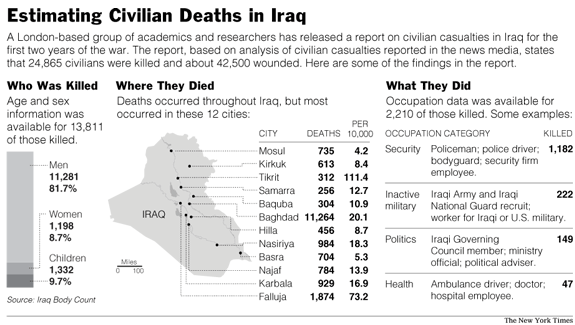
That's over 1300 children dead because of this war. That police force/army that the Republicans boast about isn't doing much better. No wonder we can't get them trained fast enough. The sad thing is that a lot of this might have been avoided with some actual planning...
Is it because we aren't getting the images of dead civilians beamed into our homes every night at supper that we don't give a damn, or are we really that cold hearted of a nation? I hope it is the former or God's going to have a long talk come judgement day and it won't be about Hefner's bunnies.
Next Up
Armando at dKos made an excellent point today that I want to repeat, now that we know who our nominee is. Armando quotes an article by law prof Bruce Ackerman in the current American Prospect. Ackerman writes:
The president has repeatedly promised us justices like Clarence Thomas or Antonin Scalia, and I propose to take him at his word. If we simply take the trouble to read their opinions, it becomes evident that a Court dominated by Thomases and Scalias would launch a constitutional revolution on a scale unknown since the New Deal.The Senate should also take the president seriously. Bush has already told us the kind of justices he wants, and if he has had a last-minute change of heart, it should be up to individual nominees to convince us that they are not in the Thomas-Scalia mold.
Placing this burden on the nominee permits senators to define a more decorous and consequential role for themselves in giving “advise and consent.” Rather than browbeating nominees, senators should take the president at his word, unless the candidate convinces them otherwise. They should repeatedly confront nominees with the opinions of Thomas and Scalia, and ask them to state, clearly and without equivocation, whether they agree or disagree. This approach would focus public attention on the main issue: the sweeping revolution promised by a Thomas-Scalia ascendancy…
Roberts is a blank page. We must know about his own core judicial philosophy and he must be closely questioned, or we run the risk that this will be nothing more than hagiography. So much of his record is based on the positions he argued for clients that we don't know what he really thinks. I'm with Ackerman, let's take Bush at his word and see how Roberts stacks up against Bush's own announced standard. He may be a great guy, but if he is a judicial radical in the Scalia/Thomas mold, let's find that out sooner rather than later.
Finally
The nominee is John G. Roberts of the DC Circuit. As assistant solicitor general, he held that Roe was wrongly decided, and as appellate judge, his first opinion questioned the constitutionality of the Endangered Species Act.
It's war.
Alliance for Justice's podcast should be updated shortly.
The Nominee
Keep in mind we don't know who Bush's pick will be, but certainly all the speculation has been about Judge Edith Brown Clement. I got this summary from the Senate Judiciary Committee:
The Senate Judiciary Committee sends along this summary of the opinions of Judge Edith Brown Clement:
BiographyJudge Edith Brown Clement, 57 years old, was confirmed to the U.S. Court of Appeals for the Fifth Circuit on November 13, 2001. She was previously the chief judge for the Eastern District of Louisiana, appointed by former President Bush in 1991. She graduated from the University of Alabama in 1969 (B.A.) and from Tulane University (J.D.) in 1973. After clerking for Judge Christenberry of the Eastern District of Louisiana, her legal career was spent in private practice in New Orleans, where she specialized in admiralty and maritime law, representing insurance companies, oil companies, and the marine services industry.
Issues of Concern
* Limited Constitutional Rights: Judge Clement is a conservative jurist whose opinions belie an exceedingly narrow view of the Constitutional rights of individuals. In almost every en banc case she votes with both Edith Jones and Emilio Garza. (21 out of 25 times)
* Restricts Access to Court: Judge Clement employs a narrow view of plaintiff standing (similar to Justice Scalia) which restricts citizens' access to courts for redress of their constitutionally-based claims. (Parents for Educational Justice v. Louisiana State Superintendent of Education, 2000)
* Cozy With Corporate Interests/ Regular Attendee of Judicial Junkets: Judge Clement has attended more than ten of the notorious judicial junkets paid for by corporate interests. Ruth Marcus, Issues Groups Fund Seminars for Judges, Washington Post, April 9, 1998. This issue raised suspicions about her sense of government ethics and her willingness to refrain from activities that create an appearance of impropriety in her 2001 confirmation hearing. Despite questions being raised during her confirmation hearing, Judge Clement has continued to attend private judicial seminars sponsored by corporate interests.
* Imposes Her Views Above Jury Verdicts: Judge Clement has authored several opinions which demonstrate a lack of deference to jury findings on issues such as damages for pain and suffering. She has been criticized by her fellow jurists for substituting her views for those of trial courts and juries. Fifth Circuit Judge Reavley specifically criticized Judge Clement for violating the Arule of deference to jury verdicts@ in a case in which Judge Clement wrote the majority opinion greatly reducing the award to the family of a mother and 3-year-old daughter who died in a car accident in part based on her assertion that there was not sufficient evidence the 3-year-old girl experienced pain and suffering before dying. (Vogler v. Blackmore, 5th Cir. 2003).
* Endorses Activist Courts: In her Senate Questionnaire, Judge Clement said "in determining whether or not the legislative or executive branch has acted within its constitutional powers, the court should be 'activist' in its considerations of constitutional definitions, granting of powers and guarantees of liberties in determining the meaning of the text."
* Opposed Environmental Protection of Endangered Species Judge Clement joined a vigorous dissent from a denial of en banc review, in which Judge Edith Jones questioned the constitutionality of an application of the Endangered Species Act to stop a development that would have threatened six species. The dissenters broke with other conservative members of the Fifth Circuit and the conservative Fourth Circuit, which had rejected a similar challenge; their logic would greatly restrict the effectiveness of the Endangered Species Act. (GDF Realty Investments v. Norton, (5th Cir. 2004).
* Hostile to Minority Rights: Judge Clement dissented from a decision granting class certification to a group of black policy holders suing insurance companies for allegedly paying lower benefits and charging higher premiums to black customers. The majority called her logic "circular" and wrote, "It is safe to say that the dissent's novel approach is unsupported by caselaw." (In Re Monumental Life Insurance, (5th Cir. 2003).
Swirling SCOTUS
The rumor mill is going nuts. All kinds of names are being thrown into the mix. Jeffrey Toobin on CNN is reporting that 4th Circuit judge Michael Luttig has his entire family in court with him today, all dressed up. This is the height of tea leaf reading. Some of the righty blogs say they are hearing Edith Jones.
The New Girl
Tom Goldstein at the Supreme Court Nomination Blog has compiled a synopsis of Judge Clement's decisions on the 5th Circuit. Looks pretty ordinary to me. Lawyers, if you see anything alarming, make a note in comments.
Welcome to the Neighborhood
Think Progress has just launched a new blog, Supreme Court Extra, which will be staffed primarily by former SCOTUS clerks. Given today's big news, I'm looking forward to this new resource as we parse the ins and outs of the upcoming confirmation process. I'm sure they'll have all kinds of interesting insidery stuff.
Guessing Game
Wikipedia tells us:
Edith Brown Clement (born in Birmingham, Alabama, April 29, 1948) is a judge on the United States Court of Appeals for the Fifth Circuit. She was nominated to this seat on September 4, 2001, by George W. Bush, was confirmed by the Senate on November 13, 2001, and received commission on November 26, 2001. With the resignation of Justice Sandra Day O'Connor from the United States Supreme Court, Judge Clement has been mentioned by some pundits as a potential Bush administration nominee to the Supreme Court of the United States.Born in Birmingham, Alabama in 1948, Clement was educated at the University of Alabama, receiving her B.A. in 1969, and at Tulane Law School, where she received a J.D. in 1972. Her early career included a period clerking for Judge Herbert W. Christenberry at the U.S. District Court for the Eastern District of Louisiana ( 1973-1975 ), after which she worked in private practice in New Orleans, Louisiana until 1991.
On October 1, 1991 Clement was nominated to the U.S. District Court for the Eastern District of Louisiana by George H.W. Bush. She was confirmed by the Senate to this post on November 21, 1991, and received commission on November 25, 1991. In 2001 she served as chief judge of this court, before being nominated to the U.S. Court of Appeals for the Fifth Circuit.
Judge Clement is a member of the Maritime Law Association of the United States, the Federal Bar Association, the American Law Institute, the Federalist Society, the Tulane Law School's Inn of Court, and the Committee on the Administrative Office of the Judicial Conference of the United States.
Why am I telling you this? Expect a heavy news day. Teddy Kennedy has a presser just after noon and Bush has a press availability at noon. ABC News "The Note," a source with great Republican contacts, is already putting out Clement as today's announcement.
Timing: think about getting the spotlight off Karl Rove.
UPDATE: Bush will make his announcement at 9 PM EDT tonight.
Your Ass and the Bottom Line
Ah, yes, the economy is "strong and getting stronger."
Hewlett-Packard to Lay Off 14,500 to Save $1.9 Billion
By GARY RIVLIN
Published: July 19, 2005
SAN FRANCISCO, July 19 - Hewlett-Packard said today it would lay off 14,500 employees, almost 10 percent of its staff, in the next year and a half and freeze its pension plan for new and existing workers who have not vested in it yet.Hewlett announced the highly anticipated program before the opening of the stock market in a bid to persuade investors that the struggling company finally has its house in order. The company, which hired Mark V. Hurd in March to replace Carleton S. Fiorina, said it would save $1.9 billion annually beginning in 2007 and half of the savings would be used to "offset market forces or reinvested in the business."
Hewlett will dissolve its Customer Solutions Group, a business unit that sold to businesses and public entities, and distribute its work to the company's three product groups. The company said it would protect employees in sales and research and development from the brunt of the layoffs, which will mostly affect support positions in information technology, human resources and finance.
By freezing its pension, Hewlett becomes the latest in a series of companies to halt growth or completely end the traditional retirement plans. Long-serving employees and retirees who have already earned their pension benefits won't lose them, but workers who haven't yet vested will no longer have that option. In exchange, the company will increase its matching contribution in employees' 401(k) accounts to 6 percent from the current 4 percent.
"What everyone I speak to at H.-P. continues to emphasize is that this announcement is about the setting of priorities," Mark D. Stahlman, an analyst at Caris & Company, said before the announcement. "They'll tell you over and over again this is not about cutting back expenses because H.-P. is failing, or because it's somehow trying to meet Wall Street expectations."
Mr. Stahlman added that Hewlett had been trying to deliver the message that "Wall Street has completely missed what's going on, that this isn't a case where a company needs to get out a bone-cutter and desperately start chopping."
Such is the legacy of Carly Fiorina and Wall Street's attention to the goddamn bottom line. If you are unemployed you are a lazy son of a bitch.
Alleviating Suffering
You won't find me quoting NYT's John Tierney here very often, but this is personal. I'm a chronic pain patient. The US has a nutso relationship with pain and pain medication. Lurking in the background is an old Calvinist assumption that there is something redemptive about suffering. It's bad theology.
Every study I've read indicates that opioids used for pain relief rarely result in addiction: pain patients use as much as they need and no more. There is not a goddamned thing redemptive about suffering, theologically or medically, and the government shouldn't have the right to get in between a pain patient and her doctor.
Punishing Pain
By JOHN TIERNEY
Published: July 19, 2005
Mr. Paey, who is 46, suffers from multiple sclerosis and chronic pain from an automobile accident two decades ago. It damaged his spinal cord and left him with sharp pains in his legs that got worse after a botched operation. One night he woke up convinced that the room was on fire."It felt like my legs were in a vat of molten steel," he told me. "I couldn't move them, and they were burning."
His wife, Linda, an optometrist, supported him and their three children as he tried to find an alternative to opiates. "At first I was mad at him for not being able to get better without the medicines," she said. "But when he's tried every kind of therapy they suggested and he's still curled up in a ball at night crying from pain, what else can he do but take more medicine?"
The problem was getting the medicine from doctors who are afraid of the federal and local crusades against painkillers. Mr. Paey managed to find a doctor willing to give him some relief, but it was a "vegetative dose," in his wife's words.
"It was enough for him to lay in bed," Mrs. Paey said. "But if he tried to sit through dinner or use the computer or go to the kids' recital, it would set off a crisis, and we'd be in the emergency room. We kept going back for more medicine because he wasn't getting enough."
As he took more pills, Mr. Paey came under surveillance by police officers who had been monitoring the prescriptions. Although they found no evidence that he'd sold any of the drugs, they raided his home and arrested him.
Mr. Paey wasn't a Rush Limbaugh drug abuser, he's a pain patient. The government can't figure out the difference.
The New Kid
Bush Plans Interviews With Court Candidates
President Wants Confirmation by October
By Peter Baker
Washington Post Staff Writer
Tuesday, July 19, 2005; Page A08
President Bush said yesterday that he plans to interview finalists for the Supreme Court to "get this process moving" so that the Senate can confirm the next justice by the beginning of the new term in October, but gave little clue about whom he is considering.Bush depicted his selection process as "thorough and deliberate," and insisted that he is listening to the many senators he and his staff have consulted. But he strongly reaffirmed that he will make the choice, not the senators who have weighed in with suggestions.
At a news conference with visiting Indian Prime Minister Manmohan Singh, Bush said he will meet some potential nominees after studying their records."I will sit down with some and talk to them face to face, those who I have not known already," he said. "You know, we've got some people that [are] perhaps in contention that I've already spent time with, that I know. . . . And so I don't need to interview those."
His formulation suggested that some finalists would include close acquaintances such as Attorney General Alberto R. Gonzales or U.S. Appeals Court Judge Priscilla R. Owen, fellow Texans who owe their current jobs to Bush and would not need to be interviewed further. He is also considering several other judges he does not know. The White House declined to discuss individual candidates or Bush's schedule of interviews.
The WaPo piece suggests that we'll have a name as early as this week. My ears are hearing that such an idea is woefully optimistic.
Working...And Poor
As Medicaid Balloons, Watchdog Force Shrink
By MICHAEL LUO
and CLIFFORD J. LEVY
Published: July 19, 2005
New York's Medicaid program pays more than a million claims a day, feeding a $44.5 billion river of checks to radiologists and ambulance drivers, brain surgeons and orderlies, medical centers and corner pharmacies. Many who get those checks pocket more money than they deserve, and millions of taxpayer dollars are believed to be lost every day to theft and waste.
This article is the second in a series examining the security, effectiveness and cost of New York's Medicaid program, the largest of its kind in the nation and the state's biggest expense.Yet the state, charged with protecting those dollars, has done little to stop them from draining away.
A yearlong New York Times investigation found only a thin, overburdened security force standing between this enormous program and the unending attempts to steal from it. Even as spending by New York Medicaid has more than tripled since the late 1980's, the number of fraud investigators who guard its cash register has fallen by half, and several of their leaders have quit or retired in disillusionment.
Of the 400 million claims that Medicaid paid last year, Health Department regulators uncovered just 37 cases of suspected fraud, far fewer than their counterparts in any other large state, even though New York's Medicaid budget is by far the largest in the nation. Many experts say that it is likely that at least 10 percent and probably more of New York Medicaid dollars are stolen or wasted.
In dozens of interviews, prosecutors, lawmakers and former regulators said the program paid for almost everything and scrutinized almost nothing, in large part because its primary mission has been to ensure that there are enough health care providers in the system to address the needs of the poor. It often appears that the Health Department is barely even looking: There are more than 140,000 hospitals, nursing homes, doctors and other health care providers in the system, but the department visited just 95 in the 2004 fiscal year to audit their billings.
Analyzing Medicaid data obtained under the state's Freedom of Information Law, The New York Times identified scores of instances in which the claims of health care providers jumped markedly in a single year. These spikes are a classic indication of possible improper billing, yet few of those providers had even part of their billings audited by the department, state records show.
New York's Medicaid program, once the pride of the Great Society era, has become a system "that almost begs people to steal," said Michael A. Zegarelli, a senior New York Medicaid regulator until 2003 and a past president of the national association of Medicaid oversight officials.
Meanwhile, other states, including California and Texas, have increased their antifraud efforts and discovered what seems a simple truth: The effort to seek out theft and unnecessary spending can more than pay for itself, just as a parking violations bureau brings in revenue. Workers assigned to Medicaid fraud prosecution units around the nation help bring in an average of $200,000 each in recoveries, according to federal statistics.
The question The Times leaves unasked, and which I find more interesting, is what percentage of the poor are completely uncovered by Medicare and how much does that cost?
July 18, 2005
Air! We need Air!
Court Backs EPA on Lack of Greenhouse Gas Limits
By Juliet Eilperin
Saturday, July 16, 2005
The Environmental Protection Agency does not have to regulate gases linked to climate change as air pollutants, a federal appeals court ruled yesterday, dealing a blow to a dozen states and three cities -- including the District of Columbia and Baltimore -- hoping to cut heat-trapping gases.
In a 2 to 1 ruling, a panel of the U.S. Court of Appeals for the D.C. Circuit ruled that the EPA had solid policy reasons not to impose mandatory limits on carbon dioxide, methane, nitrous oxide and hydrofluorocarbons. All four gases are said to contribute to trapping heat in the atmosphere.
Writing for the majority, Judge A. Raymond Randolph did not address the Bush administration's argument that it lacked legal authority to regulate greenhouse gases. Randolph said he and Judge David B. Sentelle assumed the EPA had the power to regulate for the purposes of this case but "the question we address is whether EPA properly declined to exercise that authority."
Judge David S. Tatel dissented, saying that if the EPA determines that the emissions pose a public health risk, "then EPA has authority -- indeed, the obligation -- to regulate their emissions from motor vehicles."
California has already enacted legislation limiting greenhouse gas emissions from cars, and other states are considering similar steps. States will still be allowed to pursue those policies despite the panel's ruling, legal analysts said.
"This decision is wrong and deserves reversal on both law and policy," said Connecticut Attorney General Richard Blumenthal, one of the plaintiffs. "The decision disregards the EPA's obligation to protect against the growing threat of global warming, which severely endangers public health and imperils shorelines, water quality, and other vital natural resources."
*cough* *cough* *cough* Eh, we don't really need to do a sequel to March of the Penguins do we? After all, who really cares one bit about the quality of the air once we get inside?
Besides, there are always more drastic measures that we can take to solve that air quality problem....
Beisdes, there are always more drastic measures that can be taken to solve that pesky problem of air quality... observe the administration's role models and how they dealt with it:
Dark Helmet: [C]ommence operation: Vacusuck.

Col. Sandurz: It's Mega Maid. She gone from suck to blow.
Yup, it will probably work as well for our bunch too.
Flu Wiki--Chamber Music
The afternoon has been spent behind the scenes working on the Flu Wiki. Go take a look, there is so much information that we are spending a lot of time right now on learning how to organize it so that people can find what they are looking for. It would be great to get an information technology or library scientist in there to help organize things. We're (we being the whole community) are doing it on the fly, but having someone around who is used to thinking systematically about these things would sure be helpful.
The wiki is a whole new experience, and I'm liking it. The entire community takes responsibility for the content, including the editing. It is a cool collaborative tool. Not everyone works best this way, but collaboration brings out the best in me. I'm a chamber musician, not a soloist. (I line edited a piece by DemfromCT. You can fix spelling and keystroke screwups. Let your inner editor come out to play. He teased me about it. It was just like a woodwind quintet rehearsal, except we have the biggest living room in the world.) It turns out that this is not only important, it is fun.
Who knew?
Moving the Goalposts
In Shift, Bush Says He'll Fire Aides Who 'Committed a Crime'
By DAVID STOUT
Published: July 18, 2005
WASHINGTON, July 18 - President Bush changed his stance today on his close adviser Karl Rove, stopping well short of promising that anyone in his administration who helped to unmask a C.I.A. officer would be fired."If someone committed a crime, they will no longer work in my administration," Mr. Bush said in response to a question, after declaring, "I don't know all the facts; I want to know all the facts."
For months, Mr. Bush and his spokesmen have said that anyone involved in the disclosure of the C.I.A. officer's identity would be dismissed. The president's apparent raising of the bar for dismissal today, to specific criminal conduct, comes amid mounting evidence that, at the very least, Mr. Rove provided backhanded confirmation of the C.I.A. officer's identity.
In the months after the name of the officer, Valerie Plame Wilson, was made public in July 2003, the White House said repeatedly that no one working for the administration was part of the disclosure.
Mrs. Wilson's husband, former ambassador Joseph C. Wilson IV, has asserted that his wife was unmasked, and her career consequently damaged, in retaliation for his criticism of the Bush administration's policy toward Iraq. He has also said he suspects that Mr. Rove, by all accounts one of the president's most trusted political advisers and an architect of his successful re-election strategy, had a role in the disclosure.
I'm assuming this means indictment AND conviction. Frank Rich to the contrary, I don't see Rove going anywhere.
Pragmatism
Iraq War Hasn't Made United States Safer, Author Says
Polls Indicate Americans Agree
By Terry M. Neal
washingtonpost.com Staff Writer
Monday, July 18, 2005; 8:00 AM
So the question is, did Iraq make us safer?In his best-selling book "America the Vulnerable: How Our Government Is Failing to Protect Us From Terrorism," Stephen Flynn, a senior fellow at the Council on Foreign Relations and a former U.S. Coast Guard commander, argues essentially that Iraq was a "phony war" based on the president's oft-repeated assertion that America is "fighting the terrorists abroad so we don't have to face them at home."
Every nation, even one as rich as the United States, has finite resources. And America is spending large portions of its resources, both in terms of human and economic capital, fighting a conventional war against a nation-state that does not address America's biggest vulnerability -- its openness to unconventional attacks by terrorists who don't respect borders.
America remains astonishingly vulnerable to attacks from al Qaeda, which has morphed under Bush's watch, from an organization to a worldwide movement, Flynn argues.
"The degree to which the Bush administration is willing to invest in conventional national security spending relative to basic domestic security measures is considerable," Flynn argues in an article he wrote for Foreign Affairs magazine based on his book.
"Although the CIA has concluded that the most likely way weapons of mass destruction (WMD) would enter the United States is by sea, the federal government is spending more every three days to finance the war in Iraq than it has provided over the past three years to prop up the security of all 361 U.S. commercial seaports."
Flynn accuses the administration of a "myopic" focus on conventional military forces at the expense of domestic security. He draws this comparison: "In fiscal year 2005, Congress will give the Pentagon $7.6 billion to improve security at military bases. Meanwhile, the Department of Homeland Security will receive just $2.6 billion to protect all the vital systems throughout the country that sustain a modern society."
I called Flynn this week to ask him if the nation's priorities were so horribly skewed, why hadn't America been attacked again? And perhaps couldn't it be surmised that the terrorists attacked Madrid and London instead of, say Washington or New York, because it was easier to do so?
Flynn argues that this would be an improper conclusion to draw.
Here's the gist of the argument he gave me: Al Qaeda and al Qaeda-inspired terrorist are patient. They seek maximum bang for the buck, so to speak. As they did in Madrid and London, the terrorists build a three-cell unit. The first is the leadership or operations cell. The second is the reconnaissance team, which scouts potential targets for risk and reward. And the third is the action cell, which carries out the attack.
Building this sort of operation can take many years, and the risks are high. And once the action unit attacks, it creates an instant forensics trail that "creates an operational security problem. If you use it for a relatively low-end thing, you put your organization at risk for little gain and you have to start over again."
In London, investigators learned much about the attackers quickly, just as American investigators did after 9/11. It could take the terrorists years to recover in London, as it has in America. But they will be back, Flynn argues, because there will always be enough "angry young men who can possess powerful weapons of destruction" to target a nearly endless supply of soft-targets.
Iraq has not changed that equation one bit, Flynn argues. It has only diverted resources from the more pragmatic approach of targeting and hunting down terrorists around the world and, even more important, bolstering domestic security.
This is just common sense.
Dueling Timetables
Beltway insiders can't make up their minds.
GOP Allies Say Bush Is Close to Court Pick
Choice May Be Announced This Week
By Peter Baker
Washington Post Staff Writer
Monday, July 18, 2005; Page A02
President Bush, accelerating his search for a new Supreme Court justice, appears to have narrowed his list of candidates to no more than a few finalists and could announce his decision in the next few days, Republican strategists informed about White House plans said yesterday.Advisers to Bush had anticipated an announcement closer to the end of the month, but the White House signaled allies over the weekend to be prepared for a nomination this week, according to the strategists, who asked not to be named because the process remains officially confidential. "We've been told to be ready," one strategist said.
The faster pace came after a surprise statement Thursday night by Chief Justice William H. Rehnquist, who is 80 and battling thyroid cancer, in which he dispelled intense speculation that he intends to retire soon. In disclosing his intentions, Rehnquist clarified the choice facing the president, who can move forward knowing that he has only one seat to fill -- that of retiring Justice Sandra Day O'Connor.
Laying the groundwork for his nomination, Bush used his weekly radio address Saturday to press the Senate for an expeditious confirmation process. Bush has said he wants to seat the new justice by the time the court begins its next term Oct. 3, although O'Connor agreed in her retirement letter to stay on until her successor is confirmed. In delaying his decision so far, Bush has managed to limit the time before Oct. 3 when his nominee would be vulnerable to attacks from opponents.
As Bush interviews his finalist or finalists, the White House has kept secret his paring-down process. Some advisers said they increasingly believe the president may pick a woman to replace O'Connor, the nation's first female justice, just as first lady Laura Bush publicly urged him to do last week. "There's a lot more focus on a woman," one GOP strategist said.
Bush also has considered several African Americans and Hispanics, although allies believe he is now leaning against appointing Attorney General Alberto R. Gonzales, a friend.
But Roll Call says: (sub. req.)
By Paul Kane
Roll Call Staff
July 18, 2005
Bucking conventional wisdom, the Bush White House is taking its time in announcing its first Supreme Court nominee — so much time that, if the indecision lasts past Thursday, it will go down as the longest a Republican president has taken to announce a high court nomination since 1971.Instead of making a decisive move to appoint a nominee within a day or two of the vacancy — as almost all of President Bush’s supporters had been predicting as recently as three weeks ago — Bush has led the selection process in a slow and deliberate manner.
He went to Europe and back, engaged in a lengthy consultation with the Senate and publicly discussed his criteria for a justice several times, including Saturday’s radio address.
Yet no nomination has come from the White House, prompting many GOP Senators to ruminate on the cause of the delay. The Senators offered a litany of potential explanations, ranging from shock that Justice Sandra Day O’Connor retired instead of Chief Justice William Rehnquist, to the fact that Bush himself might not have focused on making a selection until he actually had a retirement.
Regardless of the reason for the delay, Senate Republicans acknowledged in interviews last week their genuine surprise at the delay — and they suggested they were ready for the battle to begin.
“My general view is, you know this is coming — move quickly,” said Sen. George Allen (R), who said he advocated a quick-strike method in making judicial selections as Virginia’s governor in the 1990s.
“I wouldn’t want him to go faster than he feels comfortable with, but I do think we need to get this thing going,” said Sen. Jeff Sessions (R-Ala.), a Judiciary Committee member.
“All I know is that he’s taking a long time in his consultation process, which is good, but it does delay the nomination,” said Sen. Jon Kyl (R-Ariz.), a Judiciary member and the No. 4 ranking member of GOP leadership.
I made the rounds of my sources this morning and heard "no clue." Stay tuned.
Leaks and the Leaking Leakers....
More from Kamen's column:
Now Hear This
Mark your calendars! Time magazine White House correspondent Matthew Cooper heads a panel of witnesses testifying Wednesday morning at a Senate Judiciary Committee hearing. Others scheduled to appear are Cooper's boss, Time Editor in Chief Norman Pearlstine and University of Chicago law professor Geoffrey Stone.The hearing is titled "Reporters' Shield Legislation: Issues and Implications." Cooper should attract a fairly good crowd. But if committee Chairman Arlen Specter (R-Pa.) were to have New York Times reporter Judith Miller testify on a video hookup from the Alexandria Detention Center . . .
Typically, C-Span doesn't decide what they are going to air until the night before, so it will be a while before we know if this piece of video will be available live.
A Betting Man
I read WashPo's Al Kamen's "In the Loop" column for entertainment, but sometimes he's prescient:
Gonzales Way Out in Front in Court Betting
The betting continues on who will replace Supreme Court Justice Sandra Day O'Connor . As of this weekend, Sportsbook.com had Attorney General Alberto R. Gonzale s solidifying his lead as a solid 5-8 favorite (meaning an $8 bet would return $13). But Judge Edith Brown Clement has moved up to 4-1, while fellow appellate judge Emilio M. Garza dropped to 8-1, tied with Judge Janice Rogers Brown . Some money drifted to U.S. Appeals Court Judge Michael McConnell , who moved up a notch to 9-1, but the rest of the pack stayed well back of the leaders.The gamblers apparently did not take note of first lady Laura Bush 's statements that she wants a woman nominated. But the political punditocracy quickly added, among others, Judge Karen Williams of the U.S. Court of Appeals for the 4th Circuit, Michigan Supreme Court Justice Maura Corrigan and Harvard Law professor and Vatican adviser Mary Ann Glendon to the list.
My money would be on Edith Brown Clement or Edith Jones.
Jesus Saves; Moses Invests
A Church That Packs Them In, 16,000 at a Time
By JOHN LELAND
Published: July 18, 2005
HOUSTON, July 17 - Where the Beers of the World kiosk once dispensed suds to rowdy N.B.A. fans, volunteers were handing out church literature on Sunday. And where Patricia Davis, 38, once saw ZZ Top in concert, she now plans to worship.Members of the Lakewood Church, the nation's largest, Saturday night at the first service in their new home.
"I was saved from that," Ms. Davis said last week, sitting near the old three-point line at the 16,000-seat arena here that is now her church's new home. "With the waterfalls," she said, "this really feels like a sanctuary."
The nondenominational Lakewood Church, the nation's largest congregation, moved into the Compaq Center, once the home of the Houston Rockets, over the weekend. After $95 million in renovations, including two waterfalls and enough carpeting to cover nine football fields, the arena now belongs to a charismatic church with a congregation of 30,000, revenues of $55 million last year and a television audience in the millions.
Like many new evangelical churches, the building has no cross, no stained glass, no other religious iconography. Instead, it has a cafe with wireless Internet access, 32 video game kiosks and a vault to store the offering.
On Saturday evening, at the first service in the arena, Joel Osteen, the pastor, exhorted a packed house of black, white and Latino worshipers, some of whom arrived three hours early. "What a sight this is. You guys look like victors, not victims," he said, to a round of applause. "We're just going to have a great time and celebrate the goodness of God tonight."
Mr. Osteen, 43, a personable Texan with soap-opera features and wavy, gelled hair, did not go to seminary and dropped out of college after a year. But since he inherited the church from his father in 1999, he has been on a roll, spreading a simple self-help message that congregants say is both uplifting and accessible. God, Mr. Osteen preaches, does not want to see people suffering and poor; he wants them to be healthy, wealthy and wise.
My cable system carries the Sunday broadcast from this....place. I can't really call it a church. I've watched the show a couple of times in the interest of research. This is another one of those peculiarly American versions of religion+money=redemption (however you define it.) Funny, I can't find anything in the Bible which reads, "Know the truth and it shall make you rich." As a theologian, this kind of stuff offends me; it is a complete misrepresentation of the Gospels. Ever notice how much people love misrepresentations of the Gospels? The reporter doesn't know enough about religion to be able to provide that context, of course.
What he also can't tell you is that this Church of Wealth and Comfort theology has invaded all of suburban religion, whatever the denomination or tradition. And that none of it represents the actual history and traditions of the faiths it claims to belong to. Judaism and Christianity were both born in cultures of oppression and suffering and neither ever preached wealth and comfort as part of their sacred texts.
Your Tax Dollars At Work
An Empty Apology
By BOB HERBERT
Published: July 18, 2005
One of President Bush's surrogates went before the N.A.A.C.P. last week and apologized for the Republican Party's reprehensible, decades-long Southern strategy.The surrogate, Ken Mehlman, is chairman of the Republican National Committee. Perhaps he meant well. But his words were worse than meaningless. They were insulting. The G.O.P.'s Southern strategy, racist at its core, still lives.
"Some Republicans gave up on winning the African-American vote, looking the other way or trying to benefit politically from racial polarization," said Mr. Mehlman. "I am here today as the Republican chairman to tell you we were wrong."
He made his remarks during an appearance in Milwaukee at the annual convention of the N.A.A.C.P., which has a relationship with President Bush reminiscent of the Hatfields' relationship with the McCoys. In a chilling act of political intimidation, the Internal Revenue Service responded to criticism of Mr. Bush by the N.A.A.C.P.'s chairman by launching an investigation of the group's tax-exempt status.
The Southern strategy meant much, much more than some members of the G.O.P. simply giving up on African-American votes. Put into play by Barry Goldwater and Richard Nixon in the mid- to late 1960's, it fed like a starving beast on the resentment of whites who were scornful of blacks and furious about the demise of segregation and other civil rights advances. The idea was to snatch the white racist vote away from the Democratic Party, which had committed such unpardonable sins as enacting the Civil Rights and Voting Rights Acts and enforcing desegregation statutes.
The important thing to keep in mind was how deliberate and pernicious the strategy was. Last month a jury in Philadelphia, Miss., convicted an 80-year-old man, Edgar Ray Killen, of manslaughter in the slaying of three civil rights workers - Andrew Goodman, Michael Schwerner and James Chaney - in the summer of 1964. It was a crime that made much of the nation tremble, and revolted anyone with a true sense of justice.
So what did Ronald Reagan do in his first run for the presidency, 16 years after the murder, in the summer of 1980? He chose the site of the murders, Philadelphia, Miss., as the perfect place to send an important symbolic message. Mr. Reagan kicked off his general election campaign at the Neshoba County Fair in Philadelphia, an annual gathering that was famous for its diatribes by segregationist politicians. His message: "I believe in states' rights."
Mr. Reagan's running mate was George H. W. Bush, who, in his own run for president in 1988, thought it was a good idea to exploit racial fears with the notorious Willie Horton ads about a black prisoner who raped a white woman. Mr. Bush's campaign manager, Lee Atwater, said at the time that the Horton case was a "values issue, particularly in the South - and if we hammer at these over and over, we are going to win."
Not since Nixon have the wheels of government been manipulated so clearly for political purposes.
WASHINGTON, July 17 - The Federal Bureau of Investigation has collected at least 3,500 pages of internal documents in the last several years on a handful of civil rights and antiwar protest groups in what the groups charge is an attempt to stifle political opposition to the Bush administration.The F.B.I. has in its files 1,173 pages of internal documents on the American Civil Liberties Union, the leading critic of the Bush administration's antiterrorism policies, and 2,383 pages on Greenpeace, an environmental group that has led acts of civil disobedience in protest over the administration's policies, the Justice Department disclosed in a court filing this month in a federal court in Washington.
The filing came as part of a lawsuit under the Freedom of Information Act brought by the A.C.L.U. and other groups that maintain that the F.B.I. has engaged in a pattern of political surveillance against critics of the Bush administration. A smaller batch of documents already turned over by the government sheds light on the interest of F.B.I. counterterrorism officials in protests surrounding the Iraq war and last year's Republican National Convention.
F.B.I. and Justice Department officials declined to say what was in the A.C.L.U. and Greenpeace files, citing the pending lawsuit. But they stressed that as a matter of both policy and practice, they have not sought to monitor the political activities of any activist groups and that any intelligence-gathering activities related to political protests are intended to prevent disruptive and criminal activity at demonstrations, not to quell free speech. They said there might be an innocuous explanation for the large volume of files on the A.C.L.U. and Greenpeace, like preserving requests from or complaints about the groups in agency files.
But officials at the two groups said they were troubled by the disclosure.
"I'm still somewhat shocked by the size of the file on us," said Anthony D. Romero, executive director of the A.C.L.U. "Why would the F.B.I. collect almost 1,200 pages on a civil rights organization engaged in lawful activity? What justification could there be, other than political surveillance of lawful First Amendment activities?"
Protest groups charge that F.B.I. counterterrorism officials have used their expanded powers since the Sept. 11 attacks to blur the line between legitimate civil disobedience and violent or terrorist activity in what they liken to F.B.I. political surveillance of the 1960's. The debate became particularly heated during protests over the war in Iraq and the run-up to the Republican National Convention in New York City last year, with the disclosures that the F.B.I. had collected extensive information on plans for protests.
In all, the A.C.L.U. is seeking F.B.I. records since 2001 or earlier on some 150 groups that have been critical of the Bush administration's policies on the Iraq war and other matters.
The Justice Department is opposing the A.C.L.U.'s request to expedite the review of material it is seeking under the Freedom of Information Act, saying it does not involve a matter of urgent public interest, and department lawyers say the sheer volume of material, in the thousands of pages, will take them 8 to 11 months to process for Greenpeace and the A.C.L.U alone. The A.C.L.U., which went to court in a separate case to obtain some 60,000 pages of records on the government's detention and interrogation practices, said the F.B.I. records on the dozens of protest groups could total tens of thousands of pages by the time the request is completed.
The Missing
The Dropout Puzzle
By PAUL KRUGMAN
Published: July 18, 2005
Economists who argue that there's something wrong with the unemployment numbers are buzzing about a new study by Katharine Bradbury, an economist at the Federal Reserve Bank of Boston, which suggests that millions of Americans who should be in the labor force aren't. "The addition of these hypothetical participants," she writes, "would raise the unemployment rate by one to three-plus percentage points."Some background: the unemployment rate is only one of several numbers economists use to assess the jobs picture. When the economy is generating an abundance of jobs, economists expect to see strong growth in the payrolls reported by employers and in the number of people who say they have jobs, together with a rise in the length of the average workweek. They also expect to see wage gains well in excess of inflation, as employers compete to attract workers.
In fact, we see none of these things. As Berkeley's J. Bradford DeLong writes on his influential economics blog, "We have four of five indicators telling us that the state of the job market is not that good and only one - the unemployment rate - reading green."
In particular, even the most favorable measures show that employment growth has lagged well behind population growth over the past four years. Yet the measured unemployment rate isn't much higher than it was in early 2001. How is that possible?
The answer, according to the survey used to estimate the unemployment rate, is a decline in labor force participation. Nonworking Americans aren't considered unemployed unless they are actively looking for work, and hence counted as part of the labor force. And a large number of people have, for some reason, dropped out of the official labor force.
Those with a downbeat view of the jobs picture argue that the low reported unemployment rate is a statistical illusion, that there are millions of Americans who would be looking for jobs if more jobs were available. Those with an upbeat view argue that labor force participation has fallen for reasons that have nothing to do with job availability - for example, young adults, recognizing the importance of education, may have chosen to stay in school longer.
That's where Dr. Bradbury's study comes in. She shows that the upbeat view doesn't hold up in the face of a careful examination of the numbers. In fact, because older Americans, especially older women, are more likely to work than in the past, labor force participation should have risen, not fallen, over the past four years. As a result, she suggests that there may be "considerable slack in the U.S. labor market": there are at least 1.6 million and possibly as many as 5.1 million people who aren't counted as unemployed but would take jobs if they were available.
There's both good news and bad news in that assessment. The good news is that the economy probably has plenty of room to expand before inflation becomes a problem (which implies that the Fed's decision to start raising interest rates was premature).
The bad news is that it's hard to see where further expansion will come from. We've already had four years of extremely loose fiscal and monetary policy. Tax cuts have pushed the federal budget deep into the red. Low interest rates have helped generate a housing bubble that has lifted real estate prices to ludicrous heights in major parts of the country.
If all that wasn't enough to give us a full economic recovery, what will?
Brad DeLong has the commentary, but PGLat at Angry Bear has the charts.
July 17, 2005
Intent: The Movie
"Beats me" if it is a crime, says Matt Cooper of TIME. After the amount of time he spent closeted with his lawyers this week, I find that more than a shade disengenuous. Read the story and make up your own mind.
Catching Up at the Gray Lady
What the stupid reporters don't see is that there is a pattern here, one designed to show who is in control, and it is not the Western Hegemonic Alliance.
Iraqis Stunned by the Violence of a Bombing
By KIRK SEMPLE
Published: July 18, 2005
BAGHDAD, Iraq, July 17 - Even in Iraq, where shocking killings have become part of daily life, some acts are so profoundly violent that the country seems to pause, trying to fathom what happened.That was the case on Sunday, after a suicide bomber appeared in Musayyib, a poor town just south of Baghdad, and blew himself up under a fuel tanker on Saturday night, igniting a fireball that engulfed cars, shops and homes. At least 71 people died; 156 were wounded. Some bodies were badly charred, making identification difficult.
Some senior elected officials and civic and religious leaders spoke out on Sunday, condemning the attack, one of a wave of suicide bombings that has shaken the greater Baghdad area in the past eight days. Grand Ayatollah Ali al-Sistani, the most revered Shiite cleric in Iraq, asked the government "to defend this country against the mass annihilation," according to Vice President Adel Abdul Mahdi, who led a delegation that visited the ayatollah on Sunday.
But nothing has stopped the bombings. In Baghdad, four suicide bombers struck within a span of four and a half hours on Sunday.
An Interior Ministry official listed the attacks: at 8 a.m., a car exploded at a checkpoint guarded by ministry commandos, killing three of them and wounding 10 civilians. Another car bomb killed a police commando and a civilian and wounded five civilians at 9:45 a.m. A third detonated near an office of the High Electoral Commission in Baghdad at 11:10 a.m., killing three and wounding one. The fourth struck at 12:30 p.m., killing one civilian and wounding another.
The surge of suicide attacks torturing the capital has seemingly confounded Iraqi and American forces, which have focused their Baghdad security efforts on stopping the bombers. Attacks are often undetectable until the last seconds before detonation, especially in the case of moving car bombs, and nearby civilians can slow the reaction of security forces.
Additionally, no obvious pattern has appeared in the recent string of attacks except that, like the scores of others that have made suicide bombs a prominent feature of this war, they have often singled out Shiites in large numbers or Iraqi and international security forces.
Insufficient troops on the ground, utterly no understanding of Fourth Generation Warfare, and you expect a different result? The reporters are idiots. This would be expected by anybody who reads military history and the last five "lessons learned" from the War College. Oh, the Pentagon hasn't read them? What a shock that our war fighters are being run by morons.
Yes, morons. We shouldn't be in Iraq in the first place, and if you can answer the question "Why are we here in the first place," I'll shoot you down by asking which other African human rights dictatorships we ought to take down, ones we supported by the CIA most of the time.
We're waging an incompetent war for illusionary reasons. Thomas Aquinas is spinning in his grave, but, surely, he is used to it.
I'm not.
Um, Kirk? This has been going on for four years. What are you, a new hire?
Buried Lede: Suicide Bomber Waltzes Into Green Zone
Report: Iraq foils assassination attempt
United Press International
Jul 16, 2005, 15:37 GMT
BAGHDAD, Iraq (UPI) -- An independent Iraqi newspaper Saturday said Iraq`s Interior Minister Bayan Soulagh escaped an assassination attempt.
The Al-Mashreq daily said a suicide attacker targeting Soulagh tried to blow himself up Thursday during the minister`s press conference in the Green Zone in Baghdad.
The newspaper reported the interior ministry`s intelligence forces foiled the attempt, but did not say how.
The attacker, dressed in an Iraqi police uniform, had sneaked into the Convention Center, located in the high security Green Zone, after he managed to pass several Iraqi and U.S. military check points.
The attacker was wearing an explosives belt under his uniform.
The Barn Door
Roche Carolina nabs contract to produce avian flu drug
By ANDY COLE
Morning News
FLORENCE - Roche Carolina will have a part in a $58 million Department of Defense contract to produce its anti-flu drug Tamiflu.The contract was awarded to Roche Laboratories last week to produce Oseltamivir Phosphate (Tamiflu) capsules, which fight flu symptoms and is indicated for protection against avian influenza. Health professionals around the world have been increasingly worried about the possibility of an outbreak of avian flu, and the Department of Defense is ordering Tamiflu capsules to protect military personnel.
The final active ingredient of Tamiflu is made in Florence.
"At the moment, we're the only site in the U.S. registered with the FDA to manufacture the final active ingredient in Tamiflu," said Dr. Frank Cox, vice president and general manager for Roche Carolina.
Tamiflu is approved for treatment of type A and B influenza in patients 1 year old and older and for prevention of influenza in adults and adolescents 13 years and older. It is not indicated specifically for protection against avian flu, but experts, including the World Health Organization, say that Tamiflu could play a critical role in managing an outbreak. Tamiflu is the only antiviral drug known to be effective against avian influenza.
"To be most effective it has to be administered within 48 hours of onset," Cox said.
The drug has been shown to be effective in preventing people from catching other influenzas, but it isn't approved as a prophylactic drug for avian flu Cox said.
"The challenge of avian flu is that there is so little know about it," Cox said.
One reason there's so little known about the virus is that its outbreaks have been in remote parts of the world. Vietnam, Cambodia and China have all seen outbreaks. Cases of avian flu have been increasing in Asia, and health care professionals around the world are keeping an eye on the outbreak because of the potential to become a pandemic, spreading around the world.
According to the World Health Organization, the current outbreak of the avian flu has seen 55 people die, all of them in Southeast Asia. The aggressive strain of avian influenza, Virus H5N1, was the cause of the illness and death in humans. The virus has also killed a large number of animals.
Three years ago an outbreak of avian flu in poultry in South Asia led to the slaughter of millions of chickens, and U.S. officials have seen different strains of the virus in poultry farms here.
The disease not only poses a health risk, but it's also an economic threat. The avian influenza crisis in Asia has already caused more than $10 billion dollars in damage in the economies of the most seriously affected countries, but this is just the tip of the iceberg compared with the possible global economic consequences of a human influenza pandemic according to a study, Thinking Ahead: The Business Significance of an Avian Influenza Pandemic, released by Bio Economic Research Associates.
"According to the quantitative measures we developed for assigning relative economic risk exposure to infectious disease outbreaks for countries in Asia, Hong Kong and Singapore are especially vulnerable to the initial economic shock waves that would ensue from a pandemic," said James Newcomb, managing director and principal author of the bio-era report. Bio Economic Research Associates is a private research and advisory firm.
"The secondary impacts on other countries, especially China, could have far-reaching impacts for economies around the world, including the U.S.," Newcomb added.
Yeah, I know the NYT has an editorial on avian influenza today. This is a much better article, it's accurate. The Times piece is so badly written and filled with so many inaccuracies that I don't want to propogate it further. This piece doesn't come right out and say that the likelihood of all this Tamiflu activity being way too little, way too late, but if you read it carefully, you can catch that drift.
I Bought It Too
— Brendan Buhler and Michael Soller
Last week, Supreme Court Chief Justice William H. Rehnquist swatted away rumors of his retirement. We convict these aspiring pundits of poor judgment ."I suspect that the chief justice will step down by next summer."
— Political scientist Sheldon Goldman in November 2002
"William Rehnquist will retire soon."
— Kate Michelman, former NARAL Pro-Choice America president, in November 2003
"The time of retiring is going to be as soon as the president is back in the country, as soon as Air Force One lands in the country, which I guess is about 10 minutes till 5 Eastern time today."
— columnist Robert Novak on CNN, July 8
"I suspect Bob is right. He's very plugged into this."
— CNN political analyst James Carville
"Report: Rehnquist Retires; To Be Announced Tonight"
— headline in the Drudge Report, July 8
"He is most likely to retire, and the stars are aligned right for it."
— Roger Pilon of the libertarian Cato Institute in January 2003
Second Acts
Mike Kinsley is dead on right today:
Michael Kinsley:
New life for a cuddly little piglet
# The glow of celebrity washes away all sins. Especially in the nation's capital, where discredited politicians such as Newt Gingrich refuse to fade away.
What does it take in Washington to be so thoroughly discredited that nobody cares what you think? Gingrich is far from the worst miscreant ever to be rehabilitated. By the time he died, even Richard Nixon was regarded as a major foreign policy guru. Bill Bennett exposed himself as a hypocrite with his gambling addiction, but that didn't necessarily disqualify his insights about education. No one seeks advice on political strategy from Jimmy Carter, but his moral authority grows and grows.But Newt! He may hold the record for being discredited in so many ways. He's failed as a prognosticator. (Pick almost anything he's said about the economy, for example.) He's failed as a strategist. (In 1994, he was King of the World. Time's Man of the Year. His revolution had succeeded. The presidency was his for the asking. By 1998 it was all gone, gone, gone, primarily because of his own ineptitude and overreaching.) His moral authority is, or ought to be, zilch. (He led the impeachment campaign against President Clinton while conducting an extramarital affair of his own with a congressional aide.) He's been out of office for years. Who is Newt Gingrich to lend luster to Hillary Clinton?
Answer: He's a celebrity. In the famous definition of that term, he's famous for being famous. In our celebrity culture, it doesn't matter if you're a famous war hero or a famous ax murderer. What matters is the size of your fame, not its cause.
And if you invest it wisely, your fame can grow and support you long after its cause has been forgotten.
Hollywood is thought to be the center of empty celebrity. But actually, of this country's three capitals (Washington for political power, Wall Street for money and Hollywood for culture), Hollywood is probably the most rigorous enforcer of fame's limits. And Wall Street is second. A movie star who stops selling tickets actually can sink into television, into commercials and ultimately into genuine obscurity. A top businessperson can lose his or her job if the numbers turn south (although Wall Street losers get tens of millions of dollars as a going-away present).
Washington, by contrast, is littered with has-beens, many of whom are richer, happier and maybe even more influential than when they were in elected jobs. More influential? Sure, if they're on TV a lot like Newt. Congressmen come running when CNN calls. CNN does not come running when one of 435 members of Congress calls.
Gingrich is not more influential than when he bestrode Congress, but I bet he is having more fun. He was always more interested in mouthing off than in following through. That is not a huge moral failing (or at least I hope not, for personal reasons). But does the world need more full-time mouthers-off? I know I don't. There's enough competition already.
Newt has always had his cuddly-little-piglet side, which he is nurturing. But even more helpful has been his use of the notorious "even" technique. It's very simple. You just endorse, embrace or otherwise attach yourself to something or someone representing everything, or as close to everything as possible, you have always stood against. Try it yourself. Suddenly, you are interesting. You're thoughtful. You're a statesman.
As part of this transformation, you become more moderate and more tolerant generally. And you get a new name. You're not just Newt Gingrich anymore. You're a new, improved version known as "Even Newt Gingrich."
This fellow Even Newt does things the old, unimproved Newt would never do, such as share a press conference with Hillary Clinton. He can criticize House Majority Leader Tom DeLay for behaving more or less the way Gingrich himself did in his weeks of absolute power.
"Even" is not an ancient British heraldic title like Sir or Lord. But it may be the American equivalent. It is a rebuke to Scott Fitzgerald's famously misguided remark that American lives have no second acts. And nobody deserves this honor more than Newt.
Going Bad
No Place for Me
I Still Love God, But I've Lost Faith in the Black Church
By John W. Fountain
Post
Sunday, July 17, 2005; B01
When I returned to Chicago nearly five years ago, after living in Northern Virginia, where I worked as a reporter at The Post, I was eager to assist in the ministry at my grandfather's church. Within a few months, however, it became apparent to me that there was little serious interest among the leadership in connecting to the local community -- aside from the idea that they might potentially fill the empty pews. And I decided to leave, though not without first having many conversations with my grandfather about the implosion of church ministry.And further contributing to my disappearing act is that, after being put down and put upon in a society that relegates black men largely to second-class status, the last place I want to feel that way is at church. And yet, in the church, where I have at times in my life felt the most uplifted, I have at other times felt greatly diminished, most often by insecure leaders. If such leaders feel threatened by your ability to speak or preach or teach better than they, or by the fact that you think differently from them, or by the fact that you possess some other social badge they do not-- like a college education -- then they perceive you as stealing a little of their sheen in the public's eyes. And you become subject to the same kind of shunning and subtle disconnection that I have seen and known in the professional world.
By the summer of 2002, there had been a myriad hurts and disappointments to accompany my disillusionment. When the then-pastor of my Chicago area mega-church responded to my inquiry about not being able to reach him for weeks, I was already bending in the wind.
"Do you have a cell phone?" he asked during a follow-up telephone conversation to a letter I had sent him.
"Yes," I answered.
"Then let me ask you something, John," he continued. "If you had a problem with your cell phone and you called SBC, would you expect to reach the CEO?"
His words blew me away.
Like Mr. Fountain, I would be devestated if my pastor spoke to me like that. Sadly, it isn't just the black church which is suffering from debased ministry.
In my ministry of spiritual direction, I work with a lot of clergy. That makes sense: for them, spiritual self-care is of utmost importance. To the last man and women, they are people who care deeply about their ministries and about their parishioners or congregants. They want to do the best job of which they are capable and regularly take part in continuing education to extend their understanding and knowledge. I find them deeply admirable. But there are clucks in the clergy just as there are in every walk of life. They are capable of doing enormous damage because they engage people at the deepest levels of their hopes and fears. Some of the other folks I work are the people who have been on the receiving end of that damage.
This is a painful article to read, but an important one.
Judging the Future
White House Delay On Court Nominee Is Calculated Plan
Stretching Out Time for Selection Intended to Cut Into Senate Debate
By Peter Baker
Washington Post Staff Writer
Sunday, July 17, 2005; Page A04
Every spring for the first three years of President Bush's administration, Karl Rove and other top aides gathered to prepare for the possibility that a Supreme Court justice would retire. Yet, when a seat finally opened in Bush's fifth year, the strategy to fill the vacancy suddenly turned into hurry-up-and-wait.More than two weeks since Justice Sandra Day O'Connor announced her retirement on July 1, the famously disciplined Bush White House has yet to name a replacement, nor does it look likely to do so for another two weeks. The delay has surprised and dismayed some outside White House advisers concerned that the resulting political vacuum will complicate Bush's selection by allowing a free-for-all interregnum when all sides lobby, advance their candidates and tear down others.
But the delay represents a calculated decision by the president's team that it is better to take slings and arrows on the front end to try to shorten the time the Senate has to consider a nominee on the back end. If Bush names a nominee between July 26 and 28, as many advisers now predict, that would leave fewer than 10 weeks in which his choice would be vulnerable to attack if the Senate votes before the court's term starts Oct. 3.
I'm not reading anything into this: one could assume that Bush is planning a non-controversial nominee if he's planning a very short confirmation lead time. In normal times, that would be a rational assumption. But these are not normal times and I'm guessing this is going to be extraordinarily ugly.
Incremental Steps
Via Susie, here's the linkto The Raw Story's reprint of Matt Cooper's TIME story. I'll get the link to this morning's Press the Meet as soon as it goes up. Cooper doesn't really advance the story. Depending on the leak situation, we might probably won't know dispostively what's going on until Fitzgerald issues and indictment.
Covert Meddling
Plan Called for Covert Aid in Iraq Vote
By DOUGLAS JEHL and DAVID E. SANGER
Published: July 17, 2005
WASHINGTON, July 16 - In the months before the Iraqi elections in January, President Bush approved a plan to provide covert support to certain Iraqi candidates and political parties, but rescinded the proposal because of Congressional opposition, current and former government officials said Saturday.In a statement issued in response to questions about a report in the next issue of The New Yorker, Frederick Jones, the spokesman for the National Security Council, said that "in the final analysis, the president determined and the United States government adopted a policy that we would not try - and did not try - to influence the outcome of the Iraqi election by covertly helping individual candidates for office."
The statement appeared to leave open the question of whether any covert help was provided to parties favored by Washington, an issue about which the White House declined to elaborate.
The article, by Seymour M. Hersh, reports that the administration proceeded with the covert plan over the Congressional objections. Several senior Bush administration officials disputed that, although they recalled renewed discussions within the administration last fall about how the United States might counter what was seen as extensive Iranian support to pro-Iranian Shiite parties.
Any clandestine American effort to influence the Iraqi elections, or to provide particular support to candidates or parties seen as amenable to working with the United States, would have run counter to the Bush administration's assertions that the vote would be free and unfettered.
Mr. Bush, in his public statements, has insisted that the United States will help promote conditions for democracy in the region but will live with whatever governments emerge in free elections.
The article cites unidentified former military and intelligence officials who said the administration went ahead with covert election activities in Iraq that "were conducted by retired C.I.A. officers and other non-government personnel, and used funds that were not necessarily appropriated by Congress." But it does not provide details and says, "the methods and the scope of the covert effort have been hard to discern."
Representative Jane Harman of California, the top Democrat on the House intelligence committee, issued a statement saying that she could not discuss classified information, noting: "Congress was consulted about the administration's posture in the Iraqi election. I was personally consulted. But if the administration did what is alleged, that would be a violation of the covert action requirements, and that would be deeply troubling."
Despite the denials by some Bush administration officials on Saturday, others who took part in or were briefed on the discussion said they could not rule out the possibility that the United States and its allies might have provided secret aid to augment the broad overt support provided to Iraqi candidates and parties by the State Department, through organizations like the International Democratic Institute.
....
Officials and former officials familiar with the debate inside the White House last year said that after considerable debate, the president's national security team recommended that he sign a secret, formal authorization for covert action to influence the election, called a "finding." They said that Mr. Bush either had already signed it or was about to when objections were raised in Congress. Ultimately, he rescinded the decision, the officials said.Among those who discussed the matter in interviews on Saturday were a dozen current and former government officials from Congress, the State Department, intelligence agencies and the Bush administration. They included some who said they had supported the idea of a covert plan to influence the Iraqi elections, and some who had opposed it.
None would speak for the record, citing the extreme sensitivity of discussing any covert action, which by design is never to be acknowledged by the United States government.
The current and former officials said the debate was likely to resurface within the administration in advance of the next round of Iraqi elections, scheduled for January.
Time magazine first reported in October 2004 that the administration had encountered Congressional opposition over a plan to provide covert support to Iraqi candidates. The New Yorker account detailed more elements of that debate.
The current and former officials interviewed Saturday amplified how Mr. Bush had initially approved the plan, and how the White House met objections as it notified Congressional leaders, as required by law.
Mr. Bush's precise reasons for rescinding the plan are not clear.
Among those whom Time and The New Yorker cited as raising objections was Nancy Pelosi, the House Democratic leader. The Time report said Ms. Pelosi had had "strong words" with Condoleezza Rice, then the national security adviser.
A spokeswoman for Ms. Pelosi, Jennifer Crider, said Saturday that Ms. Pelosi could "neither confirm nor deny" that she objected. "Leader Pelosi has never publicly spoken about any classified information and would never threaten to take any classified information public," Ms. Crider said. "That is against the law."
Does any of this surprise anyone? We know the CIA was funding the Iraqi National Congress, at least for a while.
Plamegate Update
Jim Van DeHei and Mike Allen have a front-pager in the WaPo this morning which is a pretty good tick tock on the Rove-Plame saga. It's been so compulsively covered here and elsewhere in the lefty blogosphere that I don't feel the need for lengthy excerpts. Their round-up of the unanswered questions is a good review of the state of play:
As for the Bush administration, the investigation has exposed how an administration that publicly deplores leaking has engaged aggressively in the practice to advance its goals.Yet much of the case remains a mystery. Did the White House leak the identity of a CIA operative? Is it a crime? Did Bush have any knowledge of it? Will Fitzgerald have spent this much time pressuring officials and reporters and not deliver an indictment? Those questions may be answered soon, as the grand jury's term is set to expire in October.
Holy Justice
Labor and Religion Reunite
# The AFL-CIO is sending forth seminary students to shore up the waning clout of unions by reviving the connection with a traditional ally.
By Stephanie Simon, Times Staff Writer
ALEXANDRIA, Va. — The office manager pressed forward, glowering, his muscles straining the seams of his pinstriped suit. "I'm asking you to step outside," he said.The nine men and women who had taken over the lobby of AlliedBarton Security Services did not budge.
Rabbinical student clasped hands with Islamic scholar and Methodist seminarian. Heads bowed, eyes closed, they sang "Amazing Grace." And prayed that the security guards employed here would join the Service Employees International Union.
Struggling to regain power and prestige for the sagging labor movement, the AFL-CIO has hired more than three dozen aspiring ministers, imams, priests and rabbis to spread the gospel of union organizing across the nation this summer.
The program seeks to recreate the historic partnership between faith and labor, an alliance that for nearly a century gave union leaders an aura of moral authority — and their cause the stamp of divine righteousness.
As it prepares for a national convention next week in Chicago, the AFL-CIO faces stark challenges: Less than 8% of private-sector workers belong to unions, compared with more than 35% in the 1950s. Calling the federation so weak it risks irrelevancy, several member unions have threatened to secede.
Labor leaders are responding with programs to overhaul their image. They want unions to be seen as a dynamic force for social justice, not as a stodgy special interest.
That's where the seminary students come in.
For $300 a week, they're organizing security guards in metropolitan Washington, carpenters in Boston, hotel maids in Chicago, meatpackers in Los Angeles. Some spend their days with the workers, trying to give them courage to mobilize. Others visit local congregations to urge solidarity with the union cause.
The interns also march on management, quoting Scripture, hoping the power of prayer — and a bit of embarrassing public theater — might force concessions come contract time.
"We're showing up in their office, telling them that God does not want them to act the way they're acting toward their workers," said rabbinical student Margie Klein, 26. "They're going to get the message."
Most of the interns can readily quote the religious text that moved them to apply for the labor internship, which is cosponsored by Interfaith Worker Justice, a nonprofit advocacy group.
John Flack, who plans to be ordained in the Evangelical Lutheran Church in America, talks about the biblical injunction to "love thy neighbor."
Ali Abrams, a rabbinical student in Los Angeles, expresses concern that "though these people are made in the image of God, they're not being treated that way."
Born-again Christian Jerad Morey finds motivation in the stories workers have told him about forced overtime, on-the-job injuries and schedules forever in flux. They're pushed so hard, he said, they don't have the chance to "lead an abundant life" — to read, to play with their children, to worship. "They're not living up to their divine potential," he said.
For all their idealism, several interns said they took the job not at all certain that unions were a force for good. As Flack put it, he worried he'd find "a lot of corruption and complacency."
So far, he hasn't. On the contrary, he's been impressed with the union's energy. The tough part has been persuading other ministers to set aside their stereotypes. "I get lots of wary responses," said Flack, 25. "Pastors don't like to get involved with people they think are playing dirty."
Other interns report similar obstacles. They have struggled to find congregations willing to join union rallies or walk picket lines.
"It's a hard sell," said Clete Daniel, a professor of labor history at Cornell University. "Unions have become so weak and ineffective, churches and synagogues are at a loss as to why they should take up cause with them."
Historically, religious leaders have been among labor's most steadfast partners.
Propelled by the doctrine of "social gospel," which holds that Christians are obligated to lift up the poor, ministers stood with Pullman railroad workers in the 1894 strike that started the modern labor movement. When John L. Lewis was struggling to organize steelworkers in 1938, Bishop Bernard J. Sheil famously offered his hand in solidarity.
I'm glad to see the AFL-CIO try to revive this historical partnership, but it needs a reality check. The suburban churches of the Protestant Main Line and the suburban synagogues are made up of middle class to upper middle class people who are openly hostile to the labor movement. Labor is going to have to make common cause with the inner city churches and those in the immigrant suburbs.
When I was leading strikes in the early '90's, I had Labor Day sermons preached against my union in Catholic pulpits all over the area. My own congregation, at the time, crossed my picket line. The seminarian in the parish bragged about crossing the grocery workers' picket line the previous year.
Going back to the 1930's, business has run a propaganda campaign against labor in this country, painting the movement as inherently corrupt. It has largely worked in the mind of the public. Is there corruption in the labor movement? Sure. Is there corruption in American business? Enron. Worldcom. United Airlines pension fund.
Whistle Blowing
Top British ex-diplomat blasts US invasion of Iraq
Sat Jul 16, 6:52 PM ET
LONDON (AFP) - One of Britain's most senior former diplomats has branded the US invasion of Iraq "politically illegitimate" in an incendiary new book that the government has moved to block, a British newspaper reported.Sir Jeremy Greenstock, who was British ambassador to the
United Nations during the run-up to the 2003 invasion, makes the comments in a book entitled "The Cost of War", excerpts of which were quoted in Sunday's The Observer.UN negotiations "never rose over the level of awkward diversion for the US administration", he charges in an extract published in the paper.
While "honourable decisions" were made to remove former Iraqi president
Saddam Hussein, the opportunities of the post-conflict period were wasted by "poor policy analysis and narrow-minded execution," he charges.The Observer claims that the book is being held up by Prime Minister
Tony Blair's office and the Foreign Office, which it says have asked Greenstock to strike out a number of passages.Officials are said to have been "deeply shocked" by his candid accounts of talks with Blair and Foreign Secretary Jack Straw and of deliberations at the UN Security Council, the paper reports.
Greenstock, who was Blair's special representative to Iraq in the aftermath of the war, has apparently been asked to remove all these sections.
On this side of the Atlantic, Larry Diamond and David Phillips have written similar insider books about the squandering of opportunity and outright bungling from within the Coalition Provisional Authority. I caught Diamond on Book TV last night. He is very effective in person.
The Paper of Record Gets Even Stupider
By ROBERT PEAR
Published: July 17, 2005
SCARBOROUGH, Me., July 15 - Four months before enrollment begins, the Bush administration has started a cross-country campaign to sell its most significant domestic policy initiative, the new Medicare drug benefit. But it is encountering skepticism from some consumers, whose participation is critical to the program's success.Mark B. McClellan, administrator of the Centers for Medicare and Medicaid Services, took questions on Tuesday from an audience in Maine, where federal officials were promoting the new Medicare drug benefit.
In a stop here, four top Bush administration officials, including the surgeon general of the United States, said the drug benefit would be a boon to retirees, worth $1,300 a year to a typical recipient and much more to those with low incomes.
But the officials offered none of the details that would have allowed beneficiaries to judge for themselves. Crucial information, like the monthly premiums and the names of covered drugs, will not be available until mid-September.
After hearing federal officials praise the program for about 45 minutes, Joan M. Jenness, 72, of Bridgton, Me., said: "I heard nothing I had not heard before. I still have lots of questions."
Everyone enrolled in Medicare is eligible for prescription drug coverage. But public opinion polls suggest that many people have not heard about the new benefit or do not understand it, and many have not decided whether to sign up for it.
What the Times can't tell you is that the new plan is a boondoggle that benefits the drug companies, who wrote it. The average consumer can look at their bills and figure this out.
And here sits the NYT, all wide-eyed and wondering why Joan and John retiree aren't tossing their hats in the air. Golly, Bill Kessler, how fucking stupid do you think we are?
July 16, 2005
Caution, and Using a Rubber
Saturday Night Edition.
How did you meet your mate? If you are uncoupled, how would you like to meet one, if you are looking? I've spent the last 24 hours on the straight singles boards and am extremely depressed: if this how singles meet, I'm heading for the convent. If you can't spell the word "discrete," don't expect that I'm going to take you seriously. If you are using that word, it means that you are married and trolling for something on the side.
One of the things that attracted me to blogging was the way that communities formed around them blogs. I like that. What I learned today is that finding dysfunctional communities on the Web is as easy as walking out the back door of my house. You might remember that I got booted from dKos for putting up some blatantly feminist posts. This has been a day of learning, some of it pleasant, some of it decidedly heading for the trash next to the cat litter. Eeewww.
It's going to take my time to process all of it (I like to eat slow and think slow) and come back with some conclusions. Suffice it to say that I've gotten an education in the last 24 that was priceless, if painful. It's not about the porn sites, I've known about them for years. The "relationship" sites are the real danger. Lonely people are going to get the lint stolen out of their pockets, along with their secure data. This was a truly frightening trip around a part of the web about which I knew nothing.
Just as with churches, community associations, the Rotary and the Lions, there are self policing places to go looking for community. On the Web, those associations to self-policing are harder to find. Procede cautiously. I note that the Catholic Church didn't do a great job on the ground before the Internet ever came into play.
Consider yourself warned. Mind your lists, love your friends and procede cautiously.
Deepening the Pool
Court Search Focuses On Women, Minorities
By Peter Baker
Washington Post Staff Writer
Saturday, July 16, 2005; Page A01
President Bush's advisers are focusing the search for a Supreme Court nominee to see if there is an acceptable female or minority legal figure to succeed Justice Sandra Day O'Connor, the first woman to serve on the court, according to Republican strategists familiar with the selection process.The White House has been moving in that direction for several days, the strategists said, even before Chief Justice William H. Rehnquist's dramatic statement Thursday night dispelling speculation that he may retire soon. Rehnquist's decision to remain on the court despite his health means that Bush is likely to have only O'Connor's seat to fill in the near future.
"With the chief off the table, obviously the question of whether the administration chooses a woman becomes far more important," said one GOP strategist with insight into the thinking of Bush aides, who insisted on anonymity because the White House has tried to keep the selection process confidential. "They are now trying to screen women to see if there are any who are acceptable to the president. That doesn't mean he has to pick any of them, but it's perfectly reasonable for them to look at the field of candidates."
Jay Sekulow, chief counsel at the American Center for Law and Justice and an adviser to the White House on court issues, said Bush could easily find a female nominee who would meet his standards for a justice who adheres to a strict interpretation of the Constitution. "There's a lot of women who are very well qualified for the position," he said. "I wouldn't be surprised if it's a woman."
If not a woman, several Republicans close to the White House said Bush may pick a black or Hispanic nominee. While much public attention focused initially on Attorney General Alberto R. Gonzales, strategists said it appears less likely that he will be selected for this seat. But other candidates have emerged or reemerged, including former deputy attorney general Larry D. Thompson, an African American who is a Bush favorite.
....
The list of women being mentioned in GOP circles has grown in recent days. Bush could pick either of the two judges he just pushed through the Senate for appeals court seats, Priscilla R. Owen, an old friend from Texas, or Janice Rogers Brown, from California, though either would be an incendiary choice to Democrats who only reluctantly permitted floor votes on them.Judges Edith Hollan Jones and Edith Brown Clement of the 5th Circuit are widely discussed as well; Jones was a candidate considered by Bush's father, the runner-up to David H. Souter in 1990, but some Republicans say she may be too controversial because of her strongly expressed views against Roe .
Other names emerging in recent days include Judge Alice M. Batchelder of the 6th Circuit, Chief Judge Deanell Reece Tacha of the 10th Circuit, Judge Karen J. Williams of the 4th Circuit, Judge Maura D. Corrigan of the Michigan Supreme Court and professor Mary Ann Glendon of Harvard Law School.
Glendon is the best known of these: she's been a very public conservative legal scholar. She has a large paper trail, however, which is one of the many things that can get a nominee into confirmation trouble.
Irrational Exuberance
Frothy to Flat: Denver's Cautionary Housing Tale
By MOTOKO RICH
Published: July 17, 2005
PARKER, Colo., July 12 - Tom Woods, a 37-year-old defense industry consultant, wanted to build a nest egg for one of his young sons' college tuition. Inspired by rising prices for homes in this Denver suburb, three years ago he invested in a new three-bedroom townhouse for $155,000. His hopes were that renters would cover most of his mortgage and that the property's value would appreciate by at least $10,000 a year.But last October, when Mr. Woods put the townhouse up for sale to help pay some unforeseen medical bills, there was more pain than gain: the house sat on the market for eight months. He finally found a buyer in June, but to seal the deal he had to make big concessions, including paying the buyer's closing costs. After handing over the keys on Friday, he ended up with a profit of just $10,000 for his three-year investment.
Even as prices for homes in frothy markets like Las Vegas; Riverside, Calif.; Miami; and Washington are still jumping by more than 20 percent a year, Denver's homeowners are learning the hard way about living through the real estate doldrums. Five years ago, median house prices were rising at an annual clip of nearly 17 percent. By the first quarter of 2005 the increase had slipped to 3 percent, according to an analysis by Economy.com, a research firm.
Still, some Denver homeowners have read reports in the news media of skyrocketing prices elsewhere and assume they are accumulating wealth in their homes at the same rapid pace.
"I was surprised," Mr. Woods said. "My expectations were higher."
Although sellers continue to profit, houses are sitting on the market longer, buyers are negotiating harder, and some owners, particularly young buyers who may have been counting on rapid appreciation, are postponing dreams of renovations, moves to larger homes and big savings for their families.
With economists warning that prices in hot markets cannot continue to rise as sharply as they have in the past few years, the experience of Denver's homeowners may foreshadow what could happen if those markets start to cool. Denver's circumstances are in some ways particular to the area, driven largely by job losses in the telecom sector, but they illustrate how a moderate slowdown could play out for homeowners in other parts of the country and stand as a potent reminder that galloping price appreciation is not the norm.
Economists are divided as to whether certain markets will simply cool off, or whether they will actually melt and send prices plummeting, as happened in parts of California, New England and New York in the 1980's and early 1990's. Earlier this year, Federal Reserve Chairman Alan Greenspan cited some analysts' concern that the housing market might "implode" and later said some metro areas were showing signs of "froth."
Optimists point to Denver as a model of an adjusting real estate market. "I think it's a good example of when a market softens, what happens," said David Lereah, the chief economist of the National Association of Realtors, a trade association. "You see double-digit price appreciation go down to 4 percent or even 1 percent, and then it starts coming back to a historical norm of between 4 and 6 percent. That's very healthy. That's wonderful. It beats inflation."
But many analysts take a gloomier perspective, suggesting that the most heated markets could suffer more than Denver's so-called soft landing, with prices that actually fall. "I think Denver is a best-case scenario," said John H. Vogel Jr., adjunct professor of real estate at the Tuck School of Business at Dartmouth College. In the case of markets like Naples, Fla.; Miami; Chicago; and New York, he said, "I think you'll see dramatic price decreases because I think the prices have become artificially inflated by trading and speculation."
This scares the crap out of me. The DC housing market is blazing hot: you can't find a single family house inside the Beltway for under a half mil. Since virtually my entire net worth is in my home, my retirement is riding on the housing market.
Court Packing
Ruling Lets U.S. Restart Trials at Guantánamo
By NEIL A. LEWIS
Published: July 16, 2005
WASHINGTON, July 15 - A federal appeals court ruled unanimously on Friday that the military could resume war crimes trials of terrorism suspects at Guantánamo Bay, Cuba, which were suspended last year.The decision, by a three-judge panel of the United States Court of Appeals for the District of Columbia Circuit, reversed a lower court's ruling that abruptly halted the first war crimes trials conducted by the United States since the aftermath of World War II. The appeals judges said the Bush administration's plan to try some detainees before military commissions did not violate the Constitution, international law or American military law.
Their ruling, in the case of Salim Ahmed Hamdan, a driver for Osama bin Laden, was a significant legal victory for the administration, which has found itself engaged in several court battles over tools that officials say they need to fight terrorist groups.
"The president's authority under the laws of our nation to try enemy combatants is a vital part of the global war on terror," Attorney General Alberto R. Gonzales said on Friday, "and today's decision reaffirms this critical authority."
Neal K. Katyal, a Georgetown University law professor who represented Mr. Hamdan, said he would consider an appeal.
"Today's ruling," Mr. Katyal said, "places absolute trust in the president, unchecked by the Constitution, statutes of Congress and longstanding treaties ratified by the Senate of the United States."
He noted that many retired senior officers who had signed a brief supporting his position maintained that the way detainees at Guantánamo had been treated imperiled American troops who might themselves be captured on the battlefield.
Hey, if "star chamber" trials are good enough for these prisoners, they should be good enough for our troops, too. Right? According to the very scary Attorney General Al Gonzales, the executive has the right to determine which human rights apply to which people and when, right? We should trust "dear leader" to always know who gets civil rights and who doesn't, right?
Third Geneva Convention, for reference.
Mixed Motives
Suicide Blasts Kill 13 Across Baghdad
# The eight attacks, which were aimed at security forces, fuel doubts about claims that a U.S.-Iraqi crackdown in the capital has been a success.
By Alissa J. Rubin, Times Staff Writer
BAGHDAD — Suicide car bombers launched eight attacks across Baghdad on Friday, killing at least 13 people and further calling into question U.S. military claims that insurgent suicide cells in the capital had been disrupted by more than a month of targeted operations undertaken with Iraqi forces.Several of the attacks caused no deaths, but at least one, in the working-class Shaab neighborhood, killed at least eight members of the Iraqi national guard and injured 20 civilians who were in the busy area at noontime.
In Samarra, a city north of Baghdad that has been the site of frequent violence for more than a year, dozens of armed men attacked a U.S. military outpost in the center of town. Fighting continued for two hours, leaving at least one person dead and several injured, witnesses said.
A steady stream of suicide attacks over the last six days has continued to destabilize the Iraqi capital and made some residents wonder whether to fear or welcome Iraqi security forces on their streets because they are so frequently the target of attacks that also kill civilians and destroy businesses.
"This is quite wrong to have the Iraqi national guard and Iraqi police near a residential area," said Omar Amir, 30, who opened a modern grocery store six months ago just steps from Friday's deadly bombing in Shaab. Nearby lay four cars, burned and blackened.
"When the Iraqi security installs checkpoints right in front of our shop, we become very frightened because we know they are a magnet for the bombers," he said.
The Iraqi national guard and police are the two main forces in Iraq's cities, often running checkpoints and guarding buildings. Both security forces are frequent targets of suicide bombers. The Iraqi army, which is far fewer in number, primarily works with U.S. troops on selected operations.
In the aftermath of the Shaab attack, frightened national guardsmen fired randomly into the air, and several otherwise undamaged cars were left with bullet holes in their windshields.
"Fuel Doubts," Alissa? We have the troop strength to put the squeeze on one neighborhood at a time. That's it. One neighborhood. For an occupation, this is extraordinarily inept. For bringing democracy and freedom to a benighted nation, it is insane.
Where are those WMDs, by the way?
Keep the Ragheads Out
July 15, 2005
Eminent Briton refused entry
By Richard Ford
ZAKI BADAWI, the chairman of the British Council of Mosques, was prevented from entering the United States after flying into New York on Wednesday.He had been invited to speak at the Chautauqua Institution in Chautauqua, New York, where he had planned to give a talk entitled The Law and Religion in Society.
He said that he had received no explanation from the officials who denied him entry. The US Immigration and Customs Enforcement offices in Washington and New York City had not returned his calls on the matter.
Dr Badawi, who has been awarded an honorary knighthood and attended a state banquet at Buckingham Palace for President Bush’s visit, said: “The people I was speaking to were very junior people, and just executing things they were told. They were very very embarrassed and I felt sorry for them.”
He said that he had last visited the US in 2003. Last Sunday Dr Badawi joined other British religious leaders at Lambeth Palace to condemn the London bombings. He appeared with the Archbishop of Canterbury, Rowan Williams; Cardinal Cormac Murphy-O’Connor, the Roman Catholic Archbishop of Westminster; David Coffey, the Free Churches Moderator and Sir Jonathan Sacks, the Chief Rabbi.
In September Yusuf Islam, the singer who was formerly known as Cat Stevens, was ejected from the US without explanation. His flight from London made an emergency landing in Maine when American authorities discovered that he was aboard.
I'm sure that blind racism serves us well and makes us "safer."
Around the Neighborhood
Bush Wants Land Transferred to City
D.C. Control of Mostly Waterfront Property Could Increase Tax Revenue by Millions
By Spencer S. Hsu and Dana Hedgpeth
Washington Post Staff Writers
Saturday, July 16, 2005; Page A01
President Bush proposed yesterday to give the District government control over roughly 200 acres of federal land in the city, most of it waterfront property where redevelopment could increase D.C. tax revenue by tens of millions of dollars a year.The biggest parcels are the 66-acre site of the former D.C. General Hospital on Capitol Hill, 15 acres of parking lots near Robert F. Kennedy Memorial Stadium and 100 acres of parkland at Poplar Point, on the east side of the Anacostia River.
In a letter to Congress, which must approve the plan, Office of Management and Budget Director Joshua B. Bolten cited the government's "special relationship" with the District and said the properties involved are "not currently providing substantial value to the federal government; some in fact are an unnecessary burden."D.C. officials said the proposed transfer of federal property is the largest since the city was granted home rule in 1973. The proposal rewards a multi-year campaign by Mayor Anthony A. Williams (D) and civic leaders to redevelop the Anacostia waterfront and to persuade the federal government to compensate the District for contributing to its fiscal problems.
Congressional analysts estimate that the District loses out on $470 million to $1.1 billion a year in tax revenue because of the federal presence. The so-called "structural imbalance" arises because 42 percent of District land is owned by the federal government and other entities that do not pay taxes -- such as embassies and nonprofit groups -- and because Congress exempts nonresident workers from paying District income tax.
Williams, who has called the 20-year, $20 billion public plan to revive the Anacostia waterfront his greatest potential legacy, said in a statement that he is grateful to Bush.
"This plan will benefit not only the people who live here but also the millions of workers and tourists who come to Washington each year," the mayor said.
D.C. Del. Eleanor Holmes Norton (D) welcomed Bush's support of the long-sought transfers, which came after a comprehensive survey of federal land in the District that Bush requested in February.
The federal government would turn over 17 parcels in all to the city. In return, the District would give up control of five administrative buildings on a federal portion of the St. Elizabeths Hospital campus in Southeast Washington where federal officials want to build a U.S. Coast Guard headquarters. The District also would give up 11 small parcels throughout the city, mostly to help National Park Service management at various sites.
City officials have long coveted the 66-acre D.C. General Hospital site, also known as Reservation 13, just south of RFK. The city has proposed a waterfront project with 800 housing units, 3.2 million square feet of health care and office space, including a 250-bed hospital, and 35,200 square feet of retail space.
The 15 acres of National Park Service land northwest of RFK would be turned over to the city on the condition that some of it be provided to a D.C. public charter boarding school, such as one run by the nonprofit SEED Foundation, city officials said.
Around here, this is one hell of a big deal. You may not be aware of it, but the District of Columbia has no voting rights in Congress and is run by a House committee very nearly as a plantation of the Congress. Its budget has to be scrutinized by the House District Committee, and these huge tracts of federal land pay no taxes.
If the current mayor of the District, the basically ineffectual Tony Williams, pulled this off, he deserves re-election. He's slightly less corrupt than Marion Barry.
The "Potter" Buzz
Oh, hell, it's the end of July. Give me a pass on some soft news. BTW, I won't be lining J.K. Rowling's pockets with this one. The charms of this series got predictable and old by about Volume III. I'll use the time to re-read "The Chronicles of Narnia" and "Lord of the Rings," much finer classics, instead.
Harry Potter and the Ring of the Register
Thrilled Fans Line Up for New Book, Promising a Sales Record
By Philip Rucker and Michael Alison Chandler
Washington Post Staff Writers
Saturday, July 16, 2005; Page A01
Children -- and quite a few parents -- darted through the aisles of the Barnes & Noble bookstore in Bethesda last night dressed as wizards and witches, eagerly anticipating the release of the sixth installment of J.K. Rowling's Harry Potter series.The magic show that the store staged seemed its most popular event, but the black, Harry-style horn-rimmed glasses were the party favor of choice..
Even before Washington area booksellers unsealed the latest Harry Potter tome just after midnight this morning, the book was on its way to shattering single-day U.S. sales records.
Six years ago, when the Harry Potter franchise had secured global word-of-mouth, Scholastic Inc. introduced the third installment with a first printing of 500,000 copies. Yesterday, Scholastic -- Rowling's U.S. publisher -- said it expected to surpass records set by all previous Potter books by selling more than 5 million of the 10.8 million printed copies in the first 24 hours.
As recently as 2000, the initial print run for "Harry Potter and the Goblet of Fire" was a mere 3.8 million.
"There's no greater sense of wonder in the book business, and I've been doing this for 30 years," said Steve Riggio, chief executive of the 800-store Barnes & Noble chain.
Um, Steve? Narnia and LOTR have been in continuous print for half a century and will still be read a hundred years from now when your eyeglassed school boy's charms will have been swept into the dustbin of history. They are literature. "Harry" is a fun read, but nothing more than entertainment. But since you work for Barnes, I wouldn't expect you to undertand the difference.
Am I glad kids are reading "Harry?" Yes. But I'm hoping they move on to "Narnia," "Lord of the Rings" and Bullfinch's "Mythology." Otherwise, they are getting the appetizer without the rest of the dinner. Soup is good, but I wouldn't make a complete diet out of it.
The Great Game
State Dept. Memo Gets Scrutiny in Leak Inquiry on C.I.A. Officer
By RICHARD STEVENSON
Published: July 16, 2005
This article was reported by Douglas Jehl, David Johnston and Richard W. Stevenson and was written by Mr. Stevenson.
WASHINGTON, July 15 - Prosecutors in the C.I.A. leak case have shown intense interest in a 2003 State Department memorandum that explained how a former diplomat came to be dispatched on an intelligence-gathering mission and the role of his wife, a C.I.A. officer, in the trip, people who have been officially briefed on the case said.Investigators in the case have been trying to learn whether officials at the White House and elsewhere in the administration learned of the C.I.A. officer's identity from the memorandum. They are seeking to determine if any officials then passed the name along to journalists and if officials were truthful in testifying about whether they had read the memorandum, the people who have been briefed said, asking not to be named because the special prosecutor heading the investigation had requested that no one discuss the case.
The memo was sent to Colin L. Powell, then the secretary of state, just before or as he traveled with President Bush and other senior officials to Africa starting on July 7, 2003, when the White House was scrambling to defend itself from a blast of criticism a few days earlier from the former diplomat, Joseph C. Wilson IV, current and former government officials said.
Mr. Powell was seen walking around Air Force One during the trip with the memo in hand, said a person involved in the case who also requested anonymity because of the prosecutor's admonitions about talking about the investigation.
Investigators are also trying to determine whether the gist of the information in the memo, including the name of the C.I.A. officer, Valerie Wilson, Mr. Wilson's wife, had been provided to the White House even earlier, said another person who has been involved in the case. Investigators have been looking at whether the State Department provided the information to the White House before July 6, 2003, when her husband publicly criticized the way the administration used intelligence to justify the war in Iraq, the person said.
The prosecutors have shown the memo to witnesses at the grand jury investigating how the C.I.A. officer's name was disclosed to journalists, blowing her cover as a covert operative and possibly violating federal law, people briefed on the case said. The prosecutors appear to be investigating how widely the memo circulated within the White House and the administration, and whether it might have been the original source of information for whoever provided the identity of Ms. Wilson to Robert D. Novak, the syndicated columnist who first disclosed it in print.
On Thursday, a person who has been officially briefed on the matter said that Karl Rove, President Bush's senior adviser, had spoken about Ms. Wilson with Mr. Novak before Mr. Novak published a column on July 14, 2003, identifying the C.I.A. officer by her maiden name, Valerie Plame. Mr. Rove, the person said, told Mr. Novak he had heard much the same information, making him one of two sources Mr. Novak cited for his information.
But the person said Mr. Rove first heard from Mr. Novak the name of Mr. Wilson's wife and her precise role in the decision by the C.I.A. to send her husband to Africa to investigate a report, later discredited, that Saddam Hussein was trying to acquire nuclear material there.
It is not clear who Mr. Novak's original source was, or whether Mr. Novak has revealed the source's identity to the grand jury.
Mr. Rove also talked about the Wilsons with Matthew Cooper, a Time magazine reporter, on July 11, 2003, two days after he discussed the case with Mr. Novak. After his conversation with Mr. Cooper, The Associated Press reported Friday, Mr. Rove sent an e-mail message to Stephen J. Hadley, then the deputy national security adviser, about the exchange, saying he "didn't take the bait" when Mr. Cooper suggested that Mr. Wilson's criticisms had been damaging to the administration.
Mr. Rove told the grand jury in the case that the e-mail message was consistent with his assertion that he had not intended to divulge Ms. Wilson's identity but instead to rebut Mr. Wilson's criticisms of the administration's use of intelligence about Iraq, The A.P. reported, citing legal professionals familiar with Mr. Rove's testimony.
The Times should consider, hard, yanking Jehl from this beat. Everything above is GOP legalism and anyone who knows the Agency and the culture would know it is purest crap.
CIA employees, for the most part, covert or not, never discuss their employment with even their families. Rarely will you learn that a neighbor or friend or even family member works there. Most cover their tracks (down to the administrative assistants) by saying they work in the defense industry. A covert NOC wouldn't be known in her social circle as a spy. She'd probably be covered as a lawyer, "energy analyst' or something plausible, one of the host of job titles that mean nothing specific. The fact that she was married to a highly social and self-promoting member of the diplomatic corps must have given her higher ups absolute fits. Joe Wilson is both brilliant and a showboater. That little bit of theater he crafted at the end of his term in Baghdad as charge' d'affairs, showing up in Saddam's office with a noose around his neck, is not something they teach you at Johns Hopkins School of Advanced and International Studies. You've got to have a touch of theater in your soul for a scene like that. Most of the folk I know at State are as offended by his behavior as they are horrified by Karl Rove. American diplomats, the career folk, are quiet, careful people who leave the theatrical stuff for the political appointees. Until five years ago, they also kept their politics out of the office. A skilled negotiator is a good card player: there are five of them on the table. Beyond that, no one needs to know anything about you.
July 15, 2005
More Internet Humor
While I've got something longer in the works on some of the new forms of media out on the Internet, I think this post from Rocketboom for today should put a smile on your lips, and maybe even give you and your friends something to do.
Heh.
On the Media
UPDATE: Post your thoughts on Brooksy's PBS outing this evening. I got so angry that I had to turn it off. I just can't listen to that bullshit anymore and respond rationally. I think you'll get some recipes over the weekend because I just can't stay this pissed off any longer, I need a break from the madness very badly. If the churls and swine the GOP sent out to do their bidding had a sense of class, I'd feel less need to take a shower right now. They must be desparate, this is lowest common denominator material and they should be embarrassed if the public were paying attention. Ah, Bush's poll results are down the swirly. Time to create a distraction. The poodle press complies, while the Iraq disaster piles up the bodies and no one in the MSM pays any attention at all.
While PBS missed the point, how many people were killed by American forces in Iraq today? Jim Lehrer gives you his take on the story every night, and his accounting of the American dead. How fscking noble. How many Iraqi's died today? Anybody? Jim Lehrer?
Gee, it might be important to the "global war on terror" that we're killing Iraqis. Our media can't be bothered to notice.
Anybody want to write to "The News Hour?"
Grrr.
Update: I need a bubble bath, a glass of wine and a mystery novel. All of those await me upstairs. I'm outta here. I gotta get away from this for a while.
Open Thread
Friday night edition. Here in the mid-Atlantic we are either all going to become ducks or start growing mushrooms on our t-shirts--the amount of tropical, flooding rains we've seen in the last week and predicted for next is something I haven't seen in a couple of decades. When I lived in North Carolina in the early 1980's, I lived in a house with a tuck-under garage and a badly graded yard. There was one summer I can remember spending a significant fraction of my time cleaning out the sump pump in the basement. It flooded in the daily hard rains. I think I burned out three of them that year.
Laundry and household chores are up for the weekend. How about you? How are those vacation plans coming along?
Oh, and it looks like Tiger Woods is getting ready to go wall-to-wall at the British Open. It was bittersweet to watch Jack Nicklaus, the Golden Bear, retire from competition today while his young heir is making another of his fearsome charges. I got started watching golf as a little girl, at the beginning of the Nicklaus-Palmer rivalry and grew up with the arc of their careers. I'm headed through middle age with this brilliant young player who has brought up the standard of the game for everyone, including the women. I'm regularly awed by the play of Annika Sorenstam and, now, Michelle Wie. How the game has changed: only a few years ago a Craig Stadler or Fuzzy Zoeller could walk the course with a cigarette in their hands between strokes. You don't see that anymore. These are honest-to-God athletes now. Golfers pump iron now. Whodathunkit?
Triangulation
Writing this morning in WaPo'sCampaign for the Supreme Court blog, Fred Barbash says:
From the standpoint of vote groupings on the court, Rehnquist's departure and replacement by an equally conservative justice would have not changed the direction of the court. The O'Connor vacancy mattered more and still does.
Cause and Effect
The Stalled Spin on Rove
By E. J. Dionne Jr.
Friday, July 15, 2005; Page A23
For most of his first term, the president rode out controversies by drawing on a substantial well of public respect and affection. But Bush's popularity ratings have been on the decline for much of the year. Public patience with the war in Iraq is waning, and support for the president's major domestic initiative on Social Security has dropped steadily. A president who in the past might have pulled his top political adviser out of trouble instead finds the controversy surrounding Rove deepening the difficulties he already had.And at a critical moment, the normally effective Bush spin operation finds itself handcuffed because the leak of the identity of CIA operative Valerie Plame is the subject of a criminal investigation that seems close to fruition. The embers of the Rove controversy were stoked into flame on Monday because of a remarkable White House briefing in which spokesman Scott McClellan was forced to avoid 35 questions on Rove because of the "ongoing investigation."
This powerlessness is an unprecedented situation for Bush. For most of his presidency, Bush had little reason to fear the actions of an independent branch of government. Republicans have controlled both houses of Congress since the 2002 elections, meaning that the president did not face embarrassing public hearings. For most of the 17 months in Bush's term when Democrats narrowly controlled the Senate, the president enjoyed near invulnerability because of his popularity after the Sept. 11, 2001, attacks. And in most controversial cases -- notably over whether Vice President Cheney could keep the consultations of his energy task force secret -- the courts sided with Bush.
But special counsel Patrick Fitzgerald, who is investigating the Plame leak, is outside the administration's control. Even the president, who values loyalty and must dearly want to defend his closest adviser, was forced to punt this week on questions about Rove. Bush said he did not want to "prejudge the investigation."
It has thus fallen to surrogates, notably Republican National Committee Chairman Ken Mehlman, to launch a counteroffensive. Yet the strategy to defend Rove oddly reinforces the charges against the administration. Mehlman issued a statement devoted largely to citations of news reports attacking the credibility of Plame's husband, Joseph Wilson. Yesterday, as Wilson called for Rove's firing, Sen. Christopher Bond (R-Mo.) said Wilson's attacks on Bush policies were a "political sham."
The irony is that Plame's name was leaked in the first place as a way of undercutting Wilson's criticisms of the administration's claims that Iraq was acquiring nuclear weapons. So a White House under investigation for allegedly leaking an attack on an opponent now has its supporters defending against the charge with -- more attac ks.
The conventional view is that Rove will be safe as long as he escapes indictment. Given how much Bush values his services, that may be true. But even if Rove survives, the events of this week will leave scars on the administration by dramatizing negative perceptions that, until now, have done little damage.
As long ago as October 2002, when Washington Post reporter Dana Milbank wrote a memorable story under the headline "For Bush, Facts Are Malleable," the administration has been accused of distortions, exaggerations and falsehoods. The spectacle of McClellan's being unable to back up his previous denials -- he said in the fall of 2003 that Rove and two other administration officials "assured me they were not involved in this" -- brought this problem home as no catalogue of questionable administration statements ever could.
E. J. is missing a good hunk of the story. The facts have all been out there for two years. The blogosphere was all over this like white on rice. The press wasn't reporting it specifically because Bush's ratings remained high. Now that they are down the swirly, the story comes out.
Fraud
Corruption threatens to leave Iraq with a 'ghost army'
By Patrick Cockburn in Baghdad
Published: 15 July 2005
A tidal wave of corruption may ensure the Iraqi army and police will be too few and too poorly armed to replace American and British forces fighting anti-government insurgents. That could frustrate plans in Washington and London to reduce their forces in Iraq.The Iraqi armed forces are full of "ghost battalions" in which officers pocket the pay of soldiers who never existed or have gone home. "I know of at least one unit which was meant to be 2,200 but the real figure was only 300 men," said a veteran Iraqi politician and member of parliament, Mahmoud Othman. "The US talks about 150,000 Iraqis in the security forces but I doubt if there are more than 40,000."
The army and police are poorly armed despite heavy expenditure. "The interim government spent $5.2bn (£2.6bn) on the ministry of defence and ministry of the interior during six months but there is little to show for it," said a senior Iraqi official who did not want his name published.
He cited the case of more than $300m spent on buying 24 military helicopters and other equipment from Poland. When Iraqi experts examined the helicopters they found them to be 28 years old - and their manufacturer recommended that they be scrapped after 25 years. Iraq is now trying to get its money back.
The corruption started under the US-run Coalition Provisional Authority in 2003 when Iraqis, often with little experience, were appointed to senior positions in ministries. The Iraqis did not act alone. "The Americans were the partners of the Iraqis in all this corruption," says Dr Othman. The results of the failure to buy effective arms are visible at every Iraqi police or army checkpoint. The weapons on display are often ageing Kalashnikovs. The supposedly elite police commandos drive about in elderly pick-ups with no armour. The ministry of the interior was recently unable to provide a presidential guard with 50 pistols.
As a result of the lack of weapons, the Iraqi police and army are often less well-armed than the insurgents.
Iraqi soldiers have often turned out to be pathetically vulnerable to guerrilla attacks. "During the past two years, people could make money in Iraq on a scale that would astonish a Colombian drug lord," said an Iraqi politician who, like many, wanted to remain anonymous. "To protect the amounts of money they made, these people will kill very easily." Meanwhile, the new Defence Minister, Saadoun al-Dulaimi, complains he inherited so little infrastructure that he has to bring in tea bags to his office so he can offer tea to visitors.
The Iraqi government hoped it would be able to obtain weapons free from the US but that has turned out to be a frustrating process. An official said: "The Americans don't trust our soldiers or policemen. They say the arms might fall into the hands of insurgents. But I tell them the insurgents already have these kind of weapons so why should they want some more?"
The corruption started under the US-run Coalition Provisional Authority in 2003 when Iraqis, often with little experience, were appointed to senior positions in ministries. The Iraqis did not act alone. "The Americans were the partners of the Iraqis in all this corruption," says Dr Othman. The results of the failure to buy effective arms are visible at every Iraqi police or army checkpoint. The weapons on display are often ageing Kalashnikovs. The supposedly elite police commandos drive about in elderly pick-ups with no armour. The ministry of the interior was recently unable to provide a presidential guard with 50 pistols.
As a result of the lack of weapons, the Iraqi police and army are often less well-armed than the insurgents.
Iraqi soldiers have often turned out to be pathetically vulnerable to guerrilla attacks. "During the past two years, people could make money in Iraq on a scale that would astonish a Colombian drug lord," said an Iraqi politician who, like many, wanted to remain anonymous. "To protect the amounts of money they made, these people will kill very easily." Meanwhile, the new Defence Minister, Saadoun al-Dulaimi, complains he inherited so little infrastructure that he has to bring in tea bags to his office so he can offer tea to visitors.
See any of this in the US media? Anyone?
Gang of 14 Update
Swing Senators Meet on the Court Vacancy, but Their Course Remains Uncharted
By SHERYL GAY STOLBERG
Published: July 15, 2005
WASHINGTON, July 14 - Members of the so-called Gang of 14, the bipartisan group of senators whose compromise averted a showdown on the process of confirming judicial nominees, met Thursday morning over coffee and Krispy Kreme doughnuts to talk about the Supreme Court vacancy created by the retirement of Justice Sandra Day O'Connor. But their conversation was stymied by the lack of a central ingredient: a nominee."It's very difficult to speculate or to hypothesize about someone who is anonymous at this point," said one member of the group, Senator Olympia J. Snowe, Republican of Maine. "We're talking about a hypothetical."
Twelve of the 14 gathered for an hourlong breakfast chat in the office of Senator Ben Nelson, Democrat of Nebraska. Participants said afterward that they had agreed to meet again once President Bush made a selection, and perhaps before. Members of the group from both parties said they were pleased that Mr. Bush had been consulting with senators, as their pact had recommended.
But the participants shied from charting a specific course as the coming confirmation process unfolds. They said they had not shared the names of potential candidates for the court and had not talked about whether the president should share his short list of candidates with senators.
At least one of the Gang of 14, however, thought such a move by Mr. Bush would be a good idea. "There is a lot of precedent for that, where the president would have a series of meaningful consultations with key members of the Judiciary Committee," said this senator, Mark Pryor, Democrat of Arkansas. "I think that model would work well."
The 14 - 7 Democrats and 7 Republicans - came together in May, when the Senate Republican leader, Bill Frist of Tennessee, was threatening to bring about a rules change that would have barred filibusters against judicial nominations. Their pact provided that Democrats would filibuster such nominations only in "extraordinary circumstances." In exchange, the group's Republicans promised to oppose the rules change.
Those at Thursday's session did not try to define extraordinary circumstances. Members of the group agree that the words are open to interpretation, but say it would be too difficult to agree on a definition.
"It took us hundreds of hours to come up with what we came up with," said Senator John McCain, Republican of Arizona. "I guarantee you, no one wants to revisit it."
Senator Nelson said that "it gets defined individually, but that doesn't mean we won't be talking to one another," and added, "There is no danger at the present time of the group not continuing."
Power corrupts, Senator Nelson. Power always corrupts.
"The Architect"
Karl Rove's America
By PAUL KRUGMAN
Published: July 15, 2005
Mr. Rove also understands, better than anyone else in American politics, the power of smear tactics. Attacks on someone who contradicts the official line don't have to be true, or even plausible, to undermine that person's effectiveness. All they have to do is get a lot of media play, and they'll create the sense that there must be something wrong with the guy.And now we know just how far he was willing to go with these smear tactics: as part of the effort to discredit Joseph Wilson IV, Mr. Rove leaked the fact that Mr. Wilson's wife worked for the C.I.A. I don't know whether Mr. Rove can be convicted of a crime, but there's no question that he damaged national security for partisan advantage. If a Democrat had done that, Republicans would call it treason.
But what we're getting, instead, is yet another impressive demonstration that these days, truth is political. One after another, prominent Republicans and conservative pundits have declared their allegiance to the party line. They haven't just gone along with the diversionary tactics, like the irrelevant questions about whether Mr. Rove used Valerie Wilson's name in identifying her (Robert Novak later identified her by her maiden name, Valerie Plame), or the false, easily refuted claim that Mr. Wilson lied about who sent him to Niger. They're now a chorus, praising Mr. Rove as a patriotic whistle-blower.
Ultimately, this isn't just about Mr. Rove. It's also about Mr. Bush, who has always known that his trusted political adviser - a disciple of the late Lee Atwater, whose smear tactics helped President Bush's father win the 1988 election - is a thug, and obviously made no attempt to find out if he was the leaker.
Most of all, it's about what has happened to America. How did our political system get to this point?
As Dan Froomkin quoted in his WaPo column the other day, "It's Karl Rove's America. We just live in it."
Krugman's question is the relevant one.
It's Not the Heat, It's the Humidity
Rove Reportedly Held Phone Talk on C.I.A. Officer
By DAVID JOHNSTON and RICHARD W. STEVENSON
Published: July 15, 2005
WASHINGTON, July 14 - Karl Rove, the White House senior adviser, spoke with the columnist Robert D. Novak as he was preparing an article in July 2003 that identified a C.I.A. officer who was undercover, someone who has been officially briefed on the matter said.Mr. Rove has told investigators that he learned from the columnist the name of the C.I.A. officer, who was referred to by her maiden name, Valerie Plame, and the circumstances in which her husband, former Ambassador Joseph C. Wilson IV, traveled to Africa to investigate possible uranium sales to Iraq, the person said.
After hearing Mr. Novak's account, the person who has been briefed on the matter said, Mr. Rove told the columnist: "I heard that, too."
The previously undisclosed telephone conversation, which took place on July 8, 2003, was initiated by Mr. Novak, the person who has been briefed on the matter said.
Six days later, Mr. Novak's syndicated column reported that two senior administration officials had told him that Mr. Wilson's "wife had suggested sending him" to Africa. That column was the first instance in which Ms. Wilson was publicly identified as a C.I.A. operative.
The column provoked angry demands for an investigation into who disclosed Ms. Wilson's name to Mr. Novak. The Justice Department appointed Patrick J. Fitzgerald, a top federal prosecutor in Chicago, to lead the inquiry. Mr. Rove said in an interview with CNN last year that he did not know the C.I.A. officer's name and did not leak it.
The person who provided the information about Mr. Rove's conversation with Mr. Novak declined to be identified, citing requests by Mr. Fitzgerald that no one discuss the case. The person discussed the matter in the belief that Mr. Rove was truthful in saying that he had not disclosed Ms. Wilson's identity.
On Oct. 1, 2003, Mr. Novak wrote another column in which he described calling two officials who were his sources for the earlier column. The first source, whose identity has not been revealed, provided the outlines of the story and was described by Mr. Novak as "no partisan gunslinger." Mr. Novak wrote that when he called a second official for confirmation, the source said, "Oh, you know about it."
That second source was Mr. Rove, the person briefed on the matter said. Mr. Rove's account to investigators about what he told Mr. Novak was similar in its message although the White House adviser's recollection of the exact words was slightly different. Asked by investigators how he knew enough to leave Mr. Novak with the impression that his information was accurate, Mr. Rove said he had heard parts of the story from other journalists but had not heard Ms. Wilson's name.
Robert D. Luskin, Mr. Rove's lawyer, said Thursday, "Any pertinent information has been provided to the prosecutor." Mr. Luskin has previously said prosecutors have advised Mr. Rove that he is not a target in the case, which means he is not likely to be charged with a crime.
I think it's going to be a while before any of the truth comes out, and it will be wrapped in an indictment.
July 14, 2005
Playing the Race Card
Bush and G.O.P. Chief Court Black Support
By MARIA NEWMAN
Published: July 14, 2005
President Bush told an audience of black business and civic leaders in Indianapolis today that his administration had worked to help African-Americans get better educations, buy more homes and own more businesses.
"I see an America where every citizen owns a stake in the future of our country and where a growing economy creates jobs and opportunity for everyone," the president said, speaking to the Indiana Black Expo, a 35-year-old organization for black social and economic advancement.
In Milwaukee, the chairman of the Republican National Committee, Ken Mehlman, told another mostly black audience that some in his party had wrongly tried to "benefit politically from racial polarization" in recent years.
Mr. Mehlman spoke at the annual convention of the National Association for the Advancement of Colored People, the nation's oldest and largest civil rights group and one that Mr. Bush has avoided addressing since he was elected president nearly five years ago.
The two appearances today were notable because the Bush administration has had a tepid relationship with black leaders and black voters, who overwhelmingly vote Democrat in most elections. Last November, Mr. Bush won 11 percent of the black vote. Since then, the Republican Party has been making an effort to woo black voters to what Mr. Mehlman reminded his audience was once widely hailed as "the party of Lincoln." But whether those efforts will pay off remain to be seen.
In his remarks, Mr. Mehlman noted that about 90 percent of blacks vote for Democrats in most national elections. And he said Republicans themselves were partly to blame.
"Some Republicans gave up on winning the African-American vote, looking the other way or trying to benefit politically from racial polarization," Mr. Mehlman told his audience. "I am here today as the Republican chairman to tell you we were wrong."
Alluding to the rise of the Republican Party in the South since the civil right movement nearly a half-century ago, Mr. Mehlman said that "if my party benefited from racial polarization in the past, it is the Democratic Party that benefits from it today."
Mr. Bush did not address issues of party affiliation nor politics in his remarks in Indianapolis, where he chose to be instead of at the N.A.A.C.P. convention, to which he had been invited. He declined for the fifth year in a row to speak at the N.A.A.C.P.'s annual convention, saying he had a scheduling conflict.
Mr. Bush, who has had a tense relationship with the N.A.A.C.P. since he was governor of Texas, is the first sitting president since Herbert Hoover not to appear before the influential group over a full term. For Republicans, the bad blood dates back to the 2000 election, when the N.A.A.C.P.'s political wing ran television advertisements in Texas suggesting that Mr. Bush had been insensitive to the murder of a black man by a group of whites. Republicans note that Mr. Bush spoke to the group's convention that year, yet they still pilloried him.
At last year's N.A.A.C.P. convention, the chairman, Julian Bond, delivered a blistering attack on the Bush administration, asserting it encouraged racial division. Within months, the Internal Revenue Service said it would review the group's tax-exempt status, on the ground that tax-exempt groups' like the N.A.A.C.P. are barred from supporting or opposing particular candidates. N.A.A.C.P. officials have called the inquiry politically motivated and have refused to turn over documents.
I see... so W. and Kenny want all of the African-Americans to forget about such legendary "statesmen" as Jesse Helms, Strom Thurmond, and Trent Lott? They also want them to politely ignore the whispers about John McCain's "black child" that cost him the South Carolina primary?
Maybe people will start to believe them when they stop taking phone calls and donations from Bob Jones University or call out people like David Duke and others for their statements. But if they do that, there goes the South.
Talking about Bird Flu
Here is an audio link to today'sLeonard Lopate Show from WNYC. He has a 30 minute interview with Michael Osterholm from the Center for Infectious Disease Research and Policy at the University of Minnesota and Peter Aldhous of the journal Nature. Obviously, they are talking about avian influenza. This takes Real or an MP3 player.
UPDATE: I just listened to the segment. Osterholm spends a great deal of time talking about the societal and economic ramifications of a pandemic flu, as he did in his articles in Nature and Foreign Affairs. Even though I already knew this information, to hear it spoken about out loud is utterly chilling.
Bull's eye
Rove Uproar Sparks Democratic Plan on Security Clearance
By DAVID STOUT
Published: July 14, 2005
WASHINGTON, July 14 - Senate Democrats tried to add to Republican discomfort over the presidential adviser Karl Rove today as they called for legislation to deny security clearances to officials who unmask undercover agents.The Democrats hoped to attach the measure to a spending bill for the Department of Homeland Security. Should the maneuver succeed, and Republicans then resist the overall bill, Democrats could portray them as trying to block legislation vital to national security.
Votes on various amendments to the Homeland Security bill, including the one addressing security clearances, were expected to begin in midafternoon, with a vote on the overall bill possible by evening.
The amendment on security clearances was offered by the Democratic senators Harry Reid of Nevada, who is the minority leader, John D. Rockefeller IV of West Virginia, Joseph R. Biden Jr. of Delaware and Carl Levin of Michigan.
On the other side of the Capitol, several Democratic House members proposed a resolution calling for a Congressional investigation into the unmasking of the C.I.A. officer Valerie Plame Wilson, an episode that Representative Jay Inslee of Washington State said demonstrated that "this administration put partisan pettiness above national security."
This isn't going anywhere, but it sure is satisfying.
Paying Attention
What Americans want in O'Connor court vacancy
By Susan Page, USA TODAY
COLUMBUS, Ohio — President Bush has gotten a flood of advice from key senators, high-powered interest groups and even his wife as he weighs one of the most consequential decisions of his tenure: whom to nominate to the Supreme Court.
According to a poll, most Americans would like to see Justice O'Connor replaced by a Hispanic woman.
By Tim Dillon, USA TODAY
Phil Estis has a view, too."A Hispanic woman," Estis, a 53-year-old management analyst with the Ohio Department of Jobs and Family Services, suggested without hesitation as he paused across the street from the state Capitol here. "Men have had a chance to run the government for years."
Despite divisions on ideology, most Americans agree with Estis. The latest USA TODAY/CNN/Gallup Poll, taken July 7-10, showed overwhelming support for putting another woman on the court. Three of four favored appointing a woman to replace Sandra Day O'Connor, the first woman to serve on the high court.
Two-thirds of those surveyed liked the idea of naming the first Hispanic to the Supreme Court, too.
And an equal number didn't want Roe v. Wade, the decision recognizing abortion rights, overturned by the court.
Justices aren't elected, of course, and Bush is free to ignore public opinion when he makes his choice. But he told reporters Wednesday he was open to suggestions that his search be sweeping. "You bet, we're considering all kinds of people — judges, non-judges," he said. He said Laura Bush, who told reporters she'd like a woman named, had given him "some good advice ... which is to consider women, which, of course, I'm doing."
He may have the opportunity to pick more than one nominee. Chief Justice William Rehnquist, 80 and ill, may retire. He was hospitalized Tuesday night with a fever.
Americans' views are among the calculations presidents have included for decades in selecting justices — including President Reagan's choice of O'Connor in 1981. (He had promised during the 1980 campaign to nominate a woman if he got the chance.)
"That's a consideration: Will this person be someone who will resonate with the public?" said Richard Davis, a political scientist at Brigham Young University and author of Electing Justice: Fixing the Supreme Court Nomination Process. That's more true these days, he says. "The pressure we see going on here I haven't seen before."
I don't normally pay a lot of attention to polls, but this one is pretty interesting and indicates that Americans are paying much more attention to the Supreme Court nomination process than I would have thought. This is a long article, I've excerpted only a fraction of it. Definitely worthwhile for watercooler conversation at the office.
Doomed to Failure
U.S. can't leave iffy Iraqi forces
BY TRUDY RUBIN
Knight Ridder Newspapers
BAGHDAD - (KRT) - You see them everywhere in the Iraqi capital - careening down city streets in white Toyota pickup trucks with mounted machine guns; manning checkpoints to foil suicide bombers. These are the new Iraqi security forces.As my driver approached an Iraqi intersection one evening, dozens of Iraqi soldiers in camouflage ran toward our car, guns pointed. We had crossed paths with a convoy escorting Iraqi President Jalal Talabani. The good news is that the Iraqi soldiers were protecting their own (and weren't so trigger-happy as to shoot us).
The sobering news is that the new Iraqi security forces are far from ready to replace U.S. troops.
....
Defense Secretary Donald H. Rumsfeld's claim, early last year, that 200,000 Iraqis were providing security proved bogus. When the Pentagon sent Gen. David Petraeus in June 2004 to retrain Iraqi forces, he had to rebuild the military almost from scratch.Today, there are more than 100 military and police commando battalions, totaling 169,000 Iraqis. But of the 80 military battalions, only three - at most - are fully capable of planning and carrying out counterinsurgency operations on their own. The number may be smaller.
A sizeable number of battalions can carry out operations with coalition support. But the remaining battalions are far less capable. A tour of Iraqi bases also makes it clear that numbers alone won't determine how well Iraqis will fight.
I can't find the link at the moment, but there was a story earlier this week which said that IDF troops are barracked in facilities without water or sanitary facilities, much less air conditioning. Think there might be a morale problem or two?
Hatchet Job
Question of Recusals Is Raised Against Gonzales
Roles as White House Counsel, Attorney General Cited as Possible Hindrance as a Justice
By Charles Lane
Washington Post Staff Writer
Thursday, July 14, 2005; A08
White House officials weighing the nomination of Attorney General Alberto R. Gonzales to the Supreme Court are considering whether a federal ethics law would require him to sit out cases of critical importance to the Bush administration once he was on the court, according to Republican sources who have discussed the issue with administration officials.The intensified review of Gonzales's record is partly a reaction to pressure from activist conservatives, who in recent days have switched from arguing that Gonzales is ideologically unreliable to asserting that he would have to disqualify himself whenever issues he worked on in the Bush administration came before the court.
Anytime a justice recuses, there is the possibility of a 4 to 4 tie, automatically affirming the lower court's judgment.
Much of the White House review focuses on anti-terrorism policy, of which Gonzales was an architect while serving as White House counsel. But social issues Gonzales has dealt with as attorney general, such as assisted suicide and abortion rights, are also at stake.
"Of the arguments conservatives have made against him, this is the only one the White House is taking seriously," one of the Republican sources said. The source, who requested anonymity because officials asked him to avoid public statements, said that White House officials have begun going through the issues Gonzales has worked on in government, asking which ones that might come before the court would pose a conflict for him under applicable law.
"There are some cases where they would have to be a recusal," a second Republican source said. "The question is, how big a trade-off would it be?"
The White House declined to comment.
This is a set-up by Gonzales' conservative enemies. A non-story. You'd think that a WaPo reporter would be sophisticated enough to figure that out.
Boondogle
Homeland Security Chief Announces Overhaul
By ERIC LIPTON
Published: July 14, 2005
WASHINGTON, July 13 - Saying that "much remains to do," Homeland Security Secretary Michael Chertoff announced Wednesday that he was reorganizing his sprawling department to better prevent - or at least react to - a terrorist attack.The changes, Mr. Chertoff said, will improve his agency's ability to identify possible terrorists, screen airline passengers more quickly, retard the flow of illegal immigrants at the borders, ease the student and tourist application process, and sift cargo for unconventional weapons even as it is moved more quickly.
To those ends, the secretary said in a speech to hundreds of his department's employees, he plans to appoint a new intelligence chief, who will collect information from its 22 agencies, and an assistant secretary for cyber and telecommunications security. Other steps in the overhaul, he said, will be the hiring of a chief medical officer to help plan for the thousands of casualties that might result from a biological, chemical or nuclear attack. An under secretary for policy will also be named, as will a director of operations coordination.
In further organizational shuffling, the Federal Emergency Management Agency will focus exclusively on responding to catastrophes instead of helping state and local governments prevent them. All prevention duties will now be handled by a new Directorate for Preparedness, which will oversee the billions in grants to state and local governments and devise plans for protecting crucial national buildings and infrastructure from attack.
Mr. Chertoff, who took over the Department of Homeland Security five months ago, provided few details as to how these new steps would help him accomplish his goals. But he said his speech was just the start of a series of announcements about changes at the agency, which has been repeatedly criticized on the grounds of wasteful spending, internal rivalries and ineffective planning.
Wait a minute! An agency which isn't even two years old doesn't need "reorganization." It isn't old enough to have "organization." This is proof positive that the whole mess is a complete cock-up which has cost us billions and done nothing to "make us safer," which was a complete myth, anyway. Show me where this government does anything, anywhere to make us "safer." Go ahead. Show me.
Morons
Kennedy Rebukes Santorum for Comments
Republican Repeats Remark Linking Scandal to Boston 'Liberalism'
By Alan Cooperman
Washington Post Staff Writer
Thursday, July 14, 2005; Page A02
Sen. Edward M. Kennedy (D-Mass.) led a phalanx of Massachusetts politicians yesterday in demanding that the third-ranking Republican in the Senate, Rick Santorum of Pennsylvania, apologize for blaming the Catholic Church's sex abuse scandal on "liberalism" in Boston.In an indignant, unusually personal speech on the Senate floor, Kennedy said that "Boston-bashing might be in vogue with some Republicans, but Rick Santorum's statements are beyond the pale."
Other Massachusetts Democrats quickly piled on. Rep. Edward J. Markey said Santorum should apologize for maligning "the courageous Boston parishioners who finally stood up to decades of an international Catholic Church coverup."Sen. John F. Kerry said the families of Massachusetts soldiers who have died in Iraq "know more about the mainstream American values of Massachusetts than Rick Santorum ever will."
Rep. Barney Frank called Santorum a "jerk."
Massachusetts Gov. Mitt Romney, a Republican, said Santorum's remarks were "unfortunate" but stopped short of asking for an apology.
What drew the concentrated ire of the Bay State's congressional delegation was Santorum's decision this week to repeat his three-year-old comment that liberalism was at the root of the scandal over child sex abuse in the church.
"Priests, like all of us, are affected by culture," Santorum wrote in a July 12, 2002 article for the Web site Catholic Online. "When the culture is sick, every element in it becomes infected. While it is no excuse for this scandal, it is no surprise that Boston, a seat of academic, political and cultural liberalism in America, lies at the center of the storm."
Since Santorum wrote those words, the scandal has spread from Boston to almost every diocese in the country, has forced three bishops to declare bankruptcy and has cost the church close to $1 billion. In a study for the U.S. Conference of Catholic Bishops, the John Jay College of Criminal Justice reported last year that 4,392 priests had been accused since 1950 of abusing more than 10,600 children.
Asked by the Boston Globe this week whether he stood by his remark, Santorum said he did. "I was just saying that there's an attitude that is very open to sexual freedom that is more predominant" in Boston, the Globe quoted him as saying Tuesday.
Santorum, who has been touted as a candidate for president in 2008 but faces a tough reelection campaign next year, recently published a conservative manifesto titled "It Takes a Family" that criticizes liberal politicians.
A spokesman for Santorum, Robert Traynham, said yesterday that "It's unfortunate that the senior senator from Massachusetts, in consort with the extreme left, has chosen to take three-year-old comments out of context and politicize them on the Senate floor."
Um, Bob? He repeated them last week. Maybe you should be paying attention to what your employer is actually doing and saying.
Asked to explain the proper context for Santorum's comments, Traynham said that "what the senator was talking about was the whole sexual revolution in the 1960s and '70s, and how that unfortunately created a culture where these unfortunate sex abuse scandals occurred."The abuse, Traynham said, "was particularly worse in Boston and the reason why, according to the senator, is because of some of the social institutions that call Boston home. When you take a look at Harvard University and some of the other universities in Boston, I think it's an open secret that there is a liberal bias, unfortunately."
In his floor speech, Kennedy noted that more than a dozen current U.S. senators were educated in Boston, including Majority Leader Bill Frist (R-Tenn.), who went to Harvard Medical School. He said that child sex abuse "happens in every state of this great nation -- red states and blue states, in the North and in the South, in big cities and small."
Somebody should tell Traynham that when you find yourself in a hole, the best thing to do is stop digging. The Diocese of Portland, OR, has a liability more than five times that of Boston.
These are stupid people.
The Guardians
NIH Inquiry Shows Widespread Ethical Lapses, Lawmaker Says
By David Willman, Times Staff Writer
WASHINGTON — Results from an ongoing internal review of drug company consulting payments to scientists at the National Institutes of Health show the agency's ethical problems are serious and widespread, a House committee chairman said Wednesday.The review examined whether a sample of 81 NIH scientists had moonlighted for industry without getting required permission from the agency, whether they disclosed company payments on annual forms and whether they performed company services on government time.
More than half, 44, were found by NIH officials to have violated the agency's then-existing policies or recommendations.
Excerpts from the findings, provided in recent days by NIH Director Elias A. Zerhouni to three members of Congress, were obtained by the Los Angeles Times.
"We discovered cases of employees who consulted with research entities without seeking required approval, consulted in areas that appeared to conflict with their official duties, or consulted in situations where the main benefit was the ability of the employer to invoke the name of NIH as an affiliation," Zerhouni said in a letter to the congressmen dated Friday.
The chairman of the House Energy and Commerce Committee, Rep. Joe Barton (R-Texas), said Wednesday that the findings showed the "ethical problems [at the NIH] are more systemic and severe than previously known."
Barton elicited the information by posing written questions to Zerhouni in March. Barton's letter had been cosigned by the committee's most senior Democrat, Rep. John D. Dingell of Michigan.
The 44 scientists cited by the internal review "violated policies or regulations and were recommended for administrative action," said the summary of information that the NIH provided to the members of Congress.
Eight of the alleged violators have left the NIH and are not subject to administrative action, the agency said.
Nine individuals — none of whom were named in the agency's summary — were referred for further investigation to the inspector general of the Department of Health and Human Services.
"More than half?" This isn't a question of personal moral lapses, it's a problem of institutional culture. Isn't it comforting to know that the people who are supposed to be keeping us safe from bad drugs 'n' things live in a culture of "wink, wink" when it comes to taking outside money?
Theocracy Watch
Conservative Caucus's Choice for Top Court Is Cast in Stone
By Hanna Rosin
Washington Post Staff Writer
Thursday, July 14, 2005; Page C01
Upstairs in the otherwise staid University Club yesterday was a gathering designed to annoy President Bush: Members of a group called the Conservative Caucus sat around an oval table wearing Ten Commandments pins on their lapels and declining to speak in the polite tones favored by Bush in this "dignified debate" over judicial nominations.Here at this news conference, outgoing Justice Sandra Day O'Connor was not the "great American" deserving of a hug, as Bush said, but someone whose judicial philosophy concerning abortion rights was summarized as: "If it helps your career, then kill your baby." Here, the Supreme Court was not a venerable American institution but the body responsible for "decades of assault and abuse on the Constitution."
Alan Keyes speaks at a Conservative Caucus news conference during which the group pushed its candidate for Supreme Court: Roy Moore, the
Alan Keyes speaks at a Conservative Caucus news conference during which the group pushed its candidate for Supreme Court: Roy Moore, the "Ten Commandments judge." (By Susan Biddle -- The Washington Post)In this room, Attorney General Alberto Gonzales, assumed to be Bush's personal favorite to replace O'Connor, is a "big step backward," and only one man, really, is qualified for the job: Roy Moore, former chief justice of Alabama, best known for refusing to follow a federal order to remove a monument of the Ten Commandments from the state courthouse and was therefore removed himself two years ago.
Moore is not here, except as a gauzy robed portrait smiling up from dozens of copies of his book, "So Help Me God," spread around the table. Instead, this is a kind of Draft Roy Moore movement, where his absence only adds to his followers' conviction that he is destined for something grander than this mere press conference. "A national hero to millions," Howard Phillips, chairman of the Conservative Caucus, says by way of introducing the man whose spirit hovers above the room. "The great patriot, that exemplary jurist, God's man for these times."
Let the circus begin! Perhaps because Bush refers to "the consultation process," many Americans have mistaken this judicial nomination process for a national brainstorming session. Here are the latest contributors. They are celebrities of the political fringe, professional political spoilers of the right: Phillips, who founded the U.S. Taxpayers Party in 1992 basically as a vehicle for Pat Buchanan to run for president, and tried desperately to recruit Moore to run in 2004; Alan Keyes, the perennial Republican religious alternative candidate known for speaking in perfect sermonic paragraphs; and a handful of other local religious leaders who aspire to be like them.
Earlier this month, the White House and Senate Republicans asked religious conservatives to back off their campaign against Gonzales, and for the most part they did, with some movement leaders agreeing, in theory at least, to support the president's choice. The crowd in this room is not playing that game.
As a Christian, I find these people alarming. The variety of Christianity they want to shove down our throats isn't the one I learned in seminary.
The Truth
Data Shows Faster-Rising Death Toll Among Iraqi Civilians
Among civilian casualties is Qusay Bahnam Shamoun, 28, who was seriously burned in a suicide-bombing in June in which his brother was killed. With him was his wife, Noha Rafail; they had been married a month.In response to questions from The New York Times, the ministry said that 8,175 Iraqis were killed by insurgents in the 10 months that ended May 31. The ministry did not give detailed figures for the months before August 2004, nor did it provide a breakdown of the figures, which do not include either Iraqi soldiers or civilians killed during American military operations.
While the figures were not broken down month by month, it has been clear since the government of Prime Minister Ibrahim al-Jaafari took over after the Jan. 30 election that the insurgency is taking an increasing toll, killing Iraqi civilians and security workers at a faster rate.
In June the interior minister, Bayan Jabr, told reporters that insurgents had killed about 12,000 Iraqis since the start of the American occupation - a figure officials have emphasized is approximate - an average monthly toll of about 500.
The issue of civilian deaths in Iraqi has been a delicate one, with some contending that the Bush administration and the Pentagon have deliberately avoided body counts to deprive their critics of a potent argument against the war. Estimates have ranged from the 12,000 offered by Mr. Jabr to as many as 100,000 in a widely reported study last year. The new figures are likely to add to that debate.
The figures, released by e-mail through an American official after multiple requests, are a significant milestone, for while the Iraqi government tallies Iraqi deaths, figures on the overall totals have been tightly guarded. But the numbers do not account for civilian deaths caused by American and Iraqi soldiers in military offensives, at checkpoints or on raids.
"It's an important number, it's a big deal," said Marc Garlasco, senior military analyst at Human Rights Watch in New York. "It shows the toll Iraqi civilians are paying for their freedoms."
Obtaining tallies of Iraqi dead has always been difficult, in part because they have not always been compiled systematically. For some time after the 2003 invasion, the Health Ministry released daily counts that were cobbled together mostly from figures provided by hospitals. But last year, when the numbers began to rise, the ministry stopped releasing even those tallies publicly, and provided classified copies to the government.
Last summer, the Interior Ministry took over responsibility for tracking the deaths, according to a ministry official who oversees statistics. The official, Waleed Khalil, said that before August 2004, the figures came in haphazardly on scraps of paper, and that a large portion had been what he called "dark numbers," approximate counts of all the deaths.
Where the Health Ministry figures covered only hospitals and morgues, the Interior Ministry's system is far more comprehensive, Mr. Khalil said, although he declined to be more specific.
In another set of figures provided to The New York Times, officials in the communications office of the Iraqi cabinet gave a breakdown of the deaths by Iraqi province, and by gender and age. These figures, compiled by the Health Ministry and provided in an e-mail message, are far lower than those given by the Interior Ministry because they come only from hospitals.
There is no commentary adequate to this news. I have chosen not to include pictures on this blog in order to keep bandwidth and hosting to a minimum, but if you, like me, have seen the pictures hosted on other sites, you know that this NYT article, while accurate, is antiseptic. The brutality of what is happening on the ground in Iraq is harder to capture in words. I invite you to review the work of matt, Friendly Fire and yankee doodle in their July 4 post at Today in Iraq.
July 13, 2005
My Country
A friend sent this along in his sig line tonight. It brought a smile to my lips, and that isn't something I've seen much of, lately.
A little patience, and we shall see the reign of witches pass over, their spells dissolve, and the people, recovering their true sight, restore their government to its true principles. It is true that in the meantime we are suffering deeply in spirit, and incurring the horrors of a war and long oppressions of enormous public debt.... If the game runs sometimes against us at home we must have patience till luck turns, and then we shall have an opportunity of winning back the principles we have lost, for this is a game where principles are at stake. --Thomas Jefferson (letter to John Taylor of Philadelphia, June 4, 1798, after passage of the Alien and Sedition Act)
Black Tuesday Wrap Up for July, 2005
As most of you probably know, Microsoft now publishes its accumulated security vulnerabilities over the previous month on the second Tuesday of each month. As some of you know, other vendors, such as the Mozilla Project, Oracle, and other, are following suit.
Hence, the term "Black Tuesday" is becoming a well-understood and commonplace item of IT and Infosec jargon.
Yesterday was pretty exciting. Not only do we have three new MS security flaws, all remote and all more than capable of allowing a blackhat to completely 0wn your machine, but we also have remote system 0wnage in Mozilla, Firefox, and Netscape. To make things even more joyous, Oracle has joined us, with yet another "urgent" patch.
I will omit details of this last, since I seriously doubt many of you are running Oracle on your home systems. But the reference to the Oracle fix is at this Oracle PDF. Note that the knuckleheads at Oracle tell you even less about the exact nature of the exposures involved than does Microsoft does when it's their turn!
Time to join the fun! The entertainment's just begun!
Remotely exploitable application vulnerabilities, Mozilla, versions 1.7.8 and lower, and Firefox, versions 1.0.4 and lower.
Risk: Bypass of security restrictions. Cross site scripting attacks. System compromise. Firefox/Mozilla exploit code has been published to the Internet.
Mitigation:
- Mozilla:
Do not browse untrusted web sites.
The vulnerabilities have been fixed in the CVS repository and will be included in the upcoming 1.7.9 release (unavailable as of 9:49 PST, 07/13/2005). See the "Mozilla "Releases" page for availability of the 1.7.9 release.
- Firefox: Update to version 1.0.5, available as of 09:40 PST, 07/13/2005.
References: Secunia Advisory 16059,
Mozilla Advisory mfsa2005-45,
Mozilla Advisory mfsa2005-46,
Mozilla Advisory mfsa2005-47,
Mozilla Advisory mfsa2005-48,
Mozilla Advisory mfsa2005-49,
Mozilla Advisory mfsa2005-50,
Mozilla Advisory mfsa2005-51,
Mozilla Advisory mfsa2005-52,
Mozilla Advisory mfsa2005-53,
Mozilla Advisory mfsa2005-54,
Mozilla Advisory mfsa2005-55,
Mozilla Advisory mfsa2005-56,
Secunia Advisory 14938,
Secunia Advisory 16043,
Bugtraq Advisory 14242,
FrSIRT 2005 Advisory Number 1075
Remotely exploitable application vulnerabilities, Netscape 8.x.
Risk: System compromise. Cross site scripting attacks.
Mitigation:
- Generic system compromise risk: Do not visit untrusted web sites.
- Generic cross-site scripting risk : Disable JavaScript support.
References: Secunia Advisory 16044,
Secunia Advisory 16043,
Secunia Advisory 15553,
Secunia Advisory 15549
The term "system compromise" in these advisories means "system 0wn3d at the level of privilege of the user running the browser.
If you are running an alternative OSS operating system, like Linux or one of the BSDs, chances are you are not running as the administrative user, and this will help contain the damage. If you are running Windows, 19 chances out of 20 you are running with administrative privileges and you will simply be hosed if you get hit.
Remotely exploitable application vulnerability, Mozilla Thunderbird 1.0.4 and lower.
Risk: Bypass of security restrictions.
Mitigation:
- Do not open mails from untrusted sources.
- The vulnerability has been fixed in the CVS repository and will be included in the upcoming 1.0.5 release.
References:
Secunia Advisory 16062,
Mozilla Advisory mfsa2005-46
Now, onward to the three MS vulnerabilities that are making MS patch services groups stay up late this week.
Remotely exploitable application vulnerability, Microsoft Word.
Risk: System compromise at the level of privilege of the MSWord user.
Mitigation: Vendor patch. See reference at Microsoft Advisory MS05-035
References: Microsoft Advisory MS05-035
Remotely exploitable OS vulnerability, Windows 2000 Service Pack 4, Windows XP Service Packs 1 and 2, Windows XP Professional x64 Edition, Windows Server 2003 and Microsoft Windows Server 2003 Service Pack 1, Windows Server 2003 for Itanium and Microsoft Windows Server 2003 with SP1 for Itanium, Windows Server 2003 x64 Edition, Windows 98, Windows 98 Second Edition (SE), and Windows Millennium Edition (ME) .
Risk: System compromise at the level of privilege of the user. The attacker needs to include a malicious JPEG in an email.
Mitigation: Vendor patch. See reference at Microsoft Advisory MS05-036
References: Microsoft Advisory MS05-036
Remotely exploitable OS vulnerability, Windows 2000 Service Pack 4, Windows XP Service Pack 1 and 2, Windows XP Professional x64 Edition, Windows Server 2003 and Server 2003 Service Pack 1, Windows Server 2003 and Server 2003 Service Pack 1 for Itanium, Windows Server 2003 x64 Edition, Windows 98, Windows 98 Second Edition (SE), and Windows Millennium Edition (ME) . (Jview Profiler in Microsoft Internet Explorer, versions 5.01 to 6 SP1).
Risk: System compromise at the level of privilege of the user. Email client or browser has to be actively being used by logged-on user on system in order to exploit. This is currently being exploited in the wild.
Mitigation: Vendor patch. See reference at Microsoft Advisory MS05-037
References: Microsoft Advisory MS05-037
The last three of these are just wonderful fun.
Just about everybody who surfs the web on a Windows system is logged on at the Administrative level of privilege. Maybe one in twenty is paranoid enough to not do this. So in the other 19 cases out of 20, those who get hit by these get their systems 0wn3d right down to the bare metal.
Summer in the Tropics
Apologies for the light posting this afternoon. My power has been flickering since heavy thunderstorms moved in. They are going to be hanging around all evening, so I'll try to post around the edges when I have power. The battery in the laptop needs recharging and the cable modem goes down when the power does, so I'm out of business when the power is out.
Post Chat
A very telling moment in WaPo's Dan Froomkin's Post Chat today:
St. Louis, Mo.: In his recent press briefings, Scott McClellan stated that the investigator asked them not to comment, but he used some fuzzy language, and at times, he and now President Bush resort to more vague arguments that "it's a bad idea" to comment during the investigation. Is it possible that they haven't been prohibited from commenting but are once again parsing words to make it sound like they were?Dan Froomkin: It's my understanding that Fitzgerald has indeed asked his witnesses not to talk about their testimony in public -- and McClellan and Bush have both been questioned by Fitzgerald.
That said, that does not put them under any legal obligation. And at some point, it's possible that any number of parties will decide this has gone on entirely too long, and will start talking. I think they should.
Furthermore, not talking about their testimony is a far cry from clamming up about every single thing that has anything to do with Karl Rove, or the issue of White House credibility, etc. etc. That is either an absurd overreaction, or a sign that the White House is feeling more under siege than it would otherwise appear.
New Blog
The Campaign for the Supreme Court has sprouted another blog, this one courtesy of the WaPo. This is such a blogable event that it is sprouting blogs all over the place, including mine.
The Court and Your Air
Last Friday, public radio's Living on Earth featured a segment on retiring justice Sandra Day O'Connor and her influence on environmental law. Listen to the program here or read the transcript on the same link.
My Earthjustice colleague Glenn Sugameli is among the panelists.
The Hard Truth
Army study: U.S. facing hard choices
Lack of GIs may force cut in mission goals
By Michael Kilian
Washington Bureau
July 12, 2005
WASHINGTON -- Defense Secretary Donald Rumsfeld has consistently rejected any contention that the Army is stretched too thin in fighting simultaneous wars in Iraq and Afghanistan. But a new Army study has concluded the service is so strained that the U.S. will soon "need to decide what military capabilities the Army should have and what risks may be prudent to assume."Numerous critics and outside defense policy groups have warned that the fighting in Iraq and Afghanistan has taxed the Army so badly that it will have difficulty meeting any new crises elsewhere, but the new assessment comes from an in-house undertaking prepared by the RAND Corp.'s Arroyo Center, the Army's federally funded research institute.
"The challenge the Army faces is profound," senior RAND analyst Lynn Davis, lead author of the report, said in a statement accompanying the study. "Any approach is fraught with risks and uncertainties, along with significant costs and some possible changes in the Army's long-term goals."
Afghanistan deployment
Even as the Army was studying the report, it announced Monday that it is augmenting its troop strength in Afghanistan this month with a battalion of the 82nd Airborne Division that just returned from Iraq in March. And the Army's latest monthly recruitment figures released Monday show the service and its reserve components likely will not meet recruitment goals for this fiscal year.
The report--"Stretched Thin: Army Forces for Sustained Operations"--was to have been released Monday, but a RAND spokeswoman said it had been postponed to allow "further review" by the Army. Nonetheless, Davis indicated the report raises significant questions about the Army's future and the burdens the Pentagon and taxpayers will have to bear to field adequate forces.
Joint Chiefs Chair Gen. Richard Myers was on Blitzer's CNN show yesterday and denied all of this. He re-assured America that we are winning everywhere and everything in Iraq is just ducky. According to Soldiers for the Truth, the only way you move up in this Rumsfeld's Pentagon is to toe the Rummy line. Truth is the first casualty of war, they tell me.
Public Commons
Can we talk?
Rita Bornstein | My Word
Posted July 13, 2005
We are living in a time of incivility. People with extreme views turn disputes with opponents into bloody boxing matches. Talking heads on television and radio scream at and over each other. Elected officials call each other nasty names. Speakers are booed and jeered throughout their remarks.Much of the moral and political polarization today arises from the unwillingness of both conservatives and liberals to find common ground or to compromise. But compromise is very much an American tradition. The recent Senate compromise on judicial nominations is a good example of each party to a dispute giving up something to gain a greater good.
The vast majority of Americans are not extremists and do not feel represented by this uncivil verbal jousting, but they have been silent. It is time for a call to "civil discourse" in homes, schools and colleges, governments and businesses, and our communities. Civil discourse does not require that we relinquish our core values, but that we engage in a respectful exchange of views without interruptions, inflammatory language, or personal attacks. It includes openness to other ideas, a willingness to seek common ground, and, at times, to compromise.
If we were to require this kind of talk from ourselves, and others, especially around controversial issues, we could begin to repair our frayed social fabric. We could rebuild the trust and reciprocity on which American democracy has always relied. Civil discourse is a challenging idea. It provides opportunities to hear multiple viewpoints, but may threaten the certainty of our belief systems. At the very least, however, we should begin this effort by agreeing to listen and speak respectfully. While we may not change our views, we can elevate the quality of discourse and rediscover our common culture.
I think there is a recent poster on this site who won't understand this article.
One of the things I treasure about blogging is that the commentors here mainly adhere to these guidelines, and we do manage civil discourse, most of the time.
Mad Dog
Classic Rove
By Harold Meyerson
Wednesday, July 13, 2005; Page A21
Now Karl Rove has become "fair game." .... That's been the hallmark of Rove's career -- and Bush's. After Bush lost the 2000 New Hampshire primary to John McCain, Rove directed a slanderous campaign in South Carolina that knocked McCain virtually out of the race with a barrage of fabrications about the personal lives of the senator and his family. Once Bush decided to invade Iraq, and particularly after the weapons of mass destruction failed to materialize, Rove orchestrated the campaign to depict the war's critics as terrorist sympathizers. Just a few weeks ago Rove told a right-wing audience that "liberals saw the savagery of the 9/11 attacks and wanted to prepare indictments and offer therapy and understanding for our attackers." Get in Bush's way and Rove turns you or your loved ones into the scum of the earth.You can go pretty far with this kind of modus operandi, particularly if the press is complaisant. Sometimes, you can go too far, as Joe McCarthy discovered when he leveled his woozy allegations against the Army. As Karl Rove is discovering, with ever clearer indications that in his zeal to bring down Wilson he went after a CIA agent, too.
And it's not just Rove who's been caught up in the coverup. Looking like no one so much as Ron Ziegler, Nixon's press guy, in the middle of Watergate, Bush press secretary Scott McClellan was one beleaguered boychik on Monday as he sought to duck questions on how to square his previous assurances of Rove's noninvolvement with the new revelations. Twenty-two times, he invoked the ongoing investigation by special prosecutor Patrick J. Fitzgerald as a reason not to answer questions.
Time was, however, when the investigation posed no such deterrent. On Oct. 1, 2003, McClellan, after noting that "there's an investigation going on," went on to offer the assurance that, "It's simply not true that [Rove] was involved in leaking classified information."
But the most important questions that the Rove case raises aren't for McClellan; they're for Bush himself. In his zeal to get to the bottom of this matter, and to terminate the employment of any administration official involved in the leak, has the president spoken to Rove about this matter since Sunday, whenNewsweek broke the story of the Cooper-Rove conversation?
After all, on Sept. 30, 2003, Bush said, "If somebody did leak classified information, I'd like to know it, and we'll take appropriate action." Presumably, by "appropriate action," the president didn't mean promoting the culprit to deputy chief of staff, Rove's title for the past six months.
Or did he? There's no basis to conclude that if Rove was the guy who outed Plame, he told his boss about it. But Rove was, and has always been, Bush's one indispensable aide precisely, though not only, because he would do whatever it took to advance his boss's interests, no matter the consequences to his intended targets or innocent bystanders. Though we can't be certain it was Rove who disclosed Plame's identity, we can be damned sure that if he did, it was all in a day's work on behalf of George W. Bush.
Um, Harry, you're being too fair by half. Everybody knows Rove did it. Why else do you think that Scotty Boy is so tongue tied?
LATimes has more: "The Architect".
And the WaPo's David Sanger weighs in here. I hope Turd Blossom is enjoying all the scrutiny.
July 12, 2005
Bias Anyone?
The recent attempts to "fix" Public Broadcasting by the Far Wrong has simply been laughable. I really wish my professors in college allowed such fine research for my projects as this one as reported in the Nation last week.
It's one of the problems I've always had with Media Research, namely how do you craft a study that is rigorous enough to withstand scrutiny but still cover the topics you want to cover? This is especially true with something like bias, which is especially hard to define, since some of it is in the eye of the beholder.
As many of you know, the author of that stunning piece of research, and by all means read the Nation's report on it if you haven't because it's pure comedic gold, was Kenneth Y. Tomlinson who was appointed the chairman of the Corporation for Public Broadcasting with no real qualifications, aside from being a political hack. Luckily for us, Tomlinson's report, that was never supposed to be public, got out and voters are starting to wonder what they got for their money.
PBS Chief Backs Programming Investigation
By LYNN ELBER, AP Television Writer
Tuesday, July 12, 2005
PBS President Pat Mitchell said Tuesday she supports an investigation of what she called a "very troubling" use of federal money to track the political leaning of programming on public television.
Mitchell declined to say whether Kenneth Y. Tomlinson, the chairman of the Corporation for Public Broadcasting, should lose his job over surveys he ordered of PBS programming. The corporation funnels the federal funds that pay for a part of public TV.
The CPB inspector general is reviewing Tomlinson's actions at the request of two Democratic legislators.
"Just like I don't report to him, he doesn't report to me and I have no say over his coming and going," Mitchell said in response to questions about Tomlinson from members of the Television Critics Association.
On Tuesday, Democratic Sen. Byron Dorgan of North Dakota said that CPB Inspector General Kenneth A. Konz's investigation has expanded to include how CPB's new president was hired.
Dorgan requested the inquiry after complaints that last month's selection of Patricia S. Harrison, a former co-chairwoman of the Republican National Committee, as president and chief executive was rushed and didn't follow normal protocols.
Man, Moyers must have had some serious dirt on those thugs. It's one thing if the mainstream media (or Public Broadcsating for that matter) were horribly liberal, but they aren't. After all, when was the last time anyone seriously interviewed a Noam Chomsky?
The Rat Hole
Sharp Increase in Tax Revenue Will Pare U.S. Deficit
By EDMUND L. ANDREWS
Published: July 13, 2005
WASHINGTON, July 12 - For the first time since President Bush took office, an unexpected leap in tax revenue is about to shrink the federal budget deficit this year, by nearly $100 billion.On Wednesday, White House officials plan to announce that the deficit for the 2005 fiscal year, which ends in September, will be far smaller than the $427 billion they estimated in February.
Mr. Bush plans to hail the improvement at a cabinet meeting and to cite it as validation of his argument that tax cuts would stimulate the economy and ultimately help pay for themselves.
Based on revenue and spending data through June, the budget deficit for the first nine months of the fiscal year was $251 billion, $76 billion lower than the $327 billion gap recorded at the corresponding point a year earlier.
The Congressional Budget Office estimated last week that the deficit for the full fiscal year, which reached $412 billion in 2004, could be "significantly less than $350 billion, perhaps below $325 billion."
The big surprise has been in tax revenue, which is running nearly 15 percent higher than in 2004. Corporate tax revenue has soared about 40 percent, after languishing for four years, and individual tax revenue is up as well.
Most of the increase in individual tax receipts appears to have come from higher stock market gains and the business income of relatively wealthy taxpayers. The biggest jump was not from taxes withheld from salaries but from quarterly payments on investment gains and business earnings, which were up 20 percent this year.
That was similar, though much smaller than a sharp rise in tax revenue during the stock market boom of the late 1990's, which was followed by plunges in revenue when the market bubble burst.
Re-read that last sentence, and think about the housing bubble. Try not to think about avian flu.
Read Brad DeLong, and then wish that the CBO did. This is temporary, people, and the WaPo swallowed it wholesale. As Brad Would Say, "Why Can't We Get Better Economic Reporting?"
Calling It
Robert Scheer:
The real Rove scandal
If you can't shoot the messenger, take aim at his wife.
According to e-mails that Time magazine reporter Matthew Cooper sent to his editor (which were revealed by Newsweek over the weekend), Rove told Cooper that Wilson's devastating expose should be discounted because the Niger fact-finding trip had been authorized by Wilson's wife, who worked at the CIA.This was three days before Robert Novak, citing two White House sources, outed Plame as a CIA agent in his column and put forward the same notion: that Wilson's information was suspect because the CIA had hired him on the advice of his wife.
In the end, though, what Rove's leak and Novak's column really exposed was the depravity of the administration's deliberate use of a false WMD threat and its willingness to go after anyone willing to tell the truth about it.
It's ironic that the expertise of this couple should be turned against them by a White House that has demonstrated nothing but incompetence in dealing with the WMD issue. But clearly truth and competence are virtues easily shed by the Bush administration in the pursuit of political advantage, even when this partisan game jeopardizes national security.
This is the most important issue raised by the Plame scandal. It has been unfortunately obscured by the secondary debate in the case: whether reporters should ever reveal their sources. Yet what the emerging Rove scandal demonstrates is the ease with which a wily top White House official can subvert the Bill of Rights' protection of the free press to serve the tawdriest of political ends.
Millbank on Rove
WaPo's Dana Millbank is conducting a live chat right now. A sample:
San Diego, Calif.: Have any Republican leaders come out against the White House's silence or Rove's admitted leaking of a CIA operative's identity (maybe he didn't say her name but it's the same result.)?Dana Milbank:
As we say euphemistically, some Republican leaders have done so 'privately.' That means not on the record. That means Fitzgerald would have to throw us in the pokey before we identify the sources.
I take my entertainment where I can get it these days.
Here's a link.
Years Later....
Democrats Take Aim at Rove in Leak Case
# Some lawmakers call for action to be taken against Bush's aide. The White House says little.
By Richard Simon and Richard B. Schmitt, Times Staff Writers
WASHINGTON — The ongoing controversy about who might have leaked the name of a covert CIA operative to journalists heated up Monday as reports about the possible involvement of President's Bush's chief political strategist, Karl Rove, dominated the daily White House news briefing and Democrats began to ratchet up their criticism of Rove.Less than a week after one reporter went to jail for not revealing her source and two weeks after Time magazine's corporate parent surrendered volumes of its reporter's notes to a federal grand jury investigating the leak, the pot was stirred anew Sunday when Newsweek reported that Rove was the source for Time's Matthew Cooper.
On Monday, White House spokesman Scott McClellan, who had previously defended Rove, repeatedly declined to comment on the case amid a barrage of questions from reporters.
Still, the new information about Rove's role was emerging as a potential embarrassment for a White House that had scrupulously sought to avoid the kinds of investigations that plagued the Clinton administration.
It has also given Democrats a political issue.
Rep. Henry A. Waxman of Los Angeles, the top Democrat on the House Government Reform Committee, called for a congressional hearing, contending that the disclosure raised questions about "whether there was conspiracy with other White House staff to use classified information for the political purpose" of discrediting former ambassador Joseph C. Wilson IV.
Wilson — whose wife, Valerie Plame, was the outed CIA operative — had publicly questioned intelligence that Bush used in making the case for war against Iraq.
The grand jury is investigating whether anyone in the administration leaked Plame's name to reporters. Deliberately disclosing the identity of a covert operative is a federal crime.
Juan Cole speaks for me:
"Whether the courts can and will punish Karl Rove for telling Time Magazine's Matthew Cooper that Joe Wilson's wife was a CIA operative should be beside the point. That's for the courts to decide.
"The real question is whether we want a person to occupy a high office in the White House when that person has cynically endangered US national security to take a petty sort of revenge on a whistleblower.
"Ambassador Joe Wilson, who once dared Saddam to hang him while wearing a rope around his neck while acting ambassador in Baghdad in fall of 1990, was the first to let the American people know that the Bush administration lied about Iraq's alleged attempt to purchase uranium yellowcake from Niger. Wilson went to that country, investigated the structure of the uranium industry (which is mainly in French hands anyway), and concluded it was impossible. Bush and Cheney had believed a set of forged documents manufactured by a former employee of Italian military intelligence. (In the US, the only major public intellectual with close ties to Italian military intelligence is pro-war gadfly Michael Ledeen of the American Enterprise Institute).
"In revenge, Rove tried to discredit Wilson and perhaps also punish him and his family. The purpose of such punishment is always to bully and terrorize other employees, as well as to shut up the whistleblower. Since the Bush administration has done so many illegal things, if Washington insiders started blowing the whistle, there could be a hundred Watergates. Rove let everyone in Washington know that he would destroy anyone who dared step forward. The White House also dealt with former Treasury Secretary Paul O'Neil when he blew the whistle on the Bush planning for and Iraq War in January of 2001 (look at the date). They threatened O'Neill with jail time for revealing classified information, even though O'Neill had never been given any. He subsequently fell quiet. It is also said that the Bushies tried to prevent Anthony Zinni, a retired Marine Corps general, from getting any consulting gigs in Washington because he opposed the Iraq war."
Both petty and incompetent, the criminals who govern us now have begun to parody themselves. I hope that will be sufficient entertainment until we can replace them.
Bad Dreams
The Dangerous Comfort of Secrecy
Published: July 12, 2005
Thomas Kean, the co-chairman of the independent commission on the 9/11 attacks, warns that the official twilight could not be more counterproductive for security."The best ally we have in protecting ourselves against terrorism is an informed public," Mr. Kean said. The government's failure to prevent 9/11 was linked to barriers in the sharing of information between agencies and with the public, he said, not to leaks of sensitive information.
The White House has also been increasing the number of offices empowered to classify information, extending the privilege to agencies like the Agriculture Department. Terrorist attacks on agriculture are a legitimate worry, but we somehow suspect that the power may prove more useful for cloaking nonlethal cases of mismanagement and bureaucratic embarrassment. The federal Information Security Oversight Office finds secrecy reaching such ludicrous levels as classifying information already in school textbooks and Supreme Court decisions.
The Senate has approved a measure that would at least notify the public when more of the currently subliminal exemptions to the Freedom of Information Act are approved. The sponsoring senators, John Cornyn, a Texas Republican, and Patrick Leahy, a Vermont Democrat, know that far more is needed, including an independent watchdog; faster responses to inquiries, most of which come from the public, not news organizations; and penalties for agencies that slough off requests.
No one questions the need for governments to keep secret things that truly need to be kept secret, especially in combating terrorists. But the government's addiction to secrecy is making an unnecessary casualty of the openness vital to democracy.
The Times ed board contradicts itself this morning even more than usual. Democracy means openness, otherwise the people can't make informed choices, you idiots. Don't let the Bushies arrogate more power to themselves without a fight. You people, the NYT ed board, seem to forget that. You think it is fine when they beaurocrats tell us "Oh, we're going to hide some more stuff, but we aren't going to tell you what it is." Leahy and Cornyn aren't patriots, they are tools of the nightmare we are living through right now.
The Occupation
The War's Realists
By E. J. Dionne Jr.
Tuesday, July 12, 2005; Page A21
"We're fighting the enemy in Iraq and Afghanistan and across the world so we do not have to face them here at home."That's what President Bush said in his speech yesterday at the FBI Academy in Quantico. After the attacks on Britain, our closest ally in the war on terrorism, it is an astonishing thing to say. "It's a very insensitive statement with regard to the British," said Sen. Carl Levin (D-Mich.). "Tony Blair must absolutely have blanched when he heard that."
What does Bush's statement mean? Appearing on "Fox News Sunday," Fran Townsend, the president's homeland security adviser, said that the war in Iraq attracts terrorists "where we have a fighting military and a coalition that can take them on and not have the sort of civilian casualties that you saw in London."
Huh? If British troops fighting in Iraq did not stop the terrorists from striking London, then what is the logic for believing that American troops fighting in Iraq will stop terrorists from striking our country again? Intelligence reports -- and Townsend's own words -- suggest that Iraq has become a terrorist breeding ground since the American invasion. How, exactly, has that made us safer?
It is time for a policy on terrorism that is based on more than ideology and the rote incantations the president has been offering for four years. The horror in London should force intelligent politicians to ask fundamental questions: What will it take to achieve success in Iraq? And how should our homeland security policy be adjusted to make the United States safer?
As it happens, some politicians are doing just that. Yesterday Levin, the ranking Democrat on the Senate Armed Services Committee, issued a report on his visit to Iraq last week. It is refreshingly balanced and free of ideology. The good news, Levin said, is that there is "a high level of optimism" among Iraqis that they will meet the Aug. 15 deadline for writing a draft constitution. The bad news is that the "insurgency is not weakening and that the flow of foreign jihadists into Iraq has increased."
What's needed, he says, is a clear American signal to the Iraqis that they must meet the deadline on the constitution. We also need a "road map for Iraqis taking ownership of the risks and responsibility for their own security and survival."
"If there is any prospect of defeating the insurgency," Levin argues, "we need to make clear to the Iraqis that if they are unable to reach agreement on the constitution, we will reconsider our presence in Iraq and that all options will be on the table, including withdrawal."
Levin's call for "measurable benchmarks" is designed to make clear how many Iraqi units "capable of counterinsurgency operations" will be needed "so that coalition units can first withdraw from cities and other visible locations and begin a withdrawal from the country as a whole."
Levin is calling for a policy of achievement, not cut-and-run. As he puts it: "Without adopting and implementing a measured and credible plan, coalition forces could be needed for an indeterminate time. Without such a plan, Iraqis may never assume responsibility for taking back their country from the insurgents and taking the risks and making the compromises necessary to chart their own destiny."
Um, E.J.? You are partaking of the myth that we can somehow "win" in Iraq. We shouldn't be there in the first place and we'll be lucky to withdraw with a fig leaf of "honor." It is very hard to talk about "honor" when we've waged an illegal, immoral war and done it so incompetently that it will a study for the books in war colleges for the next century. You are paid to opine, not to toe the company line. Why can't you see this?
The Waiting Game
Bush said ready for more court vacancies
Would have to fill second position if Rehnquist retires
By Steve Holland, Reuters | July 12, 2005
WASHINGTON -- President Bush is prepared for additional Supreme Court vacancies should they occur, the White House said yesterday amid speculation that Chief Justice William Rehnquist will retire and give Bush a second appointment to make to the high court.For days, some court specialists have been anticipating a retirement announcement from Rehnquist, who is 80 and has thyroid cancer.
If Rehnquist retires, his vacancy would give Bush a second Supreme Court opening to fill, along with that of Justice Sandra Day O'Connor, who said July 1 that she will retire when a replacement is confirmed by the Senate.
''This is something that we have prepared for for quite some time at the White House. But I'm not aware of any announcement that's been made on an additional vacancy at this point," said White House spokesman Scott McClellan.
Bush has been reviewing background material and the legal opinions of more than a half-dozen potential candidates to the Supreme Court and appears unlikely to make an announcement on whom he wants to replace O'Connor until closer to the end of the month.
Bush is to meet with top Republican and Democratic senators at the White House today to hear their views on how he should fill the position. They are Senate majority leader Bill Frist of Tennessee; Senate Democratic leader Harry Reid of Nevada; the Senate Judiciary chairman, Arlen Specter of Pennsylvania; and the committee's top Democrat, Senator Patrick Leahy of Vermont.
''The president is not prejudging anything. He wants to hear what their views are and hear what they have to say as we move forward on a Supreme Court nominee," McClellan said.
Democrats want Bush to appoint a moderate like O'Connor, who was appointed by President Ronald Reagan, a Republican, and who was often a swing vote between the court's conservative and liberal wings.
''From the range of choices the White House is currently considering, America and the Constitution would be best served if President Bush chooses a nominee in the mold of Sandra Day O'Connor," said Senator John F. Kerry, Democrat of Massachusetts.
Reid, who has been tough on Bush, called today's meeting a ''good opportunity for us all to work together."
''We don't need a protracted battle" about a Supreme Court nominee, he said, noting fights with the White House on Social Security and judicial nominees, and said it would be good if Bush nominated someone ''just like" O'Connor.
Whether there is a battle about the nominee is ''up to him," Reid told reporters.
Conservatives want Bush to use the opportunity to shift the court's majority firmly to the right.
''In many ways, the heart and soul of the battle over traditional values centers on the US Supreme Court, and right now, the court hangs in the balance," said the Christian Coalition of America in a statement.
So, they can walk and chew gum. Hardly impressive.
To Praise God
Evangelicals Are a Growing Force in the Military Chaplain Corps
It was the opening ceremony of a four-day Spiritual Fitness Conference at a Hilton hotel here last month organized and paid for by the Air Force for many of its United States-based chaplains and their families, at a cost of $300,000. The chaplains, who pledge when they enter the military to minister to everyone, Methodist, Mormon or Muslim, attended workshops on "The Purpose Driven Life," the best seller by the megachurch pastor Rick Warren, and on how to improve their worship services. In the hotel hallways, vendors from Focus on the Family and other evangelical organizations promoted materials for the chaplains to use in their work.The event was just one indication of the extent to which evangelical Christians have become a growing force in the Air Force chaplain corps, a trend documented by military records and interviews with more than two dozen chaplains and other military officials.
Figures provided by the Air Force show that from 1994 to 2005 the number of chaplains from many evangelical and Pentecostal churches rose, some doubling. For example, chaplains from the Full Gospel Fellowship of Churches and Ministries International increased to 10 from none. The Church of the Nazarene rose to 12 from 6.
At the same time, the number of chaplains from the Roman Catholic Church declined to 94 from 167, and there were declines in more liberal, mainline Protestant churches: the United Church of Christ to 3 from 11, the United Methodist Church to 50 from 64.
Other branches of the military did not make available similar statistics, but officials say they are seeing the same trend.
The change mirrors the Air Force as a whole, where representation is rising from evangelical churches. But there are also increasing numbers of enlistees from minority religions as well as atheists. It has all created a complicated environment and caused tensions over tolerance and the role of the military chaplain.
Some conflicts have already become public. A Pentagon investigation into the religious climate at the Air Force Academy here found no overt discrimination, but it did find that officers and faculty members periodically used their positions to promote their Christian beliefs and failed to accommodate non-Christian cadets, for example refusing them time off for religious holidays.
Other conflicts have remained out of the public eye, like the 50 evangelical chaplains who have filed a class action suit against the Navy charging they were dismissed or denied promotions. One of the chaplains said that once while leading an evangelical style service at a base in Okinawa he was interrupted by an Episcopal chaplain who announced he was stepping in to lead "a proper Christian worship service."
There is also a former Marine who said that about half of the eight chaplains he came into contact with in his military career tried to convince him to abandon his Mormon faith, telling him it was "wicked" or "Satanic."
Want to get ahead in the Military? Join the evangelical corps or get out. This is very scary.
July 11, 2005
The Raw Story
I find I want to say a little more about the Texas Music Educators' Association post from earlier today. As a natural female tenor, I'm out of the mainstream but part of the curve of normal distribution, as are male sopranos. We may be rare, but we are not weird or unnatural.
I grew up in radio, in the years when women's voices were heard only on the segments devoted to consumer news or home life, the "women's corner". I came up with public radio, NPR was new in 1971, I went to work for my first NPR station in '73, one of the few female voices on my station. NPR had blazed new trails when they hired, first, Susan Stamberg and then Cokie Roberts as anchors and principal correnspondents for their flagship program, "All Things Considered." It was shocking to hear women's voices taking so much of a broadcast program. There was one other female announcer at my station when I was there, she was doing public affairs while I did news and classical music, but both of us handled the boards together during the flat out live radio emergency which was the Irvin Committee hearings, the Watergate hearings, that experiment in live radio when NPR was new and none of us really knew what we were doing.
I should mention by way of explanation that I really did grow up in radio. My parents met when they were both working at a small radio station on the Mesabi iron range of Northern Minnesota. My dad continued in radio (in Canada) when I was a small girl as weekend announcer at CFOB in Ft. Francis, Ont. I made my debut with a live mike in front of me at the age of four, reading a story for Mother's Day during my dad's air shift. By high school, I was producing my school's weekly radio show on the local daytimer, and my NPR career started in college. I moved back and forth between commercial classical and public radio until I left the field in 1981. I did hard news, community affairs panel shows, drive time, transmitter maintenance and bringing the doughnuts for the morning drive team. I've always been the on air talent, but also sold ads, wrote them, recorded them, ripped and read wire copy, captured actualities, assembled the news cast, scheduled the breaks, run the logs, hired the engineers and written the program guide after programming it, and done the community appearances. You don't have to be manic to be in community radio, but it sure helps.
That's a long way to introduce a little anecdote about one fairly short (mercifully) period in my broadcast career which is about male and female voices. I was working at a now defunct station in the Minneapolis suburbs. They were one of the last stations trying to do commercial classical in that market in 1976. I was the new hire so I got all the really shitty shifts, sign off at midnight, sleep a couple of hours in the bunk in the transmitter room and turn the transmitter on at 4 to warm it up for the 6 am sign on. Or, get up at 3 from my bed at home 30 minutes away to turn on the transmitter (none of us miss tubes) in a blinding snow storm. Dead air is never allowed. Never. As my friend Susie says, shift work leaves you living in a permanent half-existence, your circadian rhythm destroyed, never really awake and never really sleeping. I'd been on more than off for a couple of days, covering for my boss's vacation (I didn't get one, the new hire, remember?) when the phone rang at 7 one Sunday morning. As the only employee in the place at that hour, I answered it, of course. "KWWW, how can I help you?" The voice on the other end of the line said, "Women have no place in radio. I'm going to bring my dogs over there and tear you apart." I slammed the phone down and called the cops. I'd been getting threats for as long as I'd been on the air, but this was personal. The cops refused to come, it was too "speculative." It was Sunday, so the management wasn't around. I checked the lock on the front door, which I could have broken with a credit card, and went about my shift. I was still pretty shaky when my shift concluded at 2 pm. I called the program director the next day and told him that I thought we have a problem and asked to be scheduled during hours when there was other staff present at the station. The request was denied. I made it several times again during the next three weeks. It was denied, as I received at least one phone call per shift from the same nut offering me death and destruction. I was a talented announcer, which is why they hired me in the first case, with sophisticated ability to pronounce complicated titles and composer names accurately in six languages. I quit the night the nut called three times and was starting to lace his threats with profanity, theatening me with rape, in addition to death.
I could not afford to lose this job. I went on to clean houses in order to keep body and soul together. This was not the first rape and death threat I ever received, nor was it the last. The last was five years ago by late nite phone calls. The local phone company never was able to trace it.
To take this job, I left another one at a newspaper where the editor informed me quite baldly that if I wanted decent assignments, I had to sleep with him.
DavidByron, I'm a fairly random female. While you fulminate over the farther edges of men's experience, I'm certain that you have no interest in the fact that more than a third of the women I know have been raped. You should be astonished that any of us are willing to sleep with any of you at all anymore and that some of us seem to enjoy it.
Disclaimer, a recent picture of me is up on the topside of the right sidebar. I'm an ordinary looking woman that you wouldn't pick out of a crowd. I dress conservatively and always have. I'm not gorgeous. I wear glasses and look like a librarian, don't frequent bars, and got all off these threats at my home (yes! I've had a stalker and a restraining order) or on the job.
My girlfriends who are gorgeous are fending off multiple threats and have home alarms installed. It almost seems that being a pretty female makes you a public object.
Some of them have been raped. You are right to point out the rape of male prisoners in our nutso prison system. But men have turned the streets into a prison for women. Men. Deal with that. Women don't break into men's homes and rape them.
The Roadblock
It's taken a little while, but Keith Olbermann does grow on you. His particular brand of snark is a little cerebral, and definitely less heated than Wolcott (whom I also love) but the subtle charms develop over time.
Karl Rove: Soft on terror
(Keith Olbermann)
SECURED UNDISCLOSED LOCATION -- Karl Rove is a liability in the war on terror.Rove -- Newsweek’s new article quotes the very emails -- told a Time reporter that Ambassador Joe Wilson’s trip to investigate of the Niger uranium claim was at the behest of Wilson’s CIA wife.
To paraphrase Mr. Rove, liberals saw the savagery of the 9/11 attacks and wanted to prepare indictments and offer therapy and understanding for our attackers; conservatives saw the savagery of 9/11 and the attacks and prepared to ruin the career of one of the country’s spies tracking terrorist efforts to gain weapons of mass destruction -- for political gain.
Politics first, counter-terrorism second -- it’s as simple as that.
In his ‘story guidance’ to Matthew Cooper of Time, Rove did more damage to your safety than the most thumb-sucking liberal or guard at Abu Ghraib. He destroyed an intelligence asset like Valerie Plame merely to deflect criticism of a politician. We have all the damned politicians, of every stripe, that we need. The best of them isn’t worth half a Valerie Plame. And if the particular politician for whom Rove was deflecting, President Bush, is more than just all hat and no cattle on terrorism, he needs to banish Rove -- and loudly.
Global Warming
Data reveal sea levels have risen more than 1 inch in last decade
By Robert S. Boyd
Knight Ridder Newspapers
WASHINGTON - Melting ice and warming waters have raised average sea levels worldwide by more than an inch since 1995, new data from space satellites and robotic submarines have revealed.That's twice as fast as the rate the oceans rose during the previous 50 years, ocean experts said Thursday. If the current rate continues or accelerates, as they say is likely, the world's seas will rise at least a foot by the end of this century, causing widespread flooding and erosion of islands and low-lying coastal areas.
"Even a small change will matter to a whole lot of coastal people," said Richard Alley, a geoscientist at Pennsylvania State University in State College. "If 15 percent of Greenland ice sheet were to melt, much of South Florida would be underwater."
More than half the sea rise was caused by a recent speedup in the melting of glaciers and ice sheets, especially in Greenland and Antarctica, according to Laury Miller, the chief of the Laboratory for Satellite Altimetry at the National Oceanic and Atmospheric Administration.
"Many of us have been quite surprised at how rapidly that melting has occurred," Alley said.
"Right now we don't really know enough to scare, but we don't really know enough to reassure either," he said.
Well, I sure as hell know how I respond to this. It's slightly less alarming than avian influenza.
Pressure Applied
Courting Lobbyists (sub. req.)
K Street Help Is Sought In High Court Battle
By Kate Ackley
Roll Call Staff
July 11, 2005
When it comes to the battle over President Bush’s Supreme Court selections, the draft is just beginning.The GOP and like-minded organizations are mounting what is likely to be the most coordinated effort yet to enlist rank-and-file lobbyists to help win confirmation for the president’s picks, numerous sources on K Street said.
Sean Rushton, executive director of the conservative Committee for Justice, said that while most GOP lobbyists will get involved because they believe in the cause, Republican officials will also be taking note of who is helping.
“This is one of those things where I think it is noted who is on board and who is playing, who is supporting the president,” Rushton said.
He added that “some degree of incentivizing” has gone on, “from Karl Rove on down” — that is, reminding lobbyists that “this is something that matters to this president and we’re going to appreciate your supporting his judges.”
Of course, Ed Gillespie, a prominent GOP lobbyist, has already been tapped as the point person for message outreach on the confirmation fight. And former Sen. and “Law and Order” star Fred Thompson (R-Tenn.), whom the White House chose to serve as a Senate liaison on the confirmation fight, is a registered lobbyist who received roughly $280,000 last year for work on behalf of Equitas Ltd., a reinsurance company with a stake in asbestos litigation reform.
In the meantime, several large trade groups have pledged to back the president’s choices.
But Republican insiders say individual GOP lobbyists, too, can play a crucial role, even if it’s to write checks or drum up support from clients.
Grover Norquist, executive director of the conservative group Americans for Tax Reform, said that business groups that failed to weigh in when Senators were considering the “nuclear” option now have a chance to do the right thing.
“You had a big mistake on the part of the business community not to weigh in then,” Norquist said. “You should weigh in because the Supreme Court is going to make a decision about whether your client is going to be able to stay in business. These are make-or-break decisions.”
Senate aides remain tight lipped about their strategy, but several lobbyists report that they have been contacted for a variety of roles in support of whomever the president picks.
Kevin McMahon, a partner at Nelson Mullins Riley and Scarborough, served as a counsel on the Senate Judiciary Committee during the confirmation hearings of Robert Bork and David Souter. Fresh out of law school, McMahon helped prepare questions for then-Sen. Strom Thurmond (R-S.C.) to ask Bork, who did not make it on the Court.
He said that Senate leaders have inquired about his availability over the summer and fall. What McMahon could do, he said, is speak out on public affairs programs about the process.
“As a lobbyist, my clients have no dog in the fight,” he said. “Clearly they have interests, but it’s not typically a situation where individual companies get involved and try to insert themselves into the process. The key thing is, this process and this decision is really between the president and 100 U.S. Senators.”
Sources on K Street and Capitol Hill said privately that Senate leaders and the White House have expressed their intentions to tap Cassidy and Associates’ Senior Vice President Juan Carlos Benitez, a former Justice Department special counsel, to help Attorney General Alberto Gonzales should he be nominated.
Wow. This doesn't sound like courtship to me, it sounds like "get involved or else." The other thing which sounds "off" about this to me is that all you have to do to get conservative lobby shops involved is spread a little green around. The Bushies must be worried if they think they have to "incentivize" this campaign.
They All Do It
Hillary Author Frozen Out
By Howard Kurtz
Washington Post Staff Writer
Monday, July 11, 2005; 8:36 AM
C. Boyden Gray, who was White House counsel under President Bush's father, recently signed on as a Fox News consultant to hold forth on the coming battle to fill Sandra Day O'Connor's Supreme Court seat.Gray is also chairman of Committee for Justice, an advocacy group he founded that is playing an increasingly visible role in trying to get the president's eventual nominees confirmed.
Is the dual role for Gray, who in one case was interviewed on Fox without a liberal counterpart and mistakenly labeled a network "analyst," a problem? "He's a contributor," says Fox News spokesman Brian Lewis. "We pay contributors for strong opinions."
Sean Rushton, the committee's executive director, says Gray's "exclusivity arrangement" with Fox "basically means he gets a lot of time on their network." Fox erred by initially mislabeling Gray, Rushton says, but "as long as he's identified as an advocate, I don't see what is the big deal."
Of course, Howie "Conflict of Interest" Kurtz is hardly in a position to call Gray out for this....
Brain Dead
Here it is, the new definition of gender, coming to you oh-so-straight from Texas: Real boys don't sing soprano.Boys cannot audition for soprano or alto roles in that state's All-State Choir. Girls cannot audition for tenor or bass. No matter where their talents lie.
As a result, 17-year-old Mikhael Rawls, who already has won awards for his countertenor — the male parallel to soprano — can't try out in the part where he excels.That rule was made by the Texas Music Educators Assn. You would think music teachers would know that countertenors such as Mikhael are a widely respected part of classical music and tradition.
But then, Texas educators can be a touchy lot on gender issues. In its eagerness to keep middle-schoolers from thinking gay marriage might be OK, that state's Board of Education required textbooks to define marriage as the "lifelong union between a husband and wife." Apparently, the close to 50% of Texas marriages that end in divorce don't count.
As a natural female tenor myself, it's good thing I didn't grow up in Texas. This is the moral equivalent of legislating biology. Even the Texas MEA has to answer to the state's hard right ideologues. Disgusting.
High Noon
Swing Democrats Seek High Court Pick Who Isn't an `Activist'
July 11 (Bloomberg) -- A group of U.S. Senate Democrats who may determine if their party can block a Supreme Court nominee say they would support someone with strong conservative views so long as those beliefs are checked at the courthouse door.Senators Ben Nelson of Nebraska and Mark Pryor of Arkansas say they're less concerned about the ideology of President George W. Bush's choice to replace retiring Justice Sandra Day O'Connor than the candidate's ability to follow the law when deciding cases.
Nelson and Pryor are among seven Democrats who promised they wouldn't vote to block Senate confirmation of Bush's judicial nominees through a filibuster except in ``extraordinary circumstances.'' The May 23 agreement by seven Democrats and seven Republicans averted a Senate showdown over Bush's appointments to lower federal courts.
``It's not just about ideology, it's about how the nominee might apply their ideology,'' Pryor said in a July 8 interview. ``Are they going to become judicial activists, are they going to replace the Congress through their decisions? That is something senators will look very closely at.''
Nelson, who as governor of Nebraska appointed all the members of that state's Supreme Court, said an acceptable candidate understands that judges don't play a political role.
``Judges are adjudicators, not legislators. You don't want somebody going to the bench to become a legislator,'' Nelson said in an interview on July 7.
`Off the Mark'
Still, the two Democrats said they might support blocking a Senate vote on a nominee if Bush chooses a jurist with a pattern of using judicial rulings to advance political objectives.
``Could somebody be so far off the mark and I am so convinced they are going to be an activist judge?'' Nelson said. ``I would have problems with that. I could end up voting against'' a Senate confirmation vote on that nominee, he said.
The O'Connor vacancy assumes added importance to both sides because she was often a swing vote when the court was divided on major issues. The confirmation stakes could escalate if Chief Justice William Rehnquist, who has thyroid cancer, also retires.
On yesterday's ABC ``This Week'' program, Senator Lindsey Graham of South Carolina, one of seven Republicans who joined the agreement, said, ``What I think we're all against is judicial activism, whether you're liberal or conservative, where judges, sort of, make political points, not legal points.''
The president has said he won't nominate judges who would legislate from the bench. Both Republicans and Democrats have tried to pin the label ``judicial activist'' on the nominees of their political opponents.
Filibuster
``It's hurled at those decisions that you simply don't like,'' said A.E. Dick Howard, an expert on the Supreme Court at the University of Virginia law school in Charlottesville.
The agreement signed by Nelson, Pryor and five other Democrats averted a Senate crisis over use of the filibuster, a parliamentary tactic of unlimited debate, to block Senate votes on judicial nominees. Democrats used filibusters to kill 10 appeals court nominees in Bush's first term.
The seven Republicans who joined the May 23 agreement promised not to support Senate Republican Leader Bill Frist's threat to eliminate filibusters over judicial nominations.
It takes 60 votes to end a filibuster in the Senate, which Republicans control 55-44 with one independent. Democrats would be unable to block Bush's nominee if five of the seven Democrats who signed the agreement join all 55 Republicans in voting to end debate.
Bush could avoid a filibuster on replacing O'Connor if his nominee meets the test outlined by Nelson, Pryor and three other Democrats who signed the agreement: Ken Salazar of Colorado, Mary Landrieu of Louisiana and Robert Byrd of West Virginia. All five say Bush shouldn't nominate an ``activist'' judge.
Judiciary committee leaders are schedule to meet with the President tomorrow to "discuss" Supreme Court vacancies, present and future, I assume. Expect dueling press conferences if it goes badly, or a grand show of unity if it goes well.
Stretched Thin
Part-Time Forces on Active Duty Decline Steeply
By ERIC SCHMITT and DAVID S. CLOUD
WASHINGTON, July 10 - The number of Reserve and National Guard troops on domestic and overseas missions has fallen to about 138,000, down from a peak of nearly 220,000 after the invasion of Iraq two years ago, a sharp decline that military officials say will continue in the months ahead.The decrease comes as welcome relief to tens of thousands of formerly part-time soldiers who, with their families, employers and communities, have been badly stressed by their long call-ups for duty in Afghanistan and Iraq.
Reserve and National Guard members from all of the armed services make up about 35 percent of the troops in Iraq, a share that is expected to drop to about 30 percent by next year; the vast majority are from the Army Reserve and Army National Guard.
But as these returning troops settle back into their civilian lives, the Army is running perilously low on its Reserve and National Guard soldiers who largely fill certain critical support jobs, like military police and civil affairs officers and truck drivers. Marine Corps reservists are facing similar constraints.
A main reason for the shortages is that more and more of these troops who have been involuntarily mobilized are nearing their 24-month maximum call-up limit set by the Bush administration, military personnel specialists say.
The Army says it has found ways to handle the dwindling pool of reservists eligible to fill the support jobs, but some members of Congress, senior retired Army officers and federal investigators are less sanguine, warning that barring a reduction in the Pentagon's requirement to supply 160,000 forces in Iraq and Afghanistan, or a change in its mobilization policy, the Army will exhaust the supply of soldiers in critical specialties.
"By next fall, we'll have expended our ability to use National Guard brigades as one of the principal forces," said Gen. Barry McCaffrey, a retired four-star Army commander who was dispatched to Iraq last month to assess the operation. "We're reaching the bottom of the barrel."
Peter B. Bechtel, deputy chief of the Army's war plans division, acknowledged that the situation posed difficulties but said there were solutions. "There are some concerns for the long-term access to the Reserve component," he said. "But it does not pose an insurmountable challenge."
The number of reservists serving in combat positions like infantry will be declining in the months ahead. The Army National Guard has six combat brigades and a division headquarters - more than 25,000 soldiers - in Iraq. That will decline to two combat brigades - 6,000 to 10,000 soldiers - over the next year or so. But that is not seen as a problem; the number of Guard combat units spiked for a limited period to allow newly restructured active-duty combat brigades to prepare to assume more combat responsibility.
To fill the pivotal support jobs for deployments to Iraq, Army and Pentagon planners are increasingly turning to the Navy and Air Force to provide truck drivers and security personnel. They are relying on more Army reservists to volunteer for extended duty, hiring more private contractors and accelerating the retraining of thousands of soldiers who had been essential to the cold war, like artillerymen, to be civil affairs and military intelligence troops needed for counterinsurgency operations.
The Army's revamped active-duty combat brigades contain more combat-support positions. The Guard and Reserves are enlisting thousands of people each month, but are well beyond their recruiting quotas. And it takes several months of training to prepare them for combat missions.
There have been warning signs of the looming shortages. In the last several months, the chief of the Army Reserve, Lt. Gen. James R. Helmly, has repeatedly cautioned that the Reserve was "rapidly degenerating into a 'broken' force." General Helmly declined through a spokesman to comment for this article.
Janet St. Laurent, a senior defense specialist at the Government Accountability Office, an investigative arm of Congress, said the Army was "taking many constructive steps to address these problems." But, she said, "many of the initiatives will take significant time to implement." The G.A.O. is expected to release a report within days that highlights the challenges facing the Army Reserve.
The long deployments in Iraq and Afghanistan have left fewer troops available to be mobilized by governors to deal with state missions traditionally performed by guard units, like helping with forest fires, hurricanes and other natural disasters.
Heat, winds fuel Western wildfires
Dozens flee homes in southern Colorado; S. Dakota blaze rages
Associated Press
Published July 11, 2005
WETMORE, Colo. -- Gusty wind and temperatures heading into the 90s prompted authorities to evacuate about 70 more homes Sunday east of a 2,900-acre wildfire in southern Colorado."The fire has got the advantage right now," said fire incident commander Marc Mullenix.
Officials had already evacuated 150 homes since the fire was reported Wednesday.
Black smoke billowed over the mountains Sunday as residents evacuated from the west side of the fire were given four hours to check their homes. Firefighters, meanwhile, hoped to burn vegetation around a ranch in the fire path's. The fire was spreading in an area about 25 miles west of Pueblo.
Sam Smith, 72, had a checklist of things he wanted to do at his house: grab his wife's billfold, close the windows, get clean socks, water the flowers and check the refrigerator.
"I am not worried about the house. It's insured," he said. "I can build another."
Elsewhere, fire crews in South Dakota got help Sunday from a tanker airplane as they battled a 3,500-acre blaze that had destroyed one home in the Piedmont area of the Black Hills, northwest of Rapid City.
Residents of part of the community were told to evacuate Saturday, and occupants of three subdivisions were warned Sunday to be prepared to leave, said Nick Fletcher of the Great Plains Interagency Information Center. The temperature hit 106 Saturday at Rapid City and wind gusted to 20 m.p.h.
Lightning was suspected as the cause of both the Colorado and South Dakota blazes.
Dennis Whips The Panhandle
By JEROME R. STOCKFISCH AND GRETCHEN PARKER The Tampa Tribune
Published: Jul 11, 2005
President Bush declared portions of Florida, Alabama and Mississippi disaster areas because of Hurricane Dennis on Sunday, making them eligible for a variety of federal assistance.Hoping to avoid delays that hampered recovery efforts after Florida was hit by four major hurricanes last year, Gov. Jeb Bush ordered 2,600 National Guard troops and 700 law enforcement officers to staging areas in Jacksonville, Orlando and Tallahassee.
``We have learned a lot over the last year,`` Bush said.
The American Red Cross sent 35,000 meals to Crestview and Pensacola, and is preparing six trailers with comfort and cleanup kits. Disaster specialists are ready to aid local Red Cross workers, and 18 emergency vehicles were standing by Sunday. The Red Cross opened 27 shelters, with a population of about 8,000 people.
State and federal authorities stockpiled building materials to be sent to the Panhandle immediately and Federal Emergency Management Agency officials said they have medical, water, food and other supplies in place to respond to hard-hit areas quickly.
About 10 life-support trucks with more than 30 paramedics left Pinellas County for Tallahassee, awaiting deployment to the hardest hit areas of the Panhandle, said Pinellas County Emergency Operations Center spokeswoman Marcia Crawley.
Governor, Senators To Survey Damage
Gov. Bush, Lt. Gov. Toni Jennings and U.S. Sens. Bill Nelson, D-Tallahassee and Mel Martinez, R-Orlando, plan to survey the damage today.
About 150 Department of Transportation land and sea inspectors are deployed to survey road damage and key arteries such as Interstate 10 will not be open until they are cleared - possibly by today -- Secretary of Transportation Denver Stutler said.
New Blog + App News
LA Times Sunday "Current" section contributors duke it out in the new blog, LiveCurrent. Fraysters so far include Pepperdine's Doug Kmiec, Edward Lazarus, and UChicago's Cass Sunstein.
This is one to bookmark for future reference. Note that I said bookmark. If that term is unfamiliar to you, you really need to upgrade your firm or department's desktop to Mozilla or Firefox for web browsing. I read The Register every day and note that each new patch to Internet Explorer or Outlook is exploited or completely hacked within a week of being released. If you are still using them, you are exposing your firm, your department, your network and your own machine to all kinds of exploits. Download Mozilla or Firefox/Thunderbird. Mozilla is a stand-alone browser+email client. The browser will import all your "favorites" with a click, and the email client will do the same with your address book in Outlook. Firefox and Thunderbird break the two functions up into two applications with smaller footprints and faster loading times, and all the functionality of the original. Need the scheduler in Outlook? It's still in beta but seems to work fine, meet Sunbird.
I'm a proud member of the Open Source community. I receive no compensation or other benefit to endorse these platforms. I bring them to your attention as a member of this community who has used and promoted these products as a user for over two years. I recommend them because I join a wide swath of the net community who have simply found them to be better than Microsoft, more flexible, better featured and safer for Win users.
All of these apps are ready to run on OS 9 and X, if you are an Apple shop, but it is far less critical for you than it is for Win based networks to move and move now.
July 10, 2005
Like, This is News
Al Qaeda recruiting in British colleges -paper"
Sat Jul 9, 8:06 PM ET
LONDON (Reuters) - Al Qaeda -- chief suspect behind last week's London bomb attacks which killed more than 50 people -- is secretly recruiting Muslims in British colleges, according to the Sunday Times newspaper.It is especially looking for students with engineering or computer expertise, the paper added, citing what it said was a leaked report from the Home Office and Foreign Office.
It quoted the report as saying: "Extremists are known to target schools and colleges where young people may be very inquisitive but less challenging and more susceptible to extremist reasoning."
The
Iraq war was one of the key causes of young British Muslims turning to terrorism, the report added."It seems that a particularly strong cause of disillusionment among Muslims is a perceived 'double standard' in the foreign policy of western governments, in particular Britain and the U.S," the report was quoted as saying.
None of this is new, anyone who has been paying attention has known about this for years. What is awful to contemplate is that we aren't counter recruiting the same population because we are too fucking racist. Talk about cutting off your nose to spite your face.
A native Arab speaker who wants a job with the CIA or the FBI is going to have to find a new mother to pass the security check. How stupid is that?
Honoring the Dead
Questions Remain About Those Killed in London Bombings
By ALAN COWELL
Published: July 10, 2005
LONDON, July 10 - On a day that blended prayer and pageant, jitters and defiance, today was a day of bewildering contrasts across the British capital in the aftermath of the terrorist bombings Thursday that killed at least 49 people.In one part of the British capital, rescue workers toiled deep underground in high temperatures and thick dust to retrieve bodies from a bombed subway tunnel. On a balcony at Buckingham Palace, Queen Elizabeth II and her family watched a wartime Lancaster bomber drop one million red poppy leaves over a crowd of thousands of World War II veterans thronging the mall in bright sunshine in front of her.
The British police announced the arrests of three Britons at Heathrow Airport under anti-terror laws but said it would be "pure speculation" to link the arrests to the attacks on three subway trains and a bus.
Elsewhere, the country's most senior Christian, Jewish and Muslim leaders gathered to a read a joint statement to condemn the bombings, anxious to head off religious tensions.
But, if there was one striking oddity it was the continued absence of any sense of who, exactly, died in the closely synchronized bombings during Thursday morning's rush hour - London's worst terror strike in decades.
The police said 49 people died in the attacks and 25 more were believed to be missing, but senior officers said none of the dead had been formally identified under British procedures, so there was no official list of the dead to make public.
"The identification process is a legal process led by the coroner and it will take some time before the coroner decides to release the details once all the formal identification has been done," said Andy Trotter, the deputy chief constable of the British Transport Police.
The commemoration of the ending of the World War II had been arranged months in advance but its organizers did nothing to change the scheduling, the pomp or the security arrangements so that the gathering of aging veterans with medals gleaming on navy blue blazers became a display of Britain's ambiguous mood - part resolve, part nerviness - after the terror attacks.
"You just took it in your stride then and you take it in your stride now," said Victor Humphries, 64.
Another display of that famous British stiff upper lip. Do any of you know anything about UK coroner's procedures and how long it takes to notify next of kin?
Baby Panda
Link to Animal Planet's Pandacam. The National Zoo's cams are getting too many hits to be easily available.
The Zoo website says that mom and child seem to be bonding well.
Where My Thoughts Are
Hurricane Gains Strength and Bears Down on the Gulf Coast
By THE ASSOCIATED PRESS
Published: July 10, 2005
Filed at 12:34 p.m. ET
FORT WALTON BEACH, Fla. (AP) -- Hurricane Dennis closed in on the Gulf Coast on Sunday with battering waves and high wind after strengthening into a dangerous Category 4 storm, roaring toward a region still patching up damage from a hurricane 10 months ago.Hurricane Dennis is expected to make landfall Sunday afternoon.
As the eye of the storm got closer to shore Sunday, wind exceeding 45 mph blew rain sideways and rolling waves pounded piers and beaches. Landfall was expected Sunday afternoon somewhere along the coast of the Florida Panhandle or Alabama in virtually the same spot as last year's Hurricane Ivan.
People who stayed in the area wound up their preparations and rushed to get inside.
''It's time now to just hunker down and ride it out,'' Okaloosa County Emergency Management Chief Randy McDaniel said. ''It's just a matter of sitting and watching and waiting.''
The National Hurricane Center in Miami has no record of a Category 4 storm ever hitting the Florida Panhandle or Alabama.
With nearly 1.4 million people under evacuation orders, some towns in the projected path were almost deserted, and storm shelters were filling up in Mississippi, Florida and Alabama. More than 9,000 people were in shelters Sunday in Florida alone, and others headed to motels and relatives' homes.
''We're expecting to be sheltering tens of thousands,'' said Red Cross spokeswoman Margaret O'Brien.
Even the police force evacuated Gulf Shores, Ala., instead of riding out the storm in a municipal building as they did during last year's Hurricane Ivan, whose damage still scars the beach resort.
Soledad O'Brien is one of the many reasons for the collapse of the House that Ted Built. What on earth makes her worthy of the real estate she inhabits? Good thing I'm wearing soft shoes today....
Emperor Has No Clothes
Bush's war on terror is a colossal failure
Haroon Siddiqui says terrorists are targeting us because of our policies in Muslim lands, not because we are free
HAROON SIDDIQUI
The war on terror has been a monumental failure. In fact, it has made matters worse.You could see that in the words of George W. Bush and Tony Blair after the London blasts.
They contrasted the dastardly acts of the terrorists with their own good deeds for Africa and the environment. True but irrelevant. The terrorists are not from Africa and they don't care about gas emissions.
Blair added: "We will not allow violence to change our values and our way of life." And Anne McLellan parrotted: "We will defend our way of life."
This is a Bush-ian formulation: they hate us because we are free. It cleverly obviates any need for self-scrutiny.
It is also patently false.
Terrorists, if they are to be believed, are targeting us because of our policies in Muslim lands. Thursday's communiqué made that clear enough.
Terrorists also have already changed our way of life.
Abu Ghraib. Guantanamo Bay. Secret prisons abroad. "Renditions." Torture. Assassinations. CIA abductions, even on the friendly soil of Italy.
Fear still rules America. Even after waging a war on false pretences, Bush can find refuge from low approval ratings by continuing to link Iraq to 9/11, as he did the other day before — where else? — military cadets.
Our own governments are invading our privacy, suspending civil liberties, criminalizing entire communities and repeatedly exhorting us to be "vigilant," thereby risking vigilantism, the anti-thesis of the rule of law.
All this may be excusable if it were making us any safer.
Combine this with the other failed elements of the war on terror, and you can see why we don't feel reassured by even the Churchillian calls of Blair ("We shall prevail and they shall not") and Bush ("We'll find them, we'll bring them to justice.")
Paul Martin and other leaders, cowered into co-operating with Bush, need to start saying that the emperor has no clothes.
Terrorists used to be spawned in Afghanistan, Saudi Arabia and Egypt. Now they mushroom in Iraq, even Europe.
So much for Wahhabism being the font of terrorism. What shall we do now? Bomb Europe?
Far from being "in its last throes," as Dick Cheney claims, the insurgency in Iraq is getting worse. Iraq is also sliding into civil war and lawlessness.
Condoleezza Rice, helicoptered in and out of the walled American headquarters in Baghdad, urges Arabs to send envoys to Iraq but it is they who are getting slaughtered, as the Egyptian one has just been.
If Iraq is indeed "vital to the future security" of America — and, by extension, all of us — as Bush says, he has made it so.
In Afghanistan, where the war was won long ago, the war goes on. Civilians still die under "friendly fire," prompting even the American puppet Hamid Karzai to complain publicly. Raids on civilians continue, alienating even more people.
It's not just the Muslims who are up in arms, as a worldwide poll by the Pew Research Centre shows. China's image is now better than America's. Canadians lead those who think of Americans as violent. The biggest reason cited for the widespread anti-Americanism is Bush and his policies.
There is no easy answer to how we should proceed. But a dose of honesty would be a good start.
PPPPPPP
U.S. Is Found Lacking in Detainee Care Plans
By Josh White
Washington Post Staff Writer
Saturday, July 9, 2005; Page A08
Defense Department officials failed to adequately plan for the medical care of detainees captured during the Iraq war, causing some medical personnel to reuse needles and other medical supplies and leaving them without guidance on how detainees should be treated, according to an Army surgeon general's report released yesterday.The 215-page report, parts of which were redacted, was made public a day after Lt. Gen. Kevin C. Kiley, the Army's surgeon general, announced that his office's assessment had found only isolated cases of detainee abuse involving medical personnel. In his Thursday briefing, Kiley also praised the U.S. military's worldwide care of detainees.
But Kiley did not mention that his office's inquiry found serious flaws with the early stages of detainee health care in Iraq and Afghanistan. The report details dozens of alleged cases of abuse, lack of care or questionable collaboration between medical personnel and interrogators who were working to extract information.
Maj. Gen. Lester Martinez-Lopez, who led the assessment team, recommended that the Defense Department stop using physicians and psychiatrists to aid interrogators, criticizing the lack of a doctrine or policy defining the role of such Behavioral Science Consultation Teams.
The BSCT units, referred to as "biscuit teams" within the military, have stirred controversy because some critics in the medical profession think the teams violate ethical boundaries by using medical information to guide interrogation efforts. The report says that members of the teams had access to medical records at the U.S. detention facility in Guantanamo Bay, Cuba, until June 2004 and that "biscuit" team members at Abu Ghraib had knowledge of detainees' medical conditions until "recent months."
It looks like we failed to plan for almost anything. This is a staggeringly thorough-going clusterfsck.
The AMA should be raising holy hell about this.
Risk Assessment
We can't win this war the old way
# The bombings in London make it clear that fighting terrorism with armies abroad is not the answer.
By Timothy Garton Ash, Timothy Garton Ash is professor of European studies at Oxford University and a Hoover Institution senior fellow.
When the bombs hit my native city, I was asleep in California. Waking, I watched the wounded emerging from those familiar London Tube stations and the wreckage of the No. 30 bus, all mediated through American television. One commentator said, "This shows we live in a world at war." And every fiber in my body cried: No, that is not the lesson of London.London knows firsthand what war is like. But this is not a war in the sense that American commentators like to imagine it. Wars are won by armies. This one never will be. It must be fought differently.
First, we must acknowledge that there will be more of this. We're not fighting against a single group that can be defeated, like Hitler's Wehrmacht. Terrorism is a technique, a means to an end, made more widely available by what we usually call "advances" in the technology of killing, and by the ease with which people can now move cheaply within and across borders. It will be used, and used again. To some extent, we will have to learn to live with it, as we do with other chronic threats.
This is where London is most impressive. The capital's police chiefs had already warned that the question was "not if but when" a terrorist attack would come. Contingency plans for the emergency services were in place, and seem to have worked reasonably well. The matter-of-fact phlegmatism with which Londoners met Thursday's attacks reflected long experience, notably of 30 years of IRA bombings, as well as national temperament. "Just getting on with it," as Londoners do, is the best answer ordinary people can give to the terrorists.
How much freedom are we now prepared to sacrifice in the name of security? There is a real danger that countries such as the United States and Britain will move toward a national security state, with further curtailment of civil liberties. That must not be — for it will cost us liberty without bringing us any guarantee of security. I, for one, would rather remain more free, and face a marginally higher risk of being blown up by a terrorist bomb.
Garton Ash asks the salient question that I haven't heard much asked. This country has, at best, a peculiar relationship with risk, real and imagined. The risks to the Republic right now are the ones which aren't being examined while TV brings us shark attacks.
Wishful Thinking
UK memo says US, UK readying Iraqi withdrawal-report
09 Jul 2005 23:20:28 GMT
Source: Reuters
LONDON, July 10 (Reuters) - A leaked document from Britain's Defence Ministry says the British and U.S. governments are planning to reduce their troop levels in Iraq by more than half by mid-2006, the Mail on Sunday newspaper reported.The memo, reportedly written by Defence Minister John Reid, said Britain would reduce its troop numbers to 3,000 from 8,500 by the middle of next year.
"We have a commitment to hand over to Iraqi control in Al Muthanna and Maysan provinces (two of the four provinces under British control in southern Iraq) in October 2005 and in the other two, Dhi Qar and Basra, in April 2006," the memo was reported to have said.
The memo said Washington planned to cut its forces to 66,000 from about 140,000 by early 2006.
"Emerging U.S. plans assume 14 out of 18 provinces could be handed over to Iraqi control by early 2006," the memo said.
The United States is training Iraqi forces to take over the country's defence in the face of an insurgency involving allies of former Iraqi President Saddam Hussein and foreign militants allied to al Qaeda operative Abu Musab al-Zarqawi.
But critics say Iraqi troops are not ready to take charge of security in their country.
"There is, however, a debate between the Pentagon/Centcom, who favour a relatively bold reduction in force numbers and the multi-national force in Iraq, whose approach is more cautious," read the memo.
Reid said in a statement in response the article:
"We have made it absolutely plain we will stay in Iraq for as long as is needed. No decision on the future force posture of UK forces has been taken.
This is a freakin' fairy tale.
Rememberance of Things Past
We're Not in Watergate Anymore
By FRANK RICH
Published: July 10, 2005
WHEN John Dean published his book "Worse Than Watergate" in the spring of 2004, it seemed rank hyperbole: an election-year screed and yet another attempt by a Nixon alumnus to downgrade Watergate crimes by unearthing worse "gates" thereafter. But it's hard to be dismissive now that my colleague Judy Miller has been taken away in shackles for refusing to name the source for a story she never wrote. No reporter went to jail during Watergate. No news organization buckled like Time. No one instigated a war on phony premises. This is worse than Watergate.To start to see why, forget all the legalistic chatter about shield laws and turn instead to "The Secret Man," Bob Woodward's new memoir about life with Deep Throat. The book arrived in stores just as Judy Miller was jailed, as if by divine intervention to help illuminate her case.
Should a journalist protect a sleazy, possibly even criminal, source? Yes, sometimes, if the public is to get news of wrongdoing. Mark Felt was a turncoat with alternately impenetrable and self-interested motives who betrayed the F.B.I. and, in Mr. Woodward's words, "lied to his colleagues, friends and even his family." (Mr. Felt even lied in his own 1979 memoir.) Should a journalist break a promise of confidentiality after, let alone before, the story is over? "It is critical that confidential sources feel they would be protected for life," Mr. Woodward writes. "There needed to be a model out there where people could come forward or speak when contacted, knowing they would be protected. It was a matter of my work, a matter of honor."
That honorable model, which has now been demolished at Time, was a given in what seems like the halcyon Watergate era of "The Secret Man." Mr. Woodward and Carl Bernstein had confidence that The Washington Post's publisher, Katharine Graham, and editor, Ben Bradlee, would back them to the hilt, even though the Nixon White House demonized their reporting as inaccurate (as did some journalistic competitors) and threatened the licenses of television stations owned by the Post Company.
At Time, Norman Pearlstine - a member of the board of the Committee to Protect Journalists, no less - described his decision to turn over Matt Cooper's files to the feds as his own, made on the merits and without consulting any higher-ups at Time Warner. That's no doubt the truth, but a corporate mentality needn't be imposed by direct fiat; it's a virus that metastasizes in the bureaucratic bloodstream. I doubt anyone at Time Warner ever orders an editor to promote a schlocky Warner Brothers movie either. (Entertainment Weekly did two covers in one month on "The Matrix Reloaded.")
Time Warner seems to have far too much money on the table in Washington to exercise absolute editorial freedom when covering the government; at this moment it's awaiting an F.C.C. review of its joint acquisition (with Comcast) of the bankrupt cable company Adelphia. "Is this a journalistic company or an entertainment company?" David Halberstam asked after the Pearlstine decision. We have the answer now. What high-level source would risk talking to Time about governmental corruption after this cave-in? What top investigative reporter would choose to work there?
Rich is being more than a little tendentious. When I read Worse Than Watergate last year, it seemed the work of a lawyer and patriot who was desperate to get the public's attention in a terribly important a electoral year. The book is meticulously researched and carefully sourced. While Rich is correct to point out the perilous times in which we now live, getting there by putting Dean down isn't smart, helpful or necessary. Last year's evils are just as bad as this year's.
Time's sins of commission this year are bad. NYTimes sins of omission last year are just as bad. Where was Rich when the NYT was providing stenography for Ahmad Chalabi?
July 09, 2005
God's Creatures Great and Small
The 6 year old in me is very excited tonight! Why?
The pandas at the National Zoo gave birth to a new cub ! This is the first born of Mei Xiang and Tian Tian who arrived at the zoo in 2000. This is how the paper described the birth:
They praised the mothering skills of Mei Xiang, who was holding a rubber toy at the moment of birth and at first seemed surprised by her squawking cub. But she quickly gave it her full attention.
"She looked kind of startled for all of about two minutes, and then she picked the cub up," said Lisa M. Stevens, associate curator for pandas and primates. "She picked it right up and began cuddling and cradling it. The cub responded immediately and settled in."
According to Chinese tradition, the baby panda won't be named until it's been alive 100 days and they don't know the sex of it yet. Scientists currently estimate there are 1600 pandas alive in the wild today and 160 in capitivity.
I fell in love with pandas when we studied them in 1st grade not only because they are cute, but I got to see Ling-Ling and Hsing-Hsing in person when we travelled to DC that year. While many kids were into dinosaurs, I wanted to learn all there was to know about pandas.
The National Zoo has a great web page up that has live web cams on them (granted they are currently off line but will probably return soon)! I plan on bookmarking this site so I can show it to my children. My son is sleeping with his panda right now while my daughter has her dinosaur keeping her safe. Both of them can identify panda pictures so they should love it!
Open Thread
Sorry for the light posting today, Bumpers. I'm still not well, but I intend to make a shot at church in the morning if I'm sure I'm not shedding bugs. This has been a long and complex week (for reasons which are both obvious and not, I do have a personal life away from this place) and the SCOTUS developments and feeding two busy blogs while dealing with the demands of Judging the Future. It will be something of a relief to actually have a dead tree book in my hands again.
The Flu Wiki is developing so fast that I'm having a very hard time keeping up with it. Revere, DemFromCT and pogge are doing a wonderful job staying on top of their responsibilities. I, on the other hand have been way too busy when I haven't been, erm, otherwise occupied with matters intestinal. It was a very long week.
Here are a few thoughts for an open thread: we're bracing for the remnents of Dennis. Are any of you in the direct path? DavidByron? How are you planning? It looks like it is going to be a busy tropical season. We had some entire towns washed away by Isabel a couple of years ago--those of you who don't live along the coast may not realize that more than the Gulf Coast and Florida are affected by these storms. After Isabel, my brother and his wife were without power, landline phone and water for a week, and that is near Baltimore. That storm came ashore far south but was still a hurricane when it got here. It was the third such I've been through, and I'm not looking forward to this hurricane season. The remnents of Cindy, a tropical storm, left us with a 10 foot deep, 16 foot wide sink hole in one of our major commuter routes yesterday morning. Let me just say that I'm grateful that my commute in the morning is down the stairs (and, yes, the first three or four posts usually are written while in my jammies. Deal with it.) I don't have the link, but there was an article earlier this week on how fragile the electrical grid is in this part of the world, stretching from Upper Ontario through the mid-Atlantic.
If you haven't thought about this yet as a dry run for preparing for a pandemic flu, you are missing an opportunity. Remember your pets. I'm looking for storage space for cat food and litter. I'm also aware that this virus has already recombined to be infective for domestic cats and I need to keep my little tribe of tiger safe, as well as myself. No, they don't go out. I live on a truck route.
Lastly, can you recommend a "beach novel" you've read this summer which is worth the cost of the paperback. I have some serious reading to do in the next couple of weeks, but at this time of the year, I like one breezy but worth it fiction read. Crawford, over at H5N1 has already demolished Pandemic, the novel. I like mysteries and sci/fi for light reading, DC procedurals are a fave, but no Tom Clancy, please. All suggestions welcomed.
I've also got some retreat work scheduled for the fall, and if you've found some new spiritual resources (science? physics? theology? art? I'm open.) that you would care to share, post those, too, or email.
It's Saturday Night! How are you?
Trouble for Tony
This terror will continue until we take Arab grievances seriously
Our focus must now be on the conditions that allow Bin Ladenists to recruit and operate
David Clark
Saturday July 9, 2005
The Guardian
It should be clear by now that we cannot defeat this threat with conventional force alone, however necessary that may be in specific circumstances. Even good policing, as we have found to our cost, will have only limited effect in reducing its capacity to harm. The opposite response - negotiation - is equally futile. How can you negotiate with a phenomenon that is so elusive and diffuse? And even if you could, what prospect would there be of reaching a reasonable settlement? The term "Islamofascism" may be a crude political device, but those who coined it are right to see in Bin Ladenism a classic totalitarian doctrine that accepts no limits in method or aim. What they want, we cannot give.An effective strategy can be developed, but it means turning our attention away from the terrorists and on to the conditions that allow them to recruit and operate. No sustained insurgency can exist in a vacuum. At a minimum, it requires communities where the environment is permissive enough for insurgents to blend in and organise without fear of betrayal. This does not mean that most members of those communities approve of what they are doing. It is enough that there should be a degree of alienation sufficient to create a presumption against cooperating with the authorities. We saw this in Northern Ireland.
From this point of view, it must be said that everything that has followed the fall of Kabul has been ruinous to the task of winning over moderate Muslim opinion and isolating the terrorists within their own communities. In Iraq we allowed America to rip up the rule book of counter-insurgency with a military adventure that was dishonestly conceived and incompetently executed. Tens of thousands of innocent Iraqis have been killed by US troops uninterested in distinguishing between combatant and noncombatant, or even counting the dead. The hostility engendered has been so extreme that the CIA has been forced to conclude that Iraq may become a worse breeding ground for international terrorism that Afghanistan was. Bin Laden can hardly believe his luck.
The political dimensions of this problem mean that there can be no hope of defeating terrorism until we are ready to take legitimate Arab grievances seriously. We must start by acknowledging that their long history of engagement with the west is one that has left many Arabs feeling humiliated and used. There is more to this than finding a way of bringing the occupation of Iraq to an end. We cannot seriously claim to care for the rights of Arabs living in Iraq when it is obvious that we care so little for Arabs living in Palestine. The Palestinians need a viable state, but all the indications suggest that the Bush administration is preparing to bounce the Palestinians into accepting a truncated entity that will lack the basic characteristics of either viability or statehood. That must not be allowed to succeed.
At its inception post-9/11, the war on terror was shaped by the fact that it was American blood that had been shed. This gave President Bush the moral authority to tell the world "you're either with us or against us". Having stood with America, and paid a terrible price for doing so, it is now time to turn that demand back on Bush. We have a vital national interest in defeating terrorism and we must have a greater say in how that is done. The current approach is failing and it's time for a change. If Tony Blair cannot bring himself to say this, he owes it to his country to make way for someone who can.
I'm taking side action on whether or not Tony makes it to the end of the year.
Retreat to Ignorance
Leading Cardinal Redefines Church's View on Evolution
By CORNELIA DEAN and LAURIE GOODSTEIN
An influential cardinal in the Roman Catholic Church, which has long been regarded as an ally of the theory of evolution, is now suggesting that belief in evolution as accepted by science today may be incompatible with Catholic faith.The cardinal, Christoph Schönborn, archbishop of Vienna, a theologian who is close to Pope Benedict XVI, staked out his position in an Op-Ed article in The New York Times on Thursday, writing, "Evolution in the sense of common ancestry might be true, but evolution in the neo-Darwinian sense - an unguided, unplanned process of random variation and natural selection - is not."
In a telephone interview from a monastery in Austria, where he was on retreat, the cardinal said that his essay had not been approved by the Vatican, but that two or three weeks before Pope Benedict XVI's election in April, he spoke with the pope, then Cardinal Joseph Ratzinger, about the church's position on evolution. "I said I would like to have a more explicit statement about that, and he encouraged me to go on," said Cardinal Schönborn.
He said that he had been "angry" for years about writers and theologians, many Catholics, who he said had "misrepresented" the church's position as endorsing the idea of evolution as a random process.
Opponents of Darwinian evolution said they were gratified by Cardinal Schönborn's essay. But scientists and science teachers reacted with confusion, dismay and even anger. Some said they feared the cardinal's sentiments would cause religious scientists to question their faiths.
Cardinal Schönborn, who is on the Vatican's Congregation for Catholic Education, said the office had no plans to issue new guidance to teachers in Catholic schools on evolution. But he said he believed students in Catholic schools, and all schools, should be taught that evolution is just one of many theories. Many Catholic schools teach Darwinian evolution, in which accidental mutation and natural selection of the fittest organisms drive the history of life, as part of their science curriculum.
Darwinian evolution is the foundation of modern biology. While researchers may debate details of how the mechanism of evolution plays out, there is no credible scientific challenge to the underlying theory.
American Catholics and conservative evangelical Christians have been a potent united front in opposing abortion, stem cell research and euthanasia, but had parted company on the death penalty and the teaching of evolution. Cardinal Schönborn's essay and comments are an indication that the church may now enter the debate over evolution more forcefully on the side of those who oppose the teaching of evolution alone.
One of the strongest advocates of teaching alternatives to evolution is the Discovery Institute in Seattle, which promotes the idea, termed intelligent design, that the variety and complexity of life on earth cannot be explained except through the intervention of a designer of some sort.
Mark Ryland, a vice president of the institute, said in an interview that he had urged the cardinal to write the essay. Both Mr. Ryland and Cardinal Schönborn said that an essay in May in The Times about the compatibility of religion and evolutionary theory by Lawrence M. Krauss, a physicist at Case Western Reserve University in Cleveland, suggested to them that it was time to clarify the church's position on evolution.
The cardinal's essay, a direct response to Dr. Krauss's article, was submitted to The Times by a Virginia public relations firm, Creative Response Concepts, which also represents the Discovery Institute.
Mr. Ryland, who said he knew the cardinal through the International Theological Institute in Gaming, Austria, where he is chancellor and Mr. Ryland is on the board, said supporters of intelligent design were "very excited" that a church leader had taken a position opposing Darwinian evolution. "It clarified that in some sense the Catholics aren't fine with it," he said.
Bruce Chapman, the institute's president, said the cardinal's essay "helps blunt the claims" that the church "has spoken on Darwinian evolution in a way that's supportive."
But some biologists and others said they read the essay as abandoning longstanding church support for evolutionary biology.
"How did the Discovery Institute talking points wind up in Vienna?" wondered Glenn Branch, deputy director of the National Center for Science Education, which advocates the teaching of evolution. "It really did look quite a bit as if Cardinal Schönborn had been reading their Web pages."
Mr. Ryland said the cardinal was well versed on these issues and had written the essay on his own.
Dr. Francis Collins, who headed the official American effort to decipher the human genome, and who describes himself as a Christian, though not a Catholic, said Cardinal Schönborn's essay looked like "a step in the wrong direction" and said he feared that it "may represent some backpedaling from what scientifically is a very compelling conclusion, especially now that we have the ability to study DNA."
What Dean and Goodstein don't tell you is that this represents a dramatic shift in the Roman Church's position on evolution, which had been accepted without argument for more than a hundred years. The Church continues to slide backward into the waiting arms of the anti-modernists who want to roll back history.
Invasion of Idiots
The judgement of history will be hard on George Bush, and on the America which created him. Among the crimes against humanity for which he is responsibile is the looting of the Baghdad museum. This is our patrimony, all of ours, which has been jackbooted by this cultureless cretin.
In archaeological circles, Iraq is known as "the cradle of civilization," with a record of culture going back more than 7,000 years. William R. Polk, the founder of the Center for Middle Eastern Studies at the University of Chicago, says, "It was there, in what the Greeks called Mesopotamia, that life as we know it today began: there people first began to speculate on philosophy and religion, developed concepts of international trade, made ideas of beauty into tangible forms, and, above all developed the skill of writing."[2] No other places in the Bible except for Israel have more history and prophecy associated with them than Babylonia, Shinar (Sumer), and Mesopotamia -- different names for the territory that the British around the time of World War I began to call "Iraq," using the old Arab term for the lands of the former Turkish enclave of Mesopotamia (in Greek: "between the [Tigris and Eurphrates] rivers").[3] Most of the early books of Genesis are set in Iraq (see, for instance, Genesis 10:10, 11:31; also Daniel 1-4; II Kings 24).The best-known of the civilizations that make up Iraq's cultural heritage are the Sumerians, Akkadians, Babylonians, Assyrians, Chaldeans, Persians, Greeks, Romans, Parthians, Sassanids, and Muslims. On April 10, 2003, in a television address, President Bush acknowledged that the Iraqi people are "the heirs of a great civilization that contributes to all humanity."[4.] Only two days later, under the complacent eyes of the U.S. Army, the Iraqis would begin to lose that heritage in a swirl of looting and burning.
In September 2004, in one of the few self-critical reports to come out of Donald Rumsfeld's Department of Defense, the Defense Science Board Task Force on Strategic Communication wrote: "The larger goals of U.S. strategy depend on separating the vast majority of non-violent Muslims from the radical-militant Islamist-Jihadists. But American efforts have not only failed in this respect: they may also have achieved the opposite of what they intended."[5] Nowhere was this failure more apparent than in the indifference -- even the glee -- shown by Rumsfeld and his generals toward the looting on April 11 and 12, 2003, of the National Museum in Baghdad and the burning on April 14, 2003, of the National Library and Archives as well as the Library of Korans at the Ministry of Religious Endowments. These events were, according to Paul Zimansky, a Boston University archaeologist, "the greatest cultural disaster of the last 500 years." Eleanor Robson of All Souls College, Oxford, said, "You'd have to go back centuries, to the Mongol invasion of Baghdad in 1258, to find looting on this scale."[6] Yet Secretary Rumsfeld compared the looting to the aftermath of a soccer game and shrugged it off with the comment that "Freedom's untidy. . . . Free people are free to make mistakes and commit crimes."[7]
The Baghdad archaeological museum has long been regarded as perhaps the richest of all such institutions in the Middle East. It is difficult to say with precision what was lost there in those catastrophic April days in 2003 because up-to-date inventories of its holdings, many never even described in archaeological journals, were also destroyed by the looters or were incomplete thanks to conditions in Baghdad after the Gulf War of 1991. One of the best records, however partial, of its holdings is the catalog of items the museum lent in 1988 to an exhibition held in Japan's ancient capital of Nara entitled Silk Road Civilizations. But, as one museum official said to John Burns of the New York Times after the looting, "All gone, all gone. All gone in two days."[8]
A single, beautifully illustrated, indispensable book edited by Milbry Park and Angela M.H. Schuster, The Looting of the Iraq Museum, Baghdad: The Lost Legacy of Ancient Mesopotamia (New York: Harry N. Abrams, 2005), represents the heartbreaking attempt of over a dozen archaeological specialists on ancient Iraq to specify what was in the museum before the catastrophe, where those objects had been excavated, and the condition of those few thousand items that have been recovered. The editors and authors have dedicated a portion of the royalties from this book to the Iraqi State Board of Antiquities and Heritage.
At a conference on art crimes held in London a year after the disaster, the British Museum's John Curtis reported that at least half of the forty most important stolen objects had not been retrieved and that of some 15,000 items looted from the museum's showcases and storerooms about 8,000 had yet to be traced. Its entire collection of 5,800 cylinder seals and clay tablets, many containing cuneiform writing and other inscriptions some of which go back to the earliest discoveries of writing itself, was stolen.[9] Since then, as a result of an amnesty for looters, about 4,000 of the artifacts have been recovered in Iraq, and over a thousand have been confiscated in the United States.[10] Curtis noted that random checks of Western soldiers leaving Iraq had led to the discovery of several in illegal possession of ancient objects. Customs agents in the U.S. then found more. Officials in Jordan have impounded about 2,000 pieces smuggled in from Iraq; in France, 500 pieces; in Italy, 300; in Syria, 300; and in Switzerland, 250. Lesser numbers have been seized in Kuwait, Saudi Arabia, Iran, and Turkey. None of these objects has as yet been sent back to Baghdad.
The 616 pieces that form the famous collection of "Nimrud gold," excavated by the Iraqis in the late 1980s from the tombs of the Assyrian queens at Nimrud, a few miles southeast of Mosul, were saved, but only because the museum had secretly moved them to the subterranean vaults of the Central Bank of Iraq at the time of the first Gulf War. By the time the Americans got around to protecting the bank in 2003, its building was a burnt-out shell filled with twisted metal beams from the collapse of the roof and all nine floors under it. Nonetheless, the underground compartments and their contents survived undamaged. On July 3, 2003, a small portion of the Nimrud holdings was put on display for a few hours, allowing a handful of Iraqi officials to see them for the first time since 1990.[11]
The torching of books and manuscripts in the Library of Korans and the National Library was in itself a historical disaster of the first order. Most of the Ottoman imperial documents and the old royal archives concerning the creation of Iraq were reduced to ashes. According to Humberto Márquez, the Venezuelan writer and author of Historia Universal de La Destrucción de Los Libros (2004), about a million books and ten million documents were destroyed by the fires of April 14, 2003.[12] Robert Fisk, the veteran Middle East correspondent of the Independent of London, was in Baghdad the day of the fires. He rushed to the offices of the U.S. Marines' Civil Affairs Bureau and gave the officer on duty precise map locations for the two archives and their names in Arabic and English, and pointed out that the smoke could be seen from three miles away. The officer shouted to a colleague, "This guy says some biblical library is on fire," but the Americans did nothing to try to put out the flames.[13]
....
In January 2003, on the eve of the invasion of Iraq, an American delegation of scholars, museum directors, art collectors, and antiquities dealers met with officials at the Pentagon to discuss the forthcoming invasion. They specifically warned that Baghdad's National Museum was the single most important site in the country. McGuire Gibson of the University of Chicago's Oriental Institute said, "I thought I was given assurances that sites and museums would be protected."[15] Gibson went back to the Pentagon twice to discuss the dangers, and he and his colleagues sent several e-mail reminders to military officers in the weeks before the war began. However, a more ominous indicator of things to come was reported in the April 14, 2003, London Guardian: Rich American collectors with connections to the White House were busy "persuading the Pentagon to relax legislation that protects Iraq's heritage by prevention of sales abroad." On January 24, 2003, some sixty New York-based collectors and dealers organized themselves into a new group called the American Council for Cultural Policy and met with Bush administration and Pentagon officials to argue that a post-Saddam Iraq should have relaxed antiquities laws.[16] Opening up private trade in Iraqi artifacts, they suggested, would offer such items better security than they could receive in Iraq
Freedom is untidy. So is ignorance, lack of planning, stupidity, racism and lying.
The Rights of Man
Despite Terror, Europeans Seem Determined to Maintain Civil Liberties
By RICHARD BERNSTEIN
Published: July 9, 2005
BERLIN, July 8 - From the 9/11 attacks through the Madrid bombings, Europeans have refused to sacrifice civil liberties in the fight against terrorism, sharply criticizing the United States for restricting its citizens' rights for the sake of security. Even with the London attacks, there is little indication that this philosophical divide is narrowing.Certainly some European counterterrorism experts believe that Europe's determination to preserve open borders, ease of movement and civil liberties has been what one German expert on terrorism, Rolf Tophoven, calls "a gift to terrorists." It is all too easy for jihadists, once they are inside the European Union, to move from one country to another, the experts say, propagating their views and setting up groups sympathetic to Al Qaeda.
But from the early signs, Europe will not change course.
"I don't think the attack in London will change European policies," Mr. Tophoven said.
For one thing, it is too early to make the case that the London attacks were the product of open borders or too much tolerance of fanatical Muslim activity in Britain.
"If it turns out that the guys who did this were carrying French passports and they came from outside to do this special job, then there may be some feeling about the borders being too open," Gary Samore, a terrorism expert at the International Institute for Strategic Studies, in London, said in a telephone interview. Investigators, though, lean toward the theory that the London attacks were the work of terrorists already in Britain.
In general, Mr. Samore said, British police intelligence has been very good at keeping tabs on Muslim radicals inside Britain and has succeeded in foiling earlier terrorist plots.
"MI5 has very good relations with the British Muslim community, and it's developed a good network of informants, and they've penetrated the radical groups," Mr. Samore said, referring to the British domestic intelligence service.
Without more evidence it is impossible to know if there was a failure to gather intelligence on groups in Britain, or whether outsiders aided or directed the attacks, going to the country for that purpose.
But whichever turns out to be the case, experts say, radical Muslim communities have been established in several European countries since well before the current wave of Al Qaeda-inspired attacks, and that makes the situation in Europe different from that in the United States.
Bullshit. We've got our own set of radical Muslim communities, we just have law enforcement and media which are much less open about it. And much less competent.
The unanswered question, for Europe or for us, is whether or not these folks are a threat. Of course, we aren't prepared to answer that question about any number of Christian extremist groups in the Northwest, either. The Dominionist fringe and its armed ancillaries doesn't make it onto the front page of the NYT. Ever.
Oh, about the civil liberties thing: it should sting that the Urpeans are better at it than we are. It should. But nobody is paying attention.
"Resolve" is Not a Policy
Here is the meat of Br. Cole's argument in Salon. Watch a brief commercial to view the piece.
"The time of revenge has come"
Blowback from Bush and Blair's incompetently pursued war on terror has hit London. When will the U.S. figure out how to fight smart?
- - - - - - - - - - - -
By Juan Cole
The United Kingdom had not been a target for al-Qaida in the late 1990s. But in October 2001, bin Laden threatened the United Kingdom with suicide aircraft attacks if it joined in the U.S. campaign in Afghanistan. In November of 2002, bin Laden said in an audiotape, "What do your governments want from their alliance with America in attacking us in Afghanistan? I mention in particular Britain, France, Italy, Canada, Germany and Australia." In February of 2003, as Bush and Blair marched to war in Iraq, bin Laden warned that the U.K. as well as the U.S. would be made to pay. In October of 2003, bin Laden said of the Iraq war, "Let it be known to you that this war is a new campaign against the Muslim world," and named Britain as a target for reprisals. A month later, an al-Qaida-linked group detonated bombs in Istanbul, targeting British sites and killing the British vice-consul. Although bin Laden offered several European countries, including Britain, a truce in April of 2004 if they would withdraw from Afghanistan and Iraq, the deadline for the end of the truce ended in mid-July of that year.Ayman al-Zawahiri recently issued a videotape, excerpts of which appeared on al-Jazeera on June 17, which stressed the need for violent action as opposed to participation in political reform. True reform, he said, must be based on three premises: The rule of Islamic law, liberating the lands of Islam from the Occupier, and the freedom of the Islamic community in managing its own affairs. He thundered that "expelling the marauder Crusader and Jewish forces cannot be done through demonstrations and hoarse voices." Al-Zawahiri's videotapes have often been issued just before major terrorist actions, and some analysts believe that they are intended as cues for when they should be undertaken. Abdel Bari Atwan, the London editor of the Arab newspaper al-Quds, warned that the appearance of the tape signaled an imminent attack.
The communiqué on the London bombing is unusual in appealing both to the Muslim community and to the "community of Arabism." "Urubah," or Arabism, is a secular nationalist ideal. The diction suggests that the bombers are from a younger generation of activists who have not lived in non-Arab Muslim countries such as Pakistan and Afghanistan, and think of Arabism and Islam as overlapping rather than alternatives to one another. The text makes relatively few references to religion, reading more as a statement of Muslim nationalism than of piety.
In accordance with al-Zawahiri's focus on violence as the answer to the "marauding" of occupying non-Muslim armies in Muslim lands, the statement condemns what it calls "massacres" by "Zionist" British troops in Iraq and Afghanistan, both of them Muslim lands under Western military occupation (and, it is implied, similar in this regard to Gaza and the West Bank under Israeli control). These bombings, it says, are a form of revenge for these alleged predations. The language of revenge recalls tribal feuds rather than Islamic values.
....
From the point of view of a serious counterinsurgency campaign against al-Qaida, Bush has made exactly the wrong decisions all along the line. He decided to "unleash" Israeli Prime Minister Ariel Sharon rather than pressing for Israeli-Palestinian peace and an end to Israeli occupation of the territories it captured in 1967. Rather than extinguishing this most incendiary issue for Arabs and Muslims, he poured gasoline on it. His strategy in response to Sept. 11 was to fight the Afghanistan War on the cheap. By failing to commit American ground troops in Tora Bora, he allowed bin Laden and al-Zawahiri to escape. He reneged on promises to rebuild Afghanistan and prevent the reemergence of the Taliban and al-Qaida there, thus prolonging the U.S. and NATO military presence indefinitely. He then diverted most American military and reconstruction resources into an illegal war on Iraq. That war may have been doomed from the beginning, but Bush's refusal to line up international support, and his administration's criminal lack of planning for the postwar period, made failure inevitable.Conservative commentators argue that Iraq is a "fly trap" for Muslim terrorists. It makes much more sense to think of it as bin Laden's fly trap for Western troops. There, jihadis can kill them (making the point that they are not invulnerable), and can provoke reprisals against Iraqi civilians that defame the West in the Muslim world. After Abu Ghraib and Fallujah, many Muslims felt that Bin Laden's dire warnings to them that the United States wanted to occupy their countries, rape their women, humiliate their men, and steal their assets had been vindicated.
These claims were not credited by most of the world's Muslims before the Iraq war. Opinion polls show that most of the world's Muslims have great admiration for democracy and many other Western values. They object to the U.S. and the U.K. because of their policies, not their values. Before Bush, for instance, the vast majority of Indonesians felt favorably toward the United States. Even after a recent bounce from U.S. help with tsunami relief, only about a third now do.
The global anti-insurgency battle against al-Qaida must be fought smarter if the West is to win. To criminal investigations and surveillance must be added a wiser set of foreign policies. Long-term Western military occupation of Afghanistan and Iraq is simply not going to be acceptable to many in the Muslim world. U.S. actions at Abu Ghraib and Fallujah created powerful new symbols of Muslim humiliation that the jihadis who sympathize with al-Qaida can use to recruit a new generation of terrorists. The U.S. must act as an honest broker in resolving the Israeli-Palestinian conflict. And Bush and Blair must urgently find a credible exit strategy from Iraq that can extricate the West from bin Laden's fly trap.
Chicago political scientist Robert Pape argues in his new book, "Dying to Win," that the vast majority of suicide bombers are protesting foreign military occupation undertaken by democratic societies where public opinion matters. He points out that there is no recorded instance of a suicide attack in Iraq in all of history until the Anglo-American conquest of that country in 2003. He might have added that neither had any bombings been undertaken elsewhere in the name of Iraq.
George Bush is sure to try to use the London bombings to rally the American people to support his policies. If Americans look closer, however, they will realize that Bush's incompetent crusade has made the world more dangerous, not less.
If all you have to talk about is "resove, will, force," recycling the old scripts will do nicely. If you actually have to do something about terrorism, the manifest incometence of the Bush admin just gets italicized and underscored. We're being led by idiots and we are going to pay the price.
July 08, 2005
Internet Humor
Just so you think that the US isn't the only country that has overzealous leaders...
Home Secretary Charles Clarke of Great Britain has pushed for new national ID cards for citizens of the UK for quite a while now. The purpose is to track the citizens and presumably help law enforcement with their jobs. Apparently, these cards are supposed to contain multiple biometric items within them to make them harder to forge and to allow the authorities easy access to the person's identity with a quick scan of the bar code.
As you can imagine, many people have not been very enthusiastic about it and some of them have struck back here . Take a look and have a good laugh but remember that there are plans to change our policies and add biometrics to them in the US.
Climate Changes
Fresh talks but little hope on climate change
Patrick Wintour
Saturday July 9, 2005
G8 leaders agreed yesterday to start a new series of talks on climate change that will bring together big polluters, including the US and China, with the aim of finding a replacement for the Kyoto treaty, which expires in 2012.
But the action plan contains no substantial pledges of financial investment in low-carbon technologies or assistance for developing countries.
The communique, watered down to meet US objections to legally binding targets for emission cuts, states: "Uncertainty remains in our understanding of climate change, but we know enough to put ourselves on a path to slow and, as science justifies, stop and then reverse the growth of greenhouse gases."
Tony Blair defended the settlement, saying he had found a way of bringing the US back into discussions with the rest of the world over the issue.
"My fear is that if we do not bring the US into the consensus on tackling climate change, we will never ensure the huge emerging economies, particularly China and India, are part of a dialogue," he said.
"If we do not have the US, India and China as part of that dialogue, there is no possibility of succeeding in resolving this issue."
Now, as Forest Gump once observed, I'm not a smart man but it seems to me that the only people that "doubt" that there is global warming are the people most likely to prosper from ignoring it. Sadly, they are also the ones in charge of our environmental policy right now.
I suppose that Tony is happy that everyone is talking, at least he can salvage something positive from this week. He should have requested an actual check from Bush once they made that pledge for Africa and then sent it to Scotland Yard to make sure it wasn't made out of rubber. Ah well, the public will forget that we made that promise soon enough....
Tony Blair is right about one thing though, if we are going to have a serious talk about greenhouse gasses then the US, China, and India MUST be at the table and MUST be taking proactive steps to reduce emissions for any serious improvements to take place.
Oh, just in case anyone doubts the science on greenhouse gasses take a look at the main article in the Business section of my paper today:
Warming may hit insurance
The insurance industry is one that won't talk to the media unless they believe that there is something there. Sure, the article shows that there isn't 100% support behind this concern, but enough people are worried to make people outside of the industry notice. Here are some numbers from the article that illustrates their point:
Nevertheless, although most insurers do not believe that climate change is currently eroding their bottom line, many are growing concerned that it could in years to come if computer predictions prove correct and extreme weather becomes more common in a warmer world heated by greenhouse gases.
Last month, for example, the Association of British Insurers, a trade group representing about 400 companies, predicted that the worldwide cost of major storms could rise by as much as two-thirds by 2080 because of global warming, raising average annual losses to $27 billion in current dollars.
Or to put it another way, I saw on the news that these tropical storms and hurricanes are some the earliest to develop since we've been keeping records on hurricanes. I'm no scientist, but if I was in insurance would I want to allow for a policy that protects a beach house on the Outer Banks of North Carolina if the chance of it getting wiped out just skyrocketed (we don't normally see named storms until August or September)?
Familiarity Breeds Contempt
Study Cites Drug Abuse 'Epidemic' Among Teens
By Mary Pat Flaherty
Thursday, July 7, 2005
Abuse of prescription drugs is "epidemic," with teenagers the fastest growing group of new abusers, yet the problem has not drawn adequate attention from health and law enforcement agencies, physicians, pharmacists and parents, according to a study released today.
Abusers of prescription drugs -- 15.1 million people -- exceed the combined number abusing cocaine, hallucinogens, inhalants and heroin, the report by the National Center on Addiction and Substance Abuse at Columbia University said. Of those, 2.3 million are teenagers, but youngsters turn to prescription drugs at much higher rates than adults do, the study reports.
Teenagers arrange "pharming parties" where they swap drugs they have spirited from home or purchased off the streets or Internet, the report said.
"Availability is the mother of abuse," said Joseph A. Califano Jr., the center's chairman and former U.S. secretary of Health, Education and Welfare. "When I was young my parents would lock their liquor cabinet. It may be parents should be thinking of locking their medicine cabinets."
The tally of abusers of medications derives from the 2003 National Survey on Drug Use and Health, the most recent in which participants report their own use. An abuser is anyone who reported using an unprescribed drug or one taken only for the feeling it caused.
Now I'm sure that some of the cultural conservatives would like to blame all of this on the single welfare mother or the families where both parents must hold down full time jobs to keep their homes (or even dream of purchasing one), but it's not that simple. This is not to let the parents off the hook mind you, but not all kids who find themselves in this situation come from "bad" parents.
The fact is that so many of our kids are on so many different types of medications, rightly or wrongly, that they don't think there is any problem with taking a pill to solve their problems. I know of many students that "borrow" medicine from their friends, especially the ADHD medcines. Our culture tells them that the medicines will make them feel better, be more attractive, cure problems they didn't know they had, so why not take it? And more importantly, aside from hiding the meds, what can we do about it?
Whew!
Bombings Could Have Deep Impact on Airline Industry
By CHRISTOPHER ELLIOTT
Published: July 8, 2005
After Jayne Levinson, a teacher from Marlboro, N.J., heard about the London bombings yesterday, she said she was "very scared." Despite pleas from her daughter, Elissa, 14, to cancel their British Airways flight to London from Newark, she decided to go."I feel that it's safer now than before," Ms. Levinson, 42, said while awaiting the flight at Newark Liberty International Airport. "It's not our time to go, and God is on our side. And we have to think positive." The airline industry is trying to think positive, too. But yesterday, that did not seem easy.
European routes are among the airlines' most profitable. And even though London's airports remained open throughout the attacks, they could have a deeper impact - at least in the near term - on the airline industry than the train bombings last year in Madrid did.
London's airports feed more traffic to the rest of Europe than those in Madrid do. Industry officials and analysts worried that high-paying business travelers would postpone trips, afraid that what happened in the British capital was only the beginning of a wave of terrorist attacks.
"Carriers like American, Continental and Northwest, which have a lot of flights going to London, are going to take a hit," said Michael Boyd, president of the Boyd Group Inc., an aviation consulting business. He estimated that bookings to London by the nation's airlines would drop 3 percent to 5 percent immediately after of the attacks. "It will be a dent in the fender, but not a big enough dent to send them into bankruptcy," he said.
However, later today:
Blogsessed
Blogs seen as powerful new tool in high court fight
52 min ago
By Donna Smith
WASHINGTON (Reuters) - Political groups preparing to battle over the first U.S. Supreme Court nomination in 11 years have a powerful new tool -- Internet blogs -- to spread information quickly and influence decision makers without relying on traditional media.Web logs likely numbering in the dozens provide a way for the thoughtful and the passionate to publish their views. Politicians are taking notice as they prepare for the first high court nomination fight since the Internet became common in American households.
....
"A key part of our strategy is reaching out to the Internet community," said Jim Manley, spokesman for Senate Democratic leader Harry Reid of Nevada.Blogs and similar forums have been around since the early days of the Internet, but only in the last year have they begun to have an impact on public opinion and lawmakers, congressional staffers and bloggers said.
A recent study by the Pew Internet and American Life Project said that 7 percent of the 120 million U.S. adults who use the Internet have created a blog or web-based diary.
Reid and other political leaders now hold conferences with bloggers in the same way they meet with traditional press.
"I think they are instrumental in getting information out and deconstructing spin," said Eric Ueland, chief of staff to Senate Majority Leader Bill Frist, a Tennessee Republican.
"They are much defter and swifter than the mainstream media," he said, adding that blogs are also "very clear in their philosophical and idealogical leanings."
BLOG FANS
Carol Darr, director of George Washington University's Institute for politics, democracy and the Internet, said those who read and write blogs aren't "the sad, the mad and the lonely." Rather, research shows they tend to be people able to influence others, she said.
Sean Rushton, executive director of the Committee for Justice, a group formed to support Bush nominees, said the blog at http:/committeeforjustice.org is aimed at journalists, other bloggers and talk radio hosts. It also gets information to advocacy groups and "allows them to do what they are good at, and that is activism," he said.
Tom Goldstein said researchers at his Washington law firm Goldstein and Howe already are poring over the background and court decisions of potential nominees. His firm's blogs at http:/www.scotusblog.com and http:/www.sctnomination.com/blog strive to be non-partisan, but will offer opinions on how a candidate may decide important cases, he said.
"If we believe this person will vote to overturn Roe v. Wade, we will say that," he said, speaking of the ruling that legalized abortion.
Melanie Mattson said she bought more bandwidth for her liberal court blog at http:/judgingthefuture.net, saying she was unsure how much more traffic to expect.
"The medium is still so new and the Internet is growing so fast it is hard to know," she said. "Once we get a name we will get more hits."
Silly Season
POLITICAL WATCH
Grandstanding in D.C.
Friday, July 8, 2005
News flash: George Soros, the billionaire benefactor of many liberal causes, has joined one of the groups positioning to buy the Washington Nationals baseball team. The prospect of a liberal having a big stake in the capital's home team triggered a bit of hyperventilation by some Republicans, including Rep. Tom Davis of Virginia, who immediately tossed the political equivalent of spitballs -- mentioning Soros' support for medical marijuana, his New York residency, his dislike of President Bush and his conviction of insider trading (in France) as evidence of his unsuitability to own a piece of America's pastime.Background: Perhaps it's coincidence, but one of the competing bidding groups is headed by Fred Malek, a former aide to President Nixon and Republican donor. So far, at least, Bush -- former part-owner of the Texas Rangers -- has steered clear of the controversy.
Upshot: The silly flap is a sad commentary on the current level of partisan polarization in Washington. In our view, politics should stop at the ballpark's entrance. But hey, if Soros' bid for the Nationals fails, we know a few professional sports franchises in the Bay Area that could use an owner with deeper pockets. His politics would not be a liability here.
Tom Davis, congresscritter from a district adjacent to mine, has historically kept himself out of the wingnut fray. When heard about this flap earlier this week, I realized that the pressure to drink the hard right's kool aid has gotten completely out of hand. Davis used to be a reasonable man, able to work in a bi-partisan fashion. Comity is completely out the window in the House.
What's In A Name?
Gonzales: 'Constitution Is What the Supreme Court Says'
By Jeff Johnson
CNSNews.com Senior Staff Writer
July 07, 2005
(CNSNews.com) - Comments made by U.S. Attorney General Alberto Gonzales, in his former capacity as White House counsel, have some conservatives warning that he would be the wrong choice to replace retiring Supreme Court Justice Sandra Day O'Connor."The Constitution is what the Supreme Court says it is," Gonzales responded in the summer of 2003 when asked by Dr. John Willke, president of the Life Issues Institute, to comment on whether the document that created the U.S. government addressed the issue of abortion.
Gonzales, a long-time legal adviser to George W. Bush, both when Bush was governor of Texas and since he's been president, continues to be one of the top names mentioned for the Supreme Court position that O'Connor announced on Friday she was vacating.
The exchange between Willke and Gonzales took place during a White House meeting with a group of conservative business leaders. The Third Branch Conference, a coalition of mostly conservative groups interested in the nominations process, emailed Willke's transcript of the comments to conservatives Wednesday, along with the record of a question-and-answer session from an earlier meeting Gonzales attended in May of 2003.
During that exchange, Willke -- who is also president of the International Right to Life Federation and a past president of the National Right to Life Committee -- asked Gonzales more directly about his views on abortion.
Willke: We're hearing conflicting reports about your position on abortion. Can you tell us where you stand?
Gonzales: As a judge, I have to make judgments in conformity with the laws of our nation.
Willke: Would you say that, regarding Roe v. Wade, stare decisis would be governing here?
Gonzales: Yes.
Stare decisis is Latin for "to stand on the decisions" and is used to describe the current American judicial philosophy that once an issue has been decided by the Supreme Court, future justices will not reconsider the finding.
Asked if he was certain that the transcripts of Gonzales' remarks were accurate, Willke was emphatic.
"I sat down with a number of other lead people who had attended that meeting and I said, 'Let's get this data right down. We don't want to be misquoting this thing.' And we did get the verbatim thing down, which everyone agreed to," Willke told Cybercast News Service Wednesday. "What has been printed is a verbatim (transcript)."
Willke said Gonzales' stated belief that the meaning of the Constitution was subject to the whims of the members of the high court "sent a chill" up his spine.
Gonna be a long, hot summer.
The Myth Machine
Zarqawi: Everywhere and nowhere
By Dahr Jamail
The Bush administration has regularly claimed that Zarqawi was in - and then had just barely escaped from - whatever city or area they were next intent on attacking or cordoning off or launching a campaign against. Last year, he and his organization were reputed to be headquartered in Fallujah, prior to the American assault that flattened the city. At one point, American officials even alleged that he was commanding the defense of Fallujah from elsewhere by telephone. Yet he also allegedly slipped out of Fallujah, either just before or just after the beginning of the assault, depending on which media outlet or military press release you read.He has since turned up, according to American intelligence reports and the US press, in Ramadi, Baghdad, Samarra and Mosul among other places, along with side trips to Jordan, Iran, Pakistan and/or Syria. His closest "lieutenants" have been captured by the busload, according to American military reports, and yet he always seems to have a bottomless supply of them. In May, a news report on the BBC even called Zarqawi "the leader of the insurgency in Iraq", though more sober analysts of the chaotic Iraqi situation say his group, Jama'at al-Tawhid wal Jihad, while probably modest in size and reach, is linked to a global network of jihadis. However, finding any figures as to the exact size of the group remains an elusive task.
Former US secretary of state Colin Powell offered photos before the United Nations in February, 2003 of Zarqawi's "headquarters" in Kurdish-controlled northern Iraq, also claiming that Zarqawi had links to al-Qaeda. The collection of small huts was bombed to the ground by US forces in March of that year, prompting one news source to claim that Zarqawi had been killed. Yet seemingly contradicting Powell's claims for Zarqawi's importance was a statement made in October, 2004 by Secretary of Defense Donald Rumsfeld, who conceded that Zarqawi's ties to al-Qaeda may have been far more ambiguous, that he may have been more of a rival than a lieutenant to bin Laden. "Someone could legitimately say he's not al-Qaeda," added Rumsfeld.
When there is no strategy, it makes sense to create demons.
Odds On Favorite
Bettor Days for Gonzales
By Al Kamen
Friday, July 8, 2005; Page A21
The money, literally, is moving to Attorney General Alberto R. Gonzales as the pick to succeed Justice Sandra Day O'Connor on the Supreme Court, according to Sportsbook.com, the giant online betting operation.The betting opened Tuesday with Gonzales a clear favorite: The odds were 6-5 that President Bush would pick him, followed by federal appellate judge Emilio M. Garza at 6-1. Appellate judges Janice Rogers Brown , Edith Jones , Edith Brown Clement , Michael Luttig and Samuel Alito all came in at 8-1. Judges Michael McConnell , John G. Roberts and J. Harvie Wilkinson were 10-1.
But these preliminary numbers, spokesman Patrick Erlich said, were based on a team of oddsmakers' assessments over the past two weeks based on news accounts -- and they were working on the assumption that Chief Justice William H. Rehnquist would be the first to quit.
Then the gamblers weighed in. Bush widely praised Gonzales, and the odds changed sharply for him. By late yesterday, Gonzales had moved to a 5-9 favorite. "That means he's getting a lot of action," Erlich said. "The betting public is firmly behind Gonzales."
Clement zipped up to 4-1, Garza dropped to 7-1, and others faded, with Luttig and Roberts surprisingly dropping back to 15-1. Erlich wouldn't say how many bets had been placed but allowed as how the average bet so far is $61, which is "pretty good" for a non-sports, non-racing event in what's called the "novelty" category.
"If we see a huge wad of money" on one person, said Marketing Director Alex Czajkowski , "coming from, say, D.C. or Texas, where the news may have been leaked, we'll tell you who the next justice will be."
I've got nothing, and I don't think we're going to hear anything soon. I think the odds are good that Bush is going to wait until the last minute to make his nomination.
But, then, away from the track, I don't bet.
BRAC
Base Closing Plan's Legality Is Disputed by Sen. Warner
By Spencer S. Hsu
Washington Post Staff Writer
Friday, July 8, 2005; Page B01
Sen. John W. Warner (R-Va.) yesterday challenged the legality of a Pentagon plan to move 23,000 military workers away from the close-in Northern Virginia suburbs by 2011 as part of a national defense streamlining proposal.Warner, chairman of the Senate Armed Services Committee and co-author of the 1990 law guiding the military base closing process, added his influential voice to a chorus of Virginia and District leaders who testified against the impact of proposed changes at day-long hearings of the Base Closure Realignment Commission.
Warner said Defense officials illegally targeted for relocation military workers in leased office space and in the Missile Defense Agency, Defense Information Systems Agency and National Geospatial-Intelligence Agency.
"I know the law, and I know what Congress intended," said Warner, a former undersecretary of the Navy who has overseen from the Senate all five earlier base-closing rounds. "The goal to vacate leased office space was the guiding principle for many of these recommendations -- not military value, cost savings or any other legislated criteria. This is not permitted by law."
The District, Alexandria and Arlington County would be among the hardest-hit communities under a plan submitted May 13 by Defense Secretary Donald H. Rumsfeld. The plan would shutter defense facilities nationwide to save $49 billion over 20 years. It calls for the relocation of nearly 6,000 jobs from Walter Reed Army Medical Center in Washington to Bethesda and Fort Belvoir in southeastern Fairfax County.
Beyond the Capital Beltway, Maryland and Virginia would gain more than 20,000 jobs at suburban bases such as Belvoir, Fort Meade and Aberdeen Proving Ground, where the Pentagon says security is better and land is federally owned.
The hearings marked the first -- and likely last and best -- opportunity for local leaders to influence the nine-member commission, which is holding 19 such sessions across the country on its way to producing a final list of targeted bases Sept. 8. President Bush and Congress must accept or reject the list in its entirety.
I've already written to Warner about BRAC, specifically regarding Walter Reed, which supplies services which would be hard to duplicate elsewhere, it is a specialty facility and its loss would be a hardship to the District of Columbia. I drove past that campus everyday while I was in school. The job loss would hit the city disproportionately
Laying Down the Lines
In Americans, Lurking Fears Rise to Surface
By PAUL VITELLO
Published: July 8, 2005
Even on a roaring uptown No. 6 train in Manhattan, there is a certain kind of quiet that veteran riders can sometimes sense. And yesterday, when the morning rush seemed almost to shiver in the aftershock of a terrorist attack on commuters in London five hours earlier, was one such time.It is the quiet of being reminded that one's entire life, if it is lived in any urban area of this country, is a soft target.
"You notice it in the vibe of the train," said Geoff Hoffman, an uptown No. 6 rider who described himself as a painter. "Everyone's brow is furrowed. Everyone's thinking about it. Just look around."
It is usually hard to say what everyone is thinking about, but yesterday you could say it: "It's dangerous to live here," said Craig Fols, an actor. "But I thought this through after 9/11. It's a kind of danger I'm going to live with."
In Chicago, Boston, Miami and San Francisco, people said similar things yesterday, whether with a certain bravado, or on the legs of denial, or from a more tentative resolve. "When I stop to think about it, I don't feel very safe," said Nancy LaMantia, a Fort Lauderdale, Fla., business owner. "But then again, on a day-to-day basis, I feel fine."
The American psyche, if such a four-time-zone mind exists, has for the past four years been poised somewhere between the frantic alarm of Sept. 11, 2001, and the daily routine of the low-grade anxiety that has replaced it. But with a bombing in the heart of a world capital like London - a capital so closely related to America culturally - that equilibrium seems lost, and in its place yesterday, you could sense the raw emotion, and even the fatalism behind it.
"It's only a matter of time before something happens in New York again," said Jason Falk of Brooklyn. He described his certainty about his statement as "definitive."
Phil Spencer, a sales executive from Kansas City who was interviewed in Chicago, said: "Things are just not the same as they were before 9/11. "It's just different. I wouldn't call it a sense of fear. Call it a sense of awareness."
Since 9/11, public officials have asked Americans to walk a fine line between the real likelihood of further attacks and the real demands of keeping their society - the world's largest economy, and the ultimate bulwark against world terrorism - humming at full strength.
It's a trick not everyone has managed to pull off.
"It's like we live in two parallel existences," said Peter King, a Republican congressman from Long Island who is chairman of a House subcommittee on emergency preparedness. "You know something could happen, and yet you don't want to alarm people constantly, or get too specific in your recommendations."
Welcome to the new world order. We could be talking about Oklahoma City or bird flu and you are going to have to get used it. It is better to confront fear than to succomb.
July 07, 2005
If these are our friends...
Uzbeks Threaten to Evict U.S. From an Air Base Near Afghanistan
By ETHAN WILENSKY-LANFORD
Published: July 8, 2005
BISHKEK, Kyrgyzstan, July 7 - Uzbekistan on Thursday threatened to evict the United States military from an important air base near the border with Afghanistan.
The United States was allowed to use the Soviet-era base, in Karshi-Khanabad after the Sept. 11, 2001, attacks in the United States and continues to use it to support the continuing military efforts in Afghanistan.
The statement on Thursday from Uzbekistan's Foreign Ministry said it had allowed the base, where 800 American troops are stationed, to be established for the sole purpose of ousting Taliban rulers from Afghanistan.
"Any other prospects for a U.S. military presence in Uzbekistan were not considered by the Uzbek side," The Associated Press quoted the statement as saying.
The statement was released two days after a meeting of the Russia- and China-led Shanghai Cooperation Organization, which called for the United States to set a timeline for withdrawing its troops from Afghanistan and Central Asia.
American relations with Uzbekistan have grown increasing strained recently, after a government crackdown in the wake of a prison break and protest in Andijon, in northeastern Uzbekistan, on May 13 in which hundreds of unarmed demonstrators died. Uzbek authorities restricted American military operations at the air base, in June after Washington officials called for an international inquiry into events in Andijon.
The Defense Department, State Department, Drug Enforcement Agency and Central Intelligence Agency have trained Uzbek military, police, and intelligence officers since at least the 1990's, according to American officials and Congressional records.
Great. So now we can't even trust the tyrants and thieves that we've properly bribed to remain so even after we have to publicly take them to the woodshed when we can't remain silent any longer.
It might have helped if we had actually used that base to, say, finish off the Taliban. Nah, that would mean that this administration would have to honor its word to someone that didn't contribute money to their campaign. Besides, we really don't want to speculate on any other reasons why the US might want to stay in control of that base.
Yet Another Amendment
One of my relatives in Kentucky just forwarded me this article from the Louisville Courier Journal.
Apparently a group of Congressmen are going to introduce an Amendment for make religious symbols legal of government property including schools .
Here are my favorite quotes from the article though:
Rogers called a new constitutional amendment necessary "to protect the rights of the American people to express their beliefs whether they are at home, school or work."
Davis' spokeswoman, Jessica Towhey, said Davis thinks that allowing displays like the Ten Commandments in public places "does not amount to state-endorsed religion."
"The First Amendment also allows you to have a diversity of faiths," she said. "We want to protect that and celebrate it."
That sound you hear in the background is their sledgehammer pounding on the wall between Church and State. I have to wonder what they will do if someone doesn't agree with the version of the 10 Commandments they plan on posting, or should we tear down all of the other monuments so there is more room for all versions?
And they have the gall to call us "activists" and "radicals" when it comes to the Constitution. Perhaps some of these yahoos need a remedial class in that Constitution they are supposed to be protecting...
New News
I'm hearing that Rehnquist announces between 10 and noon tomorrow morning. Oh, lordy, the summer just got complicated.
Pointing Out the Tensions
Here's the thing that I find politically interesting about the Supreme Court situation: it reveals the divisions of interest groups within the GOP coalition. Dan Balz has a canny article in today's WaPo.
In President's Strategy, Two Prongs Collide
By Dan Balz
Washington Post Staff Writer
Thursday, July 7, 2005; A01
After Bush pointedly complained about the attacks on Gonzales, critics on the right have grown more tentative in directly criticizing the attorney general. But they cannot mask their unease about his possible nomination to the Supreme Court. Hispanic leaders are equally clear about their resentment over attacks on Gonzales."We don't like it, and we'll have to deal with it as it unfolds," said Hector Flores, president of the League of United Latin American Citizens. He added that many Hispanics think this nomination should be Gonzales's. "We feel very strongly that Alberto Gonzales should be the first one to bat," he said.
All this may be premature, given that only a handful of people know who is on Bush's list of possible nominees. But the conservative criticism of Gonzales has alarmed some GOP strategists, although they are reluctant to inject themselves publicly into the middle of the fight before Bush makes a decision.
"There is a lot of grumbling about this, about whether we seem to be catering to just one side of the party," said one Republican strategist. "We need to be inclusive to all. If it's 'our way or no way' [among social and religious conservatives], that's really not a party."
Bush's political project, which he shares with his chief political adviser, White House Deputy Chief of Staff Karl Rove, has moved the party close to the kind of dominance Republicans and conservatives have worked toward for more than three decades. It rests on a foundation of rock-solid support among conservatives -- economic, social and religious -- and often has been seen as little more than that.
But between 2000 and 2004, Bush was successful in expanding GOP support at the margins among others outside that base, from Roman Catholics to women to Hispanics. Noting that Bush got 11.6 million more votes in 2004 than in 2000, Rove told Washington Post editors and reporters this week, "It's a misread to suggest that we got that by appealing to the base."
Asked whether Gonzales fits the mold of Antonin Scalia or Clarence Thomas, whom Bush has cited as examples of conservative justices he admires, Gary Bauer of the Campaign for Working Families said: "Only the president can answer that."
Tony Perkins of the Family Research Council was equally deflective when asked about Gonzales's views, but he did note that "I think there will be a problem within the coalition" if Bush fails to nominate a genuinely conservative justice.
Among political strategists, there was disagreement yesterday over whether Bush risks rupturing that coalition and thereby damaging his longer-term political project with his choice.
Simon Rosenberg, founder of the New Democrat Network, said the decision comes at a time of growing strain in the GOP coalition. "You're seeing the kind of public fighting inside the Republican Party that didn't happen a few years ago," he said. "This year has been the toughest year in their coalition since they won the Congress in 1994."
It is going to be fascinating to watch this play out, particularly coming up to the 2006 midterm elections. Well, it will if you are a political junkie.
Jitters
D.C. Police On Higher Alert
Police Chief Says Officers Will be 'Extremely Vigilant' After London Blasts
By Daniela Deane
Washington Post Staff Writer
Thursday, July 7, 2005; 9:45 AM
Police in the nation's capital have moved to a higher alert level, dispatching officers armed with machine guns and bomb-sniffing dogs to patrol subway and bus stations in Washington following a series of rush-hour explosions on London's transit system.The U.S. Department of Homeland Security, said, however, that there was no immediate indication that any similar attacks were planned in the United States. Spokeswoman Katy Montgomery told the Reuters news agency that there was no immediate plan therefore to raise the terrorism threat level in the United States.
"The Department of Homeland Security does not have any intelligence indicating this type of attack is planned in the United States," Montgomery said. "However, I would just also say that we constantly evaluate both the threat information as well as our protective measures."
D.C. Police Chief Charles Ramsey, in an interview with WTOP radio, said that Washington had "gone to a higher alert" level though. "We're going to be extremely vigilant," Ramsey said.
Washington rush-hour commuters will see more officers at Metro stations and some of those officers will be armed with machine guns. Extra bomb technicians are also on duty and other specialized units have been activated too, Ramsey said.
"We're ramping security immediately," Metro spokeswoman Candace Smith told WTOP radio. A statement on Metro's web site told commuters to be on the look-out for suspicious packages or activities.
I think I'll put off that Metro trip I had planned for later today.
Judging the Judges
Bush Answers Gonzales Critics
President Decries Attacks From Right, Says Character Will Guide Nomination
By Jim VandeHei and Peter Baker
Washington Post Staff Writers
Thursday, July 7, 2005; Page A01
KONGENS LYNGBY, Denmark, July 6 -- President Bush tried Wednesday to quell the conservative criticism engulfing Attorney General Alberto R. Gonzales, his longtime adviser, and scolded special interest groups for exploiting the debate over the next Supreme Court justice to raise funds.In his first news conference since Justice Sandra Day O'Connor announced her retirement Friday, Bush said he will not require her replacement to pass a test on abortion or same-sex marriage. He offered a robust defense of Gonzales, the one potential nominee who has stirred vigorous opposition among the president's own conservative supporters.
In the wake of Bush's stern warning, delivered from his first stop on a European trip, many conservatives ratcheted down their rhetoric or went silent altogether, but others ignored the president and pressed their attack on Gonzales for not aggressively opposing abortion and affirmative action. Further fueling the debate over the potential nominee, Senate Minority Leader Harry M. Reid (D-Nev.) offered qualified words of support for Gonzales.
The continued focus on the attorney general underscored how the selection process has swiftly evolved into a Gonzales-or-someone-else choice. Whether Bush views it that way or not, senators and interest groups on both sides have concentrated their attention on Gonzales's record and perceived views on the theory that the president's friend and confidant has emerged as the front-runner. These lawmakers and groups are publicly discussing other possible candidates, almost all federal appellate judges, almost as if they were indistinguishable and relevant mainly as the alternative to Gonzales.
Bush seemed aggravated by the attacks on his friend, who followed him from Texas to Washington and served as White House counsel before taking over the Justice Department in February. "All of a sudden this fellow, who is a good public servant and a really fine person, is under fire," Bush told reporters at a news conference with Danish Prime Minister Anders Fogh Rasmussen. "I don't like it at all."
Bush offered no clues to his thinking about various candidates but promised to probe the character, not the legal rulings, of prospective justices during interviews at the White House after he returns at the end of the week. Senators, he added, should ignore the intense pressure coming from partisan groups, which plan to spend an unprecedented $100 million to influence the choice.
"I hope the United States Senate conducts themselves in a way that brings dignity to the process and that the senators don't listen to the special interest groups, particularly those on the extremes that are trying to exploit this opportunity for not only . . . what they may think is right but also for their own fundraising capabilities," Bush said.
In hopes of bolstering his own lobbying campaign, Bush tapped former senator Fred D. Thompson (R-Tenn.) to escort the eventual nominee around the Senate. Thompson, who retired from public office two years ago to return to his acting career and now plays a district attorney on NBC's "Law & Order," will serve much as Sen. John C. Danforth (R-Mo.) did during the confirmation of Clarence Thomas in 1991.
"It's a smart thing to do because the people in the White House can't spend all their time on this" and Thompson is "extremely well regarded," said C. Boyden Gray, who was White House counsel to Bush's father and founded the Committee for Justice to support the current president's nominees.
....
"I will let my legal experts deal with the ramifications of legal opinions," Bush said. "I will try to assess their character, their interests." While Bush initially considered announcing his pick next week, aides said there is talk of delaying the decision to protect the nominee from prolonged attacks from the left or right. Either way, Bush wants the new justice approved by early October.Bush said the criteria for the job are simple. "I'll pick people who, one, can do the job, people who are honest, people who are bright, and people who will strictly interpret the Constitution and not use the bench to legislate from." Bush was mum on who meets such criteria.
Oh, I really feel good about the idea that a narcissistic personality disorder can judge the "character" of anyone, much less a Supreme Court nominee.
Over There
In case you haven't heard the news, Phil received call up orders last week.
The Quiet Man
By PHILLIP CARTER
Published: July 6, 2005
Editors' Note:
The Op-Ed page in some copies of Wednesday's newspaper carried an incorrect version of the below article about military recruitment. The article also briefly appeared on NYTimes.com before it was removed. The writer, an Army reserve officer, did not say, "Imagine my surprise the other day when I received orders to report to Fort Campbell, Ky., next Sunday," nor did he characterize his recent call-up to active duty as the precursor to a "surprise tour of Iraq." That language was added by an editor and was to have been removed before the article was published. Because of a production error, it was not. The Times regrets the error. A corrected version of the article appears below.
* * *
LOS ANGELES — AMERICA is facing a military manpower meltdown. Overwhelmed by the demands in Iraq and Afghanistan, the Army has all but used up its emergency recruiting measures: higher enlistment bonuses; more expensive marketing campaigns; even home loans for some recruits. Although the Army recruited its quota for June, it will probably miss its target for the year. Retention is going fairly well, thanks in part to re-enlistment incentives that are tax-free when a soldier re-ups in a combat zone.The Army has also cycled through hundreds of thousands of reservists and deployed emergency personnel policies like “stop loss” to man its units.
Yet the supply of troops is still dwindling, to such an extent that the Army has now told field commanders to retain soldiers they had been intending to discharge for alcohol and drug abuse. It’s time to call in the heavy artillery: the president of the United States.
Since Sept. 11, 2001, President Bush has made many speeches in support of the global war on terrorism, including his address last week exhorting Americans to stay the course in Iraq. Unfortunately, he has never made a recruiting speech, and his only call to arms came in a fleeting reference at the end of his recent speech. Young Americans (and their parents) need to be told that they have a duty to shoulder the burden of military service when our nation is at war, and that doing so is essential for the preservation of freedom and democracy at home and abroad.
President Abraham Lincoln was able to man the Union Army without conscription for the first two years of the Civil War in large part because of his calls to service. Winston Churchill girded Britain for great sacrifice during World War II with his famous pledge to fight in the streets and on the beaches. Such leaders understood the power of the bully pulpit, and the need for the people to connect their personal sacrifice to a larger national goal.
President Bush’s second inaugural address, with its vision of America’s mission to spread freedom, offers a good platform for a recruiting pitch. And he could broaden his message beyond just military service by calling for young Americans to serve in all areas where their country needs them, from front lines of homeland security to those of inner-city education.
Still, the military is where the need is most acute. Recruiting duty may be the toughest job in the Army today; many recruiting sergeants would probably rather be with a combat unit in Iraq than hitting the high schools in Illinois.
A presidential recruiting speech may not fill every barracks, nor will it induce every old soldier to sign on for another tour, but it would help remind potential soldiers of what we’re fighting for.
And it ain't going to happen. The concept of shared sacrifice isn't something that would ever occur to Bush or to Karl Rove. That's not part of the hegemonist mindset.
Morning Trauma
Blasts Rock London Subway, Destroy Bus
By JANE WARDELL
The Associated Press
Thursday, July 7, 2005; 6:31 AM
LONDON -- At least six blasts rocked the London subway and tore open a packed double-decker bus during the morning rush hour Thursday, police said, killing at least two people and injuring nine, prompting officials to shut down the entire underground transport network.The near simultaneous explosions came a day after London was awarded the 2012 Olympics and as the G-8 summit was getting underway in Scotland. Initial reports blamed a power surge, but officials were not ruling out an intentional attack.
"There have been a number of dreadful incidents across London today," said Home Secretary Charles Clarke, Britain's top law enforcement officer. He said there were "terrible injuries."One witness, Darren Hall, said some passengers emerging from an evacuated subway station had soot and blood on their faces. He told BBC TV that he was evacuated along with others near the major King's Cross station and only afterward heard a blast.
Police confirmed an explosion destroyed a double-decker bus at Russell Square in central London and said they suspected a bomb caused the blast. Dow Jones Newswires reported that police said there were explosions on two others buses.
A witness at the Russell Square blast said the entire top deck of that bus was destroyed.
"I was on the bus in front and heard an incredible bang, I turned round and half the double decker bus was in the air," Belinda Seabrook told Press Association, the British news agency.
She said the bus was packed with people.
"It was a massive explosion and there were papers and half a bus flying through the air," she said.
British Prime Minister Tony Blair, who was hosting the world's most powerful leaders at Gleneagles, Scotland, was expected to make a statement at 7 a.m. EDT. It was not clear if the G-8 gathering focusing on climate change and aid for Africa _ but from which Iraq has largely been left off the agenda _ would have to be postponed.
Police said incidents were reported at the Aldgate station near the Liverpool Street railway terminal, Edgware Road and King's Cross in north London, Old Street in the financial district and Russell Square in central London, near the British Museum.
London Ambulance Service said several vehicles had been dispatched to the area near Liverpool Street station.
"We believe there was some sort of explosion. There are some walking wounded at Aldgate," said a spokesman for City of London police, speaking on condition of anonymity.
Waiting on more information. Those of us in cities which have subway systems have been dreading this for a while.
I'm supposed to travel into the city on Metro today. Plans might be changed.
Habibi
Coming Home
An Iraq Correspondent Living in Two Worlds
By Dahr Jamail
It isn't an accident that, after 11 weeks, only as I'm leaving again, do I find myself able to write about what it was like to come home -- back to the United States after my latest several month stint in Iraq. Only now, with the U.S. growing ever smaller in my rearview mirror, with the strange distance that closeness to Iraq brings, do I find the needed space in which the words begin to flow.For these last three months, I've been bound up inside, living two lives -- my body walking the streets of my home country; my heart and mind so often still wandering war-ravaged Iraq.
Even now, on a train from Philadelphia to New York on my way to catch a plane overseas, my urge is to call Iraq; to call, to be exact, my interpreter and friend, Abu Talat in Baghdad. The papers this morning reported at least four car bombs detonating in the capital; so, to say I was concerned for him would be something of an understatement.
The connection wasn't perfect. But when he heard my voice, still so far away, he shouted with his usual mirth, "How are you my friend?" I might as well be in another universe -- the faultless irreconcilability of my world and his; everything, in fact, tied into this phone call, this friendship, our backgrounds… across these thousands of miles.
I breathe deeply before saying a bit too softly, "I just wanted to know that you're all right, habibi."
The direct translation for "habibi" in Arabic is "my dear." It is used among close friends to express affection and deep trust.
It's no fun having a beloved friend in a war zone. I'm all too aware now of what it must be like for loved ones and family members to have those close to them far away and in constant danger… It's no way to live. Having spent so many months in Iraq myself, I finally have a taste of what my own loved ones have been living with.
While bloody Iraq stories are just part of the news salad here for most Americans -- along with living and dead Popes, Michael Jackson, missing wives-to-be, and the various doings of our President -- I remained glued to the horrifying tales streaming out of Baghdad and environs. I emailed Abu Talat and other friends constantly to check on their safety in that chaotic, dangerous land I'd stopped being any part of.
Trying to live life here with some of my heart and most of my mind in Iraq, which is endlessly in flames, has felt distinctly schizophrenic. It's often seemed as if I were looking at my country through the wrong end of a telescope even as I walked down the streets of its well functioning cities, padded through a coffee shop where everyone was laughing, relaxed, or calmly computing away, or sat for hours in a room that possessed that miracle of all miracles -- uninterrupted electricity.
I ask Abu Talat if the most recent car bombs were close to his home. "There have been 10 car bombs in Baghdad today, habibi, at least 30 people killed with over 70 wounded. Iraqis are suffering so much nowadays. It's becoming unbearable, even for those of us who have known so much suffering for so long."
This time I find, to my amazement, that I'm wiping back the tears and forcing back the crazy desire I've been unable to dodge all these months to return to Baghdad. Right now. This second. That old pull to plunge back into the fire, despite the obvious risk. To be with my close friend, in solidarity, in a place that, absurdly enough, seems more real to me now that this one somehow doesn't. To be there on the front lines of empire, able to see, without blinking, without all the trimmings, the true face my country shows the world.
"Please stay safe habibi, and I will see you soon," I tell him as my train approaches New York where I am to catch my flight.
"Insh'Allah -- God willing -- I will stay safe and will see you soon, habibi. Insh'Allah," he replies.
Then he quickly tells me there's gunfire nearby. He has to go. I wait for him to hang up first. It's a kind of ritual. Only then do I push the button on my phone, set it down, and leave Iraq once again for this country of mine where I've never quite landed.
Habibi. That's the way I feel about Dahr. And I worry.
Time to Hide like Rats
G.O.P. Asks Conservative Allies to Cool Rhetoric Over the Court
By DAVID D. KIRKPATRICK and CARL HULSE
Published: July 6, 2005
WASHINGTON, July 5 - The White House and the Senate Republican leadership are pushing back against pressure from some of their conservative allies about the coming Supreme Court nomination, urging them to stop attacking Attorney General Alberto R. Gonzales as a potential nominee and to tone down their talk of a culture war.
In a series of conference calls on Tuesday and over the last several days, Republican Senate aides encouraged conservative groups to avoid emphasizing the searing cultural issues that social conservatives see at the heart of the court fight, subjects like abortion, public support for religion and same-sex marriage, participants said.
Instead, these participants, who insisted on anonymity to avoid exclusion from future calls, said the aides - including Barbara Ledeen of the Senate Republican Conference and Eric Ueland, chief of staff to Senator Bill Frist, the majority leader - emphasized themes that had been tested in polls, including a need for a fair and dignified confirmation process.
Mr. Ueland acknowledged that he and others had been working almost since the vacancy occurred last Friday with Justice Sandra Day O'Connor's resignation to persuade conservative activists to steer clear of divisive language.
"Every contact we have with these folks is 'stay on message, stay on purpose,' " Mr. Ueland said. "The extremism of language, if there is to be any, should be demonstrably on the other side. The hysteria and the foaming at the mouth ought to come from the left."
In other calls, emissaries from the office of Harriet Miers, the White House counsel, are urging conservatives to stop discussing individual nominees, especially Mr. Gonzales, whose views on abortion and affirmative action are viewed with wariness by some conservatives. Steve Schmidt, a White House spokesman working on the confirmation, joined some calls, participants said.
This reminds me of parents telling us about a trip we went on with one of my Dad's old Naval Reserve buddies. They had 3 kids that were the same age as my brother and I and both of the mothers spent most of the trip shushing us. Why? Well, if you have ever dealt with 5 year olds, they are painfully honest at times. You never know what kind of family secrets they will let out as they try to participate in the adult conversation around them.
These Fundies are the 5 year olds. Does the nation really want to know that this administration is being run by a group of religious fanatics that were out of touch with America in the 1950's. much less in 2005? Of course not! Why do you think they were safely kept off camera during the National Convention last year? Bush really didn't want Gary or any of his buddies to pull a Buchanan on them
I hope they get really loud in the next couple weeks. I want them to be mad and proud of their beliefs and to regularly exercise their 1st Amendment rights all over the mainstream media just like they did with Terri Schiavo. All the Dems will need to do is hit record on their Tivo's and play it back as their campaign theme for '06 and beyond.
July 06, 2005
Medical Investments
Senators Ask Drug Giant to Explain Grants to Doctors
By STEPHANIE SAUL
Published: July 6, 2005
The Senate Finance Committee yesterday began an inquiry into whether Johnson & Johnson used educational grants to promote the pediatric use of its former heartburn medication, Propulsid, even as internal company concerns mounted during the 1990's about the drug's safety in some children.
The inquiry follows a June 10 article in The New York Times describing how, despite growing evidence linking the drug to heart problems and deaths, the company helped pay for a physician's book recommending Propulsid's use in children and gave grants to pediatric gastroenterology organizations that favored such use.
Johnson & Johnson withdrew Propulsid in 2000 after reports of 80 heart-related deaths and 341 injuries among patients taking the medication.
In a letter yesterday to the company's chief executive, William C. Weldon, Senators Charles E. Grassley and Max Baucus cited the article and requested information and documents disclosing who received the grants, the amount of those grants and their purpose.
Johnson & Johnson gave $1 million during the late 1980's and 1990's to the American Pseudo-Obstruction and Hirschsprung's Society, a support group for parents of children with unusual digestive diseases for which Propulsid was a treatment.
Dr. Hyman was a chief medical adviser to the group, which shifted some of its focus away from the rare diseases and toward common childhood acid reflux with financing from Johnson & Johnson, according to the Times article.
It's great that Congress is looking into this, but unless they are actually planning on doing something about it, like passing some regulation with enforcement powers, it's just a dog and pony show.
However, parents need to remember that their doctors really should NOT be suggesting drugs for children that have not been tested on kids (I'm talking about regular sicknesses here not the life threatening type where there is no known cure). There is more to the differences between the bodies of children and adults than proportion size.
The Matrix
It isn't up to us. It is up to the birds.
“The occurrence of highly pathogenic H5N1 avian influenza virus infection in migrant waterfowl indicates that this virus has the potential to be a global threat,” Jinhua Liu of China Agricultural University, George Gao of the Chinese Academy of Sciences and colleagues wrote in their report in Science.“Lake Qinghaihu is a breeding center for migrant birds that congregate from Southeast Asia, Siberia, Australia and New Zealand.”
The reports echo concerns voiced last week by the World Health Organization, which urged China to step up its testing of wild geese and gulls.
The outbreak was first detected about two months ago in bar-headed geese at China’s remote saltwater lake, which is a key breeding location for migratory birds that winter in southeast Asia, Tibet and India. The virus has hit that species the hardest, but also affects brown-headed gulls and great black-headed gulls.
The H5N1 strain, which affects ducks with little harm but which kills chickens, had not before been seen to transmit among wild birds. One of the symptoms observed in the animals was diarrhea, which could mean the virus would spread in contaminated water.
The latest outbreak of the virus that started in 2003 has killed 39 people in Vietnam, 12 in Thailand and four in Cambodia. The WHO has said the virus would kill millions of people worldwide if it acquires the ability to pass easily from human to human. So far it has not, but influenza is extremely prone to mutation.
If a bird flu virus infects a person who also carries a human flu virus, the result could be a hybrid bug that passes easily from person to person. “That’s the spark that sets off the forest fire of a global pandemic, and that’s what everyone is worried about,” said flu expert Dr. William Schaffner of Vanderbilt University.
The flu outbreak in migratory birds at Qinghaihu Lake “makes us ever more anxious this event could occur” because it suggests the virus could become more widespread, said Schaffner, who was not involved in the new studies.
We have no control over the migratory routes. One of the conceits of this pandemic is that it could be controlled by local authorities. What a fiction.
Mitigation control will be offered here and at the Flu Wiki if you want to learn more.
I'm Not a Threat
Politicians Deal With Newcomer, The Blog
Va. Candidates Find Help, Lies on Web
By David Cho
Washington Post Staff Writer
Tuesday, July 5, 2005; B01
David and Shayna Englin are all too familiar with the power of bloggers. Courting these off-the-cuff Internet columnists helped David Englin, a relative unknown, win a Democratic primary for a Northern Virginia House seat last month.But after the race, the Englins quickly discovered another side of blogs.
First came this posting on the site virginia2005.blogspot.com: "David isn't the only Englin with designs on public office. . . . There's going to be an Englin running for Congress in 2006, but not the one you think. I know for a fact that Shayna has already been getting pledges for money for her race."
Then a slightly more disturbing note appeared on the same Web site: "Driving home tonight, guess what I saw on the Englins' front lawn??? Democrat Greg Werkheiser. I walked back to try to listen into the conversation but couldn't hear much without being obvious."
Both were anonymous postings on a Web site run by the group of bloggers known as Not Larry Sabato. The pseudonym is a dig at the frequency with which Larry J. Sabato, director of the University of Virginia's Center for Politics, appears in mainstream media.
Shayna Englin, 31, who lives in Alexandria, said she has no plans to run for office, especially against Rep. James P. Moran Jr. (D-Va.). She added she was "chilled" to learn that people were spying on her home and posting what they saw on the Internet.
"It's creepy. That somebody would spread rumors on Jim Moran's seat, that's not all that surprising. The fact that somebody is keeping tabs on who we have over to dinner, that's more problematic," she said. "The whole thing about being anonymous is that there's no accountability. They can literally post anything."
Such is the new and emerging realm of Internet blogs. Since the 2005 Virginia election cycle kicked off, the number of blogs talking about Virginia politics has swelled to at least 20. Many are run anonymously, allowing people to express their views freely -- and giving them an easy way to spread rumors and half-truths.
Organizers of the Not Larry Sabato blog contend that postings about candidates are fair, especially because they are public figures. Speaking only on condition of anonymity, one of them said the blog criticizes politicians on both sides of the aisle.
"We are equal opportunity bashers here," the Not Larry Sabato blogger said in a phone interview. The group, he added, is made up of two Democrats and two Republicans from across the state. "There's no question it's completely thumbing our nose at the establishment. You can imagine how much fun it is when [state delegates] have a closed meeting . . . and all of a sudden, the secret meeting . . . is now out on the Internet."
Gawd, I wish I'd thought of the title Not Larry Sabato. He's the most annoying political scientist to disgrace the airwaves.
I gave an interview to a Reuters reporter today about this site, Judging the Future and the The Flu Wiki and she asked a lot of the same questions that this WaPo reporter must have asked. What are the effects of the blogs on politics, on the Supreme Court battle? We don't really know yet. I told her that I know from what you tell me, that Bumpers are more likely to be activists, people who talk to their elected representatives about the issues that concern them. I know that you are opinion leaders in your communities
Would I have done what the bloggers in the story did if I lived down the street from a candidate? No, it isn't germaine and doesn't advance the story.
Repubs Go Sin City
This is from Al Kamen's "In the Loop" column in this morning's WaPo. Not earthshaking stuff, but entertaining, and we can sure as hell use a little of that around here.
Junior Pols to Ruminate on Day's Vital Issues
The stereotype would have buttoned-down young Republicans convening in a Cleveland hotel, discussing the virtues of a flat tax and the evils of big government and labor unions. The reality, according to their Web site, is that the Young Republican National Convention starting today is looking to put the party back into GOP.The July 6-10 gathering features a night off for "attendees to explore the lights of Las Vegas on their own," the site says. "Many of you have never been to Las Vegas and have not had the opportunity to see all the City of Las Vegas has to offer. With dozens of hotels on the Las Vegas Strip, hundreds of bars and clubs, attendees will not have a problem finding a place in which to enjoy all Las Vegas has to offer." Yes, indeed.
Even better, the meetings are at the Mandalay Bay Resort and Casino, which styles itself "the ultimate casino experience." The resort says it is "the perfect venue" and "considered . . . to be one of the most exclusive and luxurious hotels and casinos in all of Las Vegas," with the largest pool in town and 135,000 square feet of casino games, so you can gamble -- or "game" -- all night. Book tickets now for heavy metal Judas Priest appearing with Queensryche this weekend.
No, former education secretary William J. Bennett is not listed as a guest speaker.
And the Young Democrats of America? Their convention in August is in San Francisco, which is a beautiful town. But they are staying at the Holiday Inn and "nearby hotels."
Worse, there's lots of chatter on the Web site about platform-drafting. "Come get inspired" by House Minority Leader Rep. Nancy Pelosi (D-Calif.) and California party chief Art Torres .
"Stay tuned as we announce more exciting speakers leading up to convention." But no Coldplay? The Killers? Not even Kiss? What was that song they did? "I'm Living in Sin . . . at the Holiday Inn"?
What It Really Means
I've been reading complaints about "activist judges" from both the right and the left for, oh, more than 20 years. Prof. Paul Gewirtz puts the whole subject to bed on the Op-Ed page of the NYTimes, as far as I'm concerned.
So Who Are the Activists?
By PAUL GERWITZ and CHAD GOLDER
Published: July 6, 2005
New Haven
WHEN Democrats or Republicans seek to criticize judges or judicial nominees, they often resort to the same language. They say that the judge is "activist." But the word "activist" is rarely defined. Often it simply means that the judge makes decisions with which the critic disagrees.In order to move beyond this labeling game, we've identified one reasonably objective and quantifiable measure of a judge's activism, and we've used it to assess the records of the justices on the current Supreme Court.
Here is the question we asked: How often has each justice voted to strike down a law passed by Congress?
Declaring an act of Congress unconstitutional is the boldest thing a judge can do. That's because Congress, as an elected legislative body representing the entire nation, makes decisions that can be presumed to possess a high degree of democratic legitimacy. In an 1867 decision, the Supreme Court itself described striking down Congressional legislation as an act "of great delicacy, and only to be performed where the repugnancy is clear." Until 1991, the court struck down an average of one Congressional statute every two years. Between 1791 (the court's founding) and 1858, only two such invalidations occurred.
Of course, calling Congressional legislation into question is not necessarily a bad thing. If a law is unconstitutional, the court has a responsibility to strike it down. But a marked pattern of invalidating Congressional laws certainly seems like one reasonable definition of judicial activism.
Since the Supreme Court assumed its current composition in 1994, by our count it has upheld or struck down 64 Congressional provisions. That legislation has concerned Social Security, church and state, and campaign finance, among many other issues. We examined the court's decisions in these cases and looked at how each justice voted, regardless of whether he or she concurred with the majority or dissented.
We found that justices vary widely in their inclination to strike down Congressional laws. Justice Clarence Thomas, appointed by President George H. W. Bush, was the most inclined, voting to invalidate 65.63 percent of those laws; Justice Stephen Breyer, appointed by President Bill Clinton, was the least, voting to invalidate 28.13 percent. The tally for all the justices appears below.
One conclusion our data suggests is that those justices often considered more "liberal" - Justices Breyer, Ruth Bader Ginsburg, David Souter and John Paul Stevens - vote least frequently to overturn Congressional statutes, while those often labeled "conservative" vote more frequently to do so. At least by this measure (others are possible, of course), the latter group is the most activist.
Bumpy Weather
Tropical Storm Dennis rallies, Cindy fades
Cindy downgraded to tropical depression
Wednesday, July 6, 2005; Posted: 12:30 p.m. EDT (16:30 GMT)
MIAMI, Florida (CNN) -- Tropical Storm Dennis approached hurricane strength Wednesday morning as it pushed across the Caribbean toward Jamaica and Cuba, while the remnants of Tropical Storm Cindy moved across Alabama.At 11 a.m. ET, Dennis' top sustained winds had reached 70 mph as the storm tracked west-northwest at about 15 mph. Forecasters expect Dennis to cross the hurricane threshold at 74 mph Wednesday afternoon and increase its intensity as it crosses the Gulf of Mexico later in the week -- possibly reaching Category 3 status, near 115 mph.
Jamaica and the southwestern peninsula of Haiti were under a hurricane warning, and the southern coast of the Dominican Republic was under a tropical storm warning.
A hurricane watch covered the Cayman Islands and eastern Cuba.
Located 225 miles south-southeast of Port au Prince, Haiti, and about 395 miles east-southeast of Kingston, Jamaica, Dennis appeared poised to scoot between Jamaica and the southern coast of Cuba before crossing Cuba's eastern end.
Current forecasting models show the storm missing eastern Florida, but they disagree about where it will make landfall -- anywhere from New Orleans, Louisiana, to Tampa, Florida
....
Mobile was already swamped by rains from Cindy, which was downgraded to a tropical depression Wednesday.Water covered roads in several locations in the Alabama city, including the Mobile Bay Causeway between Mobile and Spanish Fort. Interstate 10 across the bay was barely above the water level as a high tide kept the gray, choppy waters over the roadway.
By 11 a.m. ET, Cindy's winds had dropped to 35 mph, and all watches and warnings were canceled, the hurricane center said, but the rains kept up with the storm's northeastward passage. Located 50 miles north-northwest of Mobile, the depression was moving to the northeast at about 14 mph.
According to forecasting by National Hurricane Center in Miami, we're going to take a direct hit from the remnents of Cindy by late tomorrow or early Friday. Depending on how well she holds together, we may be looking at widespread power outages. If Bump goes silent, that will be the reason, not any sort of Internet wierdness. It is still too soon to predict the course of Dennis, but we may be having similar problems late in the weekend
Guest posters, keep your eyes on the site over the next couple of days. You may be needed.
Flu News+Site News
Countries Hit by Bird Flu Have Little Medicine to Treat Humans
As Rich Nations Stock Up, Asians Unprepared for Pandemic
By Alan Sipress
Washington Post Foreign Service
Wednesday, July 6, 2005; Page A09
JAKARTA, Indonesia -- As highly lethal avian influenza circulates among poultry in East Asia, posing the prospect of a worldwide human pandemic, most of the countries now affected have virtually no stocks of the medicine needed to treat the virus, according to officials in the region."When we have an epidemic, we cry for help," said Santoso Soeroso, a physician with a helpless smile, shuffling along the spartan hallway of the isolation wing in Jakarta's Sulianti Saroso Infectious Disease Hospital. "What else can we do?"
Soeroso said his facility, the premier hospital for treating diseases such as bird flu, has enough influenza medicine on hand to treat eight people. Each of the 33 other hospitals across Indonesia designated to receive bird flu patients have enough, on average, to treat two.Since early last year, the virus has ravaged poultry flocks in nine Asian countries and killed at least 55 people in Vietnam, Thailand and Cambodia. The World Health Organization has warned that the virus could undergo a genetic change that would make it easier for humans to contract the disease, threatening a worldwide outbreak capable of killing tens of millions of people.
The one effective influenza drug, oseltamivir, marketed under the name Tamiflu, costs up to $40 per treatment, meaning bulk purchases are beyond the means of most developing countries, officials said.
"Even if we spend all of our WHO budget, we still can't buy enough for these countries," said Hitoshi Oshitani, an influenza expert with the World Health Organization in East Asia.
By contrast, wealthier nations, primarily in Europe, already have begun ordering sufficient quantities of the drug to treat up to half of their populations should the disease spread beyond Asia.
In the United States, the government has set aside 2.3 million treatments, each of which includes 10 capsules to be taken over five days. The Infectious Diseases Society of America, based in Alexandria, last month called that amount "totally inadequate," urging the Health and Human Services Department to spend about $1 billion to buy enough oseltamivir to treat about a third of the U.S. population.
The word that Dr. Henry Niman like to use to describe our preparation for a possible pandemic is "shameful." The word that occurs to me is "tragic."
In other flu news, The Flu Wiki turns nine days old today. This is rapidly becoming a much used community site which is loaded with all kinds of interesting and useful information. We've gotten a fair amount of attention from the MSM already with more on tap, possibly as early as this week. There are articles on how an Emergency Department of a hospital works, flu planning, timetables and CanadaSue's brilliant imagined flu scenario in her home of Kingston, Ontario. Revere is working on a piece on disease transmission which will be up later today or tomorrow. I'll be trying my hand at learning the markup language (PHP) to do a review of our media mentions so far. DemFromCT tells me that PHP isn't that hard to learn and encourages me to try the wiki sandbox, a safe place to learn to fiddle with the code. While Bump was down yesterday, I got to spend some time just reading through the contributions on the site. There is so much information, and more coming everyday, that it isn't surprising that the average visitor is staying for a dozen page views! Go take a look, and then contribute your knowledge and wisdom. There is a lot to do and a finite amount of time to do it in.
Sigh of Relief
Apologies all around for yesterday's disappearing act. A series of miscommunications with our domain registrar over the holiday weekend meant that the domain fell out of status for about 24 hours. Let's just say that the less you have to do with GoDaddy.com, the better. We're back at tucows.
Anyway, thanks for your patience. We're back to our regularly scheduled programming.
July 05, 2005
Raising the Subject
Pressing issues spark little debate
Larry Kane
From time to time, it's good for a columnist to reflect on the various themes on which he has touched, especially at this midpoint of the year. True, it's also good to look ahead, to figure out what is coming around the bend. But this year, I'm filled with a decent level of discontent about what has not happened.A few months ago, I reported in this space on the avian flu, the lethal strain that is cutting a swath through portions of Southeast Asia. It has been six months since the head of the Centers for Disease Control and Prevention warned of a pandemic that could kill millions. Recently, world health experts were talking about one million deaths in the United States next year. Yet there has been notable lack of urgency about what could be the greatest health crisis since the 1918 influenza, which killed at least 30 million people.
The White House has done little and said less; Congress has spent high-profile time attacking steroids in baseball, while a potential flu epidemic could be only months away. I'm more concerned with life-and-death issues for millions of Americans than with the number of home runs hit by pumped-up ballplayers. These questions need to be answered: Is the vaccine potent enough? Can we get enough of it? Is Congress ready to act?
A vaccine is months, maybe a year, away, and anything crafted right now won't be challenged by the eventual human to human form of the virus. I'm glad Kane raised the subject, but it would be helpful if he were a more careful reporter.
Hearts and Minds
Living in the shadow of American occupation
By James Glanz The New York Times
MONDAY, JULY 4, 2005
BAGHDAD Iraqis call it Assur, "The Fence." In English, everyone calls it "The Wall," and over the past two years it has grown and grown until it has become an almost continuous rampart, at least 10 miles in circumference, around the seat of American power in Baghdad. The wall is not a small factor in the lives of ordinary Iraqis outside it. Khalid Daoud, an employee at the Ministry of Culture, still looks in disbelief at the barrier that cuts through his garden. It is 12 feet, or 3.7 meters, high, and is composed of slabs weighing 5 tons, or 4,500 kilograms. A few months ago, he said, the American military arrived with a crane and tore up the trees in his garden, smashed the low wall surrounding it, swung the slabs into place and topped them with concertina wire. Later they put up on the other side a brilliant floodlight and a guard tower that is manned 24 hours a day. With their privacy gone, his wife and daughter must now tend the garden in their abayas, or loose robes, and the family no longer sleeps outside when electricity failures at night shut down the air conditioning. "I feel like it's going to choke me," Daoud said of the wall. This is one snapshot of life for countless Iraqis who live, work, shop and kick soccer balls around in the shadow of the structure. Many despise the wall, a few are strangely drawn to it, but no one can ignore it. Fortifications of one kind or another abound in the city, but there is nothing that compares to the snaking, zigzagging loop that is the wall. Sometimes likened to the Berlin Wall by those who are not happy about its presence, the structure cleanly divides the Green Zone - the relative safety of Saddam Hussein's old palace and ministry complex, now used by the American authorities and heavily patrolled by American troops - from the Red Zone - most of the rest of Baghdad, where security ranges from adequate to nonexistent.
Are there still people who think we can "win" (whatever that means) in Iraq? We've sure as hell done just about everything perfectly to make sure we're hated.
On the Docket
This WashPo article is so badly written that I post it only to make note of the fact that it exists.
Fall Cases on Hot-Button Issues May Hinge on the New Justice
By Charles Lane
Washington Post Staff Writer
Tuesday, July 5, 2005; A04
Abortion. Physician-assisted suicide. Gay rights. How will the Supreme Court handle those issues without Justice Sandra Day O'Connor, the centrist swing voter who announced her retirement from the court last week after a 24-year tenure?Actually, it probably won't take long to find out. The abortion rights of teenagers, administration efforts to override a state right-to-die law, and the military's "don't ask, don't tell" policy are all on the docket for the court term that begins Oct. 3.
O'Connor's past opinions show that she would have played a pivotal role in these cases. Now, their outcome may hinge on the views of her successor. Learning those views may prove challenging to senators, if a nominee adheres to the practice of not answering questions about matters that are, or soon will be, before the court.
"One of the fascinating dances in the confirmation process is going to be how much you can get a nominee to answer, even about relatively recent precedents, when the issues are presented in cases that are pending on the docket," said Douglas W. Kmiec, a professor of constitutional law at Pepperdine University.
The retirement of O'Connor, who often cast the deciding vote in the court's cases, could portend great change at the court, especially if President Bush replaces her with a steadfastly conservative nominee, as many expect.
If O'Connor's career teaches anything, it is that a justice's initial votes on the court are not necessarily a reliable guide to what that justice will do in the course of a long, life-tenured career. In her first years, she leaned heavily against abortion and affirmative action, only to tack in the other direction later.
Even if O'Connor were replaced by a conservative opponent of Roe v. Wade , the 1973 ruling recognizing a right to abortion, Roe would still have the support of a five-justice majority. Any challenge to its core holding would take years to bubble up from lower courts.
Still, next term will present O'Connor's successor with a chance to answer important questions about the scope of Roe as well as other precedents.
For example, a 1992 Supreme Court decision, co-written by O'Connor, set forth a test for the constitutionality of state abortion regulations, saying they must not impose an "undue burden" on exercising the right to abortion.
The court defined an undue burden as a law that "in a large fraction of cases" puts a "substantial obstacle" in the way of someone seeking an abortion.
At the same time, the court has said that states may pass laws requiring minors to notify their parents of plans to terminate a pregnancy, as long as they permit minors to seek a court's permission when informing their parents is impossible or dangerous.
The court has never clarified whether O'Connor's "undue burden" test means that parental-notification laws, which are on the books in 33 states, must include an explicit exception for cases in which the pregnant girl's health is at risk.
But in Ayotte v. Planned Parenthood , No. 04-1144, which is to be argued in December and decided by mid-2006, the court will rule on a New Hampshire law that has no health exception. The U.S. Court of Appeals for the 1st Circuit, based in Boston, ruled last year that the New Hampshire law is unconstitutional and cannot go into effect.
In its appeal, however, New Hampshire said the 1st Circuit applied the wrong legal standard. It cited a 1987 Supreme Court ruling that suggests opponents of the law must show that the law would limit abortion rights not just in some or most cases but in all cases.
If the justices affirm the ruling of the 1st Circuit, striking down the law, the effect will be to fortify and entrench Supreme Court precedents on abortion rights. If the court rules in favor of New Hampshire law, it will open the door to other states to adopt similar legislation.
Any elucidation of the court's view of its doctrine of a health exception could also affect the federal ban on the procedure critics call "partial birth" abortion. Enacted by Congress with Bush's support in 2003, it included no exception to protect the woman's health. But three district courts have found it unconstitutional under a 5 to 4 Supreme Court ruling in 2000, joined by O'Connor, that said such bans must include a health exception.
Been There, Done That
Robert Scheer:
Bush Is Serving Up the Cold War Warmed Over
The "war on terror" is turning out to be nothing more than a recycled formulation of the dangerously dumb "domino theory." Listen to the way President Bush justifies the deepening quagmire of Iraq: "Defeat them abroad before they attack us at home." If we didn't defeat communism in Vietnam, or even tiny Grenada, went the hoary defense of bloody proxy wars and covert brutality in the latter stages of the Cold War, San Diego might be the next to go Red.Now, the new version of this simplistic concept seems to say, "If we don't occupy a Muslim country, inciting terrorists to attack us in Baghdad, we'll suffer more terror attacks at home." The opposite is the case. Invading Iraq has, like the Soviet occupation of Afghanistan before, proved to be a massive recruiting tool for Muslim extremists everywhere. Even the embattled CIA, which the White House is struggling to neuter as a semi-objective voice on foreign affairs, recently declared the Iraq occupation to be a boon to terrorists.
Yet the president stumbles on, demanding that we support his Iraq adventure lest we sully the memory of the victims of Sept. 11, 2001. "We fight today because terrorists want to attack our country and kill our citizens, and Iraq is where they are making their stand," said Bush last week. Actually, no. We fight in Iraq today because Bush listened to a band of right-wing intellectual poseurs who argued America could create a reverse domino effect, turning the Middle East into a land of pliable free-market, pro-Western "democracies" through a crude use of military force. This is rather like claiming a well-placed stick of dynamite can turn a redwood forest into a neighborhood of charming Victorians.
Furthermore, it is not Bush and his band of neocons who are fighting — and dying — for the Iraq domino, but rather raw 19-year-old recruits, hardworking career military officers and impoverished or unlucky Iraqis. And foreign terrorists linked to Al Qaeda are in Iraq because it is a field of opportunity, not because it is their last stand.
For four years the White House has framed the war on terror as an open-ended global battle against a monolithic enemy on many fronts, rather than employing a modern counterterrorism model that sees terrorism as a deadly pathology that grows out of religious or ethnic rage and must be isolated and excised.
From the immediate aftermath of the 9/11 attacks, Bush has systematically sought to parlay the public's shock over a singular, if devastating, terrorist assault by a small coterie of extremists into what amounted to a call for World War III against a supposed "axis of evil." But these countries — Iran, Iraq and North Korea — shared only a clear hostility to the United States, rather than any real alliance or ties to 9/11 itself.
In the process, Bush has justified an enormous military buildup, spent tens of billions of dollars in Iraq, reorganized the federal government, driven the nation's budget far into the red and assaulted the civil liberties of Americans and people around the world, all without bothering to seriously examine the origins of the 9/11 attacks or compose a coherent strategy to prevent similar ones in the future. Meanwhile, Osama bin Laden remains at large, as do his financial and political backers in Saudi Arabia and elsewhere.
It really is all about the oil and a massive handout to the "military industrial complex," the defense industry and its hangers-on.
Coalition of the...
MoD plans Iraq troop withdrawal
By Jimmy Burns and Peter Spiegel
Published: July 4 2005 22:02 | Last updated: July 4 2005 22:02
The Ministry of Defence has drafted plans for a significant withdrawal of British troops from Iraq over the next 18 months and a big deployment to Afghanistan, the Financial Times has learnt.In what would represent the biggest operational shake-up involving the armed forces since the Iraq war, the first stage of a run-down in military operations is likely to take place this autumn with a handover of security to Iraqis in at least two southern provinces.
Defence officials emphasised that all plans for Iraqi deployments were contingent on the ability of domestic security forces to assume peacekeeping duties from UK troops. Iraqi forces have so far proven unable to take over such roles in areas where the insurgency is most intense, and progress has disappointed coalition officials.
But senior UK officers believe the four south-east provinces under UK command, which are largely Shia and have not seen the same violence as more Sunni-dominated areas north of Baghdad, may be ready for a handover earlier than those under US command.
Any reduction of UK troops could be timed to coincide with plans being developed to deploy a total of up to 3,000 troops to Afghanistan before the end of next year. This deployment would take the lead in a Nato force to take over from US troops in the south of Afghanistan.
In that role, the UK forces would help fight insurgents and provide support for the war on narcotics in the region.
While the MoD insisted that no decision had been made on Afghan or Iraqi deployments, John Reid, defence secretary, said yesterday that Iraqi forces could begin to take charge of security in their country within a year.
In an interview with the BBC Radio 4 Today programme, Mr Reid suggested that plans were consistent with the recent prediction of Donald Rumsfeld, US defence secretary, that it could take take up to 12 years to defeat the Iraqi insurgency.
He told the BBC that while the insurgency in Iraq may go on for “some considerable time”, there remained a second question.
“Who will lead the security efforts against the insurgency? And I think in a relatively short period of time we can start the process of that being led by the Iraqi security forces themselves,” he said.
Mr Reid went on: “So although Donald Rumsfeld may have said, correctly, that this may take years before it is finally completed, that did not imply that all that period will have to be led by the multi-national forces or the British forces.
“I personally think that within a year we could begin that transition to the Iraqi forces leading the effort themselves.”
Oh, my. But not something you'll read in the US papers.
July 04, 2005
Burger Hint
I learned this a long time ago. If you like to use leaner cuts of beef for your hamburgers (or even if you don't) a hot grill can dry and toughen your burger before it gets to the degree of done you prefer (I eat mine still mooing, so it is less of an issue but I still use this trick.) Add an ounce of bourbon (if you can have alcohol) per pound of ground beef. I like to add in about a teaspoon/pound of Worcestershire sauce as well. It keeps the beef moist regardless of the cooking method. If you can't have alcohol, try a half ounce of balsamic vinegar. Both work.
Last Minute Elegance
Here's something very simple and very good to make at the last minute if you are casting about for something to fill out the feast tonight or want something easy and elegant to take to a potluck.
GRILLED MUSHROOM SALAD WITH FRISEE AND HAZELNUTS
1/4 cup hazelnuts
1 garlic clove, halved
1 lb fresh exotic mushrooms such as chanterelle, cremini, and shiitake, trimmed (discard shiitake stems)
1 1/2 tablespoons Champagne vinegar or white-wine vinegar
3/4 teaspoon fine sea salt
1/3 cup extra-virgin olive oil
1 (8-oz) head frisée (French curly endive), trimmed and torn into bite-size pieces
1 teaspoon hazelnut oil or white truffle oil (optional)
Special equipment: 6 to 8 wooden skewers
Preheat oven to 350°F. Roast nuts in a shallow baking pan in middle of oven until toasted, 10 to 12 minutes. Wrap in a kitchen towel and rub to remove skins from nuts (not all skins will come off). Cool nuts and coarsely chop. Rub a large salad bowl with cut sides of garlic, then discard garlic and add nuts to bowl.
Prepare grill for cooking or preheat broiler.
Thread mushrooms horizontally through caps onto skewers and arrange on a baking sheet. Whisk together vinegar and salt in a small bowl, then gradually whisk in olive oil until emulsified. Add pepper to taste.
Brush a few tablespoons vinaigrette onto mushrooms and grill 4 to 6 inches over glowing coals, turning once, until mushrooms are golden and tender, 3 to 5 minutes. (Alternatively, mushrooms can be broiled.)
Working quickly, remove mushrooms from skewers and slice 1/4 inch thick. Add to salad bowl with frisée, remaining vinaigrette, hazelnut oil, and salt and pepper to taste and toss well.
Makes 4 servings.
Crumbled blue cheese would be a nice addition if you aren't already serving a lot of heavy protein. If you haven't had hazelnut oil in a salad dressing, you are missing a real treat. It's pricey, but a little goes a long, long way.
Site News
I'm having issues between my old domain registrar and the new one I hired on Saturday. The transfer should have been completed days ago, but it isn't yet. I've got a service ticket in with GoDaddy, but there is no guarantee that they'll get to it before the end of the day. If they don't finish the transfer today, Bump may disappear tonight until we get the paper work straightened out. Don't panic if your bookmark doesn't work for a little while. Whatever happens, everything should be resolved by tomorrow at the latest. Let's just say that the last couple of hours have been pretty unpleasant.
Clawback
States Rejecting Demand to Pay for Medicare Cost
By ROBERT PEAR
Published: July 4, 2005
WASHINGTON, July 3 - States are openly resisting a provision of the Medicare law that requires them to pay billions of dollars a year to the federal government to help finance the cost of the new Medicare drug benefit.Texas is leading the charge against the requirement, which states see as more onerous than the mandates imposed on them by the 2002 education law, the No Child Left Behind Act.
Gov. Rick Perry, a Republican, has vetoed a $444 million appropriation covering the Texas contribution for the next two years.
In his veto message and in a letter to other governors, Mr. Perry said he objected to the federal requirement in principle and to the way it was being interpreted by the federal Medicare agency.
"For the first time," Mr. Perry said, "state governments would be expected to directly finance federal Medicare benefits with state tax dollars. In effect, states will be billed on a monthly basis for the cost of federal services."
Bush administration officials say the federal Medicare law clearly requires states to make the payments, starting in January. One purpose of the 2003 Medicare law was to relieve states of prescription drug costs for low-income elderly people. But as states do the arithmetic, many have concluded that they will lose money because they must give back most of the savings and will incur new administrative costs.
The confrontation comes as governors, state legislators, Congress and the Bush administration search for ways to rein in Medicaid costs, which have been growing 10 percent a year since 1999 - much faster than federal or state revenues. The tussle with state officials is potentially awkward for the Bush administration, which often points to the states as models for federal policy makers.
The Congressional Budget Office estimates that required state contributions to the Medicare trust fund, also known as clawback payments, will total $124 billion from 2006 to 2015.
In New Hampshire, the state budget enacted last week stipulates that "no payments shall be made to the federal Medicare program, unless a court has determined that the provisions" of the federal law, "popularly known as the clawback, are constitutional."
In an interview, the majority leader of the New Hampshire Senate, Robert E. Clegg Jr., a Republican, said: "We are not going to pay. We are not sending the feds any money. We don't think it's constitutional for the federal government to commandeer our revenue. The federal government can print its own money. We can't."
The money owed to Medicare - $13.5 million in the fiscal year that began Friday and $30 million in the next year - will be deposited in New Hampshire's rainy day fund.
This is going to be one hell of a fight. The states simply can't afford this. I see lawsuits in the future.
Wiggle Room
This is the real story of the last SCOTUS term.
In Other News From the Middle, Some Shifts by Justice Kennedy
By Charles Lane
Washington Post Staff Writer
Monday, July 4, 2005; A15
All eyes were on Justice Sandra Day O'Connor after the Supreme Court wrapped up its term this week.But while O'Connor and her centrist legacy may have been at the center of attention because of her surprise retirement announcement Friday, the center of power during the term was one chair to her left, where Justice Anthony M. Kennedy -- the court's other center-right swing voter -- sits.
In three crucial cases this term, Kennedy, a 1988 appointee of President Ronald Reagan, defected from the five-member right-of-center bloc that Chief Justice William H. Rehnquist nominally leads.
Kennedy joined with the court's liberals to abolish the death penalty for juvenile offenders, to give local governments a green light to take private property for economic development and to endorse a broad theory of federal regulatory power that denied states the right to override a federal law against homegrown medical marijuana.
O'Connor actually found herself in dissent in most of the court's big cases last term, voting to uphold the juvenile death penalty, to strike down Texas's display of the Ten Commandments, to forbid takings of private property for economic development and to uphold California's right to pass a medical marijuana law.
And she expressed that dissent in what was, for her, an unusually uncompromising tone; she seemed uninterested in keeping her options open for future cases, as she often did in the past.
In the marijuana case, for example, she accused the majority of "threaten[ing] to sweep all of productive human activity into federal regulatory reach."
In hindsight, this may have been a clue to her plans to retire. Referring to the property rights case, Richard J. Lazarus, a professor of law at Georgetown University, noted that it was very uncharacteristic of O'Connor. "It didn't read like an O'Connor opinion," he said. "It made me think she was in a different frame of mind."
For Kennedy's part, not only did he desert the conservative camp on crucial issues, he did so in spite of his past votes and writings on the court, which suggested that he might have come out the other way each time.
"What's up with Justice Kennedy?" Boston University law professor Randy Barnett asked at a forum on the recently concluded term sponsored by the American Constitution Society last week. "He's clearly crossed some kind of a Rubicon. That's the big news of this term."
I think Barnett is overdrawing his characterization. Kennedy has been a lot like O'Connor in that he seems to make his decisions on a case by case basis, rather than seeing each case projected against some over-arching judicial philosophy.
Listen to the Neighbors
U.S. losing sway in Americas
Several Latin American countries are now rebuffing Washington as distracted White House ignores their interests
PETER MCKENNA AND JOHN M. KIRK
Amid all the talk about informal empire, the so-called "hyperpower," and its domination of the Group of Eight summits, the pre-eminence of the United States in the Americas has recently exhibited signs of serious decline.In 1823, under the guise of the Monroe Doctrine, Washington forcefully designated Latin America as part of the U.S. sphere of influence or its so-called "backyard." From that point onward, the U.S. has dominated, directed and defended virtually every political and economic development in the region.
Today, this is no longer the case. America has effectively gone from being the main hegemon to struggling to find its footing in the Americas.
It simply does not possess the ability to get its way by merely throwing its considerable military might around.
Several countries in the region are now rebuffing official Washington and asserting their independence from U.S. policy preferences.
Last month, Washington was unsuccessful in getting its candidate — El Salvador's former president Francisco Flores — anointed as the new secretary-general of the Organization of American States.
To add insult to injury, it couldn't even secure the nomination of its second choice, Mexico's Foreign Minister Luis Ernesto Derbez, as head of the hemispheric forum.
In the end, it was Chilean Interior Minister Jose Miguel Insulza, a long-time socialist — backed by the influential and left-leaning Brazilian government — who got the nod.
Moreover, at the early June OAS annual general assembly in Florida, the United States was stymied in its efforts by other member states to have the organization play a larger role in "monitoring" democratic developments in the region.
Many thought this was aimed at meddling in Venezuela's internal affairs.
Another sign of Washington's decline is its seeming invisibility in the region, even as it experiences significant difficulties, as evidenced by internal problems in Haiti, Ecuador and, most recently, Bolivia.
But it is Brazil, not the U.S., that is taking the lead in confronting these trouble spots. For instance, the lion's share of peacekeepers in strife-torn Haiti come from Brazil.
Bushco's myopia to the rest of the hemisphere contains the seeds of economic disaster, but that's hardly new. Foreign policy to the region is largely defined by an expensive, foolish "war on drugs" which is terminally ineffective.
The Beginning
In Congress, July 4, 1776
The unanimous declaration of the 13 United States of America.
When in the course of human events it becomes necessary for one people to dissolve the political bands which have connected them with another and to assume among the powers of the earth, the separate and equal station to which the laws of nature and of nature's God entitle them, a decent respect to the opinions of mankind requires that they should declare the causes which impel them to the separation.
We hold these truths to be self-evident, that all men are created equal, that they are endowed by their creator with certain unalienable rights, that among these are life, liberty and the pursuit of happiness.
• That to secure these rights, governments are instituted among men, deriving their just powers from the consent of the governed.
• That whenever any form of government becomes destructive of these ends, it is the right of the people to alter or to abolish it, and to institute new government, laying its foundation on such principles and organizing its powers in such form, as to them shall seem most likely to effect their safety and happiness. Prudence, indeed, will dictate that governments long established should not be changed for light and transient causes; and accordingly all experience hath shewn that mankind are more disposed to suffer, while evils are sufferable than to right themselves by abolishing the forms to which they are accustomed. But when a long train of abuses and usurpations, pursuing invariably the same object evinces a design to reduce them under absolute despotism, it is their right, it is their duty, to throw off such government, and to provide new guards for their future security.
• Such has been the patient sufferance of these colonies; and such is now the necessity which constrains them to alter their former systems of government. The history of the present king of Great Britain is a history of repeated injuries and usurpations, all having in direct object the establishment of an absolute tyranny over these states. To prove this, let facts be submitted to a candid world.
He has refuted his assent to laws, the most wholesome and necessary for the public good.
He has forbidden his governors to pass laws of immediate and pressing importance, unless suspended in their operation till his assent should be obtained; and when so suspended, he has utterly neglected to attend to them.
He has refused to pass other laws for the accommodation of large districts of people, unless those people would relinquish the right of representation in the legislature, a right inestimable to them and formidable to tyrants only.
He has called together legislative bodies at places unusual, uncomfortable, and distant from the depository of their public records, for the sole purpose of fatiguing them into compliance with his measures.
He has dissolved representative houses repeatedly, for opposing with manly firmness his invasions on the rights of the people.
He has refused for a long time, after such dissolutions, to cause others to be elected, whereby the legislative powers, incapable of annihilation, have returned to the people at large for their exercise; the state remaining in the mean time exposed to all the dangers of invasion from without, and convulsions within.
He has endeavoured to prevent the population of these states; for that purpose obstructing the laws for naturalization of foreigners; refusing to pass others to encourage their migrations hither, and raising the conditions of new appropriations of lands.
He has obstructed the administration of justice by refusing his assent to laws for establishing judiciary powers.
He has made judges dependent on his will alone for the tenure of their offices, and the amount and payment of their salaries.
He has erected a multitude of new offices, and sent hither swarms of officers to harass our people and eat out their substance.
He has kept among us, in times of peace, standing armies without the consent of our legislatures.
He has affected to render the military independent of and superior to the civil power.
He has combined with others to subject us to a jurisdiction foreign to our constitution, and unacknowledged by our laws; giving his assent to their acts of pretended legislation:
• For quartering large bodies of armed troops among us:
• For protecting them, by a mock trial from punishment for any murders which they should commit on the inhabitants of these states:
• For cutting off our trade with all parts of the world:
• For imposing taxes on us without our consent:
• For depriving us in many cases, of the benefit of trial by jury:
• For transporting us beyond seas to be tried for pretended offences:
• For abolishing the free system of English laws in a neighbouring province, establishing therein an arbitrary government, and enlarging its boundaries so as to render it at once an example and fit instrument for introducing the same absolute rule into these colonies:
• For taking away our charters, abolishing our most valuable laws and altering fundamentally the forms of our governments:
• For suspending our own legislatures, and declaring themselves invested with power to legislate for us in all cases whatsoever.
He has abdicated government here, by declaring us out of his protection and waging war against us.
He has plundered our seas, ravaged our coasts, burnt our towns, and destroyed the lives of our people.
He is at this time transporting large armies of foreign mercenaries to compleat the works of death, desolation, and tyranny, already begun with circumstances of cruelty & perfidy scarcely paralleled in the most barbarous ages, and totally unworthy the head of a civilized nation.
He has constrained our fellow citizens taken captive on the high seas to bear arms against their country, to become the executioners of their friends and brethren, or to fall themselves by their hands.
He has excited domestic insurrections amongst us, and has endeavoured to bring on the inhabitants of our frontiers, the merciless Indian savages whose known rule of warfare, is an undistinguished destruction of all ages, sexes and conditions.
In every stage of these oppressions we have petitioned for redress in the most humble terms: Our repeated petitions have been answered only by repeated injury. A prince, whose character is thus marked by every act which may define a tyrant, is unfit to be the ruler of a free people.
Nor have we been wanting in attentions to our British brethren. We have warned them from time to time of attempts by their legislature to extend an unwarrantable jurisdiction over us. We have reminded them of the circumstances of our emigration and settlement here. We have appealed to their native justice and magnanimity, and we have conjured them by the ties of our common kindred to disavow these usurpations, which would inevitably interrupt our connections and correspondence. They too have been deaf to the voice of justice and of consanguinity. We must, therefore, acquiesce in the necessity, which denounces our separation, and hold them, as we hold the rest of mankind, enemies in war, in peace friends.
We, therefore, the representatives of the United States of America, in general congress, assembled, appealing to the Supreme Judge of the world for the rectitude of our intentions, do, in the name, and by authority of the good people of these colonies, solemnly publish and declare, that these united colonies are, and of right ought to be free and independent states, that they are absolved from all allegiance to the British crown, and that all political connection between them and the state of Great Britain, is and ought to be totally dissolved; and that as free and independent states, they have full power to levy war, conclude peace, contract alliances, establish commerce, and to do all other acts and things which independent states may of right do.
And for the support of this Declaration, with a firm reliance on the protection of divine providence, we mutually pledge to each other our lives, our fortunes and our sacred honor.
The Body Electric
But it's also, alas, a partisan issue.
First, let's talk about what isn't in dispute: around 1980, Americans started getting rapidly fatter.
Some pundits still dismiss American pudge as a benign "affliction of affluence," a sign that people can afford to eat tasty foods, drive cars and avoid hard physical labor. But all of that was already true by 1980, which is roughly when Americans really started losing the battle of the bulge.
The great majority of us (yes, me too) are now overweight, and the percentage of adults considered obese has doubled, to more than 30 percent. Most alarmingly, obesity, once rare among the young, has become common among adolescents, and even among children.
Is that a bad thing? Well, obesity clearly increases the risks of heart disease, diabetes, back problems and more. And the cost of treating these weight-related diseases is an important factor in rising health care spending.
So there is, understandably, a movement to do something about rising obesity, especially among the young. Bills that would require schools to serve healthier lunches, remove vending machines selling sweets and soda, and so on have been introduced in a number of state legislatures. By the way, Britain - with the second-highest obesity among advanced countries - has introduced stringent new guidelines on school meals.
But even these mild steps have run into fierce opposition from conservatives. Why?
In part, this is yet another red-blue cultural conflict. On average, people living outside metropolitan areas are heavier than urban or suburban residents, and people in the South and Midwest are heavier than those on the coasts. So it's all too easy for worries about America's weight to come off as cultural elitism.
More important, however, is the role of the food industry. The debate over obesity, it turns out, is a lot like the debate over global warming. In both cases, major companies protect their profits not only by lobbying against policies they don't like, but also by financing advocacy groups devoted to debunking research whose conclusions they don't like.
The pro-obesity forces - or, if you prefer, the anti-anti-obesity forces - make their case in part by claiming that America's weight gain does no harm. There was much glee on the right when a new study, using data from the Centers for Disease Control and Prevention, appeared to reject the conventional view that obesity has a large negative effect on life expectancy.
But as officials from the C.D.C. have pointed out, mortality isn't the only measure of health. There's no question that obesity plays an important role in many diseases that diminish the quality of life and, crucially, require expensive treatment.
The growing availability of such treatment probably explains why the strong relationship between obesity and mortality visible in data from the 1970's has weakened. But the cost of treating the obese is helping to break the back of our health care system.
So what can we do?
The first step is to recognize the industry-financed campaign against doing anything for the cynical exercise it is. Remember, nobody is proposing that adult Americans be prevented from eating whatever they want. The question is whether big companies will have a free hand in their efforts to get children into the habit of eating food that's bad for them.
Remember, the food industry are the people who bring you the news that the empty calories of Kellogg's Frosted Flakes are "great!" Their bottom line is the profits they send back to shareholders, not your health.
Obesity is an epidemic in a number of western countries, not just ours. The TV tells us that family togetherness and happiness is something which comes out of a KFC bucket or a Domino's box. If you aren't cooking for yourself and your family, you aren't controlling portions, fat or salt. Bad things are going to happen.
Live well on a diet lean in meat and dairy, filled with seasonal fruits and veggies, organically grown, if you can find them. A sedentary geek like myself can live very well on under 2,000 calories a day, if they are selected from the vitamin and mineral rich categories of fruits and veg and complex carbohydrates. Avoid simple sugars (like high-fructose corn syrup laden drinks) like the plague, Drink a lot of water.
You can make a banquet at the grill of fire roasted fresh veggies. Have a portobello mushroom instead of a burger, dress it on a bun with no-cal* vinagrette, lettuce, tomato and grind your own mustard.
Slice a 1 lb portabello mushroom into quarters. Clean them carefully and marinate them for four hours in
Juice of 2 limes
One lime skin, zested
Olive oil (about a 1/4 cup)
I Tbsp crushed allspice
4 crushed cloves of garlic
To roast, pat down the 'shroom pieces to remove excess moisture, you want them to grill, not steam. Leave the garlic and allspice in place. Cook for five minutes on a side over a hot fire.
Remove to a freshly toasted sesame bun and top with a little goat cheese and a couple of strips of bacon, fresh tomato slices and a handful of wild field greens. Munch happily after applying good mustard. These condiments/accessories will make a chicken, tuna salad or beef burger a much happier affair. And this will make the veg crowd at your next cookout quite mad about your skills on the grill.
*no cal vinagrette
You need a blender or a food processor
I cup water
1 tbsp cornstarch
2 tbsp lemon juice
2 tbsp wine vinegar
2 tbsp olive oil
1 tbsp each salt and sugar
1 tbsp horseradish
1 tbsp prepared mustard
2 tbsp chopped gherkins
1 tsp Worcestershire sauce
3 tbsp minced parsley
Mix the cornstarch with cold water and cook over low heat, stirring, about five minutes until it begins to boil. Continue stirring and cooking until the sauce is clear, about 5 minutes. Cool and then add the rest of the ingredients. Beat well with a wire whisk. This will keep well in the fridge, but it will need to be shaken hard before each use.
The military-Industrial complex needs you to be fat, dumb and happy. Resist.
July 03, 2005
What we don't know
Feds Increasingly Classify Documents
Saturday July 2, 2005
By KEVIN FREKING
Associated Press Writer
WASHINGTON (AP) - Driven largely by ongoing military operations in Iraq and Afghanistan, the federal government reports that the number of documents being classified jumped 10 percent last year to 15.6 million.
The numbers come from the Information Security Oversight Office in its latest annual report to the president.
Meanwhile, the number of pages that the government declassified continued to drop. Last year, 28.4 million pages were declassified, a 34 percent drop from the previous year.
An increase in the number of documents being classified has raised concerns that the government is being too secretive, and the report notes that overclassification of documents has been a consistent issue for decades. However, the report stops short of saying that the trend runs counter to the nation's interest.
``It cannot be said conclusively from this report's data that recent increases in the number of classification decisions were due substantially to the phenomenon of overclassification,'' the report states.
Wow. Of course it's not in our interest to know what they are up to because then we might have a reason to vote them out of office right?
So exactly how crazy has this administration gone in classifying stuff? About this crazy:
US accused of excessive secrecy
Gary Younge
Monday July 4, 2005
The Bush administration is classifying documents at the rate of 125 a minute and a cost of $7.2 bn (£4.07 bn) a year, sparking accusations across the political spectrum of excessive government secrecy in the name of anti-terrorism.
According to the security oversight office, federal departments classified 15.6m documents last year, twice the number in 2001, with the help of new categories with unclear functions such as "sensitive security information". Meanwhile declassification has slowed from 204m pages of documents released to the public in 1997 to just 28m pages last year.
"You'd just be amazed at the kind of information that's classified - everyday information, things we all know from the newspaper," the former Republican governor of New Jersey and head of the 9/11 commission, Thomas Kean, told the New York Times. "We're better off with openness. The best ally we have in protecting ourselves against terrorism is an informed public."
Mind you, this a REPUBLICAN saying that there is too much secrecy, not some flaming, borderline anarchistic liberal. We aren't even going to discuss the monetary cost ($7.2 billion per year) of doing this or the fact that decassification has slowed to nothingness (anyone seen those minutes for the energy policy?). What's the purpose of having FOIA regulations if the government ignores them?
Besides, on this 4th of July we might want to keep in mind what a great man once said:
"The price of freedom is eternal vigilance." Thomas Jefferson
It's hard to do that if you can't find out what the government is doing in your name.
Open Thread--Holiday Edition
I'm fighting (unsuccessfully) some sort of stomach bug which has been plaguing me for a week. Tonight it turned, erm, serious, and I suspect will put the kibosh on my July 4 plans. Guest posters, you are welcome to fill in the blanks. I'm going to go hide underneath my comforter until this passes. Today has been seriously unfun.
Your holiday plans? Got a recipe to share? (Not that I want to think about food much right now...but a holiday is a holiday.) What is the Fourth like in your town or city? Any Canadians want to talk about your Dominion Day celebration? This is open thread for thoughts on holidays (and holy days, which is where the word comes from) while I crawl into a bath tub for a few minutes to see if I can't soak some of the damn virus out of me before I crawl back into bed. Even the cats don't want anything to do with me tonight.
The New Kid
As promised this spring, Garrison Keillor's weekly column went live today and the Strib is carrying him. Like so much of his work, it is bitter sweet.
The Old Scout Garrison Keillor
On the Fourth, honoring one tidal change that did happen, the adoption of Mr. Jefferson's little peroration against the King, you sit in the shade and think of America at its best, a generous and redemptive land, an amiable people. A nation of optimistic sentimental humorists. Europeans can be shocked at how instantly friendly we can be with people we don't know. We meet strangers over a cup of coffee and suddenly we're telling about the crazy uncle who ran off with the church secretary. We rally to help people we never met. Amiability is the basis of civil politics: You don't cheat people you like, you don't abuse people who might become your friends.That's the America I know, the nation of Rotarians and Methodists and generous teachers and parents, and then there's the other one, the angry freeways and the inhuman office parks and the angry radio and the greasy TV, the media America that seems to be gaining on us, but the old amiable America lives on. You can find it this summer at the State Fair where people come to view pigs the size of Volkswagens and eat deep-fried broccoli and ride inside something like a salad spinner and look at a threshing machine and see a two-headed calf. There are blue-ribbon pies and bushels of apples and you can walk around and look at your fellow Americans perspiring in their shorts and T-shirts.
Meeting people, it seems that more and more when you ask them, "What do you do?" they don't have a simple answer. There are fewer farmers and machinists and welders and many more people in various forms of information technology and manipulation. Fewer ministers and more executive assistant vice presidents in charge of organizational resource imaging. This is troubling. But somebody must have grown these strawberries, and they are at their prime now, and we should enjoy them fully. The ones in September aren't nearly so good.
Crossing the Border
This long weekend is the quintessential North American Moment. On Friday, Canadians celebrated Canada Day, tomorrow is the US's Independence Day. Torontonian James Bow pauses a moment to consider diversity and national identity as revealed by food, one of my favorite subjects.
America is a lot more diverse than we think. The regional differences between the Philly cheesesteak and the St. Louis St. Paul sandwhich reflect not only the space between the cities, but the different people who settled there (Germans and Chinese in these two cases). Even the hamburger and the hot dog reflects the influence of German culture in American society, and it’s simply wonderful that the falafel is becoming popular in Boston and New York.Canada has the same regional differences, the same cultures contributing their beauty into the mix. This country has the same gems going undiscovered by the wider population, but it’s important to recognize that has that same diversity exists beneath the surface of America, and that it too deserves celebration. Our struggle to maintain our local identities within the corporatization and the consolidation of this world is shared by average Americans, and we can use all the allies we can get. But most importantly, we need to make time to open our mind. I wish I could. I wish I could visit New Orleans and have myself a Po’Boy sandwich. I want a real Philly cheesesteak (not the crappy copy from East Side Marios). Unfortunately, I just don’t have the time to travel to the neighbourhood gems in either Canada or the United States.
None of us have enough time to really get to know each other very well. I thank James for taking a moment to think about it.
Next
Salon's view. It's a decent round-up, you can click through the ad.
After O'Connor
What's next for abortion, gay rights and post-9/11 civil liberties? Activists and scholars debate the Supreme Court's future.
Cass Sunstein, Distinguished Service Professor of Jurisprudence, Law School and Department of Political Science, University of ChicagoThis will be an extremely intense and probably ugly battle ahead. O'Connor has been an old-style conservative -- one who believes in tradition, in respect for the past, and in incremental change. Many modern conservatives reject incremental change; they think the Constitution has been badly misinterpreted and that it's time to right old wrongs. The filibuster deal is completely off, I think.
The Bush administration isn't monolithic, but key issues that will shape the battle include the president's power to fight the war on terrorism, the right of privacy, gay and lesbian rights, separation of church and state -- that's a really big one -- federalism, abortion, gun control, property rights and affirmative action. I think the Bush administration will seek a reliable, even staunch conservative -- one who isn't likely to be unpredictable.
As far as who Bush might pick, Michael McConnell [currently a judge on the 10th U.S. Circuit Court of Appeals] is very conservative -- and also superb, principled and judicious. He's much more conservative than O'Connor, but he'd be a fine choice. For liberals, there are lots of worst-case scenarios, unfortunately!
Barry W. Lynn, executive director, Americans United for Separation of Church and State
Today’s announcement by Sandra Day O’Connor potentially opens the door to the greatest change in the court’s direction in modern history. Although O’Connor was a conservative justice, she often saw the complexity of church-state issues and tried to choose a course that respected the country’s religious diversity.
Religious right leaders are obviously going to throw their weight around. They expect the next Supreme Court seat to be filled by a justice in the mold of Justices Antonin Scalia or Clarence Thomas. They don't want any surprises, or "one more Souter," as they sometimes say.
The so-called compromise over the filibuster is troubling. The Senate followed that deal by rubber-stamping three of the administration's most outlandish judicial nominees. Two of them, Janice Rogers Brown and William Pryor, are major threats to the separation of church and state. It is my hope that the filibuster is still a viable option in the face of a nominee with a record of hostility to the First Amendment principle of church-state separation.
I think President Bush would like a Supreme Court that would turn back a number of civil rights advancements and weaken the separation of church and state. The administration realizes that an important constituency, its religious right base, is clamoring for greater influence on the Supreme Court.
Our organization opposed the nomination of Michael McConnell to the 10th U.S. Circuit Court of Appeals. We would likely join with other public interest groups in opposing his nomination to the Supreme Court. Not only is he wrongheaded on church-state issues, but he also harbors contempt for Roe vs. Wade.
It would be disastrous for all Americans if this administration gets the opportunity to fill more than one vacancy on the Supreme Court. With O'Connor's retirement, that's now a likely scenario, and it's highly disconcerting.
Nancy Keenan, president, NARAL Pro-Choice America
The shape of this nomination will be determined by President Bush -- will he unite the country by consulting senators from both parties and finding a consensus pick, or will he try to force a hardcore conservative through on a partisan vote? If he chooses the latter course, it would certainly fit the definition of a "special circumstance" that would warrant a Senate filibuster. Certainly, senators should not give their assent to any nominee who can't demonstrate a commitment to personal freedom, or who won't answer questions about such basic constitutional questions as the right to privacy.
Justice Sandra Day O'Connor's decision to retire from the Supreme Court marks a significant moment for the values of individual freedom and the right to privacy that are core principles under Roe vs. Wade. We'll look back on Justice O'Connor as someone who put reason ahead of ideological fervor, standing her in stark contrast to many of the judges who might replace her if the radical right gets its way. When it comes to reproductive freedom, her tenure has been one of narrowly averted disaster. At key junctures when a woman's right to choose could have been lost entirely, she kept Roe alive, but at a significant cost for many of our most vulnerable women. Now that she has retired, stakes are high -- and NARAL Pro-Choice America is prepared to defend Roe vs. Wade against anti-choice nominees.
The radical right has been trying to overturn Roe vs. Wade for a generation, and they are looking to President Bush to get them to that promised land. There's no question it's their top priority -- and one that he has shared throughout his political career. But if he chooses that route he'll have a fight on his hands with the 60 percent of Americans who disagree.
Roberta Combs, president, Christian Coalition of America
We believe that we have already seen a prelude to what is on the horizon. The liberals have shown during the nomination process of the lower court nominations that they are going to fight with all their vigor on the Supreme Court fight. All over Washington in the next couple of weeks there will be "war rooms" that will be set up on both sides to fight and support the president's nominee.
This is going to be the most powerful fight ever in the history of the Supreme Court nomination process and we will be ready. The Christian Coalition of America has set up our own "war room" around the country. As of last week, CCA has formed the National Judiciary Task Force. In the next few weeks, we will have a state chairman in every state in the country. The main goal of the task force is to be prepared and ready with our grass roots to make certain President Bush's nominee is confirmed. We will have thousands of petitions, make phone calls to every one of the 50 senators and have rallies in support of the nominee in every state.
As we see it, the key issues the Bush administration will have in mind when making nominations are overturning Roe vs. Wade, allowing the Ten Commandments and crèches in public places, and overturning the Massachusetts decision allowing same-sex marriage.
The best-case scenario is that Janice Rogers Brown will be nominated and confirmed. She is an American Cinderella story. She was raised in the segregated South by sharecroppers and rose to become a state Supreme Court judge in California. She is a minority by being a woman and an African-American. Justice Brown is very qualified and would do an excellent job. The worst-case scenario would be the confirmation of someone who does not uphold the Constitution and legislates from the bench.
Ben Brandzel, campaign director, MoveOn PAC
Now that Justice O'Connor has resigned, our members and the American people know that some of our most basic rights and freedoms are on the line in a very real way. O'Connor is a very respected and, in many circles, beloved justice, which ensures there will broad engagement in finding the right replacement for her. But also, we know that the balance of the court is really in the air, and could be shifted dramatically by the wrong nominee. So the priority of our campaign and our members' energy around defending their rights couldn't be higher. We're anticipating a sustained and intense campaign to protect our rights if Bush's nominee is not in the same vein as Justice O'Connor.
Let's look at Bush's Patriot Act, when Bush exploited people's mourning after 9/11 and gave the federal government unchecked powers to spy on our private records, communication and even our homes.
Or the way Bush used the Schiavo tragedy to score political points by violating our most basic individual right, the right to make our own private family decisions.
When Bush nominates a new Supreme Court justice, the American people will insist that our senators do what it takes to protect our rights -- it's that simple. And I think that's exactly what the Senate will do. They know that people won't tolerate an extremist nominee, just like they didn't tolerate the president's outrageous meddling in the Schiavo family tragedy. Republicans learned a hard lesson about following their radical leadership into disaster, and Democrats saw that they can stand up for our rights and win.
A filibuster may be necessary to stop a nominee who poses an extraordinary threat to our rights. If that happens, we trust the 14 senators who signed the compromise that ended the "nuclear option" will keep their word. The public has been against the "nuclear option" from Day One. If it comes down to that fight, I know the American people will win, and our rights will be preserved.
Triumphalism
The Right's Moment, Years in the Making
By Thomas B. Edsall and Dana Milbank
Washington Post Staff Writers
Sunday, July 3, 2005; Page A01
With the Supreme Court vacancy left by the retirement of Justice Sandra Day O'Connor, the conservative movement has within its grasp the prize it has sought for more than 40 years: the control of all levers of the federal government.From the ashes of Barry Goldwater's presidential campaign, conservatives have built an enduring governing majority, with Republicans winning seven of 10 presidential contests and holding unified control of Congress for 11 years.
The judiciary has until now been alone in clinging to liberalism and the remnants of the Democratic New Deal coalition. A series of Republican appointments to the Supreme Court -- John Paul Stevens, O'Connor, Anthony M. Kennedy, David H. Souter -- have disappointed conservatives by frequently siding with the court's liberal bloc.
That could well happen again with O'Connor's replacement, but conservatives are cautiously hopeful it will not. President Bush has indicated that he will appoint a justice in the tradition of Antonin Scalia, a conservative stalwart. And the conservative movement has something it lacked during its losing battle for the confirmation of Robert H. Bork to the court 18 years ago: a highly coordinated movement that has fused the big dollars of economic conservatives with the grass-roots clout of millions of religious conservatives.
This, conservatives say, will prevent the defeat of another nominee such as Bork and will inoculate Bush from pressure to appoint a moderate such as Kennedy or Souter. And if it works with O'Connor's replacement, conservatives say, they will have found a formula that will allow them gradually to control the judiciary and revisit the full range of precedents regarding abortion, affirmative action, church-state matters and regulations of business and the environment.
"It is a moment of conclusion after years [in which] the conservative movement has moved very far," said Manuel Miranda, a former counsel to Senate Majority Leader Bill Frist (R-Tenn.) who leads a coalition of groups pushing for conservative jurists. "The resources on the right are so overwhelmingly different from what they were 11 years ago," when there was last a court vacancy.
Connie Mackey, of the conservative Family Research Council, said at a news conference Friday she sees "a tremendous amount of organization, unlike I'd ever seen" in past confirmation fights. "The social-issue groups as well as the fiscal conservative groups are determined that they're not going to see a Borking of any nominee that would be a good constitutionalist." That was a reference to the effective campaign by Democrats to demonize Bork and defeat his nomination by President Ronald Reagan to the high court.
The conservative bid to reshape the federal judiciary has been years in the making. Since the 1973 Roe v. Wade decision -- widely condemned by conservative legal thinkers -- groups such as the Federalist Society have sought to expand the ranks of young conservative lawyers. Dozens of conservative judicial appointments by Reagan and President George H.W. Bush have given the current president a broad pool of judges from which to choose for the high court.
The prospect of a new Supreme Court vacancy has accelerated this campaign. With the blessings of the Bush White House, a team of conservative leaders self-dubbed "the four horsemen" formed in 2002 and has taken over much of the planning for the nomination fight.
These men are C. Boyden Gray, an establishment lawyer who chairs the Committee for Justice; Jay Alan Sekulow, chief counsel for the American Center for Law and Justice; Leonard A. Leo, executive vice president of the Federalist Society; and Edwin A. Meese III, attorney general during part of the Reagan administration.
If this doesn't make your blood run cold in your veins, you haven't been paying attention. These are the oligarchs.
Not Quite the News
Expect this to vanish without a trace.
Lawrence O'Donnell07.02.2005 Lawrence O'Donnell
Rove Blew CIA Agent's CoverI revealed in yesterday's taping of the McLaughlin Group that Time magazine's emails will reveal that Karl Rove was Matt Cooper's source. I have known this for months but didn't want to say it at a time that would risk me getting dragged into the grand jury.
McLaughlin is seen in some markets on Friday night, so some websites have picked it up, including Drudge, but I don't expect it to have much impact because McLaughlin is not considered a news show and it will be pre-empted in the big markets on Sunday because of tennis.
Since I revealed the big scoop, I have had it reconfirmed by yet another highly authoritative source. Too many people know this. It should break wide open this week. I know Newsweek is working on an 'It's Rove!' story and will probably break it tomorrow.Lawrence O'Donnell
Some little white girl will go missing and CNN will find that it has to go 24/7 to cover that.
McLaughlin has been ditched in favor of the French Open and NASCAR in my market. I'll head on over to Newsweek and see what I can find.
UPDATE: Expect the Sabbath Gasbags to be uncurious about this story.
July 02, 2005
For Independence Day
Let's Proudly Hail the Rights of All
By Colbert I. King
Post
Saturday, July 2, 2005; A29
The Declaration of Independence and the Constitution were still around in World War II. But we also had the panic of Pearl Harbor, governmental zeal and prejudice, as expressed by Sen. Tom Stewart, a Tennessee Democrat who, in arguing for his bill to seize all Japanese living in the United States regardless of where they were born, told the Senate: "Where there is a drop of Japanese blood there is Japanese treachery."And, of course, the oxen being gored were not America's majority.
The Post, arguing against the continued internment, warned in a Dec. 17, 1943, editorial: "Every American has a direct interest in protecting the rights of these citizens of Japanese ancestry, for our own rights may be vitally linked to theirs."
Continuing the editorial campaign into 1944, The Post observed that excluding Japanese Americans based on nothing more than racial hostility raised an ugly threat to the fundamental principles of American life. "If the freedom of citizens can be restricted because of the spelling of their names, then none of us can claim more than a temporary and illusory hold upon freedom."
Ah, you might say, that was then. It was a time when the Hood River American Legion Post took out an advertisement in a local paper urging Japanese not to return to Hood County, Ore.; when the Veterans of Foreign Wars of Gardena, Calif., refused to put the names of Japanese Americans on the World War II honor rolls and scratched off the names that had been posted; when a barber in Parker, Ariz., refused to cut the hair of a wounded soldier because he was Japanese American.
All that, you say, is in the past -- another time in America. Well, yes. But consider June 2005:
· A man is sentenced for firebombing a mosque in El Paso.
· A Koran is desecrated with human waste in Nashville.
· A bag stuffed with burned Korans is left in front of an Islamic center in Blacksburg, Va.
· A mosque is burned to the ground in Adelanto, Calif.
· An Islamic school is vandalized for the third time in Miami.
As my son Stephen, a former federal prosecutor, would remind me: There is a weakness in contrasting private acts of violence with government activity after Sept. 11, 2001, and during World War II. And, he would want you to know, there are several reasons why people held as material witnesses don't testify before grand juries -- some of which have to do their own decisions. Finally, he posits that some so-called legal analysis of government actions borders on the hysterical and biased. Granting all that, and I do, there is still ample reason to be concerned.
Frederick Douglass asked in the 1852 Fourth of July commemoration: "Are the great principles of political freedom and of natural justice, embodied in that Declaration of Independence, extended to us?"
In 2005 the question may be asked once more: Whose Fourth of July is it?
I echo Colby's question. In those raw weeks after September 11, I heard "nuke the entire ME to glass" from voices who were hardly right wingnuts. The polarizing voices of the Bush administration have done little to assuage the hysteria. Abandoning the Bill of Rights means letting the terrorists win.
National Shame
The Homeless and the Numbers Game
# Without new leadership, we all lose.
By Joel John Roberts, Joel John Roberts in the executive director of People Assisting the Homeless.
The headlines said it all: 90,000 homeless in Los Angeles County.For most of us, we don't need a slide rule to figure out that homelessness has increased. Anyone who exits a freeway off-ramp, who travels through our downtown neighborhoods or even visits our world-famous beaches knows that there are too many people in our community without homes.
The counting of homelessness has always been hotly debated. Some want to exaggerate the number to encourage more funding for services; others want to diminish the number to deny that there really is a problem. For a decade we've argued over this number, as if it was some statistical problem rather than a human dilemma.
So now we have a number, an official count. But in this homeless numbers game, there are other numbers. There is the dollars game. It is big business. In fact, this homeless count was a result of the dollars game. The federal government mandated that all communities, including ours, count the number of homeless or else their much-needed federal funding would be cut. In Los Angeles County that means nearly $50 million per year.
Private fundraising for homeless services is also a high-stakes game of risk. If you don't convince supporters that your charity is important, you risk closing your doors to people in need. I would estimate that private support of homeless services is many times greater than federal funding in our community.
Then there is the affordable-housing game. It's a sad game of musical chairs in which there are too many players and not enough chairs. Round and round the people go, hoping for an empty home to buy or rent. But when the music stops, there are always people left out with no place to call home.
This all reminds me of the game of Monopoly. The urgency of gathering dollars, collecting property and staying out of jail. At the expense of other players, we hoard these resources in order to win. In the game, there's one winner and the losers are only the other players. In the real world, the homeless — and ultimately, all of us — lose.
Bush will be at the G-8 conference this week pledging money he never intends to spend to alleviate poverty in Africa, while more and more people in the US fall into homelessness. It is perishingly easy to have happen to you. It has happened to me, and it is one of the few great fears I've never been able to vanquish. Once you've spent a few months living in your car and trying to figure out where to cadge showers, you never forget the experience.
Just when you thought we couldn't possibly do anything dumber ...
We go and murder the cousin of the United Nations Ambassador from Iraq. The mind reels. Juan Cole, unsurprisingly, seems to have been first blogger out of the starting gate on this one. The story he cited ran on the BBC.
Iraq envoy accuses US of killingIraq's ambassador to the UN has demanded an inquiry into what he said was the "cold-blooded murder" of his young unarmed relative by US marines.
Samir Sumaidaie said his 21-year-old cousin was shot as he helped marines who were carrying out searches at his village in the restive Anbar province.
Mr Sumaidaie said the ramifications of such a "serious crime" were enormous for both the US and Iraq.
US officials said the allegations would be thoroughly investigated.
Meanwhile, a suicide bomber has killed at leat 20 people outside a special police recruiting centre in the capital Baghdad.
It is the latest in a spate of attacks targeting the country's security forces.
English exercise
In a letter to colleagues, Mr Sumaidaie explained in detail what happened to his cousin Mohammed al-Sumaidaie on 25 June in the village of al-Sheikh Hadid.
He said Mohammed, an engineering student, was visiting his family home when some 10 marines with an Egyptian interpreter knocked on the door at 1000 local time.
He opened the door to them and was "happy to exercise some of his English", said the ambassador.
When asked if there were any weapons in the house, Mohammed took the marines to a room where there was a rifle with no live ammunition.
It was the last the family saw him alive. Shortly after, another brother was dragged out and beaten and the family was ordered to wait outside.
As the marines left "smiling at each other" an hour later, the interpreter told the mother they had killed Mohammed, said Mr Sumaidaie.
"In the bedroom, Mohammed was found dead and laying in a clotted pool of his blood. A single bullet had penetrated his neck."
The US military said the allegations "roughly correspond to an incident involving coalition forces on that day and in that general location".
Maj Gen Stephen T Johnson said the allegations were being taken seriously and would be thoroughly investigated.
Acting US ambassador to the UN, Anne Patterson, had "expressed her heartfelt condolences" to Mr Sumaidaie, said a spokesman.
She has urged the Pentagon and state department to look into the matter immediately.
"All indications point to a killing of an unarmed innocent civilian - a cold blooded murder," said Mr Sumaidaie in his letter.
"I believe this killing must be investigated in a credible and convincingly fair way to ensure that justice is done, and the sense of grievance is mitigated, and to deter similar actions in the future."
In other words, General Johnson intends to "arrest the usual suspects".
While Anne Patterson tries to put out the fire. When the dismissal implicit in the "heartfelt condolences" bromide sinks home, she's liable to find she's used a can of gasoline for that little job.
The button men Marines who actually performed the hit killing are, of course, done. They will slide down the "military justice" disposal chute into oblivion. Perhaps, someday, they will find their true niches in life, as mob enforcers or hired assassins. Who knows, perhaps they will get a chance to return to their playground, as spooks or contractors for Blackwater USA or somesuch.
But I digress.
This sort of thing has happened over and over and over in Iraq. So often, in fact, that it is simply a well-known aspect of our policy there, albeit an aspect nobody likes to talk about.
But now, they'll talk. Because the cold-blooded murder of the cousin of the Iraqi Ambassador to the United Nations is simply to big a gaffe to either ignore or hush up. We can expect to see the story minimized and/or buried in the American press, of course. But, as we have seen, the foreign press is right on it.
And others will talk too, to great effect. Samir Sumaidaie isn't some wretched nameless Iraqi father who gets the attention of the cameramen for maybe 5 seconds as he weeps, while cradling the body of his dead relative in his arms. He is Iraq's Ambassador to the United Nations. If that doesn't give him a bully pulpit from which to denounce not merely this one murder, but the entirety of the U.S. occupation policy in Iraq, and, by extension, our very presence there, then I really don't know what does.
It gets even better. Can you imagine the magnitude of the gift we just handed the insurgency? We have just made the following bit of policy as pikestaff plain as if we had written it in letters 100 feet high, right smack dab in the middle of downtown Baghdad.
It doesn't matter if your family collaborates with us. It doesn't even matter if you collaborate with us. If we want you dead, for any reason or none, even on a whim, then you are simply dead. Your life is worthless to us. You are as completely expendable as a candy bar wrapper.
This message puts each and every one of the collaborators in a corner, whose only escape route is clandestine cooperation with the insurgency. The smart ones will understand this, and draw the lesson, and apply it. If you thought we had intelligence leaks before, well, just you wait and watch. Because from now on, the insurgency will be getting golden intel straight from the very people the U.S. trusts to carry out its policies. The ones it confides in, to the extent that the U.S. occupiers confide in any Iraqis at all.
And it doesn't take rocket science, at this point, to predict that the insurgents are going to find it much easier, in future, to get IEDs inside the supposedly safe Green Zone.
You know, Bumpers, I have studied military history since I was in my early teens. And I have never, but never, read of a war effort prosecuted with such utterly consistent and disastrous incompetence as this one.
Arrogance
Blair may snub US on climate
Leaked papers reveal huge gulf between Europe and Bush as PM ponders political gamble
Paul Brown, environment correspondent
Friday July 1, 2005
The Guardian
Tony Blair is contemplating an unprecedented rift with the US over climate change at the G8 summit next week, which will lead to a final communique agreed by seven countries with President George Bush left out on a limb.The alternative is to face a "catastrophic failure" of his plan to get concerted action to combat global warming, which he has long said is the greatest threat the world faces.
Mr Blair's cabinet colleagues have described him as showing great courage in sticking to his guns, despite being advised that it is "a very dangerous thing to do politically".
It would be the first time that the G8 has faced a "split" communique - and with the world's most powerful country in a minority of one.
The size of the task facing the negotiators became apparent yesterday when the Guardian was leaked the disputed text on climate change which is to go before the G8 leaders next week in Gleneagles. So far apart are the US and the rest of the G8 that the senior civil servants from all eight countries are meeting today and tomorrow to try to avoid a showdown.
The text, described as "the base for Friday, Saturday meeting", shows that the US refuses to accept either the science surrounding climate change or that the burning of fossil fuels is contributing to it.
The US is objecting to these words: "Climate change is a serious and long-term challenge that has the potential to affect every part of the globe. There is now strong evidence that significant global warming is occurring and that human activity is contributing to this warming."
All the G8 countries accept the next sentence: "Global energy demands are expected to grow by 60% over the next 25 years. This has the potential to cause a significant increase in greenhouse gas emissions associated with climate change." However, the US disputes the next sentence: "But we know that we need to slow, stop and then reverse the growth in greenhouse gases to reduce our exposure to potentially serious economic, environmental and security risks."
One possible compromise Downing Street has considered is to drop the climate change clauses in return for agreement to discuss action on greenhouse gas emissions. This would let the US refuse to acknowledge climate science while encouraging Mr Bush to discuss measures to combat its causes. Up to now, the US has refused to do even this.
The WaPo tells the story a little differently this morning
Climate Plan Splits U.S. and Europe
Parties Dicker on Draft for G-8 Talks
By Juliet Eilperin
Washington Post Staff Writer
Saturday, July 2, 2005; Page A04
To hear President Bush's top environmental adviser tell it, Europe is coming around to the administration's approach to confronting global warming."We are all working at the same realistically aggressive pace," James L. Connaughton said in an interview this week. "The world is coming to a more sustainable, collective vision of how to address climate change."
As the eight major industrialized nations struggle to reach an agreement on global warming policy before next week's Group of Eight summit, however, many European officials have a different take on the matter."I wish I could believe it was true," said Barbara Young, chief executive of Britain's Environment Agency. When it comes to Bush's climate change policy, she added, "the amount of energy that goes into denying the case and not getting on with the job is just criminal."
This clash of visions between the other seven industrialized nations and the United States will come to a head when their leaders meet at Scotland's Gleneagles resort starting Wednesday to outline how they plan to address global warming and poverty in Africa. Summit organizers hastily arranged a last-minute round of talks in London this weekend to try to forge a joint statement on the environment, but so far that has eluded them.
The Bush administration's success so far in resisting its allies' calls for bolder measures to mitigate global warming -- such as mandatory emissions limits for greenhouse gases, concrete dollar commitments to new technology and specific energy efficiency targets -- is a testament to America's continuing power to shape the international agenda on climate change. In a consensus-oriented process, the most skeptical -- and most economically and politically powerful -- player, the United States, is largely dictating the terms of the debate.
Other industrialized nations acknowledge they have yet to win serious concessions from Bush. A week ago, British Prime Minister Tony Blair -- who as the current G-8 president placed climate change atop the group's agenda this year -- told reporters that when it came to reaching a summit agreement, "climate change is obviously very difficult." French President Jacques Chirac said Thursday that he welcomed Blair's efforts to bring Washington "back on board" in terms of an international pact but that "results have been modest."
The other G-8 members are Canada, Germany, Italy, Japan and Russia. In addition, Brazil, China, India, Mexico and South Africa will participate in next week's summit.
The most recent draft of the G-8 text on climate change, obtained by The Washington Post this week, shows that U.S. negotiators helped pare down a lengthy statement on scientific and policy details by two-thirds, in some cases inserting quotes directly from Bush's past speeches.
I'll bet Bush is going to have a wonderful time at Gleneagles next week.
The Good Old Days
Practical Voice for Partisan Times
By E. J. Dionne Jr.
Saturday, July 2, 2005; Page A29
The danger for moderates and liberals is not the end of liberal judicial activism -- those days are over -- but the onset of a new era of conservative judicial activism. You'll never know it in the commotion of the coming months, but the O'Connor succession fight is not primarily over Roe . The real battle is over whether new conservative judges will roll back the ability of elected officials to legislate in areas such as affirmative action, environmental regulation, campaign finance, and disability and labor rights.That's why, to liberals, O'Connor now looks so good. She was sometimes wrong from their point of view, but she was not always wrong and she was not predictable. She was not a pioneer looking for some lost Constitution and she was not trying to make history by starting a new era of one sort or another. When she used the phrase "grand unified theory," it was to criticize it.
One Democratic Senate staffer, struggling for the right phrase, described her judicial philosophy as "principled practicalism." Sen. Joe Biden (D-Del.) stuck with the tried and true in calling her a "mainstream conservative." That might have been accurate when she was named to the court in 1981, but the mainstream of her Republican Party and the conservative movement has gone way past where she was comfortable.
O'Connor's seeming love for the swing-vote spotlight and her constant wrestling with small things (such as whether strangely configured congressional district lines met some proper aesthetic standard) led many smart court-watchers to have fun at her expense. The legal scholar Jeffrey Rosen once compared her to the Oracle of Delphi "making ambiguous pronouncements calculated to obscure the future and to confuse the Greeks." Rosen suggested that O'Connor's one clear judicial principle was that Sandra Day O'Connor should get to decide all the important questions before the country.
But right about now, faced with the alternative of a court veering right, that idea looks pretty good to liberals and moderates.
The popular term for what would commence in Washington upon O'Connor's resignation has been "Armageddon." If Bush names a justice far from the ill-defined but nonetheless tangible O'Connor center, Armageddon will happen. Compared with that, "principled practicalism" might look good to a president who likes to pick fights but may have enough of them on his hands already.
Because of my work at Judging the Future and the community that I work with there, I've gotten an education on the politics of the Supreme Court I probably wouldn't have received any other way. Let's just say that yesterday's love-fest over O'Connor wasn't one that I joined. Bush v. Gore, anyone? She was an intellectual and legal lightweight who substituted an admirable work ethic for any real brain effort, she was a juridical beaurocrat.
Since anyone can play this game, I'll take up the speculation bowl and toss out a name that I haven't heard mentioned very many places: Edith Clement. An attorney friend sends along this review:
"She's considered a "must oppose" by a majority of coalition groups. Look for a 2004 piece in the New Republic by Jeffrey Rosen. She's participated in several corporate junkets for judges sponsored by corporate interests (see www.tripsforjudges.org/free.html for background). She was on the advisory board of the Federalist Society.
"As for rulings, in In Re Monumental Life, a case alleging 280 insurance companies overcharged Black customers for policies with substandard benefits, her dissent says she wouldv'e denied class certification, despite over 4.5 million claimants. Tort reform groups often sponsor those junkets I just mentioned.
"More disturbingly, she reversed (therby reducing) a $200,000 jury verdict to a mother and daughter that were killed in an accident with an 18-wheeler (Vogler v. Blackmore, 2003). She reveresed it b/c she didn't think the 3-year-old daughter had any awareness of the impending accident before it killed her.
"She's joined in dissents attacking the constitutionality of the Endangered Species Act (with Edith Jones in GDF Realty v. Norton). She's considered very "states' rights" oriented and not protective of the rights of criminal defendants."
For those of you without a legal background, the Federalist Society is training camp for neocon lawyers and judges, the "judicial activists" of the far right wing.
Not Over
MSNBC Analyst Says Cooper Documents Reveal Karl Rove as Source in Plame Case
By E&P; Staff
Published: July 01, 2005 11:30 PM ET
NEW YORK Now that Time Inc. has turned over documents to federal court, presumably revealing who its reporter, Matt Cooper, identified as his source in the Valerie Plame/CIA case, speculation runs rampant on the name of that source, and what might happen to him or her. Tonight, on the syndicated McLaughlin Group political talk show, Lawrence O'Donnell, senior MSNBC political analyst, claimed to know that name--and it is, according to him, top White House mastermind Karl Rove.Here is the transcript of O'Donnell's remarks:
"What we're going to go to now in the next stage, when Matt Cooper's e-mails, within Time Magazine, are handed over to the grand jury, the ultimate revelation, probably within the week of who his source is.
"And I know I'm going to get pulled into the grand jury for saying this but the source of...for Matt Cooper was Karl Rove, and that will be revealed in this document dump that Time magazine's going to do with the grand jury."
Other panelists then joined in discussing whether, if true, this would suggest a perjury rap for Rove, if he told the grand jury he did not leak to Cooper.
We'll see. It would be odd to see Bushco's teflon coating wash off over something this simple.
Questions Without Answers
Can someone explain to me why it is that there is a light in the refrigerator of your standard over and under refrigerator/freezer combination, but none in the freezer? I mean, it is just as dark in there. Yeah, I need to replace the light in the kitchen, but still. This makes no sense to me.
July 01, 2005
Lies, D**m lies, and Statistics
It's so ironic that I get forwarded this particular article today, because of the e-mail sitting in my inbox right before it. Here's the article first:
North Carolina's Near Perfect Graduation Rate, and Other Fables
By Jay Mathews
Washington Post Staff Writer
Tuesday, June 28, 2005
As they enter the fourth year of what they see as the oppressive No Child Left Behind regime, our state governments are fighting back. Some are complaining of federal interference. Some are filing lawsuits. Some are suggesting they might stop taking the federal money that chains them to the law.
But among their acts of rebellion is one that, for some reason, I have yet to hear them brag about. Many states are finding creative ways to misinterpret the rules for reporting their statistics so that their school children seem to be doing wonderfully even though that often is not the case.
Now there is a new report on how states are hiding their feeble high school graduation rates under thick glops of statistical nonsense. It is "Getting Honest About Grad Rates: How States Play the Numbers and Students Lose," by Daria Hall of the Education Trust, a non-profit organization based in Washington, D.C., that works for higher academic achievement, particularly for low-income and minority children. The report is available on the Education Trust website.
Hall found 34 states that chose graduation-rate goals that were lower than their reported graduation rates for 2002-2003, the most recent year they are required to disclose. She also found 31 states, including Virginia, that decided any progress, even the slightest upward bump in graduation rates, would be sufficient to meet the adequate yearly progress provisions of No Child Left Behind as far as they were concerned. There were four other states, including Maryland, that set their required improvement rate at only one tenth of one percent a year. And two states, New Mexico and South Carolina, appeared to have tired of the whole thing and declared they would not require themselves to make any progress at all.
And yet, by some magic, the state-reported graduation rates were almost all higher, and in some cases much higher, than those estimated by an independent expert, Christopher Swanson of the Urban Institute. Hall found this unexpected success particularly intriguing in North Carolina, which told the U.S. Education Department that 97 percent of its high school students got diplomas in 2003.
North Carolina in the past has appeared to take school improvement seriously, but Hall says the state's education officials have been handling their graduation rate figures with the situational ethics I use when calling close, hard serves to my backhand.
The North Carolina graduation rate, Hall said, is "based not on the percentage of students who entered in the ninth grade and received a diploma four years later, but on the percentage of graduates who got their diplomas in four years or less. In other words, students who dropped out of high school were excluded from North Carolina's calculations altogether."
This produced, not surprisingly, a 2002 graduation rate of 92 percent and a 2003 graduation rate of 97 percent, highest in the nation. It also produced the largest gap---33 percentage points---between the state-reported rate and the Urban Institute estimate of reality.
According to Hall, the North Carolinians have been arguing without blushing that their formula is consistent with the wording in No Child Left Behind that says a graduation rate is "the percentage of students who graduate from secondary school with a regular diploma in the standard number of years." Hall says "no administrator, policymaker, or educator could, in good faith," make such an interpretation. She chides North Carolina, and does the same to the federal government for accepting this fairy tale about North Carolina's near perfect graduation season.
Now I don't know the first thing about this reporter, but how in the Sam Hill can he be *shocked* to find that states are fudging their information when presented with an impossible goal? Next thing you know, he's going to walk into Rick's Cafe and discover there is gambling there after planning a few rounds.
The scary thing is that North Carolina got called on the carpet because we're an easy target, especially with it a Southern State *cues the Dueling Banjos*. I have no problem believing the Urban Institute's estmation, especially in the Charlotte-Mecklenburg and other urban schools. I wish he had gone into more detail about what the other states are doing (hint: fudging stats is not an act of rebellion, it's one of desperation).
I also wonder what would have happened if this reporter had dug even deeper to see what kind of statistical games are being played with the high stakes testing that is administered at the state level.
This is where the irony of the next e-mail comes in. According to my principal, if we have calculated the scores from my school, we both met the No Child Left Behind standards for improvement and, we think, exceptional growth for the state accountability program this year. I don't believe it for a moment, but if North Carolina wants to pay me an extra $800 or so in bonus money, I'll take it, but don't believe our end of grade scores; they had over 84% of our 9th graders "at or above standard" in Freshman English. Now I taught history to 140 of these guys (out of a class of 300+) and I can tell you that 84% are NOT "at or above" the standard that most people would expect out of a 14-15 year old.
Professionalism
How hard would it be, really, for the networks and cable channels to have a reporter that actually knows something about the military and war-fighting and such like interview the military guests they have on the news programs? I just watched Margaret Warner blow a half-dozen questions on the Newshour on PBS. This was a tease, the whole interview will be broadcast on Monday. If the rest of the interview is anything like it, it will be a big yawn. I don't know that the media have an agenda, so much, but they like to protect their ignorance.
What Knight-Ridder's Joe Galloway could have done with that interview. Jeebus.
The Road Ahead
Gang, I just got off a conference call with the Vast Left Wing Conspiracy--they are learning to do what the right does so well, and are now coordinating with the blogs. We have a job to do in this SCOTUS nomination season. We know that, that's why we have blogs. We are going to be coordinating on each step of this fight, and the one we are all looking down the road to: Rehnquist's retirement, probably later this summer. We're going to be getting their oppo research, their talking points. About damn time.
I'm glad to say that Just a Bump and Judging the Future are going to be part of the fight to preserve individual rights, the freedom to determine your own values and to uphold human rights.
Human Rights Campaign Speaks
Court opening leaves equality in question
Sandra Day O’Connor’s retirement is a loud wake-up call. The antigay right is going to try to replace her with a justice who believes the U.S. Constitution’s equal protection clause doesn’t apply to gay and lesbian Americans.
By Joe Solmonese President, Human Rights Campaign
An Advocate.com exclusive posted, July 1, 2005
Only nine people hold the job at any given point. People work a lifetime to hear their names raised as mere possibilities for the job. And now a seat is open. As Justice Sandra Day O’Connor announced her retirement July 1, immediate attention turned to who would be chosen to replace her.O’Connor’s retirement marks more than the first vacancy on the court in over a decade: It also marks a moment of critical importance to gay, lesbian, bisexual, transgender, and allied Americans. The battle over Justice O’Connor’s successor will be a battle between those who believe in a Constitution that protects our right to equality and those who believe that it permits states to treat GLBT Americans as criminals.
In the wake of the Supreme Court’s Lawrence v. Texas decision, which stated unremarkably that the state cannot deprive adults of liberty for engaging in private, consensual sex, Focus on the Family’s James Dobson called Justice Anthony Kennedy, a Reagan appointee, “the most dangerous man in America.” Opponents on the far right are going to do everything they can to ensure the appointment of a justice who, unlike Justice O’Connor, would have voted against fairness.
The response to Lawrence is a Rosetta Stone for understanding what’s at stake today. In that case the court held that “mere moral disapproval” is insufficient to brand a class of people as criminals. Most Americans agree. But what Justice Kennedy called “mere moral disapproval” is legally indistinguishable from what a small group of vocal opponents consider biblical disapproval of homosexuality. That’s why Lawrence was unacceptable to those who want the government to enforce their interpretation of the Bible. And that’s why the same forces that rallied unsuccessfully around the federal antimarriage amendment are going to pressure the president to appoint a justice who shares their limited view of the Constitution.
Justice O’Connor’s concurrence in the Lawrence decision concluded that GLBT people are entitled to basic equality under law. She also voted with the majority in Romer v. Evans to strike down an antigay Colorado constitutional amendment than banned any laws in that state favoring equal protection for gay people. Justice O’Connor has been a thoughtful consensus-builder in the areas of choice and the separation of church and state. If she is replaced by a justice who is less protective of individual rights, the court’s balance could tip against GLBT equality for decades to come.
President Bush has repeatedly stated that he will appoint judges who don’t “invent” new rights. This suggestion has dangerous implications for fair-minded Americans who have long relied upon the courts to safeguard individual rights from the tyranny of the majority.
It’s important to understand that even if the chosen nominee does not have an explicitly anti-GLBT record, his or her record on other issues, like choice, will be important. Roe v. Wade and Lawrence v. Texas are legally intertwined. An end to Roe could very well mean an end to Lawrence and the promise that it holds for greater GLBT rights.
Also important will be the nominee’s record on federalism, in particular whether he or she holds a restrictive view of Congress’s power to enact workplace protections and safeguard people from hate violence. Given that religion is often wrongly cited as the justification for discrimination in the civil sphere, a nominee’s record on the separation of church and state is also crucial. It is particularly important because Justice O’Connor served as a critical voice against state-endorsed religion.
There are a lot of people with a stake in the outcome of this drama. That's why an independent judiciary is so important: it's the last bastion of defense between the individual and the tyranny of the majority in Congress.
The Consequences
Time Not On Our Side, in Plame Case
It's not September 11 or December 7, to be sure, but for journalists fighting their fiercest battle in years to protect anonymous sourcing, it might indeed be a day that will live in infamy: The first time in memory a major news organization, getting heat and against the wishes of its own reporter, gave up a confidential source.
By Joe Strupp
(July 01, 2005) -- I kept hearing the same things all day Thursday. Phrases like, "caved in," "gave up" and my personal favorite, "dark day." Was June 30, 2005, a dark day for journalism? That's the day Time Inc. decided to turn over documents that would reveal a confidential source to federal investigators.It's not September 11 or December 7, to be sure -- but for journalists fighting their fiercest battle in years to protect anonymous sourcing, it might indeed be a day that will live in infamy: The first time in memory a major news organization gave up its confidential source under threat of fine or other prosecution.
And Time appears to stand alone. While it is willing to take the easy way out in the face of anti-journalism pressure, its own reporter, Matthew Cooper, has all along stated he would go to jail if needed to protect his source, a source who revealed to him the name of CIA agent Valerie Plame. Judith Miller of The New York Times, who also faces jail for refusing to disclose her source for the same information, is likely to be ordered behind bars on Wednesday, July 6, when all parties meet again in U.S. District Court Judge Thomas Hogan's courtroom.
Time Inc. Editor in Chief Norman Pearlstine told E&P; Thursday that he chose to hand over the documents, not because he did not want to pay the $1,000-per-day fine that would be imposed, but because he did not believe that journalists were "above the law." I believe him. A thousand bucks a day for a company like Time Inc. is not a major loss, especially in the face of journalistic freedom.
But saying that a news organization's refusal to hand over confidential sources simply places it above the law is not correct. Protection of confidential sources is a paramount tenet of journalism, going back decades, if not centuries. For Time to simply shrug it off is an insult to the many reporters who have gone to jail or battled in courts for years. It is offensive to any reporter who holds such protections sacred, and must in order to do his or her job.
You might as well tell a soldier to enter a combat zone without a gun or send a doctor into surgery without scalpel. Anonymous sources, while sometimes abused, are a tool necessary in today's reporting. End of story.
The fallout from this could be destructive. First, with Time wilting in the heat of government pressure, federal and local prosecutors will believe more than ever that they have a right to demand such sources, and will be even more active in trying to get them. That will tie up courts in these legal battles, meaning reporters and editors will waste even more time in the courtroom instead of out there reporting news.
Second, sourcing will dry up. Why should any source, especially in Washington, D.C., where this case occurred, believe that their confidentiality will be protected? In the past, reporters could say they will go to jail for their source and mean it. Now, a source may be told the reporter is ready to face jail if needed, but will the source then ask, "what about your bosses? Will they give me up?"
Sad to say, in many cases, the reporter will now have to say, "I don't know." Ironically, I used a confidential source, at Time, in breaking the story of Time Inc.'s capitulation on Tuesday.
I have both been a confidential source as well as using them myself. I believe that the governing feature in Judge Hogan's decision is that the leaker is a potential felon. This is something other than plain whistleblowing.
SCOTUS
Justice Sandra Day O'Connor has retired. I'll be working at Judging the Future for the rest of the day.
Where's the Beef?
Mad Beef Policy
The more federal officials downplay mad cow disease, the scarier things get.
A Texas-born beef cow said to have arrived dead at a pet-food plant had been declared disease-free in November, but turned out to have had mad cow disease after all. Not only that, a test conducted seven months ago on the cow had come up positive, but those findings were not made public.The positive test was only experimental, USDA officials said, while the negative came from the Agriculture Department's "gold standard" test. There matters rested until recently, when the agency's inspector general, Phyllis Fong, reportedly concerned about the discrepancy, ordered a third test, using a method called the "Western blot," and received a positive reading.
This shows, according to a strange interpretation of events by the USDA, that the nation's testing system works. Actually, it shows the testing works only when safety-minded leaders reject complacency.
Now USDA officials, having determined that the 12-year-old cow was born and raised in the U.S. (no blaming it on Canada, as with the only previous confirmed case), are scrambling to track down its ranch-mates and offspring as well as other places its apparently contaminated feed was sent.
The animal never entered the human food chain, USDA officials soothed. So-called downer cattle can't be butchered for the supermarket. Feedlots are banned from feeding beef and its byproducts to cattle. Those can, however, be put in the feed given to other animals, such as pigs and chickens, and it is easy for different types of feed to get mixed up or misused. In addition, the waste left after butchering chickens, including their leftover feed containing cattle meal, can be fed to cattle.
The Bush administration has been dragged, kicking, into every protective step. Three months ago, the USDA, in a letter to Consumers Union, dismissed any need to use the Western blot test for confirmation of the disease. Then Fong ordered it for the Texas cow, a move that provided the key results. This week, the USDA said it would regularly use the blot test for confirmation.
The U.S. beef industry has already lost billions in overseas beef sales to more cautious nations and stands to lose billions more. Japan, for instance, was once the primary export market for California beef.
Former Agriculture Secretary Ann M. Veneman announced plans two years ago for a national identification system to track animals coming to the nation's feedlots. It was never carried out, even though some large corporations, such as McDonald's, already do so.
The USDA should enforce the ID system now, so in future cases the government can quickly track cattle and feed.
It should also:
• Ban the feeding of cattle meat, bone meal and other byproducts to any livestock.
• Prohibit the use of cattle blood as a "milk replacer" for calves.
• Allow beef producers who want to test all of their cattle to do so. The USDA has barred Kansas meatpacker Creekstone Farms from such testing, which would enable it to market its meat in Japan.
• Expand testing to include more healthy-seeming animals.
In the Bible, cattle disease was one of 10 plagues to strike Egypt when an unheeding leader refused to act for the good of his people. Pretending that mad cow disease will just go away won't help the USDA any more than it helped Pharaoh.
Maybe I'll be serving Boca burgers at this year's July 4 cookout.
For the 4th
My Mom's Potato Salad (the secret's in the dressing)
For 4
Five Large Spuds (Yukon Gold work well for this), skinned,quartered and boiled til tender & cooled
2 Hardboiled Eggs
Dressing:
3/4 Cup Mayonnaise
1 Tbsp Mustard
3 Tbsp White Wine Vinegar
Salt and Pepper to taste
3 Tbsp chopped green olives with pimiento
Cook and cool the potatoes and eggs.
Cube the potatoes into 1" dice. Slice the eggs.
Mix the dressing and stir it into the potatoes until they are well covered.
Line the serving dish with 4 leaves of lettuce on the corners.
To serve, spoon dressed potatoes into serving bowl. Cover with sliced hard-boiled egg. Serve cold.
This is the perfect side with burgers and corn on the cob.
For dessert, strawberry shortcake with a twist
For four
The night before, turn two containers (8 oz) of plain, nonfat yoghurt into a coffee filter seated in a sieve or Melitta coffee holder. Set over a glass in the fridge and allow to drain overnight.
Hull and slice a pint of fresh strawberries.
Turn the drained yoghurt into a bowl and add a tsp of vanilla, mixing well.
On four plates, top four shortcake shells with 3 tblsp of yoghurt, jumbled berry slices and garnish with fresh mint leaves
Your guests will be utterly delighted that you turned their fruity summer favorite into a low-fat delectable. This yoghurt preparation works in nearly every case where you thought whipped cream was necessary.
In Country
They Died for Their Country
by Tom Engelhardt and Paul Rogat Loeb
Tom Dispatch
"In this time of testing, our troops can know: The American people are behind you. Next week, our nation has an opportunity to make sure that support is felt by every soldier, sailor, airman, Coast Guardsman, and Marine at every outpost across the world. This Fourth of July, I ask you to find a way to thank the men and women defending our freedom – by flying the flag, sending a letter to our troops in the field, or helping the military family down the street. The Department of Defense has set up a Web site – AmericaSupportsYou.mil. You can go there to learn about private efforts in your own community. At this time when we celebrate our freedom, let us stand with the men and women who defend us all." - George Bush in his TV address to the nation on Iraq at Fort Bragg, June 28, 2005The president's speech Tuesday had the ring of familiarity to it – utterly flat, remarkably stale familiarity. Sooner or later, when words ring so familiarly and are, at the same time, so discordant in relation to reality, even a president's supporters begin to worry. If anything in the president's speech was new, it was only to the degree that reality had somehow infiltrated his world, despite the best efforts of his handlers. For instance, in the relatively brief speech, clearly meant to be upbeat despite bad times in Iraq, "loss" and "lose" were used seven times; "prevail" twice; "win," "won," "victory," "triumph" not at all. Iraq was mentioned 91 times and Afghanistan only twice (even as news about a Taliban-downed Chinook helicopter carrying 16 Americans was being played down at the Pentagon so that it would not share headlines with the president's message).
George Bush's handlers can read the polls, and about the only number favoring the president these days is the 52 percent of Americans who still think he's handling the "war on terror" well. Not surprisingly then, the speech managed to meld the 9/11 attacks, the war on terror, and the war in Iraq in a major way. It was a case of history-by-association. In a speech supposedly focused on Iraq, the date Sept. 11, 2001, was mentioned five times; "terror," "terrorism," "anti-terrorism," and "terrorist" were used 35 times (or approximately once for every 100 words). And yet this too had a tired ring to it. Perhaps the only new note in a well-worn speech was the repositioning of our president as recruiter-in-chief for our overstretched military. ("I thank those of you who have re-enlisted in an hour when your country needs you. And to those watching tonight who are considering a military career, there is no higher calling than service in our Armed Forces.") That was another bow to unpleasant reality and, I suppose, one way of supporting the troops as well. Make more of them.
The president's "clear path forward" – when opinion polls sink, you go on television and address the nation, resolutely reiterating your previous policy in order to get a quick bump in the polls, and you do so in front of a military audience – was familiar in another way (for those of us old enough to remember). Lyndon Johnson, a president who swore often to "stay the course," once strode exactly this path. Some of his Vietnam statements would sound eerily up-to-date at the moment – and his speeches too grew uncomfortably familiar, even to his increasingly anxious supporters, as he headed via Credibility Gap directly into Credibility Gulch.
Day after Bush's optimism, State Dept says Iraq perilous
Anne Gearan (AP)
Washington, June 30, 2005
The State Department called Iraq too dangerous for American travellers on Wednesday, hours after President George W Bush pointed to "significant progress" there."Attacks against military and civilian targets throughout Iraq continue," and targets include hotels and restaurants, the State Department's travel warning said. "There have been planned and random killings, as well as extortions and kidnappings." The State Department issues warning against unnecessary travel to countries where internal conditions such as war, political unrest or terrorism may make American tourists, business people or other travellers targets. Wednesday's warning replaced a similarly worded warning issued in October.
Bush's speech on Tuesday night marked the first anniversary of the transfer of power from the US-led coalition to Iraq's interim government. The president cited advances in the past year, including the January elections, infrastructure improvements and training of Iraqi security forces.
"In the past year, we have made significant progress," Bush said.
"Rebuilding a country after three decades of tyranny is hard and rebuilding while a country is at war is even harder. Our progress has been uneven but progress is being made."
The State Department warning said terrorism threatens travel over land and by air.
"There is credible information that terrorists are targeting civil aviation. Civilian and military aircraft arriving in and departing from Baghdad International Airport have been subjected to small arms and missiles," the warning said.
US government personnel are not allowed to fly commercially aboard Iraq's national airline, Iraqi Airways. They must come and go to the country on US military or other government-owned aircraft, or by Royal Jordanian Airlines.
The Consequences
Read CanadaSue:
The hardest hit province has been British Columbia for a number of reasons. The lower mainland tends to wet winters - flu virus loves it. There's a large Asian community and a lot of human smuggling which resulted in a fairly hefty initial caseload which spread far and wide throughout the larger communities. Delivering supplies has been made difficult by the usual weather problems - mud slides, avalanches, some flooding - all winter headaches now compounded by pandemic flu.Toronto is really a mess. It has a huge population, is a huge metropolitan area, (for Canada) and co-operation between sections of the metropolis was never ideal. It alone has seen close to a million cases and almost 100k deaths. North of the city, heavy equipment is constantly digging mass graves which are filled as quickly as they can be dug. Initially the flu was spread fast by a city with a subway system that wasn't closed fast enough. It spread to and among the suburbs through commuter trains. By the time those were shut down it was seeded everywhere. People now for the most part are trying to cope within their communities and this is very difficult in those which consist of little more than miles and miles of tract housing.
Overall, people are almost numb to the overall death toll. With that many reported dead, another several thousand added to the count daily seems meaningless. It's the deaths of known people that hit hard and the reported deaths of well known figures or icons that hit hard. **((I'd happily list such here but I'd get shot by their fans - LOL))** We thought the hockey strikes was hard? Harder to hear of favorite players dying - some just getting it and dying and others known to have actually been working some aspect of pandemic and unfortunately contracting a fatal case.
A mixed picture internationally. The wave has definitely passed over increasingly more nations in Asia and now parts of eastern Europe think the worst may be behind them. Let's hope so.
As of today, this is CanadaSue's imagination. By this fall, it might be fact. We might have more time than that, but we just don't know. What we do know is that a pandemic flu is overdue. H5N1 might be the candidate bug. If it isn't, I have a hard time imagining what else might be circulating out there.
Read Sue's report and then decide what you want to do. One of the things I'm going to do is go to my city council and ask them about "surge capacity." God knows, they haven't thought of this yet. Somebody has to bring it up and I guess that somebody would be me.